




Abstract
Expanding women’s ownership of land has remained a challenge despite amendment to inheritance laws towards gender equality on account of gender bias, originating from entrenched patriarchy, hereditary customs and sociocultural norms. This may never change without political will and support from executive arms of related government departments, but innovative interventions may help. The article recommends one such measure drawing upon a multi-state evaluation study, wherein type and proportion of works completed on private lands under the Mahatma Gandhi National Rural Employment Guarantee Act (MGNREGA) were examined with respect to land ownership of beneficiary household by gender. The study found inequality in terms of both number and type of works completed on land owned by women, which largely may be attributable to comparatively lower proportion of women having land in their name. The article advocates affirmative action with respect to MGNREGA works on private lands, which could be a proactive policy push towards expanding women’s land rights.
Introduction
Women in India and elsewhere remain subsumed within households, their position inferior and subordinate to men. Their access to education, mobility, ownership to property and land are curtailed, which diminish their bargaining power within households, role in the community and further limit their legal rights and political participation. In the current global policy paradigm, Sustainable Development Goals (SDG), 1.4, 2.3 & 5a acknowledge ‘Equal land rights of Women’. The SDG 5a exhorts governments to undertake reforms to give women equal rights to economic resources, as well as access to ownership and control over land and other forms of property, financial services, inheritance and natural resources, in accordance with national laws. The progress to be measured with indicators, 5.a.1 (a) Proportion of total agricultural population with ownership or secure rights over agricultural land, by sex; and 5.a.1 (b) share of women among owners or rights-bearers of agricultural land, by type of tenure.
The article suggests tweaking of policy with respect to the MGNREGA that may aid in expanding women’s land rights and is organised into five broad sections. Following the short Introduction, the section ‘Barriers to Realizing Land Rights’ gives a brief on the distribution of land in the country, gender dimensions of land, importance of land rights for women, and barriers towards achieving the same. The section ‘Policy on Women’s Land and Property Rights’ looks into policy initiatives towards expanding gender concerns, including women’s access and ownership of land. In the section ‘MGNREGA and Works on Private Lands’, we discuss MGNREGA work towards asset creation on private lands. Further field data across the states of Karnataka, Madhya Pradesh and West Bengal on private land are examined to see type of works beneficiary households received and gender disaggregated ownership of private land (on which the work is completed). The fifth and final section suggests scope for policy changes within MGNREGA, which could facilitate expanding women’s land rights.
Land Distribution, Rights and Gender
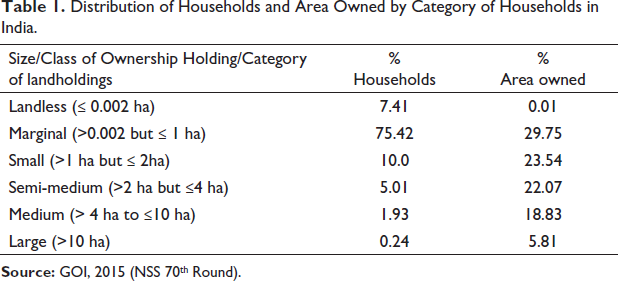
Historically, land distribution was highly unequal and followed inefficient and unjust ownership structures, which lead to its concentration in the hands of few. Post-independence, state governments passed land reform laws, feudal agrarian structures particularly intermediaries were abolished, tenancy was either regulated or abolished and measures were put in place to limit land holdings through ceilings and redistribution of ceiling surplus land (Haque, 2001). But despite these, distribution remain inequitable with 83 per cent of rural households owning just about 30 per cent of total operational holdings (Table 1). As this article focuses on women’s land rights (WLR), further discussion is limited to land rights issues of rural women, for whom land is not only an asset, but a basic need that aid subsistence, a secure base for shelter and a critical asset that enhance livelihoods and capabilities.
Distribution of Households and Area Owned by Category of Households in India.
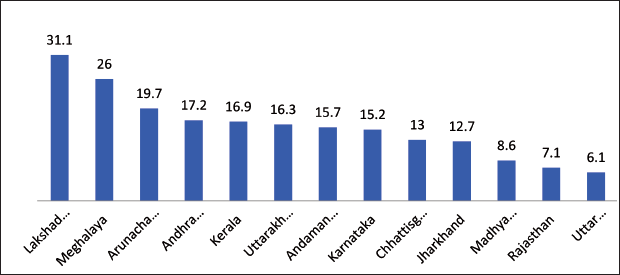
Nationally representative gender-disaggregated data on land ownership are entirely missing in the country. As per the most recent Agricultural Census 1 (2015–2016), women operated approximately 13.9 per cent of operational holdings in the country, which though comparatively higher than that recorded by the ninth Census of 2010–2011 (12.8 per cent) is abysmally low, particularly when we consider women’s participation in agricultural workforce and overall production. The data also indicate that there is variability among regions and states, with women in the Southern states and parts of the North-East operating around 15 per cent land, while those in Northern and Eastern states operated 9.8 and 9.2 per cent of total agricultural holdings. The Southern states like Andhra Pradesh (17.2 per cent), Karnataka (15.2 per cent) and few others are in a comparatively better situation with respect to women’s land rights (Figure 1), may be owing to state specific amendments of the Hindu Succession Act 1956, which made daughters coparceners, and allowed inheritance of agricultural land.
Land and property rights are important towards furthering equality and improving women’s status within households and society. In the context of urban women, ownership to house/dwelling and other movable and immovable property may be more important while for rural women 2 engaged in agriculture on family farms as primary cultivators, formally recognised land ownership rights is critical to avail bank loans and credit. WLR is important in multiple contexts, rural women and agriculture, poverty alleviation, violence against women, and as Agarwal (1994) argues, has implications on welfare, efficiency, and empowerment. The sources of land for women primarily include, direct government transfers, market (by purchase or lease), and inheritance. To enhance women’s land access from all three sources, Saxena (2012) advocates inclusion of their name on land titles provided through government land transfers, provision of credit to purchase or lease in land from the market, and further recommends measures towards raising awareness on inheritance rights and provision of legal support as well as supportive government schemes.
Land rights are particularly important for single women and female-headed households (FHH). The Population Census 2011 data indicate the rising number of FHH with 12.8 per cent of India’s female population as single (widowed, divorced, separated and older unmarried women). Even before, GOI (2011) had recorded that approximately one-fifth of all rural households were de facto female headed due to widowhood, desertion or male migration. In these circumstances, enforceable property rights alone may aid women to build self-reliant households. Studies by Choudhry (2012) and Kelkar (2011) provide evidence with respect to how land ownership improve self-esteem and reduce spousal violence. Further, co-ownership may help women in the event of widowhood, as Agarwal (1998, p.1) emphatically points out ‘effective economic security during widowhood would therefore need securing women’s property rights prior to the event, not only after it, which means securing their claims as daughters in addition to their claims as widows’. Additionally, ownership of assets such as house and land could improve overall welfare not just directly but through better treatment from relatives (Chen, 1998). Also, as Westholm and Ostwald (2020) point out, there may even be a positive correlation with household nutrition and non-farm incomes.
Barriers to Realising Land Rights
The extreme inequality in land distribution in the country remains a major barrier to land ownership for all. Women’s land rights are important for both livelihood security and gender justice, but there are strong arguments against its realisation on ground. Beginning with the question ‘whether rural women themselves want to own land’. Voices demanding land rights for women are few and feeble, but as Agarwal (2003) questions ‘does absence of widespread demand indicate the absence of need’? Land rights has remained elusive for rural women for so long, that they may have got used to the deprivation. As Sen (2003, p. 63) points out
‘the deprived people come to terms with their deprivation because of the sheer necessity of survival, and they may as a result lack the courage to demand any radical change and may limit their desire to what they unambitiously see as feasible’.
The strong social bias against daughters begins before her birth and continue throughout with many parents considering expenditure and endowments a waste with little reciprocal benefit after marriage. Deeply entrenched social taboos against parents turning to their married daughters in the event of an economic crisis, further result in strong resistance towards daughters inheriting family land. Thus, despite amendments in personal laws regarding daughters’ inheritance, many families choose to ignore rather than act on them. Further, the practice of dowry and marriage expenses remain strong impediments to women inheriting parental property. RDI (2009) notes that the payment of dowry or bride price is often considered a daughter’s share of the family asset and hence accepted justification for why daughters should not inherit land equally. Sharma (2017) further gives evidence on how women tend to believe dowry compensate for their inheritance. Studies also indicate that natal family expects women not to demand their share, or rather willingly give up inheritance rights for keeping good relations with their kin (Rao, 2008; also see Jaising, 1997; Kishwar, 1994; Agarwal, 1994). With respect to inheritance by widows, Chen (1998) records that only about half of the widows inherit land and those who do generally become co-owners with adult sons having effective control.
Patrilineal hereditary rights are also sanctioned by personal laws (applicable to each religion) are therefore nullify all formal laws. The formal laws further give way to customary laws in the case of tribal land matters. Even in the cases of land transfers from the State achieved through struggles and petitions, studies have indicated that women have not benefitted much (Brown & Chowdhury, 2002; also see Gupta, 2002). Similarly, for women to gain effective 3 control of land, there are significant constraints, beginning from accessing government systems due to general lack of awareness, low educational attainments, mobility and inherent inhibition.
Policy on Women’s Land and Property Rights
As discussed earlier, there are no accurate data on land ownership by women. Various estimates peg it at 9–13 per cent of all land holdings in India, but these are only approximations. According to the Population Census, the number of women cultivators (main and marginal cultivators) was about 35.9 million in 2011, while concurrent Agricultural Census 2010–2011 indicated 17.6 million holdings as operated by women. A lacuna with the data is the fact that these account for information only pertaining to agricultural land and exclude homestead lands 4 , primarily because they do not exist. Gender-disaggregated data on ownership of homestead land are important, as 41.6 per cent of households in rural India have only a small piece of land surrounding their house. Therefore, there is a need to collect land ownership data by gender and the Digital India Land Records Modernization Programme (DILRMP) is expected to capture gender-disaggregated data, which once completed across states may provide a better picture regarding land ownership by women in India 5 .
Gender concerns and the declining status of women was inconclusively brought out in the Towards Equality report prepared by the Committee on Status of Women 6 . Later ‘women’s land rights question’ continued to surface, quite ‘sporadically’ both in research and grass root peasant movements (Sharma, 1980). The Government of India realising the extent of gender discrimination, in various spheres of women’s lives, shifted its approach from ‘welfare’ to ‘development’ during the Sixth Five Year Plan (1982–1987), and recognised women as economic actors for the first time. Towards their economic empowerment, it was argued that gender-based discriminatory practices should be removed and enabling conditions towards equal access to and control over resources created. Agarwal (2003) further notes that there were changes in policy framework at various levels, particularly, the Government promise that it would ‘endeavor’ to give joint titles to spouses when distributing agricultural land and home sites.
The Ninth FYP (1997–2002) document thus included a section on ‘Gender and Land Rights’, which emphasised the need for land ownership by women, the approach in consonance with the national policy of ensuring empowerment of women through improved access, control and /or ownership of family/ community assets. Subsequently, during the Tenth FYP (2002–2007) the Hindu Succession Act (1956) was amended. The amended Hindu Succession Act (HSA) 2005 deleted a major gender discriminatory clause – Section 4 (2) of the 1956 HSA, which made women’s inheritance rights in agricultural land equal to that of men. Second, it made all daughters, including married ones, coparceners in joint family property. Third, the 2005 Act by deleting Section 23 of the 1956 HSA gave daughters (including married ones) the same rights as sons to reside in or seek partition of the parental dwelling house. However, the amended HSA remain more or less silent on women’s right to land within marriage.
Government redistribution programmes as part of land reforms were mostly gender blind even in the successful states, and land was assigned solely in the name of men alone. Recognising the exclusion of women belatedly, under the Eighth FYP the Central government directed the states to allot 40 per cent of ceiling surplus land to women, and the rest, jointly, in the names of the husband and the wife (Agarwal, 1994, p.7). In states such as Kerala where redistribution was comparatively more successful, rules under the Kerala Land Assignment Act, 1960, were amended in 1997 to make joint pattas mandatory for married people applying for assignment of land [GO (P) No 764/P1/97/RD in GOK 1997].
In order to incentivise registration of property in women’s name or jointly than solely in men’s name, during the Tenth FYP (2002–2007), several states Delhi, Gujarat, Himachal Pradesh, Madhya Pradesh and many others introduced incentives for property purchased by women, commonly either by giving concession or exemption in registration charges/registration duty. Another gender transforming policy was the subsidised housing scheme, the Indira Awas Yojana (IAY/now PMAY), wherein all dwelling units were to be registered in joint ownership of husband and wife, with the wife’s name as the primary owner.
Recent governmental and non-governmental initiatives include direct purchase of land by Society for Elimination of Rural Poverty (SERP) in Andhra Pradesh (AP), and group leasing facilitated by Deccan Development Society (DDS) in AP and Kudumbashree in Kerala towards enabling land ownership or user rights to landless women. Studies by Abraham (2019) and Agarwal (2003) indicate how interventions by kudumbashree in Kerala and the DDS in AP facilitated group leasing of land, thereby improving land access for poor women enabling enhanced income and household nutrition. In a recent study, Reddy (2020) brings evidence on how para-legal assistance strategy through Bhoomi Nyaya Sahaya Kendram initiative, helped poor women to secure land rights and improve status.
Further interventions on a pan India level, both direct and indirect, are required towards expanding women’s ownership of land. In this context, the possibility of tweaking the MGNREGA with respect to enhancing women’s land rights is discussed.
MGNREGA and Works on Private Lands
The MGNREGA, enacted in 2005, is a landmark legislation that guarantees 100 days of wage employment in a financial year to every rural household willing to do unskilled manual work at a predetermined wage 7 . The primary objective of the Act is augmenting wage employment, and therefore, one may wonder how could it possibly become a strategy to enhance women’s land rights? For answering this, it is important to understand that MGNREGA works address causes of chronic poverty and has primarily aimed to improve natural resources management and conservation, has implemented climate change mitigating measures, and has created livelihood generating plantation works, cattle sheds and other assets in rural areas. The list of permissible work under MGNREGA is categorised under A, B C and D of which category B are works on private lands of vulnerable beneficiary households (under paragraph 5). The works include ‘provision of irrigation facility, horticulture plantation and land development activities on land owned by households belonging to the Scheduled Castes (SC) and the Scheduled Tribes (ST) or to Below Poverty Line (BPL) families or to beneficiaries of land reforms, Indira Awas Yojana (IAY) houses, and small and marginal farmers (SF/MF)’.
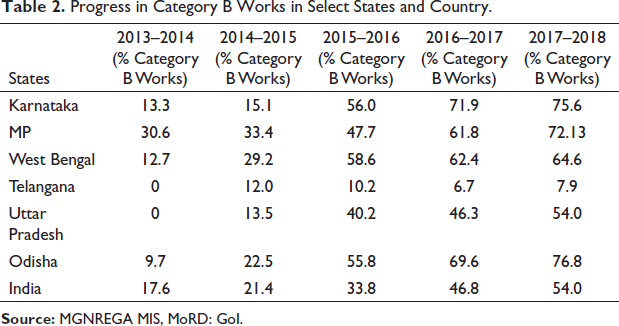
MGNREGA works on private lands are taken up with the objective of enhancing sustainable livelihood generation for individual households. Over the years, its share in total works has increased from 17.6 per cent (out of the total 10.46 million works) in 2013–2014 to 46.8 per cent (out of the total 16.71 million works) in 2016–2017. Within the broad Category B works, there are subcategories, and common works under some of them include creation of infrastructure such as dug wells, farm ponds and other water harvesting structures for improving productivity of land. In addition, there are also works related to horticulture, sericulture, plantation and farm forestry (S/H/P & FF) for improving livelihoods, livestock shelters for poultry, goat, piggery and cattle, storage facilities and promotion of fisheries through developing seasonal water bodies.
It is well recognised that the programme has brought about significant improvement in rural women’s lives through affirmative action stipulating ‘priority to be given to women in the allocation of work in such a way that at least one-third of the beneficiaries shall be women’ (Schedule II, Para 6, NREGA guidelines 2008) and equality with respect to wages. This has ensured women’s participation in the programme even beyond what has been mandated. But, despite the expansion of private land works in recent years, there is no programme data available on the share of private land works completed on land owned by women. It is not surprising that these data are altogether missing for two reasons. First, eligible beneficiary households are treated as a single unit, and second, the issue of ownership by gender was never really thought of as a beneficiary selection criterion in the first place, owing to sociocultural bias and a total absence of gender-disaggregated data on land ownership.
This article primarily uses field data from Karnataka, Madhya Pradesh and West Bengal collected as part of a larger study8 on potentially income enhancing private land MGNREGA works. The selection of states and locations was based on programme data from the MGNREGA Management Information System (MIS). The programme data indicated progress of private land works to be uneven with more than three-fourth of the completed works concentrated in about six states (Table 2). Hence, states, districts, blocks and gram panchayats9 chosen were those that had been most prolific in completing these works during 2013–2014 to 2015–2016. A sample of 3,128 beneficiary households who had received works10 during the period was selected from the list of works completed across 60 gram panchayats and direct interviews were carried out with head or spouse of the head of household. In addition to the quantitative data, focus group discussions (FGDs) with villagers and unstructured interviews with MGNREGA functionaries aided in obtaining a more nuanced understanding of these works.
Progress in Category B Works in Select States and Country.
The beneficiary households in each of the selected gram panchayat was purposively chosen (from the work expenditure list available on MGNREGA MIS), ensuring different types of works (dug wells, livestock shelters, fruit tree plantation works and others). The works were expected to turn into income-generating assets upon completion. Either the head or spouse of the head of household were interviewed with the aid of a structured questionnaire, capturing details on assets, sources of income from farm and non-farm sources, and the impact on income from crop or livestock following the completion of MGNREGA work on their land.
To capture gender dimensions, the study, apart from the gender of the household head, also collected details on ownership of land on which the work was completed through a self-reporting process.
MGNREGA Works Completed on Land Owned by Women
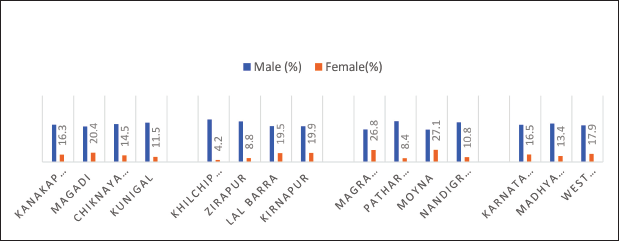
Who got the MGNREGA Private Land Works? The gender of household head of beneficiary households indicated 16.6 per cent to be female-headed households. As even in female-headed households, there is a possibility of land not being owned by women, ownership of land on which the work was completed was examined. It was observed that the land on which the work was completed was either individually or co-owned by women in 16.7 per cent of sample households (corresponded closely to proportion of female-headed households in the sample). Across the study states, in Karnataka, MP and West Bengal, 16.5, 13.4 and 17.9 per cent works were on land owned by women. For the study, self-reported statement from the respondent determined the question of ownership. The variability with respect to ownership of land by gender across study blocks is clear (Figure 2). The specific works completed on land owned by men and women were examined for better clarity on whether there was difference in the type of works received by gender.
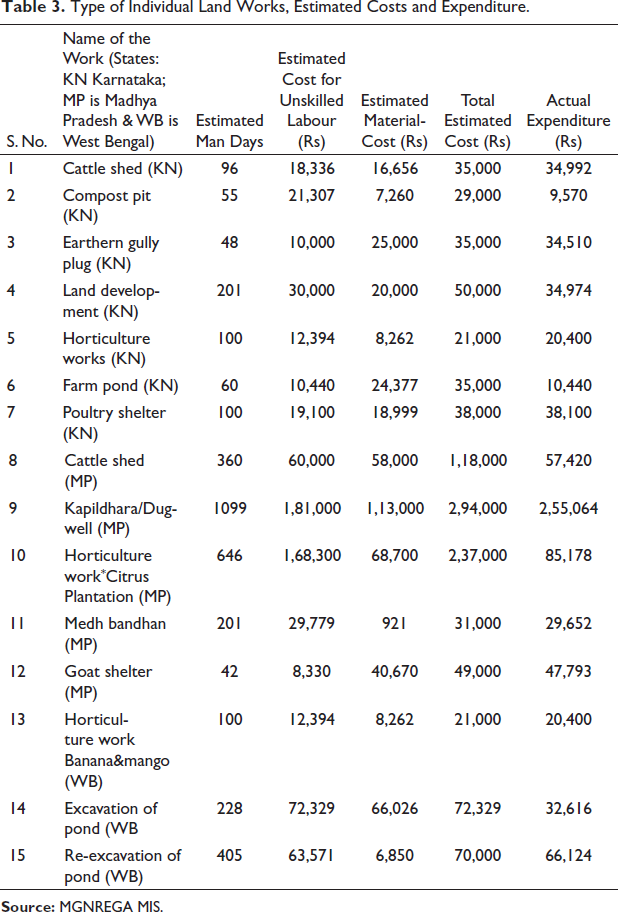
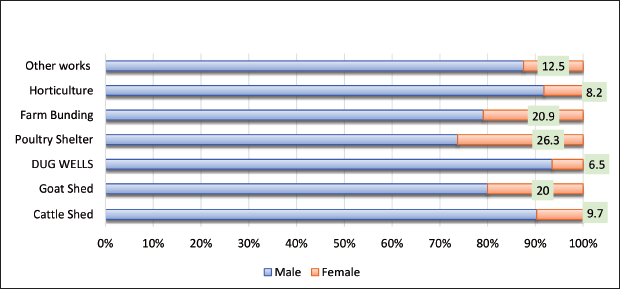
Comparing works completed on private lands with respect to land ownership by gender, it was clear that women did not get a justified share of works. Not only was the numbers low, but also their share in work that had higher expenditures was minimal. The actual expenditure and estimated costs on works varied (Table 3) across states with works such as cattle sheds having very different estimates in MP and Karnataka. It was observed that beneficiary households who received high budget works in the state of MP and West Bengal were mostly headed by men and the land ownership was also in their name. In the case of plantation of fruit trees (mostly citrus orchards), only 8.2 per cent of works were completed on land owned by women (Figure 3). In the case of works such as dug wells in MP, only 6.5 per cent were completed on land owned by women (the Census 2011 data indicate 9.8 per cent single women headed households in the state, indicating disproportionate representation). Dug wells are very important for the overall wellbeing of families and particularly for reducing the drudgery of women, but they did not seem to be receiving their ‘just’ share of the work. Is it because women headed households were land poor that they had only received 6.5 per cent of dug wells and 8.2 per cent of citrus plantation works?
Type of Individual Land Works, Estimated Costs and Expenditure.
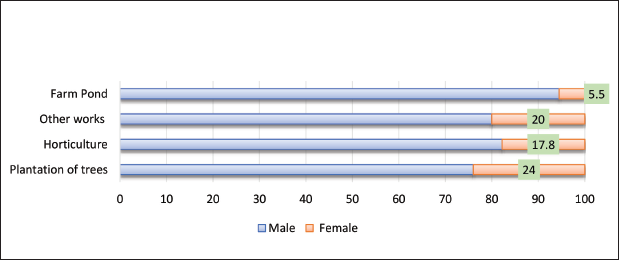
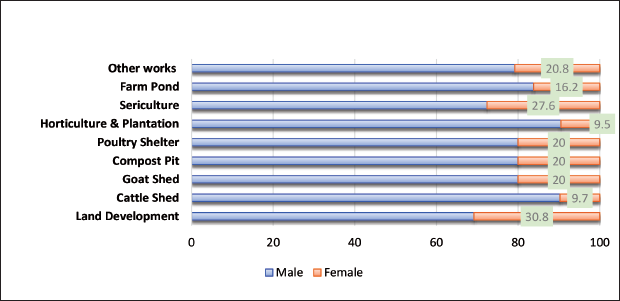
In West Bengal, out of the households that had received fruit tree plantation commonly banana/mango trees on their homesteads, 24 per cent was on land owned by women (jointly/individually). The higher share in the state may owe to the fact that women were recipients of joint pattas/land titles to homestead plots as part of land re-distribution programme10. But it should be noted that while many women received homestead plots here, women’s share with respect to agricultural holdings is one of the lowest in the country. Therefore, in the case of farm pond works which were either re-excavation/new excavation works and required a larger area of land, only 5.5 per cent were on lands owned by women (Figure 4). In Karnataka, overall, 16.5 percent of works were completed on lands singly/jointly owned by women. Within works, they had 27.8 per cent share in works such as sericulture, one of the higher expenditure works, indicating women here were in a better position with respect to receiving higher expenditure MGNREGA works than the other two states (Figure 5). In the following section, we look at how MGNREGA works may be used as an indirect policy push to further the cause of women’s land ownership, but before that a brief on how the programme has helped rural women in general is discussed.
Overall Impact of the Programme on Rural Women
MGNREGA no doubt is a landmark legislation, which has brought some improvement in rural women’s status through two major clauses. The first is the affirmative action stipulating ‘priority to be given to women in the allocation of work in such a way that at least one-third of the beneficiaries shall be women’ (Schedule II, Para 6, NREGA guidelines 2008). Over the years, this has led to improved participation by women in MGNREGA with more than 50 per cent of all wage work done by them. The second is the stipulation of equal wages to all workers for similar work, which has improved not just wages, but even the status of rural women as workers.
Studies indicate that the programme has improved wages for rural women through its provision of ‘equal wages’, which has also reduced wage gaps between male and female workers (Shah & Makwana, 2011). MGNREGA has set a reservation wage (GOI, 2012; Gulati et al., 2013) and reduced distress migration (Das, 2014; Kareemulla et al., 2009; Kumar & Prasanna, 2010). However, studies have reported insufficient workdays, delayed wage payments and comparatively low wages (IEG, 2018) and even over representation of single women (Carswell & De Neve, 2013, p. 87). However, while data on participation of women in wage work are available on MGNREGA MIS, gender-disaggregated data on works completed on private lands, or what proportion of works are being completed on land owned by women is completely missing. With private land woks increasing in the total work carried out under MGNREGA, it becomes imperative to know on whose land are the works completed.
Expanding Women’s Land Rights: Can we Tweak Policy?
In the previous section, we had examined MGNREGA private land works and ownership of private land by gender. It is clear that both with respect to number of works and works with higher expenditures, majority were completed on land owned by men. The gender-wise difference may primarily owe to the fact that land is mostly in the name of men, but may also indicate exclusion of women, particularly in works with higher expenditures.
Policy Changes—MGNREGA & Land Administration
While there is reservation for women with respect to wage employment, there is none with respect to works on private lands, except a clause on priority to single women headed households.
Insertion of a clause regarding land ownership with respect to private land works, in specific reservation of 50 per cent of all works on private land to be on land which is individually/jointly in women’s names, could be a huge policy push towards expanding women’s land rights. In addition, it may also be a proactive step towards achieving the SDG goal 5a. Within the reservation of 50 per cent, 20 per cent works may be on land owned by single women/disabled women, while the remaining 30 per cent may be women having joint (with men) ownership of the land. Subsequently, this clause may be expanded making it mandatory for all category B works on private lands to be on land that is jointly/individually owned by women.
Given the scale and reach of MGNREGA, such a clause may have a significant influence, as eligible beneficiary households for private land works also include small and marginal farmers thus covering over 80 per cent of rural households. More importantly, the measure would open up a path for women to gain access to land within the marital household.
The implementation of such a clause in MGNREGA would be challenging, as it would require political will and substantial co-operation and collaboration of MGNREGA implementation machinery (state–district–block) with land administration departments and structures from state to district and panchayat levels. It may also require extensive support from community-based organisations such as self-help groups, and other non-governmental organisations to work at the village and panchayat level to educate and sensitise communities. Awareness generation campaigns, and communication content and strategies may also be formulated sensitively so that opposition from men would be minimum. The communication strategies should be aimed to win the men over, such that they acknowledge the fact that women’s formal rights to household land would only improve overall family well-being.
As conversion of land titles owned by the household from single to joint ownership involve many difficulties, processes involved should be simplified and re-registration 11 fees in these cases waived off. Waiving off the re-registration fees is critical, as the fees may not be affordable for many small and marginal farm households and may hold back men who want to give joint ownership of the land to their wives. Therefore, we strongly recommend that for all MGNREGA households who may approach the panchayat office to register any adult women in their household as co-owners of household land, the registration fee should be completely waived 12 off. Another important aspect is to sensitise staff as well as improve women’s representation within land administration institutions such as the panchayat office, titling and land registration offices, so that they are not only aware, but also sensitised about women’s land rights issue that they may in turn become women’s land rights champions.
In Conclusion, the article reiterates that expanding women’s land rights, particularly ownership rights require addressing stubborn patriarchy and age-old hereditary customs and socio-cultural norms. In addition to enabling legislations, political will and support from executive arms of numerous ministries, the cause may require approaches that are indirect and subtle. Despite progressive policy initiatives, women’s ownership and stable user rights to land remain low with an absence of reliable data obscuring what progress has been made on expanding share of women among owners or rights-bearers of agricultural land by type of tenure.
For expanding poor women’s land rights from the market, group/collective leasing may be the best option. Legislations towards legalising land leasing and innovations from land administration and governance systems towards ensuring benefits from government 13 is received by tenants, can alone, create stable and equitable land access rights to landless and land poor women. Enhancement of women’s ownership rights to land, particularly hereditary rights and rights to property in the marital household are critical to expanding women’s land rights in the country, and this would require a number of sustained measures. These would need continuous sensitisation campaigns towards socio-cultural changes, including promoting male ‘champions of change’ to work in communities (across religious groups, as women’s right to land is determined by personal laws) for changing the mind-set regarding property and land rights which has largely been reserved for men.
Further, it is critical for the government to play an important role in championing women’s land rights. All Government assignment land/grant for purchase of land/concession or waiver of stamp duties for registration should be given only when women are individual/joint beneficiaries. It is well known that poor women’s ownership of pucca houses improved with the IAY/PMAY scheme of the government, which specified these houses to be given in the name of women.
Similarly, we believe women’s land rights may be enhanced through MGNREGA by tweaking policy pertaining to private land works. We have suggested 50 per cent reservation of all works on private lands to be on women owned land towards expanding women’s ownership rights to land. Given the scale of MGNREGA, this change would be a big policy push and could have a huge impact on expanding women’s land ownership in the country.
Footnotes
Declaration of Conflicting Interests
The authors declared no potential conflicts of interest with respect to the research, authorship and/or publication of this article.
Funding
This article is from insights drawn from a larger project undertaken by the authors, which received funding support from the National Institute of Rural Development & Panchayati Raj (NIRD&PR), Hyderabad.
