




Abstract
This article explores Muslim political attitudes in contemporary India. It contextualizes the political responses of Muslim communities in the backdrop of two crucial legal-constitutional changes introduced by the Bharatiya Janata Party (BJP) government: the abrogation of Article 370 of the Constitution and the Citizenship Amendment Act, 2019. These changes, I suggest, stem from the official doctrine of New India and its operative mechanism, Hindutva constitutionalism. Analysing the nature of Muslim participation in the anti-CAA (Citizenship Amendment Act) protests and Muslim electoral responses in two subsequent elections (Delhi Assembly Election, 2020 and the Bihar Assembly Election, 2020), I argue that political engagement of Muslims could be interpreted as an ever-evolving discourse, which not merely responds to Hindutva politics but also asserts its relative autonomy.
Introduction
This article makes an attempt to understand Muslim political attitudes in contemporary India. It contextualizes the political responses of Muslim communities against the backdrop of two crucial legal-constitutional changes introduced by the Bharatiya Janata Party (BJP) government: the abrogation of Article 370 of the Constitution and the Citizenship Amendment Act, 2019. These structural changes, the article shows, underline a new form of politics. I describe this phenomenon as Hindutva constitutionalism and explore its intrinsic relationship with the official doctrine of New India. The article looks at the nature of Muslim participation in the anti-CAA (Citizenship Amendment Act) protests and the Muslim electoral responses in two subsequent elections (Delhi Assembly Election, 2020 and the Bihar Assembly Election, 2020) to figure out the possible linkages between Hindutva constitutionalism and Muslim political attitudes.
The article, more broadly, responds to the recent intellectual debates on the survival, decline and even the deaths of democracies. 1 Exploring Muslim political attitudes as a serious point of reference, it tries to map out the Muslims’ imaginations of Indian democracy. This exploration is useful to evaluate the dominant media-driven claim that radical Hindutva majoritarianism has forced Muslims—the most vulnerable minority—to give up politics of all kind (Menon, 2019). I find this position empirically wrong and analytically misleading. The article suggests that Hindutva politics has not yet succeeded in determining the Muslim engagements with politics at various levels. Active Muslim participation, especially in the realm of Hindutva dominating electoral politics, encourages us to pay serious attention to the everyday meanings of democracy in India. 2
Terms like ‘political participation’ and ‘electoral behaviour’ are often used interchangeably to explain different formulations about Muslim political attitudes. Muslim participation as a positive feature is evoked to celebrate India’s adherence to plurality, inclusiveness, and democratic constitutionalism. It is argued that active involvement of Muslims in democratic processes—mainly in electoral politics—demonstrate that India’s minorities do not feel isolated and marginalized. 3 However, there is a negative imagination of Muslim political participation. Muslims are seen as a politically conscious community, which is supposed to be fully aware of its communal interests. Hence, they participate in politics to bargain with the state for the protection of their collective, communal and eventually separatist interests. 4
These two conflicting interpretations of Muslims’ engagement with politics, interestingly, rely on a strong assumption that Muslim political attitudes have been homogeneous, consistent, and static and–precisely for this reason—it should always be analysed in relation to larger questions of Indian politics such as the success of democracy 5 and/or the threat of separatism/communalism. 6 As a result, Muslim political attitudes emerge as an analytically uncomplicated and politically self-explanatory phenomenon. The article attempts to address this conceptual issue. 7
I use the term Muslim political attitudes to describe the highly diversified and even conflicting opinions and values Muslim individuals/communities hold about contemporary political debates (such as nationalism and Hindutva), critical events (such as lynching and communal riots), and influential personalities (such as Narendra Modi, Amit Shah, and Asaduddin Owaisi) that determine their political actions in different contexts. More precisely, I invoke two related formulations—political participation as interaction and political participation as instrumental action—to map out the contours of Muslim political attitudes. 8
Participation as interaction is about the ways in which Muslims as citizens interact with other citizens and groups, respond to public debates, and assert their opinion, anxieties, and criticisms. This notion of participation envisages Muslims as active political actors who participate in political/public activities as citizens with or without adhering to their Islamic belief and/or constitutionally recognized status as a religious minority. 9 I examine the nature of the Muslim presence in the anti-CAA protests as an example of this form of political participation.
Participation as instrumental action, on the other hand, introduces us to a more formal form of political action. Muslims, like other social groups, take part in political processes, especially in elections, as stakeholders to secure certain material benefits. They behave like consumer/clients and respond to the welfare packages offered by the political parties. 10 The elections, in this schema, turn out to be the most visible arena of politics where Muslim participation could easily be identified. However, the interaction between Muslim communities and the state in different regional and local contexts and numerous ‘survival strategies’ evolved out of it also produce different forms of participation, which may legitimately be called ‘instrumental action’. 11 Analysing these two forms of Muslim political action, the article argues that Muslim communities certainly respond to the challenges posed by the Hindutva hegemony. However, their political attitudes cannot be interpreted merely as a reaction to it.
The Context: New India, Hindutva Constitutionalism, and Hindutva Hegemony
The doctrine of New India is a well worked out ideological framework. It was first introduced as a political slogan by Prime Minister Narendra Modi in his Independence Day speech of 2017. 12 Highlighting the need to have a positive outlook, Modi argued: ‘If each one of us…strives with a new resolve, a new energy, a new strength, we can change the face of the country with our combined strength in the 75th year of our independence in 2022’. 13 The BJP formally accepted the idea of New India as a political principle in 2018. 14 This formal recognition led to an official campaign to seek citizens’ participation in this initiative. The NITI Aayog brought out an interesting document, Strategy for New India@75, which outlines a policy framework so as to translate the doctrine of New India into a workable action plan. 15
Narendra Modi’s official website (Retrieved August 29, 2020, from
This is an interesting pledge. Citizens are expected to support and participate actively in the official programs such as Swachh Bharat, Accessible India, and a cashless economy. On the other hand, the government does not take any responsibility to provide employment to citizens. In fact, seeking employment as a right is strongly discouraged. The citizens are told that job-creation is not a duty of the government. The last theme of the New India pledge reiterates this point more sharply. It says: ‘I will be a job creator not a job seeker’.
The state in New India, in this sense, seems to assert itself as a sovereign entity to work on behalf of the citizens in the sphere of politics; while, at the same time, it keeps itself away from economic sphere and does not take any responsibility on behalf of citizens. For Modi, ‘New India is the era of responsive people and responsive government’. 16
To understand the political implications of this responsive government-responsive people formulation, we have to look at the ways in which the doctrine of New India is linked to what I call Hindutva constitutionalism.
There can be two meanings of term constitutionalism. In a rather technical sense, constitutionalism refers to the norms and principles that not only create state institutions (legislative, executive and judicial powers) but also impose certain limits and curbs on them. Hence, constitutionalism as a positive principle reminds the political elites to follow the legal limits set out by the Constitution. 17 However, there is a political meaning of constitutionalism in the Indian context that has evolved over the years. 18 The ideologically divided political class of the 1950s somehow accepted the Constitution as the fundamental reference point to participate in the formal electoral politics. Yet, there was a strong apprehension about the success of the Constitution in the Indian context. Jayaprakash Narayan’s famous book A Plea for the Reconstruction of the Indian Polity (1959) is an example of this political anxiety. On the one hand, this led to an interesting ideological churning. political parties relied heavily on the language of constitutionalism in the realm of electoral politics. On the other hand, they continued to evolve different ideologically suitable interpretations of the Indian Constitution. This intellectual engagement with the Constitution actually paved the way for various kinds of ideologically oriented and politically feasible constitutionalism. The Hindutva constitutionalism is one such political form. 19
It is important to remember that Hindutva groups never envisaged the Constitution as a self-explanatory text. In the post-1990 period when every political party, including the left groups, started celebrating the Indian constitution as the ultimate symbol of Indian democracy, the Rashtriya Swayamsevak Sangh (RSS) and BJP continued to have a critical engagement with it. Even the Vajpayee government constituted a committee to evaluate review the working of the Constitution (The National Commission to Review the Working of the Constitution (NCRWC) also known as the Venkatachaliah Commission). 20 The BJP, however, changed its attitude in the 2010s. The party started employing the potentials of the Constitution for its Hindutva politics in two significant ways.
First of all, the Constitution was transformed into as a sacred political object. As the Prime Ministerial candidate of the BJP, Narendra Modi began his 2014 election campaign with a bold declaration that Constitution is a ‘holy book’ and the only code of conduct of the government should be ‘Sab ka Saath, Sab ka Vikas’. 21 This fascination with the Constitution as a sacred political object took a more formal shape after the success of BJP in the 2014 election. In October 2015, the Modi government declared that 26 November, the day when the Constituent Assembly adopted the final draft of the Constitution in 1949, would be celebrated as the Samvidhan Divas every year. In a speech dedicated to the greatness of the Constitution, Modi went on to say that ‘if there is any creation made by man, which is immortal, it’s India’s Constitution’. 22
There was another very crucial and thoughtful move by the BJP leadership. Senior BJP leaders, especially Narendra Modi and Amit Shah, did not use the expression Hindutva to describe the nature of their politics. Unlike L. K. Advani or A. B. Vajpayee, who celebrated Hindutva as a reflection of cultural nationalism, Narendra Modi always stays away from any direct discussion on this issue.
23
The speech he delivered on 3 December 2018 in Rajasthan is the best example to underline this point. Responding to Rahul Gandhi’s allegation that Narendra Modi did not have true knowledge of Hindutva, he replied the following:
He says Modi has no knowledge of Hinduism. Oh brother, is it an electoral issue? …Rajasthan needs to vote on the issues such as electricity, roads, and water. It has nothing to do with Modi’s knowledge of Hindu; I don’t understand this…. However, I will definitely say that our culture is a storehouse of knowledge…and Hindutva…is a rich heritage. This Hindutva, this Hindu knowledge is so profound…so vast, and so ancient…it is higher than the Himalayas and deeper than the sea. No one can claim that he or she has complete knowledge of it. Even the sages never claimed to have full knowledge of Hindu and Hindutva. I am very small man and I do not claim to have such a vast knowledge.
24
Modi does not find it logical to compare Hindutva with material/developmental issues. Even he does not make the conventional argument that Hindutva is a way of life and it has nothing to do with politics. Modi actually conceptualizes Hindutva as an uncontested, neutral and self-evident cultural expression of Indian identity. In other words, Modi, unlike Advani, does not express regret that Hindutva is misunderstood or eventually linked to the BJP’s politics. Instead, he confidently asserts that there is no need to discuss Hindutva in the realm of politics as it has become a new political commonness. This strong claim might have been the reason why the BJP officially disowned Hindutva as its core political philosophy after 2012. 25
These two moves—Hindutva as an acceptable cultural idiom and the Constitution as a sacred political object—have actually constituted the Hindutva constitutionalism: a political mechanism that is created to achieve responsive people and responsive government thesis. 26
Three core features of Hindutva constitutionalism are relevant for our discussion. First of all, there is a strong adherence to legal technicalities to articulate a politically favourable position. Hindutva groups make a crucial distinction between the political-philosophical principles that the Constitution invokes (such as secularism, rule of law, liberty and rights) and the legal technicalities associated with them. Constitutional principles are celebrated as fixed, settled, and static ideals, while the legal technicalities are seen as a matter of concern, which need to be amended and nationalized.
27
This framework helps the Hindutva groups, especially the BJP, to emphasize on the rights of the state and Fundamental Duties of the citizens. This is precisely what Narendra Modi calls a paradigm shift. He argues the following:
For some reason everything was centered around (sic) rights. Everyone was concerned with rights. This is an opportunity whereby we can ensure a paradigm shift within the country by carrying it towards duties from rights. The responsibility of the people’s representatives is also to awaken the people’s conscience and to lead the way.
28
Emphasis on a refined and more profound idea of minority—not majority—is the second feature of Hindutva constitutionalism. In the last six years, Hindutva groups have tried to appropriate the idea of minority to legitimize the Hindu victimhood argument. 29 Public Interest Litigation (PIL) filed in the Supreme Court in 2017 by a BJP leader demanded that Hindus must be declared a minority in nine states (Lakshadweep, Mizoram, Nagaland, Meghalaya, Jammu and Kashmir, Arunachal Pradesh, Manipur, and Punjab). The suit claimed that the minority rights of Hindus are ‘being siphoned off illegally and arbitrarily to the majority population because neither Central nor the State Governments have notified…Hindus as a “minority” in these states’. 30 The CAA 2019 also extends the scope of this legal claim. By highlighting the persecution of Hindu minorities in Muslim states, this law seems to underline the old RSS argument: the Hindu majority in India is insignificant because India is surrounded by Muslim majority states. 31 To address this problem of numbers, Hindutva groups offer a simple yet highly provocative solution. It is suggested that majority–minority distinction must be abolished so as to create a national political community of citizens. The slogan development for all and appeasement of none actually stems from this refined Hindutva imagination.
Finally, Hindutva constitutionalism recognizes the one nation-one Constitution as the foundational principle of its politics. Instead of relying entirely on the conventional Hindu nationalist argument that Kashmir—a Muslim majority state—should not have any special status, the Hindutva groups propose a refined legal explanation. It is asserted that while the other provisions of the Constitution are fixed, permanent and consistent, the Article 370 is an unwanted and useless addition to it. The political determination of BJP and the strong will of Modi-Shah, according to this line of reasoning, have been instrumental in achieving the one nation-one Constitution framework. 32 It is worth noting that the Presidential order that revoked the special status of Kashmir is called the Constitution (Application to Jammu and Kashmir) Order, 2019.
We must remember that the Hindutva constitutionalism does not exist only as a political-ideological mechanism; it also functions as a political hegemony. 33 The responses of the opposition parties on CAA and Article 370, especially in the Rajya Sabha, underline the dominance of Hindutva hegemony in the realm of electoral politics (Ahmed, 2020). This wider acceptability of Hindutva also contributes to the changing patterns of social interactions. Does it mean that Hindutva has emerged as the dominant template for defining India’s national identity? Let us take an example to elaborate this point.
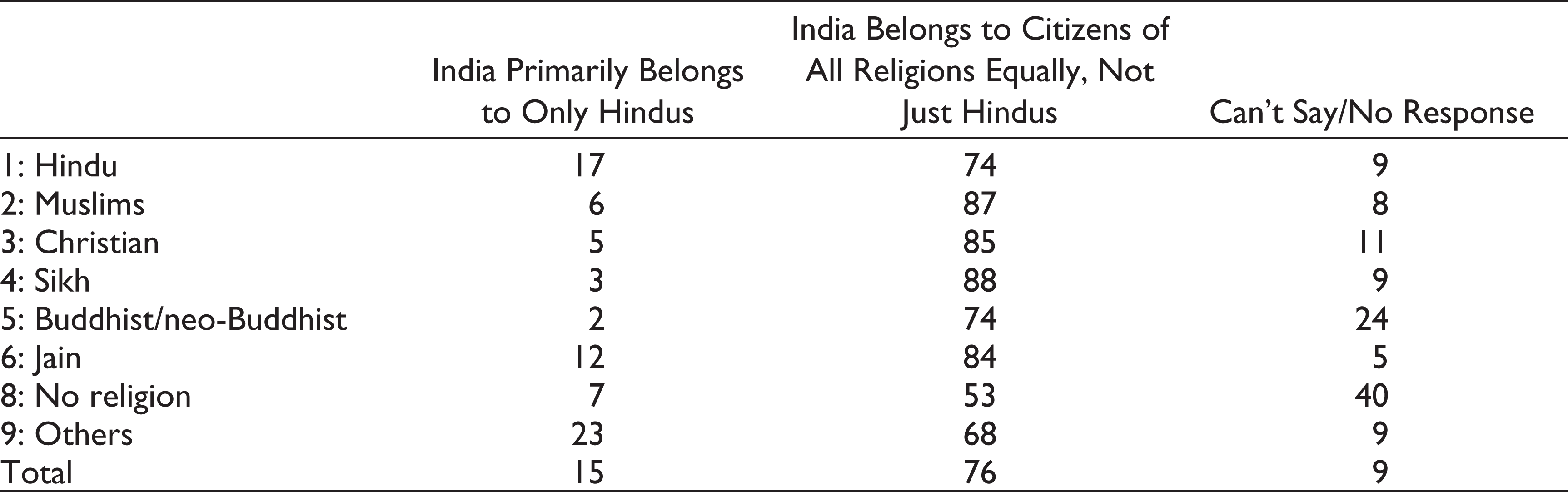
The National Election Study (NES) conducted by CSDS-Lokniti, in April–May 2019, shows that an overwhelming majority of respondents supported the argument that India does not belong only to Hindus. In fact, 74 per cent of Hindus clearly rejected the Hindutva propaganda that India is a natural Hindu homeland. On the other hand, only 6 per cent Muslims appear to have lost faith in the secular promise that India belongs to citizens of all religions (see Table 1).
India Belongs to Whom?
However, the Delhi assembly election, 2020 survey (pre-poll) introduces us to a very different set of opinions. This survey was conducted in January–February 2020, when the anti-CAA protests were going on throughout the country and Delhi’s Shaheen Bagh had become the epicentre of this politics of protest. Table 2 shows that a majority of respondents supported the CAA and NCR. In fact, one finds a clear communal divide on this issue. Almost 80 per cent of Muslim respondents opposed the CAA-NRC; while the majority of Hindus (62 per cent) did not find any problem with these issues.
CAA/NRC and the Hindutva Hegemony

These apparently conflicting responses underline the complex configuration of Indian public life. The rise of aggressive anti-Muslim Hindutva discourse has not yet affected the belief that Indian belongs to all religions and communities. Nevertheless, there is growing communal polarization on virtually all contentious political issues. 34 Muslim political attitudes, therefore, should be seen in the backdrop of this complex political reality.
The Protest: Participation as Interaction
The success of BJP in 2014 contributed significantly to the revival of an aggressive anti-Muslim Hindutva politics. The Hindutva groups and a section of pro-BJP media initiated a new discourse of nationalism. Every aspect of social and cultural life of Muslims in Indian was transformed into an unsolvable civilizational conflict between Hinduism and Islam. Issues such as the cow protection movement, protection of Hindu girls from love-jihad, Muslim population growth, the Ram temple in Ayodhya and ban on triple talaq/introduction of UCC were the constitutive elements of this Hindutva driven discourse of nationalism. This aggressive propaganda led to a new kind of violence against Muslims—lynching, molestation, and even rape. Despite this hostile anti-Muslim attitude, Muslim communities did not get involved in any anti-Hindutva counter mobilization. Religious organizations, Muslim pressure groups and even Muslim political leaders (except a few unknown faces, who appear on primetime TV every night!) did not call upon Muslims to launch any mass protest. 35
However, this was not the case with the CAA. Unlike the Babri Masjid case and the triple talaq law, which had already lost the political potential to provoke Muslims, the CAA/NRC posed a direct challenge to the political existence of Muslims as legitimate citizens (Ahmed, 2020). Muslims Communities reacted to it more sharply. There were a number of Muslim-led protests throughout the country against the CAA/NRC. Although this Muslim assertiveness did not get any concrete formal-organizational shape, the violent and even brutal reaction of the state towards Muslim activists in later months underlines the political significance of these protests. 36 Three broad facets of these protests are relevant to highlight a particular form of Muslim political attitudes: participation as interaction. 37
The non-party character of anti-CAA protests is the first distinctive aspect of Muslim assertions against CAA. Muslim campaigners, it seems, drew inspiration from grassroots politics and people’s movements (such as movement against displacements, Dalit/Adivasi movements and the farmers’ agitations and so on) in two significant ways. They identify the Constitution as a legitimate political source for asserting their citizenship status. The liberal values of the Constitution, especially the Preamble, were creatively interpreted to question the disruptive agenda of the government. At the same time, an attempt was made to represent the anti-CAA protest as a non-party political agitation. This conscious move helped the protestors to get rid of the BJP versus Congress framework. It also allowed them to portray the anti-CAA protest as an inclusive movement for social change. 38
The invocation of national symbols is the second aspect of anti-CAA protests. The national anthem, the national flag and even the Constitution were not merely seen as intellectual resources. Muslim protestors also used them as political symbols. It is worth noting that this creative reinterpretation of national symbols is a relatively new phenomenon in Indian politics. The anti-corruption movement of 2011 was the first major political event when official national symbols were recognized as legitimate source of political agitation. Muslim protestors, however, expanded the scope of this symbolism. Photographs of Ambedkar and Gandhi were placed side by side along with the copy of the Constitution; religious texts—Bhagwat Geeta, the Quran, the Bible and the Guru Grath Sahib—were recited in order to assert the postcolonial sarvdhramsambhav tradition; havan were organized for communal harmony; and the national anthem was sung on the stairs of the historic Jama Masjid in Delhi. This creative rearticulating of symbolic nationalism takes us beyond the given imaginations of Muslim political identity. The Muslim communities, who are often treated as religiously inward looking and politically untrustworthy, seem to reassert the point that their Muslimsness is an inseparable part of their Indian identity.
The refined idea of political representation is the third aspect of Muslim assertiveness. The Muslim protestors were not led by any particular Muslim organization or individual. It is true that the Hyderabad based All India Majlis-e-Ittehad-ul-Muslimeen (AIMIM) organized a number of protests against CAA and Muslim religious bodies such as the Jamiat-Ulama-e-Hind and Jamat-e-Islami Hind have been very critical of this law. However, these established Muslim organizations were not given any formal recognition. Muslim protests, in this sense, redefined the idea of representation in two possible ways. First, it was asserted, in fact rather stridently, that political anxiety associated with CAA and NRC should not necessarily be represented exclusively by Muslim politicians. The presence of Dalit leaders, and Sikh religious leaders in the Muslim dominated anti-CAA protests throughout the country demonstrated the fact that Muslim communities refused to make the CAA an exclusive Muslim issue. Secondly, and perhaps most importantly, Muslim women—who were always depicted as victims of Islamic patriarchy—led these protests. The active participation of ordinary Muslim women in sit-ins and demonstrations as well as their vocal critique of the citizenship law underline a new form of Muslim self-representation—the idea that challenges the authority of Muslim leaders (primarily male) to speak on behalf of common Muslims. 39
The Voting: Participation as Instrumental Action
Let us now examine the other form of Muslim participation, which I describe as instrumental action. Muslim voting patterns in two crucial assembly elections (Delhi and Bihar) that took place in 2020 immediately after the massive nationwide protests against CAA/NRC are very relevant in this regard. Muslims not merely participated in these elections as enthusiastic voters but also responded positively to the competing electoral agendas offered by different political parties at the state level. Interestingly, Muslims did not vote as a homogeneous community of voters in Delhi and Bihar. This political heterogeneity, especially in the realm of electoral politics, requires a systematic unpacking.
The timing of the Delhi Assembly Election, 2020 was very crucial. This was the first election after the enactment of CAA and the abrogation of Article 370. It is worth noting that the BJP had already decided to invoke the CAA/NRC debate as an important electoral issue in this election. An aggressive election campaign led by the Home Minister Amit Shah was launched. The anti-CAA protesters were described as irresponsive, anti-national elements and the voters (read Hindus) were asked to give them a fitting reply. 40 It was clear that the BJP was primarily interested in communal polarization and wanted to create a clear political dived between Hindu and Muslim votes. The AAP, however, adopted a different strategy. It virtually remained silent on the CAA/NRC issue. Although AAP MLAs and various leaders associated with it continued to take part in the anti-CAA protests, the party did not make any clear statement on this issue. The party identified civic governance—education, health and city infrastructure—as a preferred mode to mobilize voters.
The election results were astonishing. The AAP won 62 seats with a vote share of 53 per cent. The BJP, on the other hand, could only win eight assembly seats. However, party’s vote share (38 per cent) increased rather significantly.
Despite AAP’s ambivalent and virtually unclear stand on CAA/NRC, the party was able to win all five Muslim dominated seats very comfortably (Table 3). This overwhelming Muslim support for the AAP might be interpreted as an obvious reflection of Muslim resentment against the BJP. One may argue that Muslim communities were already resisting the imposition of CAA/NRC and the Delhi assembly election gave them an appropriate opportunity to support AAP. The anti-BJP attitude, the argument goes, might have forced Muslims to ignore AAP’s dubious stand on the abrogation of the Article 370 and CAA/NRC. 41
AAP’s Performance in the Muslim-Dominated Constituencies
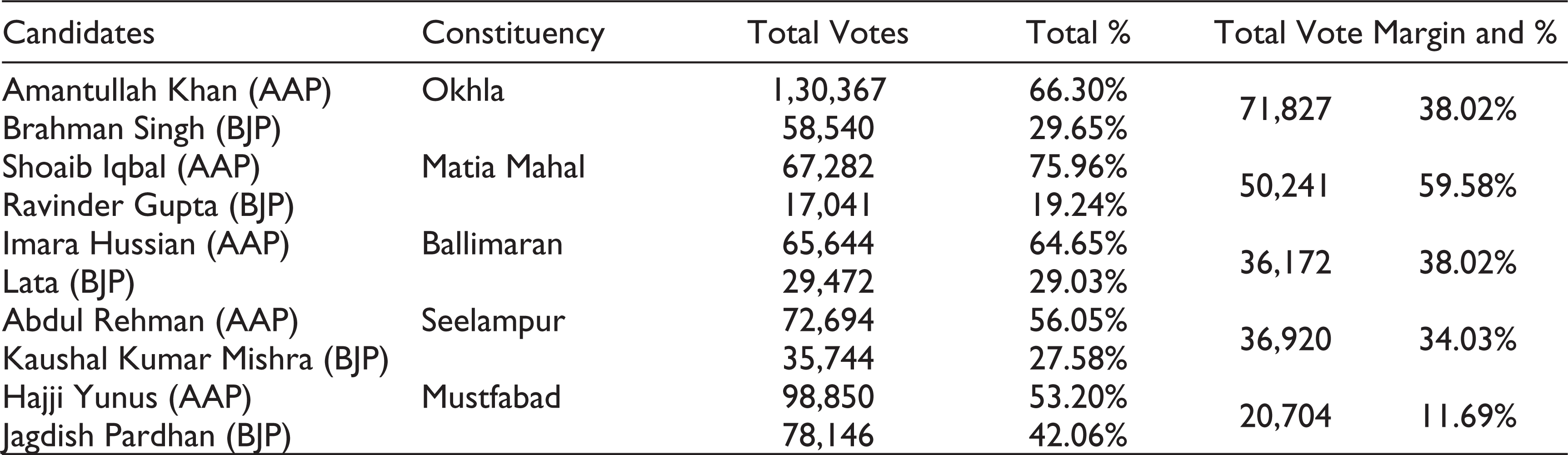
Although there is a merit in this line of reasoning, Muslim voting patterns cannot be entirely reduced to anti-CAA protests or any possible form of anti-BJPism. The AAP emerged as the most viable political option for the Muslim voters of Delhi since it was a bipolar contest (and the BJP had already made it clear that it was not interested in Muslim votes). However, there were other important issues as well that influenced the Muslim voting patterns in this election.
As pointed out earlier, governance and development were the main issues in the Delhi election (Table 4). The performance of the AAP in the field of healthcare and education had been very impressive and the party was keen to capitalize on it. This agenda of good governance/development attracted the majority of voters, including Muslims (Table 5). The AAP, in this sense, had actually become the first political choice for Muslim voters in Delhi. The CAA/NRC debate further consolidated the AAP’s position. It was obvious for the Muslim voters to give overwhelming support to AAP—not only to recognize the value of governance-centric agenda but also to assert their voter-citizen identity.
Importance of Governance/Development for Delhi Voters

Muslims’ Satisfaction with AAP

The Bihar Assembly Election, 2020 offers us a very different picture. Governance, in the wake of COVID-19, emerged as the main political issues. The National Democratic Alliance (NDA) of BJP-Janata Dal United (U) evoked the slogan of good governance simply to capitalize on the established image of Nitish Kumar as Sushasan babu (leader committed for good governance). On the other hand, the Mahagathbandhan (Grand Alliance) of Rashtriya Janata Dal (RJD), Congress, and the Left parties raised the issues of governance rather differently. They highlighted the nature of unemployment in the state and the impact reverse migration after the pandemic.
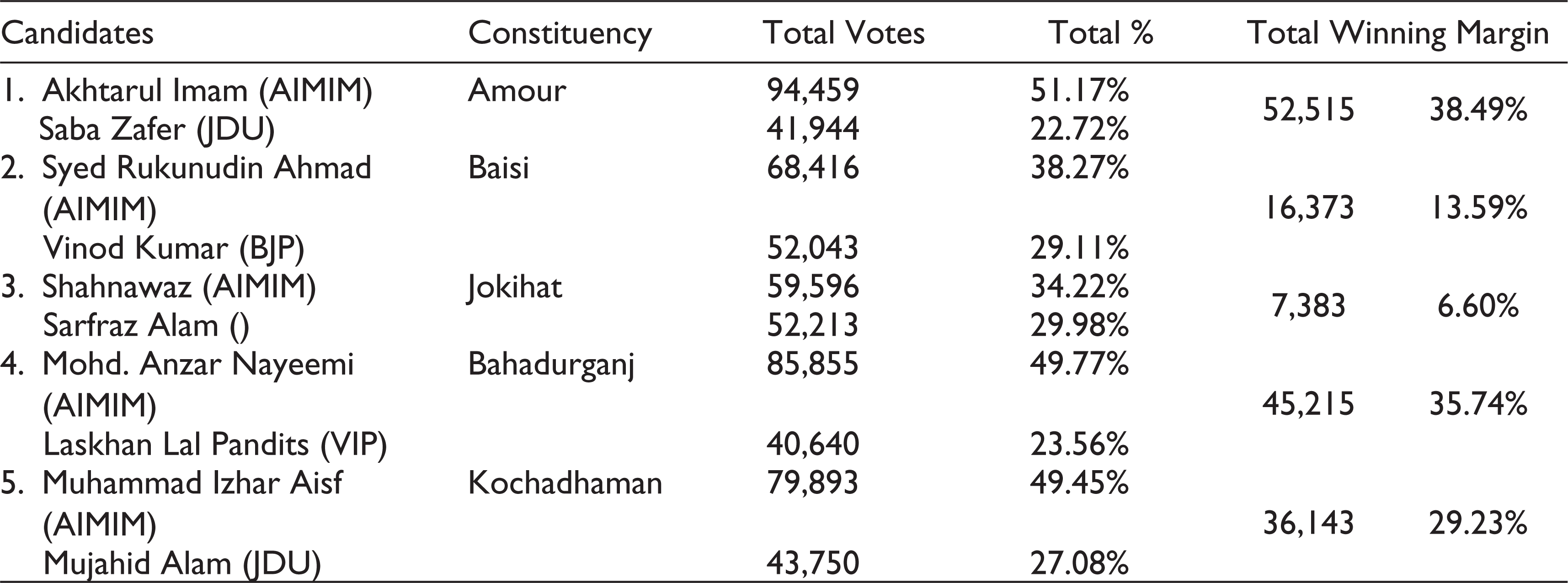
The NDA won 125 seats (with a vote share of 37.26 per cent) and formed the government. The BJP’s performance was very impressive. The party established itself as the leading player in Bihar politics by winning more seats (74 seats with a vote share of 19 per cent) than its partner JD (U) (43 seats with a vote share of 15 per cent). The Mahagathbandhan also performed well. It won 110 seats (with a vote share of 37.23 per cent). However, rise of the Hyderabad based AIMIM was the most perceptible aspect of this election. The AIMIM won the five Muslim dominated constituencies in the Seemanchal region (with a vote share of 1.24 per cent at the state level). The rise of AIMIM was seen as a reflection Muslim resentment against BJP/JD(U) as well as RJD/Congress. It was argued this trend would lead to communal polarization in north India. Let us look at the Muslim voting patterns in a systematic manner to understand the limitation of this kind of media-driven political explanations.
The CSDS-Lokniti Bihar 2020 (post-poll) survey demonstrates that a majority of Muslim voters supported the Mahagathbandhan candidates in the state. Three-fourths of the Muslim vote went to the RJD-led alliance. However, the AIMIM secured a high share of Muslim votes in the Seemanchal area. This division of Muslim votes is inextricably linked to the sociological profile of Muslim communities. Bihar has a highly diversified Muslim population, which is divided on class-caste-region lines. These sociological dynamics actually determine the nature of Muslim political participation in the state (Sajjad, 2014).
In a recent article, Julien Levesque makes an important argument to elucidate this point. He identifies two types of Muslim-centric constituencies: Muslim dominated constituencies where Muslims constitute a decisive political majority and other constituencies where Muslims are not in a majority; yet their effective support may affect the outcome of any election. Levesque argues that a very specific kind of Muslim politics seems to emerge in the Muslim dominated constituencies. In such cases, the Muslim voters tend to assert themselves as an electoral-political community. The emergence of AIMIM in the Seemanchal region was an obvious outcome of this political assertion (Table 6). On the contrary, a politics of security prevailed in other Muslim-dominated areas that forced the Muslim voters to support the non-BJP/NDA parties (Levesque, 2020). They overwhelmingly voted against the BJP/NDA in these constituencies.
AIMIM’s Performance in Bihar
Levesque also examines the caste-configuration of Muslim voters in the Seemachal region to unpack the success of AIMIM in Muslim—dominated constituencies of this area. He notes the following:
The AIMIM had to appeal to Seemanchal’s two largest social groups among Muslims. The Surjapuris—considered to be Shaikh and therefore part of the dominant Ashraf cluster—are in large numbers in Kishanganj district, while the marginalized Kulhaiya—who were included in the category of Extremely Backward Classes created by Nitish Kumar’s government in 2005—constitute a significant group in Araria district. The AIMIM’s winning candidates hail from the numerically dominant community of their respective constituencies: Surjapuri Shaikh for Akhtarul Iman, Anzar Naeemi, and Izhar Asfi in Kishanganj and Purnia districts, and Kulhaiya for Shahnawaz Alam in Araria district. To help the AIMIM candidates win over the Kulhaiya vote, Shahnawaz Alam campaigned with them in their constituencies. Finally, the AIMIM’s fifth MLA, in Baisi, is a Sayyid—the highest social group among Muslims…whose family has long been integrated with the Surjapuri environment. (Levesque, 2020)
This explanation is very useful in making sense of the impact of caste/region on Muslim voting patterns. However, it does not mean that Muslim communities do not recognize the significance of economic/development-related issues. Table 7 shows that development and unemployment were the main issues that had been recognized as decisive electoral concerns by Muslim voters. It is also true about other religious and caste communities in the state. Interestingly, the CAA/NRC could not emerge as the decisive ‘core-Muslim issues’. The Muslims of Bihar themselves did not consider it a relevant electoral concern.
Muslim Electoral Concerns
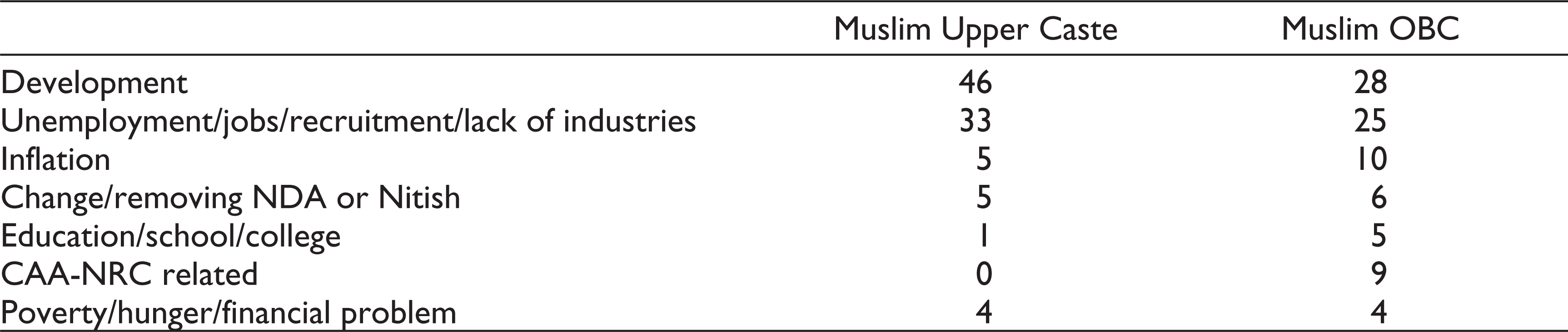
This is an important finding. It appears that Muslim voters were clear that the CAA/NRC was not going to be a part of the electoral discourse. Although the non-BJP parties have been opposing the CAA/NRC (and even the JD [U] had been critical of the NRC process), they were not interested in converting this controversial law into an electoral plank. Even the AIMIM, which aggressively raised the CAA/NRC debate to mobilize Muslims, worked very hard to represent itself as a development-oriented party (Nair, 2020). In this scenario, it was obvious for the Muslim voters to work out various strategies at the constituency level to make feasible political configurations.
Conclusion
Let us elaborate the points which have been made in previous sections, to recapitulate the main argument of this article. We find that the three features of Hindutva constitutionalism—the Constitution as sacred object/law book, rejection of minority–majority framework, and the primacy of one-nation one constitution—provide a political-intellectual foundation to the doctrine of New India, especially the responsive people and responsive government thesis. In a way, an imagination of a homogenous national political community—the responsive people/citizens—is established that has to be governed by another uniform, obligated, and sovereign political entity—the responsive government. The placement of Muslim identity in this framework is very interesting. Muslims are seen as an inseparable constituent of the national community. The slogan sab ka sath sab ka vikas and sab ka vishwas (together, for everyone’s growth, with everyone’s trust) is invoked to deal with the concerns and issues faced by all citizens including Muslims. This political homogenization helps the BJP leaders to claim that the status of Muslims as a religious minority is questionable since the Constitution does not define the term minority at all. 42
The Muslim dominated anti-CAA protests as a form of political participation posed a serious challenge to the doctrine of New India and its operative mechanism: Hindutva constitutionalism. These protests rejected the Hindutva interpretation of the Constitution by highlighting the significance of the constitutional principles. In this sense, the responsive citizens and responsive government thesis was given a different political explanation. It was asserted that the duty of a responsive citizen is to protect the values and principles that the Constitution represents; while the task of the responsive government is to create an environment of mutual trust.
The anti-CAA agitation certainly expresses those political anxieties, which do not find any space in the usual business of competitive politics. However, these popular protests do not always get translated into electoral issues. Political parties have to abide by the dominant narrative of electoral politics; and precisely for this reason, citizens as voters are always asked to vote on a few politically acceptable lines. 43 Muslim voting behaviour in post-CAA elections actually demonstrates this aspect of political participation in two significant ways.
First, Muslim voters responded to the given electoral packages positively. The aggressive anti-Muslim discourse did not affect their enthusiasm to participate in elections. In the wake of the BJP’s Hindutva hegemony, which depends on the negative portrayal of Muslim communities, the Muslim voters seem to evolve various survival strategies to remain politically relevant. The overwhelming support to AAP in Delhi, acceptance of AIMIM in Seemachal, and enthusiastic voting in favour of RJD-led Mahagatbandhan in rest of Bihar clearly show that Muslim communities recognize the election as an important arena of politics. They adjust themselves with the prevalent political narratives and vote accordingly.
Secondly, and perhaps most importantly, Muslim voting behaviour demonstrates an important feature of electoral politics. It is often assumed that Muslim communities give priority to the identity-oriented issues while participating in politics. This formulation is rather misleading. CSDS-Lokniti surveys show that Muslims like other social group always give considerable importance to the overtly secular development-centric issues that affect them as citizens. Muslim voters, however, do not ignore the identity-related concerns. The identity, in this case, functions as a template that provides community-specific meanings to secular-development-oriented promises that political party make during elections. The anti-Muslim rhetoric of BJP in recent elections, for example, has created the dominant template of identity. It reminds Muslim communities that their economic and educational marginalization is inextricably linked to their Muslim identity and the politics of communal exclusion. Muslims as voters, however, interpret this identity-development configuration in their own ways. They participate in elections as voter-citizens without giving up their identity as Muslims.
The political engagements of Muslims in contemporary India, I argue, could be seen as an ever-evolving discourse, which certainly respond to the Hindutva hegemony; yet it is not always governed by it.
Footnotes
Declaration of Conflicting Interests
The author declared no potential conflicts of interest with respect to the research, authorship and/or publication of this article.
Funding
The author received no financial support for the research, authorship and/or publication of this article.