




Abstract
There are two dominant explanations of contemporary Muslim voting behaviour. A section of public commentators reiterates an old argument that Muslims always participate in politics to defeat the BJP. This argument is not entirely incorrect. The BJP did not deviate from its Modi-centric Hindutva-driven campaign. The party relied heavily on an apparent anti-Muslim rhetoric to reach out to its core voters. The failure of the BJP to secure an absolute majority in Lok Sabha, in this sense, is also seen as an obvious outcome of this strategy. It is claimed that the BJP’s attempt to polarize voters on religious grounds encouraged Muslims to vote for non-BJP candidates throughout the country.
The second explanation is more speculative. The INDIA alliance has so far tried to avoid any discussion on the overwhelming Muslim support they have received this time. The non-BJP parties, except a few, do not want to publicly acknowledge the fact that their success was almost impossible without active Muslim support. This kind of political reluctance is justified as a strategic silence. There is an assumption that the pro-Muslim gestures of these parties will make the Hindu voters unhappy.
Findings of National Election Studies (NES) 2024 take us beyond these popular descriptions of Muslim voting. This survey introduces us to the complexities of contemporary Muslim politics and its electoral manifestations. This article tries to establish a link between Muslim self-perceptions as a religious minority in India and their political behaviour. We ask three basic questions: First, did Muslim communities vote more actively this time than Hindu communities? Second, did they vote as a homogeneous community or as a vote bank? And finally, did they vote basically to defeat BJP?
Introduction
Self-claimed Hindutva groups and a section of professional politicians associated with the BJP as well as a particular kind of pro-BJP media, try to demonize Indian Muslims and, in particular, to create an impression that Muslims are pampered and, at the same time, form a potential threat to the nation (Chatterji et al., 2019). This discourse is challenged by civil society groups and liberal intellectuals. But it is important to measure its impact on public opinion, an under-studied area of research (Ahmed, 2019; Alam, 2023). The first part of this article addresses this intellectual inconsistency to analyse the perception of Muslims by others as well as their self-perception on the basis of the first survey of that kind. How is this minority seen by the other groups—including the Hindus? And how are Muslims assessing their own situation and perceiving their community as well as its leaders?
While the survey on which the first part of this article has been conducted in the context of the 2024 Lok Sabha elections, other lessons can be drawn from these elections’ results for understanding the place of Muslims on the Indian political scene. These elections reconfirmed a structural trend as the share of Muslim MPs further eroded, dropping from 4.6% in 2019 to 4.4% of the Lok Sabha MPs, whereas Muslims represented 14.5% of the Indian population in the 2011 census, 4 but the 2024 Indian general election also reflected the increasing polarization of the voting pattern according to communal lines, the subject of the second part of this article. If the rise to power of Narendra Modi resulted partly from this polarization process and the making of a majoritarian Hindu vote bank, it somewhat boomeranged in 2024. Although the vote share of the party did not reduce significantly and it formed the government under the leadership of Narendra Modi for the third time, the aggressive Hindutva-driven campaign did not give the BJP an absolute majority this time. Now, the fragmented verdict of 2024, especially the decline of the BJP in Uttar Pradesh, was linked to active Muslim voting. Yet, the popular assumption arguing that Muslims voted strategically to defeat the BJP needs to be critically assessed. In the second part of this article, we try to map out the multilayered Muslim political–electoral responses to Hindutva by examining them caste-wise and region-wise.
Muslim (Self-)Perceptions: Prejudice, Insecurity and Denial
The survey data reveal a fair degree of anti-Muslim prejudice among Hindus. 5 Twenty-seven per cent of the latter ‘fully’ or ‘somewhat’ agree that Muslims are not as ‘trustworthy as anyone else’. Among them, the most plebeian groups—Dalits and Adivasis—appear to cultivate the most negative views of the Muslims at respectively 29% and 31%. But the gap is even more significant if these data are disaggregated geographically: only 13% of the South Indian respondents ‘fully’ or ‘somewhat’ disagree with the idea that Muslims are as ‘trustworthy as anyone else’, against 27% in the Hindi belt and 20% in the West (Table 1).
27% of Hindu Voters Report That Muslims Are Not as Trustworthy as Anyone Else.
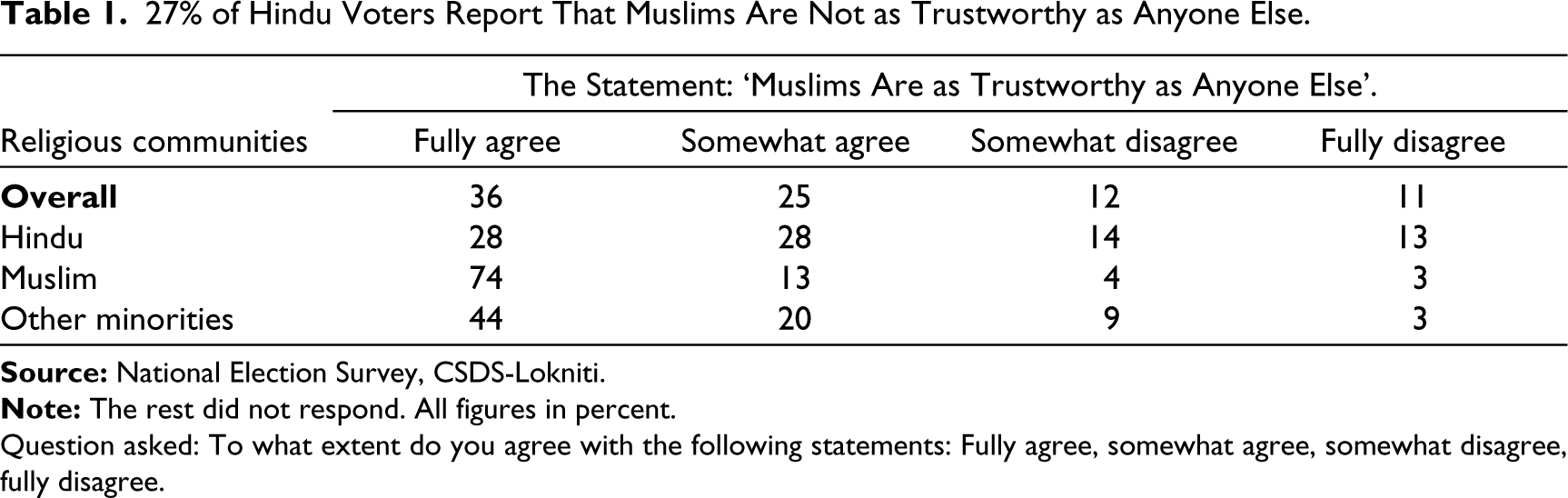
Question asked: To what extent do you agree with the following statements: Fully agree, somewhat agree, somewhat disagree, fully disagree.
Similarly, 26% of the Hindus interviewed ‘fully’ or ‘somewhat’ disagree with the idea that Muslims are as ‘patriotic as any Indian’ (Table 2). Again, Hindu Dalits and Hindu Adivasis are more prejudiced than other Hindus, at respectively 30% and 29% (against 24% for upper caste Hindus). And again, the gap between the North and the South is very significant: only 18% of the South Indian respondents ‘fully’ or ‘somewhat’ disagree with the idea that Muslims were as patriotic as any Indian, against 28% in the Hindi belt and 21% in the West.
26% of Hindu Voters Report That Muslims Are Not as Patriotic as Any Indian.
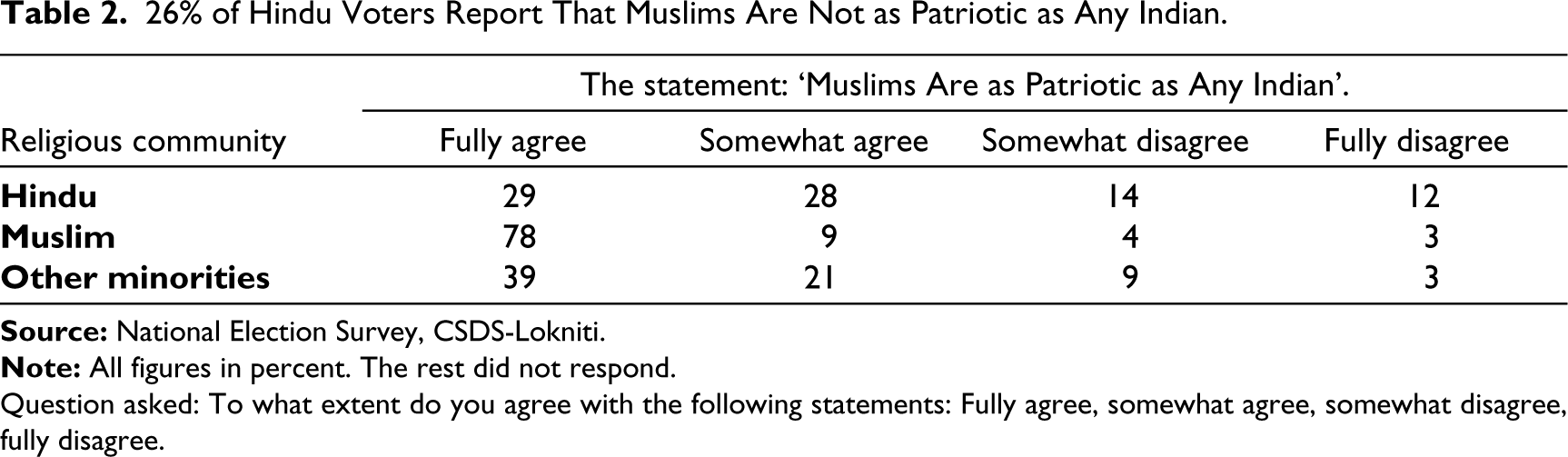
Question asked: To what extent do you agree with the following statements: Fully agree, somewhat agree, somewhat disagree, fully disagree.
The prejudiced perception of Muslims by Hindu respondents harks back, among other things, to the idea that Muslims are unduly favoured. A very large proportion of the Hindu voters who have been interviewed, 47%, ‘fully’ or ‘somewhat’ agree with the idea that Muslims are ‘unnecessarily appeased or pampered’ (Table 3)—even though the available statistical data demonstrate that Indian Muslims are undergoing an impoverishment process (Jaffrelot & Kalaiyarasan, 2023a, 2023b). When we disaggregate these data geographically, we find somewhat counterintuitive results because there is almost no difference between the South and the Hindi belt: 47% for the South against 49% for the Hindi belt. A consensus seems to prevail also from the point of view of caste and communities: if Hindu Dalits and Hindu Adivasis are relatively less inclined to share this view at—still!—43% and 44% than the upper castes and the upper OBCs, at 47% and 50%, share the view that ‘Muslims are unnecessarily appeased or pampered’.
Almost Half of the Voters Indicate That Muslims Are Unnecessarily Appeased/Pampered.
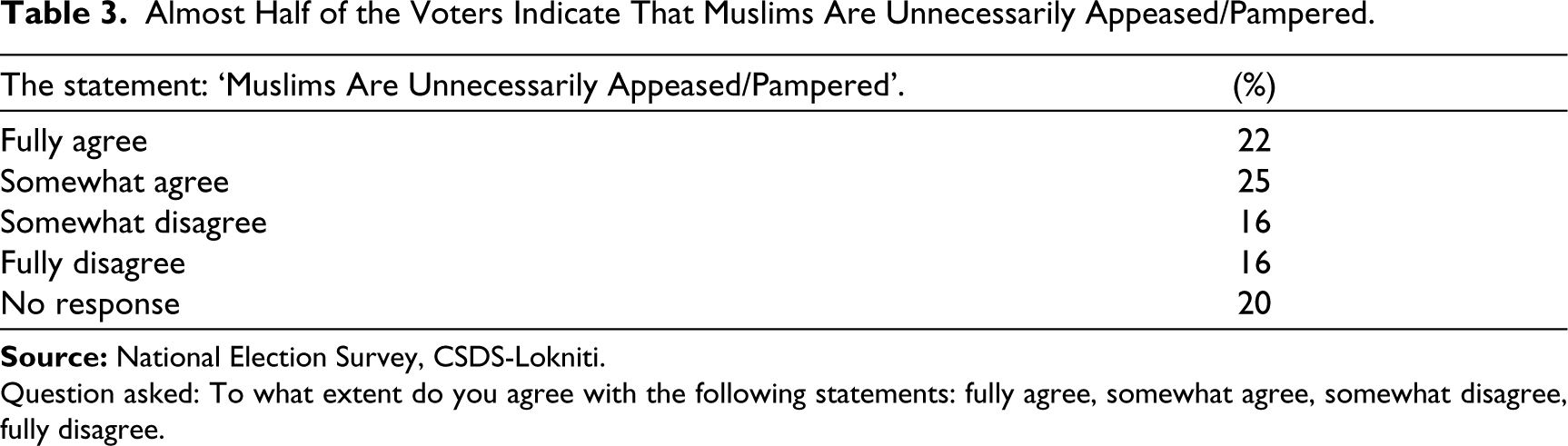
Question asked: To what extent do you agree with the following statements: fully agree, somewhat agree, somewhat disagree, fully disagree.
Here, the keyword is probably ‘unnecessarily’, which could be understood as suggesting that politicians claim that they are doing something special for the Muslims. This interpretation is reinforced by the fact that for a large fraction of Muslims (31%), ‘political parties are giving unreasonable promises to Muslims to win their votes’, a view that is equally prominent among the Hindu interviewees. Surprisingly, when asked what are the parties which try to do it, the Muslim interviewees cite first the BJP (40%) and the Congress comes a distant second at 18%. By contrast, the Hindu interviewees cite the Congress first (except the Hindu Dalits who mention the BJP in the first place). This is particularly true of the upper caste Hindus: for 37% of them, Congress tries to win the Muslims’ vote by giving unreasonable promises, when only 27% of them think that the BJP does the same—still an extraordinary figure.
This viewpoint explains that a substantial fraction of the Hindus, in this survey, 22%, consider that ‘only Hindus’ should benefit from reservations (Table 4). By contrast, 71% of Muslims think that Hindus and Muslims should get access to this form of positive discrimination. However, when the question is more specific and the interviewees asked ‘should both Hindus and Muslims be given reservations in the SC category’—a majority of Hindus and Muslims agree (among the Hindu Dalits, only 28% do not), a clear reflection of the acknowledgement that Muslim Dalits, at least, are not ‘pampered’. The idea that Dalit Muslims and Dalit Hindus should benefit from reservations in the SC category is slightly less popular in the Hindi belt (57%) than in the South (62%), where the states where Muslims already benefit from quotas (Kerala and Karnataka) are located.
Nearly One Fifth of Voters Say That Only Hindus Should Be Given Reservation.
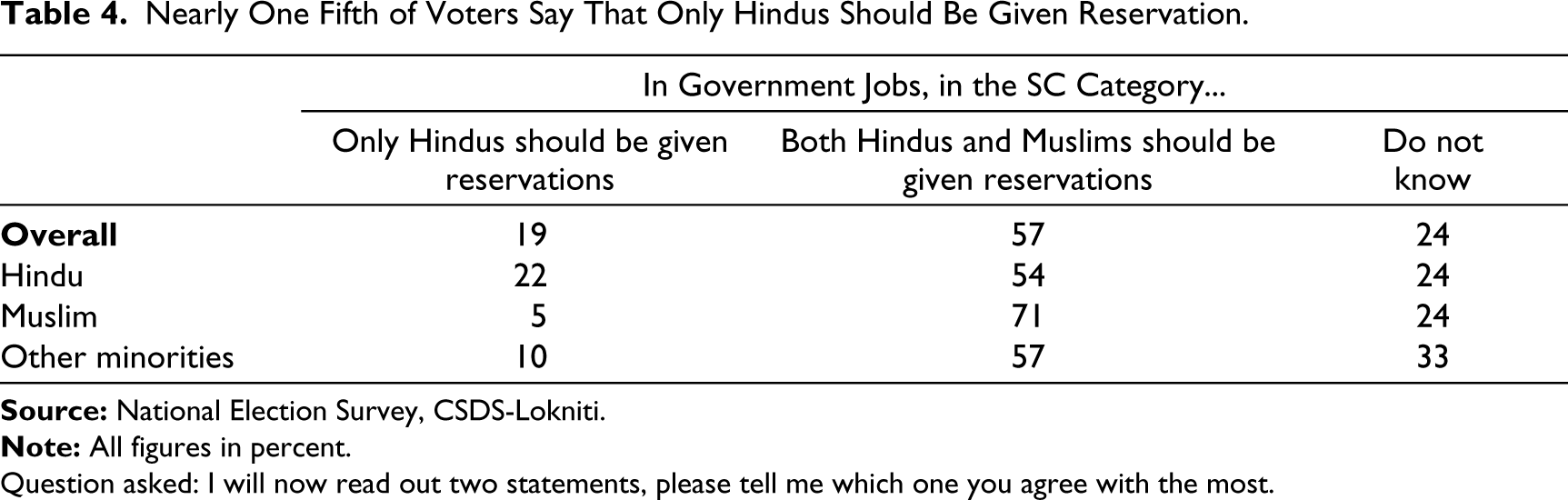
Question asked: I will now read out two statements, please tell me which one you agree with the most.
The fact that, according to the Hindu respondents, nothing special needs to be made for the non-Dalit Muslims reflects their assessment of the general condition of this minority: For many of them, not only are they pampered or appeased, but they are not even ‘treated unfairly by the state authorities’ for a huge majority of the Hindu interviewees (between 60% and 68% according to the caste groups). 6 By contrast, 43% of the Muslim respondents think otherwise (Table 5).
43% of the Muslim Respondents Say That Their Community Is Treated Unfairly by State Authorities.
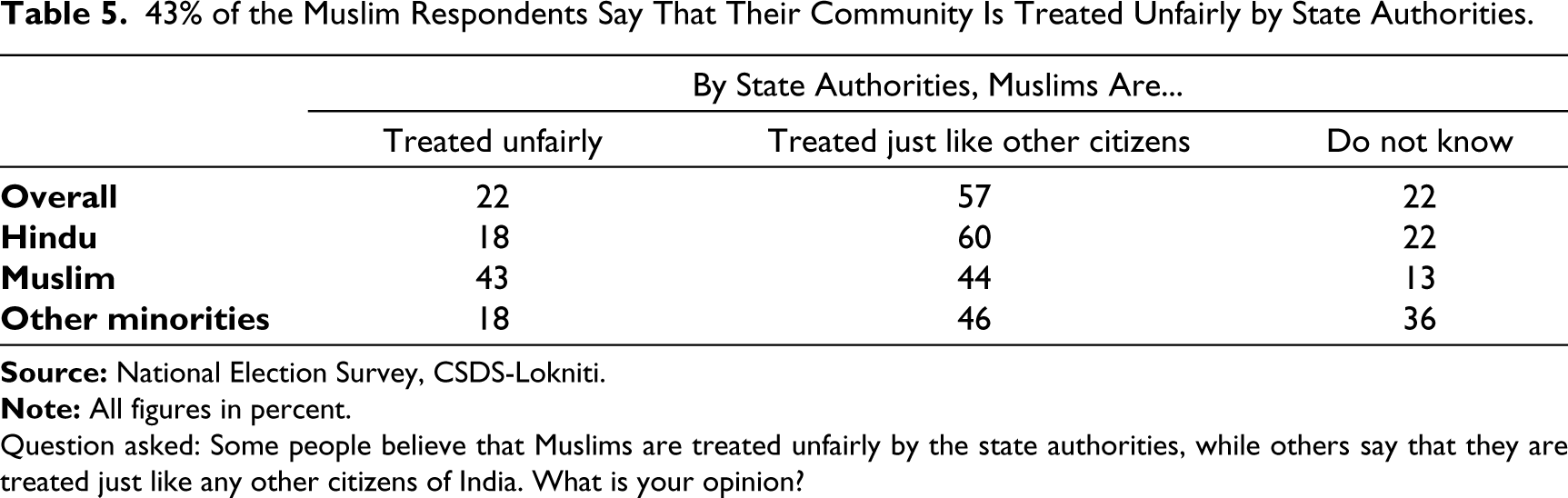
Question asked: Some people believe that Muslims are treated unfairly by the state authorities, while others say that they are treated just like any other citizens of India. What is your opinion?
This is largely related to a deep sense of insecurity which represents a major feature of the survey under review: 54% of the Muslim respondents consider that they are not ‘as safe as any other citizen in the country’ and 11% of them say that they are ‘not safe at all’ (Table 6). This perception stands in stark contrast with those of the Hindus—whatever their caste—who appear in a rather complete denial of the Muslims’ condition: 60%–62% of them claim that Muslims are equally safe.
54% of the Muslim Respondents Say That They Are Not as Safe as Other Citizens or Not at All Safe in India.
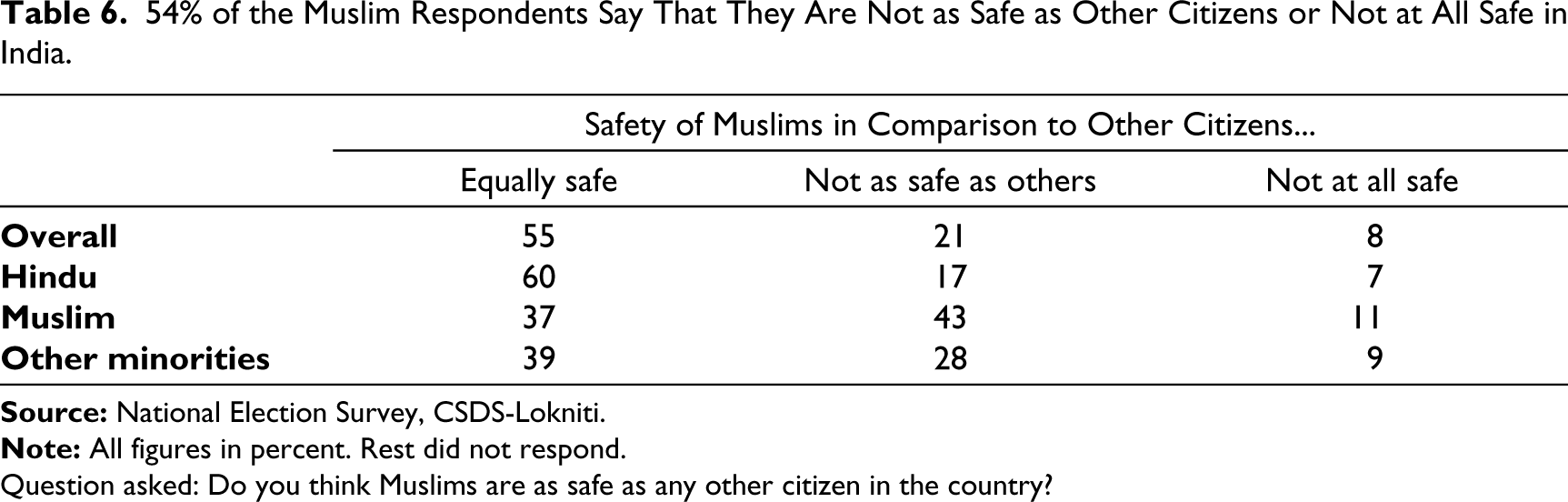
Question asked: Do you think Muslims are as safe as any other citizen in the country?
Paradoxically, the Hindu respondents argue that Muslims are not treated differently than others, are not unsafe and are even pampered or appeased, while they admit that Muslims are not properly represented in the political sphere. However, they attribute this problem to some lack of Muslim leadership. There are more Hindu respondents who consider that ‘the absence of serious and committed leaders among Muslims affects their representation in politics’ than Hindu respondents who think otherwise—whatever the caste group. An even larger proportion of Muslims (50%) think alike. In the same vein, 52%–54% of the Hindu respondents consider that ‘There is a need for better and articulate Muslim leaders in India’, a view shared by 81% of the Muslim respondents (Table 7), but, at the same time, 62% of these respondents consider that ‘the Muslim community has able, honest and committed leaders’ (it simply needs to have more) (Table 8), something the Hindu respondents deny: there are more Hindu respondents who think that this community does not have such leaders than respondents who think otherwise, irrespective of caste. The contrast between the Hindi belt and the South, here, is complete: while 38% of the Hindi belt respondents think that the Muslim community does not have ‘honest and committed leaders’ (against 28% who think that it does), 49% of the South Indians consider that the Muslim community has such leaders (against only 24% who think that it does not).
Two in Every Three Muslims Stand in Full Agreement to Need for More Articulate Muslim Leaders.
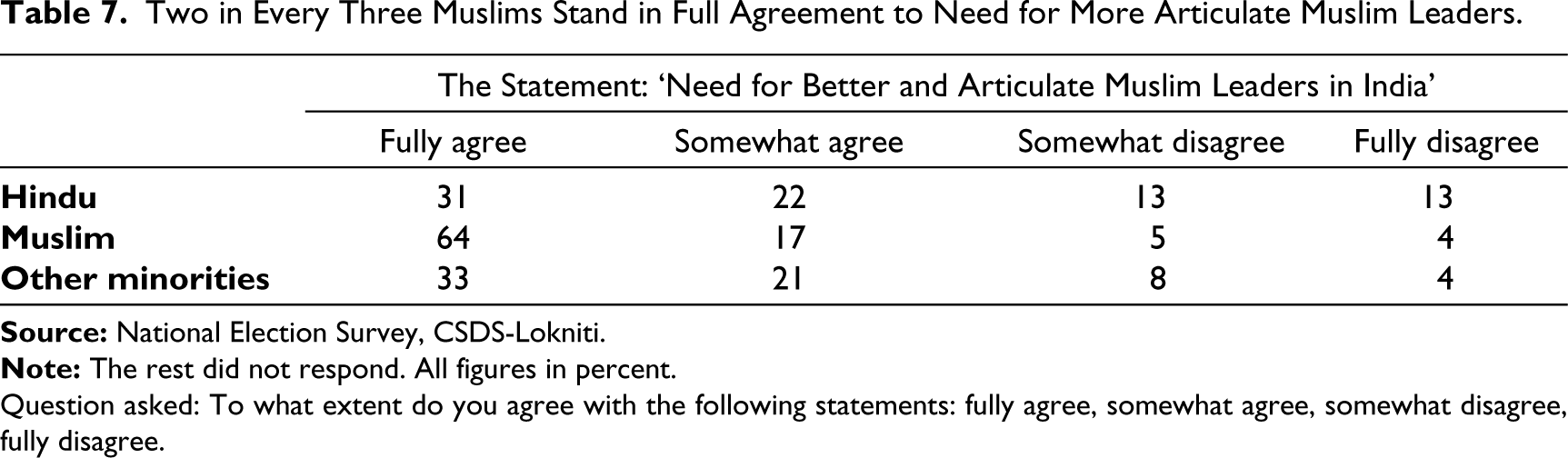
Question asked: To what extent do you agree with the following statements: fully agree, somewhat agree, somewhat disagree, fully disagree.
62% of the Muslim Respondents Feel That Their Community Has Committed Leaders.
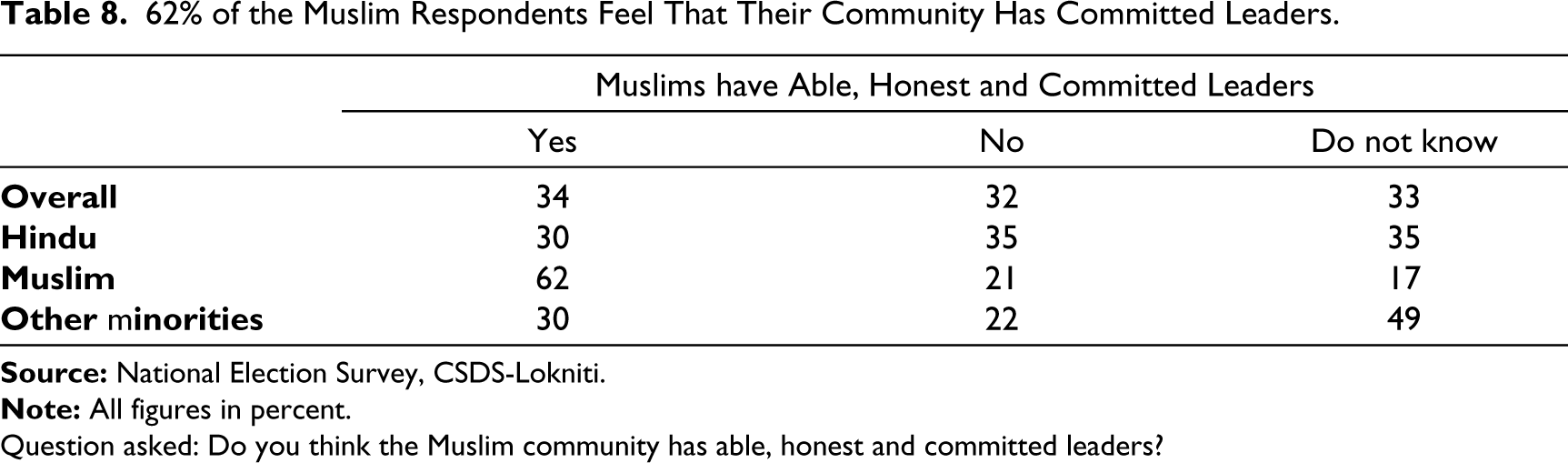
Question asked: Do you think the Muslim community has able, honest and committed leaders?
Interestingly, many Muslims attribute this situation—partly—to the leaders of the community: 50% of them report that the absence of serious leaders amongst Muslims affects their representation. Sixty-four percent of the Muslim voters interviewed stand in full agreement to the need for more articulate Muslim leaders (Table 9). However, 62% also feel that they have committed leaders—but they are in too small numbers.
Half of the Muslim Respondents Report That Absence of Serious Leaders Amongst Their Community Affects Its Political Representation.
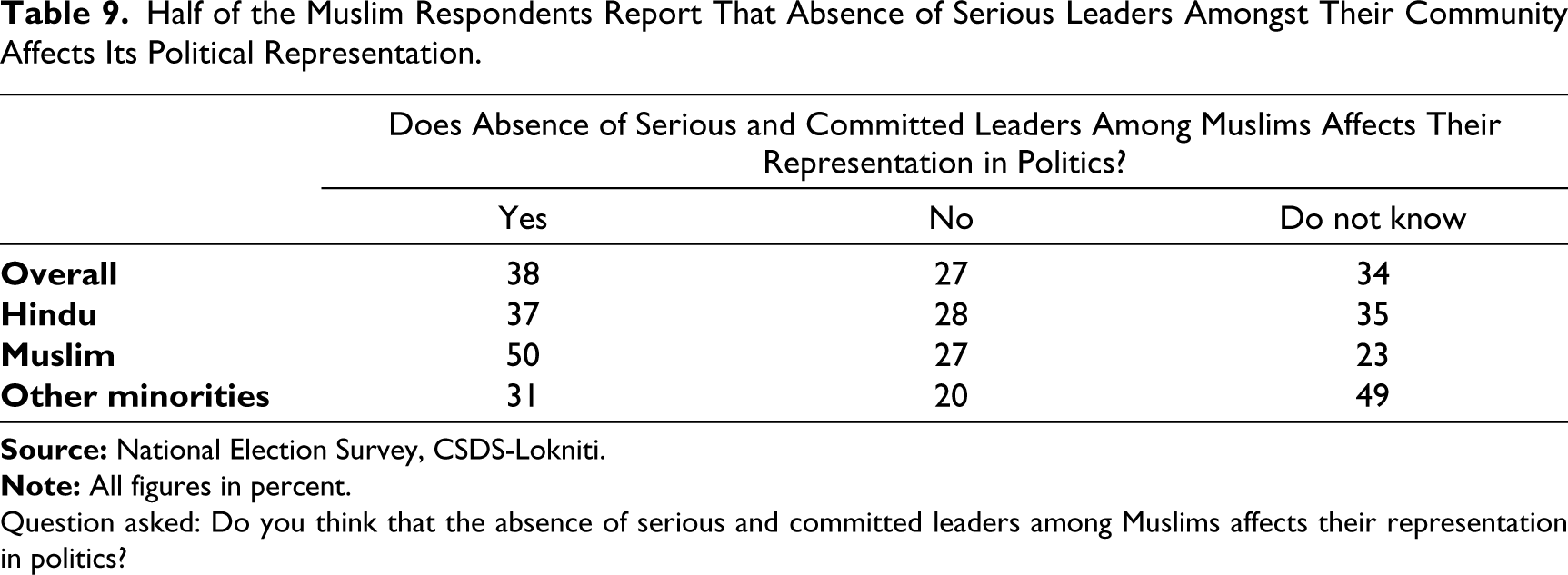
Question asked: Do you think that the absence of serious and committed leaders among Muslims affects their representation in politics?
The data analysed so far reflect the growing polarization of the Indian society, a process that is naturally more pronounced in the Hindi belt than in the rest of the country. To put it in a nutshell, Muslims feel more and more insecure and unfairly treated when Hindus consider that not only, the members of this community are as secure as others and treated the same way as others—even pampered and appeased—but (here there is a contradiction) that their situation—which, therefore admittedly, is not so good—reflects a lack of leadership. Most of the items reviewed so far have not revealed any significant difference due to the social background of the Hindu respondents. In fact, Dalits and Adivasis tended to be even more prejudiced vis-à-vis the Muslims than the other groups. This communal polarization of Indian society partly stems from the rise to power of the BJP whose discourse systematically demonizes the Muslims. But it also results from the groundwork of the Sangh Parivar at the societal level, a strategy of mobilization that has found expression in the Ram Janmabhoomi movement for decades. 7 In our survey, a majority of the Hindu respondents, precisely, consider that the construction of the Ram Mandir ‘helped in consolidating the Hindu identity’. Interestingly, 59% of the upper caste Hindus share this view, against ‘only’ 47% of the Hindu Dalits. This view is also more popular in the Hindi belt than in the South: 49% against 44% (Table 10).
About Half of the Voters Say That Ram Mandir Has Helped in Consolidating Hindu Identity.
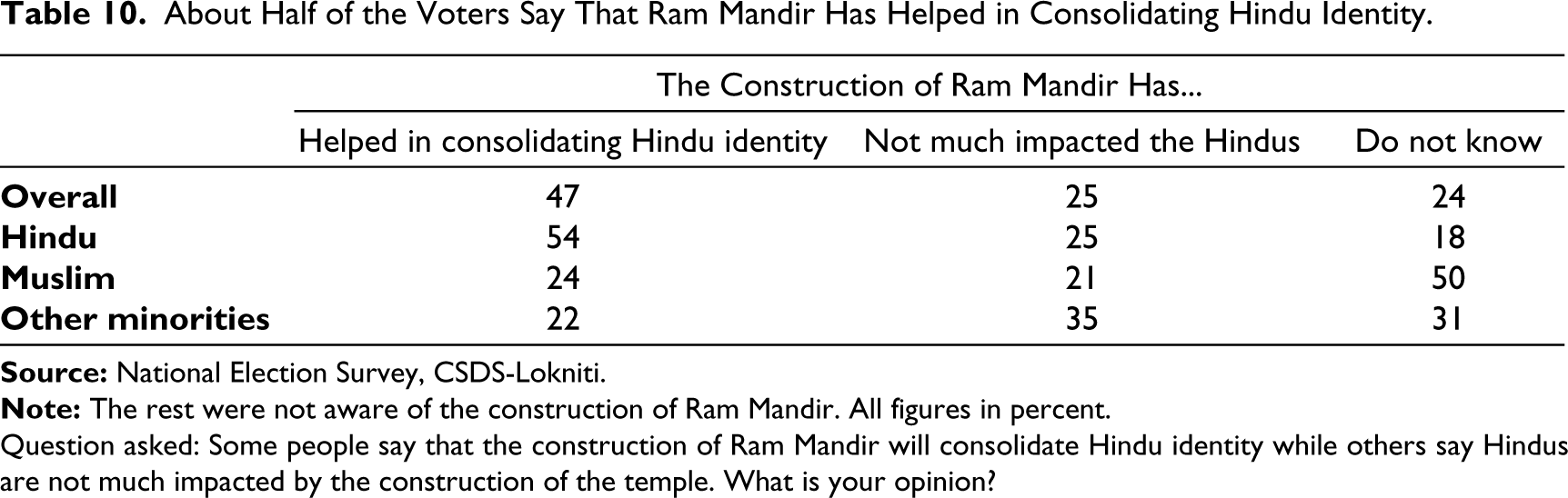
Question asked: Some people say that the construction of Ram Mandir will consolidate Hindu identity while others say Hindus are not much impacted by the construction of the temple. What is your opinion?
While the very idea of consolidating the Hindu identity went together with the notion of polarization and majoritarianism, a majority of the Hindu respondents do not consider that the Ayodhya movement has further divided society. In fact, the percentage of Hindu respondents who say that the building of the Ram Mandir will ‘foster harmony between Hindus and Muslims’ is larger than the percentage of those who consider that it will ‘increase differences among communities’. Note that the gap is larger among the upper castes (35% against 19%) than among the Dalits (26% against 23%).
These data can be interpreted as the reflection of a clear denial of reality. But one may also see it as the sign of a certain attachment to the coexistence of different communities, a conclusion one could also draw from the last Pew survey on religion in India. This reading is substantiated by the fact that in our survey, only a small minority of Hindus—10%–16% of the total according to caste groups—consider that ‘India belongs only to Hindus’, a huge majority of the Hindu respondents—between 74% and 80%—saying that the country ‘belongs to citizens of all religions’.
Similarly, about half of the Hindu respondents have ‘a friend who is a Muslim’—caste making no difference here either, a proportion larger than what could have been expected on the basis of most of the responses reviewed so far. This proportion is smaller in the Hindi belt, in spite of the size of the Muslim population in states like UP and Bihar. Only 51% of the Hindi belt respondents have a friend who is a Muslim, while this figure is 66% for the South Indian respondents.
More importantly, about 50% of the respondents—caste and religion making no difference again—declare that ‘Leaders from other religions can also effectively represent [their] interests and concerns’ (Table 11). In the same vein, there are more respondents among Hindus and Muslims who say that they may contact a leader of a different religion or a leader from their community the same way, to get their work done, if the two leaders belong to the same party and are equally competent, than respondents who declare that they will contact a leader from their community first. But geography makes a big difference here: while only 25% of the South Indian respondents would prefer a ‘leader from the same religion’, they are 41% in the Hindi belt! Similarly, while 61% of the South Indians consider that ‘leaders from other religions can also effectively represent [one’s] interests and concerns’, only 46% of those of the Hindi belt think alike.
Only One Third of the Muslim Respondents Feel More Comfortable with a Leader from Their Religion to Get Their Work Done.
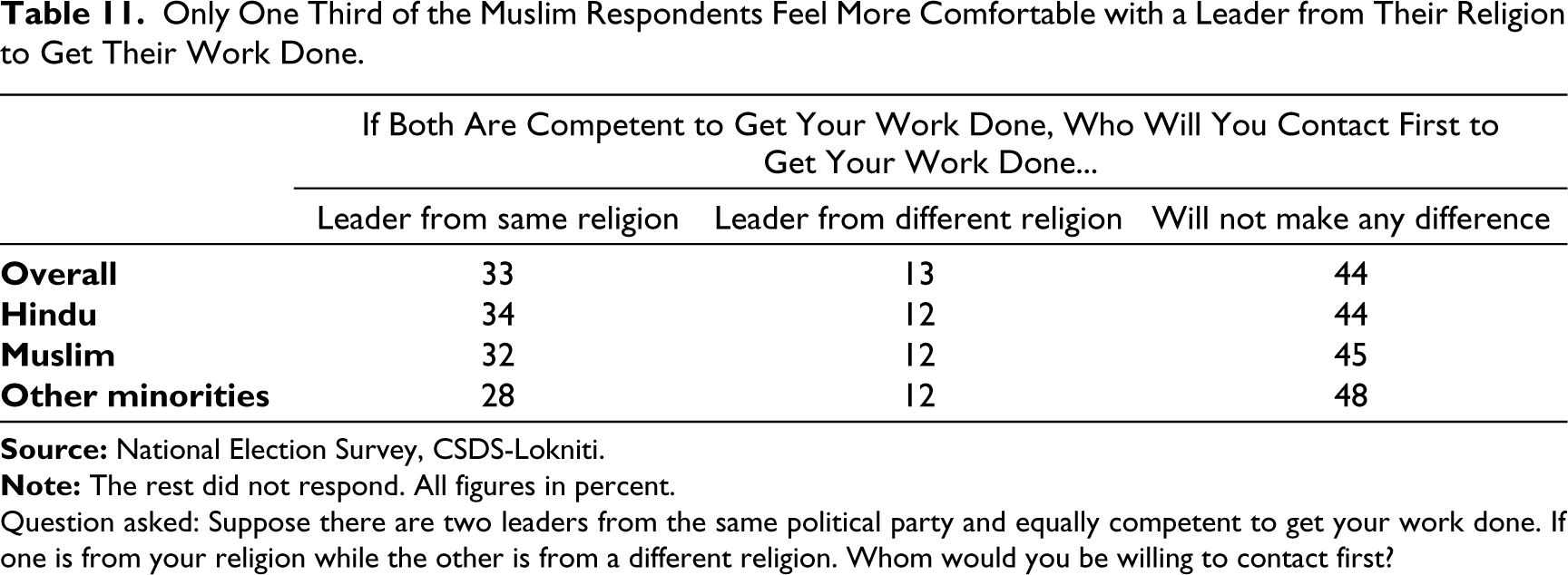
Question asked: Suppose there are two leaders from the same political party and equally competent to get your work done. If one is from your religion while the other is from a different religion. Whom would you be willing to contact first?
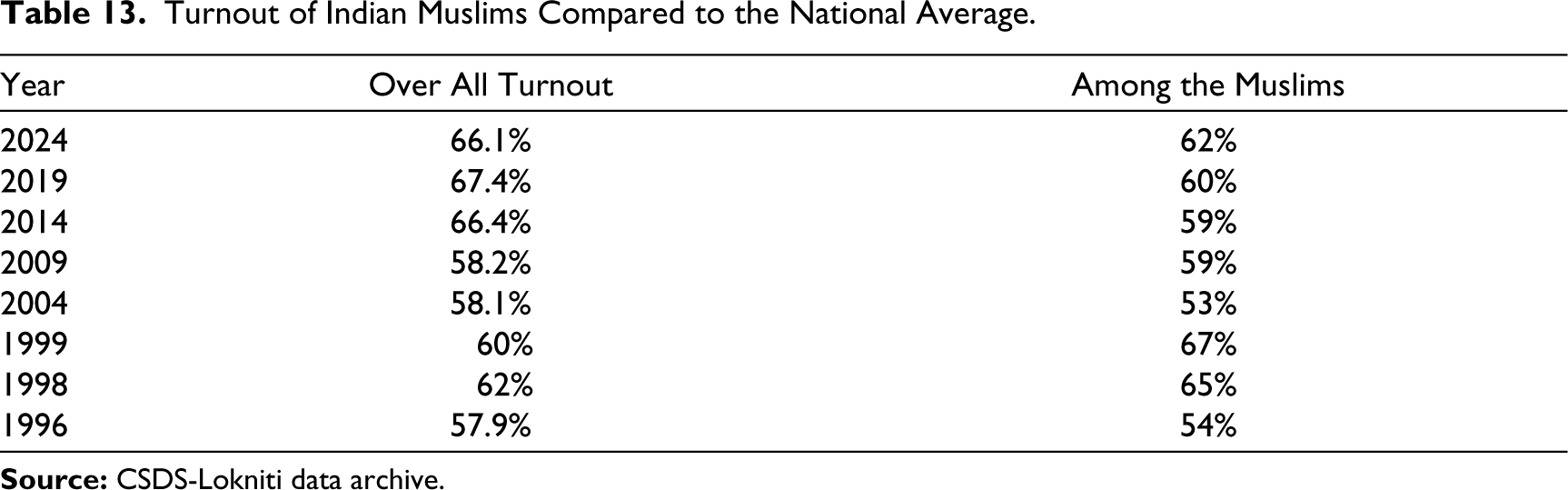
Another recomforting piece of information may be found in the fact that a majority of respondents think that their ‘vote affects how things are run in this country’ (Table 12). However, 63% of the upper caste Hindus share this view, while only 51% of the Muslims (the lowest proportion) do. This difference is reconfirmed by data regarding the turnout. Certainly, the proportion of Muslim citizens who voted in 2024 has increased from 60% in 2019 to 62%. Since 2014, it has been much lower than the overall turnout—whereas it was above the national average in the late 1990s (Table 13).
More than One in Every Four Voters Say That Their Vote Does Not Affect How Things Are Run in India.
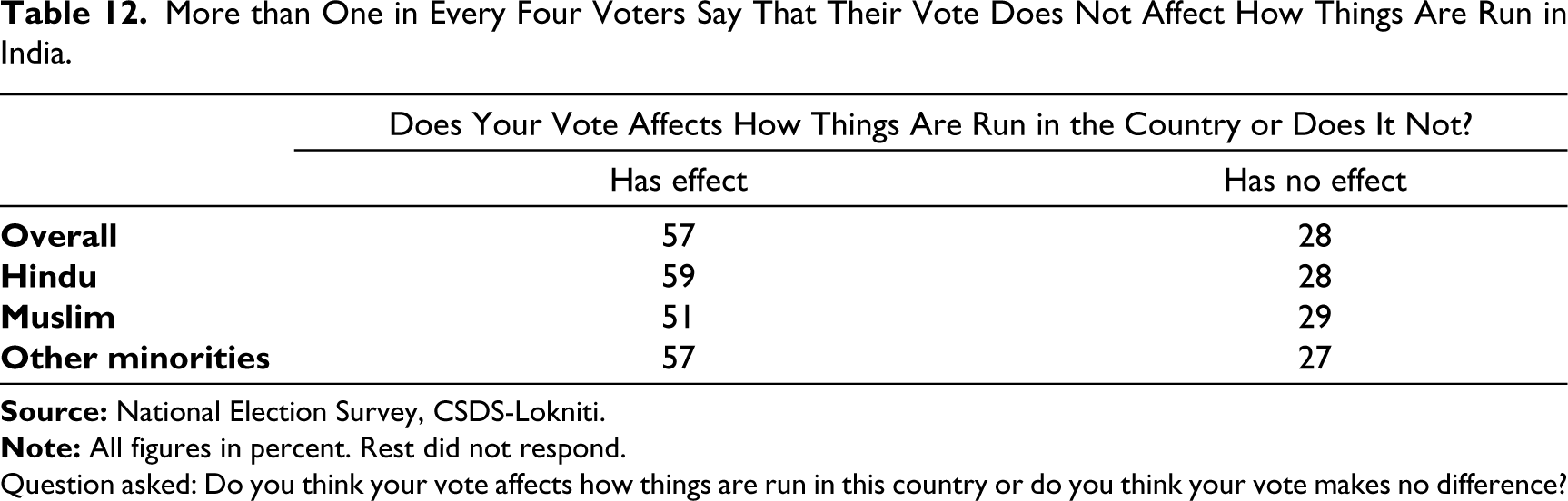
Question asked: Do you think your vote affects how things are run in this country or do you think your vote makes no difference?
Turnout of Indian Muslims Compared to the National Average.
In fact, on that front, the key variable is not religion, but geography: only 49% of the South Indians think that their vote matters, against 65% of those of the Hindi belt, this geographical gap reflecting a deep awareness of the demographics.
This discussion introduces us to two sets of observations: Muslim views on political processes and Muslim imaginations of political representation. Muslim communities are eager to get involved in the political life of the country as citizens. However, there is an apprehension that their religious identity and collective existence as a constitutionally recognized minority community is seen as a problematic category. This apprehension is clearly reflected in our data and justified by our data too, as evident from the way Muslims are perceived by the Hindus and the way they perceive themselves. The main features of the survey reviewed above are in tune with the communal character of the 2024 BJP’s election campaign. In the second part of this article, we will analyse the impact of this campaign as well as the perceptions of the Muslims by the Hindus and the Muslims’ self-perception of their voting pattern.
Muslim Voting Trends in 2024
There are two dominant interpretations of contemporary Muslim voting behaviour, especially in relation to the outcome of the recent Lok Sabha election. A section of public commentators reiterates an old argument that ‘Muslims always participate in politics to defeat the BJP’. This argument can be explained by the fact that the party relied heavily, again in 2024, on a strident anti-Muslim rhetoric to reach out to its core voters. Almost mechanically, the BJP’s attempt to polarize voters on religious grounds encouraged Muslims to vote for non-BJP candidates throughout the country. 8
The second interpretation is more speculative. The INDIA alliance has so far tried to avoid any discussion on the overwhelming Muslim support they have received this time. The non-BJP parties, except a few, do not want to publicly acknowledge the fact that their success was almost impossible without active Muslim support. This kind of political reluctance is justified as a strategic silence. There is an assumption that the pro-Muslim gesture of these parties will make the Hindu voters unhappy.
CSDS-Lokniti post-poll survey takes us beyond these popular descriptions of Muslim voting. This survey introduces us to the complexities of contemporary Muslim politics and its electoral manifestations. For the sake of analysis, three basic questions may be raised. First, did Muslim communities vote more actively this time than the Hindu community? Second, did they vote as a homogeneous community or as a vote bank? And, finally, did they vote basically to defeat the BJP?
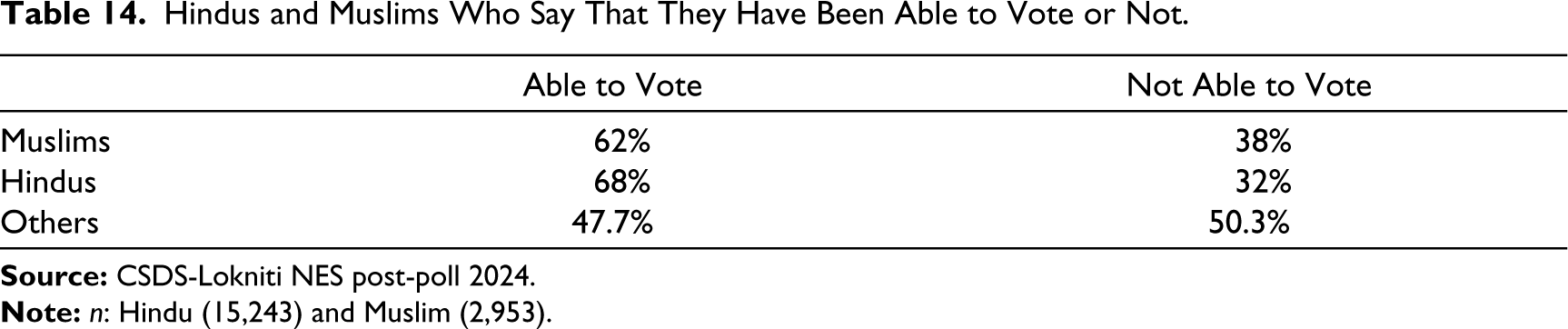
Muslim communities, we must remember, have never given up the electoral politics in the last 10 years (Verma & Gupta, 2016). It is true that the electoral participation of Hindu communities increased significantly after 2014 (around 70%), while the Muslim turnout remained almost stagnant (59%) (Table 14). In fact, there was a slight increase in Muslim voting in 2019 (60%). This pattern, interestingly, has not changed in 2024 (see Table 11). Our data show that 68% of Hindu respondents reported that they were able to vote this time, while the Muslim turnout was around 62%. As a result, Hindu participation in this election was much higher than Muslims. This evidence goes against the popular perception that Muslim voting has always been a tactical move.
Hindus and Muslims Who Say That They Have Been Able to Vote or Not.
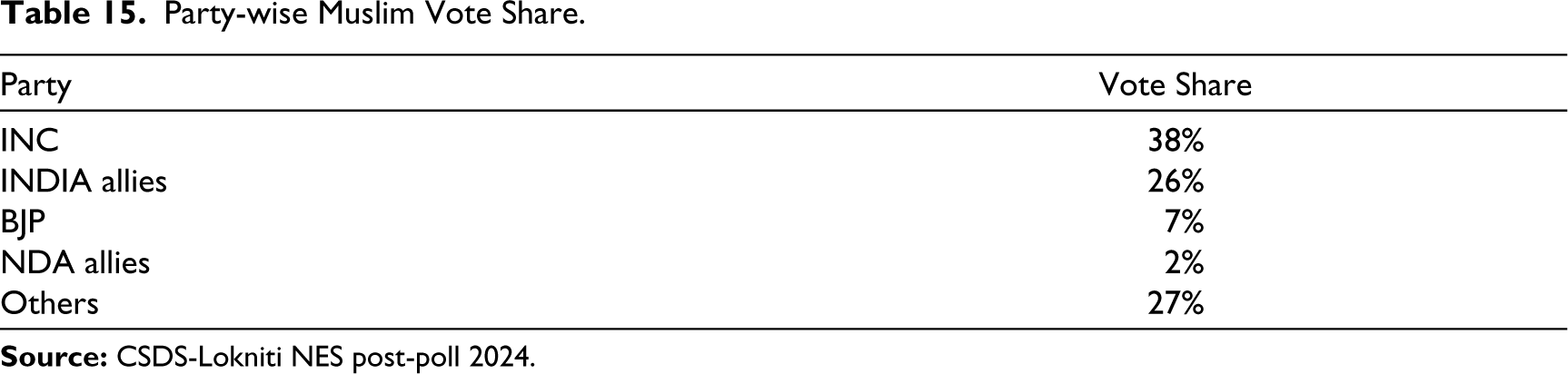
This brings us to our second question. There is a powerful view that Muslims constitute a politically united and religiously homogeneous community. This imagination is factually wrong, at least in electoral terms. Survey findings demonstrate that the Congress emerged as the first choice for Muslim voters at the national level. However, the party managed to get around only 38% Muslim votes (Table 15). The Congress alliance also did well. But it got only 26% of the Muslim votes. It does not mean that other parties, including BJP, did not get any Muslim support. It is found that around 8% of Muslims voted for the BJP this time at the all-India level. Statistically speaking, the BJP has emerged as the third national-level choice for Muslim voters!
Party-wise Muslim Vote Share.
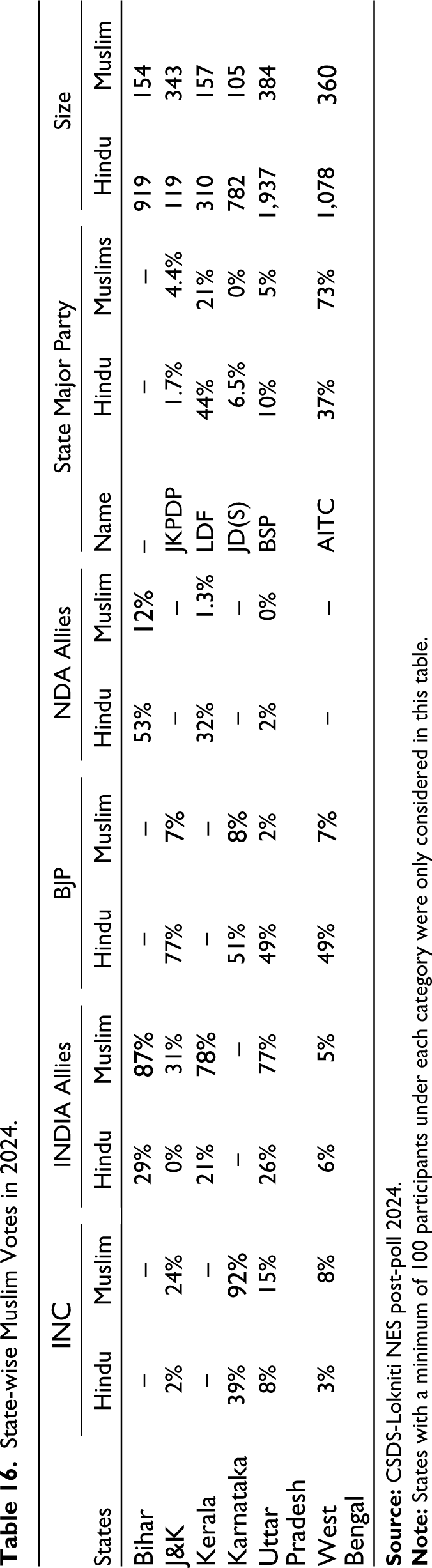
This point, however, should not be exaggerated. The state-level Muslim voting patterns make things much clearer. One finds two noticeable patterns in this regard. BJP’s Muslim vote share increased in the states where the party had a direct contest with one single dominant party. For example, in Gujarat, the Congress, which was the main opposition party, received 70% of Muslim votes. The BJP, on the other hand, performed also quite well in the state as 29% of Muslims voted for the party’s candidates in different constituencies.
There is another pattern of state-level Muslim voting as well. In the states where the nature of the contest is multi-cornered, the Muslim vote usually gets more fragmented. The West Bengal and UP are two very revealing examples in this regard. AITC emerged as the leading Muslim vote gainer in West Bengal. The party received 73% Muslim votes, while 8% Muslim voted for the Congress (Table 16). The UP case is quite similar. SP received 77% Muslim votes to become the dominant party in the state. Its partner, the Congress also did well (15%) in the state. However, the BJP’s performance was quite bad. Only 2% of Muslims voted for the party in UP. This example shows that Muslim voting is a state-level phenomenon, which in a way, underlines Muslim electoral heterogeneity in a significant way—a phenomenon that reflects the regionalization of Indian politics at large.
State-wise Muslim Votes in 2024.
This set of data can also be interpreted rather differently. CSDS-Lokniti’s previous studies have shown that a significant majority of Muslims do not feel close to the BJP. The BJP’s anti-Muslim stand in this election has, no doubt, increased this feeling of alienation. That could also be one of the reasons why the Muslim vote share for BJP has further dropped this time. However, it does not mean that defeating the BJP is the only factor that motivates Muslims to vote. The CSDS-Lokniti prepoll survey conducted just before the election revealed that Muslims identified unemployment, price rise and lack of development as the main issues for voting in this election.
The BJP’s Muslim vote share requires additional explanations, which are overdetermined by two different aspects of the attitude of the BJP vis-à-vis Muslims, at least in the electoral sense. First, the party does not deviate from its Hindutva-driven narrative of cultural nationalism. In this framework, Muslims are either projected as a problematic entity or are almost invisiblized to assert nationalism in overtly Hindu terms. This narrative of cultural nationalism is always invoked to reach out to the core, committed and loyal Hindutva voter. The derogative and anti-Muslim remarks made by a section of senior BJP leaders during the election campaign are a good example in this regard.
Second, and paradoxically, the BJP under the leadership of Narendra Modi has presented the slogan Sab ka Sath Sab ka Vikas as a reference point to reach out to all sections of society including Muslims. The banning of triple talaq has been presented as a progressive achievement for the members (mostly female members) of the Muslim minority. Similarly, the party also made efforts to reach out to Pasmanda Muslims to reclaim the Sab ka Sath policy. In fact, an impression has been created that BJP has managed to influence the political choices of Muslim women and Pasmanda groups in its favour. This expression of inclusiveness has certainly helped the BJP to satisfy a significant section of its Hindu voters, who expect the party to work for social and religious harmony, but whether it has attracted Muslim voters remains to be seen.
Especially because in 2024 the BJP’s electoral strategy vis-à-vis the Muslims was more in line with the first facet of the Janus-like strategy described above, as the party decided to downplay the Sab ka Sath policy. The BJP manifesto did not have any poll promise for the religious minorities. Although the Ram Temple issue was not given any prominence in the manifesto, the party campaign became entirely Hindutva-centric. The party leaders, including the Prime Minister, did try to create a balance by making positive remarks about Muslims. Yet, the focus of the campaign remained almost one-sided. This highly volatile political context influenced Muslim voting in a significant manner. Only 8% of Muslims preferred to vote for BJP. It was almost one percentage point below the 2019 Muslim vote share for the party.
The socio-economic profile of these Muslim voters of BJP is also a significant factor (Allie, 2024). It is found that almost 12% of Ashraf Muslims voted for the BJP at the national level (out of 8% of the total Muslim vote) (Table 17). On the other hand, the party received only 5% OBC Muslim vote. This finding goes against the popular view that the Muslim OBCs or the Pasmanda communities are more inclined to support the BJP. The Ashraf Muslims seem to be more open to embrace the BJP. This finding also shows that BJP’s attack on OBC reservations has affected the voting behaviour of Pasmanda communities.
Vote Choice Among Different Caste Groups of Muslims.
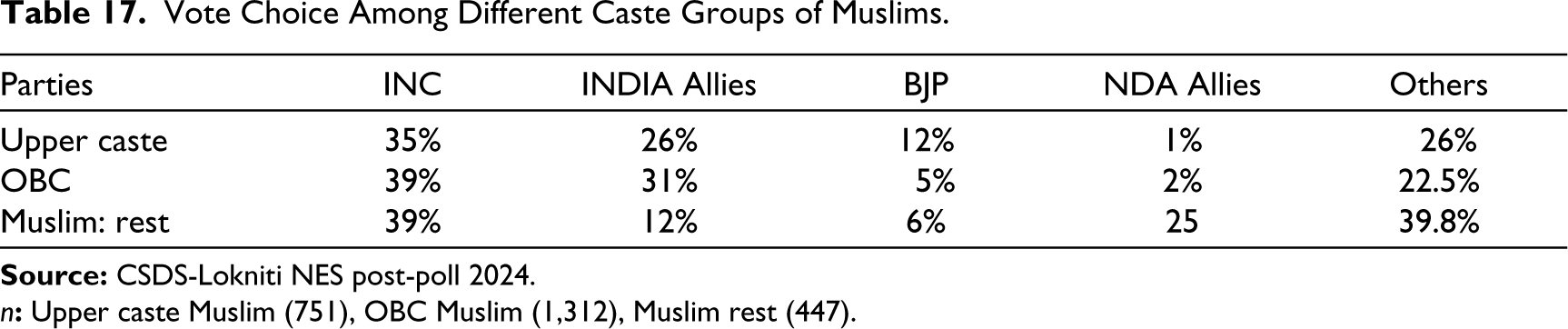
n: Upper caste Muslim (751), OBC Muslim (1,312), Muslim rest (447).
The economic background of these 8% Muslim voters of the BJP is equally interesting. Our data demonstrate that the party was a popular choice among the poorest and economically marginalized sections of Muslims. It received 11% vote from this class of Muslims. The Muslim middle classes did not find the BJP attractive in this election (Table 18). However, around 6% of rich and well-off Muslims voted for the party.
Muslim Voting Economic Class Wise.
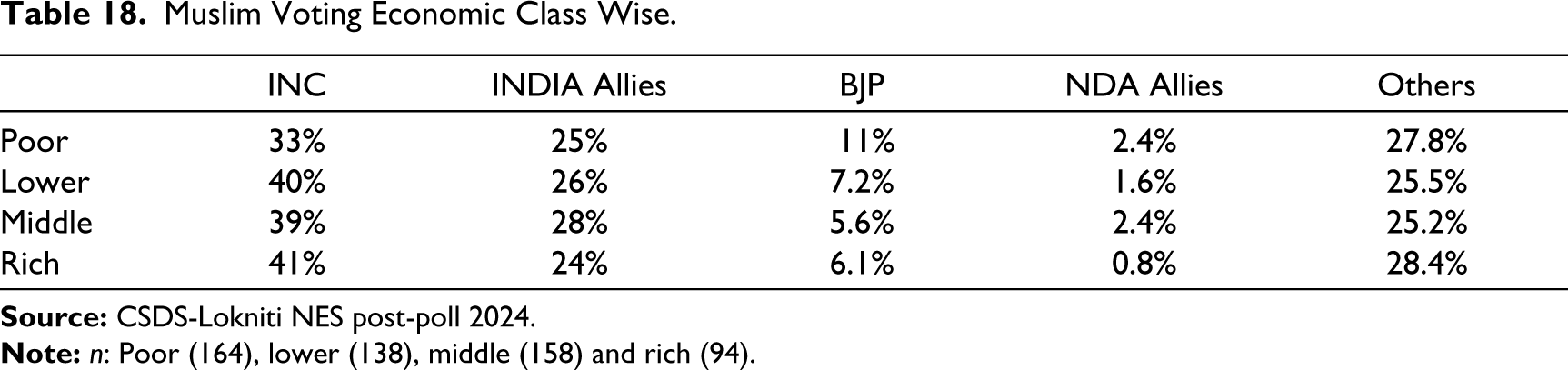
This analysis by economic class indicates a clear pattern. The welfare schemes introduced by the BJP regime to reach out to the poor and marginalized section of society somehow worked in favour of the party. Despite being rejected by the majority of Muslim voters, the BJP was able to secure the vote of poor Muslims. These Muslims, it seems, behaved like other Labharthis (beneficiaries) of welfare schemes (Ahmed, 2024). The changing attitude of the rich and elite Muslims is also understandable. These groups always remain open to political bargains. This caste-class dynamics among Muslims requires a careful and systematic analysis. We cannot make any conclusive observation in this case based on existing data.
Conclusion
The two parts of this article—the one dealing with the perception of Muslims by others (and by themselves) and the second one scrutinizing their voting pattern—are like the two sides of the same coin. While the survey analysed in the first part offers a rather complex landscape, the dominant feature lies in a rather pervasive islamophobia, culminating in the idea that Indian Muslims are a ‘pampered’ community. This popular impression is shared by a large proportion of Hindus across castes and even regions although Muslims are increasingly affected by discriminatory official attitudes of the state—something Muslims are well aware of. As a result, they feel increasingly insecure in their own country, a feeling that our survey measures for the first time in recent years. This state of things largely explains their voting behaviour, the ruling party being their last choice in most of the states. As a result, paradoxically, BJP’s polarization strategy has resulted in counter-polarization, with Muslim voters supporting massively the opposition in key states where they represent a substantial fraction of the population.
This analysis, precisely, needs to be complexified by studying both the (self-)perception dimension and the Muslims’ voting pattern at the state level—the states being, in 2024 more than in 2019 and 2014 the most relevant geographical units of analysis for understanding electoral behaviour. For differentiating (self-)perceptions, meta-regions like ‘the South’ or ‘the Hindi belt’ are an equally pertinent level. By contrast, the caste variable does not systematically retain a strong explanatory power. On the one hand, Hindu elite groups and Dalits often share similar perceptions of the Muslims and the Pasmanda’ voting pattern do not significantly differ from the Ashrafs’—as if communal identities tended to transcend caste distinctions in this regard.
This communalization process, however, needs to be qualified because a large majority of the respondents to the surveys under review are prepared to rely on non-coreligionist leaders for defending their interests. Another recomforting conclusion one can draw from the nuanced picture of Muslim electoral behaviour that we have presented clearly underlines the fact that Muslim communities do have a tremendous faith in the democratic processes. Although Muslim identity has been completely demonized in the last few years and there were very few Muslim candidates in constituencies they could win, Muslim voters have not moved away from politics. At the same time, they have also disproved the allegation that religious and/or communal concerns are motivational factors for them. In fact, Muslim communities have successfully demonstrated that a positive politics of secularism in the electoral arena is still possible.
Footnotes
Declaration of Conflicting of Interests
The authors declared no potential conflicts of interest with respect to the research, authorship and/or publication of this article.
Funding
The authors received no financial support for the research, authorship and/or publication of this article.