




Abstract
This study investigates how reciprocity works in a simple trust game when the subjects are framed as either lucky or unlucky. We induce luckiness perception to the second mover by introducing uncertainty with a different combination of possible multipliers, allowing us to observe the effect of outcome bias on trustworthiness while controlling for the wealth effect. We do not find a significantly different level of trustworthiness between lucky second movers and unlucky second movers. The result suggests the null effect of outcome bias on reciprocal behaviour.
Introduction
Reciprocity has been discussed extensively in experimental studies of two-person exchange with an initial endowment, popularly known as a trust game 1 (Berg et al., 1995). Reciprocal behaviour is captured in the second mover’s response to achieve joint benefit with the first mover, who made a costly decision for the second mover with a certain expectation. As an act of showing gratitude, reciprocal behaviour is based on the other’s intention of acting in either kind or unkind way. However, when evaluating intentions in an uncertain environment, the outcome may cause good (or bad) intentions not to be received as they were intended. Thus, some people suffer from outcome bias, a phenomenon by which the evaluators judge other’s decision by considering irrelevant information that was not known when the decision was made (Baron & Hershey, 1988). People perceive themselves lucky if they get the more favourable outcome of an uncertain event and unlucky if they get the less favourable outcome. Due to the outcome bias, such luckiness perception may lead individuals to translate the intention to different reciprocal responses.
Some observational and experimental studies have documented the evidence that luckiness perception influences pro-social behaviour. Based on survey data, the belief regarding the self- and exogenous-determination of income is found to be an important factor of redistribution preference (Fong, 2001; Isaksson & Lindskog, 2009). People who believe that poverty is caused by circumstances beyond individual control tend to support redistribution to the poor. Furthermore, Cherry (2001) and Tsang (2006) conducted modified dictator games, and their result suggests that the allocated nature of endowment affects individual other-regarding behaviour. Cherry (2001) shows a significant difference in the amount of donation between subjects whose endowment is granted by luck and subjects whose endowment is earned, while Tsang (2006) found that subjects who receive an endowment from other player exhibit higher donation and higher gratitude than subjects who gained from chance, indirectly suggesting that intention matters more than luck. These papers highlighted the effect of perception about the uncertain natural outcome on one-way generosity; however, the discussion on whether it affects reciprocal interaction, which involves intention evaluation, is under explored.
This study attempts to investigate how reciprocity works in a risky setting and check whether outcome bias affects trustworthiness. Our main research question is to ask whether lucky individuals and unlucky individuals exhibit different reciprocal responses in the absence of the wealth effect. To achieve the objective, we conducted a modified experiment of the trust game, played by a pair of subjects sharing an endowment subsequently. The modification involves a framing, generated from a coin toss, that induces different luck perceptions across treatments while maintaining the same allocation multiplier to control for wealth effect. We also control the wealth effect coming variation of the sender’s allocation by exploiting the strategy method (as opposed to the direct-response method). The result shows no significant different reciprocal decisions between lucky ones and unlucky ones, regardless of the amount of endowment received by the receivers. We could not find strong evidence that outcome bias significantly affects reciprocal behaviour with respect to the level of trust.
The present study contributes to testing the generalizability of studies on reciprocity subject to the outcome bias issue and provides an idea of how the perception of the outcome of uncertainty plays a role in intention evaluation. Many studies on reciprocity focused on showing how intention matters by testing the relevance of the sender’s intentionality (e.g., Falk et al., 2008; McCabe et al., 2003) or by testing the relevance of the alternative actions available to the sender (e.g., Andreoni et al., 2002; Falk et al., 2003). Other study tests its consistency when facing plausible deniability (Van der Weele et al., 2014). However, they did not pay attention to the robustness of reciprocity when the receiver’s perception of the intention is disrupted, especially in a risky environment. One could worry intentions with the identical outcome may elicit different reciprocating responses depending on how the risky outcomes are perceived, and this study investigates such a possibility.
Dufwenberg et al. (2001) were the first to explore the introduction of risk to the trust game by varying the value of multiplier varies across subjects. They found trust decreased insignificantly, suggesting evidence of ‘hiding of greed’ by senders, yet no difference in trustworthiness across treatments. Clots-Figueras et al. (2016) modified the game by revealing the outcome of the uncertain multiplier only to the receiver. The authors found that trust and trustworthiness remained unchanged with the introduction of risk and ambiguity. These studies reported subjects’ responses with the introduction of uncertainty but did not incorporate the individual’s perception of the uncertainty (i.e., lucky or unlucky) which affect subject behaviour. Their design did not allow for a clear comparison between lucky and unlucky due to confounding wealth effect (subjects who obtained high multiplier had a higher endowment to those who obtained low multipliers). To address this, we compare the response of individuals who face an identical outcome of uncertainty in different uncertainty framing while still maintaining constant welfare.
Furthermore, our study contributes to the literature on the role of outcome bias in reward and punishment. The closest to our study is the ‘trembling hand’ experiment, a modification of the trust game by Cushman et al. (2009). The findings indicate that when individuals have partial control over risky events, their responses are influenced by an outcome bias. In particular, people tend to penalize ‘unlucky’ selfish distributions of resources in such situations. Murata et al. (2015) extend the experiment by adding conditions when the risky event could not be chosen intentionally; however, they found similar evidence as Cushman et al. (2009). The outcome bias was observed even when the first players exhibited fair or generous intentions. The outcome of uncertainty in these studies came from a risk chosen by another person, allowing subjects to put the blame on him/her. As we focus on brute luck, the uncertainty used in our study is independent of others’ choices. 2 It permits us to observe the effect of one’s own pure luck.
The present study also builds on the growing literature discussing how people behave towards others who made a decision in an uncertain event. In a principal–agent experiment, de Oliveira et al. (2017) found that principles do not significantly reward others’ good luck but punish bad luck with reduced bonus. Other studies found that people find it fair to equalize earnings between lucky and unlucky agents but care less about the inequality between risk-takers and non-risk-takers (Cappelen et al., 2013; Mollerstrom et al., 2015). While these studies documented how people judge/compensate others luckiness, our study focuses on how people behave towards others regarding their luckiness.
Concern about uncertainty in intention evaluation is commonly shared in the discussion about compensation schemes and profit sharing. Leone et al. (2006), using stock return data, reported that the Chief Executive Officer (CEO) cash compensation is more sensitive to bad luck than good luck. Meanwhile, Garvey and Milbourn (2006), removing the effect of market or sector performance, found that executives are rewarded for good luck but not penalized for bad luck. While the present study does not claim to fully represent these cases or any case in particular, it gives an essential idea of how intention is evaluated in an uncertain environment. Understanding evaluation on intention is arguably critical as it is the key feature to ensure the continuity of cooperation (Fonagy et al., 2008) and to enforce large efficiency gains (Fehr et al., 1997).
Methodology
Experimental Design
The experiment is based on the trust game designed by Berg et al. (1995). We modify the standard game so that subjects in different treatments face uncertainty with different luck perceptions. We also simplify the sender decision into discrete donation options as in Van der Weele et al. (2014). The game is played as follows. Players A and B are randomly partnered to play a one-shot game. Player A is given 10 tokens and is asked to transfer 0, 3, 5, 7 or 10 to Player B. These values represent the level of trust: no trust, low, medium, high and absolute trust.
The allocation sent by Player A is then multiplied by a multiplier. The multiplier can take between two possible values with equal probability, varying across treatments. The experimenter determines the actual value of the multiplier by a coin toss. When players make their decisions, the different values that the multiplier can take are known to both players, but the actual value of the multiplier is only communicated to Player B.
Player B receives Player A’s allocation times the actual multiplier. Player B then decides how much amount he/she is willing to send back to Player A. The amount can be any integer between 0 and the amount Player B has. The game ends after Player B makes the decision.
We implement two treatment conditions, as shown in Table 1. In the lucky treatment, the multiplier is either 1 or 3, while in the unlucky treatment, it is either 3 or 5. As this study will focus only on the subjects who receive the main multiplier 3, the alternative multiplier is introduced to make a different perception of their luckiness. Specifically, in the lucky treatment, we induce Player B to feel lucky when he/she gets multiplier 3 because it is more favourable than its alternative, multiplier 1. In the unlucky treatment, we induce Player B to feel unlucky when he/she gets multiplier 3 because it is less favourable than its alternative, multiplier 5. The forms used in this experiment were designed such that both players can learn and compare the possible values of a multiplier (see Supplementary Materials).
The Treatment Classification.
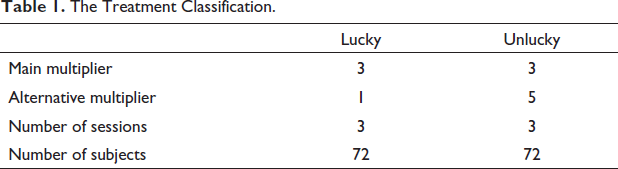
The analysis in this study relates to Player Bs’ reciprocal behaviour, measured by the amount sent back to Player A. Furthermore, we only look at the behaviour of those who get the main multiplier 3, allowing us to control for the wealth effect due to the outcome of uncertainty. To answer the research question, we compare the reciprocity between Player Bs in lucky treatment and Player Bs in the unlucky treatment.
We elicit player Bs’ decision using the strategy method. More specifically, Player Bs are asked to specify his allocation for each possible decision of Player A, excluding the case when Player A decides not to transfer anything. We, therefore, obtain four observations from each Player B: the amount Player B is willing to transfer for four potential positive allocations by Player A, which are 3, 5, 7 and 10 tokens.
This method allows us to obtain a sufficiently large and balanced number of observations of Player B. More importantly, it is used to disentangle the wealth effect coming from Player A’s allocation which then becomes Player B’s endowment. If the direct-response method is used, each Player B would have made a single decision depending on the actual choice of Player A which may vary across treatments. We cannot rule out the possibility that the strategy method may dampen subjects’ emotion and thus bias our findings. However, Brandts and Charness (2011) suggested in a meta-study that the likelihood of this is small.
Experimental earnings are determined on the basis of the strategic decisions of Player B together with the actual decision of Player A. At the end of the experiment, two pairs of Player A and Player B are chosen randomly to convert the experimental token into real money that is paid in cash privately. 3 One token is worth 5.000 IDR. Subjects are asked not to talk to other participants during the experiment but are encouraged to raise questions to the experiment leader if anything is unclear. For complete translated instructions, see Supplementary Materials.
Before the experiment ends, subjects are asked to fill in a questionnaire, which contains personal information about age, gender, studies, grades, family origin, etc. (see Supplementary Materials). Questions about personal luck adopted from the Personal Luck Usage Scale (Wohl et al., 2011) are also included to check whether the framing design works, that is, subjects feel lucky/unlucky as expected in the design. It also enables us to study the extent to which the treatment effect is mediated by luckiness feeling.
One may be concerned about the ‘wiggle room’ exploitation behind uncertainty as found in dictator games (Dana et al., 2007) and the trust game (Dufwenberg et al., 2001). We, therefore, let Player Bs learn the multiplier as in Clots-Figueras et al. (2016) to avoid hiding greedy motivation. Even if they have an excuse for not reciprocating due to the uncertainty, Van der Weele et al. (2014) have documented that the availability excuse has no effect on reciprocal behaviour in the trust game. The information about the sequence of the game is also set to be commonly known to avoid strategic motivation, as reported by Stanca et al. (2009).
Hypothesis/Prediction
Let 

As the game is played sequentially, we can use backward induction to theoretically analyse their decision. With an assumption that both players are rational and selfish, Player B’s optimal decision to return nothing
However, earlier experimental studies present evidence that is far from the game theory prediction; the average amounts sent range from 40% to 60% of the initial endowment, and the average amounts returned range from 30% to 40% (Camerer, 2003). Such a result has been replicated numerous times and found to be robust across cultures (Johnson & Mislin, 2011a). Furthermore, if the first and second stages of the trust game are played separately and independently, the player’s decision-making resembles the dictator game. Positive offer is also typically observed in this game due to non-selfish preferences such as those proposed by Fehr and Schmidt (1999) and Bolton and Ockenfels (2000).
If other-regarding preferences are considered, game theory predicts different equilibrium in which positive amounts are sent and returned. At some point, giving to others gains utility to the players and keeping all the endowment is no longer the dominant strategy. For instance, assuming people are (extremely) inequity averse, the subgame perfect equilibrium is the sender sends half of the endowment and the receiver returned a third of the tokens he/she has so both receive the same payoff (10, 10). If efficiency is considered, then the sender must allocate all the endowments and then the receiver splits his/her endowment equally (15, 15).
All the above models emphasize how relative individual relative position affects their pro-social behaviour. Another prominent model focuses on the role of intention in achieving a cooperative outcome, commonly known as the trust–reciprocity relationship (McCabe et al., 2003). The fact that the game is played sequentially by Player A and then Player B allows conditional cooperation to play a role. And if subjects’ preferences are characterized by concerns for reciprocity, in all treatments, the response of players B should depend positively on the amount sent by Player A. More specifically, Player B is willing to share a positive amount of
Both the inequity-aversion and reciprocity models emphasize a consequential perspective on distributive fairness; however, they principally neglect the fact that preferences regarding how these outcomes are reached may also affect an individual’s decision on non-selfish behaviour. Research in social psychology suggests us to expect that when individuals evaluate the decision (intention) of others, they sometimes fall into weighing a piece of information that was irrelevant to a decision when it was made, a phenomenon generally called outcome bias. When both players make a decision, only Player Bs know the value of the multiplier. They may take it as a consideration when they evaluate Player A’s decision despite it was irrelevant.
An outcome bias would cause Player B to evaluate Player A’s Intention favourably when they are lucky and evaluate them poorly when they are unlucky. If the preference for the outcome can translate to differences in non-selfish allocation, then we expect that Player As are rewarded differently between treatments. Recall that we only focus on the decision of Player Bs who obtain multiplier 3. We predict that they will allocate more to Player A when they are in lucky treatment (their multiplier is more favourable than the alternative multiplier, 1), than when they are in unlucky treatment (their multiplier is more favourable than the alternative multiplier, 5). In this regard, we formalize the following hypothesis:
H0 : Player B does not exhibit higher repayment in the lucky treatment than in the unlucky treatment.
HA : Player B exhibits higher repayment in the lucky treatment than in the unlucky treatment.
Results
The experiment was conducted at the Faculty of Economics and Business, Universitas Indonesia. A total of 144 subjects participated in the experiment, divided into six sessions. 4 Seventy-two subjects were in the lucky treatment and the same number of subjects in the unlucky treatment. The average payoff was approximately 6.3 USD. 5 The experiment lasted 35 minutes on average. The translation of the instructions and the forms are provided in Supplementary Materials.
Experiment Result
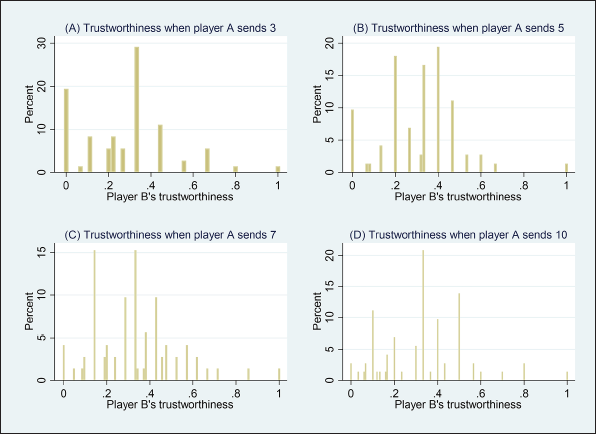
In Figures 1 and 2, we present the distribution subjects’ responses in the experiment, irrespective of the treatments. The evidence reported is in line with earlier studies in which subjects’ decisions are firmly against the way standard rational game theory predicts the subgame perfect equilibrium. Instead of sharing nothing, Player As sent a positive amount which was then repaid positively by Player Bs. It emphasizes the possibility that both players have a social preference that overrules selfish motives such as a concern for fairness, trust and reciprocity as has been consistently found in previous trust game experiments.
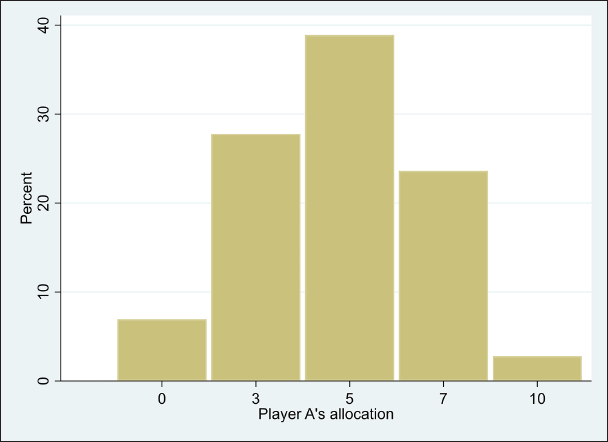
Data of Player A’s allocation shown in Figure 1 form a normal distribution, dominated mainly by the 5–5 equal allocation. Except five individuals who send zero tokens, the majority are willing to allocate some tokens, showing the trust their pair with a certain expectation. While in contrast to rational-selfish behaviour, such a positive trust is commonly found in the literature of the trust game.
In Figure 2, we present the distribution of trustworthiness of Player B’s across different potential endowments received from Player A. The trustworthiness is defined as the ratio of the amount sent back to the amount received by Player B. As depicted in Panel A, when Player A sends 3 tokens, the distribution of trustworthiness skews to the left with more than half of the subjects repay less than half of endowment and almost 20% of Player Bs repay nothing. Along with the increase of Player A’s allocation, as depicted in Panels B, C and D, the distribution becomes less skewed. This may indicate a reciprocal response, showing a fair gratitude after being trusted with a certain costly donation.
The focus of this study relates to Player B’s decision, but first we would like to comment briefly on Player A’s decision. In the lucky treatment, the average of actual Player A’s allocation, representing trust, was 4.75 (
In Table 2, we report the descriptive statistics of Player B’s trustworthiness across treatments. Recall that as we used the strategy method, we recorded Player Bs’ decision for four possible Player As’ action, which is presented in columns. Panel A, our main focus, shows the response of 44 Player Bs whose multiplier is 3. By comparing the reciprocal response from players with the same multiplier in different treatments, we observe only the luck effect and omit the wealth effect.
Trustworthiness Across Treatments.
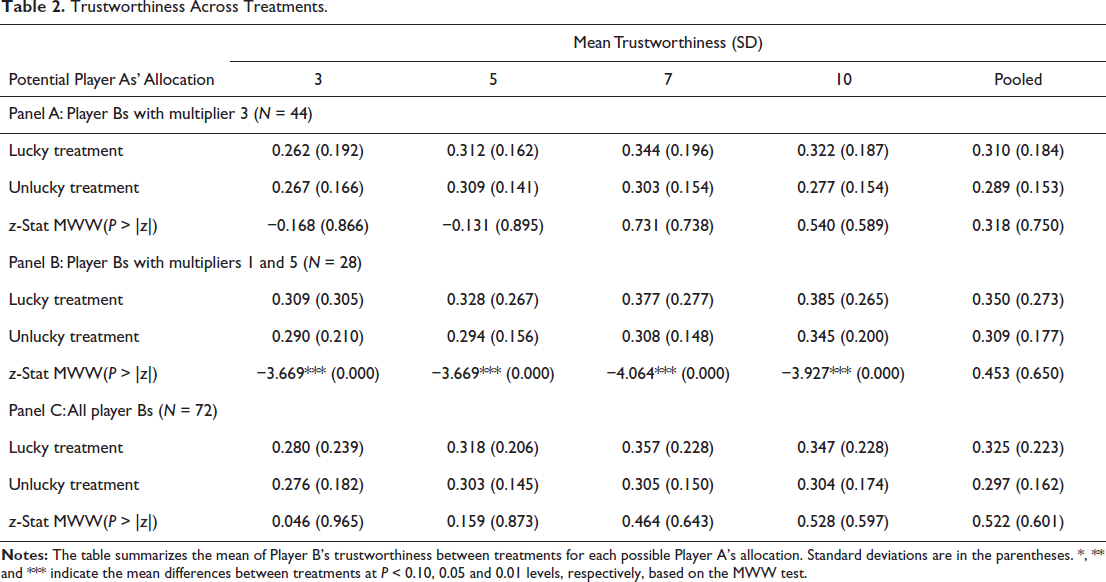
In all potential Player As’ allocation, we found no difference in Player Bs’ trustworthiness across treatments, suggesting no luck effect in place. Using the MWW test, we cannot reject the null hypothesis that there is no difference between treatments for each group of player As’ allocation (for 3 tokens,
In Panel B, we report the response of 28 Player Bs whose multiplier is either 1 if they are in unlucky treatment or 5 if they are in lucky treatment. The difference of trustworthiness between treatments shows both the wealth effect and the luck effect. From the result in each response to Player As’ potential allocation, we found that Player Bs in lucky treatment exhibit a higher level of trustworthiness compared to Player Bs in unlucky treatment. The differences are significant under the MWW test at a 5% significance level. This confirms that there is indeed a wealth effect, which also signifies the need to eliminate such an effect as demonstrated in Panel A. Panel C reports the result for all subjects regardless of the multiplier. It shows no difference in trustworthiness across treatments.
Furthermore, one may argue that Player Bs in each treatment have a different expectation about the amount that Player As send. Such expectations may build social norms which influence their decision. For instance, Player Bs in the unlucky treatment may set higher expectations if they think that Player As are supposed to allocate many tokens because the higher possible multipliers (3 and 5) can translate to a higher return. However, this is not the case. In the questionnaire, we asked Player Bs how much they expect Player A to share his/her token and we found no difference between treatments (MWW,
Regression Result
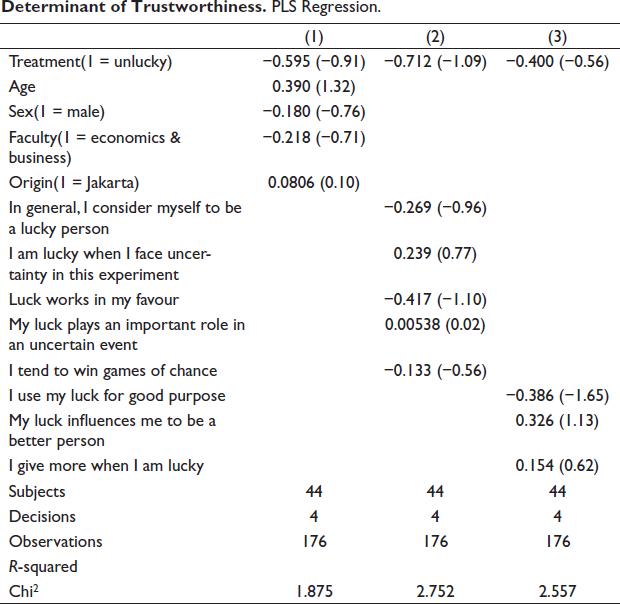
To ensure the robustness of the non-parametric analysis, we examine the determinant of trustworthiness. As the strategy method allows us to have panel data containing four observations for each Player B, we use random-effect regression shown in Table 3. The dependent variable is the trustworthiness (the amount sent back by Player B to Player A), and its coefficient represents the average trustworthiness of Player B in the lucky treatment. We present the marginal effect for several variables with standard error in parenthesis. In addition to the treatment variable, we include demographic variables in the first column and questionnaire variables in the other two columns. A similar result with the same direction is also obtained using pooled least square regression (see the Appendix). Fixed-effect regression is not utilized because most of the variables are individual invariants.
Determinants of Trustworthiness. Random Effect Regression.
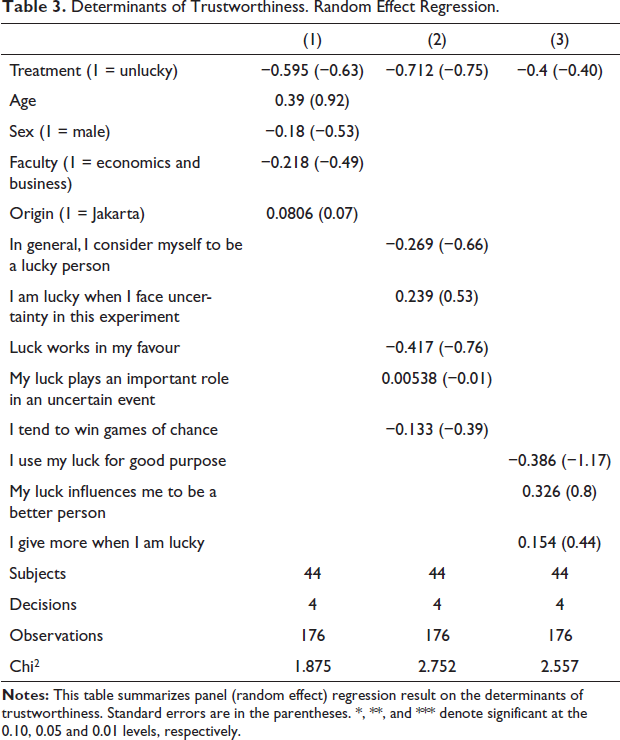
Examining the result, we see that the coefficients of the treatment variable in all columns are negative but not statistically significant. Given the coefficients are negative, we have evidence showing that unlucky subjects exhibit lower reciprocal responses; however, we again cannot confirm the hypothesis that Player Bs in the unlucky treatment tend to have lower trustworthiness because it is statistically not significant.
The results shown in Tables 2 and 3 capture an additional preference in response to the introduction of luckiness perception which makes them modify their behaviour within a certain, narrow range. Subjects in the lucky treatment favour their partner’s allocation more than subjects in the unlucky treatment do, causing them to repay differently despite that they are evaluating the same allocation. Such difference occurs only when they receive 7 or 10 tokens from Player A but is absent in the case of 3 or 5 tokens, suggesting that outcome bias affects lucky individuals to reciprocate higher only when a sufficient level of trust is invested. A convenient reason to support such a suggestion is that when low trust is invested, subjects do not really care about the outcome of uncertainty as the multiplier affects their endowment insignificantly. On the contrary, when trust is highly invested, the multiplier enlarges the gap between endowments which induces preference favouring one of the outcomes of uncertainty.
While it is tempting to conclude that the result of our experiment casts doubts on the claim that intention matters more than outcome as suggested in previous trust game experiments, we cannot strongly claim that our alternative hypothesis is true because no significant difference is found in the statistical test. This result points to the indication that the reciprocity motive overrules or at least weakens the effect of outcome bias.
Questionnaire Result
To ensure whether our design properly induces luckiness perception, we elicit the subjects’ personal luckiness scale through the questionnaire. In Table 4, we provide the descriptive statistics of the luckiness scale of 44 people who are the main subjects of our analysis. As predicted, in all questions about luckiness, subjects in the lucky treatment exhibited a larger scale than subjects in the unlucky did. However, we conducted a non-parametric (WWM) test and found that all these differences are not statistically significant (q1,
Luckiness Scale.
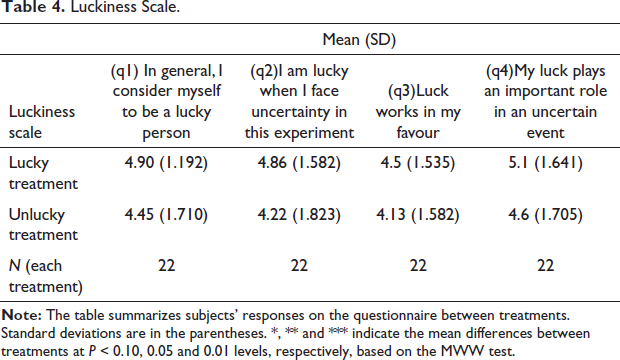
Furthermore, we asked subjects to explain why they gave some tokens as specified in their form. While most of them respond how they decide to depend on Player A’s action, only two subjects comment on the multiplier they got from the coin flip. On the one hand, it shows that the design barely suffered from the demand effect (subjects behave what they think the experimenter expects them to behave), but on the other hand, it may point to the weak salience of the luckiness induction from the random multiplier drawing. We are afraid that the weak salience possibly causes a non-significant treatment effect as reported in the earlier subsection.
Conclusion
In this study, we present an experiment designed to identify how people exhibit reciprocal behaviour in different manipulated luckiness conditions while controlling for the wealth effect. On the one hand, the sender seemed to have responded similarly to both kinds of treatments, and on the other hand, the receiver exhibited different reciprocal responses, but the difference is not statistically significant. The result suggests no luck effect across different endowments. The fact that the luckiness scale observed between treatments is not significantly different possibly causes this finding. This study establishes the ground for research about luckiness perception and reciprocal behaviour. A call for more research seems warranted, particularly aimed at investigating what psychological drive plays roles in mediating luckiness feeling and reciprocity. Future research can also focus on bringing real context to the experiment as many daily interactions involve intention evaluation in an uncertain environment.
We acknowledge some limitations in our study and provide some suggestions that can be done to improve the experiment if it were ever replicated. First, we did not use the double-blind mechanism as it was introduced by Berg et al. (1995). The experiment was conducted using papers, and the transfers among players were done via the experimenter. Although anonymity and privacy in our experiment were firmly kept, we cannot rule out the possibility that subjects may observe others’ behaviour and cause them to behave differently. One feels ashamed if one does not properly reciprocate a favour. Such a feeling can drive them to focus too much on finding or thinking about the social norm on how to return a favour and thus pay less attention to their own luck. Computer-based experiments can be considered for improvement.
Second, future experiments should consider better techniques to induce a more salient perception of luckiness. One could improve this by using the strategy decision of Player B for each possible multiplier. This method will force them to think about both lucky and unlucky conditions when they make the decisions, although one may need to be more careful as it also opens the possibility to the experimenter demand effect.
Furthermore, future research could modify the design such that it allows more data collection on Player B’s decision (notice that Player A’s data are not necessarily needed). A possible way is to distinguish the session between Player A and Player B and use multiple matching methods. Once Player A’s decisions are obtained, they can be matched with several Player Bs in other sessions. One can also consider using non-balanced random draw which favours the outcome of the main multiplier. For example, using dice, you can assign the probability of 4/6 to get the main multiplier and 2/6 to get the alternative multiplier. Although it possibly generates a different level of luckiness feeling, it does not eliminate its research essence as the risk aspect is still involved.
Appendix
Determinant of Trustworthiness. PLS Regression.
Footnotes
Acknowledgement
I am thankful for the support on the experiment arrangement and valuable comments by Alin Halimatussadiah and Chaikal Nuryakin. Outstanding research assistance was provided by Abraham and Raka.
Declaration of Conflicting Interests
The author declared no potential conflicts of interest with respect to the research, authorship and/or publication of this article.
Funding
I am thankful for the funding support by the Indonesia Endowment Funds for Education (LPDP) with award number 0001795/ECO/D/2/lpdp2022.
