




Abstract
Aim:
The aim of this study was to evaluate the effect of additional finishing and polishing sequences on a new structural colored (Omnichroma) and a conventional dental composite (Estelite Sigma Quick).
Materials and Method:
Forty disk-shaped dental composite specimens were prepared from each dental composite and assigned to four groups in terms of additional finishing polishing sequences. Group 1: Mylar strip (control). Group 2: Abrasive disks. Group 3: After abrasive disks, application of a felt brush with abrasive paste. Group 4: After abrasive disks, application of a felt brush with abrasive paste. Then, a single-bottle adhesive was applied as a surface sealer. Hardness and surface roughness were measured using the Vickers hardness test and a profilometer, respectively. SEM images of one of each group were captured at 500x, 1500x, and 3500x magnifications. Two-way analysis of variance, Tukey HSD, and Shapiro–Wilk tests were used for the statistical analysis.
Results:
Mean hardness values differ in terms of finishing-polishing sequences (P < .001), dental composites (P < .001), and interaction of finishing-polishing sequences-dental composites (P < .001). Mean roughness values differ in terms of finishing-polishing (P = .002). The main effect of composites on roughness values was not found statistically significant (P = .990). Also, there is no difference between the mean roughness values in terms of the interactions of finishing-polishing and composites (P = .967).
Conclusion:
Finishing-polishing with abrasive disks and abrasive paste are important steps for these dental composites. However, the application of a single-bottle adhesive as a surface sealant on these composites decreases the hardness of the materials.
Keywords
Introduction
Finishing and polishing are indispensable to improve restoration margins, obtain a smooth surface, and produce perfect contours. 1 A restorative dental material must be stable over time in terms of color and surface texture to obtain ideal esthetics. 2 There are a lot of different finishing and polishing sequences for different types of dental composite restorative materials to produce a perfect surface characteristic. Size and location of the restoration and characteristics of the restorative material may affect the instrument choice. 3 Abrasive disks, polishing pastes, stones, abrasive strips, carbide and diamond burs, abrasive impregnated rubber cups and points may be chosen for an effective finishing and polishing process.3, 4
For an ideal finishing and polishing technique, it is important to provide a proper anatomy of the restoration with smooth surface and light reflection. The restoration should have the brightness and the texture of the enamel. These are related with the surface roughness of the materials. 5 On the other hand microhardness and flexural strength are important mechanical properties of dental materials to predict their longevity and resistance to masticatory forces. 5 Microhardness has a relationship with depth of cure of the dental material. As the microhardness of the material decreases, it becomes more prone to form surface defects and grooves, which lowers the resistance of the material. 6
Resin composites are widely used dental restorative materials because of their improved esthetical, mechanical, and physical properties. 7 Because of several internal and external factors, it is difficult to match the color of the dental composite with the surrounding tooth.8, 9 Thus to solve this problem universal shade or one shaded dental composites have been produced. These materials can provide color matching ability to decrease the treatment length and technique sensitivity. 10 One of the most remarkable material of this category is Omnichroma (OMN, Tokuyama Dental, Tokyo, Japan), which is known for its structural color property. 11 Although there are several studies about the color matching ability of OMN;10–13 there is no data about the effect of finishing and polishing on this new material. To predict its longevity and clinical performance it is especially important to know the difference of its hardness and surface roughness after different finishing and polishing sequences because of the changes in its formulation in terms of one shade concept and structural color phenomenon. Thus, this study aimed to compare the effect of additional finishing and polishing sequences on OMN and a conventional dental composite. The null hypothesis tested was that additional finishing and polishing sequences do not affect the microhardness and surface roughness of dental composites.
Materials and Methods
Setting and Design
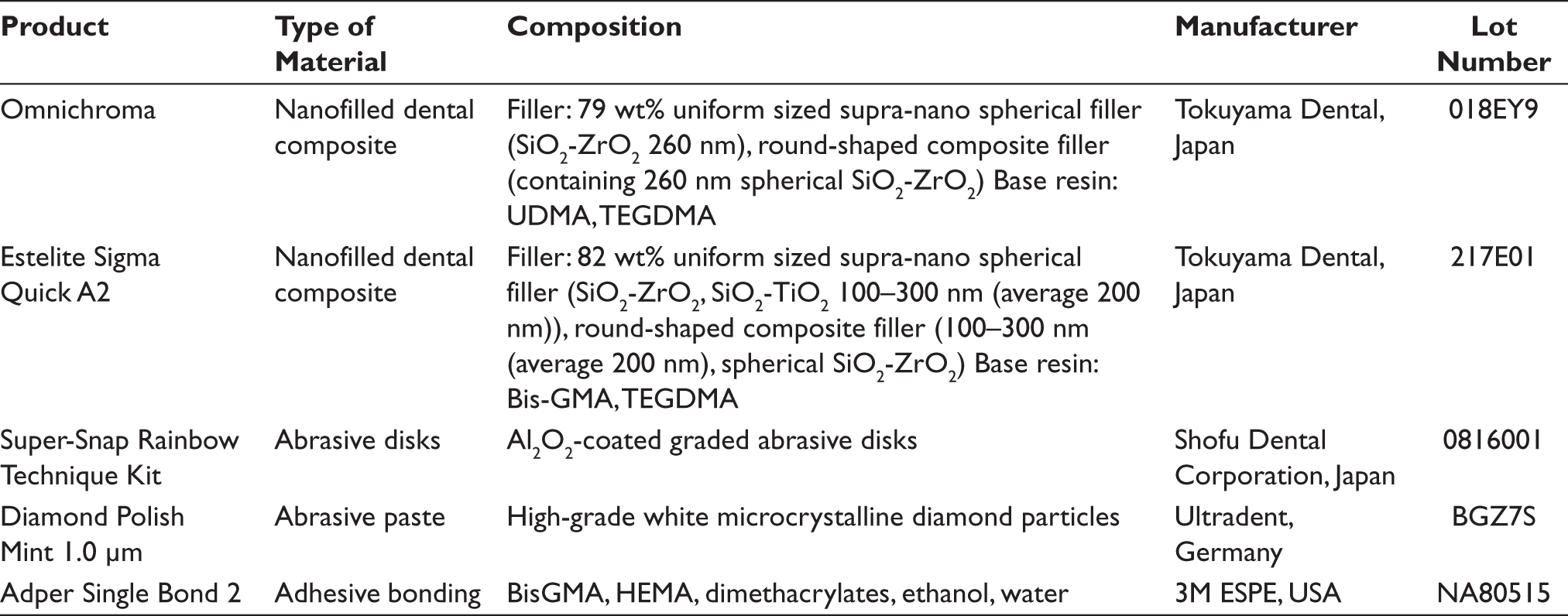
This in vitro study was conducted from September 2021 to December 2021 at Faculty of Dentistry, Karadeniz Technical University, Trabzon. OMN (Tokuyama Dental, Tokyo, Japan) and a conventional dental composite (Estelite Sigma Quick [ESQ], Tokuyama Dental, Tokyo, Japan) were used in this study. The detailed descriptions of the materials used were presented in Table 1. The sample size was calculated at 80% power and a 0.05 error level. A total of 40 specimens were prepared for each composite.
The Materials Used in the Study
Specimen Preparation
A Teflon mold (diameter: 8 mm, height: 2 mm) was used to produce composite specimens. First, the mold was mounted on a glass plate and a Mylar strip. The mold was filled with a layer of dental composite. The upper side of the mold was covered with a second Mylar strip and glass plate. After being ensure of consistent packing of the composite, the glass plate was removed. The specimens were only polymerized from the top surface using LED curing unit (Elipar S10, 3M ESPE; USA) with an output ≥800 mW/cm 2 for 20 seconds. The light curing tip was kept centered and in contact with the second Mylar strip. The top surfaces of the specimens were identified with an indelible mark. The specimens with defects or cracks were not used. In total, 40 specimens from each dental composite were divided into 4 subgroups (n = 10) in terms of surface treatments randomly.
Group 1: Only Mylar strip (Control).
Group 2: Specimens were finished and polished with abrasive disks (Super-Snap Rainbow Technique Kit, Shofu Dental Corporation, Japan) with coarse, medium, fine, and superfine grits sequentially.
Group 3: Specimens were finished and polished with abrasive disks (Super-Snap Rainbow Technique Kit, Shofu Dental Corporation, Japan) with coarse, medium, fine, and superfine grits sequentially. Then the surfaces were polished with a felt brush with abrasive paste (Diamond Polish Mint 1.0 µm, Ultradent, Germany).
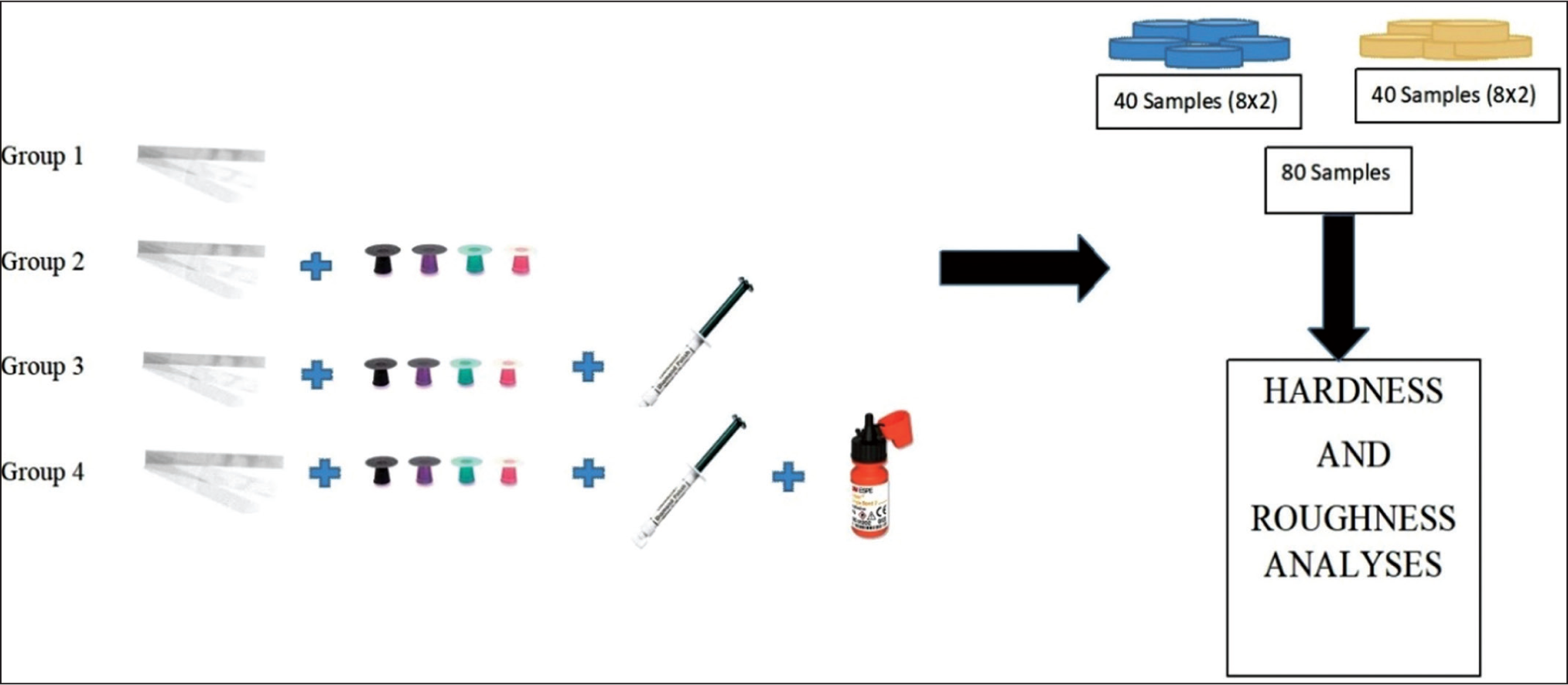
Group 4: Specimens were finished and polished with abrasive disks (Super-Snap Rainbow Technique Kit, Shofu Dental Corporation, Japan) with coarse, medium, fine, and superfine grits sequentially. The surfaces were polished with a felt brush with abrasive paste (Diamond Polish Mint 1.0 µm, Ultradent, Germany). After etching the specimens 15 seconds by orthophosphoric acid, they were coated by Adper Single Bond 2 (3M ESPE, USA). This layer was air thinned and polymerized for 20 seconds with a LED curing unit (Elipar S10, 3M ESPE; USA) with an output ≥800 mW/cm 2 . The study protocol was presented in Figure 1.
The Schematic Representation of the Study Groups
The specimens were all finished and polished in the same direction parallel to the surface. To avoid operator variability all procedures were performed for a fixed period of time (60 seconds) 14 by the same operator. Disks used once were discarded. After each polishing steps, all the specimens were thoroughly rinsed with water and air-dried before next step. Specimens were stored at 37°C in 100% humidity for 24 h prior the tests.
Surface Microhardness Measurements
The Vickers hardness (VHN) was evaluated using Struers Duramin 5 microhardness tester (Struers A/S, Ballerup, Denmark). Three indentations were made on the surface of under a 198 g load with a 10 s dwell time. 15 The mean hardness values were calculated.
Surface Roughness Measurements
The surface roughness (Ra) value was calculated using a two-dimensional profilometer (MarSurf PS 10, Czech Republic) having a diamond stylus traversing a length of 1.25 mm. Three measurements were performed from the center to different directions and the mean roughness values were calculated (Ra; µm).
Scanning Electron Microscopy (SEM) Analysis
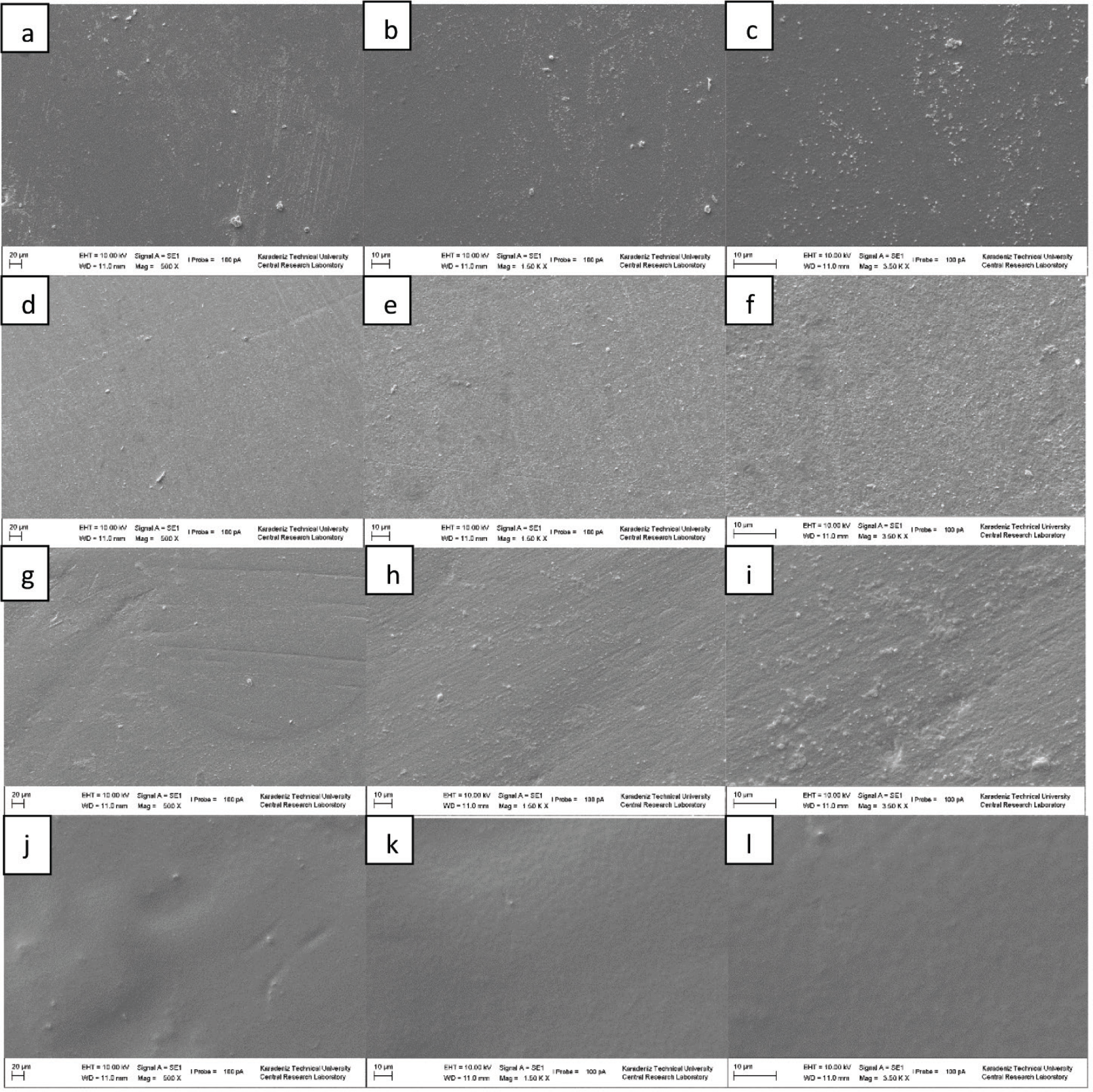
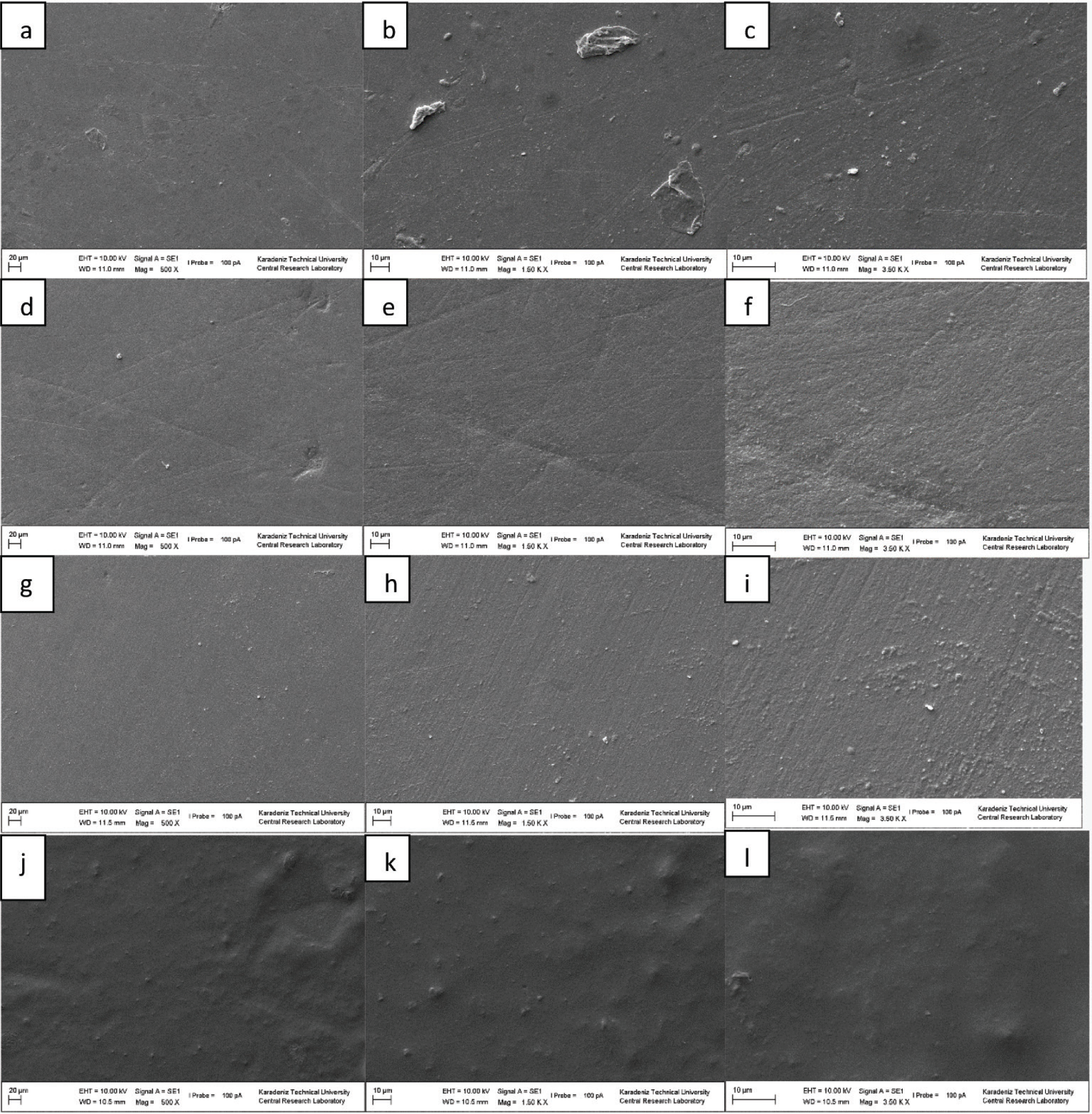
One sample from each group was chosen randomly. The samples were gold coated and evaluated under a scanning electron microscopy (SEM) (EVO LS 10, Zeiss, Germany). Three images were collected from each sample at 500x, 1500x, and 3500x magnifications (Figures 2 and 3).
Statistical Analysis
Data were analyzed with IBM SPSS V23. The conformity of hardness and roughness values to the normal distribution according to the finishing-polishing and dental composite was examined with Shapiro–Wilk test. Two-way analysis of variance was used to compare hardness and roughness according to the finishing-polishing and dental composite. Multiple comparisons were analyzed with Tukey HSD test. Results were presented as mean and standard deviation. Significance level was taken as P < .05.
Results
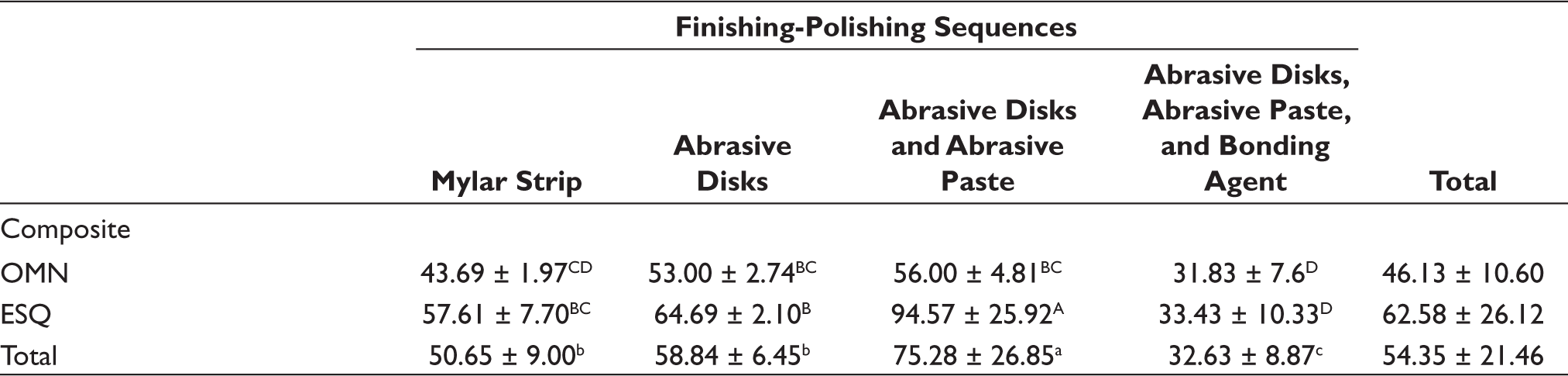
Mean hardness values differ in terms of finishing-polishing sequences (P < .001), dental composites (P < .001), and the interaction of finishing-polishing sequences-dental composites (P < .001) (Table 2). While the mean hardness value of OMN is 46.13, the mean hardness of ESQ is 62.58. Multiple comparison results were presented in Table 3.
The Comparison of Hardness Value in Terms of Dental Composites and Finishing-Polishing Sequences

The Descriptive Statistics and Multiple Comparison Results of Hardness Values in Terms of Dental Composite and Finishing-Polishing Sequences
The Comparison of Surface Roughness Values in Terms of Dental Composites and Finishing-Polishing Sequences

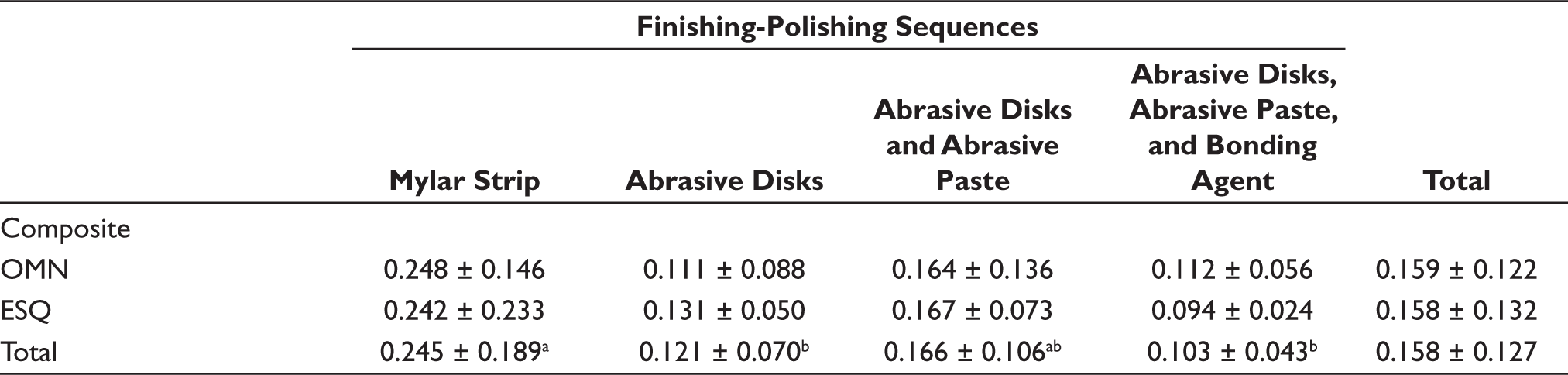
Note: R2 = %19.34; Adj. R2 = %11.49. Bold P values are statistically significant (P <.05).Mean roughness values differ in terms of finishing-polishing sequences (P = .002). The main effect of composites on roughness values was not found statistically significant (P = .990). Also, there is no difference between the mean roughness values in terms of the interactions of finishing-polishing and dental composite (P = .967) (Table 4). Descriptive statistics and multiple comparison results of roughness values in terms of composites and finishing-polishing sequences are presented in Table 5.
The Descriptive Statistics and Multiple Comparison Results of Roughness Values in Terms of Dental Composites and Finishing-Polishing Sequences
SEM Images
The SEM images of each sample were presented in Figures 2 and 3. It was confirmed that Groups 2 and 4 had the lowest surface roughness for both dental composites.
Discussion
This study aimed to investigate the effect of additional finishing and polishing sequences on hardness and surface roughness of two different dental composites. It was found that after different finishing-polishing sequences there is no significant difference between both composites in terms of surface roughness. However, hardness of the composites was affected significantly. Thus, null hypothesis was partially rejected.
To standardize specimen preparation all of the specimens were prepared using a Mylar strip. After the light application conforming to manufacturers’ instructions, 10 specimens from each group, produced with Mylar strip, were chosen randomly to use as control. This is in consistent with studies in which specimens were produced using Mylar strip and evaluated as control group.16–18 Optimal finishing and polishing may reduce biofilm accumulation, gingival inflammation, wear, staining, and improves the longevity of the restoration. 19 In this research abrasive disks, abrasive paste, and sealer application were evaluated for additional finishing and polishing sequences. To remove not only the matrix resin but also the particles on the surface, abrasive particles of the disks must be harder than dental composite. 20 Thus, aluminum oxide disks (Super Snap, Shofu, USA), which have greater hardness than the majority of particles found in the formulation of composite resins were used. The result of the finishing-polishing may be affected by the amount of time, the pressure used and the orientation of the abrading surface. 21 For this reason, the procedures were carried out by a single operator for a specific time. For standardization the composite specimens were polymerized adequately according to manufacturers’ instructions using LED curing light unit (Elipar S10, 3M ESPE; USA) with an output ≥800 mW/cm 2 .
Hardness of a dental material is an important property to compare it with other materials and tooth structure. A decrease in hardness value may affect the clinical performance, mechanical properties, and marginal integrity of the restoration adversely. 6 Hardness is affected by various material characteristics such as monomer system, dilution concentration, initiator concentration, loaded particle types, and amounts. 22 When OMN and ESQ are compared, the mean hardness values differ in terms of dental composites (Table 2). OMN is a structural colored dental composite and it has 260 nm supra-nano spherical fillers of silicon-dioxide (SiO2) and zirconium-dioxide (ZrO2). 23 Its lower hardness may depend on its organic matrix without Bis-GMA because Bis-GMA in the organic matrix provides rigid network formation and less water absorbsion. 24 Also it has lower filler weight than ESQ (Table 1). These characteristics may decrease the hardness of OMN.
For an ideal dental material it is important to achieve similar hardness to dental structures. 22 The VHN of enamel and dentin are expressed as 320 VHN and 60 VHN, respectively. 25 Also it is stated that minimum hardness value of a dental composite should be 50 VHN. 26 The mean hardness value of the control group is 43 and 57 VHN for OMN and ESQ, respectively. Finishing-polishing sequences in the Groups 2 and 3 increased the hardness of both dental composites to higher than 50 VHN except Group 4 (Table 3). This is in consistency with other studies that finishing and polishing increased the hardness of dental composites.17, 27 It is because these procedures remove the less dense superficial layer which is composed by organic matrix. Thus, more resistant underlying layer appears.28, 29 In the abrasive disks-abrasive paste group when compared with OMN, the hardness of ESQ rises to its highest value (Table 3). ESQ has RAP Technology. This technology improves the polymerization process and allows a better polymerization in depth. Thus when less dense layer of ESQ is removed, in deeper layers it may reach to its higher hardness values. 30
The surface roughness is an important characteristics for dental restorations. In studies Mylar strip was used to produce smooth surface.31, 32 However, in daily practice dentists should finish and polish the surface of a composite restoration to give a correct form. Also 0.2 µm is stated as a threshold roughness value above which bacterial adhesion and/or colonization should be considered. 33 Therefore, finishing and polishing are critical steps to provide esthetics, resistance, longevity, and color stability. 34 In present study there is no surface roughness difference between both OMN and ESQ (Table 4). This may be because of their similar filler size and characteristics. SEM images were also provided to evaluate the surface of each group (Figures 2 and 3). Except Mylar strip group, all of the additional finishing and polishing sequences decreased the surface roughness value below 0.2 µm for both composites similarly (Table 5). There is no statistically significant effect of polishing paste on surface roughness of the specimens among the finishing-polishing groups. In contrast to present study after conventional finishing and polishing with aluminum oxide disks, application of polishing paste with a felt disk decreased the surface roughness of composites in a previous study. 35
Surface sealants were developed to improve the quality of the restorations. 36 After the finishing and polishing sequences, sealants that have fluid resins with little or no filler are applied to the surface of the dental restorations.37, 38 Application of surface sealants makes the surface brighter and reduces marginal microleakage. Furthermore, investigation of their effectiveness in improving surface smoothness when used after conventional polishing is of interest. 39 Dentists use adhesive systems as surface sealers inadvertently 40 or to decrease the additional cost of sealers in dental practice frequently. In this research to show its effect on two dental composites a bonding agent was used. However, its application did not decrease surface roughness significantly comparing with abrasive disks and abrasive disks-abrasive paste groups. Similarly in previous studies it was mentioned that surface sealers had no benefit in terms of roughness.40, 41 This may be because the small particle size of OMN 23 and ESQ provides the optimal smoothness, which cannot be improved with sealers. Also, the hardness of both dental composites decreased with the application of Adper Single Bond 2 (3M ESPE, USA). This single-bottle adhesive system contains resin monomers, which are the same ingredients of the organic matrix of composite resins. These monomers may form an organic matrix rich layer, which decreasing the hardness of the materials. 42
There are some limitations in this in vitro study. In contrast to the tooth structure, the samples have flat surfaces. Intraoral conditions such as toothbrush abrasion, wear, chewing forces, and aging were not considered.
Conclusion
Abrasive disks and polishing paste are important steps for both dental composites. After abrasive disks, application of abrasive paste is an important step especially for the hardness of ESQ. However, there is no point in application of single-bottle adhesive as a surface sealant on these materials. New studies with different surface sealers and additional finishing-polishing sequences on OMN and other one shaded dental composites should be carried out.
Footnotes
Author Contribution
All of the stages of the research were performed by KD.
Ethical Approval Institutional Statement
This article does not contain any studies with human participants or animals.
Data Availability Statement
The data of the study are available for access.
Declaration of Conflicting Interests
The author declared no potential conflicts of interest with respect to the research, authorship and/or publication of this article.
Funding
The author received no financial support for the research, authorship and/or publication of this article.