




Abstract
Aim:
The aim of this in vitro study was to evaluate the color changes of three different universal resin composites after immersion in distilled water for one month.
Materials and Methods:
Omnichroma, Estelite Σ Quick, and Filtek Universal Restorative were investigated. Ten disk shaped specimens (6 mm diameter, 2 mm thickness) were prepared according to the manufacturers’ instructions for each material. After polishing, initial color measurements were taken followed by individual storage of the specimens in distilled water at 37 °C for one month when color measurements were repeated. The change in the color of each resin composites (ΔE00) was calculated with a digital method, using the CIEDE2000 color difference formula. The data were analyzed using one-way ANOVA followed by Tukey post-hoc test (P < .05).
Results:
All resin composites exhibited acceptable color change after one month. Omnichroma exhibited the highest color change (2.26 ± 0.48) value while Filtek Universal Restorative showed the lowest (1.14 ± 0.38) value. All color parameters influenced the ΔE00 values in all groups except Filtek Universal for ΔL* and Δb values.
Conclusion:
When performing composite resin restorations, especially for esthetic purposes, polymerization may lead to change in the color of restorative material over time, but it should be considered whether this is within acceptable limits.
Introduction
In restorative dentistry, esthetics is an essential function for a successful restoration. There are four main parameters of esthetic restorations; contour, position, texture, and color. 1 Although color does not influence the function of the structure, it is the most important factor for both achieving a natural appearance and patient satisfaction. Studies show that one of the important reasons for replacing anterior restorations is esthetical demand from the patients.2,3,4
Normally, direct composite resins should not change color in intraoral environment after polymerization, but the presence of changes in color coordinates after polymerization has been observed by studies.5,6 The color of the material may be affected by the features of the material such as filler, composition and inorganic structure, as well as the application thickness and material polymerization kinetics. 7 In order to avoid color mismatch, color scales such as VITA shade, composite reference shade tabs, and custom-made shade guides have been used and different techniques have been developed for this purpose. Studies have also found that humidity in intraoral environment changes the optical properties of the resin composite resins.8,9
Color change of resin composites is measured with instruments such as spectrophotometer, calorimeter, and digital cameras. 10 Many equations have been used for these calculations. In 2001, Commission Internationale de l’Éclairage (CIE) recommended CIEDE2000 color difference formula for color difference studies. Many studies have found that CIEDE2000 provides a better correlation between measured and clinically detectable color change than CIE l*a*b* in the evaluation of color difference.11,12
In 2019, a unshaded, pigment-free novel universal resin composite was launched. The special structure of this composite imitates the color of the surrounding tooth tissues by scattering a high amount of light, and this feature of the material is called “chameleon effect” in dental jargon. 13 Manufacturers have developed composites with chameleon effect that mimic nearby tooth structure and help clinicians to match the correct color. This innovation enabled coverage of 19 VITA classical shades with 3 designer shades (A1, A2, A3) to a single shade, thus reducing the possibility of a shade mismatch and complexity.
Although there does not exist a widely accepted standard value, acceptable and perceptible color change threshold have been reported in many studies in the dental literature. 14 When half of the examiners detect a difference between the compared objects (the other half will notice no difference) means 50:50 perceptibility threshold, where 50:50 acceptability threshold represents the situation where half of the examiners suggest that restoration should be repaired or replaced (the remaining half consider it acceptable). 12
Even though the blending effect of the materials is favorable for adopting surrounding tooth tissues, a color change more than the acceptable threshold value may occur in a moist environment after polymerization, resulting in a color mismatch. There are many studies that examine color adjustment potential of contemporary resin composites with chameleon characteristics; however, there is no research that measures the long-term color change of these materials after stored in distilled water. In the light of this, the aim of our study was to evaluate color changes of three novel universal resin composites with “structural color” after being stored in distilled water for one month. The null hypothesis was that storage in water for one month will not cause significant difference between the resin composites tested in this study.
Materials and Methods
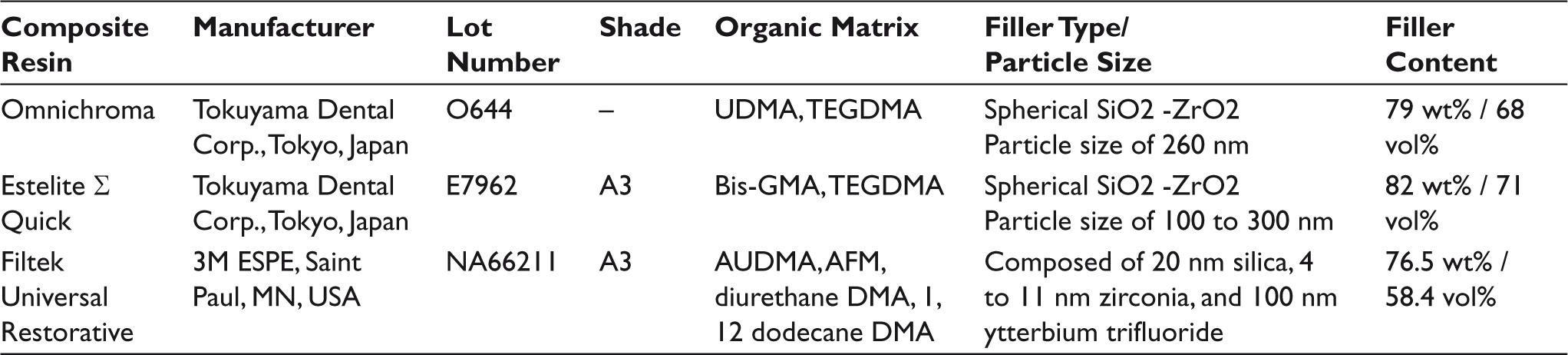
The three novel esthetic universal resin composites evaluated in this study are presented in Table 1. Disk-shaped specimens, 2 mm in thickness and 6 mm in diameter were prepared using polytetrafluoroethylene molds from each material (n = 10). To provide a flat surface before curing, the mold was placed between two glass microscope slides with mylar strips and each resin composite was light cured with a LED curing unit (Elipar Free Light 2, 3M ESPE, St Paul, MN, USA) with light intensity of 1000 mW/cm2 for 20 second according to the manufacturers’ instructions. Light intensity and lamp output performance was measured with a radiometer during the experiment (Bluephase Meter II, Ivoclar Vivadent, Amherst, NY, USA). Then specimen surface was polished with polishing disks to remove the glossy surface and resin rich layer under the mylar strip (Soflex; 3M ESPE, St. Paul, MN, USA). After polishing, each specimen was removed from the mold and stored individually in lightproof containers at 37 °C in the presence of 100% relative humidity for one month. The water was renewed every two days to avoid bacterial or yeast contamination.
Universal Resin Composites Evaluated in this Study
Color measurements of all specimens were performed immediately after curing (T0) and one month storage in water (T1) against white background in daylight using a spectrophotometer (VITA Easyshade V, VITA Zahnfabrik, Germany). Prior to the measurements, the specimens were dried with gentle air flow. Before each measurement, the spectrophotometer was calibrated in compliance with the manufacturer’s instructions. VITA Easyshade V digital spectrophotometer (VITA Zahnfabrik, Germany) was used to evaluate CIEDE00 color coordinates and measurements were carried out at the center of the samples. Color measurement of each sample was done three times both at T0 and at T1 and the values were averaged.
Color differences were calculate by the following CIEDE00 formula:
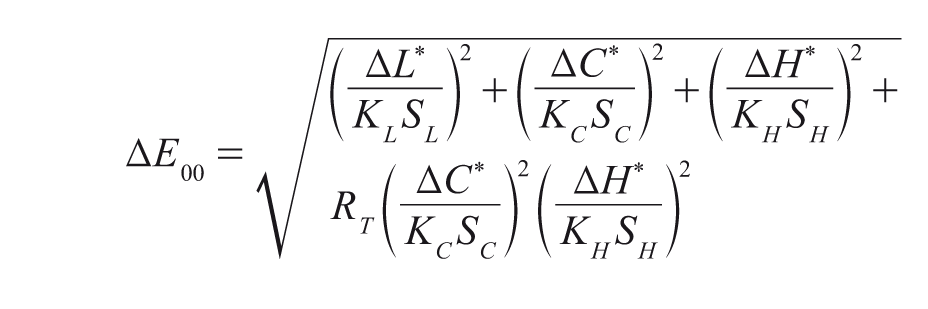
ΔL*, ΔC* and ΔH* are respectively differences in lightness, chroma, and hue, and RT is a rotation term that accounts for the interactions between chroma and hue differences in the blue region. SL, SC, and SH are weighting functions adjusting the total color difference for the variation in the location of the color difference pair in the L′, a′, b′ coordinates; the parametric factors. KL, KC, and KH are the terms for experimental conditions and were set to 1.
Statistical Analysis
To calculate an appropriate sample size for the evaluation of color changes in composites, a statistical power analyses was performed. The sample size was determined using G* Power software (G* Power 3.1.9.4, Germany) with a 1.37 effect size (f), α-value 0.05 and power of 0.95. The statistical analysis was performed using SPSS Version 22.0.0.0 (SPSS Corporation, Chicago IL, USA) for the significance level of 0.05. One-way analysis of variance (ANOVA) was used to assess the mean differences of the color parameters between the resin composites. Tukey post-hoc correction was used to determine which of the groups had statistically significant ΔE00 (change in color after one month). The influence of the difference in color parameters was determined with multiple regression analyses, in which color change after one month (ΔE00) was set as a dependent variable and ΔL*, Δa*, and Δb* as independent variables (P < .05). The regression analysis was performed for each resin composite groups separately with ΔL*, Δa*, and Δb* values obtained from the color measurements (n = 10).
Results
The mean and standard deviations (SD) for the ΔL*, Δa*, Δb*, and ΔE00 values are summarized in Table 2.
Mean and Standard Deviations of ΔE
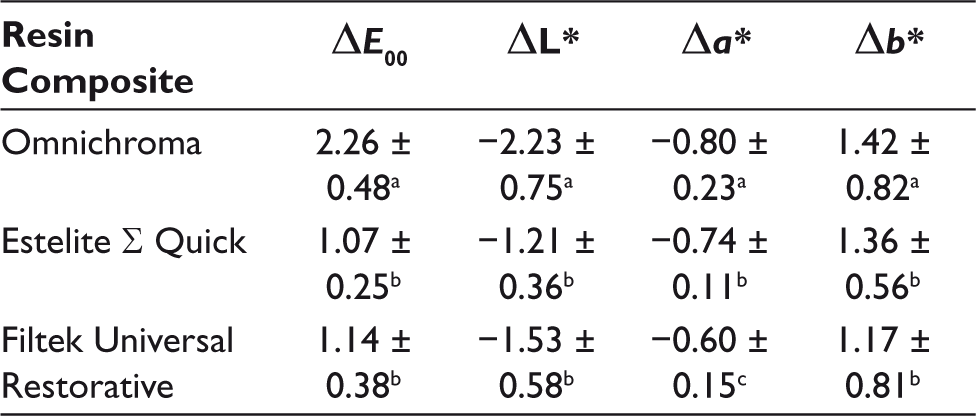
One-way ANOVA results show statistically significant difference in ΔL*, Δa* and Δb* values between groups, respectively (P = .003, P = .000, P = .000). Tukey post-hoc test showed that the difference in ΔL* values of Omnichroma-Estelite Σ Quick was P = .003 and in ΔL* values of Omnichroma-Filtek Universal Restorative P = .041). Omnichroma exhibited the greatest amount of change (–2.3 ± 0.75) in Δa* while Filtek Universal Restorative showed the lowest amount of change (–0.80 ± 0.23). Tukey post-hoc test revealed the difference between Δb* values of Omnichroma-Estelite Σ Quick (P = .000) and Omnichroma-Filtek Restorative (P = .000). Filtek Universal Restorative (1.17 ± 0.81) exhibited least amount of change in Δb* while Omnichroma showed the greatest change (1.42 ± 0.82).
Significant differences were obtained according to one-way ANOVA analysis in ΔE00 between groups (P = .000). According to Tukey’s post-hoc test, Omnichroma exhibited a significant difference and highest color change (2.26 ± 0.48) whereas Filtek Universal Restorative showed the lowest amount of change (1.14 ± 0.38).
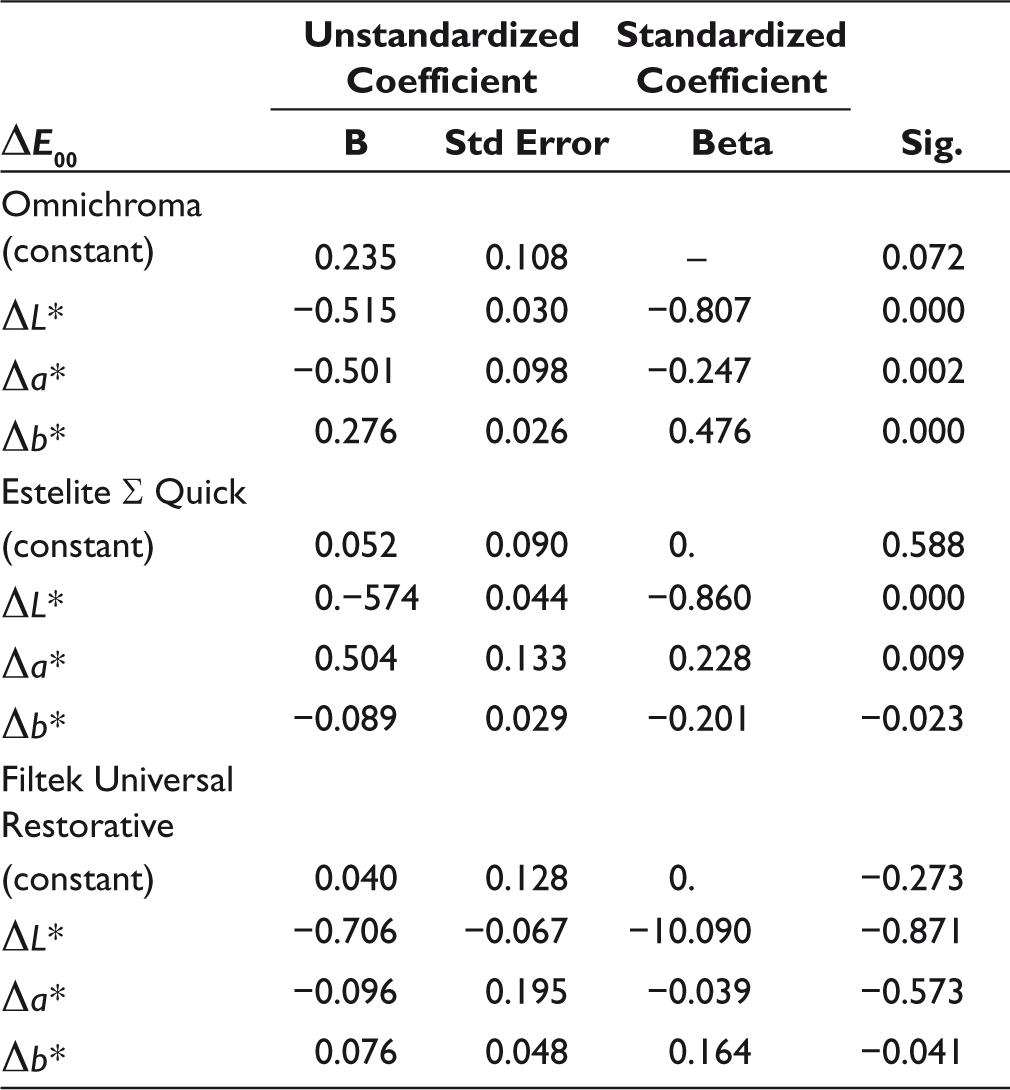
The results of multiple regression analysis demonstrated the correlation between color change after one month (ΔE00) and color parameters (ΔL*, Δa*, and Δb*) (Table 3). Changes in ΔE00 values of Omnichroma, Estelite Σ Quick and Filtek Universal Restorative were affected by all color parameters except ΔL* and Δb* values in the Filtek Universal Restorative after immersion in distilled water for one month.
Multiple Regression Analysis Between ΔE
Discussion
Direct resin composite restorations are often preferred as an alternative to indirect restoration types (crowns, inlays, onlays, etc.) in line with minimal invasive dentistry approaches and due to their natural appearance. Although resin composites have esthetically acceptable properties, discoloration at unacceptable levels is an important reason for replacing restorations.
There are different threshold values for different calculation methods in the literature, and generally accepted and widely used threshold values are 3.46 for ΔEab* and 2.25 for ΔE00 as determined by Ghinea et al. 14 The results of this study show that all novel resin composites’ ΔE00 values are below the threshold values at one month distilled water immersion after polymerization.
In studies investigating color properties, two main systems are commonly used for color assessment: Munsell system and a more quantitative method, the Commission International CIELAB system. 15 Color parameters of the restorative materials can be evaluated visually or instrumentally. In this study, VITA Easyshade V was chosen as it provides an instrumental measurement that is objective, allows standardization, and is not affected by environmental factors.
In an instrumental system, lightness (L*) is known as value and ranges from 0 to 100. Also the parameter a*, b* measures the color along the red–green and yellow–blue axis respectively. 16 In this study, we determined different ΔL*, Δa*, and Δb* values of the materials selected for our study after one month of storage in water. In line with Sensi at al., 17 in the current study both L* values and a* values decreased in all groups while b* values were increased. Therefore, after one month immersion in water, all specimens of the three resin composites became slightly darker (negative ΔE*) as well as greener and yellower in appearance (negative Δa* and positive Δb*). 18
The resin composites used in this study are recently launched and popular; even so they cannot be directly compared with the literature, but there are studies that show that aging results in a darker, yellower and greener samples.19-21 Light-activated composites often contain camphoroquinone as photoinitiator. If camphoroquinone is present in small amounts in the material, it may cause yellowing of the resin composite after polymerization. This may be associated with a positive shift in b* values after polymerization in all groups.
Color change of resin composites may be influenced by intrinsic and extrinsic factors. Extrinsic factors may be related with both restorative material and subjected nutrient dependent. 22 Some studies have investigated the effect of different colorant beverages (coffee, cola, tea, wine, etc.) and their influence on the color properties of resin composites.22-24 We, on the other hand, evaluated color changes in resin composites stored in distilled water only after polymerization in the current study. While extrinsic colorations are mostly related to the material’s ability to absorb colorant fluids and surface properties, intrinsic factors are uncontrollable with a multifactorial etiology as a result of physico-chemical parameters such as UV exposure, thermal aging, humidity.25,26 Since distilled water does not have any colorant components, color changes in the resin composites tested in this study were caused by factors based on the material only. Besides, chemical factors such as resin components, purity of oligomers and monomers, types of activators and initiators, degrees of conversion, rate of unreacted carbon double bonds, filler ratio, and organic pigments can very effectively change the color of resin composites. 27
The degree of conversion is related to the physical factor of the material, such as the chemistry of the polymer matrix, filler type, hydrophilicity, shade, etc. 28 Silami et al. stated that the conversion degree of composites containing Bis-GMA or UDMA monomer is 20% lower than composites containing other types of monomers in their study. 29 In addition, the degree of conversion of the composite resin materials after polymerization also affects the color stability. Resin composites with low conversion degrees have poor color properties because of residual monomers such as methacrylic-formaldehyde remain in their structure.30,31 This may explain why Estelite Σ Quick with Bis-GMA and Omnichroma with UDMA exhibited maximum color change after polymerization. Previous studies have shown that polymerization reaction continues in the long term after light polymerization, and this is thought to be due to the in-progress formation of cross-links between carbon atoms.32,33 The continuity of this reaction may also be the reason for the color change detected in composite resins in the current study.
Dental resin composites consist of three components: inorganic filler, interphase, and organic matrix. Each component provides different optical properties; for instance, while the matrix gives the structure translucency, fillers allow light to be refracted. 34 Arikawa et al. investigated the effect of the fillers on the optical properties of the material and determined that fillers with different shapes affect the optical properties of the material. 35 This can be explained by the fact that the Filtek Universal Restorative with nano cluster–shaped filler demonstrated different color changes compared to other restorative materials with nano spheric fillers.
Omnichroma in contrast with the other two resin composites evaluated in the current study (Estelite Σ Quick, Filtek Universal Restorative), has no pigments or additional dyes. Omnichroma contains special spherical 260 nm fillers and this special structure generates red-to-yellow structure which combines with the color of surrounding hard tissues. 36 Yamaguchi et al. investigated the effect of the size of nano fillers on color and found that the color matching abilities of the resin composites containing 260 nm nano fillers were higher compared to fillers of other sizes (both larger and smaller), by reducing the chromatic and brightness value. 37 Also, this specific type and size of filler composition may be associated with a greater color change in Omnichroma.
Regardless of the pigment content, manufacturers have claimed to have a blending (chameleon) effect for the restorative materials evaluated in this study. Paravina et al. 38 revealed that composites with blending effects reflect more light because of their high translucency. In translucent samples, making the measurements on a white background causes the light to be reflected directly from the background. This causes the effect of the white background to be more dominant on color parameters in color measurements. Yu et al. investigated the effect of composite translucency on color parameters and revealed that color parameters values were affected by the background color. 39 In this study, we investigated the color change regardless of translucency. However, white background, day light exposure and the measurement time were set as same to standardize the evaluation.
The necessity of polishing the samples in color studies is controversial. It has been pointed out that preparation of a specimen between microscope slides is sufficient for color measurement to ensure the standardization of uniform surface between samples.8,32 On the contrary, there are studies that show that color measurements after polishing the surface are necessary to eliminate the resin-rich surface and to simulate the oral environment.40,41 Therefore, the specimens were polished before immediate color measurement in this study. While these structural differences like different reflectance, filler, and monomer property provides esthetic attributes to the restorative material, they may also be related to the long-term color change in the material. Apart from the patented chameleon characteristic of Omnichroma, the differences observed between the Estelite Σ Quick and Filtek Universal Restorative may be related to the long-term color change of the resin composites.
Recent developments in manufacturing with nanotechnology enabled tooth-colored restorative materials to have better functional and esthetic properties day by day. However, this study has a few limitations. First, only distilled water was used. Thus, the results cannot demonstrate all color properties of the tested materials with relation to color pigment absorption. Second, surface characteristics and staining features due to different coloring beverages are not investigated. The methodology in this study did not simulate intraoral conditions. Therefore, further studies can mimic intraoral conditions with various beverages containing different colorant pigments and different exposure times.
Conclusions
With the limitation of this study, the results are as follows:
Storage in distilled water for one month after polymerization may lead to changes in the color parameters. The color change values observed in all tested materials were below the clinical acceptable thresholds. However, they should still be considered when planning an esthetic restoration, especially in the anterior region.
Authors’ Contributions
Both authors have made contributed equally to the conception and design of the study. CG was involved in writing, drafting, collection of data, and analysis and interpretation of data. SA was involved in conception and designing of the work and critical revisions of the manuscript and has given the final approval to the version to be published.
Footnotes
Declaration of Conflict of Interest
The author declared no potential conflicts of interest with respect to the research, authorship, and/or publication of this article.
Ethical Approval
Ethics committee approval was not required for this study.
Funding
The authors received no financial support for this research, authorship, and/or publication of this article.