




Abstract
We are living in an era where medicine and dentistry are evolving. Dental caries, tooth malalignment and periodontal diseases are being encountered by dental specialists in their daily practices. New digital technologies are emerging in dentistry for diagnostic and treatment purposes. Digitization enhances our efficiency and saves time. One of the recent smart technological innovation in healthcare field is the Internet of Things (IoT). IoT consists of a network of physical gadgets embedded with instrumentation electronics, mounted chips and sensors. Through cloud web technology and internet connectivity, the required data collection is enabled. Acquired data is then exchanged to the doctors and analysis is done. This review article deals about the concept of IoT and its futuristic role in dentistry. The review article is based on the electronic searching and analysis of various international and national publications on the IoT concept in dentistry, medicine and biomedical engineering. A bench marking analysis was made on various applications, pros and cons of IoT in dentistry. IoT will play a paramount role in the clinical advancement aspects of diagnosis and management of various oral diseases in the forthcoming decades.
Abbreviations
BFMD: Bite force measurement device
BLE: Bluetooth Low Energy
CGM: Continuous glucose monitoring
FOBS: Fibre optic biosensor
FBG: Fibre Bragg grating
IoT: Internet of Things
IoMT: Internet of Medical Things
IoDT: Internet of Dental Things
PPOS: Personal preventive oral care specialist
RFID: Radio frequency identification
Introduction
A healthy mouth is a unique and invaluable asset and yet an integrated component of general health and quality of life; it can also be regarded as a basic human right.1,2 Dental caries is one of the most common problem affecting people of all ages, acids produced by fermentation of carbohydrates such as sucrose, glucose, fructose by the plaque bacteria such as Streptococcus mutans leads to demineralization of enamel and damages the dentin-pulp complex which leads to acute/chronic pulpitis that is associated with severe toothache. Other dental problems includes tooth malalignment, tooth fracture, gingivitis and periodontitis which is associated with alveolar bone loss. 3 The monitoring of periodontal tissues and oral mucosa can play a significant role in monitoring the patients cardiovascular and cerebrovascular diseases, diabetes, AIDS and other problems.4,5,6 Hence, early diagnosis and treatment is necessary for prevention of tooth loss.
The world is now being adapted to various smart digital technologies and also in field of dentistry we are becoming more digitalised nowadays by using various technologies like digital radiographs, digital impressions, cone beam computed tomography, 3d printing, augmented and virtual reality technology assisted dental implant surgeries. One of the emerging novel smart concepts is Internet of Things (IoT). IoT is a machine to machine communication technique.
IoT is a domain that majorly involves in connecting sensors and other electronic devices to the internet. These devices can be monitored and controlled from anywhere across the world. Basically, the data acquired from sensor/device is being sent to the centralized server from where it is available for usage by the client. The data is processed as per the requirement of the client. IoT can handle big data and sets an insignia in almost all fields by changing the world into a smart world. There are various applications of IoT, it plays a vital role in the epoch of automation. Besides it can be used in the field of agriculture, medicine, dentistry, military/armed forces, governmental works, industrial, robotics and the list goes on. This article aims in summarizing the basics of IoT concept and its applications in dentistry.
Materials and Methods
The aim was to answer the question such as the following: What is IoT concept? What are the applications of IoT in medicine? What are the various dental applications of IoT obtainable in the published literature? What are the advantages and disadvantages of IoT?
Search Protocol
Search procedure included the use of following terms: IoT, IoMT, IoDT oral diseases, oral health, biosensors, smart diagnostic aid and smart toothbrushes. The PubMed and Scopus databases were mainly used to search for the relevant research articles from the year 2000 to 2020. The inclusion criteria are as follows: review articles, in vitro, human and interventional studies related to applications of IoT in medicine and dentistry and the research works that were published in English language. Short communications and letter to the editors were excluded. The article titles, abstracts and full texts were obtained from the above-mentioned databases and screened in detail. The current narrative review article followed the quality assessment scale of narrative review article guidelines. The collected articles were summarized and explained in the present article under various subheadings.
Internet of Things (IoT) Working Mechanism
A brief architecture of how the IoT system works is explained. A basic IoT system constitutes the sensors, cloud server, database and the user interface (Figure 1). The user can access the server and end devices from all over the world with help of internet. Intraoral sensors are those devices with sensors that could be invasive or noninvasive, and those could be placed closed or next to mucous membrane in oral cavity for continuous observation of patient functions without disruption to patient. 7 Wireless sensors that are usually used for continuous monitoring are placed inside the oral cavity. Invasive sensors can be used along with dental implants in the alveolar bone region. Noninvasive sensors can be attached to buccal or lingual tooth surface or to any oral devices/appliances. Sensors should always be placed in such a position, where continuous monitoring is achieved along with no discomfort or interruption to the patient.
Basic IoT Architecture
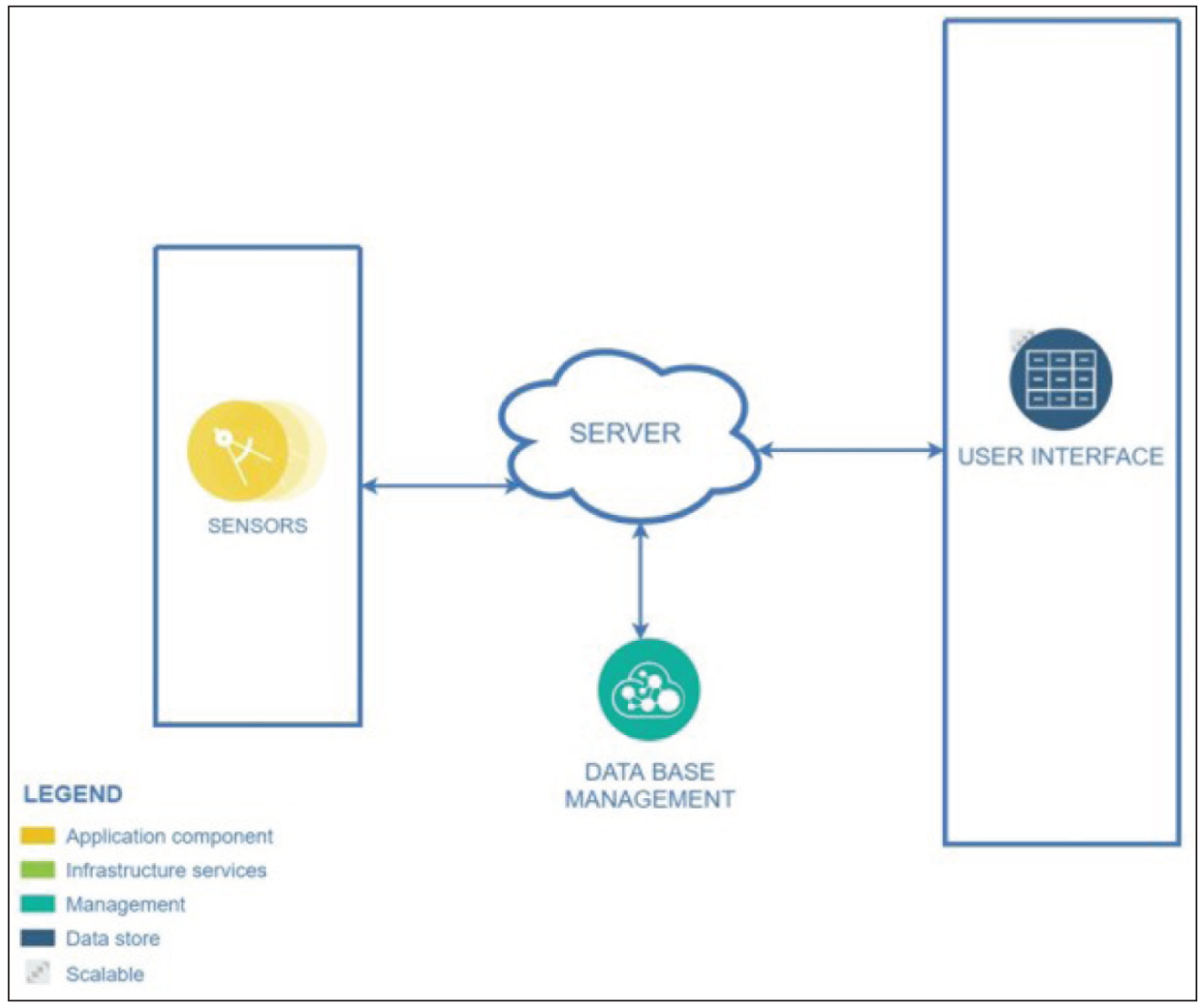
Two common computing technologies used in IoT are edge and cloud computing. Edge computing is used in applications to process time sensitive data, which means the data is used instantly without any waiting time, while cloud computing is used in applications to process data, which is not time sensitive where the data can wait for months. Besides edge computing is preferred over cloud computing in remote areas, where there is limited connectivity. When a patient uses a sensor assisted device for disease tracking, it communicates the examined data to the patient’s mobile phone or tablets, and this ultimately forms a network called ‘body area network’ (BAN). IoT based devices are commonly used to monitor, transfer and incorporate patient’s data to cloud/edge computing network for further analysis and diagnostics. 8
Internet of Medical Things (IoMT)
According to a survey, IoMT will exceed around $115 billion economy share in the IoT applications in the years of 2022–2025. About 100–150 billions different IoT tracking sensors will be associated to the cloud computing network till the end of this decade. 9 Electronic devices, wireless sensor devices and health tracking wearable monitors are connected to smart mobile apps to monitor patient’s health. There is a massive turnaround in global healthcare field due to development of IoMT, therefore a novel group of healthcare service provider may emerge in the future; they will act as ‘IoMT expert in medicine’. 10 IoMT technology is used in smart continuous glucose monitoring (CGM) and insulin pens. 11
Sensors attached to an inhaler or Bluetooth spirometer are connected to mobile app and which aids in people with asthma, emphysema, chronic bronchitis to track the use of rescue drugs and also gives allergen forecasts. 12 Smart contact lenses, apple watch app for observing and assessing major depressive disorder patients and Parkinson’s disease symptoms, Bluetooth-enabled coagulation system that permits patients to test how quickly their blood clots are few examples of IoMT assisted novel devices. In orthopaedics, sensors provide details about bone measurements, bone pain and fracture information rapidly. IoMT devices collect the daily exercise and routine data of the patient and alerts the patient to follow-up the recovery after surgery. 13 Various software applications are used to capture data from hip and knee replacement of patients. 14
Internet of Dental Things (IoDT)
The IoMT is a cloud computing network technology, which is effectuated successfully in medical field. 15 IoMT is implemented recently for the purpose of active monitoring of patient’s health status, in managing various chronic diseases and for prevention of new diseases. At present there are not many evidences about the concept of IoDT. Thus, new research works on IoDT would significantly lead to various improvements in diagnosis and prevention of dental caries, head and neck/oral cancers, periodontitis and other oral diseases. In future, IoDT will play an essential role in collection and monitoring of data in oral health care system and may aid the dentists with developing novel risk assessment methods. Salagare et al. 16 have developed an IoDT technology dependent oral healthcare model, which consisted of three main components such as data collection, data transfer, data analysis and storage. Data collection will be done by means of wireless sensors, mouthguard invaded sensors, mounted chips and by smart toothbrushes. Oral health care data will get transferred to the cloud computing servers by means of mobile phones or tablets. Finally, the data will be analysed by ‘personal preventive oral care specialist (PPOS)’, who will be a qualified dentist with special training in IoDT technology. A cloud web technology expert will also assist the PPOS. At last, a well monitored clinical process will further investigate the patients.
Applications in Dentistry
Diagnosis—As a Smart Diagnostic Aid
Liu et al. 17 developed a smart dental Health IoT system based on intelligent hardware, deep learning and mobile terminal, which aimed at investigating the feasibility of its utilization on in-home dental healthcare. They developed a smart IoT based dental device to perform the image acquisition of teeth. A data set of 12,600 clinical images was fetched by the IoT smart device from 10 private dental clinics, an automatic diagnosis model trained by MASK R-CNN was developed for the purpose of detecting and classifying seven different dental conditions, which included dental caries, cracked tooth, dental fluorosis, dental plaque, dental calculus, periodontitis and tooth loss, the recognition rate was 90.1%, 94.1%, 95%, 100%, 98.1%, 94.3% and 98.4%, respectively. The diagnostic accuracy of the IoT smart device was about 90% with high sensitivity and high specificity. One month systematic testing was done in 10 private dental clinics and 25 dentists used the app, the results showed that the number of patients who received dental treatment services with the aid of IoT smart device was increased by 18.4% and the mean diagnosis time was reduced by 37.5%. This smart process reduces the overall time taken to diagnose a patient and in the same time many number patients can be diagnosed parallelly.
Vellappally et al. 18 evaluated patients’ oral health by collecting dental X-ray images followed by IoT based xeno-genetic spiking neural network analysis. Tooth structure, gaps/spaces between teeth and positioning of incisors, premolars, molars was examined efficaciously by IoT analysis. This method of effective extraction of oral features aided in increased oral health prediction rate. The technique was 97.115% accurate, which was comparably higher than other methods (Table 1). Thus, in the upcoming years IoDT will be evolving as an advanced smart diagnostic aid for detecting caries, fracture, fluorosis, dental plaque, calculus and periodontal diseases.
Studies Reporting the Diagnostic Applications of IoT in Dentistry

Microbiological Evaluation/Bacterial Detection
A variety of putative gram negative and gram positive anaerobic bacterial pathogens implicated in dental caries and periodontal diseases are identified in several microbiological research works. Various sensors have been already used in some studies for detection of oral microorganisms. Kishen et al. 19 developed an IoT based fibre optic biosensor (FOBS) for detecting and tracking mutans streptococci activity in human saliva. Saliva samples were collected from five volunteers with zero to moderate caries. FOBS utilizes fibre optic evanescent wave spectroscopy to detect the bacterial mediated biochemical reaction using a photosensitive indicator. In another study graphene-based wireless bacteria detection on tooth enamel was explored. Direct integration of highly sensitive graphene IoT nanosensors with biomaterials such as tooth enamel has allowed battery free sensors for remote monitoring of pathogenic bacillus such as Staphylococcus aureus and Helicobacter pylori 20 (Table 2). Therefore, IoT based sensors can also be used for detection and monitoring of various pathogenic oral microorganisms.
Studies Reporting the Microbiological Applications of IoT in Dentistry

Bite Force Measurements
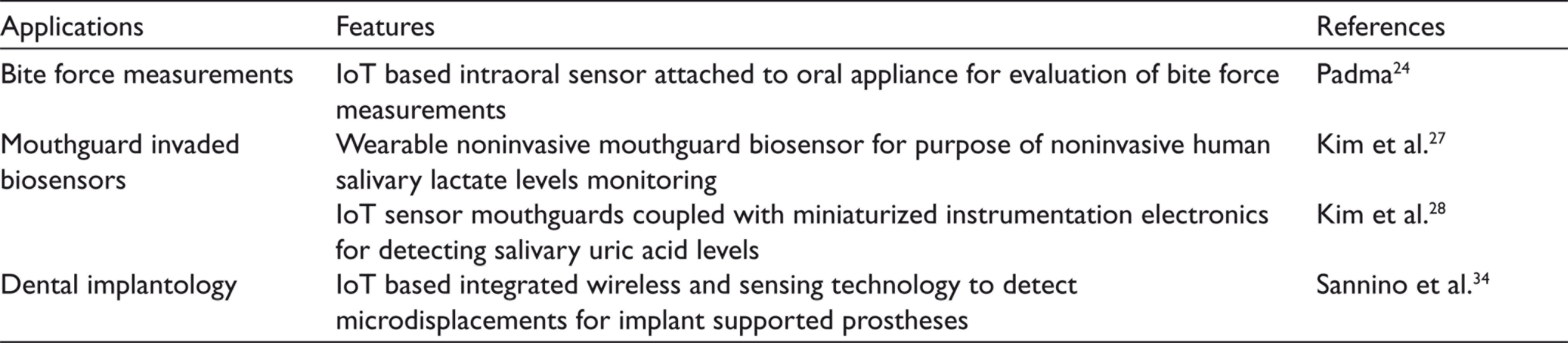
Bite force can be defined as the force applied by the masticatory muscles in dental occlusion. 21 Strain-gauge transducers, piezoelectric transducers and pressure type of transducers are commonly used in various commercially available bite force recording devices. The bite force is a prime factor in establishing the functional state of the masticatory system, which comprises of jaw muscles, teeth and joints. 22 Factors like the positional offset of teeth and mandible, age, gender, load on the periodontal tissue can influence the generated bite forces. 23 In an in vivo study, IoT based intraoral sensor named fibre Bragg grating (FBG) sensor was attached to oral appliance named bite force measurement device (BFMD) and it was used for evaluation of bite force measurements in 22 subjects. 24 BFMD was a noninvasive intraoral device that helps in transducing the bite forces exerted at occlusal surface of teeth into strain variations on a designed metal plate. Strain variations were attained by the developed FBG sensor bonded over it. BFMD helps in the adjustment of the distance between the biting platform, thereby capturing the maximum voluntary bite force at three different teeth sites (incisor, premolar and molar) (Table 3).
Studies Reporting the Bite Force Evaluation, Mouth Guard and Implant Based Applications of IoT in Dentistry
Bruxism refers to grinding or tight clenching of the upper and lower teeth, which on long term leads to tooth wear (attrition), dentin hypersensitivity, headaches, orofacial pain and temporomandibular joint problems. Thus, IoT based sensors can also be advocated in future for recording bite force measurements in cases of bruxism, trauma from occlusion, to assess the efficacy of various prosthesis around teeth and implant sites, to study about deformities and pathologies of the masticatory system and in temporomandibular joint disorders.
Mouthguard Invaded Biosensors
A biosensor is a self-contained analytical device that incorporates a biologically active material in intimate contact with an appropriate transduction element for the purpose of detecting (reversibly and selectively) the concentration or activity of chemical species in any type of sample. 25 The first biosensor developed by Clark and Lyons was an enzyme‑based glucose sensor. 26 Kim et al. 27 have introduced a wearable noninvasive mouthguard biosensor. They integrated a printable amperometric enzymatic biosensor onto an easily removable mouthguard platform for purpose of noninvasive human salivary lactate levels monitoring.
In a similar IoT sensor-based study mouthguards were coupled with miniaturized instrumentation electronics that consisted of a potentiostat, microcontroller and a Bluetooth Low Energy (BLE) transceiver, this was used for detecting salivary uric acid levels 28 (Table 3). This sensor facilitates real-time wireless transmission of the sensed salivary metabolite information to consumer electronics, smart mobile phones and laptops for patient related diagnostics and data storage. It has been proved that mouthguard sensors are highly efficient and accurate in tracking human salivary constituents/metabolites. As they yield real-time information on patient’s health, studies can be done by tracking salivary biomarkers associated with periodontitis and dental caries using mouthguard invaded biosensors. They also have great potential for use in the field of sports related dental injuries.
Smart Toothbrushes
Ancient India has devoted a lot of space to oral and periodontal problems. From ancient days to present, we have used a variety of materials and technological implements are done from nylon, natural, synthetic brushes to sonic, ionic, powered toothbrushes. Being in a digital era tends us to become addicted to technologies that has its own pros and cons. Smart brushes have inbuilt smart cameras, timers, pH and pressure sensors, and it can be connected to smart mobile phones and tablets through an app. The collected data from sensor is transmitted to the dentist for evaluation of oral health. After teeth scanning, patient’s brushing method/patterns, brushing time, pressure applied, salivary pH can be obtained from the sensors. 29 Intraoral teeth photos can also be clicked and transferred to the dentist.
Thus, we can get overall details about the oral hygiene and plaque removal efficacy of the patient. Some commercially available smart brushes are Oral-B Genius Bluetooth-connected toothbrush, ARA toothbrush with artificial intelligence software embedded on a chip embedded in the brush with deep learning algorithms on a low-power processor, Prophix toothbrush with high definition camera, Beam brush owned by Beam technologies, which has tie-up with united states health insurance providers and also offers the customers to use their smart brush and upgrade their brushing habits to gain lower premiums for their dental insurance.
Dental Implantology
A dental implant is a biocompatible device, surgically placed into mandibular or maxillary bone, which supports a prosthesis thus allowing the replacement of the teeth loss due to caries, periodontal disease, injuries or other reasons. 30 The virtue of dental implants is definitely associated with proper osseointegration process. Implant failures are of biologic, mechanical/prosthetic, surgical and aesthetic types. Irrespective of high implants success rates, literature reveals a notable incidence of mechanical/technical complications that is due to unfavourable loading or as a result of high stress concentrations. 31 More prevalent mechanical failures include abutment and prosthetic screw loosening and fracturing, 32 microdisplacement of the prosthesis and abutment-implant connection. 33
Microdisplacements can lead to failure of the components such as connection screws and prosthetic framework, which thereby leads microbial colonization in the gap between fixture and prosthesis, thus it increases the chances for developing peri-implantitis and bone resorption. Sannino et al. 34 developed an IoT based integrated wireless and sensing technology to detect microdisplacements for implant supported prostheses to prevent mechanical implant failures (Table 3). The system includes a sensor for micro-displacement detection to be inserted in the prosthesis volume, with embedded wireless communications capabilities. The room inside the prosthesis is used for placing the sensor and a small memory that records the data, integrated with a radio-frequency identification (RFID) chip. Once a day or more often an external reader device is placed close to the mouth to collect the data. An experimental dog study investigated the use of RFID passive tags by placing them inside the tooth for identification purposes. 35 But no human studies have been reported till now.
Advantages of IoT
Digital depot of patient particulars: the clinical records of the patients are stored digitally. Data collection is also easy. In emergency situations, digitally stored data in servers can be shared easily and quickly to dentists, general physicians, labs and associated organizations. Data storage is accurate with enhanced dependency and reliability.
It is easy to communicate, thus enhanced communication between dentists and patient acts as an effective way of information/data sharing.
Precise information of parameters studied. Inspection and monitoring of parameters in IoT generates a smart hospital environment.
Health tracking in a larger scale as IoT can handle big data and it is easily applicable to larger group of population and implemented effectively at community level.
Early detection and prevention of tooth loss caused by caries, periodontal diseases and other oral problems.
It makes communication faster and saves time, as it lessens the time taken for diagnosis thereby minimizing the waiting and hospital stay time which makes the patient more comfortable.
It reduces the human errors on various domains.
Disadvantages of IoT
Security and privacy of devices will be a demanding task as it maybe prone for hacking.
Nonuniformity of dental practice: as most of dental clinics still follow traditional paper record system, clinical implementation of IoDT will be a challenge.
Implementation cost is high as it involves with deployment of various sensors, server and end devices.
Getting patient’s concern in uploading the patient data to the internet server.
Conclusion
IoDT concept is the new kid on the block in the era of advanced dentistry. IoT in dentistry is booming day by day. As the world is evolving towards being ‘smart’, it is important to handle things in a ‘smart’ approach in dentistry as well. There are still no major research works done in field of IoDT, which is set to open up new horizons. Thus, IoDT has a great purview to outspread in the various branches of dentistry due to its easy execution. Precision medicine and dentistry are the recent revolutionary concepts where the omics platforms play a key role, for analysis of big data in such concepts, IoT devices can even be employed. The future is both exciting and propitious for researchers in the field of IoDT based oral diagnostics, with the unravelling of the myriad facets of the various oral pathogens, initiating research advances in the development of more sophisticated devices, making it more precise for both the dentist and the patient.
Future Scope
The future scope is to implement the IoDT in various smart dental clinics across the world. Various features of IoDT includes artificial intelligence, contactless diagnosis has to be developed and implemented as a mobile application.
Footnotes
Acknowledgements
I take this opportunity to convey my thanks to all researchers and friends who motivated me to write an article on the world’s most booming technology.
Authors’ Contributions
Balaji Ganesh S and Kalaivanan Sugumar contributed to study concept and design, manuscript writing and have approved the final version to be published.
Declaration of Conflicting Interests
The authors declared no potential conflicts of interest with respect to the research, authorship and/or publication of this article.
Funding
The authors received no financial support for the research, authorship and/or publication of this article.