




Abstract
Multinational Companies from Emerging Economies (EMNCs) have become key players in the global economy. EMNCs have started to operate in highly dynamic, competitive environments where they are faced with competition from multinational companies (MNCs) from developed economies. This study applied Mutlu et al.’s (2015) awareness–motivation–capability (AMC) framework to the airline industry to investigate how EMNCs outperform MNCs. The development of each round of Mutlu et al.’s framework was tested using secondary data sources that cover 16 years, from 2001 to 2016. A fourth round, relating to the determination of ‘who will be the market leader’, was added to the framework and tested. The findings demonstrate that firms’ awareness and capabilities evolve in each round to develop the competitive advantages required to enhance their market position. The complex nature of competition requires firms to analyse information constantly to define key influential factors and to build essential capabilities and resources to initiate an action strategy quickly. From a managerial perspective, it is important for managers to build a comprehensive view of the competition and understand how this competition is evolving over time, to develop capabilities, pursue new opportunities and predict competitors’ responses.
Keywords
Introduction
Emirates is an airline that was launched in 1985, initiating its operations with two aircraft serving nearby destinations. Following a steady expansion of its operations, Emirates started to serve a wider network of 37 destinations in 30 countries (Emirates, 2016). In 2004, Emirates developed its strategy for rapid global expansion by ordering the extra aircraft that was needed to expand its international network. Although the airline industry is known for its intense rivalry, in 2013, Emirates became the world’s largest carrier of international passengers, taking this position from leading industry carriers with strong capabilities and superior management experience. In 2016, Emirates was voted the world’s number-one airline. This international ranking was granted by Skytrax World Airline Awards, the most prestigious quality award in the airline industry worldwide (Skytrax, 2016), indicating that Emirates achieved international recognition and business excellence.
Qatar Airways, which was founded in 1993 with two aircraft, has a similar story. Qatar Airways expanded rapidly to become a five-star-rated airline and was voted the world’s number-one airline in 2015 (Skytrax, 2016). These examples are strong evidence of how some firms from emerging economies can develop unique capabilities and assets to establish a global network and adapt to the competitive challenges imposed by multinational companies (MNCs) from developed economies (Al-Kwifi, 2016; Hansen et al., 2020). Therefore, it is interesting to explore how it is possible for multinational companies from emerging economies (EMNCs) to outperform MNCs from developed countries. Additionally, under what conditions do EMNCs outperform MNCs?
It is well known that MNCs entering emerging economies possess greater managerial competencies, more advanced technologies, greater access to resources and better brand management skills than do EMNCs (Gabriel & Al-Kwifi, 2012; Jiang et al., 2015; Rana et al., 2020; Vlajcic et al., 2019). However, mounting evidence suggests that many EMNCs are able to develop unique capabilities over time and become strong competitors of the MNCs that previously dominated the market (Al-Kwifi et al., 2019; Beugelsdijk & Jindra, 2018; Demirbag et al., 2016; Peng, 2016; Spencer, 2008). As a result, competitive dynamics occur between these companies, as each strives to increase its global market presence and become the key player in that industry. This highly dynamic, competitive environment of emerging companies operating in emerging economies has prompted considerable attention from scholars and practitioners. In addition, the increasing global presence of EMNCs has encouraged many scholars to study them and define their characteristics and strategies for internationalization (Contractor, 2013; Dohse et al., 2012). In response to this interest, two companies were selected from the airline industry, and Mutlu et al.’s (2015) competitive dynamics framework was applied to provide practical evidence of the competitive dynamics and co-evolution of MNCs and EMNCs in emerging economies.
Literature Review
International business research has started to shift its focus towards exploring the process of the rapid internationalization of EMNCs to examine how they become key players in many industries worldwide. Thus, several scholars have explored the rise of EMNCs and consider them a valuable natural experiment for investigating the factors behind their international strategies and behaviours (Estrin et al., 2017; Gaur & Delios, 2015; Gaur et al., 2014; Ramamurti, 2009; Rana et al., 2020; Yeganeh, 2019). This topic is important because, in 2015, EMNCs accounted for one-quarter of the world’s outward foreign direct investment (OFDI) flows (UNCTAD, 2016) and one-fifth of the largest firms in the Fortune Global 2000. This dramatic growth of EMNCs prompted increased academic interest in these types of firms (Cuervo-Cazurra & Ramamurti, 2014; Luo & Tung, 2007).
However, because studying either type of firm in isolation might not give a complete picture of the internationalization process of both, recent attention has shifted towards the importance of exploring the interaction and competitive dynamics between MNCs and local rivals (or EMNCs) in emerging economies. Such studies also examine the conditions under which one type of firm could perform the necessary actions to win the competition. This growing interest derives from the rapid evolution of emerging economies, the dramatic changes in the fundamental macroeconomic environment and the institutions underlying the business activities (Bhaumik et al., 2019; Chung & Beamish, 2005; Delios & Henisz, 2003).
Institutional development, combined with the threat of competition by MNCs, has forced many EMNCs to commence organizational and strategic alterations to stay in the market (Newman, 2000). These dramatic transformations have resulted in a unique type of EMNC, which often competes with conventional MNCs in their home markets as well as in the host markets Gaur & Delios, 2015; Gaur et al., 2014; Luo & Tung, 2007). In reaction to the institutional development in emerging markets and the resultant development of EMNCs, MNCs have undergone a stage of revolution (Luo, 2007). Nevertheless, previous research has failed to provide appropriate explanations of the competitive dynamics evolving between MNCs and leading EMNCs. Thus, further research is needed to explore the process of competitive dynamics from an interactive, evolutionary and longitudinal perspective to enhance the understanding of the factors and conditions that influence this process.
Scholars have expressed concern about the actual merit of classifying EMNCs as a distinctive form of an MNC (Carney et al., 2018; Stoian & Mohr, 2016), questioning whether EMNCs should be investigated according to a different set of conditions. This query might be caused by an unreliable comparison stemming from the analysis, which was particularly evident when the influence of an EMNC’s home country was isolated from other potential variables (Gaur et al., 2018). However, several studies have measured the influence of the home country on an EMNC’s innovations and internationalization (Cuervo-Cazurra & Genc, 2008; Li et al., 2016; Luo & Wang, 2012) and found that EMNCs have tracked a unique path to reach globalization when compared to conventional MNCs (Gammeltoft et al., 2010; Meyer et al., 2009). This demonstrates the need for research that explores the nature and development stages of EMNCs to confirm whether they possess unique patterns compared to conventional MNCs and what factors lead to their rapid international expansion.
Firms compete differently to sustain competitive advantages in their markets, specifically at a global level, where the competition is intense. To understand competition, one must examine the interaction and consequences of actions and responses. Building on these perceptions, research into competitive dynamics emphasizes competitive actions and responses (Smith et al., 1991, 2001). Nevertheless, the majority of studies on competitive dynamics have focused on firms from developed economies with fairly sound institutional settings (Chen et al., 1992; Yu & Cannella, 2007). These studies have failed to provide a sufficient understanding of such competitive dynamics in emerging economies or to explain how the competition unfolds between MNCs and EMNCs (Chang & Park, 2012).
Recently, Mutlu et al. (2015) introduced the first article to systematically model the competitive interaction between MNCs and EMNCs in transition economies from a longitudinal perspective. This pioneering study proposed the awareness–motivation–capability (AMC) framework to develop three rounds of research to explore the evolution of the dynamic capabilities of EMNCs and MNCs and the related competitive dynamics in transition economies. Even though the framework has not been empirically tested, it provides a strong argument about the nature of the competitive dynamics process that takes place between MNCs and EMNCs in transition economies. The framework was applied to this study to account for emerging economies, and it was then modified based on Mutlu et al.’s (2015) recommendation to fit this study settings. The proposed AMC framework is unique because it actively explores the rivalry between MNCs and EMNCs as different factors evolve over time (Meyer & Sinani, 2009; Peng, 2003). This demonstrates that the competitive interactions between rival firms are not static over a certain period, as Smith et al. (1991) previously proposed.
The Dynamic AMC Framework
The AMC framework is widely used in competitive dynamics (Chen, 1996; Ferrier, 2001; Yu & Cannella, 2007). ‘Competitive dynamics’ represent ongoing actions and responses occurring between all companies competing within a market, where ‘actions’ are specific moves introduced by a firm to improve its advantageous position (Ferrier, 2001) and ‘responses’ are counteractions initiated by the competing firm to protect its market position (Chen et al., 1992). In general, firms launch competitive actions to achieve several benefits: improve market position, capitalize on growing demand, expand production capacity, provide an innovative product and obtain first-mover advantages. The AMC framework proposes that rival firms will react to competitive actions when they are conscious of these actions and have the motivation and abilities to react (Smith et al., 2001). ‘Awareness’ is the extent to which a firm understands the outcomes of its own and its rivals’ actions and responses, based on its capacity to recognize the degree of mutual interdependence that results from market commonality and resource similarity. Essentially, awareness cannot turn into competitive action without motivation, which is generated from competitive pressure and the need to sustain a strong market position (Miller & Chen, 1996). Last, a firm requires certain capabilities and resources that empower appropriate actions to secure a competitive advantage against its competitors (Alabdul Razzak et al., 2018; Yu & Cannella, 2007); without available resources, a firm lacks the ability to respond.
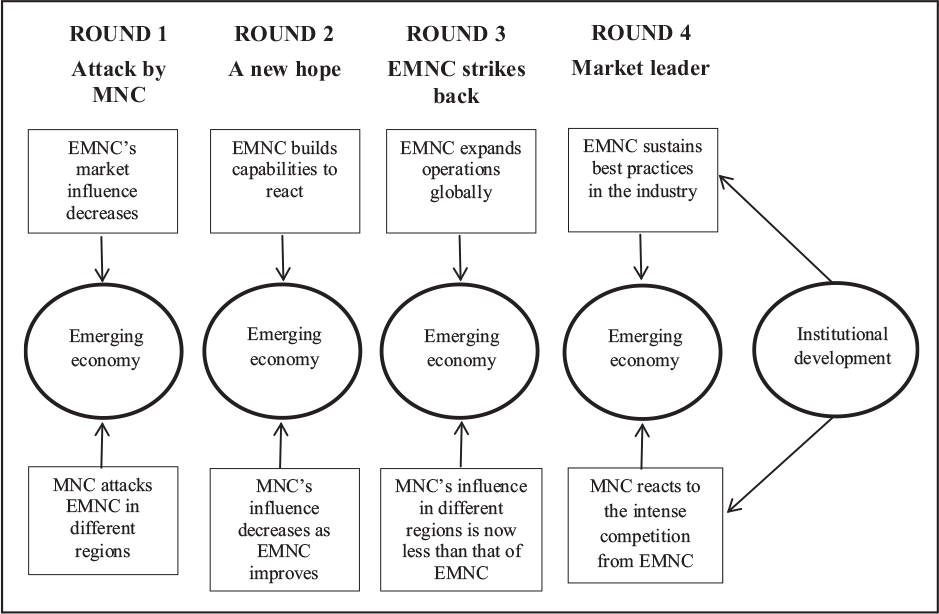
In this study, the AMC framework developed by Mutlu et al. (2015) was used, and a fourth round was added (see Figure 1), which determines who will win the competition in the future. The same labels for the three rounds proposed by Mutlu et al. (2015) were used because they are descriptive, and the fourth round was labelled ‘Market Leader’. This framework was tested using two companies from the airline industry; thus, the competition landscape is not only dominated by the emerging country but also includes global destinations in various regions. The following explanation of the different rounds considers the nature and characteristics of the airline industry, which is heavily based on dominating a wide network of regions to win the market (Adler & Smilowitz, 2007; Weber & Williams, 2001).
In the first round, the MNC starts to invade the home country and the various markets of the EMNC in order to diminish the EMNC’s market base. In this round, the MNC has superior management skills to control its operations effectively. The second round presents an intensive curve, during which the EMNC learns from the environment and other competitors to enhance its practices and to start building the required capabilities to compete effectively. In this round, the gap between the EMNC and MNC starts to lessen based on the level of learning and imitation employed by the EMNC to remove its competitive disadvantages. Similarly, the MNC places emphases on increasing its local and regional expertise to better define market needs and on developing managerial skills to professionally serve the market while minimizing the liabilities of foreignness.
As the third round starts, the nature of the competition starts to shift and the intensity of the rivalry increases. Because of mutual spillovers, the resource similarity between both firms is increased. In this round, both firms fully utilize their capabilities and management expertise to expand the competition landscape and cover more markets globally by reaching more destinations in different countries. If the EMNC is able to reach this round, it is implied that it was able to successfully develop and integrate the full range of competitive advantages needed to outperform other firms in the industry and become a major player in the global airline industry. At the same time, the MNC continues to find reaction strategies to maintain its global presence and withstand the mounting pressure created by the EMNC. This round represents a mutual transformation phase for the MNC and the EMNC. The final round determines who wins the competition through stronger resource management and by capitalizing on the previous capability developments. While the last round was not introduced by Mutlu et al. (2015), it is essential for certain industries in which firms reach operational excellence and establish a comprehensive global presence (Park et al., 2013). There are many cases in which EMNCs win in the final round by ensuring coherent control of resources and through management commitment (Chang, 2013).
Figure 1 presents the influence of institutional development on EMNCs’ competitive actions during the four rounds (Autio & Fu, 2015; Gaur et al., 2014; Halaszovich & Lundan, 2016). Although EMNCs often lack advanced technologies and extensive international experience, there is noticeable government support for EMNCs’ competitive activities, in addition to other home-country and socio-cultural advantages (Yeganeh, 2016). Several studies on EMNCs have confirmed the influence of institutional development in producing competitive advantages at a global level, through considerable backing received from the firms’ national governments (Goldstein & Pananond, 2008; Peng et al., 2008). Both MNCs and EMNCs must consider the influence of the institutional context, which will affect their competitive (dis)advantages over time. As suggested by Li et al. (2013), MNCs and EMNCs both need to develop market–political ambidexterity, including market capabilities and non-market capabilities, during institutional development. Thus, including this factor is useful for explaining multinational firms’ activities in a more vibrant environment, where the context of a rapidly changing institutional environment has continued to be the focus of exploration (Yu et al., 2015; Wright et al., 2005).
Framework Boundary Conditions and Assumptions
The proposed framework contains a set of conditions and assumptions that reflect the environment and industry structure in which both firms are competing and undergoing competitive interactions. First, in a real-life situation, competitive interactions take place between various firms from the two types of selected countries, developed and emerging. However, the focus in the current study is on the competitive dynamics process between a single MNC and a single EMNC, as this focus makes it easier to analyse the firms’ dynamics. Second, even though both firms learn from each other using different methods (Luo & Peng, 1999; Smith et al., 1991), it is assumed that neither firm is involved in any form of collaboration or merger (neither an alliance nor any form of business agreement) (Lin et al., 2009).
Third, the competitive dynamics between the MNC and EMNC were examined in particular ‘newly developed economies’, as proposed by Hoskisson et al. (2013). This helps to minimize the discrepancies between EMNCs that come from heterogeneous economies, each of which have unique social, political and economic contexts (Abu Farha et al., 2018; Wan & Hoskisson, 2003; Wright et al., 2005). This assumption is important because previous studies found that EMNCs have followed different paths and strategies to reach internalization based on the home-country effect (Gammeltoft et al., 2010; Hoskisson et al., 2013; Meyer, 2004; Meyer et al., 2009). Fourth, while there are a number of performance measures, such as return on assets and sales growth, the proxy for performance is the number of international passengers who have travelled with the airline; this number reflects the global market share, while the international recognition by customers’ ratings echoes business excellence and superior customer satisfaction (Eccles, 1991).
Because competitor analysis is the first step to understanding competitive rivalry and identifying direct competitors, two components were assessed: market commonality and resource similarity (Chen, 1996; Miller & Chen, 1996). The ‘market commonality’ condition of the MNC and the EMNC refers to the number of global destinations (i.e., cities) either airline is competing to serve, whereas ‘resource similarity’ indicates the nature of strategic capabilities owned by a firm, in terms of type and amount, equivalent to those of the other firm (Chen, 1996). Based on Figure 1, the intensity of the rivalry changes depending on how rival firms differ along the continuums of market commonality and resource similarity. In general, direct competitors have high market commonalities and high resource similarities, leading to similar competitive actions (Gimeno & Woo, 1996).
Research Methodology
Previous research used secondary sources to investigate the impact of competitive actions on performance in the US domestic airline industry over 8 years (Smith et al., 1991). Smith et al. were able to measure the impact of specific actions and responses on the airline firms’ performance using industry reports, because such actions were already implemented and could be measured. However, for the present study, two airline firms were selected from different countries: Delta Air Lines (Delta) from the USA (a developed country) and Emirates from the United Arab Emirates (an emerging economy, which is referred to in this article as the ‘Dubai Government’).
In the current study, secondary sources were also used to investigate the competitive dynamics and co-evolution between the MNC and EMNC and the influence of competitive actions of either firm on its market performance. Similar to previous research, secondary data were collected from various sources, including company-specific reports, airline-specific information, various airline organizations and industry associations. From these sources, the actions and responses of the two airlines were tracked over 16 years and mapped into different rounds of the study framework, in order to identify a series of important competitive events that took place during the competition. Before presenting the study findings, an overview of the global airline industry and the nature of its competition environment are next presented to provide an essential understanding of the competition dynamics in this industry.
Global Airline Industry
The global airline industry is highly competitive, with more than 1,200 airlines connecting more than 3,500 airports. The global air travel market has averaged ~5% annual growth over the past three decades (International Air Transport Association [IATA], 2017). According to the World Travel and Tourism Council (WTTC, 2017), travel is one of the largest and fastest-growing global service industries; its total contribution to the global economy rose to over US$7.6 trillion in 2017. The growth in travel expenses was powered by lifestyle and business activity transformations. In 2017, more than 4 billion passengers travelled worldwide. Despite the increased demand for air travel, many airline carriers announced bankruptcy because of the challenges they faced in delivering a fair financial profit and consistent service to customers (Bamber et al., 2013). By contrast, new low-cost competitors gradually put the industry under pressure to cut costs and made it hard to find ways to survive, even for legacy carriers (Francis et al., 2006). The robust competition among airline carriers forced firms to expand their international networks to cover a wider market base and enhance their returns (Amankwah-Amoah & Debrah, 2011; Anwar, 2015); therefore, many cover short-, medium- and long-haul flights. When specific destinations are hard to reach, airlines build alliances with other carriers to link passengers to distant endpoints (Freeman et al., 2006; Saglietto, 2009).
With increasing rivalry in the airline industry, the major obstacle has become the implementation of strategic actions that achieve competitive advantages at a global level, while sustaining a sound profit and providing exceptional customer service (Sofi & Hakim, 2018). This condition shifted the airline landscape, forcing some companies to leave the market due to significant losses; others entered into industry consolidation resulting from mergers and acquisitions (Bruecknera & Pelsb, 2005; Evripidou & Melanthiou, 2013; Richard, 2003), thus reducing the rivalry in a few regions. Meyer (2004) discussed the importance of industry-level perspectives on firms’ strategies and operations, as the type and extent of spillovers can influence the choice of competitive action. Holburn and Zelner (2010) emphasized the importance of linking an industry perspective on strategy to understand how firms obtain resources and develop capabilities to sustain competitive positions in the industry. Similarly, Garcia-Canal and Guill´en (2008) found that firms operating in regulated industries respond to challenges in foreign countries in different ways based on the type of challenge and their capabilities.
Most travellers consider air travel a disappointing and unpleasant experience (Sultan & Simpson, 2000) because of various experiences they confront while travelling to their destination. Such obstacles can include finding an appropriate flight, the inspection procedure at the airport, the amenities provided onboard and reaching their destination on time (Park, 2007). Airline carriers started to learn that travellers’ disappointment is a worthwhile challenge to address because, although buying modern aircraft is a costly way for airlines to distinguish themselves, it enables the airline to offer more convenient facilities, allowing the return on investment to be obtained in the long term.
However, while enhancing airport services can appear rational and conceivable, it is actually difficult to execute and requires substantial resources because it involves implementing a complete transformation in the organizational operations and culture. Therefore, airlines initiate competitive actions to reduce the mounting pressure by decreasing costs, enhancing operational efficiency and sustaining high-quality services. Under these conditions, airline carriers adopt strategic actions to achieve cost reduction and to balance customer service with an acceptable marginal profit. These actions target different components of a firm’s activities. For example, by regularly upgrading their fleets, airlines enhance their operational efficiency, because new aircraft offer better fuel efficiency (Anwar, 2015; Singh et al., 2018). By also enhancing their organizational structures, operating models and work practices, airlines improve their organizational management practices (Gillena & Lall, 2004).
Notably, because some airline carriers are partially or totally owned by local governments, they can receive additional support as part of the government’s strategy to promote economic development. Such government support can be offered through incentives such as tax breaks and through the provision of special support to help national carriers grow globally, such as in the cases of China Airlines, Qatar Airways and Etihad Airways. These support activities can give national carriers more competitive advantages to leverage in their global expansion operation. Government support activities are well documented in the literature relating to state-owned firms, especially from emerging countries such as China, India and Brazil (Goldstein & Pananond, 2008; Yeganeh, 2016).
IATA annual statistics have started to show that Dubai is becoming the main hub that links the East (i.e., Asia) with the West (i.e., Europe and North America). In 2017, 88 million passengers travelled through Dubai International Airport (DIA), making it the third busiest international airport worldwide. Of those travellers, Emirates flew more than 56 million, according to IATA statistics (IATA, 2017). Dubai’s unique location has encouraged many global carriers, mainly from North America and Europe, to establish new routes to access more passengers, making the competition in this region very solid.
This overview of the airline industry demonstrates a highly dynamic competitive environment which experiences a series of competitive actions and responses by industry players. Firms that learned and developed their awareness of the market’s needs were able to build the required capabilities to pursue the appropriate actions for achieving competitive advantages in the industry. Affiliations with the local government can ensure that an airline receives additional support to build stronger capabilities and increase its access to essential resources, which could shift the competition dynamics in favour of local firms.
Results
As explained in the methods section, the actions of both airlines examined in this study were collected from secondary sources and mapped onto different rounds of the competitive dynamics framework to provide supporting evidence of the drivers of competitive actions (i.e., awareness, motivation and capability), competitive advantages, competitive disadvantages, key actions and performance of either firm. The following sections explain each round in greater detail.
Round 1: Attack of the MNC (Starting 2001)
Delta, which has 10 domestic hubs and three international hubs, started building its global network in early 1960 by launching flights to Europe and South America; more flights were subsequently introduced to reach new destinations on six continents. Before initiating a new destination, Delta studies its profitability and feasibility, and it is always looking for new routes to serve to increase its global market presence. In 2001, Delta started to expand its global network into the Middle East region by launching flights to Dubai and Tel Aviv (Delta, 2016). As such, the first round of the framework began with Delta moving to enter Dubai as a new destination, triggering ‘dynamic strategic interactions’ with Emirates. Delta was highly motivated to compete in this emerging country, because Dubai was becoming an important global tourist destination at this time and is a vital connection to central Asia.
As one of the oldest and biggest airlines in the world, Delta has intensive knowledge and experience in launching and managing related business activities to sustain new flights; it also has strong capabilities and excellent awareness of the outcome of its actions. Delta’s competitive advantages in the first round included: (a) reduced operation costs by launching a direct flight from the USA to Dubai without stopping in Europe; (b) Dubai becoming the central business hub in the Middle East, in addition to its emergence as an attractive tourist destination; (c) Dubai being located in the geographic centre of the world, thus enabling Delta to access a wider international network and gain more passengers; and (d) Delta having superior management experience in launching and controlling efficient operations across the world. However, Delta had to tolerate some competitive disadvantages associated with entering the emerging country, such as: (a) a liability of foreignness due to its limited knowledge of the new environment, which likely results in additional costs, such as extra operating costs for using the airport’s facilities and extra administrative fees imposed by the local government; and (b) a lack of management ties needed to handle the challenges of the new environment and manage dual responsibilities to the headquarters and to the local area.
Because Delta and Emirates have low levels of resource similarity, the intensity of competition in this first round was moderately low, to the extent that Delta did not consider Emirates a major threat. In the first round, Emirates did not have the same competitive capabilities or management experience as did Delta to control a massive global network or one of the three largest fleets in the airline industry (Delta, 2016). In response, Emirates (during this round) was in the process of building its competitive capabilities, expanding its fleet by purchasing advanced aircraft, and enhancing its managerial skills to handle fleet growth. Obtaining advanced aircraft was essential to operating ultra-long-haul flights to reach US cities. Emirates’ response was considered vital in its effort to enhance its market position in North America and provide high-quality service by deploying state-of-the-art technology that allowed it to serve travellers better than Delta could.
Thus, at this stage, Emirates’ level of awareness and motivation was medium to high, because it had been working on implementing its internationalization strategy since 1995, and its capability level was also medium to high. Emirates’ competitive advantages at this stage can be categorized as government support—as it is exclusively owned by the local government—and familiarity with the local businesses and local institutions. For example, Emirates is allied with another government entity, ‘Dnata’, which is one of the largest combined air services providers in the world and the largest travel management services company in the country (Dnata, 2016). Thus, Emirates has easy access to ground handling, catering and travel services. By contrast, Emirates’ main competitive disadvantage in this period was its limited managerial capability to control homeland activities efficiently while expanding its global operations. At this time, DIA was undergoing major expansions to handle a large increase in air traffic without causing major delays for Emirates, an action that enhanced the capability of DIA to reach the operating capacity of Atlanta airport, home to Delta. Overall, Emirates’ awareness and motivation to respond increased, and it continued to analyse Delta’s actions and the market conditions to draft the most responsive strategy.
Round 2: A New Hope (Starting 2004)
The name of this stage indicates its focus on the strategic reactions of the local airline. In this round, Emirates was observing its competitor’s strategies and defining its key weaknesses and strengths, in its country and globally, to develop the appropriate reaction plans that would enhance its market position in different regions, including North America. Emirates’ strategic response was focused on utilizing its unique geographical location effectively to generate more advantages for travellers from North America. Based on its unique location, Emirates started to open new routes to connect travellers from North America to important destinations in Asia, providing flights that were more convenient and cheaper than Delta. In this stage, Emirates opened eight new routes to North America and 35 new destinations in Asia (Emirates, 2016). This dramatic increase in launching new destinations came to address the rising demand to travel between North America and Asia, where annual reports by IATA a show constant increase in the number of travellers from North America to Dubai since 2000 onwards. The strategic location of Dubai as a hub between the East and the West enabled Emirates to attract more passengers from Delta, because it was able to provide passengers with more connections across Asia and offered higher quality service on board, which is confirmed continuously by consumer satisfaction reports conducted annually by IATA and the American Customer Satisfaction Index (ACSI, 2016).
Emirates learned that achieving success in a highly competitive industry requires an extra set of unique strategies that help deliver an exceptional customer service experience, particularly because airlines have long been one of the lowest-scoring industries in the American Customer Satisfaction Index (ACSI, 2016). This showed an urgent need to boost passenger satisfaction by providing exceptional, quality services, which is the key to attracting more consumers from competitors. Emirates was active in enhancing its awareness of the competition landscape and continuing to learn from the positive spillover to develop more competitive capabilities. Emirates initiated its strategic response by acquiring state-of-the-art aircraft as the key action to enhance passengers’ travelling experiences and onboard comfort. In 2005, Emirates ordered 42 Boeing 777s in a deal worth US$9.7 billion, and in 2007, it ordered 120 Airbuses and 12 Boeings worth US$35 billion (Emirates, 2016). These aircraft were designed specifically to enhance passengers’ experience during long flights, where careful attention was paid to all aspects that could impact their comfort, including the seat legroom, recliner, width and the size of the aisle (Airbus, 2018; Boeing, 2018). At that time, most of the world’s airlines provided a 31–32-inch seat pitch, and only a select few airlines, including Emirates, provided a relaxing 34-inch seat pitch which allowed passengers increased comfort. These seats gave passengers the ability to move without bothering the passengers on the aisle side, while giving them more space to stretch their legs. Currently, Emirates operates the largest number of wide-body aircraft that are designed specifically to provide superior customer comfort, especially for long flights.
To enhance DIA’s capacity to handle a rapid expansion in airline activities and to accommodate the mounting number of passengers, Dubai’s government invested heavily in rebuilding the airport to meet the industry’s top standards. It created a dynamic and fast-growing airport that truly connects the world and utilizes state-of-the-art facilities to enhance passenger comfort. DIA provides a travelling experience with a range of high-quality services, including check-in, transport connection and accessibility. This airport also contains the world’s first and largest purpose-built Airbus A380 facility (DIA, 2016). In October 2008, Emirates moved all its operations to the new Terminal 3, which is the second largest building in the world by floor space and the largest airport terminal in the world. DIA can serve between 80 and 100 million passengers a year.
In the second round, Emirates adapted its capabilities to enable it to take stronger competitive action during the next round and secure a solid presence in the North American market. In particular, Emirates decided to order the largest number of advanced aircraft in the airline industry, because it is the key to delivering high-quality service to attract more customers. Obtaining advanced aircraft gave Emirates many competitive advantages, including fuel efficiency to reduce operating costs significantly, high customization for passengers’ comfort to increase their satisfaction and an ability to fly long and ultra-long flights, reaching all destinations in North America without needing to stop in Europe.
The influence of institutional development can be observed clearly in this stage, where Dubai is a rich government investing significant financial resources in its economic development and modern infrastructure. The government’s commitment to rapid economic development played an important role in supporting various types of infrastructure, including the airline industry, which is considered vital for supporting the tourist industry in Dubai. The Dubai government invested over US$15 billion to upgrade DIA and took a strategic move to build the largest airport in the world, Dubai World Central, which has a passenger capacity of over 200 million a year, at a total cost of US$32 billion (DIA, 2016). This airport would enable Emirates to manage its global expansion from a strong hub fully equipped with state-of-the-art facilities and services, providing Emirates with a vital competitive advantage over rivals in its local market.
During this stage, Delta observed Emirates’ rapid expansion and its response action of developing more capabilities to enhance its network in the Middle East, which motivated Delta to start expanding its flight to serve new destinations in this region and provide passengers with more alternatives, without the need to connect through Dubai Airport. Therefore, in 2008, Delta opened direct flights from the USA to Egypt, Jordan and Kuwait to increase its market coverage in the region. Delta was not able to open a new hub in the Middle East or associate itself with a major hub, because the major hubs are controlled by the direct competitors, including Emirates, Etihad and Qatar Airways. Additionally, Delta did not directly invest in buying advanced airplanes that support passengers’ comfort, as it is known for its policy of buying older-generation aircraft and for continuing to fly aircraft for 20–30 years, much longer than most other major airlines. Delta has one of the oldest fleets of any American airline, with an average fleet age of 17 years (BTS, 2016). During this stage, Delta ordered around 62 Boeing aircraft to replace part of the retiring fleet; most of them were narrow-body aircraft for short and medium flights, and only 20 aircraft were suitable for long-haul flights (Delta, 2016).
One of the key competitive advantages that Delta had during this stage was its ability to adapt to the new environment after entering Dubai in 2001. This adaptability helped Delta develop its expertise in managing more destinations in the new region. Using its membership in the SkyTeam Alliance network (SkyTeam, 2015), Delta was able to sustain strong access to its market in the Middle East region. The SkyTeam Alliance network contains 20 member airlines with access to 1,062 destinations in 177 countries. However, in this period, Emirates’ rapid regional and global growth put pressure on Delta, because Emirates was starting to serve many common destinations.
Round 3: The EMNC Strikes Back (Starting 2009)
During this round, Emirates took delivery of the largest order in Boeing’s history—70 Boeing 777s—to become the world’s largest operator of the Boeing 777. Emirates was also in the process of receiving 140 Airbus A380s to become the world’s largest operator of the Airbus A380. These two types of airplanes were designed specifically to provide superior onboard passenger comfort, based on Emirates’ requirements, making Emirates airplanes more attractive for North American travellers compared to the airplanes available from Delta and other airlines. In this third round, Emirates created a high level of awareness, motivation and capability; it now had the resource heterogeneity and strategic flexibility to initiate a ‘strike back’ by deploying all of its aircraft for new long and ultra-long flights to reach more new destinations in North America without needing to stop and refuel in Europe. These non-stop flights lasted between 14 and 16 hours and included San Francisco, Newark, Los Angeles, New York, Boston, Dallas, Seattle, Washington, Orlando, Fort Lauderdale, Seattle and Chicago. This competitive action altered the direction of the rivalry, because not only did Emirates have local advantages but it also started to possess international capabilities to compete with Delta and other global competitors in the USA, thus attracting the attention of customers.
The overwhelming majority of transatlantic flights are controlled by US carriers and their European partner airlines; however, strong competition by Emirates led to reduced profits for Delta and other airlines. The competition dynamic in this period started to shift in favour of Emirates, which was launching around 10 destinations per year to reach remote destinations on the seven continents (Emirates, 2016). This rapid international expansion in Emirates’ operation has made DIA the world’s busiest airport by international passenger traffic and the third busiest airport in the world by annual passenger traffic (IATA, 2017).
In this stage, Emirates generated intensive experience in the airline industry and learned about the key resources and capabilities required for winning the competition from its competitors. First, a huge hub that is fully equipped with facilities for superior customer satisfaction is needed to fit an airline’s rapid expansion. Second, the airline needs to have the best fleet in the industry to provide easy access to any destination in the world, support fuel efficiency and offer high-class customer comfort. Third, the airline needs to expand the management team and skills to match the previous expansion activities. The first capability is secured by having access to two large airports. The second capability is achieved by placing more orders for aircraft. In this period, Emirates ordered more aircraft (~324), worth over US $120 billion for delivery over the following few years. This resulted in Emirates operating one of the youngest fleets in the industry, with an average age of 5.2 years. The last capability is managed by implementing an aggressive hiring process for employees and ensuring that they pass the training programme to sustain high customer service on board and on the ground. Emirates has the highest number of employees in the industry compared to its fleet size (see Table 1). In this third period, Emirates generated some important competitive advantages, including an extensive international network, the most advanced fleet in the world, the largest airport in the world and a highly skilled workforce. In 2013, Emirates became the world’s largest carrier of international passengers (IATA, 2017). In this stage, Delta took several steps to support its international operations by announcing plans for a US$1.2 billion renovation and expansion of facilities at New York airport, a move that would enhance its international flights. In 2014, Delta ordered 50 Airbus aircraft for long-haul flights to support its international operations with more convenient and capable airplanes and replace its aging aircrafts.
Seeing Emirates’ growth during this third period, Delta started to feel that Emirates’ competitive actions had negatively affected its global operations. While Delta had a high level of awareness and motivation and the capabilities to react, the challenge was about how to react to Emirates’ rapid growth and superior customer service, especially since Delta owned a large fleet with an average age that was three times the comparable age of Emirates’ fleet. This condition led to a gradual convergence of resource similarity and the continued low level of market commonality. Thus, the level of competition became most intense during this round. Delta reassessed its market position and the value of different destinations to sustain the profitable ones and cancel those with a low demand. Delta also cancelled many flights to the Middle East, such as Jordan and Egypt, and ended all direct flights to India, as more passengers started to use DIA as the main gate to enter Asia. Delta did not have any competitive advantages in the emerging country, except for maintaining its direct flight to Dubai. Instead, it started to have a competitive disadvantage related to financial loss from multiple destinations, which led to their cancellation. Delta was not the only carrier facing pressure from Emirates: many European airlines, such as Lufthansa and Air France–KLM, were among the first to start losing market share (Economist, 2015).
Round 4: Market Leader (Starting 2016)
Summary of Delta’s and Emirates’ Capabilities and Resources
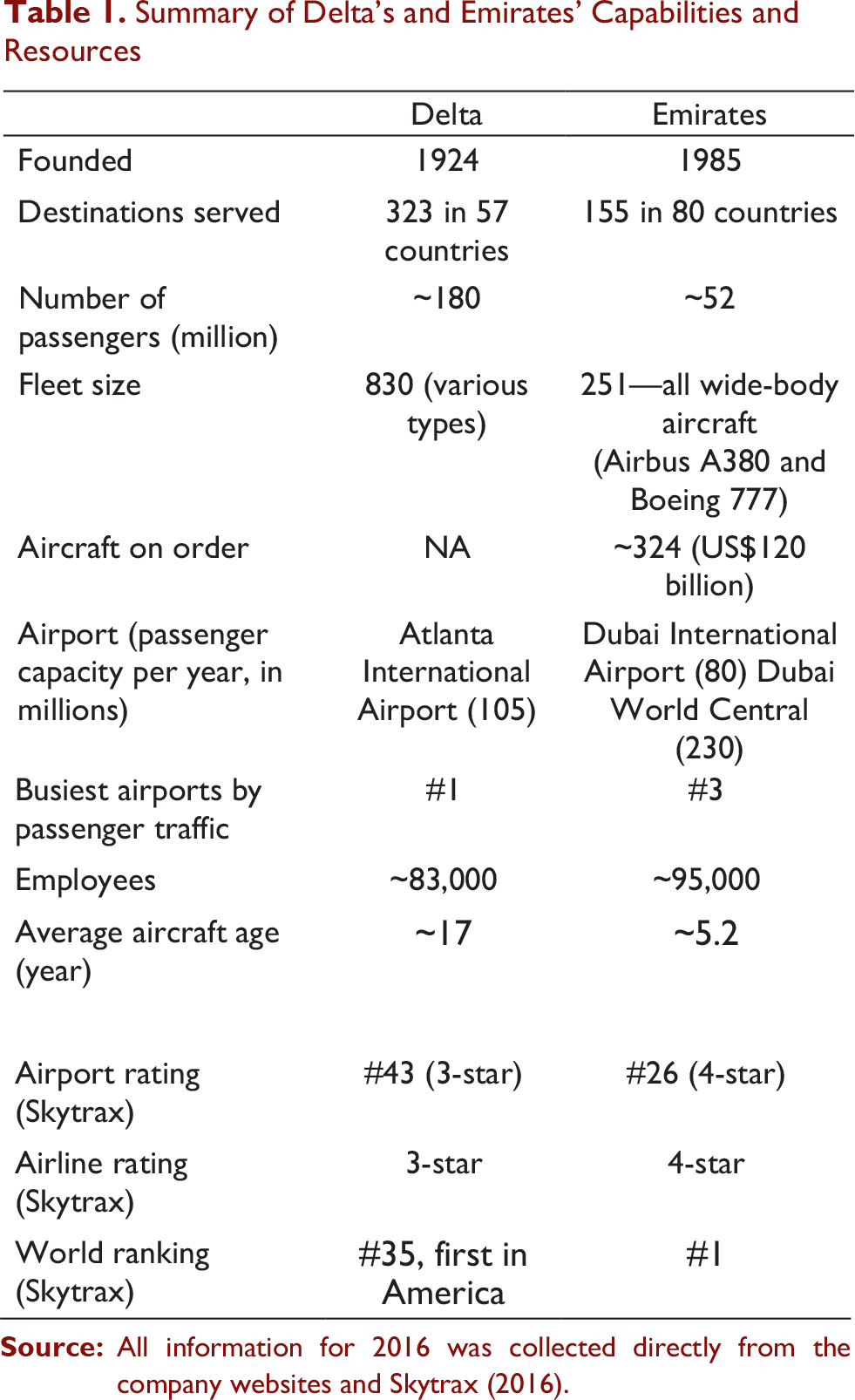
From the information presented in Table 1, it can be noticed that several items give Emirates strong competitive advantages that enable it to be the future market leader. First, the two airports in Dubai have the capacity for large future expansions, which will provide an annual capacity three-fold that of Atlanta International Airport, currently the busiest airport in the world. Second, the fleet contains the most advanced aircraft and is the youngest in the industry, which has many unique advantages that enhance operation efficiency and customer satisfaction. Third, Emirates has the capacity to continue to order a massive number of new aircraft to continue its expansion. Based on the previous trends of such orders, it is expected that Emirates will be the largest airline in the world by 2030. Fourth, the number of employees is relatively high to sustain superior customer comfort and provide high-quality services on board and on the ground, even though the number of travellers is less than a third of what Delta serves. In 2016, Emirates was voted the world’s number-one airline (Skytrax, 2016), and its brand value grew by 17 per cent to reach US$7.7 billion, making it the most valuable airline brand in the world.
Global Customer Ranking for Various Services Provided by Delta and Emirates
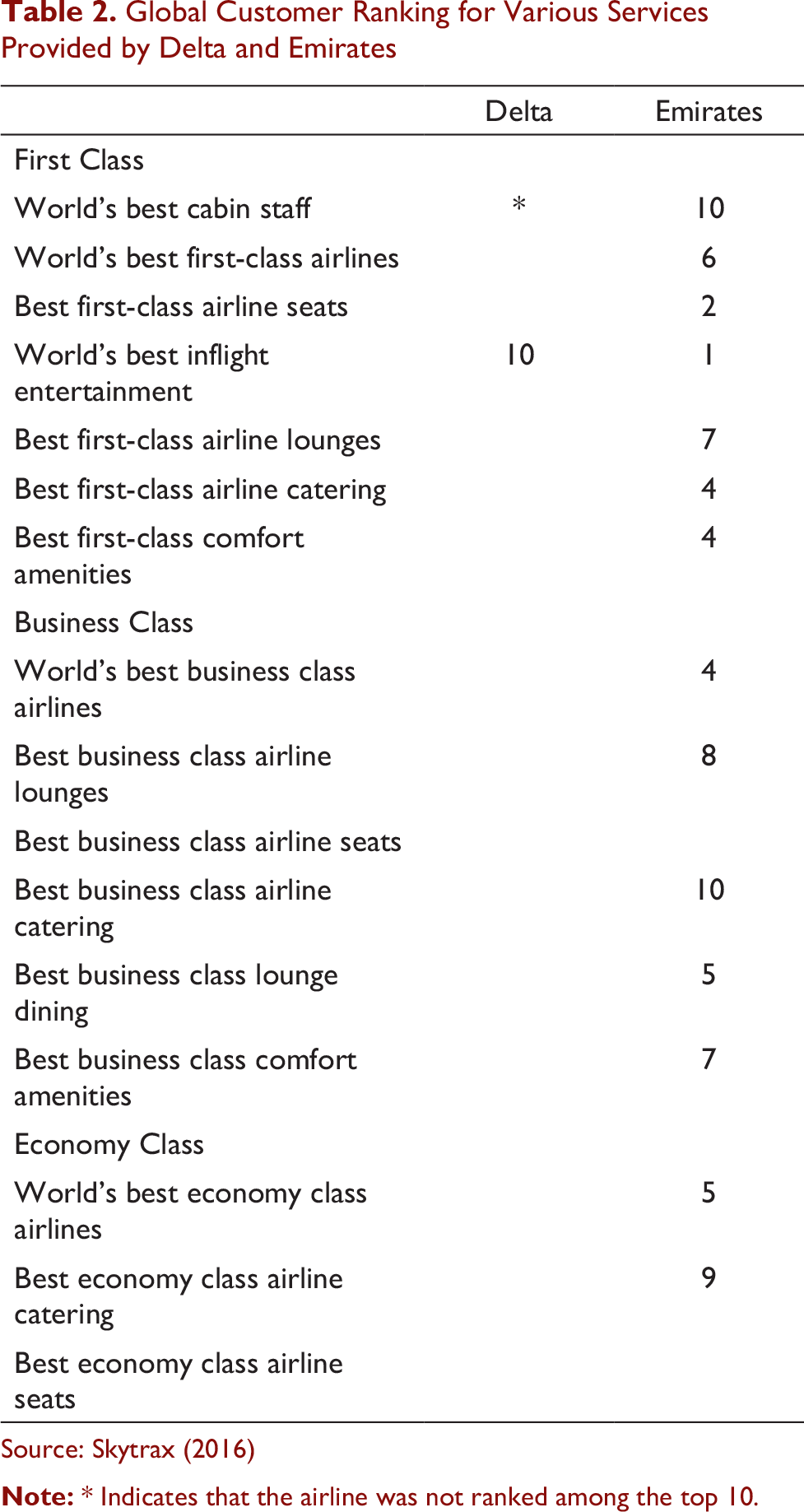
During this fourth period, Delta became aware of the intense competition with Emirates, and its motivation and capability to continue offering its flights to Dubai weakened. Thus, in February 2016, Delta decided to cancel its non-stop flights between the world’s busiest airport and the Middle East’s largest hub, claiming that this route was not profitable (Delta, 2016). Delta’s competitive response came after analysing the market conditions in the Middle East region, where it stated that the competitive dynamics had shifted with the national government’s support for Emirates. Delta announced that it was unable to compete with the level of service offered by Emirates or sustain an acceptable profit from this route. Consequently, Delta bore a certain competitive disadvantage in this period: losing an important connection to the largest hub in the Middle East, which is the gateway to Asia, and harming the firm’s image and status for being unable to compete in a critical region. Currently, Delta has suspended all its flights to the Middle East, except for one non-stop flight from New York to Tel Aviv, whereas Emirates has continued to search for new destinations to serve North American cities and increase the frequency of existing flights. Emirates currently connects 11 North American cities with its hub in Dubai. However, in 2016, Delta realized the need to renew most of its long-haul fleet, ordering 100 Airbus aircraft, which are expected to be delivered starting in 2020. This move is expected to improve Delta’s market position in serving long-haul flights as they are utilized for the appropriate routes.
Discussion
This study provides empirical evidence that the competitive dynamics between MNCs and EMNCs in emerging economies are a complex process which can be divided into four rounds. Each round provides either company discussed with a unique set of competitive advantages and disadvantages, and during each round, either company develops the awareness, motivation and capability needed for competitive actions or responses.
In the first round, Delta’s launch of a non-stop flight to Dubai triggered a competitive dynamic with Emirates (D’Aveni, 1994). As one of the leading airline carriers, Delta owned superior managerial and operational experience and a wide international network, thus having the capabilities to outperform Emirates at this stage. Owing to low resource similarity between Delta and Emirates, the intensity of the competition was so low that Delta did not consider Emirates a main competitor (Spencer, 2008). However, as Emirates perceived Delta’s move as an attack, it had no choice but to respond in an effort to secure its market position. This led to increasing Emirates’ awareness and motivation to respond by analysing the new market conditions and its competitive resources to draft the most suitable strategic response (Dawar & Frost, 1999).
In the second round, Emirates started to develop its capabilities in the hope of countering through competitive responses (Spenser, 2008). Emirates started to analyse the market conditions and quickly learned from its competitors to increase its awareness of the competitive threats posed by Delta (Lyles & Salk, 1996; Park et al., 2014). In this period, Emirates underwent a steep learning curve to understand how to react appropriately (Al-Kwifi, 2012; Uhlenbruck et al., 2003). Taking advantage of its hub location, Emirates started its response strategy by identifying high-demand destinations in different regions for launching new flight routes so that it could enhance its strategic position by attracting more travellers and expanding the global network (Abu Farha et al., 2019; Meyer et al., 2009). Emirates ordered a large number of aircraft to serve these destinations, while ensuring that its specific configurations achieved superior customer comfort and enhanced its ability to increase operational efficiency (Williams & Du, 2014). This suggests that Emirates was constantly analysing the market and customers’ needs to find ways to generate more competitive advantages.
Since Emirates is owned by the Dubai government, it received considerable backing directly and indirectly (Buckley et al., 2008), which is widely documented in the literature (Athreye & Kapur, 2009; Goldstein & Pananond, 2008; Yeganeh, 2016). This support was crucial for enhancing its market position, because it enabled Emirates to use two international hubs that could not only handle a massive number of passengers but were also fully equipped with advanced facilities to enhance the customer travelling experience (Vlachos & Lin, 2014). This support provided Emirates with an important competitive advantage over its rivals in its local market. Although Emirates was building its capacity gradually during this period, Delta did not consider Emirates an aggressive competitor.
In the third period, Emirates was in a strong position and had developed a full set of competitive capabilities. Thus, it initiated a strike back by conducting an aggressive global expansion, which included the USA, Delta’s homeland. To ensure the success of this strategic action, Emirates utilized the most advanced aircraft in the industry, which could be used for long and ultra-long flights. This enabled Emirates to reach any global destination with a non-stop flight. Emirates’ rapid global expansion was a competitive action to obtain strategic resources and decrease its institutional and market constraints at home (Choi & Williams, 2014; Luo et al., 2011).
International expansion comes with its own costs represented as liabilities of foreignness (Nachum, 2010), which could lead to a lack of critical resources or skills when they are needed for competition (Yamakawa et al., 2013). However, Emirates was effective in balancing its international expansion by coordinating the process of receiving new aircraft alongside launching new destinations; it also enhanced the skills and capabilities of its employees to match the expansion of its other activities. The competitive advantages that Emirates enjoyed locally and internationally made it a key competitor at the global level to become the world’s largest carrier of international passengers (Economist, 2015). However, as Delta was under pressure from losing customers to Emirates, it was forced to cancel many flights to the Middle East and other nearby regions, leading to a shrink in its market share.
The final period is used to define the market leader. The competitive dynamics and co-evolution of Delta and Emirates during the previous three periods show that Emirates possesses many competitive advantages to become the market leader, because it possesses all the required capabilities and experience to continue its strategic action towards international expansion. In general, Emirates’ competitive advantage cannot be matched by any other airline at any time in the near future, because it currently has the largest hubs in the world, the most advanced and youngest fleet of aircraft, highly skilled employees, intense world networks, a global brand name and government support. These combined factors are essential for making Emirates the market leader in the near future.
Research Contributions
Most of the previous research on strategy in emerging economies has focused on either the strategy of MNCs in emerging economies or the strategy of EMNCs within and outside of emerging economies (Peng, 2012; Young et al., 2014), failing to produce an adequate understanding of the interaction process when an MNC enters an emerging economy and competes with an EMNC. The competitive dynamic relationships that develop over time between MNCs and EMNCs in emerging economies are not explored in depth because previous research focused on the competitive dynamics in strategic management rather than on international business (Chen, 1996; Ndofor et al., 2011). This study is therefore the first study that employs practical evidence to explore the rivalry between an MNC and an EMNC within the context of international business by utilizing the competitive dynamics framework developed by Mutlu et al. (2015). A unique contribution of this study is adding a fourth round to help define the potential market leader from this competition.
While previous studies have mainly focused on exploring the competitive dynamics between MNCs or EMNCs over extended periods (Gaur et al., 2014; Park et al., 2013), this study is one of the first efforts that analytically models the competitive interaction between them from a longitudinal perspective, using four periods that cover 16 years. Data were obtained from various sources to describe the competitive interactions between the MNC and the EMNC and to define the actions and responses of both. Furthermore, it was shown how the dynamic capabilities evolved over time, leading to the development of competitive (dis)advantages for each firm. implementation of this kind of comparative, dynamic and longitudinal approach is critical to enhance our comprehension of the competitive dynamics process between MNCs and EMNCs in emerging economies.
The process of studying the rivalry between MNCs and EMNCs in emerging economies from a longitudinal viewpoint over four rounds is important for presenting the firms’ levels of awareness, motivation and capability in each period. These levels co-evolve with the institutional setting in emerging economies and the dynamic strategic interactions between the MNC and EMNC to determine the subsequent competitive actions. This kind of presentation for dynamic interactions was not used previously because earlier work focused more on institutional transitions and strategic choices (Peng, 2003). An interactive approach that presents how competitors compete and act during institutional development provides a deep understanding of the competition dynamic.
Managerial Implications
Since the dynamic competition process evolves between an MNC and an EMNC over an extended period, it is important that managers of both firms engage in continuous learning activities to learn from their competitors in order to define the appropriate actions that sustain competitive advantages (Kogut & Zander, 1996). This is important for enhancing the firm’s absorptive capacity (Cohen & Levinthal, 1990), whereby firms improve their knowledge acquisition and exploitation. In this regard, firms should develop fast organizational learning approaches to anticipate changes in the markets and react quickly. This can be demonstrated in this study when Emirates’ managers learned that the number of airlines travelling between North America and Asia has been increasing substantially and that they need to use advanced aircraft for long-haul flights to take advantage of this opportunity. This action was effective in their entering the North American market without the need for stopping in Europe. The best managers expect strategy to shift over time by frequently translating the actions of the competitors and by being willing to take appropriate responses to great, new opportunities.
The complex nature of competition requires managers to analyse local and global competition to define the key influential factors and then work on building essential capabilities and resources to initiate an action strategy quickly. It is important to notice that the competitive landscape can be different from region to region or county to country, giving some competitors more advantages over others. Such variations in regional markets require a deeper understanding of these markets and their characteristics in order to define the optimal competitive responses. This directly implies that managers should not use the same strategies for various global markets unless they complete an adequate investigation for each one. In this study, Emirates’ managers studied the North American market and found that customers are looking for high-quality service. This deep understanding of the needs of customers in regional markets helped them direct a strategy to offer enhanced onboard services that surpassed those of other airlines in the region and attract more passengers to its flights.
Thus, an effective manager is one who can build a comprehensive view of the competition, develop capabilities, pursue new opportunities and predict the competitors’ responses.
Even though MNCs typically possess superior managerial and technical skills, they should be aware of the impact of the institutional development of emerging economies on EMNCs’ progress. Depending on the level of economic development in some countries (Hoskisson et al., 2013), some EMNCs could have the privilege of generating more competitive advantages by receiving government funding or accessing special arrangements. This condition places pressure on MNC managers to develop a better awareness of new settings and create appropriate strategies to respond. Managers might also seek collaboration with local partners to take advantage of local ties or develop new capabilities that surpass the position of the local competitor. In general, in competitive dynamics, managers should rely on awareness, motivation and capability to frame their competitive actions and responses.
Future Research Directions
In this study, two airlines were used to test the AMC framework and examine competitive dynamics between them, one from a developed country and the other from an emerging economy. However, future studies can expand on this study by exploring the competitive dynamics among more firms from various countries. This will increase the complexity of the study, as the competition has to be measured across different dimensions in the industry, relating each response to specific actions from a particular firm. Collected data in such studies have to be monitored and analysed over an extended period to conclude the correct outcome of each round. Additional interviews with industry experts and firms’ managers can be beneficial to ensure that the measured responses were taken as specific reactions to competitors.
Footnotes
Declaration of Conflicting Interests
The authors declared no potential conflicts of interest with respect to the research, authorship and/or publication of this article.
Funding
The authors received no financial support for the research, authorship and/or publication of this article.
