



Abstract
The global health disaster COVID-19 has imposed a self-refrainment from social gathering to contain the disease, because social distancing is the only shield from community spread. Home and work places are altogether giving an unanticipated, unpredicted and unpleasant milieu due to global spread of COVID-19. The teaching–learning process is no exception, with the closure of all educational institutions as a protective step to save lives. The teaching–learning process has been reflecting a very wide and deep impact of COVID-19. With all teachers and learners confined to their places of stay, learning has been impacted to a large extent, with a sense of uncertainty, insecurity and dilemma around effective learning. In fact, the COVID-19 pandemic has thrown the mission and rigour of teaching–learning out of gear. With all classrooms shut, the pandemic has exposed teachers and learners more towards the online learning mode, with no other option perceptible at this point of time. Though online education has always been embraced by academics as a supporting tool, switching over completely to the online mode of learning has raised some serious concerns pertaining to its efficacy and the reluctance of learners in embracing it as a substitute of the regular mode of learning. This study reveals the perception of 2,895 learners on the efficiency of online learning as a substitute of the regular mode of learning. The results show the acceptance of online learning only as a supporting tool to regular learning instead of as a substitute of the regular learning mode on the basis of various factors of effective learning, such as content, pedagogy, assessment and rigour.
Introduction
COVID-19 has forced us to rapidly adopt, integrate and use technology to help us survive during these challenging times. The outbreak has forced educational institutions to think ahead and develop strategies for integration of technology to minimise interruptions for all UG/PG (undergraduate/postgraduate) programmes and education in general. How will COVID-19 change the landscape of teaching and learning now and in the future? This depends on the perception of learners towards actual learning through the online mode of education, pedagogy adopted by the teaching fraternity, available technological infrastructure and assessment of the learning and the rigour of the online mode of learning, which they have experienced during the lockdown period, as a consequence of the COVID-19 outbreak.
Online learning has become part of the curriculum in many universities. This type of learning utilises electronic technologies to learn outside a traditional classroom. Presentations can be pre-recorded or presented live, allowing participants to either learn at their own pace or even go back and review what they have already learnt and ask questions. Attendance can be registered and monitored through these platforms to ensure accountability and provide education credits.
Online learning has entered regular education after decades of innovation and its enhanced usage. Researchers have varied perceptions on the concept of online learning. The extent of implementation of online learning in higher education varies significantly, with the countries having a highly developed and advanced infrastructure for technology embracing online learning faster as the next educational opportunity in comparison to less technologically developed countries. Online education has been recommended as a radical key to varied educational issues of unfairness (Allen & Seaman, 2014). The adoption of the online mode of education is anticipated to enhance the availability of university education and expansion, making it imperative to accept online education across higher education programmes. Though online education permits social distancing necessary during the pandemic, convenience of access, virtual faculty–learner interactions and feedback, a larger audience, reduction in expenses and vast resources of content, it lacks in essential aspects of interactivity during regular mode, lacks focus, lacks infrastructure.
Pre-COVID-19 Education
Just before the COVID-19 pandemic, learners were primarily using digital content for their education in the form of electronic textbooks, journal articles, online presentations and lecture videos on a variety of websites or self-developed content. Online learning platforms have rapidly gained popularity in education, and in recent times online learning has been found to be the most commonly used educational supporting resource for the teaching fraternity, as well as for learners. Videos as an educational resource have been shown to be effective (Ahmet et al., 2018) and have grown dramatically in popularity as flipped classroom mode. This era of online education was emerged before COVID-19 and will likely be developed depending on how we continue to impart education. This pandemic has given us more exposure to online education. The majority of educational institutions have continued to impart education for their regular programmes using a wide range of online platforms available.
Education Through COVID-19
The COVID-19 pandemic has served as an effective catalyst in expanding educational opportunities—particularly with respect to knowledge sharing through web-based technology. Although digital education platforms are not new, engineering and management remain skills-oriented professions requiring acquisition of expanded knowledge to be effectively complemented with technical-skills development. The latter process requires practical exposure through replication/simulation of conditions experienced during real-time exposure. The coming years will likely see the maturation of several virtual learning technologies that will enhance the younger generation with more knowledge.
Post-COVID-19 Education
The post-COVID-19 world is predicted to be different. Around the world, COVID-19 is forcing us to re-evaluate how existing educational organisations impart education. However, during COVID-19, online education has faced a major challenge in its full acceptance by learners as a substitute of the regular mode of education, and this study reveals the facts through an empirical analysis. Efficiency in imparting knowledge and assessing learning has been a challenge.
Many of the developing platforms have interactive features, such as chat and messaging, where listeners can actively interact with the presenters, no different than the traditional question-and-answer session in the regular mode of education. Webinars can be an additional opportunity for participating learners to interact with the trainer/teacher. However, the engagement of learners with different online resources at a time, when the learners are hooked to only the online mode of education, is posing a potential risk to the actual learning, which may be attributed to lack of focus and interest. Previous studies have found that working on several tasks concurrently proves less efficient than performing each task separately (Pashler, 2000). Multitasking diminishes students’ focus and performance and can increase impulsivity (Hallowell, 2005).
Rationale for the Present Study
A wide range of studies have investigated pedagogy, assessment, multitasking and their effect on learning, be it in online, regular or blended education. The exceptionally pitiable situation of COVID-19 has forced the educationist to impart knowledge through only the online mode of education.
Quality teaching and learning cannot exist without a comprehensive and holistic pedagogy approach (Peter Serdyukov, 2015), and there are negative effects of multitasking on learning (Kuznekoff & Titsworth, 2013; May & Elder, 2018; Örün & Akbulut, 2019; Rosen et al., 2011; Sana et al., 2013). The educationist must critically evaluate whether the online mode of education is the best way to learn and whether it enhances or damages the regular mode of education. While this great opportunity exists, (rather altogether shifted from regular mode during COVID-19), it is essential to answer if fully online learning setup can grow the art of human interaction, personal connection, confirmed learning and appropriate education credits? Technology is a powerful tool that will likely emerge to enhance educational experiences, but should it serve to be the exclusive substitute of regular-mode education? This study was carried out to record the perception of learners during the COVID-19 lockdown, a rather unusual simulation set-up for them to think about a complete shift to online education, on various issues/challenges that learners perceive in taking up/completing their curriculum through the online platform during the lockdown.
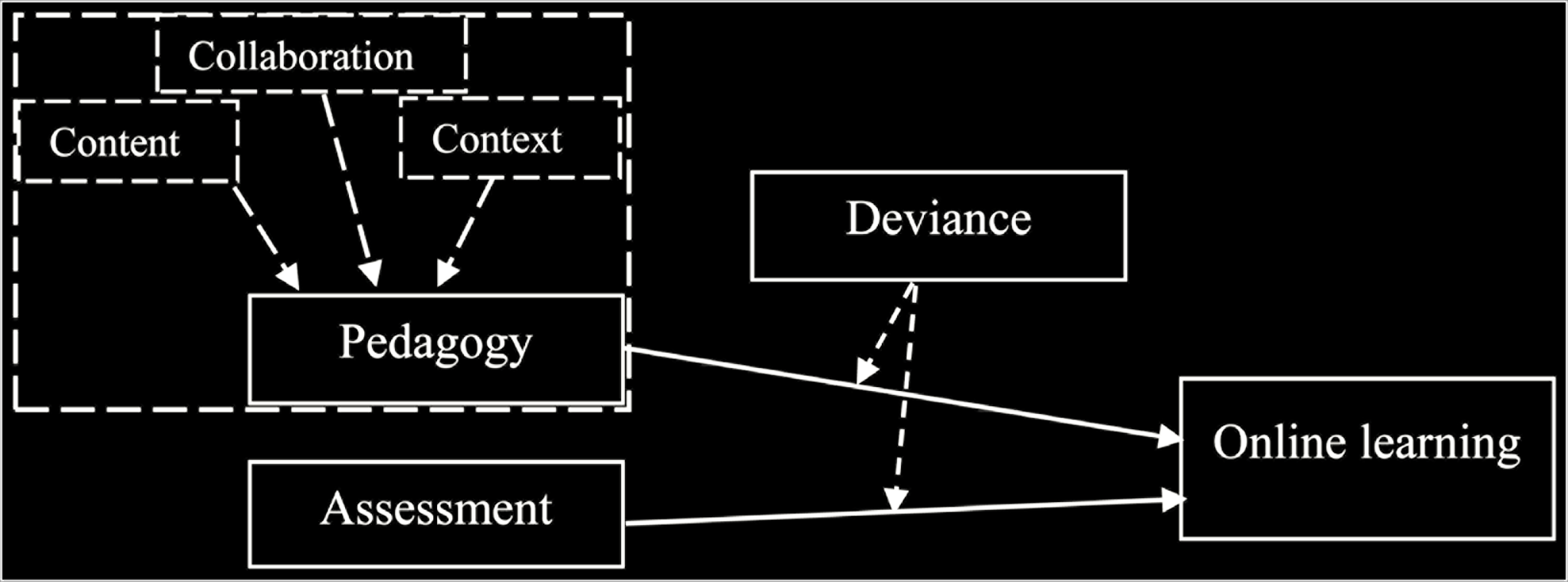
This study aims to investigate university (UG, PG) students’ perception of the effectiveness of online learning, with respect to pedagogy, learning and assessment, in comparison to the regular mode of education, to help educationists deliberate whether online education can be considered as a substitute of regular education. The effectiveness of online learning is moderated by deviation of focus due to interaction with multiple online sources at the same time while pursuing online education. The research questions revealing the conceptual model, as shown in Figure 1, are as follows:
RQ1: In the online mode of education, the effectiveness of learning has a relationship with pedagogy and assessment. RQ2: In the online mode of education, the effectiveness of learning and its relationship with pedagogy and assessment are moderated by deviance, due to interaction with multiple online resources. RQ3: The online mode of education is deficient in pedagogy and assessment in comparison to the regular mode of education.
This study contributes to an educational setup in future which actually benefits the learning of students.
Online Learning and Pedagogy
Online learning pedagogy has more to do with cognitive, social and emotional facet during the an online session as well as post session.to reflect on the perceived learning of the learners (Baturay, 2011). The availability of rich and updated digital material facilitates the interactions among teachers, learners and peers (Taskm & Kandemir, 2010). Besides the content, it is important for the teacher to use right pedagogy to ensure cognitive learning and emotional facet to satisfy the learners on their perceived learning. Integration of information technology has always being meaningful for effective teaching–learning, which enhances experiential learning.
Learner-focused pedagogies vis-à-vis problem solving (learners use interdisciplinary knowledge to solve problems with applied learning to have more than one solution to the problem (Savery, 2006)); Project based learning (learners do assignments that are of practical relevance with an emphasis to apply the acquired knowledge and complete the project, (Prince & Felder, 2006); Flipped classroom (where learners-focussed learning is with teacher-focused instructions but there is not one model for flipped classroom but revolve around same idea (Tucker, 2012). The pedagogical orientation towards PBL (project based learning) and flipped classroom in academics gives a better, richer and pleasant learning experience to the learners, but online education is devoid of such experiences, where it becomes infeasible for the teachers to fully engage and ensure the commitment of learners while adopting such pedagogies; rather, social and peer interaction become more significant. Even though online education is observed as advanced educational exercise that can accomplish both openness and interactivity (Garrison & Kanuka, 2008), but it is challenging for online education to be both open and interactive (Kanuka & Brooks, 2010).
Online Learning and Assessment
Assessment is always an important component of learning process as it evaluates how effective the mode and pedagogy is if learning was to make the learners confident of their employability and deployability when they enter the workforce. The learners are evaluated for their acquired knowledge, problem solving ability, critical-thinking and analytical skills and life-long learning. They see the need for higher education–university degrees to get a good job and preferably with a high salary (Nixon et al., 2018). Thus consider the universities responsible to make them employable with more focus on skill development and experience rich learning (Selingo, 2015). With such competitive pressure, universities rely on the perceived satisfaction of learners (Judson & Taylor, 2014). This has led to learner-focused pedagogies, such as problem-based learning, flipped classrooms, PBL, for development of skills (Tomlinson, 2017), as well as assessments that are observed to improve learning (Sorcinelli, 2007). Assessment on all these skills on Online learning mode is essential to evaluate the effectiveness and appropriateness of student’s perceived learning language. Right amalgamation of different pedagogies which are used during the learning process can be confirmed effective through the assessment of learning.
Online Learning and Deviance as a Moderator
The online learning process uses varied resources to enrich content delivery as per the needs and level of understanding of a wide range of learners. Webinars are also one of the additional resources for learners to interact with the trainer/teacher. These may be quite useful when online learning is used as a supporting tool. However, when learners do not have any other mode of learning except the online mode, then it is highly likely that their focus would deviate, either due to lack of content and inadequate pedagogy of the ongoing online learning or lack of focus and interest due to overflowing content from other sources. Deviation sources include usage of mobile phones, texting and social media interaction, such as Facebook, Instagram and YouTube videos. This is posing a potential risk to the actual learning, which may be attributed to lack of focus and interest, with the learners switching over to different content and other activities concurrently. Working on several tasks concurrently is less efficient than performing each task separately (Pashler, 2000) and deviates students’ focus and impacts their performance, as well as leading to increased impulsiveness (Hallowell, 2005).
The issue of impairment of learning due to multiple engagements has been addressed by many theories (Chen & Yan, 2016), like the cognitive theory on multimedia learning (Mayer, 2014). The adverse effect of multiple-media engagement on learning is attributed to inconsistency between visual and verbal communication and their capacity, as well as the coordination (Gog & Sweller, 2010), memory, perception and motor hindrances in information processing (Salvucci et al., 2009). It is imperative that one focuses on only one stimulus whenever there is some interference, and it is observed that doing one assignment at a time results in better performance than doing two or multiple assignments (Poldrack et al., 2005). People, especially the learners found it interesting to engage in multiple online activities resulting in deviation in attention even during the continuous activity -like online education (Levine et al., 2012; Most et al., 2001) leading to superficial learning.
Research has also revealed that even the use of media for assignments can adversely impact the learning (Mueller & Oppenheimer, 2014) and critical thinking of the learners (Heflin et al., 2017). High-level use of media and multitasking during assessments reflected low performance (Patterson, 2017). The deviation of focus due to engagement in other media activities has an adverse effect on assessment grades and study durations, perhaps reflecting inefficiency in learning (Bellur et al., 2015). Multitasking during academic activities also affects learning (Bowman et al., 2015; Kuznekoff & Titsworth, 2013). The learners engaged in different tasks, especially Facebook, showed poor performance (Downs et al., 2015) and scored less in a quiz assessment (Dietz & Henrich, 2014).
Methods
A survey was conducted among 2,895 students who were enrolled in regular programmes in management and engineering disciplines at four private universities in the National Capital Region. The students were taking regular classes before the lockdown due to COVID-19. A few of the courses were supported with either additional course content or some online course embedded in the prescribed curriculum. At the time of the study, all the students were taking classes fully on the online mode, due to the initiative taken by the government and the universities to continue to impart education without any hindrance caused by the lockdown. An online survey was used to measure the perception of students regarding learning entirely through the online mode of education in comparison to learning through the regular mode of education. The survey consisted of four parts: demographic questions; questions on PL with respect to pedagogy and assessment; questions on comparison of the online mode and regular mode of education; and questions on deviation from online learning due to involvement in multiple online resources at the same time. The demographic variables were taken to study additional information on learners pertinent to age, gender, enrolment in a university, type of degree, duration of degree. The survey was designed to gather multi-item demographic, academic, pedagogical, assessment and technological information on a 5-point Likert scale and through Yes/No questions. The multi-item research tool discovered strong internal consistency reliability, with Cronbach’s α > 0.85. The data were cleaned to remove the missing values and inconsistencies. A total of 2,895 learners responded with complete data. The respondents comprised 65% males and 34% females, with 58% of them enrolled in management and 42% in engineering programmes. Interestingly, 66% of the respondents belonged to rural areas and were taking online classes from home due to the COVID-19 lockdown. All the learners used to take up to five courses online during their regular classes. They had these online courses embedded in their course (average of 3.5 courses per semester), as well as additional supporting online courses (average of two courses/semester). The details of final data is given in Table 1 to understand the distribution of sample.
Categorisation of Sample (N = 2,895) Represented in Average and Percentage

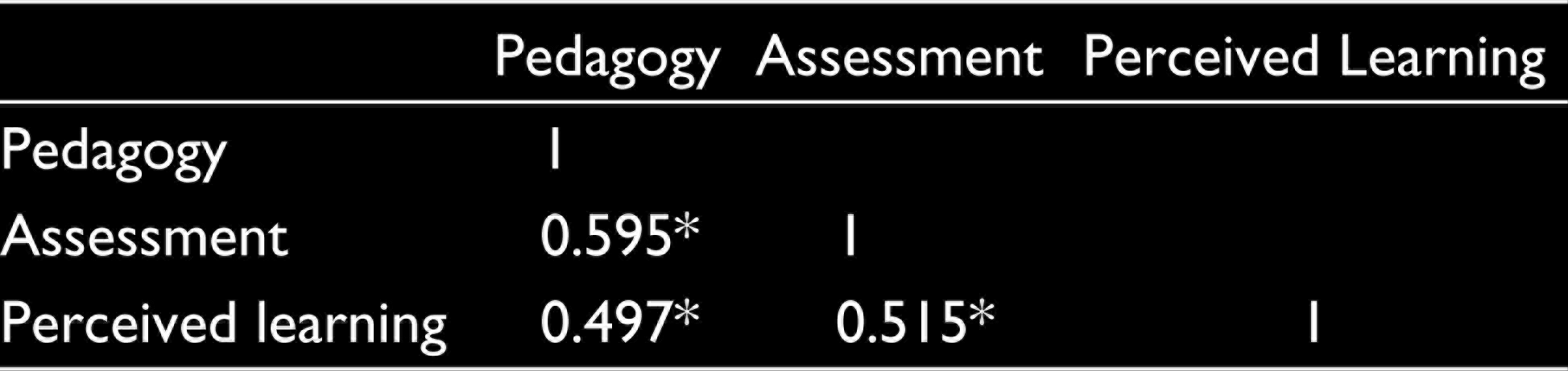
The data were analysed using Statistical Package for the Social Sciences (SPSS 25.0). Descriptive statistics were used to summarise the demographic and academic variables, as shown in Table 1, and further to know the perception of students through direct questions about the effectiveness of online learning in comparison to the learning through the regular mode of education. Pearson’s correlation between the variables was computed (Table 2). Statistical analyses to test the assumptions of normality, linearity and homoscedasticity were done before the regression analysis. Then, the regression analysis was carried out to establish the dependency of learning on pedagogy and assessment, which was further tested for moderation by deviance due to interaction with multiple resources during online learning, by using model 4 in PROCESS V3.4 by Andrew F. Hayes. Further, multivariate analysis of variance (MANOVA) was used to verify the students’ perception of deficient learning using only the online mode in comparison to the regular mode. MANOVA was used as the observations were independent and random, with each dependent variable (DV) having interval measurement.
Matrix of Correlation Between the Variables as per the Sample Responses (N = 2,895)
Results and Discussion
The questions were asked on a 5-point Likert scale (from 1 = strongly disagree to 5 = strongly agree) and not just in yes and no to know the perception of learners to compare regular and online mode with respect to various aspects of learning. The specific questions on their willingness to switch over completely to the online mode also included those on the use of technology, availability of network/infrastructure, fatigue from the screen and impact on health, behavioural changes and monotony.
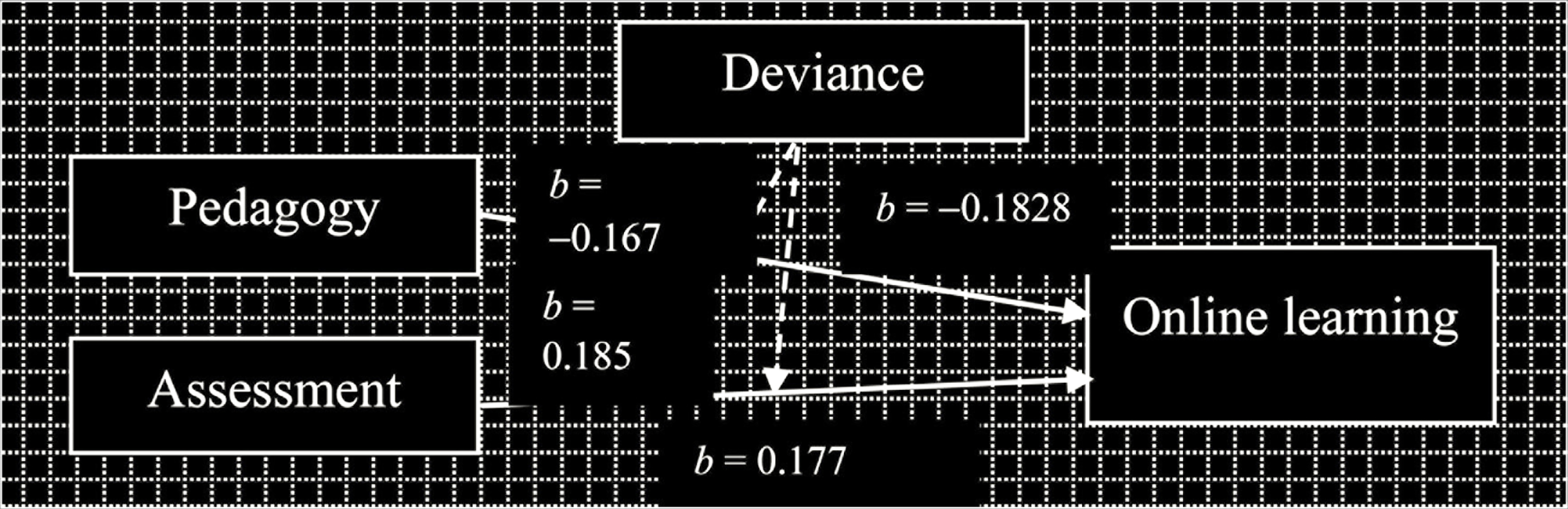
The results showed a direct and significant impact of pedagogy (b = 0.185, SE = 0.072, p = 0.009) and assessment (b = 0.177 SE = 0.083, p = 0.033) on PL when there was no deviance due to interaction with multiple online resources, where b is the coefficient, SE is the standard error and p the significance level. Further, the results of the Andrew F. Hayes moderation process model 1 test found that deviance had a significant moderating effect between pedagogy and PL (b = −0.1828, SE = 0.070, p = 0.0197) and between assessment and PL (b = −0.167, SE = 0.080, p = 0.025). There was an increase of 0.02 in the R2 value after adding the deviance variable with pedagogy and assessment. Thus, deviance reflected a moderating effect, as revealed in Figure 2.
Further, MANOVA explains the satisfaction of learners with their perceived learning using only the online mode of learning in comparison to the regular mode of learning with respect to pedagogy, assessment, knowledge attainment, skill development, interaction and discussion with peers. The MANOVA results are controlled by the learners’ domain of education (management and engineering) and gender. Gender and education domain were significant, with Wilks λ = 0.897, F = 2.232, df = 2,894 and p = 0.032 for gender and Wilks λ = 0.876, F = 2.314, df = 2,894 and p = 0.030 for education domain. The learning perceived is significantly higher through the regular mode of education than through only the online mode of education, with respect to pedagogies (mean = 4.23, p = 0.034) content (mean = 4.04, p = 0.023), skill development (mean = 3.95, p = 0.040), knowledge attainment (mean = 4.01, p = 0.042), peer interaction (mean = 4.35, p = 0.030) and assessment (mean = 3.98, p = 0.035). The results revealed the learners’ inclination towards the perceived benefits of the regular, interactive mode of education. This is further strengthened by feedback received from the students directly on rightfulness of only online mode of education in near future. Answering the question on to what extent they would like to get education through the online mode in comparison to the regular mode of education and why, about 90% of the learners preferred to have just 25% of their curriculum delivered using online resources. The reasons sought after reviewing their major concerns include the deviation due to multiple media resources available once they remain online for longer period of time; lack of attention from the instructors with respect to their specific needs and the queries; lack of interrupted discussion which is more attributed to technical lag; lesser learner engagement due to varied level of participation, leading to some unfortunate consequences of online mode of education. This study does not in any way suggest that online learning does not have importance in education. Nor does it suggest that online learning does not help in enhancing skill sets. Rather, it proposes that the online mode cannot be a substitute for the regular mode of education in the foreseeable future, due to the effectiveness of integrated, learner-focused pedagogies and assessment tools of learning and the focus deviation through the online mode due to multiple online resources.
Conclusion
The intent of this research article was to deliberate on the possible substitution of the regular mode education with only the online mode of education since all educational institutions were made to shift to the online mode of education to continue to impart education uninterrupted by the COVID-19 pandemic. The results of the research show the reluctance of learners to use only the online mode of education, as they find it less productive in terms of their knowledge building and skill development due to deficient pedagogy and assessment. Further, they found the deviance due to continued interaction with multiple online resources effected the pedagogy as well as the assessment. This decreases the level of focus and thus the learning. Multiple online resources range from mobile phone, message texting to, social media use such as Facebook, Instagram, YouTube There is no doubt that Information and communication technologies have made online education accessible to all the programs of higher education. This usually is supported by high-quality visuals and high-speed Internet to enhance the traditional learning experiences. Here, we need to ensure that the online mode complements rather than diverge from the very basic goals of teaching–learning, so that it improves learners’ knowledge, critical thinking and skill sets and facilitates collaboration among peers. Knowledge acquisition, critical thinking and problem-solving ability are the major skills of learners in higher education (Casner-Lotto & Barrington, 2006). The effectiveness of any course in higher education is based on leaners’ perceptions of learning outcomes and learner satisfaction, primarily, across different pedagogies and assessment tools. The online mode of education does not address completely the needs of students concerning their skill development and the learning expectations from the education stream they pursue in their intellectual journey. The interactive learning mode enforces peer interaction, which helps learners gain confidence, assess themselves and improve their deficient skill sets. The regular mode supported with online resources has emerged as the preferred mode of education instead of complete switching over to the online mode.
Implications and Future Research
The key points of the present research for the educationist to deliberate include the following. The online mode of education cannot be a substitute for the regular mode of education. Expansion of online education does not mean that the regular mode will cease to exist in the foreseeable future, at least not in the context under study. This, actually, might pose a risk to higher education institutions. Considering this as a risk, higher education institutions are expected to use technology as a supporting tool for the regular mode of education to enhance the learning experience of learners, instead of using it as the only tool. The reported findings are based on preliminary data evaluation based on non-probabilistic sampling. As with any study, the current research also has its limitations. The findings are based on self-reported data on learners’ perceptions. The data were collected from the registered students of universities in the two major domains of engineering and management only. A more thorough experimental design with more and varied learners and other control variables is needed to assess the reaction, needs, learning and results of learners to better equip education delivery in the future. The study opens the door for discussion about learner needs and preferences regarding the learning environment.
Footnotes
Author Contributions
The whole research presented in this manuscript is contributed by the sole author (main and corresponding), with no contribution from any other author.
Declaration of Conflicting Interests
The author declared no potential conflicts of interest with respect to the research, authorship and/or publication of this article.
Funding
The author received no financial support for the research, authorship and/or publication of this article.