




Abstract
Study design:
This study is a prospective study.
Aim:
Lower extremity malalignment is an important etiologic factor in patellofemoral pain syndrome (PFPS). We hypothesized that lower limb malalignment may affect dynamic balance and physical function. This prospective study was conducted to investigate the relationship between the lower limb alignment and the dynamic balance and physical function in patients with PFPS.
Methods:
The study included 62 individuals with unilateral PFPS. Pain severity was assessed by the numerical pain scale and the pain duration was recorded. Lower extremity bone alignment was evaluated by the lateral distal femoral angle (LDFA) and the medial proximal tibia angle. Dynamic postural balance was assessed by the star excursion balance test. The functional status of the patients was evaluated by the 30-second chair stand test.
Results:
The mean duration of the pain was 24.2 ± 31.5 months and the mean pain severity was 8.1 ± 1.4. Although there was a significant difference found between the affected and unaffected LDFA values of lower extremities (p < 0.05), there was no difference found with regard to the dynamic balance values of the lower extremities (p > 0.05). However, significant changes of posterolateral balance were identified at a painful side without causing a postural dynamic imbalance (p < 0.05).
Conclusion:
In our study, we found a valgus deformity as a deterioration in the lower limb alignment of patients with PFPS which may cause a deterioration of posterolateral balance only. However, no change in postural dynamic balance was observed in the comparison of affected side and unaffected side. Dynamic postural balance has been influenced by many kinematic changes related to lower extremities including pelvis, hip, and ankle. Thus, reciprocal mechanisms in the anatomical structures may compensate the postural balance dynamically.
Keywords
Introduction
Lower extremity alignment deterioration is an important etiologic factor in patellofemoral pain syndrome (PFPS). 1 –3 Patellofemoral joint mechanics can be influenced by the structural factors and segmental interactions of the lower extremity. 4 Lateral distal femoral angle (LDFA) and medial proximal tibia angle (MPTA) are the radiological parameters widely used in the evaluation of the lower limb alignment. 5
Pain and lower limb alignment may affect balance and functionality in PFPS patients. 6 Although there are many studies in the literature investigating the effect of anterior cruciate ligament injuries on balance control, the number of studies evaluating dynamic postural balance in PFPS patients is relatively small. 7 –9
Dynamic postural balance dysfunction increased in PFPS patients. 10,11 Star excursion balance test (SEBT) has been used as a valid and reliable tool in many studies for evaluating the dynamic postural control. 12 –15 It is known that in patients with PFPS, varying dynamic postural control, characterized by decreased knee and hip flexion, increased hip adduction and internal rotation, and the failure to provide a flat pelvis during a single-leg squat may affect the performance of SEBT. 16 –18 In agreement with this hypothesis, Aminaka and Gribble 19 observed that patients with PFPS produce shorter anterior reach distances and fewer knee/hip flexion compared to controls during SEBT.
There was no correlation found between the decreased static balance and the lower limb alignment in patients with PFPS. 20 However, the relationship between the lower extremity alignment and dynamic postural balance in patients with PFPS has not been investigated. We hypothesized that malalignment of the lower extremities may affect dynamic balance and physical function. Therefore, this study was planned to investigate the relationship between lower extremity malalignment and dynamic balance and physical function in patients with PFPS.
Materials and methods
Design
The study was designed as a prospective study.
Patients
The study included 62 individuals with unilateral PFPS (n = 53 females, 9 males, mean age of 44.1 ± 6.1 years, mean height = 163.4 ± 6.4 cm, body weight mean = 79.9 ± 13.4 kg). Inclusion criteria were the knee pain at least 6 months and PFPS signs (retropatellar pain, positive theatre sign, and patellar grinding test). Patients with patellofemoral subluxation or dislocation, meniscus, ligament or cartilage pathologies, Sinding–Larsen–Johansson syndrome or Osgood–Schlatter disease, long-term use of corticosteroids, and previous knee surgery were excluded. 21 –24 The ethical committee approval and the informed consent form were obtained from all patients for the study.
Sample size calculation
G*Power 3.1.9.2 software was used for sample size analysis. In the structured sample size analysis, the alpha meaning level (type I error), that is α = 0.05, is the power value that we want to obtain (type II error), that is, β = 0.95. The sample size was calculated to be least 54 patients. 20
Pain
An 11-point numeric rating scale (1-cm interval) was used to assess pain. 25
Lower extremity alignment
LDFA and MPTA were evaluated using posterior–anterior radiograph. Radiographic images were taken on barefoot when the patient was in full extension of the knee and body weight was evenly distributed to both extremities. The LDFA consists of an angle between the mechanical axis of the femur and the angle and the articular surface of the distal femur (normal limit: 85–90°). In the case of valgus deformity, the angle should be smaller than 85° and in the case of varus deformity, the angle should be greater than 90°. 1,5 MPTA consists of an angle between the anatomical axis of the tibia and the tibial plateau horizontal line in the frontal plane (normal limit: 85–90°). 26 All measurements were performed by the same orthopedist.
Dynamic balance
The dynamic balance measurements of the patients were evaluated by the SEBT (Figure 1). While the patients were standing on one foot, they were asked to touch the farthest point with their toes with the contralateral foot reaching the anterior, posteromedial, and posterolateral directions. Three measurements were taken after six trials in each direction. After each trial, a break of 30 s was given. The mean value of the anterior, posteromedial, and posterolateral direction measurements was recorded in centimeters. Lower extremity lengths were measured between the spina iliaca anterior superior and the medial malleolus. The results were recorded in centimeters. The normalization of the measurements in each direction was calculated by the formula: (extension distance/leg length) × 100 = % maximum reach. 27 When the patients could not maintain the posture on one foot, move the foot on which they were standing when they reached full contact with the reach legs, or could not return to the starting position after reaching out, the trial was invalidated and the reach was repeated.
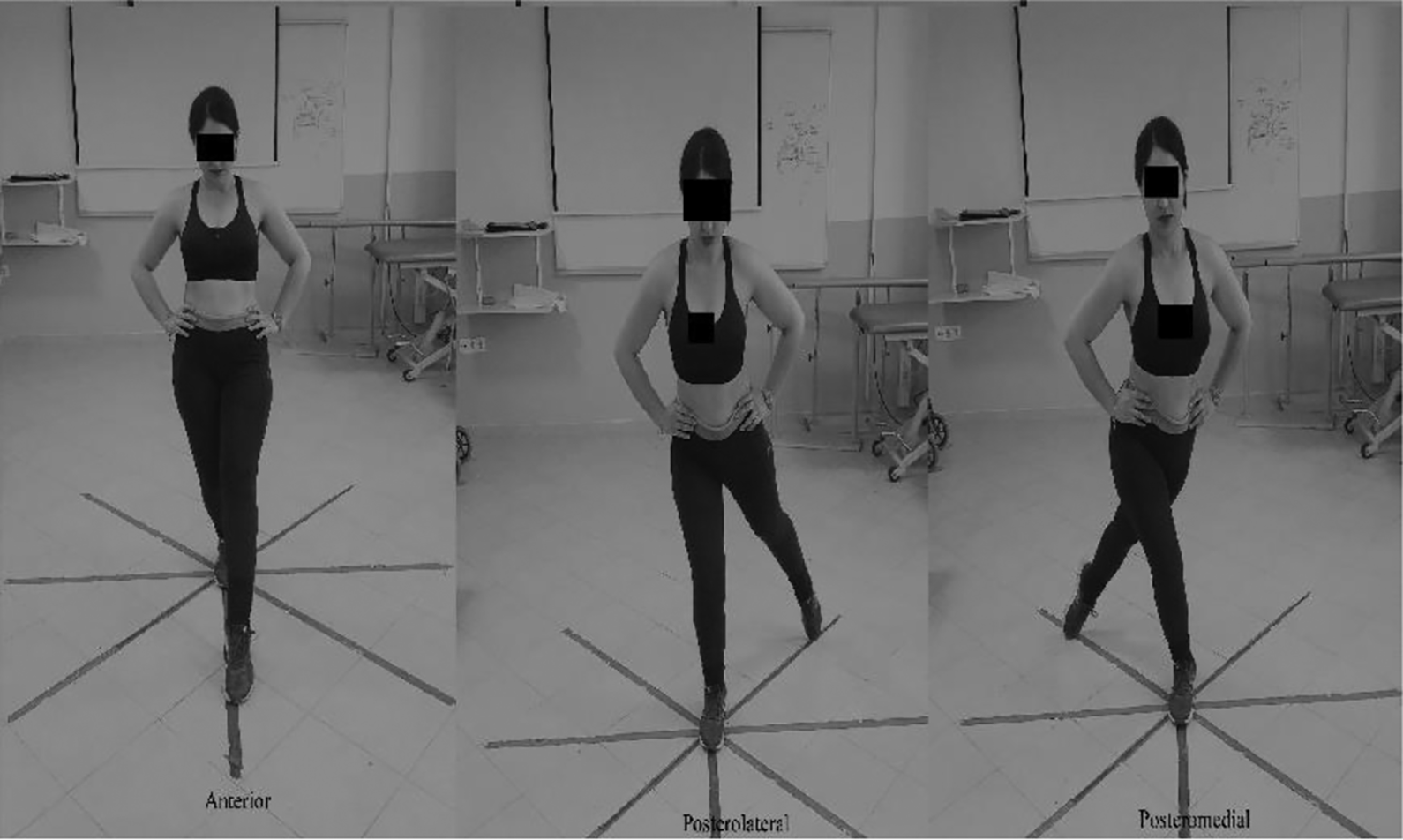
Star excursion balance test.
30-Second chair stand test
The 30-second chair stand test (30-CST) is a measure of lower body strength and endurance. Participants were asked to sit in a standard height chair (with a seat height of 43 cm) with arms crossed over the chest, then stand fully and sit down again as many times as possible within 30 s. 28 In order to decrease the effect of learning, all tests began with three to five practices.
Statistical analysis
The data were analyzed using the SPSS 22.0 for Windows program. The demographic characteristics of the individuals were given as mean and standard deviation. The affected and unaffected lower extremity results were compared using the t-test. The relationship between the lower extremity alignment, dynamic balance, 30-CST, and the pain was examined using Pearson’s correlation analysis. The significance level was adopted as p < 0.05.
Results
The mean age of the 62 patients (53 females and 9 males) was 44.1 ± 6.1 years, the mean height was 163.4 ± 6.4 cm, the mean body weight was 79.9 ± 13.4 kg, the mean duration of pain was 24.2 ± 31.5 months, and the mean level of pain was 8.1 ± 1.4 (Table 1).
Demographic characteristics of the patients.

PEPS: patellofemoral pain syndrome.
When the bone alignments of the lower extremities were examined, there was a significant difference found between the affected side and unaffected side of lower extremities in terms of LDFA values (p < 0.05; Table 2). The mean value of LDFA in the affected side was about 80.9 ± 1.2 which indicated valgus deformity. There was no difference found between the dynamic balance values of the affected and unaffected lower extremities (p > 0.05; Table 2).
Dynamic balance values and lower limb alignment in affected and unaffected sides.

SEBT: star excursion balance test; LDFA: lateral distal femoral angle; MPTA: medial proximal tibia angle.
a Paired sample t-test, p < 0.05.
There was a negative correlation between pain intensity and dynamic balance in the posterolateral direction (r = −0.286, p < 0.05). This showed that as the severity of pain increased on the affected side, the dynamic balance in the posterolateral direction was disrupted. Furthermore, there was no correlation found between the pain and the 30-CST (Table 3).
The relationship between pain intensity and lower limb alignment, dynamic balance, and physical performance on the affected side.

LDFA: lateral distal femoral angle; MPTA: medial proximal tibia angle; 30-CST: 30-second chair stand test.
a Pearson’s correlation analysis, p < 0.05.
Discussion
The results of the study showed that although the lower limb malalignment occurs in the painful knees, the dynamic balance did not show any variation. Valgus deformity has been identified as a deterioration of lower limb alignment in our patients. Any changes in postural dynamic balance were observed in comparison of the affected side and unaffected side. However, we found a negative correlation between the posterolateral balance and pain in the affected side. This result showed that posterolateral balance decreased with increasing pain severity in these patients.
It is known that lower limb malalignment is a triggering factor in PFPS. 2 Evaluation of lower limb alignment can help both reduce the risk of injury and improve performance in clinical practice. When the literature is reviewed, it is shown that static balance 20 and dynamic balance 19 decrease in PFPS patients. Potter et al. 29 showed impaired postural control in knee flexion contracture. In another study, it was reported that postural control deteriorated in the presence of lower extremity length difference. 30 Citaker et al. 20 found a statistically significant difference between the symptomatic side and the asymptomatic side in patients with PFPS in terms of static balance. This has led us to investigate the relationship between the lower limb alignment and the dynamic balance.
Balance is of utmost importance in maintaining postural stability. Loudon et al. 23 and Aminaka and Gribble 19 conducted their studies showing the relationship between the knee pain and the balance and reach test to investigate the effects of pain on postural control in patients with PFPS. Aminaka and Gribble have reported the decreased balance on the anterior direction in PFPS and have found that patellar banding reduces the knee pain and improves the SEBT balance performance. Bennell and Hinman 31 reported that, in healthy elderly individuals, the acute knee pain did not change the standing balance significantly. In this study, there was no difference between the dynamic postural balance values of both limbs. However, a moderate negative correlation was found between pain severity and posterolateral dynamic balance. This result showed that in this patient group, the posterolateral dynamic balance would decrease with increasing pain intensity.
In a previous study, it was shown that there is a significant relationship between Q angle and dynamic postural balance in young adults. 32 It has also been shown that a high Q angle is correlated with increased postural sway in the elderly population. 33 However, in our study, there was no correlation between lower extremity alignment and dynamic postural balance on the symptomatic side. Similarly, Hunt et al. 34 investigated the effect of tibial alignment surgery on single-leg standing balance in patients with knee osteoarthritis. No difference was found in standing balance following high tibial osteotomy.
Pain restricts the function and affects the quality of life in patients with PFPS. Functional tests evaluate the knee joint in conditions that mimic the actual functional requirements. Factors such as pain, crepitation, neuromuscular coordination disorder, decreased muscle strength, and joint stability may influence the results in these tests. Functional tests give us an idea of muscle strength, endurance, proprioception, and balance. 23 Barton et al. 35 have suggested that walking, climbing stairs, and ramp-up/down activity performances are reduced in patients with PFPS. Retropatellar pain gets aggravated during physical activities, for example, stair climbing, squatting, and prolonged sitting, which can increase the load on patellofemoral joint. 36,37 This study did not find a significant correlation between the pain and the 30-CST test because healthy limb may compensate the functionality.
PFPS can also affect gait parameters. Differences in gait characteristics between PFPS and healthy controls have been shown. Studies have shown a significant decrease in knee extensor moment in PFPS patients. 38,39 Compared to healthy controls, patients with PFPS show a decrease in walking speed, cadence, loading response, and terminal knee extensor moment and delayed foot eversion during gait. In addition, more hip adduction and more contralateral pelvic drops were shown in these patients during jumping, squatting, and running. 40
The limitations of this study were that the biomechanical parameters related to anatomical structures such as the pelvis, hip, and ankle could not be evaluated and detailed gait analysis could not be performed. Another limitation is that the follow-up period may affect the results in terms of dynamic postural balance regarding the severity of deformity and pain.
Conclusion
As a result of this study, the dynamic postural balance did not show a difference compared to the unaffected side limb, although it showed a lower limb malalignment in painful knees in patients with PFPS. On the other hand, our results showed that the severity of pain only affected posterolateral balance in patients with PFPS. Studies with longer term patellofemoral pain will further clarify the effect of lower limb alignment on dynamic postural balance.
Footnotes
Declaration of conflicting interests
The author(s) declared no potential conflicts of interest with respect to the research, authorship, and/or publication of this article.
Funding
The author(s) received no financial support for the research, authorship, and/or publication of this article.
