




Abstract
Background:
Pedal biphalangism, which was also defined as symphalangism, is seen at a frequency that cannot be ignored; however, no study can be found in the literature evaluating biphalangism in normal population in comparison to those who have foot disorders. The aim of this study was to evaluate the incidence of the pedal fifth toe symphalangism in normal population and in patients with foot deformity including hallux valgus, pes planus, pes cavus, and pes equinovarus. We hypothesized that pedal fifth toe symphalangism may be a predisposing factor or an accompanying structural variation for foot deformity.
Materials:
Patients admitted to the emergency department of our center in October and November 2016 were defined as the control group, and patients with the diagnosis of hallux valgus, pes planus, pes cavus, and pes equinovarus treated between 2011 and 2016 in our department were defined as the foot deformity group. Individuals who had anteroposterior, oblique, and lateral radiographs of foot were included in the study.
Results:
One thousand and four patients participated in the cross-sectional observational study. Biphalangeal fifth toe was found in 328 of 1004 (32.7%) patients. In foot deformity group (n = 672), 222 patients (33%) had biphalangeal fifth toe. In the control group, 106 (31.9%) of the 332 patients had biphalangeal fifth toe. There was no statistically significant difference in the incidence of biphalangeal fifth toe between the two groups (p = 0.72).
Conclusions:
According to the results of this study, biphalangeal fifth toe is a common pedal anatomical variant seen approximately in one-third of the population who have either foot deformity or not. This information may be valuable for podiatrist undertaking the conservative or surgical treatment of fifth toe-related disorders.
Introduction
Pedal symphalangism is a relatively common condition; the joint between the intermediate and the distal phalanges of one or more lateral toes never develops, resulting in toes with two phalanges rather than three. According to radiographic and cadaveric studies, incidence varies from 35% to 80% of the population. 1 –7 In addition to that, the incidence of biphalangeal fifth toe differs ethnically. 2 Despite being a common condition, limited number of studies is available in the literature regarding clinical manifestations of this anatomical variant. Problems in the identification of fifth toe fractures and clinical findings such as dorsal corns and claw toes that are formed due to the rigidity of biphalangeal fifth toe are some of them. 1,7 –9 Recently, publications about this topic increased, but there were no studies comparing the normal population with the foot disorder population.
The aim of this study was to evaluate the incidence of the pedal fifth toe symphalangism in the normal population and in patients with foot deformity including hallux valgus, pes planus, pes cavus, and pes equinovarus. We hypothesized that pedal fifth toe symphalangism may be a predisposing factor or an accompanying structural variation for foot deformity.
Methods
Patients who were admitted to our department and undertaken anteroposterior, oblique, and lateral radiographs of the foot participated in this cross-sectional observational study. Patients with the diagnosis of hallux valgus, pes planus, pes cavus, and pes equinovarus who were treated in our department between 2011 and 2016 were included into the foot deformity group. Patients who were admitted to the emergency department of our center in October and November 2016 with foot trauma without accompanying foot deformity were included in the control group. Patients with insufficient radiographs and lack of true anteroposterior, lateral, and oblique views were excluded from the study. After exclusion, foot radiographs of 1004 patients were evaluated in this study (Table 1). Also the study was approved by the institutional ethics committee.
Reasons for exclusion and number of patients who were excluded from the study.
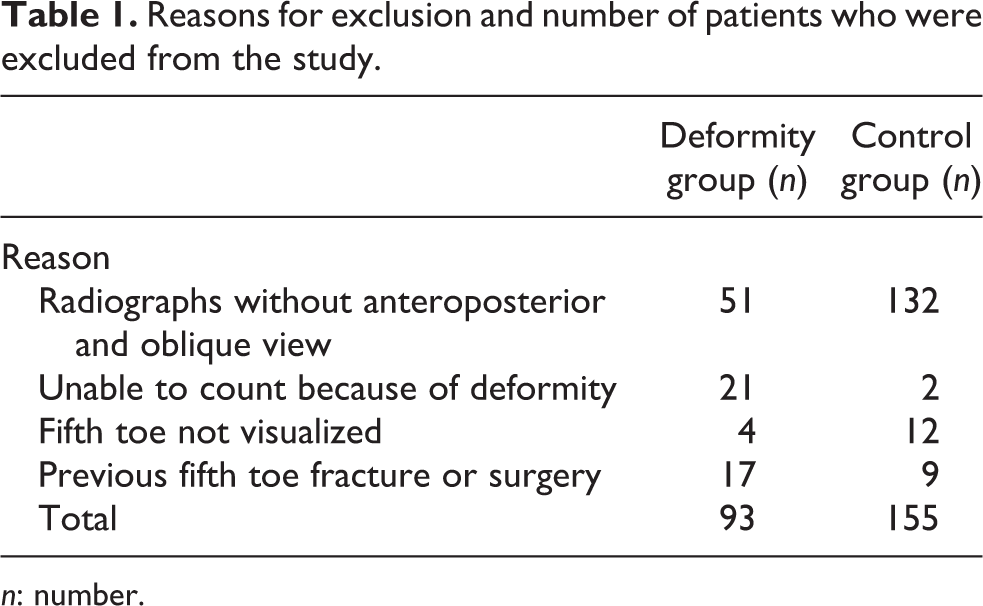
n: number.
We evaluated the foot radiographs of patients using the radiological database of our center (PACS Infinitt, Seoul, South Korea). Patients with two-phalangeal fifth toe according to radiographical views were defined as biphalangeal fifth toe, and other patients with three-phalangeal fifth toe were defined as normal fifth toe (Figures 1 and 2).
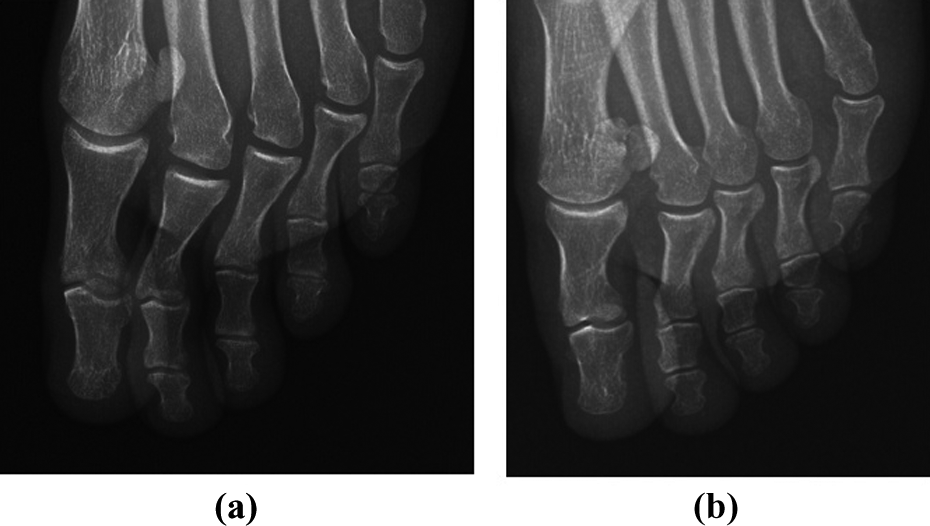
(a) Three-phalangeal fifth toe in the normal population group and (b) biphalangeal fifth toe in the normal population group.
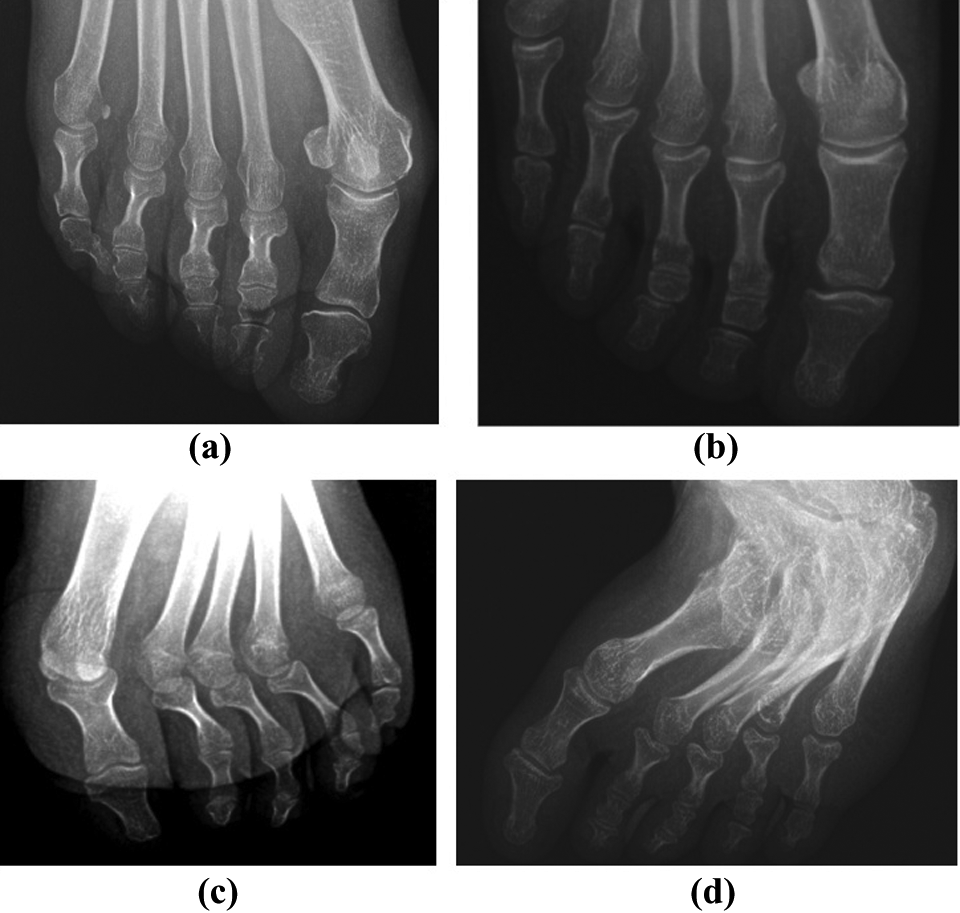
(a) Biphalangeal fifth toe in hallux valgus, (b) biphalangeal fifth toe in pes planus, (c) biphalangeal fifth toe in pes cavus, and (d) biphalangeal fifth toe in pes equinovarus.
Statistical analyses were performed using SPSS 20.0 software (SPSS Inc., IBM Corp, New York, USA). The comparison of categorical data was performed using the χ 2 test. The values of p < 0.05 were determined as statistically significant.
Results
Patient demographic data are demonstrated in Table 2. In the study population with the foot deformity group (n = 672) and control group (n = 332) with a total of 1004 patients, biphalangeal fifth toe was observed in 32.7% of all patients (328 individual; Table 3). In 672 patients with foot deformity, 222 patients (33%) had biphalangeal fifth toe. In the control group, 106 of the 332 patients (31.9%) had biphalangeal fifth toe. There was no statistically significant difference in the incidence of biphalangeal fifth toe between the normal population (the control group) and the foot deformity group (p = 0.72).
Demographic data of patients.
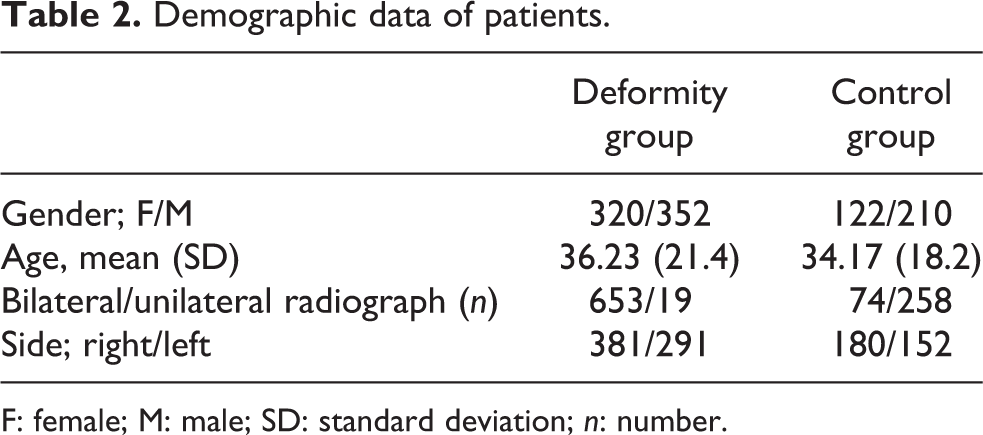
F: female; M: male; SD: standard deviation; n: number.
Frequencies of biphalangeal fifth toe in the control group and the deformity group.a

a p Value indicates the comparison of biphalangeal fifth toe frequency between the control group and the deformity group.
Ninety-nine of the 273 patients (36.3%) in the hallux valgus group, 53 of the 179 patients (29.6%) in the pes planus group, 28 of the 106 patients (26.4%) in the pes cavus group, and 42 of the 114 patients (36. 8%) in the pes equinovarus group were diagnosed as biphalangeal fifth toe. The frequency of biphalangeal fifth toe was similar in patients with hallux valgus, pes planus, pes cavus, and pes equinovarus (p = 0.16).
The number of bilateral foot radiograph of patients who have biphalangeal fifth toe was 204. In these radiographs, only 12 (5.8%) patients have unilateral two-phalanged fifth toe.
Discussion
Pedal biphalangism is seen at a frequency that cannot be ignored at all. The incidence of biphalangeal fifth toe in adult population has been reported in the literature with a broad range, which is different between ethnic populations. The lowest frequency was observed in Indian population, where as it was highest in Japanese population. 5,10 In Western populations, the incidence was reported as 46% in the United Kingdom, 11 41.02% in French adults, 4 46.4% in Euro-Americans, and 44% in African Americans. 3 We observed biphalangeal fifth toe in 31.9% of normal population, in 36.3% of hallux valgus, in 29.6% of pes planus, in 26.4% of pes cavus, in 36.8% of pes equinovarus groups in Turkish population.
When interpreting our results, it should be taken into consideration that biphalangeal fifth toe frequency varies according to the ethnic root. In addition to ethnic background, the habit of wearing shoes may change the frequency of biphalangeal fifth toe. Rabi et al. reported, in South Indian individuals, lower incidence of biphalangeal fifth toe according to Western population. 10 In their study, authors mentioned that consistent shoe wearing in Western population may increase the incidence of biphalangeal fifth toe due to reduced vasculature and disuse of the toes (particularly the fifth toe). Authors also claimed improperly designed shoes for the development of biphalangeal fifth toe. In our population, shoe wearing habit is similar to Western countries.
Although some studies have evaluated the correlation between biphalangeal fifth toe and a predisposition to symptomatic deformity. 12 To our knowledge, there is no study in the literature comparing normal population and patients with foot deformity according to the number of phalanx in fifth toe. In our study, despite the differences in foot anatomy and shoe-wearing habits between the foot deformity group and the control group, there was not a statistically significant difference in the incidence of biphalengeal fifth toe. Foot deformities such as hallux valgus, rigid or flexible pes planus, pes cavus, and pes equinovarus are common among the population. These deformities affect the functional anatomy of the foot and toes. Among the population that has these foot disorders, foot posture and foot function are associated with the presence of specific foot disorders. 13,14 Pes cavus foot in which there is loss of intrinsic musculature and domination of extrinsic musculature suffers from development of the characteristic hammer/claw toes. The lower medial column in the pes planus can alter the mechanics of the foot, resulting in limited range of motion and overlapping toes. 13,14 In patients with hallux valgus, altered regional loading and foot kinematics have been shown. 15,16 Treatment of toe deformities that are complications of these foot disorders starts with the conservative approach that consist of specially designed or customized shoes with pillows or pad support and splints to help restoration of toes’ natural position. Avoiding narrow high-heeled shoes made from hard materials should be another important approach. Surgical treatment is recommended if conservative treatment fails to relieve symptoms, or the deformed toes become rigid and immovable. There is no specific surgical treatment for deformed biphalangeal fifth toe in normal feet. Surgical intervention of deformed feet can be seen as a part of the foot deformity correction. Patients with these disorders 1,12 or foot-related trauma 2,17 are mostly candidates for forefoot surgery. Surgery is more common in fifth toes with two phalanges. 1,9 Podiatrists undertaking the conservative or surgical treatment of these patients must be aware of this common anatomical variant of the foot.
The main limitation of this study was that the other side was not evaluated in patients with unilateral foot radiographs. Sampling from only one side will miss some individuals who exhibit the trait in the other foot. 3 But we should note that, in literature, the incidence of bilateral biphalangeal fifth toe incidence was reported in 97.4% of patients. 18 Additionally, we did not assess phalanx numbers in the other fingers. In past studies, especially the frequency of fourth toe involvement, it was reported in approximately 1–4% in European and American feet and also in 12% of Japanese feet. 1 On the other hand, this is the first study including 672 patients to focus on differences of incidence in normal and deformed feet.
Conclusions
According to the results of this study, biphalangeal fifth toe is a common pedal anatomic variant seen approximately in one-third of the population, who have either foot deformity or not. This information may be valuable for podiatrist in surgical approaches of fifth toe.
Footnotes
Authors’ note
This study was conducted in Erzincan University Faculty of Medicine, Baltalimani Bone and Joint Diseases Education and Research Hospital and Sivas Numune Hospital.
Declaration of conflicting interests
The author(s) declared no potential conflicts of interest with respect to the research, authorship, and/or publication of this article.
Funding
The author(s) received no financial support for the research, authorship, and/or publication of this article.