




Abstract
Purpose:
Revision hip arthroplasty is a very challenging procedure. Use of a modular distal fixation stem is one of the available options for revision arthroplasty in patients with proximal femoral bone deficiency. The purpose of this study was to evaluate mid- to long-term outcomes of cementless modular distal fixation femoral stem implantation in revision hip surgery.
Methods:
Clinical and radiological findings, complications, and stem survival rate were analyzed for 46 patients (48 hips) who underwent revision hip arthroplasty using a cementless modular distal fixation femoral stem. The mean patient age was 58.8 years (range 31–82 years) and the mean follow-up period was 95 months (72–122 months). The preoperative diagnoses were aseptic loosening (36 hips), infection (4 hips), ceramic fracture (4 hips), and femoral periprosthetic fracture (4 hips).
Results:
The mean Harris hip score improved from 56.6 preoperatively to 88.2 postoperatively at the last follow-up. All hips showed stable osteointegration and firm fixation. Complications involved four hips (8.3%); there was one case each of periprosthetic fracture, delayed union of osteotomy site, femoral perforation, and infection. One stem re-revision was performed for deep infection of the femoral side. The Kaplan–Meier survival rate was 97.6% at the final follow-up.
Conclusion:
Revision hip arthroplasty using a cementless modular distal fixation femoral stem showed satisfactory initial firm fixation and mid- to long-term survival rate. Complications can be minimized by careful surgical planning and meticulous procedure.
Keywords
Introduction
Total hip arthroplasty (THA) remains a safe and effective means of providing pain relief to patients with hip pathologies. With an increasing number of primary hip arthroplasty procedures, the number of revision THA will increase to 96,700 by 2030 in the United States. 1 In most revision hip arthroplasty procedures, a femoral bone defect is observed, which is a very challenging aspect of revision THA and is associated with relatively poor clinical results compared to primary surgery. 2,3 The cementless modular stem was introduced to enable both proximal fill and distal fit with two-piece components. Another advantage of this stem system is that it can adjust the anteversion angle and offset; therefore, the surgeon can attain better soft tissue tension around the hip joint. 4 –8 Although some satisfactory short- and medium-term results of these modular implants have been reported, there have been few longer term outcomes reported. The purpose of this study was to evaluate and report mid- to long-term clinical and radiographic outcomes of patients who underwent revision THA with a Lima modular stem (Lima-Lto, Udine, Italy).
Methods
Patient demographics
We retrospectively reviewed the records of 49 patients (51 hips) who received revision hip arthroplasty with a modular cementless femoral stem between January 2006 and September 2011. Since the time of operation, one patient died and two patients were lost to follow-up. These three patients were excluded from the analysis, resulting in a total of 46 patients (48 hips) included in the retrospective study. All of the operations were performed by one surgeon. A posterolateral approach with extended trochanter osteotomy was done for stem removal.
The average age of patients was 58.8 (range 31–82). Thirty patients were male and 16 patients were female. The average body mass index was 25.7 kg/m2 (21.3–31.2 kg/m2). The average patient age was 58.8 years (range 31–82 years). The average follow-up period after the operation was 95 months (72–122 months). The preoperative diagnoses for revision surgery were aseptic loosening (36 hips, 75%), infection (4 hips, 8.3%), ceramic fracture (4 hips, 8.3%), and periprosthetic fracture (4 hips, 8.3%). The demographic data for the patients who received hip arthroplasty using a modular cementless femoral stem are listed (Table 1). The preoperative femoral bone defects were evaluated according to the Paprosky classification. 9
Demographic and clinical data of the patient cohort.

Stem
The Lima modular revision stem (Lima-Lto) used in this study consists of a distal stem and a femoral neck. This stem is designed to obtain primary stability independently from the biomechanical parameters of the reconstruction. The distal stem consists of a titanium alloy that is grit-blasted over the entire length of the body; this improves long-term stability due to intraosseous growth. The distal stem is a conical straight stem with eight sharp points (fluted); it has excellent mechanical stability (Figure 1). Also, the modular neck is designed to switch to any plane according to the shape of the thigh, with an angle of 4° to the stem axis (Figure 2). The femoral neck is assembled with a distal stem through a Morse taper connection and a locking screw (Figure 3). The stem improves the modularity between the proximal and distal modules, enabling accommodation to various proximal femoral geometries. It can form a variety of anteversions and combinations of necks and stems; 12 total lengths are available. Considering the diameter, a total of 72 options can be combined. We selected a stem diameter one size larger than the last reamer. The stem length was determined to be at least 7 cm longer than the osteotomy site (Table 2).

Conical straight stem with eight sharp pointed a cementless modular distal fixation femoral stem (Lima-Lto).

Angle of 4° to the stem axis.
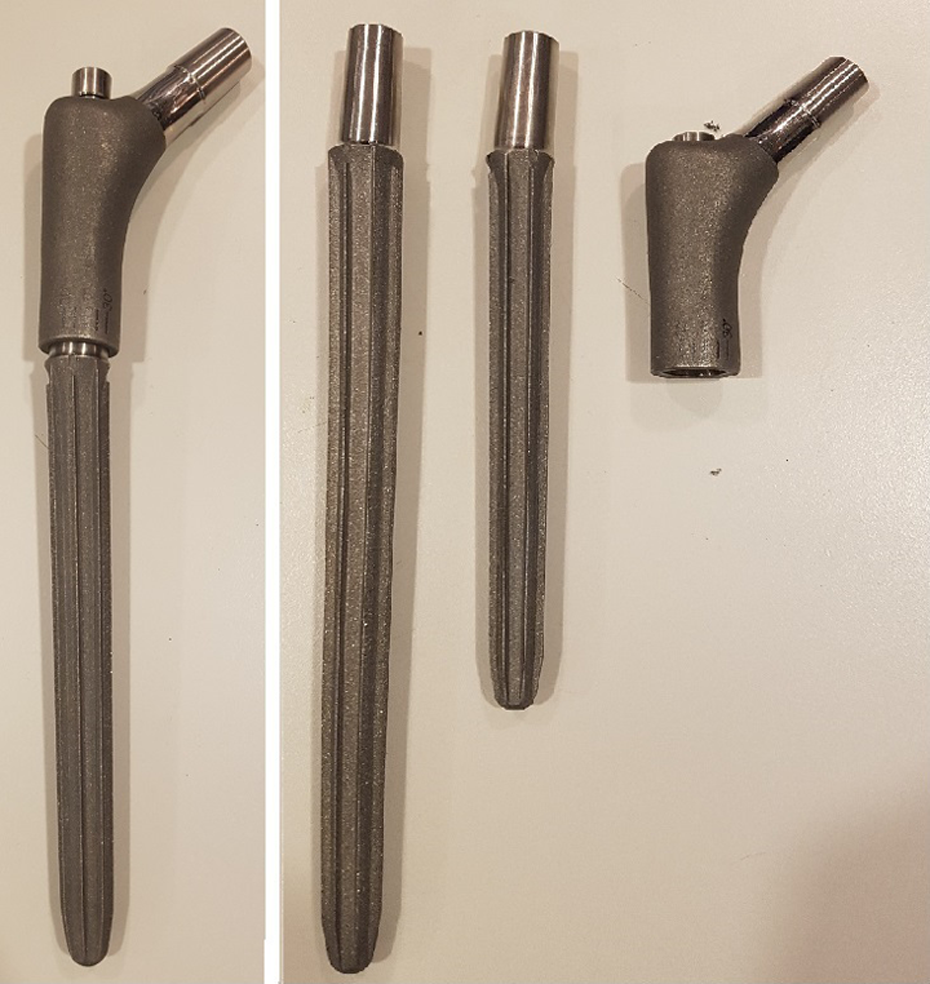
The femoral neck is assembled with a distal stem through a Morse taper connection and a locking screw.
Operative data of the revision modular fully coated stems.

Acetabular side
All patients underwent acetabular revision and a ceramic-on-ceramic bearing was used (Delta PF cup, Forte head, Delta liner; Lima-Lto).
Outcome assessment
Harris hip scores (HHSs), radiologic results, complications, and survival rate were evaluated by chart review and radiological analysis. Radiologic evaluation included identification of osteointegration, subsidence, radiolucent lines, stress shielding, and heterotopic ossification. Heterotopic ossification was evaluated according to the Brooker classification. 10 Stress shielding was classified according to the Engh classification. 11
Statistical method
Stem survival rate was analyzed with end point consulted by enforced revision time for any reason. Kaplan–Meier method was used for survival rate. Preoperative and postoperative HHS was compared by two-sample t-test. A p value of <0.05 was considered statistically significant for all differences. Statistical analysis was performed using SPSS 19 (IBM. Inc, Chicago, IL) software.
Results
HHSs improved from the preoperative average of 56.6 to the postoperative average of 88.2 (p < 0.01). At last follow-up, 32 hips (66.7%) were graded as excellent, 12 hips were good (25%), and 4 hips (8.3%) were fair. Two patients had an altered gait pattern (limping), and one had thigh pain. Radiologically, all hips showed stable osteointegration and firm fixation. Stem subsidence greater than 5 mm was not seen. Ten hips (21%) showed a radiolucent line on Gruen zones I or VII. 12 In 32 hips (75.0%), stress shielding was observed in the proximal part of the femur (Table 3). A partial pedestal reaction around the distal stem was observed in three hips. Heterotopic ossification was found in 16 hips (12 hips, grade I; 4 hips, grade II). There were no cases of loosening or osteolysis around the acetabular cup.
Engh’s classification of stress shielding.

Complications
Complications occurred in four hips (8.3%): one case each of periprosthetic fracture, delayed union of osteotomy site, femoral cortical perforation, and deep infection. The intraoperative periprosthetic fracture at the greater trochanteric area was treated by cable fixation, while no treatment was required for the delayed union at the osteotomy site (Figures 4 and 5). The cortical perforation at the distal femoral stem was less than 10 mm and the stem stability was excellent. One stem revision was performed for deep infection of the femoral side.

A hip joint AP radiograph of 71-year-old female who underwent revision surgery using cementless modular distal fixation femoral stem. (a) Aseptic loosening at 8 years after the primary surgery. (b) Intraoperative periprosthetic fracture was occurred and treated by cable fixation. (c) Hip joint AP radiograph at 2 weeks after the revision surgery, which greater trochanter was displaced a little, but the implants was maintained. (d) Hip joint AP radiograph at 6 months after the revision surgery, which fibrous union was progressed as before. (e) After 3 years, fibrous union was obtained and clinical result was fair.

A hip joint AP radiograph of 64-year-old patient underwent revision THA using cementless modular distal fixation femoral stem. (a) Acetabular cup loosening at 10 years after the primary surgery. (b) Immediate postoperative simple radiographs after the revision surgery. (c) Delayed union of osteotomy site was noticed at 6 month after the revision surgery. (d) At postoperative 10 months, bridging callus was seen. (e) At final follow-up, bone union has been obtained at the osteotomy site. THA: Total hip arthroplasty.
Survival analysis
There was no case of revision operation for aseptic prosthetic loosening. One patient required revision of the implant for septic loosening. The Kaplan–Meier estimate of the stem survival rate was 97.6% with the end point of revision (Figure 6).

Kaplan–Meier survival curve.
Discussion
Due to population aging and the good long-term outcomes of THA, the proportion of young and active patients treated with THA has increased. However, many previous studies have found a higher risk of revision arthroplasty after primary hip arthroplasty in younger patients than in older ones. 13 As increasingly younger patients are treated with artificial joints, the burden of revision THA is rising. The difficulty of hip reconstruction continues to be an unresolved problem with the associated challenges of restoring leg length, femoral offset, joint stability, and overall hip implant fixation.
The results of revision THA are greatly influenced by the quantity and the quality of the available femoral bone stock for reconstruction. The modular femoral stem is an important tool that is easily designed for revision surgery in these cases involving femoral bone defects; it strengthens fixation and soft-tissue tensioning and facilitates modification of anteversion and offset. 4,5 Through these improvements, aseptic loosening, stress shielding, and dislocation are decreased and it is expected that use of the modular femoral stem will allow more precise control of leg length. To date, these modular implants have been used extensively in revision THA and several studies reported early outcomes their use in this setting. 14 –16 However, there have been few mid- to long-term outcome studies of the use of cementless modular femoral stems in revision THA. In our single institution, retrospective review of mid- to long-term clinical and radiological results of the use of modular femoral stems during the study period, we evaluated a total of 48 hips and the mean follow-up was 95 months. Implanted cementless modular femoral stems showed stable fixation in all patients in our study.
Thigh pain has been consistently reported with hip arthroplasty using a cementless stem. This pain is known to be associated with implant micromotion, failure to fill the medullary canal, and instability of the stem. The incidence of thigh pain has been reported as occurring in 4–25% of patients and in most cases, symptoms usually disappear within 2 years. 17 –21 In this study, only one patient (2.2%) complained of thigh pain. We believe that the fine implant micromotion can be reduced by early rigid fixation of the cementless modular stem.
Corrosion or fracture of femoral components at the modular junction can be a major concern when using a modular stem. Corrosion has been associated with clinical complications, such as elevated metal ion levels, persistent pain, tissue damage, and early implant failure. Several studies suggested that the junction between the head and the stem may be susceptible to corrosion and wear due to motion between the components. 22 –26 In our series, there were no cases of corrosion-related complications. This may be due to our use of ceramic-on-ceramic bearings, improvements of the stem material, and meticulous surgical procedure. Fracture of the femoral component at the modular junction has been described as an unresolved problem. 22 In our series, there was no case of stem fracture around the modular junction. This is probably due to our use of newer implants that have a larger taper junction than the previous implants. Larger taper junctions can withstand localized stresses from extended trochanteric osteotomy in the revision surgery. 27
Subsidence of the femoral stem is a frequently reported complication in hip revision surgery. The reason for early subsidence is probably due to the lack of early press-fit sufficient to withstand patient loading. 28,29 The results showed better results than other reports using modular stem. In the study of outcomes of revision THA using a modular femoral component (ZMR; Zimmer, Warsaw, IN, USA) reported by Kang et al., five hips (13%) had subsidence of more than 5 mm. 14 Weiss et al. reported 2.7-mm median migration, but 10% of the cases in their series showed subsidence of more than 10 mm. 30 In contrast, our results showed no cases of stem subsidence greater than 5 mm. We suppose that the critical factors for prevention of stem migration are firm canal filling, strong fixation of the osteotomy site, sufficient choice of stem length, and optimal characteristics of implant design. Loudon and Charney 31 thought that the subsidence of the femoral prosthesis in total hip replacement is in relation to the design of the stem. We suspect that the characteristic conical straight stem with eight sharp pointed design of stem used for our study affected the subsidence. Tangsataporn et al. 32 suggested that good fixation in femoral diaphysis is important to prevent subsidence and adequate reaming is required for adequate cortical contact with the stem. We performed underreaming one size smaller than the diameter of the stem used for firm fixation, and stem length was at least 7 cm longer than the osteotomy site. The authors supposed that these intraoperative procedures might have affected the absence of more than 5 mm of subsidence in this study.
Postoperative infection and dislocation are known complications of the use of cementless modular stems. 14 Park et al. analyzed the results of 62 patients who underwent the revision THA using tapered modular distal fixation stems, with a mean follow-up of 4.2 years. 21 Both the revision rate and the infection rate were 2%. Weiss et al. reported similar results for revision rate (2%) and infection rate (3%) in 90 patients. 30 In our series, one stem revision was performed for deep infection of the femoral side and the re-revision rate in our study was 2.1%. In addition to the single case of deep infection, the other complications in our study included one case each of periprosthetic fracture, delayed union of osteotomy site, and femoral cortical perforation (four hips; 8.3%). We believe that fluoroscopic guided reaming is essential to avoid cortical perforation.
This study has several limitations. First, because our study was retrospective and lacked a control group, it is difficult to compare the modular femoral stem system with other systems. The second limitation is small sample size. However, to the best of our knowledge, this is the first report of mid- to long-term (minimum 6 years) outcomes of revision THA using a Lima modular stem by a single surgeon. Additional follow-up studies are necessary to confirm these results and to define other potential benefits of modularity.
In summary, revision hip arthroplasty using a cementless modular distal fixation femoral stem showed satisfactory results in terms of initial firm fixation and mid- to long-term survival rate. Complications can be minimized by careful surgical planning and meticulous procedure.
Footnotes
Declaration of conflicting interests
The author(s) declared no potential conflicts of interest with respect to the research, authorship, and/or publication of this article.
Funding
The author(s) disclosed receipt of the following financial support for the research, authorship, and/or publication of this article: This work was supported by Inha University Hospital.