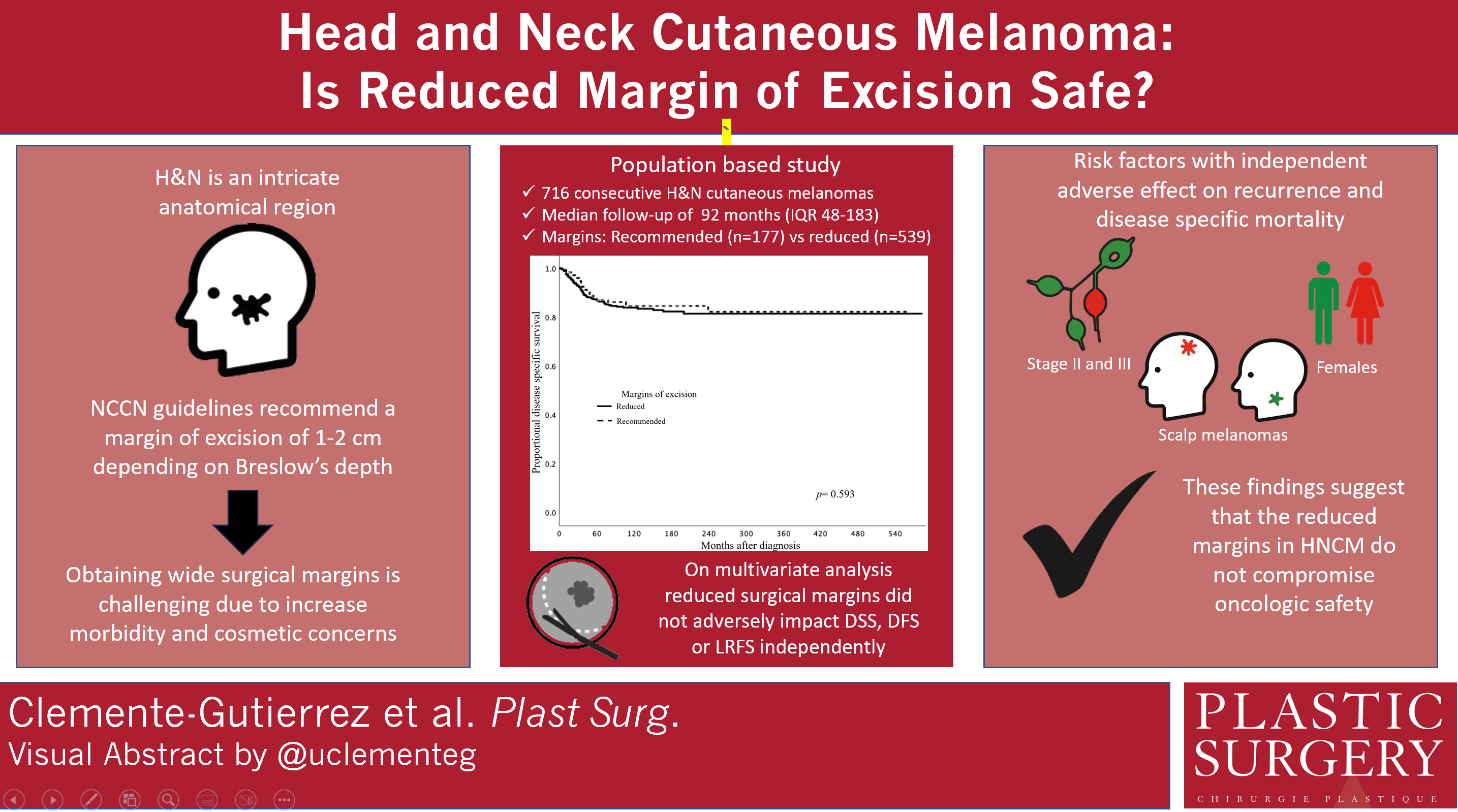
Introduction: It is often challenging to achieve recommended excision margins in head and neck cutaneous melanoma (HNCM). This study assessed the impact of reduced radial excision margins on disease-specific survival (DSS), disease-free survival (DFS), and local recurrence-free survival (LRFS) in these patients. Given ongoing uncertainty regarding optimal margin width for melanomas ≥1 mm, a secondary contemporary margin-based analysis was performed. Methods: This population-based study included patients diagnosed with HNCM in Manitoba, Canada, between 1970 and 2020. Radial excision margins were classified as “recommended” or “reduced” according to National Comprehensive Cancer Network guidelines. A secondary analysis compared outcomes between narrower (∼1 cm) and wider (∼2 cm) excision margins in patients with Breslow thickness ≥1.0 mm. Survival outcomes were evaluated using Kaplan–Meier analysis and multivariable Cox proportional hazards models. Results: A total of 716 patients met inclusion criteria; 177 had recommended margins and 539 had reduced margins. Patients in the reduced-margin group had thicker tumors (2.36 vs 1.72 mm, p = .007) and fewer Stage I melanomas (58.6% vs 78%, p < .001). Local recurrence occurred in 4.3% of reduced-margin and 6.2% of recommended-margin patients. Kaplan–Meier analysis showed no differences in DSS, DFS, or LRFS. On multivariable analysis, margin status was not an independent predictor of survival, whereas advanced stage and scalp location were associated with worse outcomes. In the secondary margin-based analysis, margin width was not independently associated with DSS, DFS, or LRFS. Conclusion: Reduced radial excision margins were not associated with inferior oncologic outcomes in HNCM. These findings support the oncologic safety of selective margin reduction in appropriately selected patients.
SiegelRLMillerKDWagleNSJemalA. Cancer statistics, 2023. CA Cancer J Clin. 2023;73(1):17-48. doi:10.3322/caac.21763
2.
Canadian Cancer Statistics 2023. Canadian Cancer Society; 2023. cancer.ca/Canadian-Cancer-Statistics-2023-EN.
3.
VeronesiUCascinelliNAdamusJ, et al.Thin stage I primary cutaneous malignant melanoma. Comparison of excision with margins of 1 or 3 cm. N Engl J Med. 1988;318(18):1159-1162. doi:10.1056/NEJM198805053181804
4.
HayesAJMaynardLCoombesG, et al.Wide versus narrow excision margins for high-risk, primary cutaneous melanomas: long-term follow-up of survival in a randomised trial. Lancet Oncol. 2016;17(2):184-192. doi:10.1016/S1470-2045(15)00482-9
5.
RossMHayduADQuinnLE, et al.The association between excision margins and local recurrence in 11,290 thin (T1) primary cutaneous melanomas: a case-control study. Ann Surg Oncol. 2016;23(4):1082-1089. doi:10.1245/s10434-015-4942-0
6.
HayduLEStollmanJTScolyerRA, et al.Minimum safe pathologic excision margins for primary cutaneous melanomas (1-2 mm in thickness): analysis of 2131 patients treated at a single center. Ann Surg Oncol. 2016;23(4):1071-1081. doi:10.1245/s10434-015-4575-3
7.
LambooLGEHayduLEScolyerRA, et al.The optimum excision margin and regional node management for primary cutaneous T3 melanomas (2-4 mm in thickness): a retrospective study of 1587 patients treated at a single center. Ann Surg. 2014;260(6):1095-1102. doi:10.1097/SLA.0000000000000792
8.
PasqualiSHayduLEScolyerRA, et al.The importance of adequate primary tumor excision margins and sentinel node biopsy in achieving optimal locoregional control for patients with thick primary melanomas. Ann Surg. 2013;258(1):152-157. doi:10.1097/SLA.0b013e31828421e1
9.
National Comprehensive Cancer Network. NCCN clinical practice guidelines in oncology: Melanoma: Cutaneous (Version 2.2025).
10.
ShainAHYehIKovalyshynI, et al.The genetic evolution of melanoma from precursor lesions. N Engl J Med. 2015;373(20):1926-1936. doi:10.1056/NEJMoa1502583
11.
UrenRFHowman-GilesRThompsonJF. Patterns of lymphatic drainage from the skin in patients with melanoma. J Nucl Med Off Publ Soc Nucl Med. 2003;44(4):570-582.
12.
ChangGAWigginsJMCorlessBC, et al.TERT, BRAF, and NRAS mutational heterogeneity between paired primary and metastatic melanoma tumors. J Invest Dermatol. 2020;140(8):1609-1618.e7. doi:10.1016/j.jid.2020.01.027
13.
MoncrieffMDGyorkiDSawR, et al.1 Versus 2-cm excision margins for pT2-pT4 primary cutaneous melanoma (MelMarT): a feasibility study. Ann Surg Oncol. 2018;25(9):2541-2549. doi:10.1245/s10434-018-6470-1
14.
FriedmanEBDoddsTJLoS, et al.Correlation between surgical and histologic margins in melanoma wide excision specimens. Ann Surg Oncol. 2019;26(1):25-32. doi:10.1245/s10434-018-6858-y
15.
RebeccaVWSondakVKSmalleyKSM. A brief history of melanoma: From mummies to mutations. Melanoma Res. 2012;22(2):114-122. doi:10.1097/CMR.0b013e328351fa4d
16.
BalchCMUristMMKarakousisCP, et al.Efficacy of 2-cm surgical margins for intermediate-thickness melanomas (1 to 4 mm). results of a multi-institutional randomized surgical trial. Ann Surg. 1993;218(3):262-267. doi:10.1097/00000658-199309000-00005
17.
BittarPGBittarJMEtzkornJR, et al.Systematic review and meta-analysis of local recurrence rates of head and neck cutaneous melanomas after wide local excision, mohs micrographic surgery, or staged excision. J Am Acad Dermatol. 2021;85(3):681-692. doi:10.1016/j.jaad.2021.04.090
18.
MortonDLThompsonJFCochranAJ, et al.Final trial report of sentinel-node biopsy versus nodal observation in melanoma. N Engl J Med. 2014;370(7):599-609. doi:10.1056/NEJMoa1310460
19.
ReadTNoonanCDavidM, et al.A systematic review of non-surgical treatments for lentigo maligna. J Eur Acad Dermatol Venereol JEADV. 2016;30(5):748-753. doi:10.1111/jdv.13252
20.
TsengWHMartinezSR. Tumor location predicts survival in cutaneous head and neck melanoma. J Surg Res. 2011;167(2):192-198. doi:10.1016/j.jss.2010.10.008
21.
GoepfertRPMyersJNGershenwaldJE. Updates in the evidence-based management of cutaneous melanoma. Head Neck. 2020;42(11):3396-3404. doi:10.1002/hed.26398
22.
RobertCRibasASchachterJ, et al.Pembrolizumab versus ipilimumab in advanced melanoma (KEYNOTE-006): post-hoc 5-year results from an open-label, multicentre, randomised, controlled, phase 3 study. Lancet Oncol. 2019;20(9):1239-1251. doi:10.1016/S1470-2045(19)30388-2
23.
MenziesAMAmariaRNRozemanEA, et al.Pathological response and survival with neoadjuvant therapy in melanoma: a pooled analysis from the international neoadjuvant melanoma consortium (INMC). Nat Med. 2021;27(2):301-309. doi:10.1038/s41591-020-01188-3
24.
WongSLFariesMBKennedyEB, et al.Sentinel lymph node biopsy and management of regional lymph nodes in melanoma: American society of clinical oncology and society of surgical oncology clinical practice guideline update. J Clin Oncol Off J Am Soc Clin Oncol. 2018;36(4):399-413. doi:10.1200/JCO.2017.75.7724
25.
EggermontAMMBlankCUMandalaM, et al.Adjuvant pembrolizumab versus placebo in resected stage III melanoma. N Engl J Med. 2018;378(19):1789-1801. doi:10.1056/NEJMoa1802357
26.
WinstanleyJBYoungTEBoyleFM, et al.Cross-cultural development of a quality-of-life measure for patients with melanoma: phase 3 testing of an EORTC melanoma module. Melanoma Res. 2015;25(1):47-58. doi:10.1097/CMR.0000000000000122
27.
HendersonMABurmeisterBHAinslieJ, et al.Adjuvant lymph-node field radiotherapy versus observation only in patients with melanoma at high risk of further lymph-node field relapse after lymphadenectomy (ANZMTG 01.02/TROG 02.01): 6-year follow-up of a phase 3, randomised controlled trial. Lancet Oncol. 2015;16(9):1049-1060. doi:10.1016/S1470-2045(15)00187-4
28.
MozzilloNCaracòCMaroneU, et al.Superficial and deep lymph node dissection for stage III cutaneous melanoma: clinical outcome and prognostic factors. World J Surg Oncol. 2013;11:36. doi:10.1186/1477-7819-11-36
29.
EggermontAMMChiarion-SileniVGrobJJ, et al.Prolonged survival in stage III melanoma with ipilimumab adjuvant therapy. N Engl J Med. 2016;375(19):1845-1855. doi:10.1056/NEJMoa1611299
30.
FujisawaYInoueSNakamuraY. The possibility of deep learning-based, computer-aided skin tumor classifiers. Front Med. 2019;6:191. doi:10.3389/fmed.2019.00191
31.
ThompsonJFSoongSJBalchCM, et al.Prognostic significance of mitotic rate in localized primary cutaneous melanoma: an analysis of patients in the multi-institutional American joint committee on cancer melanoma staging database. J Clin Oncol Off J Am Soc Clin Oncol. 2011;29(16):2199-2205. doi:10.1200/JCO.2010.31.5812
32.
SharibJSlingluffCLBeasleyGM. Melanoma trials that defined surgical management: overview of trials that established NCCN margin guidelines. J Surg Oncol. 2022;125(1):28-33. doi:10.1002/jso.26717