




Abstract
Premature loss of deciduous teeth often causes malocclusion and misalignment, requiring orthodontic treatment. Oral space maintainers (OSMs) help preserve space after primary teeth loss but are commonly metal, with limitations like esthetics, metal allergies, and complex production. This study aims to find an alternative by evaluating the esthetic and physical properties of CAD/CAM-produced PEEK OSMs compared to conventional OSMs. Forty digital oral space maintainer specimens were fabricated from Polyetheretherketone (PEEK), PEEK composites, LuxaCrown, and cobalt-chromium alloy, with 10 specimens in each group. Esthetic evaluation was conducted using a standard shade guide, and marginal fit was assessed with a stereo-microscope. Shear bond strength was tested on resins for primary and permanent molars. Statistical analysis was performed using SPSS software. LuxaCrown matched natural tooth color best, followed by PEEK composites and PEEK, with cobalt-chromium showing the least similarity. LuxaCrown had the highest esthetic values, while PEEK and its composites showed acceptable marginal fits. Cobalt-chromium exhibited the highest shear bond strength. While PEEK has lower shear bond strength than cobalt-chromium, it shows promise as an esthetic alternative for pediatric space maintainers with acceptable fit. Further studies are needed to assess its long-term performance.
Introduction
Deciduous teeth contribute significantly in the chewing, speech development and, particularly, in the proper eruption of permanent teeth, which are of great importance in the development and growth of children. A common clinical issue in pediatric dentistry is the prevention of premature loss of primary teeth, which cause complications like misalignment, tooth displacement, and consequent deleterious effects on the regular eruption of permanent teeth. Early loss of primary teeth has been shown to increase children at risk of malocclusion and thus enhance the possibility of orthodontic treatment as compared to children tending a normal eruption pattern.1,2 In order to minimize the number of extractions and enable successful orthodontic treatments, there is a need for early space maintenance. 3
Oral space maintainers (OSMs) are important devices used in pediatric dentistry for preservation of space after premature loss of a primary tooth. 4 These devices are generally made of cobalt-chromium alloy. Although these devices are effective, there are some limitations which include difficult manufacturing process, less esthetical appeal to consumers, and metal allergies. 5 Moreover, metal OSMs can be imprecise from heat expansion or cold contraction during bonding and module manufacturing, which cause deformation, fracture or a poor fit. However, such limitations can limit adaptation to some patients and thus reduce the efficacy of treatment.
Over the past several decades, Computer Aided Design/Computer Aided Manufacturing (CAD/CAM) systems have permitted the traditional dental therapy model to produce devices that have greater accuracy and esthetics to the patient. One of the most promising of the new introduced materials is Polyetheretherketone (PEEK) due to its outstanding features. Its long-term stability, biocompatibility and bonding properties have been widely studied in dental applications.6,7 The elastic modulus of PEEK that is, 3.6 GPa is comparable to bone and PEEK can be readily machined to form complex shapes.8,9 In addition, various strategies, including plasma treatment, laser surface texturing, silanization, and sulfuric acid etching, have been explored to improve PEEK’s adhesive properties by increasing surface roughness and introducing functional groups that enhance resin bonding.9,10 PEEK is esthetically similar to the natural color of teeth and radiolucent, forming minimal MRI artifacts compared to metal-based materials aiding in significantly increased patient comfort. 11
A study reported that radiation energy can induce cross linking within PEEK’s macromolecules thereby reducing its melting temperature and its crystallinity enhancing the physical properties of PEEK. This modification improves PEEK’s durability and resistance to deforming, which is useful for long term applications including oral space maintainers (OSMs). But unlike traditional metals, cross linked PEEK has tooth color esthetically and is easily customizable with CAD/CAM technology. Furthermore, PEEK exhibits minimal cytotoxicity and inflammatory response. However, the long term clinical durability and performance of PEEK in pediatrics is underexplored, with limited in-vivo trials on its wear resistance, microbial colonization and patient-reported outcomes.6–13
Despite the promising attributes of PEEK, there is very little research into the use of this material as a band and loop OSM. To bridge this gap, the present study was proposed to evaluate and compare the esthetic properties, bonding reliability and stability of PEEK with traditional materials like cobalt chromium and Luxacrown. This research seeks to determine if PEEK is a viable and better option than standard materials used in the pediatric dental treatments.
Materials and methods
Test 1: Esthetic comparison and marginal fit measurements
The fabrication of oral space maintainers (OSMs) is labor-intensive and complex due to the demanding technical procedures and the need for skilled professionals. Any small error can lead to significant changes in how the OSM fits. Therefore, the success of the treatment depends heavily on the marginal fit of the maintainer. Traditional metal OSMs, such as those made from cobalt chromium, often exhibit noticeable color differences in the mouth. This test was designed to evaluate the esthetics of digital OSMs made from four materials: PEEK, PEEK-Com, LC, and Co-Cr, and to measure their marginal fit.
Specimen preparation
Forty standard partial dentition models were produced using a Dental 3D Printer (ProJet MJP 3600, USA). Before conducting the test, a Dental CAM software system (hyperDENT® Compact Version 8.2.3, Germany) was used to design the digital OSMs. Each model was selected and modified for import. Artificial digital models of standard band and loop OSMs, 3.0 mm wide and 1.0 mm thick, were created (Figure 1). The height and shape of the maintainers were determined by the abutment shape. Forty specimens were fabricated from PEEK, PEEK-Com, LC, and Co-Cr materials, with 10 specimens in each group, using a CAD/CAM milling machine (Organical CAD/CAM, GmbH Ruwersteig 43, Germany). These specimens were divided into groups A, B, C, and D, as shown in Table 1.

Artificial digitized models of the standard band and loop OSM on the left second deciduous molar. (a) and (b) represent the top view and lateral view of OSM on artificial digitized models, respectively.
Summary of grouping and materials in test 1.

Esthetic comparison
For the colorimetry assessment, three specimens were randomly selected from each group. Two prosthodontists were invited to evaluate and rank the color of each specimen using the VITA Classical Shade Guide in a double-blind testing procedure. Each specimen was examined under natural light to determine its color. The results were recorded and the specimens were ranked from closest to furthest from the natural tooth color. The colorimetry data was collected at Jinan University’s laboratory.
Marginal fit measurements
After applying cement to the abutment tooth of each specimen, any excess cement was carefully scraped off from the bond edges. A modular stereo-microscope (SteREO Discovery V20, Germany) was used to observe 10 samples from each group at 10× magnification. Measurements were taken at the mesial, central, and distal positions on both the buccal and lingual surfaces (Figure 2). Each measuring point was evaluated twice by a single operator, and the data was double-checked by another operator. The mean value for each group was calculated after the measurements were collected. The data was gathered at Jinan University’s laboratory.

Diagram of measurement points.
Test 2: shear bond strength measurements
PEEK has a distinctly hydrophobic surface, which results in weak bonding to cement. This characteristic prevents PEEK from successfully adhering to bone or dental tissue, and inhibits cell adhesion or protein absorption. To overcome this, researchers have suggested various surface modification techniques to improve the adhesive capability of PEEK. 13 This test aimed to determine the shear bond strength (SBS) of the following materials: Co-Cr, LuxaCrown (LC), PEEK, and PEEK-Com.
Specimen preparation
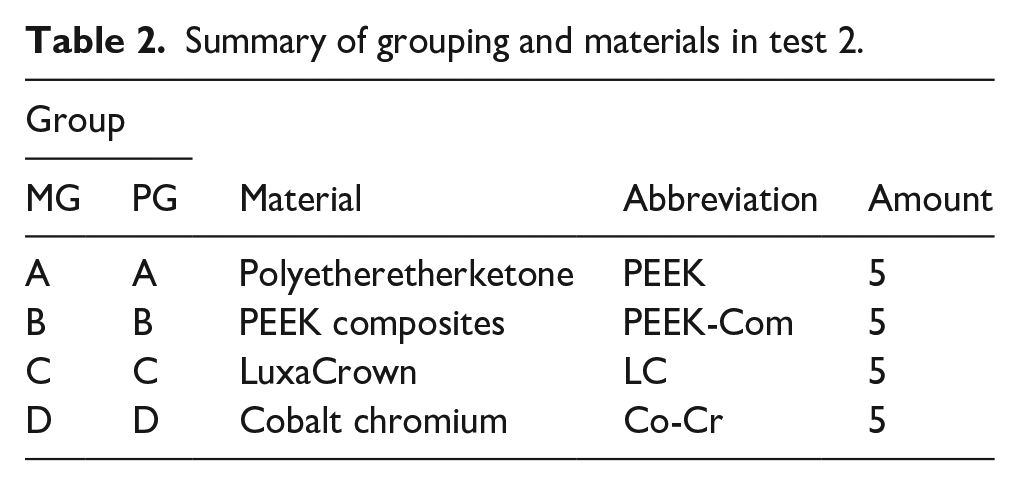
Twenty resin permanent molars and 20 resin deciduous molars, produced using a Dental 3D Printer (HeyGears, UltraCraft A2D 4K, China), were used for specimen preparation. Each resin tooth was fabricated with a flawless surface and a complete crown. The materials examined are listed in Table 1 above, and Table 2 summarizes the groupings. The 40 resin teeth were randomly divided into 2 groups: primary molars (PG) and permanent molars (MG). Each group contained five teeth, which were further assigned to subgroups A, B, C, and D. A Teflon mold was used to expose the complete crowns of all teeth, after they were placed into a self-curing denture base material (Denture Base Materials Type II Self-Curing, New Century Dental, China).
Summary of grouping and materials in test 2.
Forty cylindrical samples, each with a diameter of 3.5 mm and a thickness of 5 mm, were prepared using a CAD/CAM milling machine (Organical CAD/CAM, GmbH, Ruwersteig 43, Germany), with five samples in each subgroup. The proximal surface of the teeth was chosen as the bonding surface for the cylindrical samples, as it is flatter than the buccal or lingual surfaces. The undersides of the cylindrical samples were washed, dried, and stored.
Each bonding surface underwent etching with orthophosphoric acid (Gluma Etch 35 Gel, Kulzer Mitsui Chemicals Group, Germany), followed by irrigation and air drying until the surface appeared chalky white. The adhesive was then applied for 20 s, followed by curing for 10 s. The bonding surfaces were coated with dual-curing resin cement (NX3 Nexus™ Third Generation, Kerr Dental, USA), and any excess cement was scraped off. Each specimen, composed of a cylindrical sample and a tooth crown, was light-cured for 40 s using a dental light-curing device. The specimens were then stored at room temperature for 24 h in a large, spacious box.
Shear bond strength measurements
Each specimen was analyzed using a universal testing device (MTS/E45.105, USA) after the mixing process had been completed and the specimens were stored for 24 h. The vertical load rate was set to 0.5 mm/s. The machine was equipped with a crosshead (Figure 3) to separate or fracture the cylindrical samples. The highest measured fracture force (N) was recorded as the force required to separate the cylinder. This maximum fracture force was then compared to the cross-sectional area (mm²) of the specimen’s bonding surface to calculate the shear bond strength (MPa). The bonding area was determined to be 9.62 mm². The data were collected at Jinan University’s laboratory.

Schematic illustration of the SBS measurement.
Statistical analyses
The data from the two measurements above were managed and analyzed using SPSS software (IBM Version 26.0). One-way ANOVA was used to determine whether there were any significant differences between the groups. To compare the marginal fit and shear bond strength (SBS) across the PEEK, PEEK-Com, LC, and Co-Cr groups, the Tukey post hoc test was applied. The significance level was set at 0.05.
Results
Esthetic comparison
The Co-Cr specimens exhibited a metallic silver tint, which differed noticeably from the color of natural teeth. The PEEK specimens had a brownish color (B2), while the PEEK-Com specimens appeared white (0M2), according to the VITA Classical Shade Guide color evaluation. The LC specimens were closest to the color of permanent teeth, displaying a white color (A2). Among the materials tested, the color of the LC specimens most closely matched that of a natural permanent tooth, which is typically a shade similar to A1. Furthermore, compared to the Co-Cr specimens, the PEEK and PEEK-Com specimens showed a closer resemblance to the color of natural permanent teeth. The groups were ranked as follows in terms of color similarity: LC > PEEK-Com > PEEK > Co-Cr (Figure 4).

Presentation of esthetic comparison between PEEK, PEEK-Com, LC, and Co-Cr band and loop DOSM specimens.
Marginal fit measurements
The specimens from the Co-Cr group exhibited the lowest values, with mean measurements of 0.1659 (±0.0415) mm and maximum values of 0.2014 (±0.0503) mm for the bonding distances. The specimens from the PEEK group showed higher values, with means of 0.2074 (±0.0484) mm and maximums of 0.2508 (±0.0631) mm. The mean and maximum values for the PEEK-Com group were 0.2406 (±0.0919) mm and 0.2656 (±0.0916) mm, respectively, which were similar to those of the PEEK group. The LC group exhibited the highest mean and maximum values, indicating poorer marginal fit when compared to the other groups (Table 2).
The marginal fit values for the PEEK, PEEK-Com, LC, and Co-Cr groups were significantly different from each other (p < 0.05). However, no significant differences were found between the PEEK and PEEK-Com groups, nor between the PEEK and LC groups (p > 0.05). Table 3 show the summary of marginal fit measurements.
Summary of marginal fit measurements.

Shear bond strength measurements
The Co-Cr group specimens achieved the highest bonding strength values, with 13.24 (±2.85) MPa for molars and 17.50 (±3.16) MPa for primary molars. In comparison, the PEEK-Com group exhibited SBS values of 10.30 (±1.19) MPa for molars and 11.04 (±2.52) MPa for primary molars. The PEEK group demonstrated lower values, with 7.55 (±0.93) MPa for molars and 12.17 (±1.76) MPa for primary molars. The LC group reported the lowest values, with 5.96 (±1.84) MPa for molars and 9.23 (±2.50) MPa for primary molars (Tables 4 and 5).
Summary of SBS on resin molars.

Summary of SBS on resin primary molars.

The substantial differences in the bonding strengths of the PEEK, PEEK-Com, LC, and Co-Cr groups (p < 0.05), with the Co-Cr group outperforming the others are illustrated in Figures 5 and 6. However, there was no statistically significant difference in the SBS values between the PEEK, PEEK-Com, and LC groups (p > 0.05).

Bar chart summarizes the shear bonding strength of four groups on resin molars.

Bar chart summarizes the shear bonding strength of four groups on resin primary molars.
Discussion
Children’s behavior and self-discipline significantly affect the success of treatments for maintaining oral space. If children experience discomfort or pain during treatment, it can negatively impact their overall quality of life and ability to express themselves. In fact, children and adolescents who wear oral space maintainers (OSMs) may struggle to keep the space open and could even discontinue treatment due to these issues. Traditional OSMs are primarily made of metal, which gives them a metallic sheen and color. The difference in weight between a natural tooth and a tooth with a metal OSM can create a strong sensation of a foreign body in the mouth, further contributing to discomfort.
In this study, the primary focus was on the esthetic qualities of digital PEEK OSMs. The LC OSM specimen exhibited a yellowish-white color, which closely resembled the color of a natural permanent tooth. The PEEK-Com specimen followed in color, while the PEEK OSM had a slightly darker, brownish hue. The Co-Cr OSM showed the least similarity to a natural tooth color. Despite PEEK OSM having a grayish-brown shade, it was still more esthetically pleasing than the Co-Cr OSM. This study also found that the weight of the PEEK and composite specimens was 5.7 times lighter than the metal specimens. Previous clinical trials by Gaetano Ierardo et al. 14 showed that three young patients, who wore PEEK-based OSMs for 9 months, reported that the OSMs were comfortable and unobtrusive. The patients also stated that the OSMs appeared discrete, with no issues of discementation or fracture. These findings suggest that pediatric patients may prefer digital OSMs over traditional metal OSMs due to their enhanced comfort and esthetic appeal.
Marginal adaptation plays a crucial role in the effectiveness of OSMs in maintaining space. Multiple studies suggest that the marginal gap for acceptable restorations should be no greater than 120 μm, with gaps between 200 and 300 μm generally considered within the clinical acceptable range.15–18 According to these criteria, the OSMs from the four material groups of this study showed an acceptable marginal fit for the four OSMs. The PEEK, PEEK Com, and Co-Cr groups met these criteria, with slight improvements made to fit with the LC group. The marginal fits in the PEEK group were only slightly different from those in the Co-Cr group, with differences of only 0.5 mm in the mean and maximum measurements. The superior marginal fit during the adaptation process was likely a result of PEEK’s malleability and yield behavior. Abdullah et al. 19 have previously demonstrated that PEEK CAD/CAM temporary crowns have excellent marginal fit and high fracture resistance, which results in excellent comfort and acceptance for the patients. Guo et al. 20 similarly found CAD/CAM PEEK removable space maintainers (RSM) with superior marginal fit than metal RSMs, and PEEK is a promising material for future dental clinical applications.
Regarding the longevity of OSMs, previous studies have reported failure rates ranging from 13% to 58% in space-maintenance treatments. Qudeimat and Sasa found that decementation is a frequent cause of failure in band and loop OSMs. 21 Digital technologies such as CAD/CAM can enhance the surface roughness of OSMs, which improves the bonding between the OSM and resin composites, reducing the risk of degradation. In this study, the Co-Cr group exhibited the highest shear bond strength (SBS), followed by the PEEK, PEEK-Com, and LC groups. The SBS values for PEEK, particularly in conjunction with resin bonding, were comparable to metal OSMs, supporting Matsumura et al.’s 22 conclusion that polymer materials should achieve a minimum SBS of 10 MPa for effective bonding. The acid etching process used to prepare PEEK OSM specimens for bonding has been shown to enhance the surface properties of PEEK, allowing for better adhesion to resin materials. 23
Additionally, primary molars provide a larger surface area for cementation compared to permanent molars. The enamel of primary teeth contains a higher percentage of organic compounds and inorganic minerals, making it more responsive to chemical activation by adhesives.3,24 As a result, primary molars generally exhibit stronger bonding reactions with resin adhesives. Universal adhesives have been shown to demonstrate exceptional bonding strength to primary teeth. 25
While this study provides valuable insights into the esthetic and functional potential of PEEK-based OSMs, there are several limitations. The study did not assess the wear properties or friction resistance of PEEK OSMs, which are important factors in their long-term durability in the oral environment. In addition, the retention of OSMs is influenced by complex intraoral conditions such as temperature fluctuations, salivary exposure and bacterial presence. PEEK and its composites need further testing to determine the heat and corrosion resistance for clinical use in pediatric dentistry. Additionally, the marginal fit measurements may have been affected by measurement uncertainties associated with cementation techniques, adhesive properties, and operator skill. For this reason, future studies should investigate the long term endurance of PEEK based OSMs by performing additional physical and chemical tests. This study shows the advantages and feasibility of PEEK as a tooth-colored material in pediatric oral space maintenance and supports the growing interest in PEEK digital oral space maintainers (DOSMs) as a viable alternative to traditional metal OSMs. Results indicate that PEEK based OSM are more esthetically pleasing and comfortable for use in pediatric patients, overcoming the visual disadvantages of metallic OSMs and having a potential beneficial influence on psychological wellbeing of children during the course of treatment. Space maintainers have the capacity to serve an esthetic as well as a functional role in pediatric dentistry, and PEEK OSMs offer an innovative approach. Since more research is being done on the properties of the material, PEEK may eventually become a more viable option for clinicians looking for an alternative to metal based OSMs.
Why this paper is important to pediatric dentists
PEEK-based oral space maintainers offer natural tooth-like color, enhancing confidence and comfort in pediatric patients compared to traditional metal maintainers.
Its lightweight and customizable CAD/CAM design reduces the sensation of a foreign object, making treatments more tolerable for children.
PEEK demonstrates acceptable marginal fit and bonding strength, providing a promising, biocompatible substitute for metal-based maintainers.
Footnotes
Acknowledgements
We extend our gratitude to the technical staff and laboratory assistants who supported this study.

Ethical considerations
This was an in-vitro study and no human participant was involved. However, institutional and standard ethical guidelines were followed for this laboratory research.
Author contributions
Zhao Hao Zhen conceptualize and performed the study. Hua Cui Xiong contributed to data collection and analysis. Ke Chen supervised the experiment. Zhao Hao Zhen and Hua Cui Xiong collaborated on drafting the manuscript while Ke Chen contributed in editing and revisions of manuscript.
Funding
The author(s) received no financial support for the research, authorship, and/or publication of this article.
Declaration of conflicting interests
The author(s) declared no potential conflicts of interest with respect to the research, authorship, and/or publication of this article.