




Abstract
Oligopeptides, composed of 2–10 amino acid residues, are protein fragments with unique structural characteristics, including small molecular size, high biocompatibility, and modifiable functional groups. These features endow oligopeptides with excellent permeability, safety, and versatile biological activities, making them widely applicable in disease treatment, drug delivery, and skincare. In particular, oligopeptides have emerged as advanced ingredients in skincare, offering anti-aging, anti-wrinkle, and whitening effects by regulating key biological processes such as collagen synthesis, antioxidant defense, and melanin production. This review comprehensively discusses the structural properties, functional mechanisms, and diverse applications of oligopeptides and their derivatives, highlighting their potential in skin regeneration, rejuvenation, and anti-aging medicine. By providing insights into the latest advancements, this review aims to serve as a valuable reference for future research and development in oligopeptide-based therapeutics and skincare innovations.
Introduction
Aging of the skin is inevitable, and these changes have major implications for our social and visual interactions. Skin tends to become progressively thinner or smaller over time, mainly caused by the loss of epidermal stem cells and the loss of dermal collagen. Age-related epidermal and dermal changes involving the process of photoaging, oxidative stress damage, fibroblast apoptosis, decreased matrix synthesis, water loss, melanocyte proliferation, and increased melanin synthesis, which can impair skin structure and function. This resulted in a tissue microenvironment that promotes age-related skin diseases, such as skin barrier damage and delayed wound healing. The firmness and elasticity of the skin, for example, could be lost due to the disturbance of the synthesis of collagen and other structures of ECM with aging or various external factors like UV irradiation. 1 The anti-aging molecules make it promising to rejuvenate the aged skin and regenerate the injured skin. Oligopeptides have been widely used in skin rejuvenation and regeneration, 2 due to their effective biological activity and well permeability. The oligopeptides with molecular weight below 500 Da can penetrate through the skin barrier well and functioned under the epidermis. 3 Nowadays, more than 300 oligopeptides and their derivatives are included in the International Nomenclature of Cosmetic Ingredients (INCI) list. Some of them in skin care products had been reported. Lupo and Cole summarized oligopeptides used for cosmeceuticals. 4 Oligopeptides found in the skin, which showed potential as cosmeceuticals, have been introduced. 5 The function of oligopeptides, including acetyl dipeptide-1 cetyl ester, palmitoyl tripeptide-1, palmitoyl tripeptide-5, palmitoyl tripeptide-8, palmitoyl tetrapeptide-7, acetyl tetrapeptide-15, palmitoyl hexapeptide-12, and acetyl hexapeptide-49, used in cosmetics for sensitive skin have been reviewed. 6 The oligopeptides used for anti-aging, including signal peptides, carrier peptides, neurotransmitter inhibitor peptides, and enzyme inhibitor peptides, have been summarized, as well.7–9
This review introduced the oligopeptides and their derivatives in skin rejuvenation and regeneration. These oligopeptides include those in the INCI list and those yet to be named. The functions of these oligopeptides include anti-aging, anti-wrinkling, and whitening etc. In the introduced oligopeptides, the conventional oligopeptides can enhance the function of the existing skin care products; The newly developed oligopeptides can provide ideas for developing skin regeneration, rejuvenation, and anti-aging medicine.
Diverse sources of oligopeptides
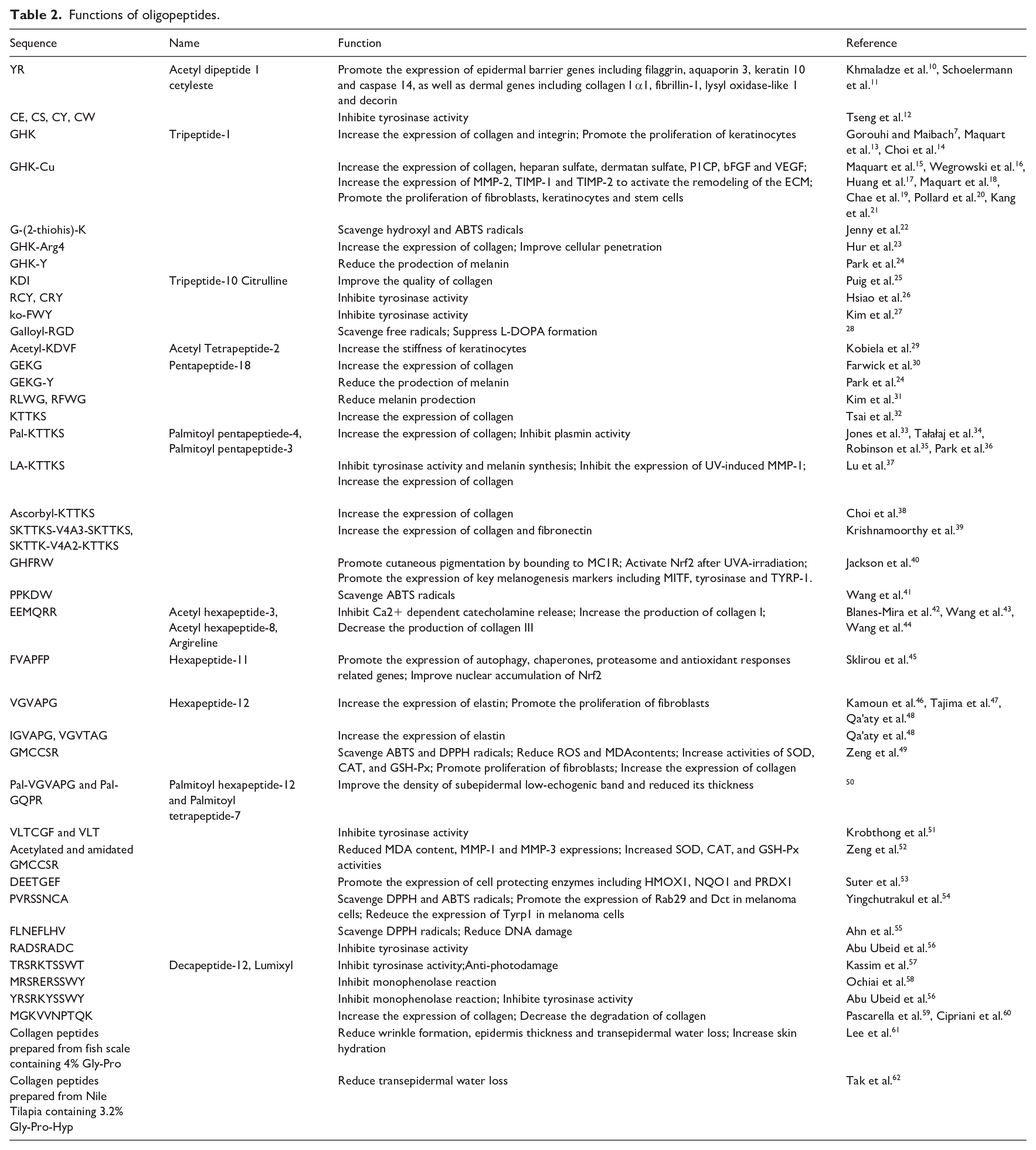
Oligopeptides exhibiting diverse biological activities and originating from a wide range of sources. Natural sources include extraction from plants and animals (such as soybeans, milk, and fish), microbial fermentation (e.g., lactic acid bacteria and yeast), and marine organisms (such as seaweed and shellfish). Chemical synthesis methods, such as solid-phase synthesis and liquid-phase synthesis, enable the efficient preparation of oligopeptides with specific sequences. Enzymatic hydrolysis, which generates functional oligopeptides by breaking down proteins, is widely applied in the food and cosmetics industries. Additionally, genetic engineering techniques allow the expression of specific oligopeptides in microorganisms or cells through recombinant DNA technology, making it suitable for large-scale production. The INCI list is a mandatory nomenclature designed to standardize the identification of ingredients in cosmetic products. The list encompasses over 300 oligopeptides, among which approximately 120 have found widespread application in skincare formulations (Table 1). However, the functions and mechanisms of the majority of these oligopeptides remain largely unexplored (Table 2). Only a few oligopeptides, including tripeptide Gly–His–Lys (tripeptide 1, GHK), pentapeptide Lys-Thr-Thr-Lys-Ser (Dipeptide-4, KTTKS), hexapeptide Glu-Glu-Met-Gln-Arg-Arg (Hexapeptide-3, EEMQRR), Decapeptide-12 (Tyr-Arg-Ser-Arg-Lys-Tyr-Ser-Ser-Trp-Tyr, YRSRKYSSWT), and Hexapeptide-12 (Val-Gly-Val-Ala-Pro-Gly, VGVAPG) have been reported.
Oligopeptides in skin care products.

Functions of oligopeptides.
Tripeptide 1 (Gly–His–Lys, GHK)
The Tripeptide-1 (GHK) is a subfragment presented in the alpha 2 (I) chain of collagen I 63 and found in human plasma, urine, and saliva.64,65 It has been widely used for wound healing, 66 skin regeneration 65 and anti-aging. 67 The peptide of collagen originated from skin breakdown, GHK, for example, serves as a signal to initiate the neo-collagen synthesis and improve the skin elasticity.7,13 Besides, a study found GHK can promote the proliferation and the expression of integrin of keratinocytes. 14 Cu plays an important role in collagen synthesis and tissue repair by stimulating several enzymes.68,69 However, its potential to induce skin irritation responses is often neglected. With its high affinity, GHK can couple with Cu well and efficiently improve the bioavailability and reduce skin irritation of Cu. 70 A study found cis-urocanic acid (UCA), a Cu-binding molecule in the human body, showed functions in skin hydration maintenance and ultraviolet (UV) protection. The biological effects of GHK could be achieved in part through the form of ternary complex [GHK][Cu][cis-UCA]. 71 By coupled with copper, CHK-Cu can promote the expression of the extracellular matrix of human fibroblasts, including not only collagen, 15 but also heparan sulfate and dermatan sulfate. 16 A study found that the production of collagen I, procollagen type I C-peptide (P1CP) and basic fibroblast growth factor (bFGF) of human fibroblasts was significantly increased with the treatment of Light-emitting diode photoirradiation (LED-PI) and GHK-Cu, compared with only LED-PI treatment. 17 In the wound chamber model of rats, GHK-Cu injection increased the content of collagen and glycosaminoglycan to promote the healing of the wound. 18 In a clinical study, GHK-Cu formulation treatment relieved erythema and pigmentation, which was induced by reconstructing of procollagen and collagen IV. 19 CHK-Cu can also increase the expression of both matrix metalloproteinase (MMP)-2 and the tissue inhibitors of metalloproteinases (TIMP)-1 and TIMP-2 to activate the remodeling of the extracellular matrix (ECM). 72 Besides, a study found that GHK-Cu can promote the proliferation of fibroblasts. The expression of vascular endothelial growth factor (VEGF) and bFGF was also increased by the treatment of GHK-Cu, compared with the untreated control. 20 Another study found GHK-Cu increased the proliferation of keratinocytes through improving the expression of proliferating cell nuclear antigen (PCNA), integrin, and p63. As p63 is a putative marker of stem cells in the skin, GHK-Cu could also promote the survival of stem cells in the skin. 21 The action mechanism of GHK as a cell growth factor has been revealed: the first residue glycine appears necessary to form copper complexes; the second residue histidine appears to have no specific role. Lysine, possessing a positive charge at physiological pH, facilitates peptides in engaging with negatively charged entities such as DNA, RNA, or cellular membranes. The lysine residues significantly influence peptide functionality and stability through their electrostatic properties, hydrogen-bonding potential, involvement in post-translational modifications, and roles in signal transduction. 73
After substituting 2-thiohis for His in GHK, the G-(2-thiohis)-K enhanced the antioxidant properties by quenching both hydroxyl radicals and 2, 2′-Azino-bis(3-ethylbenzothiazoline-6-sulfonic acid) diammonium salt (ABTS) radicals. 22 Arg4 conjugated GHK exhibits higher cellular penetration and promotes more collagen synthesis than GHK to improve anti-wrinkle activity. The inhibitory activity of Arg4 to MMP could be responsible for the enhanced activity and delivery of GHK-Arg4. 23 In addition, polymeric microneedles have been used to improve the skin permeation of GHK. 68
Palmitoyl pentapeptide-4 (pentapeptide Lys-Thr-Thr-Lys-Ser, KTTKS)
The Palmitoyl Pentapeptide-4 (KTTKS) is also a subfragment of collagen I (aa 212–216), which affects anti-aging and anti-wrinkle via promoting the expression of collagen.32,74,75 As the peptide bond of KTTKS is vulnerable to amino peptidases in the skin, a modification technology is commonly used to improve the stability and skin permeability of KTTKS. 76 Palmitic acid conjugation is one of the most common methods to modify the KTTKS. This palmitic acid modified KTTKS (Pal-KTTKS) was named as palmitoyl pentapeptiede-4, palmitoyl pentapeptide-3, or Matrixyl. Pal-KTTKS is stable after incubation with proteases up to 8 h. 77 The collagen production can be stimulated by Pal-KTTKS in a concentration-dependent manner, which is related to the self-assembly of Pal-KTTKS.33,78 A study designed and synthesized a series of KTTKS analogs with the formula of X-KTTKS, where X = palmitoyl, acetyl, lipoyl residues, and found that Pal-KTTKS showed the highest inhibitory effect on plasmin activity against anti-angiogenesis. 34 In a 12-week clinical study of 93 volunteers, the Pal-KTTKS showed significant efficiency in reducing wrinkles compared with placebo control. 35 Besides, the palmitoyl KTTKS also showed an anti-scarring effect by reducing the expression of α-SMA and inhibiting the trans-differentiation of fibroblasts. 36
In addition, other modifications have also been used to improve the performance of KTTKS. Compared with the KTTKS, the hydrophobic chain (myristoyl or stearoyl) conjunction can improve skin permeation properties. 79 Polyethylene glycol (PEG) conjugated KTTKS showed high stability against protease in rat skin. 80 Ascorbyl conjugation improves the stability of KTTKS and promotes the expression of collagen in human dermis. 38 After conjugation of lipoic acid (LA), the LA-KTTKS showed inhibitory effect on tyrosinase activity and melanin synthesis, which is higher than that of LA or KTTKS. Besides, the LA-KTTKS and LA-PEG-KTTKS inhibited the expression of MMP-1 induced by UV, and stimulated collagen biosynthesis in fibroblasts more efficiently than LA or KTTKS. 37 Compared to the original oligopeptide, SKTTKS-V4A3-SKTTKS and SKTTK-V4A2-KTTKS significantly increased the production of collagen and fibronectin of cells. 39 A clinical study with 77 volunteers found that after shortening Pal-KTTKS, Pal-KT can still reduce wrinkles and improve skin smoothness. 81 More information about KTTKS and its derivatives can be found in Abu Samah and Heard’s review. 82
Hexapeptide-3 (Hexapeptide Glu-Glu-Met-Gln-Arg-Arg, EEMQRR)
The Hexapeptide-3 (EEMQRR) is a synthetic hexapeptide, which is also named acetyl hexapeptide-3, acetyl hexapeptide-8, and Argireline. The sequence of Argireline is patterned after the N-terminal domain in the N-end of SNAP 25 (aa 12–17), which is essential for the formation of the SNAREA complex.83,84 As a botulinum toxin mimetic peptide, Argireline inhibits the Ca2+ dependent catecholamine release from chromaffin cells through competing with SNAP 25 to interfere with the assembly of SNARE ternary complex. 42 Thus, Argireline has a good effect on anti-aging and anti-wrinkle. In the skin of aging mice, Argireline resisted the process of aging by improving the collagen I/III ratio of skin in aging mice. 43 A clinical study revealed that the anti-wrinkle efficacy was significantly higher in the Argireline group (48.9%) than the placebo group (0%). The skin roughness was decreased in the Argireline group while no decrease was observed in the placebo group. 44 Another clinical study demonstrated that Argireline decreased the anisotropy of skin. 85 Besides, an acetyl hexapeptide-8 containing gel cream increased skin elasticity and inhibited sebum secretion in 26 volunteers with skin disorders. 86
As the zwitterionic form of Argireline limits skin penetration, some efforts have been made to deal with this problem. For example, a study has shown that a multi-ple water-oil-water (W/O/W) emulsion significantly increased the skin penetration of Argireline compared to W/O and O/W emulsions. In terms of dermal penetration, water-rich W/O/W and O/W emulsions were better than oil-rich W/O emulsions. 87 Another study found that modifying Argireline with different functional groups of amino side chain, and increasing molecular weight and improving lipophilicity can promote the skin permeation and anti-wrinkle ability of Argireline. 88 Besides, personalized microneedle patches with different curvatures and geometries were fabricated to improve the efficiency of transdermal delivery of Argireline.89,90
Decapeptide-12(Tyr-Arg-Ser-Arg-Lys-Tyr-Ser-Ser-Trp-Tyr, YRSRKYSSWT)
Decapeptide-12 (YRSRKYSSWT), also named Lumixyl, is an oligopeptide with multiple functions. Decapeptide-12 is a whitening oligopeptide that can inhibit the activity of tyrosinase. For the tyrosinase inhibitory activity of Decapeptide-12, the C-terminal tyrosine residue provides the greatest contribution, while the tyrosine residue at the center or N-terminal shows a slight contribution. 58 In a clinical study with five volunteers with moderate re-calcitrant melasma and Fitzpatrick phototype IV, Decapeptide-12 showed the ability to improve the appearance of melasma and overall facial esthetics. 91 A study also found Decapeptide-12 plays a role in anti-photoaging. The therapeutic effect of Decapeptide-12 in skin photoaging was also demonstrated. Fifteen females who suffer from photoaging were subject to Decapeptide-12 contained cream, 38.5% of them achieved complete clearance of photoaging which from grade 3 to grade 1, 30.7% of them improved from grade 3 to grade 2, 15.4% of them improved from grade 4 to grade 3, and 15.4% of them improved from grade 4 to grade 2 . 57 Besides, Decapetide-12 showed anti-aging ability through increasing the expression of Sirtuins. 92
Hexapeptide-12 (Val-Gly-Val-Ala-Pro-Gly, VGVAPG)
Hexapeptide-12 (VGVAPG) is a repeating oligopeptide in tropoelastin, 93 which can promote the proliferation of fibroblasts.46,47 Besides, hexapeptide-12 and its analogs Ile-Gly-Val-Ala-Pro-Gly (IGVAPG) and Val-Gly-Val-Thr-Ala-Gly (VGVTAG), which can be recognized by anti-elastin antibody, have been identified to increase the expression of elastin in mRNA and protein level, as well as the synthesis of elastic fibers of human dermal fibroblasts and human skin explants, through interacting with elastin receptor or N-terminal domain of insulin like growth factor-1 (IGF-1)-binding protein-1 to activate IGF-1 receptor. 48
Other promising oligopeptides in the INCI list
Some oligopeptides in the INCI list have been widely used in skin care products, but there are few reports on them. For example, the acetyl dipeptide-1 cetyl ester with the sequence of Tyr-Arg (YR) in a multifunctional skin care promoted the expression of epidermal barrier genes including filaggrin, aquaporin 3, keratin 10 and caspase 14, as well as dermal genes including collagen I α1, fibrillin-1, lysyl oxidase-like 1 and decorin of human primary keratinocytes. 10 Besides, the acetyl dipeptide-1 cetyl ester containing cosmetic product can reduce capsaicin-induced facial stinging in volunteers with sensitive skin. 11 Tripeptide-10 citrulline with the sequence of Lys-Asp-Ile (KDI) is a tetrapeptide that mimics the collagen-decorin binding sequences. It can interact with collagen fibrils to regulate the fibrillogenesis process, control the dimensions and diameter uniformity of fibrils, and then improve the quality of skin collagen. 25 Hexapeptide-11 (Phe-Val-Ala-Pro-Phe-Pro, FVAPFP) is a promising anti-aging peptide which isolated from yeast. The hexapeptide-11 provides a protection against oxidative stress and mediates senescence in fibroblasts through promoting the expression of autophagy, chaperones, proteasome, and antioxidant-stress related genes, as well as improving nuclear accumulation of nuclear factor erythroid 2 related factor 2 (Nrf2). It improved human skin elasticity in the skin deformation assays. 45 Acetyl tetrapeptide-2 (Acetyl-Lys-Asp-Val-Phe, Acetyl-KDVF) plays a role in anti-aging through increasing the stiffness of HaCaT keratinocytes with the remodeling of actin filaments. 29 Tetrapeptide-21 (Gly-Glu-Lys-Gly, GEKG) can improve the expression of collagen in human dermal fibroblasts at the mRNA and protein level. The skin roughness of 10 volunteers was significantly reduced in the GEKG group compared with the placebo group. 30
Oligopeptides in research
There are many newly developed oligopeptides that have great potential in skin rejuvenation and regeneration. They are extracted from animals and plants. For example, collagen peptides from hydrolyzing fish scale contain about 4% dipeptide Gly-Pro (GP). After taking these peptides orally, wrinkle formation and trans-epidermal water loss induced by UVB were significantly attenuated while the epidermis thickness and the skin hydration were increased in rats. 61 Another collagen peptide from Nile Tilapia skin contains 20% tripeptides, which Gly–Pro–Hyp accounts for 3.2%. These collagen peptides reduced trans-epidermal water loss after 12 weeks of observation, even under unfriendly temperature, humidity, and UVA conditions. 62 The octapeptide Phe-Leu-Asn-Glu-Phe-Leu-His-Val (FLNEFLHV) is derived from pectoral fin protein of salmon. This octapeptide showed a high scavenging activity against 2-diphenyl-1-picrylhydrazyl (DPPH) radicals. It can protect DNA from hydroxyl radical. 55 The hexapeptide Gly-Met-Cys-Cys-Ser-Arg (GMCCSR) is derived from Spirulina platensis. Both GMCCSR and acetylated and amidated hexapeptide GMCCSR exhibits anti-photoaging properties through reducing malondialdehyde (MDA) content, while increasing superoxide dismutase (SOD), catalase (CAT), and Glutathione peroxidase (GSH-Px) activities.49,52 The hexapeptide Val-Leu-Thr-Cys-Gly-Phe (VLTCGF) is obtained from the protein hydrolysate of Linzhi, which possesses the anti-tyrosinase activity. By shortening the C-terminus of VLTCGF to Val-Leu-Thr (VLT), the anti-tyrosinase activity reaches a maximum. 51 The octapeptide Pro-Val-Arg-Ser-Ser-Asn-Cys-Ala (PVRSSNCA) is another oligopeptide derived from Lingzhi hydrolysate. The antioxidant activity of this octapeptide is comparable to some well-known antioxidants, such as ascorbic acid, gallic acid, and FeSO4, which were identified by the DPPH and ABTS tests. This octapeptide can also whiten the skin through upregulating Rab29 and Dct, as well as downregulating Tyrp1 in melanoma cells. 54
Artificially synthesized oligopeptides
In addition to extraction from organisms, the synthesis of functional oligopeptides by molecular design is also an effective way. A synthetic tetrapeptide combinatorial library was developed by positional scanning to screen for oligopeptides that inhibit cellular melanin synthesis. Among these tetrapeptides, Arg-Phe-Trp-Gly (RFWG) and Arg-Leu-Trp-Gly (RLWG) showed high anti-melanogenic activities, which are potentially for skin whitening. 31 The decapeptide Met-Arg-Ser-Arg-Glu-Arg-Ser-Ser-Trp-Tyr (MRSRERSSWY) is a Decapeptide-12 homologous oligopeptide screened from the genomic database of rice. The oligopeptides MRSRERSSWY inhibited the monophenolase reaction in the process of melanin production, by serving as a substrate analog to bind to tyrosinase. Subsequent analysis showed that for the tyrosinase inhibitory activity of MRSRERSSWY, the C-terminal tyrosine residue is essential, and the position of the tyrosine residue is also important. 58 After screening a series of tyrosinase inhibitory oligopeptides, including Arg-Cys-Tyr (RCY), Cys-Arg-Tyr (CRY), 26 Cys-Glu (CE), Cys-Ser (CS), Cys-Tyr (CY), and Cys-Trp (CW), 12 Hsiao et al. found tyrosine residues in the C-terminus and cysteine residues in the N-terminal play an essential role in tyrosinase inhibition. Park et al. also found that the addition of tyrosine in the terminal of oligopeptides, including GHK and GEKG, can provide these oligopeptides with anti-melanogenic effects, with the intrinsic effects not affected. 24
There are some synthetic oligopeptides used for anti-aging. As the melanocortin-1 receptor (MC1R) agonist alpha-melanocyte stimulating hormone (α-MSH) showed pro-pigmenting and anti-photoaging effects, an α-MSH-mimicking peptide library with the core sequence Bz-Gly-His-D-Phe-AAB-AAA-NR1R2, where AAB is a basic amino acid; AAA is an aromatic amino acid and NR1R2 is either amide or alkyl-amide was developed to screen for the small and safe peptide sequence. The screened pentapeptide Bz-Gly-His-D-Phe-Arg-D-Trp-NPropylPropyl showed anti-photoaging effects through promoting cutaneous pigmentation by binding to MC1R, as well as anti-oxidant effects by activating Nrf2 after UVA-irradiation. This study also found that this pentapeptide promoted the expression of key melanogenesis markers, including melanocyte inducing transcription factor (MITF), tyrosinase, and tyrosinase-related protein 1 (TYRP-1). 40 The heptapeptide Asp-Glu-Glu-Thr-Gly-Glu-Phe (DEETGEF) contains the Keap1 binding motif of Nrf2,94,95 which could disrupt the formation of Nrf2-Keap1 complex to provide protection against reactive chemical species. The DEETGEF can stimulate the expression of cell-protecting enzymes, including Heme oxygenase-1 (HMOX1), NAD(P)H quinone oxidoreductase (NQO1), and Peroxiredoxin-1 (PRDX1) in the ex vivo skin explants. It can protect skin explants from UV irradiation and reduce DNA damage significantly. 53 Arg-Gly-Asp (RGD) is a synthetic oligopeptide, which is a small sequence of ECM proteins that can be recognized by cells. A study found that the galloyl-RGD showed good thermal stability and cytocompatibility, as well as the ability to remove free radicals, suppress L-DOPA formation and oxidation, which can be used as a cosmetic ingredient. 28 The decapeptide Met-Gly-Lys-Val-Val-Asn-Pro-Thr-Gln-Lys (MGKVVNPTQK) is synthesized as the C-terminal portion of serpin A1 (aa 409–418), which can promote the expression of collagen I of human dermal fibroblasts 59 and reduce the degradation of collagen. 60
Oligopeptide complex
As the limited function of single oligopeptides, complex oligopeptides are alternatives to achieve better effect on skin rejuvenation. For example, the mixture of palmitoyl hexapeptide-12 and palmitoyl tetrapeptide-7 (Palmitoyl-Gly-Gln-Pro-Arg, Pal-GQPR) improved the density of sub-epidermal low-echogenic band and reduced its thickness, indicating the interest of the anti-aging compound formula. 50 The compound of tripeptide-10 citrulline and Argireline was used by 24 female volunteers. The results showed that this compound reduced the cyclic maximum and average roughness, as well as the trans-epidermal water loss of skin synergistically. 96 Six formulations of five cosmeceutical peptides (carnosine, GHK, Argireline, acetyl tetrapeptide-5, and hexapeptide-11) with optimal concentration were tested. The results showed that the mixture of carnosine, Argireline, acetyl tetrapeptide-5 and hexapeptide-11 showed best performance of anti-aging in increasing the contents of elastin and hydroxyproline, as well as the SOD and GSH-Px activities, while reduce the intracellular content of MDA and hydroxyl radicals. 97 The oligopeptide compound of Arg-Gly-Ser (RGS, extracted from rice), Gly-Pro-Gln-Gly-Pro-Gln (GPQGPQ, a homolog to sequences in collagen IV and XVII, Cys-Gly (CG, extracted from Einkorn (Triticum monococcum) improved the expression of collagen IV, while individual oligopeptides had no visible effect, which suggested the importance of the synergetic effect of individual peptides. The results of a clinical study on 22 volunteers showed improved expertly graded wrinkle scores in the oligopeptide compound group. 98
Delivery method and mechanisms of oligopeptides
Oligopeptides can be categorized into two main delivery methods in skincare and skin regeneration: oral delivery and topical delivery. Each method has distinct mechanisms and specific examples of utilization.
Oral delivery of oligopeptides involves consuming these bioactive molecules through dietary supplements or food products. This method allows oligopeptides to be absorbed into the bloodstream, where they can exert systemic effects on skin health. These peptides are typically derived from natural sources such as hydrolyzed collagen from fish scales or plant proteins. For example, Collagen Peptides are derived from animal collagen and have been widely studied for their ability to improve skin elasticity and hydration when taken orally 99 ; Wheat Germ Oligopeptides have been shown to have antioxidant properties and can reduce oxidative stress in the skin when consumed. 100 Oral oligopeptides mainly exert their effects through the following mechanisms: (1) Systemic bioavailability: when ingested, oligopeptides are broken down into smaller peptides or amino acids in the gastrointestinal tract and absorbed into the bloodstream. These molecules can then be transported to the skin, where they stimulate collagen synthesis, enhance antioxidant activity, and promote overall skin health. 101 (2) Anti-inflammatory and antioxidant effects: some orally administered oligopeptides have been shown to reduce oxidative stress and inflammation at the cellular level, which are key factors in skin aging and damage. 102 (3) Nutrient delivery: oral oligopeptides can provide essential nutrients that support skin health from within. For example, Collagen Peptides can enhance the skin’s hydration and elasticity by promoting collagen production. 103
Topical delivery involves applying oligopeptides directly to the skin in the form of creams, lotions, or other skincare products. This method allows for localized delivery of active ingredients to the skin surface and deeper layers. For example, Palmitoyl Oligopeptides are commonly used in anti-aging creams to stimulate collagen synthesis and reduce the appearance of fine lines and wrinkles. 7 Copper Peptides are known for their wound-healing properties and ability to promote skin regeneration when applied topically. 104 Topically delivered oligopeptides exert their effects through the following mechanisms: (1) Direct penetration: oligopeptides with a molecular weight below 500 Da can effectively penetrate the stratum corneum and reach the epidermis and dermis, where they can directly influence skin cells and extracellular matrix components. 105 (2) Local stimulation: topical oligopeptides can stimulate fibroblasts to produce collagen and elastin, thereby improving skin firmness and reducing the appearance of wrinkles. 106 (3) Anti-inflammatory and antioxidant effects: similar to oral intake, topical oligopeptides can reduce inflammation and oxidative stress at the site of application, leading to improved skin health. 107
Some oligopeptides can be delivered orally or topically. For example, GHK is a versatile peptide with applications in both oral and topical formulations. When used topically, GHK-Cu complexes promote collagen synthesis and tissue repair by stimulating fibroblasts and keratinocytes.15,20 The mechanism involves the binding of GHK to copper ions, which enhances the bioavailability of copper and reduces skin irritation. GHK-Cu can also activate the expression of MMPs and tissue inhibitors of TIMPs, facilitating extracellular matrix remodeling. 72 In oral formulations, GHK has been shown to reduce oxidative stress and promote overall skin health through systemic effects. 67
Conclusions and perspectives
Oligopeptides and their derivatives have been widely used in skin rejuvenation and regeneration. Some are already listed in the INCI, others are still under exploration. To improve the efficacy of cosmetic and anti-aging products, oligopeptide compounds have been further developed. Nonetheless, there are still some challenges in the development of oligopeptides. Firstly, the mechanism by which oligopeptides function remains to be studied. At present, most studies focus on the function of oligopeptides, but few of them have revealed the mechanism of oligopeptides at the cellular and molecular level. It is essential to find the commonality and individuality of the oligopeptides’ functioning, the mechanism of oligopeptides should be further studied by signaling pathway and signal molecule. Next, the relationship between the function of an oligopeptide and its amino acid sequence needs to be elucidated clearly. Nowadays, only some of the amino acid coding rules of whitening oligopeptides have been studied.12,24 The amino acid sequence of oligopeptides is a key determinant of their biological activity. Different sequences exhibit various functions, such as antioxidant, antimicrobial, or immunomodulatory effects. These functions are achieved through the specific binding of oligopeptides to target molecules (e.g., receptors, enzymes, or membrane proteins). For example, antimicrobial peptides exert bactericidal effects by disrupting bacterial cell membranes, while immunomodulatory peptides regulate immune cell signaling pathways. The length of the peptide chain influences the stability and activity of oligopeptides. Short-chain oligopeptides (2–5 amino acids) are generally more stable and easily absorbed, while longer-chain oligopeptides (6–20 amino acids) may have more complex structures and functions. Short-chain oligopeptides can more easily cross cell membranes or intestinal barriers, whereas longer-chain oligopeptides may bind to target molecules by forming specific secondary structures. The secondary structure of oligopeptides (e.g., α-helix, β-sheet) directly affects their biological activity. For instance, α-helical antimicrobial peptides can insert into cell membranes, while β-sheet structures may participate in protein-protein interactions. The secondary structure determines the binding ability and specificity of oligopeptides to target molecules. Chemical modifications (e.g., phosphorylation, glycosylation) can enhance the stability, activity, or targeting ability of oligopeptides. For example, phosphorylation may regulate signal transduction functions, while glycosylation can improve solubility and targeting. These modifications influence the interaction of oligopeptides with target molecules by altering their charge distribution, hydrophobicity, or spatial conformation. The charge and hydrophobicity of oligopeptides affect their interactions with cell membranes or target molecules. Positively charged oligopeptides easily bind to negatively charged bacterial cell membranes, exerting antimicrobial effects, while hydrophobic oligopeptides may more readily penetrate cell membranes or bind to hydrophobic targets. These properties determine the cell-penetrating ability and target-binding capacity of oligopeptides. Cyclic oligopeptides generally exhibit higher stability and biological activity. For example, cyclic antimicrobial peptides are more resistant to protease degradation. The cyclic structure can enhance the binding affinity of oligopeptides to target molecules and prolong their half-life in vivo. Some oligopeptides contain special functional groups (e.g., sulfhydryl, hydroxyl, carboxyl groups), which may participate in redox reactions, metal ion chelation, or other biological processes. These functional groups interact specifically with target molecules, such as sulfhydryl groups participating in antioxidant reactions and carboxyl groups involved in metal ion binding. By rationally designing and modifying the chemical structure of oligopeptides, their biological activity, stability, and targeting ability can be optimized, enabling their important applications in medicine, food, and cosmetics. The efforts to reveal the relationship between functions and amino acid sequences of oligopeptides would benefit the development of a more powerful oligopeptide. In addition, the exploration of combined formulations of oligopeptides is promising for multifunctional products. As the function of a single oligopeptide is limited, the synergy between oligopeptides deserves more attention.
Footnotes
Correction (June 2025):
The affiliation of authors “Youguo Liao” and “Huahui Zhang” was incorrect and has been corrected.

Author contributions
Qiulin He and Youguo Liao contributed equally to this work. Qiulin He and Youguo Liao drafted this manuscript. Yuxiang Zhang, Yaru Wu, Huahui Zhang, and Xiaohui Long revised this manuscript. Yuxiang Zhang supervised the manuscript. All authors discussed and approved the manuscript.
Funding
The author(s) disclosed receipt of the following financial support for the research, authorship, and/or publication of this article: This work was supported by the medical and health research project of Zhejiang Province (2024KY614), Zhejiang Province Traditional Chinese Medicine Science and technology Project (2024ZL233).
Declaration of conflicting interests
The author(s) declared no potential conflicts of interest with respect to the research, authorship, and/or publication of this article.