



Abstract
Purpose:
To study the response under impact load of carbon fiber reinforced composite materials that have excellent mechanical properties.
Design/methodology/approach:
Finite element analysis of unidirectional plates was conducted under unsymmetrical impact load based on drop weight impact test. At the macroscopic scale, a finite element model was built on ANSYS/LS-DYNA, which took the impact response of carbon fiber unidirectional plates as unknown quantity. The model considered the macroscopic response of carbon fiber unidirectional plates under different initial conditions, from the aspects of stress, strain, energy change and deformation degree of unidirectional plates. Finally, a mathematical model of energy recovery of carbon fiber composite materials under partial impact load was established, and the energy recovery amount under different fiber orientations was calculated on MATLAB.
Findings:
The impact energy absorbed by the unidirectional plate is the largest when the fiber orientation is 30°. To improve the impact resistance of unidirectional plates under unsymmetrical impact load, laying schemes should be avoided at fiber orientations of 0°, 15° and 60°, and be recommended at 30°, 45°, and 75°. For impact velocity, 4.71 and 7.54 m/s should be avoided, while 2 m/s is recommended. For the impact weight, 50 and 250 kg weights should be avoided, and 150 and 200 kg weights are recommended.
Originality/value:
This model not only provides reference for similar impact resistance research, but also predicts the impact response of unidirectional plates under different initial loads in the future. It can also provide reference for the structure using carbon fiber composite materials to achieve lightweight.
Keywords
Introduction
Carbon fiber-reinforced plastic (CFRP) unidirectional plates are widely used in the plate structure of automobiles and airplanes owing to their outstanding mechanical properties. It is more scientific and reasonable to predict the macroscopical response of the unidirectional plate under the partial impact load by combining macro and micro. At present, the research on CFRP plates and shell structures mainly involves strength prediction under unidirectional load and damage evolution under high-speed impact. 1 In the elastic range of plates and shell structures, a macro-micro mechanical model has been established for macro-micro integrated analysis framework of composite structures, which would provide a good platform for composite mechanics problems and multi-scale analysis. 2 However, there is little literature on analysis of unsymmetrical load impact response of composite material unidirectional plates, and the existing analysis is often limited by large quantity of calculation and high-test costs. In this study, through the improvement of the drop weight impact test, the finite element analysis (FEA) software ANSYS/LS-DYNA was used to establish a finite element model under different initial conditions, and the design parameters of unidirectional plates under different initial conditions were optimized through analogy analysis. The specific analysis process is shown in Figure 1.

Analysis flow chart.
FEA preparation
First, the average mechanical properties of the fiber and the matrix were used to express the mechanical properties of composite materials.3,4 Then based on the improvement of drop weight impact test, the impact simulation under different initial conditions was carried out, and the fiber orientation, impact speed and weight quality were optimized through analogy analysis to identify the material and load parameters with the best impact resistance of carbon fiber composites. 5 Specifically, an impact finite element model of carbon fiber composite materials was established through ANSYS, and the impact response under different initial conditions was simulated by modifying the program file. The results were post-processed through the post-processing program LS-PREPOST and MATLAB software.
Drop weight impact test
Drop weight impact test is the most commonly-used low-speed impact test for material performance characterization. The test device is shown in Figure 2(a). 6 To achieve or approach constant strain rate loading in characterizing the impact performance of carbon fiber composite materials, a large-mass impact body needs to be selected to achieve a relatively constant deformation rate of the sample. In addition, the material and thickness of the shaper have greater influences on the loading rate. At the same time, a suitable shaper can also avoid large deformation or premature buckling of unidirectional plates and can reduce the probability of secondary impact to certain extent. On this basis, the impact compression load is applied to the unidirectional plate and the multi-scale impact response of the carbon fiber composite unidirectional plate is obtained.

(a) Schematic diagram of drop weight impact test: 1. weight 2. shaper 3. upper support plate 4. angle steel 5. specimen 6. base. (b) Specimen geometry: 1. angle steel 2. bolt 3. specimen.
According to the impact test, a kind of carbon fiber reinforced resin matrix composite material was of interest in this study. The averaged thickness of the carbon fiber composite was 1.6 mm. Composite specimens with dimensions of 63 mm × 19 mm were machined from the specimen panel. Each of them was then bolted with steel angles from both sides and at both ends as shown in Figure 2(b), resulting in a 19 mm × 19 mm × 1.6 mm testing zone.
Determination of analysis variables and kinetic parameters
Acquisition of kinetic parameters
The impact schematic diagram of a carbon fiber composite unidirectional plate under unsymmetrical impact loads is shown in Figure 3.7,8

Schematic diagram of the impact of the composite unit cell under unsymmetrical impact load.
The dynamic model of the unidirectional plate is expressed as:9,10

The dynamic model of the drop weight is:

In the impact process, Newmark integrates time to form:

Equation (3) is substituted into equation (1) of the equilibrium equation of carbon fiber composite material unit cell and is simplified as:

In the same way, the drop weight has a similar integral equation as:

In the whole impact process, the impact contact law is satisfied, at the moment of n + 1, the functional relationship of equation (3) can be written as:

Determination of analysis variables
In the simulation, the international unit SI was used (mm, N, T, s, and MPa). First, the unidirectional plate and the device were simplified under unsymmetrical impact loads to establish a geometric model.11,12
According to the requirements, the mechanical properties and the material parameters of the unidirectional plate are shown in Table 1.
Mechanical properties of carbon fiber reinforced resin matrix composites.

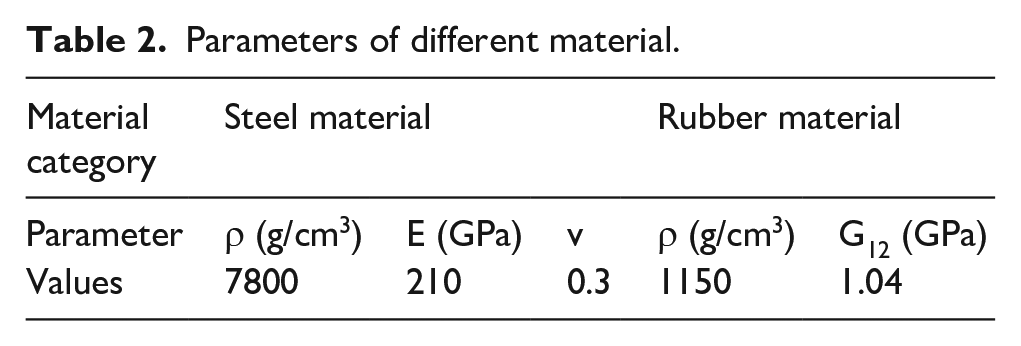
The shaper material is rubber and the material of all other devices is steel. The parameters are shown in Table 2. The unidirectional plate was discretized into SHELL163 element, and the heavy weight and shaper were discretized into SOLID164 element and meshed. The heavy weight added the initial velocity and the gravity field. The constraints and boundary conditions imposed on the impact system are shown in Figure 4.
Parameters of different material.

Drop weight impact model after meshing.
(1) Fiber orientation
Fiber orientation was used as the analysis variable and the impact response of the unidirectional plate under the fiber orientation of 0°, 15°, 30°, 45°, 60°, 75°, and 90° was analyzed.
(2) Impact velocity
Then, from the above dynamic parameters and the weight, the impact height and the initial impact velocity of the weight can be obtained as shown in Table 3.
Impact height and impact velocity.

(3) Mass
Finally, the mass of the drop weight is used as the analysis variable, and the impact response of the unidirectional plate under the weight of 50, 100, 150, 200, and 250 kg was analyzed.
Finite element method to solve the impact response
In Section 2, the impact dynamic parameters and analysis variables of the unidirectional plate subjected to unsymmetrical impact load were determined. In this section, the finite element method will be used to compare and analyze the impact response of unidirectional plates under different initial conditions.13–16
Influence of fiber orientation on impact performance of the unidirectional plates
(1) Energy result
(2) Displacement results
(3) Mesoscopic results
The simulation analysis carried out in this study is based on the homogenization assumption of the carbon fiber composites. Based on the performance parameters of the carbon fiber composite unidirectional plate, the fiber orientation, impact energy and impact mass were taken as the analysis variables from the macro perspective, and the response analysis of the unidirectional plate under unsymmetrical impact load is carried out. Modeling simulation and programing calculation by using ANSYS and MATLAB software, the best performance parameters of unidirectional plates under different load combinations are shown in Table 4 through comparative analysis.
Response parameters of the unidirectional plate under different analysis variables.

As shown in Table 4, under different analysis variables, there are great differences in the same response performance of unidirectional plates. Among them, the fiber orientation has a great influence on the impact resistance performance of unidirectional plates, followed by impact weight and impact velocity.
According to the calculated data in Table 4, when the fiber orientation is 75°, the impact velocity is 2 m/s and the impact weight is 150 kg, the impact resistance performance of the unidirectional plate under unsymmetrical impact load is the best.
According to the established geometric model of the specimen and the calculation results of the finite element model, The Element n A660 point is marked in the Figure 2(b) Specimen geometry and is analyzed.
To fully analyze the response history of the unidirectional plate when subjected to off-axis load impact from the mesoscale, the initial impact conditions of 75° fiber orientation, 2 m/s impact velocity and 150 kg drop weight were selected for analysis. With the derivative of the linear part of the strain history in the LS-PREPOST program, the strain rate under the initial conditions of the impact was determined to be 0.0416/s (Figure 9).
The above results reveal a big difference in the impact response of unidirectional plates under different fiber orientations. When the fiber orientation is 30° or 45°, the kinetic energy of the unidirectional plates is generally smaller (Figures 5 and 6). If more energy is absorbed, the strain energy is smaller. At the fiber orientation of 30°, the minimum lateral displacement of the unidirectional plate is 0.75 mm (Figures 7 and 8), which is 30% and 18.75% of those at fiber orientations of 45° and 60° respectively. When the fiber orientations are 75° and 90°, the peak longitudinal displacements of the unidirectional plates are smaller than at other fiber orientations. The peak longitudinal displacements are 33.3% and 47.62% of those at fiber orientation 0° and 15° respectively. When the strain rate is 0.0416/s, the strain and stress contour maps of the unidirectional plates can better reflect the micro-response law of the unidirectional plates during the impact process (Figures 9–11).

Kinetic energy-time curve of the unidirectional plate under different fiber orientations.

Strain energy-time curve of unidirectional plate under different fiber orientations.

Lateral displacements of unidirectional plates under different fiber orientations.

Longitudinal displacement of unidirectional plates under different fiber orientations.

Determining strain rate based on strain-time history.

Y-direction stress contour map of unidirectional plate: (a) T = 0.050983, (b) T = 0.059986, (c) T = 0.07099, and (d) T = 0.14899.

Y-direction strain contour map of unidirectional plate: (a) T = 0.050983, (b) T = 0.059986, (c) T = 0.07099, and (d) T = 0.14899.
The above results suggest that in order to make the carbon fiber composite unidirectional plates have the best impact resistance, fiber orientations at 0°, 15°, and 60° in laying schemes need to be avoided, but fiber orientations at 30°, 45°, and 75° are recommended.
Influence of impact velocity on impact response of unidirectional plates
(1) Energy results
(2) Displacement results
(3) Mesoscopic results
With the increase of the impact energy, the peak strain of the unidirectional plate arrivals time fast, the conclusion is consistent with the peak stress conclusion. On the other hand, the impact velocity in the range of 4.71–6.60 m/s, the peak strain would decrease with the increase of impact velocity. When the impact velocity is 7.54 m/s, the peak strain is 0.000723, The peak strain value is larger than that of other impact velocities. Therefore, considering the internal strain of the unidirectional plate, the impact velocity 4.71 m/s is the selected impact velocity. 17
To fully analyze the response history of the unidirectional plates subjected to off-axis load impact from the mesoscale, the specific initial conditions were fiber orientation at 75°, impact velocity 4.71 m/s and 150 kg drop weight. All above data were selected for analysis. The strain rate under the initial conditions of the impact is 0.03125/s (Figure 15).
The above results reveal a big difference in the unsymmetrical load impact response of the unidirectional plate under different impact speeds. When the impact velocity is 2 m/s, the kinetic energy peak of the unidirectional plate is smaller (Figures 12 and 13). If more energy is absorbed, the strain energy is smaller. At the impact velocity of 2 m/s, the minimum longitudinal displacement of the unidirectional plate is 0.0025 mm (Figure 14), which is 45.45% and 40.32% of those at the impact velocity of 4.71 and 7.54 m/s respectively. When the strain rate is 0.003125/s, the strain and stress contour map of the unidirectional plate better reflects the impact process of meso-level response (Figures 15–17). These results suggest that for the impact velocity, to make the carbon fiber composite unidirectional plates have the best impact resistance, the impact velocity 4.71 and 7.54 m/s should be avoided, and 2 m/s is recommended.

Kinetic energy-time curve of the unidirectional plates under different impact speeds.

Strain energy-time curve of the unidirectional plates under different impact speeds.

Longitudinal displacement of the unidirectional plate under different impact speeds.

Determining strain rate based on strain-time history.

Contour map of stress distribution of unidirectional plate under impact velocity of 4.71 m/s: (a) T = 0.094981, (b) T = 0.10098, (c) T = 0.12099, and (d) T = 0.145.

Contour plot of strain distribution of unidirectional plate under impact energy of 4.71 m/s: (a) T = 0.094988, (b) T = 0.10099, (c) T = 0.12099, and (d) T = 0.145.
Influence of the drop weight on impact response of unidirectional plates
(1) Energy result
(2) Displacement results
(3) Mesoscopic results
To fully understand the response history of the unidirectional plates subjected to off-axis load impact from the meso-scale, the initial conditions at fiber orientation 60°, the impact velocity 2 m/s and the drop weight 200 kg were specifically selected for analysis. The strain rate under the initial conditions of the impact is 0.0361/s (Figure 22).
The above results suggest a big difference in the impact response of the unidirectional plate under different weights. When the drop weight is 150 kg, the kinetic energy peak of the unidirectional plate minimizes to 27.2 J (Figures 18 and 19), which is 46.10% and 60.44% of those with the 50 and 250 kg drop weights respectively. When the drop weight is 250 kg, the minimum strain energy of the unidirectional plate is 68.2 J, which is 56.83% and 59.30% those of the 50 and 100 kg drop weights respectively. At the same time, the strain energy of the unidirectional plate increases as the drop weight is improved. When the drop weight is 200 or 250 kg, the longitudinal displacement of the unidirectional plate is equal and smaller, which is 0.017 mm and 21.25% that of the 50 kg drop weight (Figures 20 and 21). When the drop weight is 50 kg, the lateral displacement of the unidirectional plate minimizes to 0.00052 mm. The lateral displacement of the unidirectional plate is 11.81%, 16.25%, and 52.00% those of the 100, 150, and 250 kg drop weights respectively. When the strain rate is 0.0361/s, the strain and stress contour map of the unidirectional plate can better reflect the mesoscopic response of unidirectional plates during the impact (Figures 22–24). These results show that for the drop weight, to make the carbon fiber composite unidirectional plates have the best impact resistance, the drop weights of 50 and 250 kg should be avoided, and the drop weights of 150 and 200 kg are recommended.

Kinetic energy-time curve of unidirectional plates under different weights.

Strain energy-time curve of unidirectional plate under different weights

Longitudinal displacement of unidirectional plates under different weights.

Lateral displacement of unidirectional plates under different weights.
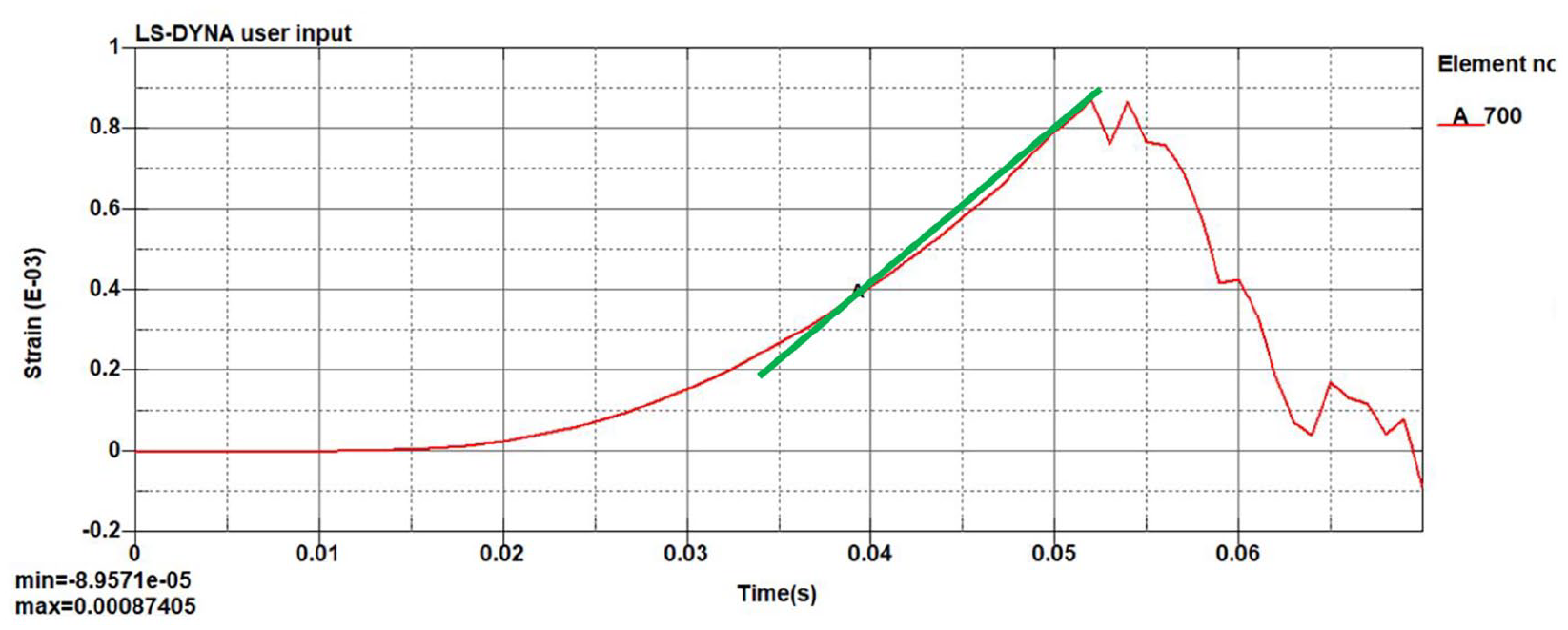
Determining strain rate based on strain-time history.

Y-direction stress contour map of a unidirectional plate with a weight of 150 kg: (a) T = 0.021991, (b) T = 0.036993, (c) T = 0.043998, and (d) T = 0.078984.

Y-direction strain contour map of a unidirectional plate with a weight of 150 kg: (a) T = 0.021991, (b) T = 0.036992, (c) T = 0.043997, and (d) T = 0.078985.
Energy recovery calculation
Establishing a mathematical model of energy recovery
Under the impact load, the energy distribution of its energy distribution diagram is shown in Figure 25.18–20

Energy distribution diagram.
The following model assumptions are made:
(1) The falling drop weight is regarded as a rigid body, ignoring the elastic potential energy;
(2) Ignoring friction, and in the energy dissipated by the system, only the energy absorbed by the plate damage is considered;
(3) The changes of kinetic energy and elastic potential energy of the unidirectional plate are ignored.
Determination of external load
According to the system dynamics parameters, the external load is determined as follows:

where
The cross-sectional area
By substituting the initial dynamic parameters and the cross-sectional area
Stress under different impact energy.

Determination of strain energy density
The stress conversion relationship for the plane stress problem is shown in21,22 equation (8).

Definition by Hooke in a broad sense is:


Substituting equation (8) into equations (9) and (10) yields:

Because carbon fiber composite material is linear and elastic:

Then, we have.

Substituting equations (8) and (11) into equation (13) yield:

Determining energy absorption capacity
Combining the strain energy density function of the unidirectional plate under the impact, the energy absorption of the composite unidirectional plate under impact load can be obtained as follows23–26:

Calculating the energy recovery by using MATLAB
The program was compiled by using MATLAB software to calculate energy recovery,27–29 so the energy recovered by unidirectional plates under different impact energy is shown in Table 6.
The energy recovery is the largest when the impact energy is 300 J (Table 6). By modifying the fiber orientation parameters in MATLAB software, the energy recovery of the unidirectional plates under different fiber orientations is shown in Table 7.
Energy recovery of unidirectional plates under different impact energy.

Energy recovery of unidirectional boards under different fiber orientations.

Under the initial load state with the same impact energy, the unidirectional plates absorbed the most impact energy when the fiber orientation is 30° (Table 7), indicating the fiber orientation of 30° has better impact resistance than other fiber orientations.
Conclusions
(1) Based on the improved drop-weight impact test from a macroscopic perspective, we used fiber orientation, impact speed and weight quality as analysis variables. The impact of unidirectional plates under different initial conditions was simulated on ANSYS/LS-DYNA. Taking the impact response for analysis indicates that the analysis variables selected in this article have value of further research.
(2) To improve the impact resistance of unidirectional plates under unsymmetrical load impact, the use of 0°, 15°, and 60° fiber orientation laying schemes should be avoided, and 30°, 45°, and 75° are recommended. The impact velocity of 4.71 and 7.54 m/s should be avoided, and the impact velocity of 2 m/s is recommended. For the impact weights of 50 and 250 kg should be avoided, and 150 or 200 kg is recommended.
(3) Microscopically, the energy recovery results of carbon fiber composites under unsymmetrical load impact reflect that the impact energy absorbed by the unidirectional plate is the largest at the fiber orientation of 30°.
(4) The impact response finite element analysis and energy recovery calculation model of carbon fiber composite unidirectional plates based on drop weight impact test can be used to analyze the impact response of the unidirectional plates under different initial conditions. It not only provides reference for similar impact resistance studies, but also can predict the impact response of unidirectional plates under different initial loads in the future. It can also provide reference for the use of carbon fiber composite materials to achieve lightweight structures.
Footnotes
Data availability
The data used to support the findings of this study are included in the paper.
Declaration of conflicting interests
The author(s) declared no potential conflicts of interest with respect to the research, authorship, and/or publication of this article.
Funding
The author(s) disclosed receipt of the following financial support for the research, authorship, and/or publication of this article: This work was supported by the National Natural Science Foundation of China (Grant No.: 52002309) and the Natural Science Foundation Project of Shaanxi Province (Grant No.: 2020JQ-669).
