




Abstract
Purpose:
The effect of flushing at different temperatures on the preparation ability of rotary nickel-titanium files was investigated to provide guideline for clinical application.
Methods:
Sixty ProTaper Universal F1 rotary nickel-titanium files were randomly divided into three groups treated by flushing at 6°C, 23°C, and 40°C. Root canal preparation was conducted by step-by-step method on standardized nickel-titanium instrument fracture models. During preparation, the thrust force was set as 10 N, and water was continuously flushed. The motor speed was 350 rpm (rounds per minute), and the torque was 3.0 N cm. When the set torque was reached, the motor automatically rotated in the reverse direction and was pulled out.
Results:
Root canal preparation was performed using ProTaper Universal F1 rotary nickel-titanium files treated by flushing. The numbers of rotations before the device was fracture were 429.33 ± 214.68, 821.92 ± 410.43, and 1304.92 ± 297.81, respectively. When each root canal was completed, the numbers of instrument rotations were 272.15 ± 88.30, 188.85 ± 34.36, and 163.41 ± 16.18, respectively. Rank sum test and analysis of variance were performed by IBM SPSS Statistics v21.0 software, and both of them were p < 0.01, indicating that the number of cycles to failure (NCF) and the number of instrument rotations for each root tube were statistically different at the three temperatures.
Conclusions:
The self-made resin-simulated curved root canal can replace the real root canal to complete the root canal preparation experiment. The group of nickel-titanium files treated by flushing at 23°C can prepare more root canals and prolong the life of nickel-titanium files than at 6°C. When flushing was done at 40°C, the number of root canals prepared by nickel-titanium files was the highest, and it was not easy to damage the instrument, but lateral perforation occurred easily during root canal preparation.
Introduction
Currently, root canal therapy (RCT) is the most effective treatment for endodontic and periapical diseases. 1 Due to their super elasticity and mechanical flexibilities, nickel-titanium root canal instruments have been widely used in root canal. As rotary nickel-titanium files are capable of dramatically improving the quality and efficiency of root canal treatment, they are increasingly favored by dentists. 2 However, fatigue causes device fracture during the treatment, which not only affects the therapeutic effect, but also substantial clinical difficulties for dentists. Importantly, device fracture may significantly increase the risk of infections; thus, patients would suffer from complications. Unfortunately, hitherto, there has been no international standard for rotary nickel-titanium files. Several nickel-titanium systems currently in clinical use are uniquely designed with regards to cross-sectional morphology, taper change, and cutting-edge angle, resulting in differences in cleaning and forming capabilities, safety, and cutting efficiency.
The steps of RCT include the use of special instruments for root canal preparation, disinfection and filling. In clinical practice, synchronous flushing at the rotary nickel-titanium file during preparation of the root canal can prolong the service life of the nickel-titanium file. In our previous series of in vitro experiments on simulated root canal preparation, we found that flushing with water 3 or different liquids (distilled water, 0.9% saline, 0.2% chlorhexidine, and 1% sodium hypochlorite)4,5 can help to improve the fracture resistance of nickel-titanium files. This also verifies the observations that flushing with water could extend the life of nickel-titanium files. Will the temperature of flushing affect the fracture resistance of nickel-titanium files? If so, how? With these questions in mind, we conducted the following experiments.
Materials and methods
Materials
Standard resin root canal model, 6 F1 ProTaper Universal nickel titanium rotary file (PTU F1) (Dentsply Maillefer, Ballaigues, Switzerland), the X-Smart Plus motor (Dentsply, USA), thermostat water bath (Shengke Instrument Co., Ltd., Shanghai, China), push-pull force gauge (Nanjingsu Measurement Instrument Co., Ltd., Nanjing, China), thermometer (Meideshi Instrument Co., Guangzhou, China), #10 enlarged needle (MANI, Tochigi, Japan), temperature gauge (Meishi Instrument Co.), S-4800 scanning electron microscope (Hitachi, Tokyo, Japan), and universal vacuum absorption vise (Zhejiang Shengshi Hardware Tool Factory, Wenzhou, China).
Methods
This study was carried out by using a standardized resin root canal model, 7 which consists of a resin module that simulates the curved root canal, a root canal preparation device, and a temperature and force-controlled fluttering device. The resin module that simulates the curved root canal is made of unsaturated polyester resin and other materials. We used the two-parameter method (angle and abruptness of curvature) proposed by Pruett et al. 8 to determine the angle of the curvature of the resin module α = 60° and the radius of curvature r = 6 mm (Figure 1). The mean root canal hardness (Shore A hardness) was 82.31 ± 2.24 HD, the working length was 18 mm, and the taper was 0.02 (Figures 2 and 3). The universal vacuum adsorption vise was adsorbed on the table, and the resin module was fixed on the vise with the root canal orifice upward. The handle of the X-smart plus motor was connected with the jig of the push-pull force gauge, and the gap was filled with self-curing plastic to secure a rigid connection. During the experiment, the temperature of the isothermal water bath was checked by a thermometer which was fixed by the bracket in the middle of the isothermal water bath box to prevent the thermometer from touching the box wall (Figure 4). The push-pull force gauge was connected to the root canal preparation motor to ensure that the force was 10 N each time. The flow rate of the flushing device was 270 mL/min (Figure 5).
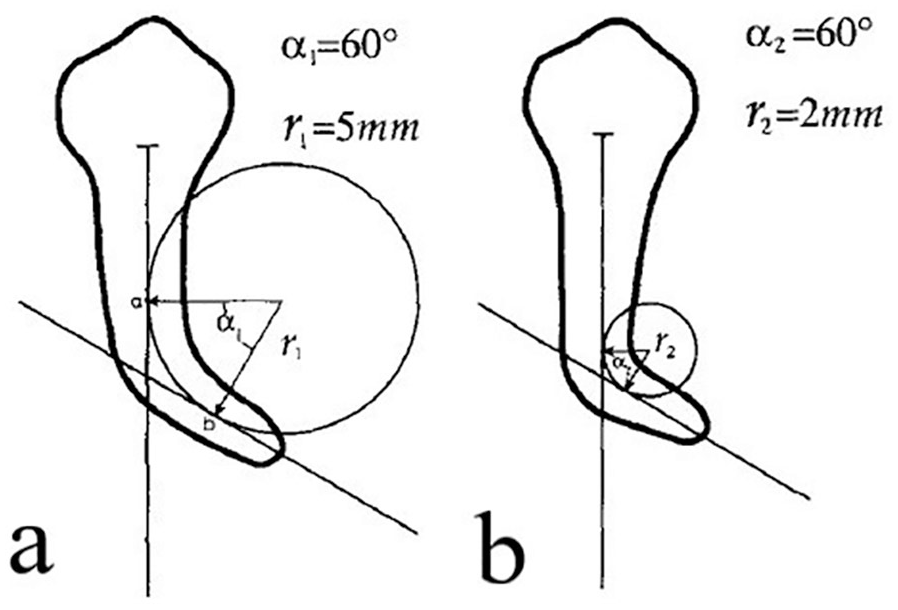
Two-parameter characterization of curved root canals. A straight line is drawn in the direction of the upper section of the root canal (a) and the direction of the root tip (b), respectively. Then, a circle is drawn with a radius of the curvature that is tangent to two straight lines. The angle from the center of the circle to the intersection of the two points is the angle of curvature alpha.

Design of the resin module used in this experiment: (a) the design of the resin root canal, (b) partial enlarged view of the resin root canal, and (c) schematic diagram of the module size.
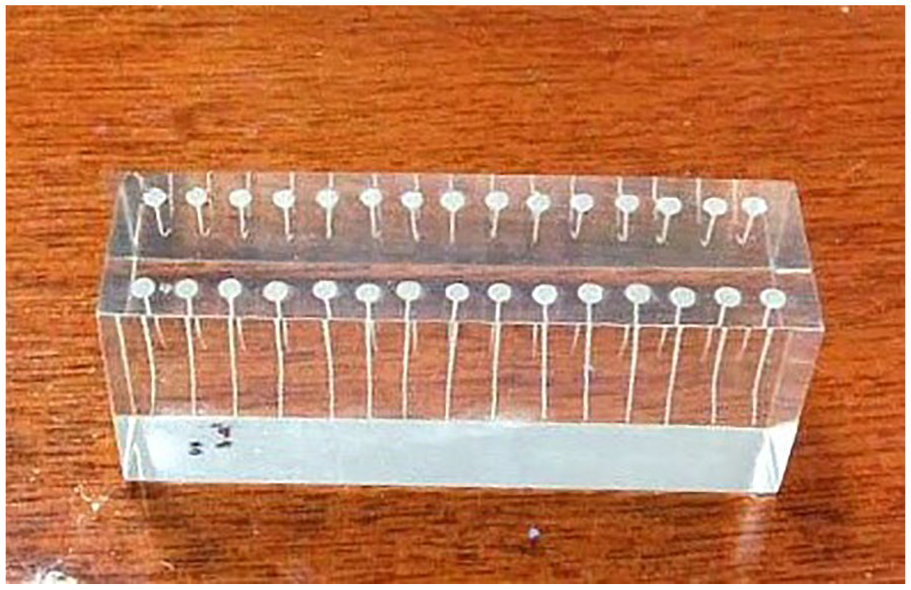
The picture of the finished resin module used in this experiment. The resin module for simulated curved root canals with a total of 30 root canals, divided into two rows. The distance between each root is 5.2 mm, the taper is 0.02, and the length is 18 mm.
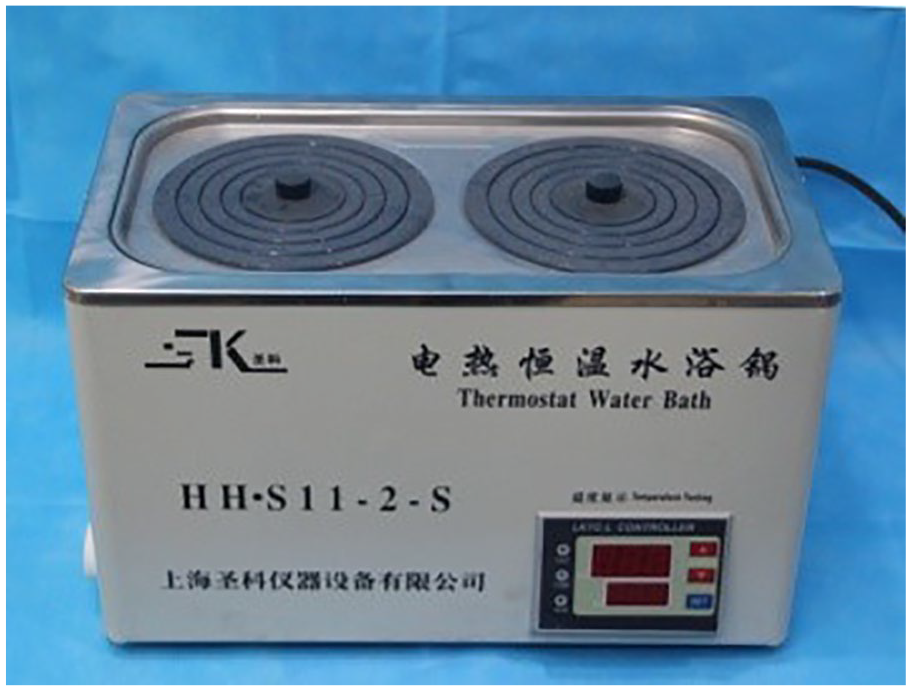
Isothermal water bath box. The water bath box can ensure that water is controlled at the desired temperature, with an accuracy of 0.1°C.

Simulated root canal fracture model: (a) push-pull force gauge reading at 0 N, (b) push-pull force gauge reading at 10 N, and (c) partial enlarged view of the push-pull gauge.
Root canal preparation was performed by a step-by-step method using a PTU F1 nickel-titanium rotary file. The motor was connected to a push-pull force gauge, and each push-pull force gauge reading was 10 N. Flushing began when the tip of the instrument just entered the root canal, and the irrigation device was about 1 cm from the root canal until the root canal was ready. The working time of each instrument entering the root canal was recorded by using a high-precision stopwatch. The motor speed was set to 350 rpm and the torque was 3.0 N cm. The auto-rotation function was enabled. When the set torque was reached, it automatically rotated in the reverse direction and was pulled out, followed by clearing the root canal using a #10 enlarged needle, which ensured smooth passage, and preparation was continued to reach the working length (Figure 6). Then, the next root canal was prepared, and the above operation processes were repeated until fracture of the nickel-titanium file occurred.
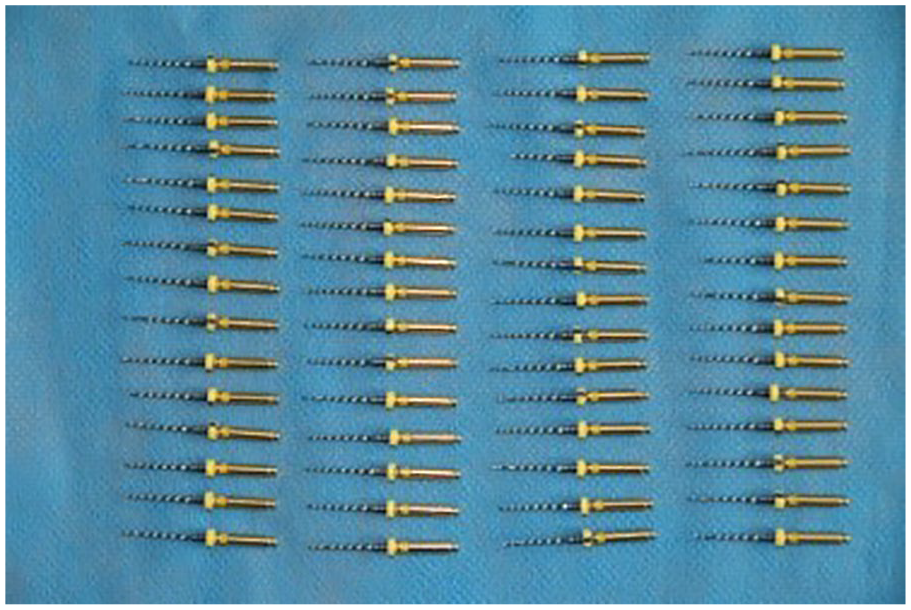
Photograph of PTU F1 nickel-titanium file after fracture.
Sixty PTU F1 nickel-titanium files were randomly divided into three groups according to flushing temperatures: 6°C, 23°C, and 40°C, with 20 files per group. The temperature fluctuation range was kept at about 0.5°C by a thermostat water bath and a refrigerating device (Figure 2). The root canal of the resin module was completely sealed with a transparent tape to avoid interference between the root canals.
The NCF, the number of rotations of each root canal, the number of dredging of each root canal, and the number of lateral perforations were recorded. In addition, the mean number of dredging per file and the proportion of lateral perforation were calculated.
Nickel titanium file had no visible changes before the device was fractured, but different degrees of cracks, pit-like structures, partial protrusions or scratches on the surface of nickel-titanium were observed by scanning electron microscopy (SEM). In order to prevent these defects from affecting the breakage of the device, we carried out SEM to eliminate nickel-titanium device with defects (Figure 7).

Scanning electronic microscopic image of PTU F1 nickel-titanium file before experiment (×20).
Statistical analysis
Statistical analysis was conducted via rank sum test, analysis of variance and chi-square test by using IBM SPSS Statistics v21.0 software (SPSS Inc., Chicago, IL, USA). If α = 0.05, p ⩽ 0.05 indicated statistically significant difference.
Results
The results of the NCF, the mean number of rotations of the instrument in each root canal, and the mean number of dredges per file are shown in Table 1.
Parameter comparison of rotary nickel-titanium files treated by flushing at different temperature (

Comparison of the NCF
The NCF at three temperatures was statistically significantly different (p < 0.01). Pairwise comparison of the NCF of the three groups showed that the differences between any two groups were also statistically significant. Importantly, the NCF at 6°C was higher than that at 23°C, while the NCF at 40°C was the lowest.
The mean number of rotations of the instrument in each root canal
The mean number of rotations of the instrument in each root canal at three temperatures was statistically significant significantly different (p < 0.01). Pairwise comparison of the mean number of rotations of the three groups showed that the difference between groups at 6°C and 23°C, and at 6°C and 40°C was statistically significant. However, the difference between groups at 23°C and 40°C was not statistically significant. In addition, the mean number of rotations of the instrument in each root canal treated by flushing at 6°C was the highest, and at 40°C was the lowest.
Comparison of the number of dredging times when preparing each root canal at three different temperatures
The number of dredging times when preparing each root canal at three different temperatures was statistically significantly different (p < 0.01). Pairwise comparison of the number of dredging times of the three groups revealed statistically significant difference between groups treated by flushing at 6°C and 40°C. However, the difference between groups treated by flushing at 23°C and 40°C, and 23°C and 40°C was not statistically significant. In addition, the number of dredging times at 6°C was higher than that at 40°C.
The counts and proportions of lateral perforations of the root canal at three different temperatures
The number and proportion of lateral perforations of the root canal at three different temperatures were counted and calculated (lateral perforation of the root canal count/total number of prepared root canals). The results are shown in Table 2. There was a statistically significant difference in the rates of lateral perforation of the root canal at the three temperatures (p < 0.01). Pairwise comparison of the number of lateral perforations in the three groups revealed no statistical difference between groups treated by flushing at 6°C and 23°C (p = 0.99). The proportion of lateral perforations treated by flushing at 6°C (0%) was smaller than that at 40°C (12.57%) with statistical difference. The rate of lateral perforations of the root canal treated by flushing at 23°C (1.03%) was smaller than that at 40°C (12.57%) with statistical difference.
The result of lateral perforation of root canal count and proportion at three different temperatures.

Discussion
Root canal preparation is a very important step in root canal treatment. Root canal preparation instruments include stainless steel instruments and machine-use rotary nickel-titanium files. Nitinol files have been widely used in root canal treatment because of their super elasticity and mechanical flexibility. 9 Especially compared with manual stainless-steel instruments, machine-used nickel-titanium files can significantly improve the quality and efficiency of root canal treatment, so they are increasingly favored by dentists. 10 However, machine-used nickel-titanium files are more prone to instrument separation than traditional stainless-steel instruments 11 and the breakage rate is significantly higher than that of stainless-steel instruments. 12
Fracture occurs in nickel-titanium instruments and mainly manifests as torsional fracture and cyclic fatigue. Torsional fracture occurs when the lower part of the instrument is locked by the narrow section of the root canal while the upper part is still rotating. When elastic deformation of the instrument exceeds the elastic limit of nickel-titanium alloy, torsion breaks mostly occur in small instruments and instruments. The tip is often accompanied by a phenomenon “unspinning” which is opposite to the original thread. Torsion and bending fatigue fracture are the fracture of metal fatigue caused by tensile stress and compressive stress repeatedly applied to the bending part of the root canal. Fatigue causes structural changes in the alloy, but no abnormal signs of thread can be observed before fracture. A previous study has only estimated the bending cyclic fatigue fracture of nickel-titanium instruments, that is, the experiment was carried out using curved metal root canals, the nickel-titanium instruments were repeatedly subjected to tensile stress and compressive stress, which finally led to fracture.13,14 In this experiment, the resin module of the simulated curved root canal was applied, and the nickel-titanium file has both types of fractures when preparing the resin module. In addition, the curvature, taper and length of the resin module for simulating curved root canals are close to most clinical root canals, so the module can simulate clinical root canals to the greatest extent. Our previous research has found that the fracture length of the nickel-titanium files in the resin module of the simulated curved root canal is all in the apical area at 0–3 mm, which is the curved portion of the root canal, and more than 90% of the fracture ends of nickel-titanium files were twisted and deformed. 15 The results indicated that the fracture of nickel-titanium files in the simulated curved root canal resin module is mainly caused by torsional fatigue. Further experiments should be carried out to study the fracture of nickel-titanium files during the preparation of the straight root canal resin module.
The results of this study showed that the temperature has a significant effect on the NCF of nickel-titanium files, which increases with the increase of temperature. This indicates that nickel-titanium files have higher fatigue resistance and longer service life when flushing at 40°C than flushing at lower temperature. A previous study has shown that the fatigue properties of nickel-titanium alloys are sensitive to both local and ambient temperatures. 16 When the flushing temperature is high, the nickel-titanium alloy may be more inclined to transition to the austenite phase, and the material morphology is more stable, exhibiting greater hardness. 17 As the nitinol file shows more torsional fatigue fractures during the preparation of resin root canals, greater hardness at higher temperatures makes it better to resist fatigue fractures. 18 In addition, when the apical segment of the root canal is prepared, the files can pass through the canal smoothly without getting stuck in the canal wall. At lower temperatures, nickel-titanium alloys tend to transform into the martensite phase, have good plasticity, and are softer. Therefore, during flushing at a low temperature, although the nickel-titanium file can pass smoothly through the curvature of the root canal, it is more likely to get stuck by the apical segment with a smaller diameter, and the instrument fractures more frequently. It takes a longer time to prepare a root canal in the lower temperature group than the higher temperature group. This may be due to the relatively soft performance of nitinol files at low temperatures, lower cutting efficiency, and more rotations for preparing the root canal.
As shown in Table 2, the lateral penetration (Figure 8) rate of the nickel-titanium file in the 40°C group reached 12.57%, which was significantly higher than that of the other two groups, and more of them occurred at the curvature of the root canal. This may be because the nickel-titanium files are harder at high temperatures, and the tip of the instrument is not easy to pass through the curvature of the root canal in the original direction, resulting in lateral perforation. It was found that more dredging was needed during high-temperature flushing, which also indicated that the nickel-titanium file was more likely to deviate from the original direction of the root canal during high-temperature flushing.

Lateral penetration of the file.
The breakage frequency of nickel-titanium instrument is subjected to the experience and proficiency of the operator. Inexperienced operators have a much higher breakage rate than experienced ones.19,20 Nickel-titanium rotary instruments have a tendency to enter and cut root canals, causing large torques when they are embedded in the root canal. 21 This is consistent with the study by Di Fiore. 22 The proficiency, strength and angle of dentists using nickel-titanium files are closely related to the risk of fracture, and more skilled clinical experts can ensure the standardization and consistency of each operation. 23 A previous study 24 has shown that when operators are aware of the possibility of instrument fractures and take measures to avoid them, the incidence of fracture can be as low as 4/1000.
Therefore, dentists who had 2 years of clinical experience in the use of nickel titanium files participated in this study. The same person prepared the root canal throughout the experiment. The direction of the nickel-titanium file should be the same as the direction of the upper section of the root canal in each preparation. When the set torque was reached, the nickel-titanium file was immediately pulled out, and the motor automatically rotated in reverse to protect the file. If the file did not reach the torque and rotated staying where it was, it should be pulled out to ensure that the file did not rotate for more than 2 s in the same place. Yoshimine et al. 25 recommends that the file be pushed hard when preparing the 1/3 of the apex. It is better to use a gentle up and down insertion method to prevent the instrument from staying at a position.
Heat resistance of the simulated curved root canal resin module was investigated, and we found that when its heat distortion temperature was 85°C, the glass transition temperature was 90°C, and its elastic modulus dropped sharply after the glass transition temperature was reached. The performance of the resin module was stable at our experimental temperature and had no effect on the results.
In general, when the water flow was at 40°C, nickel-titanium file can prepare more root canals. The instrument was not easy to break. However, the root canals were prone to lateral perforation when the water flow was at 40°C. Therefore, when rotary nickel-titanium files are used for the preparation of the root canal, water flow is recommended to be set close to normal temperature, which ensures that the maximum number of root canals can be achieved, and the probability of lateral perforation can be reduced. Water flushing at normal temperature can prepare more root canals, reducing the number of liftings reaching the working length, and decreasing the steps of external wiping and frustration, as well as shortening the time for clinical preparation of root canals; thus, it can save costs. Therefore, nickel-titanium rotary instruments can be equipped with a water hole as the dental handpiece in the future, which can reduce the frequency of use of nickel-titanium file, saving time and cost. In the future, the impact of flushing flow on nickel-titanium file will be investigated.
Conclusion
The resin-simulated curved root canal can well complete the root canal preparation experiment. Nickel-titanium files treated by flushing at 23°C can prepare more root canals and prolong the life of nickel-titanium files than flushing at 6°C. When flushing is done at 40°C, the number of root canals prepared by nickel-titanium files is the highest, and it is not easy to break the instrument, but lateral perforation occurs easily during root canal preparation.
Footnotes
Acknowledgements
The authors acknowledge Feixiang County Ruyi Arts & Crafts Co., Ltd. (Taiwan Enterprise Mainland Co.) for cooperating with the simulation of curved root canal resin modules and Shanghai Yirui Dental Materials Co., Ltd. We also acknowledge Shenzhen Yujia Medical Devices Co., Ltd. for providing materials and device.
Declaration of conflicting interests
The author(s) declared no potential conflicts of interest with respect to the research, authorship, and/or publication of this article.
Funding
The author(s) disclosed receipt of the following financial support for the research, authorship, and/or publication of this article: This research was supported by Capital Clinical Application Research and Results Promotion Project (Z171100001017154), General Hospital Transformation Project (2017TM-030), General Hospital Clinical Research Supporting Fund (2018FC-304M-TSYS-05), and Capital’s Funds for Health Improvement and Research (CFH2020-2-5021).
