




Abstract
Objective:
To evaluat
Methods:
A standardized cyclic fatigue test models were established, and five types of nickel-titanium instruments (PTU F1, WO, WOG, RE, and M3) were applied. Each instrument was randomly divided into two groups (N = 12). There was synchronous water irrigation in the experimental group, and no water irrigation in the control group. Besides, ProTaper Universal F1 was randomly divided into 10 groups (N = 20). In the static group, nickel-titanium instruments were divided into one control group (no irrigation, N = 20) and six experimental group (irrigation, N = 20) based on different flow rate, angle and position; while in the dynamic group, instruments were divided into one control group (no irrigation, N = 20) and two experimental group (irrigation, N = 20) based on different flow rate. The rotation time (Time to Failure, TtF) of instruments was recorded and analyzed.
Results:
According to the static experiments, the TtF of instruments in all experimental groups was significantly higher than that in the static control group. Besides, the dynamic tests of PTU F1 showed that the TtF in the experimental group was significantly higher than that in the dynamic control group. Compared with control group, the TtF in the experimental groups increased by at least about 30% and up to 160%. The static and dynamic tests of PTU F1 showed that the TtF of nickel-titanium instrument in all experimental groups was significantly higher than that in the control group. However, there was no significant difference between any two experimental groups.
Conclusion:
Regardless of dynamic or static model, TtF with irrigation was longer than that with non-irrigation, indicating that synchronous irrigation can increase the fatigue resistance of nickel-titanium instrument. However, different irrigation conditions may have the same effect on the fatigue resistance.
Keywords
Introduction
Root canal therapy (RCT) has been the best method for pulpal disease and periapical disease. Because of the complexity of the root canal system, the fracture of instrument needle (separation of instruments) in RCT (preparation) is considered as the one of the most common challenging complications. Compared with stainless steel instruments, mechanical nickel-titanium instruments are widely used because of their appropriate shaping and cleaning ability in curved root canal preparation. Thus, the fracture of mechanical nickel-titanium instruments in RCT usually occurs.1,2 It is very difficult for clinicians to decide whether or not to remove the broken instrument in the root canal: if it is to be taken out, it is time-consuming and difficult to perform. It is certain that there will be one or more new severe complications, such as lateral root canal puncture, longitudinal root fracture, step formation, re-separation of instruments, and flow of separation instruments into other root canals, etc. 3 If not, infection under the break needle may be difficult to remove, especially when there is an existing lesion in the root tip, which may lead to a higher failure rate.1,2
Therefore, it is very important to prevent separation of instruments. There are a variety of methods for preventing separation of nickel-titanium instruments: (1) improving the material of nickel-titanium instruments (e.g. cross-section), heat treatment, surface treatment (vapor deposition and ion implantation), and electrolytic polishing; (2) reducing the frequency of use of nickel-titanium instruments; (3) establishing a straight path; (4) choosing suitable torque preparation; and (5) use of lubricant (e.g. EDTA). Although technological advance has improved fatigue resistance and safety of nickel-titanium instruments, these above methods also have the following disadvantages: increased cost, violation of the minimally invasive principle, reduced operating efficiency, and environmental pollution.
During clinical operation, our team found that synchronous irrigation during root canal preparation could lead to improved efficiency of a mechanical nickel-titanium instrument, and reduce the breaking rate under the condition that the frequency of use remains unchanged. We conducted experiments using the resin root canal model,4,5 and the results were consistent with the above clinical observations. Therefore, we hypothesized that synchronous irrigation of nickel-titanium instrument may improve its cyclic fatigue resistance. However, the relevant experimental results of other scholars showed that the fatigue resistance of rotary nickel-titanium instrument with liquid irrigation was weakened in the previous cyclic fatigue test model, which is contrary to our hypothesis. 6 Herein, our study aimed to establish the dynamic and static cyclic fatigue test model of synchronous water irrigation of rotary nickel-titanium instrument, and evaluate fatigue resistance of nickel-titanium instrument under non-irrigation and irrigation conditions.
Materials and methods
Materials and Instruments
X·smart plus machine nickel-titanium motor equipment (Dentsply, USA), five types of nickel-titanium instruments (Table 1), water pump system or irrigation device (CHIROPRO L, Bien Air, Switzerland), constant temperature water bath (Changzhou Longyue instrument Manufacturing Co., Ltd.), thermometer (Mei De Shi instrument Co., Ltd., China), nickel-titanium instrument cycle fatigue test model (Changzhou Yi Rui Medical Equipment Co., Ltd., China), and distilled water, etc.
Material information of five type of instruments.

Methods
A closed experimental environment was built, and the experiment began when the temperature reached 24°C. The X-Smart plus parameters were set to uniform conditions in this model. The nickel-titanium instrument entered the metal model 20 mm, in which it can rotate freely.
In this study, we established a nickel-titanium file cyclic fatigue test model using metal root canals, X-Smart plus, constant temperature water bath, and water pump system (Figure 1). The metal root canal is made of stainless steel, with a diameter of 2 mm, a curvature angle of 60°, and a radius of curvature of 6 mm. Metal root canals can be semi- or completely closed. The motor handle can be fixed, and the fixed handle part can be moved to make reciprocating movement of the nickel-titanium instrument in and out of the metal root canal. In the static experiment, the nickel-titanium instrument had no axial displacement while the nickel-titanium instrument produced 7 mm reset in the axial direction in the dynamic experiment, that is, the nickel-titanium instrument completed the repeated lifting-entering movement in the metal root canal, and kept a certain part of the nickel-titanium instrument constantly in a bent state (Figure 2).

Dynamic and static cyclic fatigue test model of rotary nickel-titanium instrument under irrigation condition.
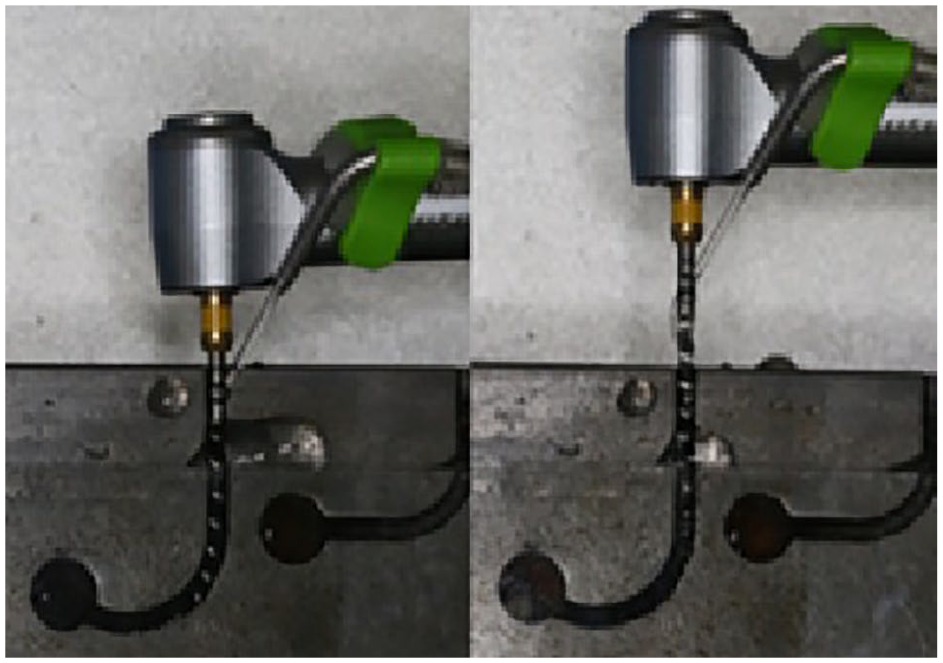
Two irrigation angles: 15° (left) and 90° (right).
Effect of irrigation on the cyclic fatigue of different types of nickel-titanium instrument
In this study, five different nickel-titanium instruments (PTU F1, WO, WOG, RE, M3) were used to conduct experiments using the established nickel-titanium instrument cyclic fatigue test model. The experimental group was flushed with distilled water while the control group was not. All five types of nickel-titanium instruments were tested in the static experiment. The irrigation position was located at the maximum bending point of the nickel-titanium instrument, the angle between the flow and the needle was 15°, and the flow rate was set to 25 mL/min. In addition, PTU F1 also required dynamic experiment. The location of irrigation was close to the root canal orifice, and the irrigation angle and flow rate were the same as those in the static tests. Herein, the time to failure (TtF) in dynamic and static status from rotation to fracture of nickel-titanium instrument in the metal root canal was recorded, which was the time of cyclic fatigue test. The longer the TtF is, the better the fatigue resistance is. The sample size for each group was set to 12.
Effect of different conditions of irrigation on the cyclic fatigue of PTU F1
The cyclic fatigue of nickel-titanium instrument PTU F1 was evaluated using the established model based on the different conditions of irrigation position, angle and flow rate (Figures 3 and 4). PTU F1 was tested in the static and dynamic experiments, and the TtF was recorded. The sample size for each group was set to 20.

Two irrigation positions: maximum bend (top) and root canal orifice (bottom).

ABC three-point fixed motor handle: overall (left) and local (right).
Static experimental groups
According to the different conditions of irrigation position, angle and flow rate, the static groups were divided into the following groups (Figure 5): At the maximum bending of the nickel-titanium instrument, the angle between the flow and the needle was 15° (as parallel as possible), and the flow rate was 25 mL/min (group A) or 140 mL/min (group B). At the maximum bending of the nickel-titanium instrument, the angle between the flow and the needle was 90° (as vertical as possible), and the flow rate was 25 mL/min (group C) or 140 mL/min (group D). Close to the root canal orifice, the angle between the flow and the needle was 15° (as parallel as possible), and the flow rate was 25 mL/min (group E) or 140 mL/min (group F). In group G, during the rotation of curved root canal, the nickel-titanium instrument did not displace axially and the irrigation device did not flush the nickel-titanium instrument. This group was defined as the static control group.

The nickel-titanium instrument produces 5 mm in the axial direction and moves to the reset position in the dynamic experiment.
Dynamic experimental groups
According to the different conditions of flow rate, the dynamic groups were set as follows (Figure 5): The outlet is fixed at the end of the nickel-titanium instrument clamped by the motor, and keeps 15° with the nickel-titanium instrument, the flow rate was 25 mL/min (group H) or 140 mL/min (group I). In group J, during the rotation of curved root canal, the nickel-titanium instrument was displaced 7 mm in the axial direction, and the irrigation device did not flush the nickel-titanium instrument. This group was defined as the dynamic control group.
Exclusion criteria
The surface of the nickel-titanium instrument was observed using a microscope, and the photographs were archived. If the following defects appeared on the surface, they were eliminated: (1) different degrees of cracks; (2) pits; and (3) partial protrusions or scratches on the surface of the instrument. The nickel-titanium instruments were numbered and grouped randomly.
Statistical analysis
The SPSS 21.0 software was used for statistical analysis. Kolmogorov–Smirnov test was used to examine whether the data conformed to normal distribution, and Levene’s test was used to examine the variance of data. The measurement data were described with mean ± standard deviation (SD). The difference between two groups was tested by independent sample t-test, and one-way ANOVA method was used for comparison among groups. A value of p < 0.05 was considered significant.
Results
Comparison of TtF among different types of nickel-titanium instruments under non-irrigation and irrigation condition
Based on the established nickel-titanium instrument cyclic fatigue test model, the cyclic fatigue of five different nickel-titanium instruments was tested, including PTU F1, WO, WOG, RE, and M3. In the static experiments, the TtF of nickel-titanium instruments in all experimental groups were significantly higher than that in the static control group (p < 0.01). Besides, the dynamic tests of PTU F1 showed that the TtF of PTU F1 in the experimental group was significantly higher than that in the dynamic control group (p < 0.001)(Tables 2 and 3). The TtF of the experimental group was 1.24–2.60 times that of the control group, with a median of 1.295.
TtF of nickel-titanium instruments in static group with different irrigation conditions (x ± s, n = 20).

Comparison of one-way ANOVA between groups (F = 9.993, p < 0.01).
Comparison of p values between groups with different static irrigation conditions.
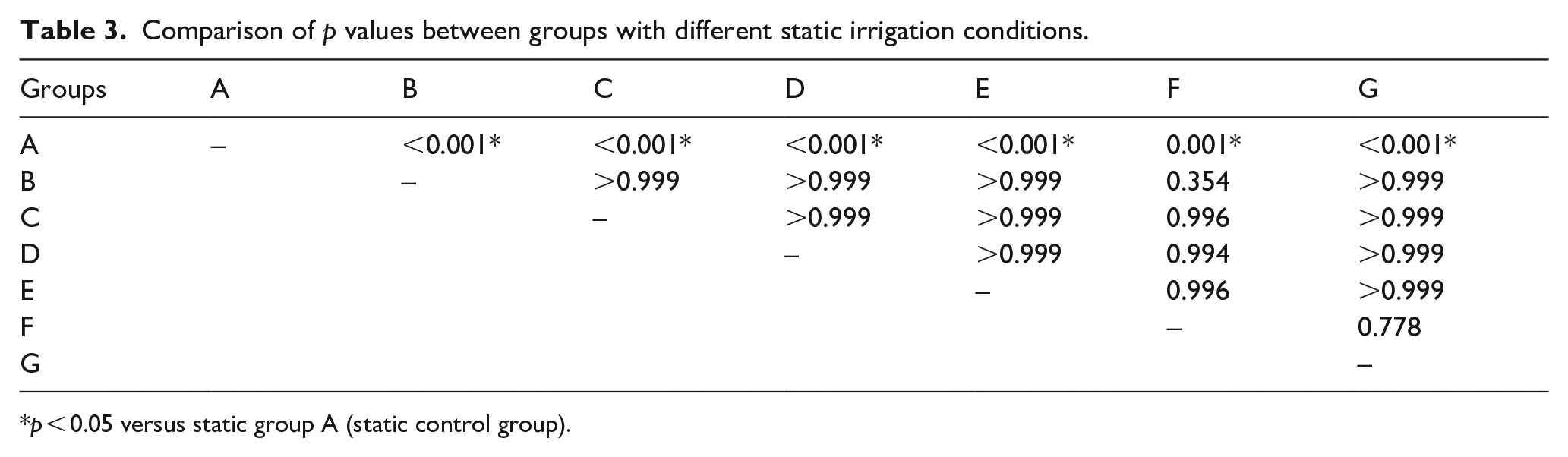
p < 0.05 versus static group A (static control group).
Comparison of TtF of PTU F1 among different conditions of irrigation
The analysis of seven groups of static TtF (experimental A-F and control G) of PTU F1 showed that the data conformed to the normal distribution and the variance was uniform. One-way analysis of variance showed that F = 10.305, p < 0.001, indicating that the overall mean of the seven groups of data was not the same. Bonferroni multiple comparison results showed that the TtF of nickel-titanium instruments in all the experimental groups (group A-F) were significantly higher than that in static control group (group G)(p < 0.01). The average value and 95% confidence interval of each group are shown in Figure 6. However, the results showed no significant difference between any two experimental groups (p > 0.05). Under different single irrigation condition, the comparison between the two experimental groups are showed in Tables 4 to 6.

TtF error bar diagram of nickel-titanium instruments under different irrigation conditions in static group.
TtF of nickel-titanium instruments in dynamic group with different irrigation flow rate (x ± s, n = 20).

Comparison of one-way ANOVA between groups (F < 19.362, p < 0.01).
Comparison of p values between dynamic irrigation flow groups.

p < 0.05 versus dynamic group A (static control group).
Comparison of TtF between dynamic A group and static G group.

The comparison between the two groups was adjusted by Tamhane’s test.
p < 0.05 versus dynamic group A (static control group).
In this study, the results of three groups of dynamic TtF (experimental H-I and control J) of PTU F1 showed that the data conformed to the normal distribution and the variance was not uniform. Besides, one-way analysis of variance showed that F = 19.362, p < 0.001, indicating that the overall mean of the seven groups of data was not the same. Tamhane multiple comparison results showed the TtF of nickel-titanium instrument in all the experimental groups (group H and I) were significantly higher than that in dynamic control group (group J) (p < 0.01). The average value and 95% confidence interval of each group are shown in Figure 7. There was also no significant difference between the two dynamic experimental groups (p > 0.05). Under different single irrigation condition, the comparison between the two experimental groups are showed in Table 5.

TtF error bar diagram of nickel-titanium instruments with different irrigation flow rate in dynamic group.
Discussion
Currently, it is considered that cyclic (cyclic bending) fatigue fracture and torsional fatigue fracture are the two main forms of fracture of nickel-titanium instrument during root canal preparation. The cyclic fatigue fracture of rotary nickel-titanium instrument of our experiment is that the instrument rotates freely until it is broken in the curved pipe, and the breaking part is usually the maximum bending portion (curvature point) of the pipe. It is generally caused by excessive use (fatigue) of metal alloys. 7
According to our assumptions, the purpose of this study was to find a way to improve the fatigue resistance of any type of nickel-titanium instruments by adjusting the preparation conditions and without changing the existing root canal preparation steps. We tried to make it possible to increase the frequency of use of nickel-titanium instruments or reduce the breaking rate under the same frequency of use. Therefore, we established a synchronous water flushing cycle fatigue test model to explore whether synchronous water flushing can improve the fatigue performance of the nickel-titanium instruments and prolong its life.
In this study, the TtF of the five nickel-titanium instruments in the static experimental groups was significantly longer than that in the static control group, and similar results were also observed in the dynamic tests of PTU F1. Besides, the TtF of the experimental groups increased by at least about 30% and up to 160% compared with the control group. Thus, it was confirmed that the synchronous irrigation could prolong the TtF of rotating nickel-titanium instrument, and improve its resistance to cyclic fatigue.
The fatigue feature of nickel-titanium alloy is sensitive to local and ambient temperature. 8 In the process of curved root canal rotation, when the irrigation device does not rinse the nickel-titanium instrument, the maximum bending is subjected to tensile-compressive stress, and the heat generated can increase the local temperature. As a result, the nickel-titanium alloy has the trend of transformation from phase M to phase A, and stiffness increases, so it is not easy to bend and deform, increase the fatigue crack growth rate and reduce the fatigue life of nickel-titanium instrument. 9 When the irrigation device flushes the nickel-titanium instrument, all the water flow will be washed directly or indirectly to the tension-compression stress concentration area of the nickel-titanium instrument, which plays the role of cooling and heat absorption. It generates the trend of transition from phase A to phase M in nickel-titanium alloy, decreased stiffness and higher flexibility, and reduced fatigue crack growth rate. In addition to cooling, irrigation will also play a lubricating role. When there is no water, the nickel-titanium instrument is in direct contact with the metal model surface, and the friction coefficient is large. When there is water, water plays a lubricating role between the nickel-titanium instrument and the metal model surface; hence, the friction coefficient decreases. According to the friction force formula: F = µ × Fn, when Fn is constant, µ (friction coefficient) decreases, resulting in a reduction in frictional force, thereby leading to a reduction in heat production. Therefore, when the nickel-titanium instrument rotates, irrigation will play a role in cooling and lubrication. Cooling will directly absorb heat and lubrication will indirectly reduce the heat produced, inhibit the increase of temperature from two aspects, and improve the fatigue resistance of nickel-titanium instrument. Cheung et al. found the ProFile nickel-titanium instrument was exposed to air at 23°C ± 2°C and infiltrated in deionized water for cyclic fatigue test, and the number of rotations of ProFile before breaking was recorded (number of cyclic fracture, NCF). NCF was positively correlated with TtF, but these results showed that the NCF of the deionized water group was smaller than that of the air group, which was contrary to the results of this study. The reason may be related with the liquid in this experiment, and the heat generated by the rotation of the nickel-titanium instrument will increase the local temperature of the liquid, which cannot effectively and continuously cool the nickel-titanium instrument. 6 In addition, we believe that the cyclic fatigue test model established in this experiment is also easier to achieve in clinical practice.
Meanwhile, the dynamic tests of PTU F1 showed that the TtF of PTU F1 in the experimental group was significantly higher than that in the dynamic control group. This result may be due to the fact that in the static experiment, the nickel-titanium instrument had no axial movement, and the compression and tensile stresses were concentrated in the same position of the nickel-titanium instrument, resulting in the change of microstructure, the formation of microcracks and the final fatigue fracture. In the dynamic experiment, due to the axial movement (7 mm) of the nickel-titanium instrument, the cyclic compression and tensile stress was distributed along the spiral cone of the nickel-titanium instrument in a section of its axial repeatedly passing through the maximum bending. Theoretically, there are countless points in a region that will bear cyclic fatigue in turn, and the TtF of a certain fixed point should be larger than that of a fixed point which has been subjected to cyclic fatigue. This result suggested synchronous irrigation can improve the fatigue resistance of nickel-titanium instrument. Therefore, in clinical preparation of curved root canal, synchronous water irrigation while keeping the nickel-titanium file repeatedly pull-in motion can effectively improve its fatigue resistance and delay the occurrence of fracture.
In addition, we used PTU F1 to conduct experiments with different conditions of irrigation, and the TtF in all experimental groups was significantly longer than that in control group. These results suggested that all conditions within the controllable range of this experiment could improve the resistance of nickel-titanium instrument to cyclic fatigue. However, there was no significant difference between any two experimental groups, indicating that different flushing conditions may have the same effect on the cyclic fatigue of the nickel-titanium instrument. The reason may be that no matter how the flow reaches the maximum bending point of instrument under different conditions in the experiment, the flow rate for cooling and lubrication is greater than the minimum effective flow rate required here. Although the flow rate increases and more heat can be absorbed, the temperature at the maximum bending point should not be lower than the water temperature due to the constant heat production. In particular, the dynamic experiment of irrigating the root canal (simulated clinical) showed that both larger flow rate (140 mL/min) and smaller flow rate (25 mL/min) could improve the fatigue resistance of the nickel-titanium instrument and have the same effect. It is suggested that a small flow rate may have a guiding significance for clinical operation, which not only saves resources, but also does not hinder the visual field of operation due to splashing.
In conclusion, five different nickel-titanium files were applied, and all reached a similar conclusion. These results suggested that for the same type of nickel-titanium instrument, when rotating in a curved root canal, the breaking time of the nickel-titanium instrument with synchronous water irrigation is increased by about 30% compared with that without synchronous water irrigation. Nickel-titanium instrument with synchronous water irrigation in curved root canal may have the following advantages: (1) It reduces the original fracture rate of nickel-titanium instrument; (2) It improves the use frequency of nickel-titanium instrument, saves resources, and protects the environment; (3) It allows root canal preparation and root canal cleaning and disinfection to be carried out at the same time, thereby improving the operation efficiency; and (4) It reduces the cost of treatment. All the above mentioned features are expected to have a positive impact on clinical practice.
Footnotes
Acknowledgements
The authors thank the UDG-United Dental Group for their technical support, especially for the establishment of cyclic fatigue model.
Declaration of conflicting interests
The author(s) declared no potential conflicts of interest with respect to the research, authorship, and/or publication of this article.
Funding
The author(s) disclosed receipt of the following financial support for the research, authorship, and/or publication of this article: This research was supported by Capital Clinical Application Research and Results Promotion Project (No. Z171100001017154), General Hospital Transformation Project (2017TM-030), General Hospital Clinical Research Supporting Fund (2018FC-304M-TSYS-05) and Capital’s Funds for Health Improvement and Research (No. CFH2020-2-5021)
