




Abstract
Introduction:
The aim of the present study was to investigate how different aging protocols can affect the flexural strength and phase transformations of yttrium-stabilized zirconia ceramics (Y-TZP) for monolithic restorations.
Materials and methods:
Bar-shaped specimens from two zirconia ceramics bars were divided into three groups: a. no treatment (c), b. aging in an autoclave (a), and c. thermal cycling (t). The flexural strength was determined by the 3-point bending test and statistical analysis was performed to determine significant differences (p< 0.05). Weibull statistics was used to analyze the dispersion of strength values while surface microstructural analysis was performed through X-ray diffraction analysis (XRD), Fourier transform infrared spectroscopy (FTIR), and scanning electron microscopy (SEM).
Results:
Aging did not significantly affect the flexural strength but differences were recorded between the two groups, with group A presenting higher strength values and m-phase percentages.
Conclusions:
The observed differences between the two ceramics could be attributed to variations in composition and processing.
Introduction
Zirconia ceramics present improved mechanical properties; however, they are susceptible to low temperature degradation (LTD), known as aging [1]. This degradation occurs through the progressive transformation of the tetragonal phase, which is thermodynamically unstable at room temperature to the stable monoclinic phase of zirconia (t→m transformation). While a restricted transformation acts as a toughening mechanism resisting crack propagation [2,3], exaggerated transformation leads to premature aging.
The biggest clinical disadvantage of zirconia restorations is chipping or delamination of the veneering layer, which has led to the concept of full contour, monolithic zirconia restorations [4]. However, in order to create zirconia that is suitable for full-contour restorations, changes in composition, structure, and grain size have led to new materials for which only limited data exist regarding LTD. Factors such as time and sintering temperature, grain size and shape, presence of oxygen vacancies, etc. affect the rate of transformation during aging [1,5]. These factors vary greatly in the different commercial monolithic zirconia ceramics, leading to different resistance to LTD [6,7]. Therefore, there is a compelling need to evaluate the behavior of different monolithic zirconia ceramics, when submitted to aging protocols that simulate oral cavity conditions.
The present study aimed at investigating how different aging protocols affect the flexural strength and phase transformations of two monolithic Y-TZP ceramics. The research hypotheses were: 1. in-vitro autoclave aging or thermal cycling would not affect the flexural strength of the monolithic zirconia specimens; 2. the flexural strength between the two zirconia ceramics would not differ before and after in-vitro autoclave aging or thermal cycling; 3. the flexural strength would not differ after different aging protocols.
Materials and methods
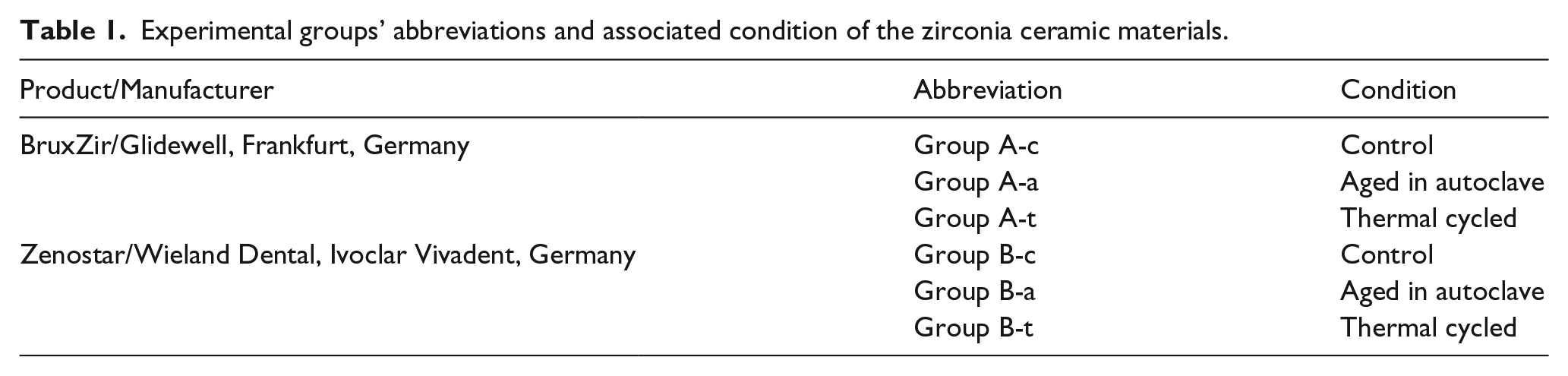
Ninety bar-shaped specimens (4 × 2 × 25 mm) were manufactured from two pre-sintered zirconia blocks (group A: BruxZir, group B: Zenostar). After sintering, the specimens were divided into 3 subgroups (n = 15) (Table 1): a. control, b. autoclave (KavoKlave 2100, KavoDental) at 121°C and 2 bars pressure for 1 hour. One-hour autoclave aging corresponds to 3–4 years of clinical use [8], c. thermal cycling in four different temperature baths (5°C, −37°C, −55°C, and −37°C), with a dwell time of 15 seconds. The number of performed cycles was 22,500, corresponding to 90,000 temperature changes. According to Gale and Darvell [9], up to 50 temperature changes can be observed in the oral cavity per day, leading to a maximum of 18,250 temperature changes per year. Accordingly, the estimated in-vivo time of the protocol utilized is approximately 4.9 years.
Experimental groups’ abbreviations and associated condition of the zirconia ceramic materials.
The flexural strength was evaluated with the 3-point bending test, at a crosshead speed of 1 mm/min. Mean values were calculated using the following equation:

where P is the fracture load in Newton; l is the length of the supporting rollers; w is the width and b the thickness of the specimen, all in millimeters.
Two-way ANOVA (a = 0.05) was applied to reveal the presence of statistically significant differences among the experimental groups, along with Bonferroni multiple comparison tests. The assumption of normality and variances’ homogeneity were tested with the Shapiro–Wilk test and the Levene’s test for equality of variances, respectively. Weibull statistics were used to calculate the Weibull modulus (m) and the characteristic strength (σ0).
Subsequent to the 3-point bending test, three specimens of each group were selected according to their strength values (minimum, mean, maximum) for the investigation of surface microstructure through XRD, FTIR, and SEM. XRD calculations were performed using a θ-2θ diffractometer (PW1710; Philips, The Netherlands) with Ni-filtered Cu–Kα radiation. Diffractograms were obtained from 3° −53° 2θ at a scan speed of 1,2°/min. The monoclinic phase percentage was calculated as proposed by Garvie and Nicholson [10]:

where IT and IM correspond to the intensity of the tetragonal (101) and monoclinic (111) and (11
Results
The mean flexural strength values ranged from 713.7 to 922.3 MPa, with the lowest value recorded for the B-a specimens (Table 2). Only the “material” factor significantly affected the flexural strength (Table 3). Group A ceramics (894.3 ± 227.8 MPa) showed significantly higher values than group B (754.8 ± 188.5 MPa).
Descriptive statistics of the flexural strength values in MPa.

Two-way ANOVA analysis of the flexural strength values.

: p<0.01.
A slight decrease in m was observed for group A aged specimens (group A-a) compared to their respective control (group A-c), although σ0 was higher (Figure 1). A considerable increase in m was recorded for group A thermal cycled specimens (group A-t), as well as group B autoclave aged (group B-a), and thermal cycled specimens (group B-t), without remarkable differences in σ0.

The Weibull modulus (m) and characteristic strength (σ0) of the recorded flexural strength values.
X-ray diffraction analysis showed that group B specimens presented almost no m-ZrO2 content (Xm), while group A presented low m-ZrO2 content in all cases (Table 4). To clearly reveal the peaks corresponding to the t- and m-ZrO2 phases, the XRD patterns present only the areas between 26–36 2θ degrees (Figure 2). On the XRD patterns of the Group A specimens a weak reflection assigned to the m-ZrO2 is clearly observed at 2θ = 28, 213° (−111). The highest amount of m-ZrO2 was recorded for the specimens with the lowest flexural strength. FTIR spectra of group B specimens do not display any peaks assigned to the m-ZrO2, while those of group A present new peaks at 265, 350, 440, 515, and 586 cm−1 assigned to the m-ZrO2 [11–14], suggesting a more pronounced development after both autoclave aging and thermal cycling (Figure 3).
Monoclinic (Xm) and tetragonal (Xt) phase percentage (% wt) of representative specimens from all groups.


XRD patterns of representative specimens of low, medium, and high flexural strength from both groups. Top: Group A. Bottom: Group B.

FTIR spectra of representative specimens from all groups.
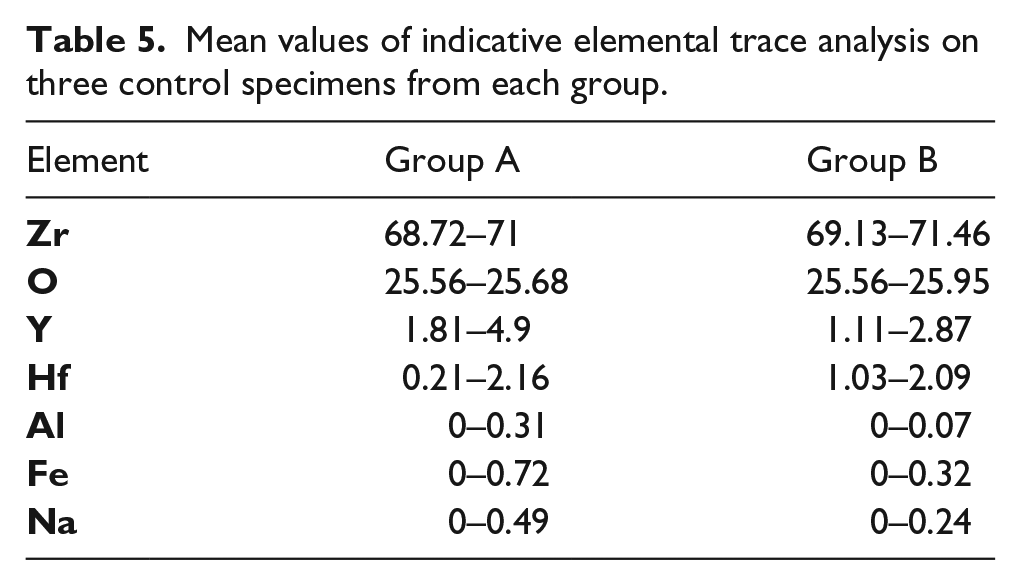
Fractographic analysis revealed more distinct cantilever curls on the opposite side of the origin of fracture, as well as more evident mirror zone and hackled lines on the specimens of highest strength (Figure 4). Pores and impurities were present in both groups, while the fracture origin was clear in most cases (arrows, Figure 5). Minor elemental differences were revealed by EDS (Table 5).

SEM microphotographs of fractured surfaces. Left: Group A-c4 (low flexural strength), Right: Group A-c7 (high flexural strength).
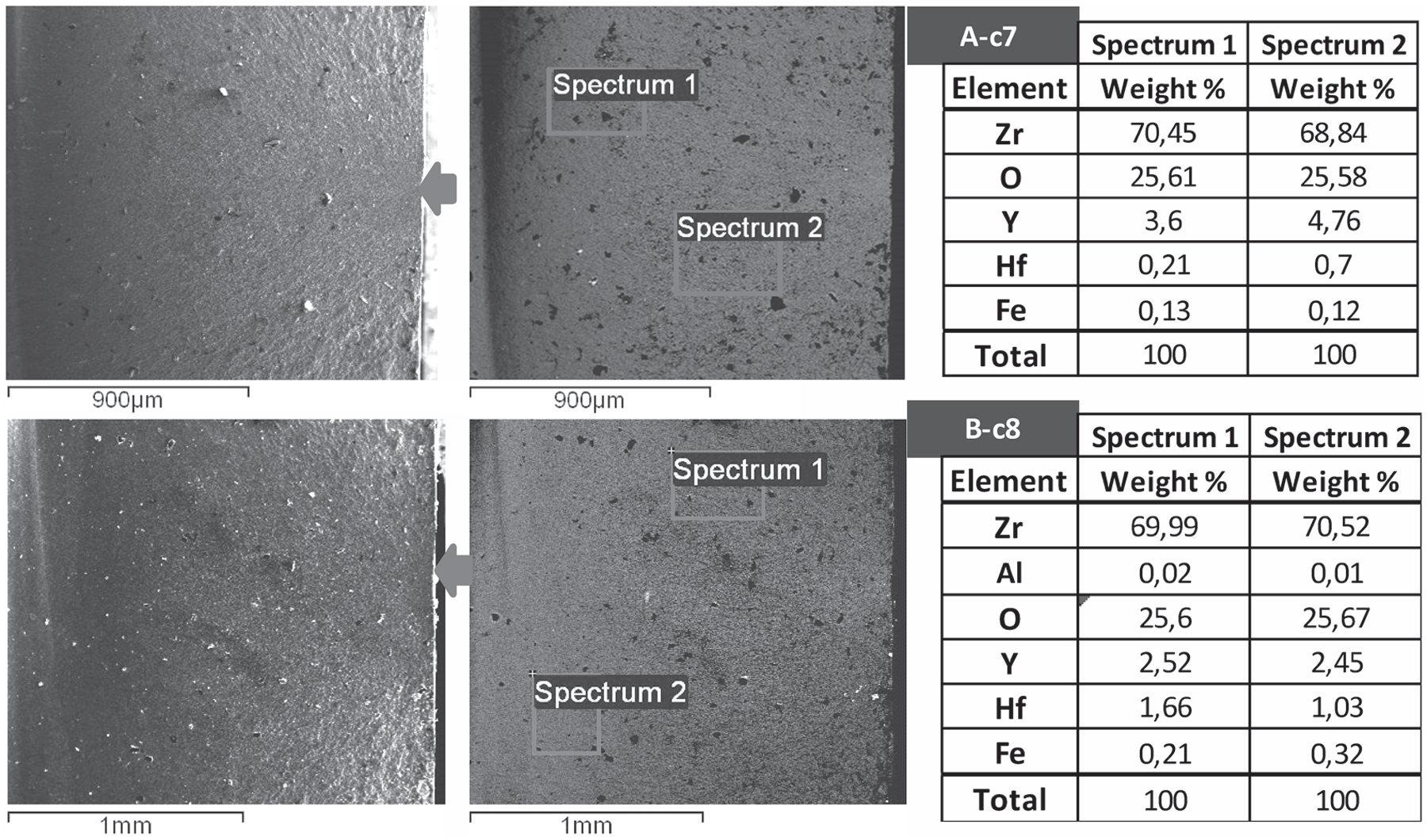
SEM microphotographs (left) of fractured surfaces with the fracture origin (arrow) and their respective backscattered ones (right). Top: Group A-c7, Bottom: Group B-c8.
Mean values of indicative elemental trace analysis on three control specimens from each group.
Discussion
In the present study the first and third null hypothesis were accepted while the second one was rejected. Flexural strength values ranged from 384.8–1484.9 MPa, in agreement with previous studies concerning monolithic zirconia ceramics [15–20]. Studies reporting flexural strength values of group A ceramics report mean values of around 900–1000MPa [21,22] similar to those reported in the present study, while in only one study a mean value of around 1300 MPa was reported [23], probably due to differences in specimens’ dimensions and loading methodology. Concerning group B ceramics, all published studies report values around 750 MPa [17,21], very close to the 761.5 MPa recorded in the present study. However, slightly higher values can be received from mirror polished specimens [24]. Comparative evaluation of the two monolithic ceramics showed statistically significant differences, with group A outweighing group B in all comparisons, suggesting that the composition and processing of each material plays a critical role [19,25,26]. The tested ceramics differ in composition, processing method of the initial powder, and sintering conditions [27]. Specifically, the Y2O3 content for ceramic A is 4.1%, whereas B is 4.5–6%, according to the manufacturers. An increase of the stabilizing oxide can result in increased resistance to aging [28] but a decrease in flexural strength [29]. Furthermore, slight variations in the amounts of Fe2O3 and Al2O3 may have contributed to the difference in aging sensitivity [30,31]. Minor elemental differences were recorded for both ceramics, but without correlation with their aging behavior.
Initial powder condensation for group A ceramics was performed through a colloidal processing, while for group B ceramics it was through cold isostatic pressing. The two procedures may have led to different properties, i.e. density [32,33]. The basic advantage of colloidal processes compared to dry-pressing is the higher homogeneity and density of the green compact that presents less intergranular voids’ inclusion [34]. Higher density is usually associated with improved mechanical performance [35] due to a lack of internal flaws that act as fracture initiators. Group A ceramics were sintered at 1580°C for 2.5 hours and group B at 1450°C for 2 hours. Sintering time and temperature are considered to affect the grain size and final density of the material, with subsequent effects on the mechanical strength [1,36]. In general, the mechanical properties of zirconia ceramics are enhanced at sintering temperatures from 1400–1580°C [37,38]. The higher sintering temperature of Group A ceramics may have resulted in the highest strength.
Autoclave aging did not have a significant effect on the flexural strength values. This is a common finding in many studies [19,23,29] and is attributed to the superficial transformation, compared with the dimensions of the specimens, which is not able to alter their mass properties [19]. The m-ZrO2 content has been considered to be a decisive factor for the mechanical properties of zirconia ceramics due to its lower inherent properties, as compared to the tetragonal. In the present study, the specimen with the highest (9.27%) m-ZrO2 presented the lowest flexural strength in its group, while in group B the specimens with m-ZrO2 content below 1% presented the maximum strength values among the aged and thermally cycled specimens. Although no significant changes in flexural strength are observed at short aging times, differences among various materials at the early stages of the t→m phase transformation may be crucial, as t→m transformation is an ongoing process, that starts from one grain and progresses eventually into the bulk through multiple crack formation and further water penetration [39]. Consequently, even a small amount of transformed tetragonal grains at the surface of zirconia at the early stages may lead to a progressively increased transformation, ultimately resulting in the failure of the material [8]. A limited decrease in strength—still being high enough to withstand the occlusal forces generated in the oral cavity—that can be associated with improved resistance to aging, is preferential for the long-term survival of prosthetic restorations. This trend has been recently adopted from the third generation of monolithic zirconia ceramics, which have significantly lower strength due to the presence of cubic zirconia but present almost no LTD. However, clinical studies are needed to validate this concept.
Concerning thermal cycling, there is no standardized protocol, making results extremely difficult to compare [40]. The ISO/TS 11405 suggests the use of two baths with temperatures 5°C–55°C and dwell time ⩾20°C. However, in the oral cavity, regulatory mechanisms tend to restore the temperature back to 37°C, while patients would not tolerate such extreme stimuli for extended periods of time. Consequently, for the present investigation it was decided to set an intermediate temperature of 37°C for better simulation of the temperature transitions that occur in-vivo. Cotes et al. [41], investigating different aging protocols, found that 6000 thermal cycles did not reduce the bending strength of zirconia ceramics. However, in another study with TC up to 5000 cycles, a significant decrease in flexural strength was recorded [42]. The present study included the highest number of cycles found in similar studies and found no significant effect on strength, probably due to the absence of a severe thermal shock that is anticipated after multiple immersions between 5°C and 55°C.
Higher values of m have been correlated to a narrower distribution of defect sizes. For the control specimens, m was similar, whereas the characteristic strength of group A was greater when compared to group B ceramics. A small decrease was observed only for the aged specimens of Group A. The increased m value after autoclave aging or thermal cycling of the other groups is justified by the transformation phenomenon. At the early stages, the m-ZrO2 tends to fill the pores and cracks, resisting crack propagation. However, when it exceeds a critical threshold, the characteristic strength depends on the size of the m-ZrO2, which is treated as a “defect”, and not from the endogenous structural flaws [43].
The new data that emerged from the current study suggest that after 22,500 cycles of thermal gradient in water, for conditions that mimic more accurately the conditions in the oral cavity, there were no significant differences concerning m-phase and flexural strength compared to the respective values after autoclave aging. This suggests that aging in an autoclave is a valid method to test the transformation of zirconia and evaluate the changes in strength, despite the large criticism that autoclave aging underestimates the t→m-phase transformation. However, only after a long-term clinical preservation in the oral cavity can a true estimation of the t→m-phase transformation be achieved.
Conclusions
Under the limitations of the current in-vitro study, it can be stated that autoclave aging for one hour and thermal cycling for 22,500 cycles, which correspond to 3–5 years of clinical aging, exert a similar and mild effect on the flexural strength of the tested zirconia ceramics. Variations in composition and processing may be the reason for the significant differences between the two ceramics.
Footnotes
Acknowledgements
The authors wish to thank Ivoclar-Vivadent AG and Digident (representing Glidewell Laboratories in Greece) for providing the zirconia ceramics, and the mathematician Dr Vasilios Karagiannis for the statistical analysis.
Declaration of conflicting interests
The author(s) declared no potential conflicts of interest with respect to the research, authorship, and/or publication of this article.
Funding
The author(s) received no financial support for the research, authorship, and/or publication of this article.