




Abstract
The aim of the current study is to alleviate the adverse effect of the strongly exothermic polymerization of polymethyl methacrylate (PMMA) bone cement in clinical applications. In this study, paraffin/poly(methyl methacrylate–methylene bisacrylamide) (paraffin/P(MMA-MBA)) phase change microcapsules (MPn; n = 1, 2) were developed via the emulsion polymerization method. The reduction of the maximum temperature of polymerization (Tmax) and physicochemical properties were evaluated after doping commercial PMMA cement with MPn in specific proportions (10%, 20%, and 30%). The results reveal that the MPn-doped PMMA exhibited an effective reduction in Tmax, which can help alleviate the adverse effect of the strong exothermic reactions during PMMA setting. After doping with the MPn, the mechanical properties of the PMMA cement decrease and the values are close to that of body cancellous bone. The Tmax of the cement doped with 20 wt% MP1 is 37.6°C, which is close to body temperature. Significantly, the setting and compressive properties of the optimized group can still adhere to clinical requirements. The MPn doping PMMA technique holds much promise in clinical practice.
Keywords
Introduction
Polymerization of polymethyl methacrylate (PMMA) bone cement has been widely used in orthopedic applications, including total joint replacement 1 , vertebroplasty 2 , bone defect reconstruction, and infectious lesion treatment for more than 50 years. However, side effects such as monomer toxicity, strong exothermicity, non-degradation in vivo, and excess mechanical strength gradually appear during clinical applications which limited the clinical applications of PMMA as bone cement3, 4. Among these, local transient high temperatures cause thermal damage to surrounding tissues which directly leads to bone necrosis around the cement. What is more, the strong exothermicity caused by the polymerization of bone cement monomer can lead to high local transient temperatures, resulting in the stimulation of the body’s inflammatory reaction; this releases a large amount of inflammatory mediators, for example, prostaglandins, which reduce the amount of blood returning to the heart, and cause a series of hemodynamic changes, such as peripheral blood pressure drop 5 . Therefore, reducing the adverse effect of exothermicity in the PMMA setting process has attracted much attention.
To date, several strategies have been employed to try to solve the problem arising from the strong exothermicity of PMMA solidification. One strategy is to add bioactive nanoparticles, including magnesium oxide 6 , hydroxyapatite 7 , silicon dioxide 8 , multi walled carbon nanotubes 9 , chitosan/multiwalled carbon nanotubes composite 10 , and chitosan/graphene oxide nanocomposite 11 in the PMMA cement powder. This minimizes the thermal damage by taking advantage of the high specific surface area of nanoparticles, which facilitates rapid diffusion of heat. Whereas, the maximum temperature of these modified cements is generally maintained above 50°C, the temperature is still too high for the muscle tissue12, 13. Another strategy is to reduce the heat release of polymerization by modification of the MMA monomer through co-crosslinking with N-methyl-pyrrolidone 14 , ethyl hexyl acrylate 15 , glycidyl methacrylate 16 , and acrylic acid 17 . However, the improvement resulting from such a strategy is modest and the introduction of other monomers may cause toxicity to the body. Recently, Yang et al. reported a new strategy to reduce thermal necrosis by using a paraffin/silica phase change microcapsules (PCM); they achieved promising results 18 . PCM has excellent energy storage capacity and has been widely used in the domain of construction technology 19 . However, paraffin/silica PCM introduce another phase, that is, silica as shell of the PCM into the PMMA system. In this article, the paraffin/poly(methyl methacrylate–methylene bisacrylamide) paraffin/P(MMA-MBA) PCM has the similar components to PMMA as shell has been developed, and it is proposed that this new variant microcapsule (MP) cannot only make use of its energy storage characteristics to reduce the curing temperature of PMMA, but also shows relatively smooth and tight interface between the doped MP and PMMA cement.
Materials and methods
Synthesis of MPn and PMMA/MPn composite bone cement
Paraffin/P(MMA-MBA) PCM was prepared by the emulsion polymerization method 20 . Briefly, 5 g MMA (methyl methacrylate) (99% AR, Chengdu kelon reagent Co., Ltd.), 5 g paraffin (Shanghai huayong paraffin Co., Ltd.), and 2 g MBA (N,N-methylene bisacrylamide) (99% AR, Shandong Xiya reagent Co., Ltd.) were mixed together in deionized water (60 mL) at 8000 revolutions per minute (rpm) by stirring for 15 minutes using a shearing emulsifier. Subsequently, 1.5 g Triton X-100 (97%, Dalian meilun biotechnology Co., Ltd.) was added and stirring was continued for 60 minutes. The solution was then transferred into a three-necked flask containing 0.15 g benzoyl peroxide (AR, Shanghai Aladdin Bio-Chem Technology Co., Ltd.) and stirred at 600 rpm for 6 hours. The product was filtered and washed with hot water to remove excess paraffin, and the MP1 was obtained after freeze drying. Subsequently, the product MP2 was prepared by changing the ratio of MMA and paraffin to 2:1.
The fabricated MP was added to the commercially available acrylic bone cement (Type III for injection, Tianjin Synthetic Material Industrial Research Institute Co., Ltd.) (PMMA BC) to assess the reduction of the exothermic effect. Five compositions of the composite cement were prepared, that is, powder mixture containing 10 wt% MP1 (BC-10MP1), 20 wt% MP1 (BC-20MP1), 10 wt% MP2 (BC-10MP2), 20 wt% MP2 (BC-20MP2), and 30 wt% MP2 (BC-30MP2). PMMA BC without MPs was used as the control.
Morphology and structure observation of MPn
A scanning electron microscope (SEM) (JEOL JSM-6510LV, Japan) was used to observe the morphology of MPn and Nano Measurer software was applied to quantitatively measure the particle diameter and distribution from the SEM images. The chemical structure of specimens was evaluated by Fourier-transform infrared spectroscopy (FTIR) (Nicolet 6700, USA). A synchronous thermal analyzer (STA) (NETZSCH 449 F3 Jupiter, Germany) was used to verify that the paraffin was wrapped in P(MMA-MBA).
Setting properties characterization of composite cements
A SEM (JEOL JSM-6510LV, Japan) was used to observe the interface between MPn and cement matrix. According to the ASTM F451 Standard and references21, 22, the PMMA BC was doped with MPn to form a paste in a polystyrene mold. The temperature in the paste (35 × 35 × 6 mm3) setting process was recorded using a thermocouple and digital meter (TES Electrical Electronic Corp., Taiwan). Based on the curve, the maximum temperature (Tmax) was recorded and the setting time (tset) was calculated. The tset was the time corresponding to achieving a temperature of (Tamb+Tmax)/2, where Tamb was the ambient temperature.
Compressive properties evaluation of composite cements
The compositions BC-20MP1, BC-20MP2, and BC-30MP2 showed a significant decrease in Tmax and were hence selected to evaluate the compressive properties after solidification by using a universal mechanical tester (UTM) (Shimadzu AG-IC 50KN, Japan) (ISO 604-2002). The mechanical test sample size was 10 × 10 × 8 mm3, the cross-head speed was set to 1 mm/minute until the specimens were compressed to approximately 50% of their original length, and the experiment was performed in quintuplicate. The SPSS Statistics package was used for statistical analysis of all the previously mentioned data. A value of p < 0.05 was considered statistically significant.
Results and discussion
Structure and morphology
The SEM images of the prepared capsules show that both MP1 and MP2 were nearly spherical morphology and tend to form cluster type structures (Figure 1(a, c)). The distribution of the particle diameters mainly ranged from 0.5 to 1.5 μm (Figure 1(b, d)). The melting peak position of paraffin at 53.7°C in differential scanning calorimetry curves (Figure 2(a)) confirms the presence of paraffin in MP1 and MP2. From the FTIR spectra (Figure 2(b)), the existence of characteristic peaks of paraffin, that is, C–H stretching vibrations at 2920 cm−1 and 2850 cm−1, C–H bending vibration at 1470 cm−1 and 1377cm−1, and two peaks of PMMA, that is, the stretching vibration of C–O and C = O groups at 1150 cm−1 and 1730 cm−1, suggest that the MPn is composed of paraffin and PMMA. The peaks at 1530 cm−1, 3270 cm−1, and 1205 cm−1 for N–H and C–N, and 1660 cm−1 for C = O have also been detected in MPn because of the introduction of amide bonds in the synthesis process (Figure 3). Adequate washing in hot water can remove uncoated paraffin, suggesting that the final product comprises a P(MMA-MBA) shell around the paraffin, which forms a PCM structure. MBA is used as a crosslinking agent, which interacts with MMA free radicals to form a bridge bond between the polymer molecular chains and forms a three-dimensional spatial network structure. This kind of structure can greatly improve the stability of the polymer23, 24. The more stable the polymer network is, the more stable is the core-shell structure of the PCM. Consequently, paraffin in PCM can be tightly wrapped to a large extent and guarantee the biosecurity of this PCM doped cement.

Scanning electron microscope images and corresponding diameter distributions of particles: (a, b) MP1; and (c, d) MP2.

(a) The differential scanning calorimetry curves of paraffin and phase change microcapsules (MPn); and (b) the Fourier-transform infrared spectroscopy spectra of polymerization of polymethyl methacrylate, paraffin, and MPn.

The chemical structure of paraffin/poly(methyl methacrylate–methylene bisacrylamide).
Setting and compressive properties
The temperature-versus-mixing time profile shows the typical exothermic effect of polymerization of the composite cement specimens (Figure 4(a)). According to Figure 4(a) and the specified data in Table 1, the addition of 10 wt% MPn does not significantly change the Tmax and tset of PMMA BC, while the addition of 20 wt% and 30 wt% MPn significantly reduce the Tmax and prolong the tset of PMMA BC. The Tmax of BC-20MP1 is 37.6°C and the Tmax of BC-30MP2 is 32.1°C; these results indicate that the MP1 possesses a better energy storage capacity than MP2 to decrease the Tmax of PMMA BC, which corresponds to heat absorption capacity of MPn presented in Figure 2(a). The cooling effect is better than 20 wt% paraffin/silica PCM doped cement (Tmax = 44°C) reported in the literature 18 . In summary, the MPn has high latent heat, and the suitable phase transition (from solid to liquid) temperature for thermal energy storage when the temperature rises rapidly accounts for this temperature reduction effect 25 . Although the addition of MPn prolongs the tset of PMMA BC, the tset of all specimens is found to be less than 25 minutes, which still meets the requirements of clinical surgery 26 .
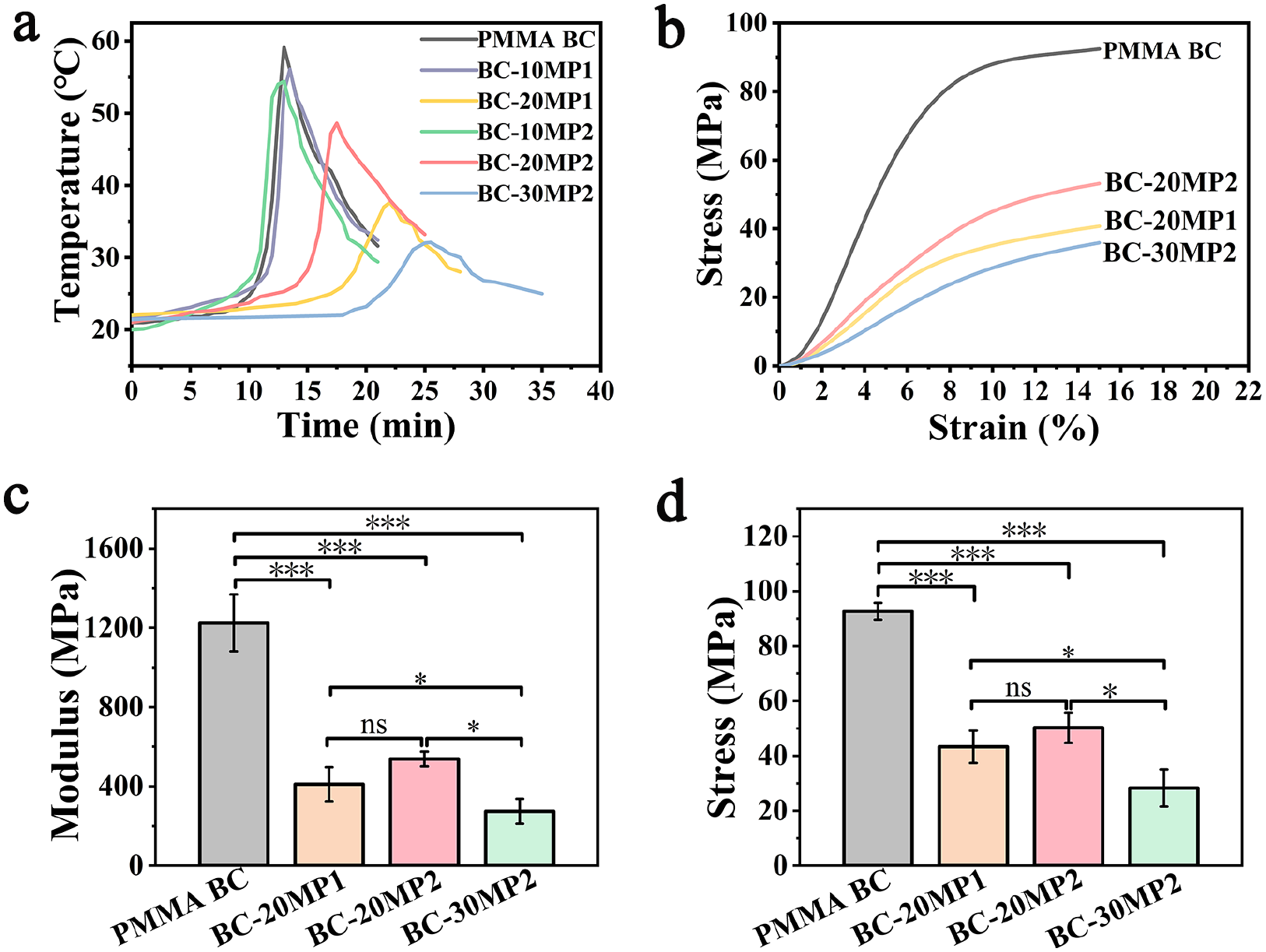
Plots of bone cement showing (n = 3): (a) temperature with time; (b) stress versus strain; (c) bulk modulus; and (d) the compressive stress of cured samples. No significant difference: p > 0.05, *, p < 0.05, and *** p < 0.001.
The maximum temperature and setting time of the bone cements (n = 3).

Note: ns, no significant difference: p > 0.05, *, p < 0.05, **, p < 0.01, ***, and p < 0.001, compared with PMMA BC.
The PMMA BC has the highest compressive stress and bulk modulus (~92.7 MPa, ~1225 MPa) (Figure 4(b, c, d)), whereas the apparent bulk compressive strength and modulus of osteoporotic cancellous bone lie in the range of 1–7 megapascal (MPa) and 50–800 MPa, respectively 27 . The relatively high elastic modulus of PMMA bone cement increases the secondary fracture risk of adjacent vertebral bodies 4 . After doping with the MPn, the mechanical properties of the PMMA BC deteriorate remarkably (Figure 4(c, d)) and the values are close to that of body cancellous bone. There is no significant difference between BC-20MP1 and BC-20MP2 in compressive stress and bulk modulus, while BC-30MP2 compressive stress is lower than other groups, indicating that more PCM incorporation will weaken the mechanical strength of PMMA cement.
As shown in Figure 5, the cross-section of PMMA BC has a plain texture, indicating that a continuous phase is formed after polymerization of MMA. The bone cement specimens with additives also have a plain texture with some holes, which represent the location of the MPs. It is also possible that it is a small number of bubbles formed during high temperature polymerization. Combining the compressive properties (Figure 4(c, d)) and SEM images of kinds of samples, the BC-20MP2 has fewer holes than BC-20MP1 and BC-30MP2, and that means the compressive strength of BC-20MP2 is relatively higher. To sum up, an integrated interface between the doped MP and PMMA cement can be observed. The samples of BC-20MP1, BC-20MP2, and BC-30MP2 can be further optimized by improving the energy storage capacity of MPn in subsequent studies.

Fracture interface of polymethyl methacrylate/ phase change microcapsules composite cements specimens.
Conclusions
Paraffin/P(MMA-MBA) PCM were successfully developed by the emulsion polymerization method. Doping commercial PMMA cement with MPn can effectively decrease its Tmax and help avoid the adverse effects of the strong exothermicity of the PMMA setting process. Significantly, the setting and compressive properties of BC-20MP1 still adhere to clinical requirements. This technique may also provide a promising platform for the addition of high temperature-intolerant drugs in bone cement to assist in the cure various diseases.
Footnotes
Acknowledgements
The authors thank Professor Jidong Li for his guidance in this research.
Declaration of conflicting interests
The authors declared no potential conflicts of interest with respect to the research, authorship, and/or publication of this article.
Funding
The authors disclosed receipt of the following financial support for the research, authorship, and/or publication of this article: This work was supported by the National Key Research and Development Program of China (Grant Numbers: 2016YFA0201703 and 2016YFA0201700), and Key Applied Basic Research Program of Sichuan Province (2018JY0031).
