




Abstract
Aim:
To evaluate the effect of simulated intraoral hydraulic, thermal, and mechanical stresses on the debonding characteristics of orthodontic brackets under different adhesive regimes.
Materials and methods:
Groups of pre-coated (G1) and non-coated (G2) orthodontic metal brackets were bonded onto the buccal surfaces of 96 premolars using etch-and-rinse (SG1, n = 24) and self-etch (SG2, n = 24) primers. Twelve specimens (C1) from each subgroup were subjected to early debonding resistance tests, while the other twelve (C2) were used to test delayed debonding resistance after exposure to conditions simulating intraoral hydraulic, thermal, and mechanical stresses. The debonding resistance of the brackets was evaluated using a universal testing machine and the debonding patterns were micro-visualized to determine the adhesive remnant indexes of subgroups of specimens.
Results:
Within each group, the etch-and-rinse primer (SG1) resulted in higher debonding resistance than self-etch primers (SG2) (p < 0.05), while there was no difference between non-stressed and stressed specimens (p > 0.05). Within each category of test specimens, there was no difference between pre-coated (G1) and non-coated (G2) brackets (p > 0.05). The tested specimens in all categories showed comparable adhesive remnant indexes. However, higher percentages of favorable scores (0 and 1) were obtained for all stressed specimens.
Conclusions:
Short-term cumulative intraoral stresses have no adverse effect on the debonding values of either pre-coated or non-coated brackets when either etch-and-rinse or self-etch primer is used for bonding. Exposure of the bonded brackets to different types of stress reflects favorable debonding patterns.
Introduction
Efficient bonding of orthodontic brackets to tooth enamel facilitates appropriate utilization of the stresses applied to teeth. The durability of the bond throughout treatment is crucial.1, 2 Both pre-coated orthodontic brackets and self-etch primers have been developed to achieve higher initial bond strength and to save time.3, 4 These materials are believed to provide clinically efficient and durable bracket bonding without harming the enamel surfaces on appliance removal.5, 6 However, their bonding performance in cases of impacted and severely misaligned teeth is uncertain, 7 resulting in inappropriate bonding protocols and application of excessive initial stresses to the bonded brackets. 8
Bonded orthodontic brackets are normally subjected to a complex combination of fluctuating stresses that may fatigue the adhesive bond. 9 Medically compromised and mouth-breathing patients may experience dry mouth, 10 a condition that involves cyclic episodes of wet and dry intraoral environments, with possible sorption and loss of fluids by the resin-based restoratives and adhesives. 11 This can result in stress and weakening of the bonding interfaces. 12 However, to our knowledge, no study has yet evaluated the effect of such stresses on the bracket–tooth bonds.
Cyclic intraoral temperature changes can also stress the interface of adhesively bonded materials with different thermal expansion coefficients. 13 Easier and more favorable debonding of orthodontic brackets, resulting in lower adhesive remnant indexes (ARIs), may result from prolonged cyclic thermal aging. 13 However, these effects may be altered by the composition and thickness of the primers and adhesives used. 14
Bonded brackets are subjected to cyclic mechanical stresses caused by occlusion, mastication, and activation of the orthodontic appliances.15,16 Consequently, fatigue may develop at the bracket–adhesive–enamel interface, reducing bond strength; however, advances in adhesive technology and bracket base design could contribute to resolving these issues.7, 9
Therefore, in this study, we investigated the bonding durability of various combinations of contemporary bracket–adhesive systems after cumulative exposure to simulated intraoral stress conditions. The hypothesis of the study was that cumulative stresses would not affect debonding of various bracket–adhesive combinations. Moreover, the effect of these conditions on debonding outcomes might assist orthodontists in making an evidence-based decision on the most favorable bracket–adhesive combination for patients.
Materials and methods
The study followed the Check List for Reporting In-Vitro Study (CRIS) guidelines. Ninety-six maxillary premolars were collected from patients undergoing orthodontic treatment. The teeth were thoroughly cleaned using a hand-scaler (Hu Friedy, Chicago, IL, USA) to remove both soft and hard deposits, prior to disinfection in 0.1% thymol solution for 24 h and storage in water at 37 ± 1°C (IN 45-EchoTherm bench-top incubator, Torrey Scientific Inc., West Carlsbad, CA, USA) for a maximum of 30 days. Tooth roots were wrapped with two layers of flexible Teflon tape (RTEF, Splash, Biere, Germany), representing the natural periodontal ligament. Each pair of wrapped roots was then embedded, 2 mm away from the cemento-enamel junction, in a cold-curing acrylic block, 3 cm in diameter and height (Orthoplast, Vertex Dental BV, Zeist, the Netherlands) to facilitate further handling and testing procedures.
All teeth were subsequently polished using rubber cups with oil-free pumice, to prepare the enamel surface for orthodontic bracket bonding. The cleaned teeth were then randomly classified into two groups (n = 48 each)
• Pre-coated (APC Plus, 3M Unitek, Monrovia, CA) (G1)
• Non-coated (Victory Series Low Profile, 3M Unitek) (G2) metal orthodontic brackets.
In each group, the selected brackets were fixed to the buccal surfaces of teeth using etch-and-rinse (Transbond MIP, 3M Unitek) (SG1) or self-etch (Transbond Plus, 3M Unitek) (SG2) primers (n = 24 per subgroup).
In SG1, enamel surfaces were first etched with 35% phosphoric acid (Unitek Etching Gel, 3M Unitek) for 15 s, washed, and dried. The Transbond MIP primer was then rubbed against the etched enamel, left undisturbed for 15 s, air-thinned for 5 s, and cured using an Elipar S10 LED curing light (3M ESPE, Seefeld, Germany) for another 10 s.
In SG2, two coats of the self-etch primer were brushed onto the cleaned enamel surfaces, left undisturbed for 15 s, air-thinned for 5 s, and light-cured for 10 s.
The pre-coated brackets of G1 were pressed against the cured adhesive in both subgroups with the aid of a Correx gauge (Haag-Streit AG, Koeniz, Switzerland) for 10 s. The extruded excess adhesive was removed with a micro-brush to leave a clean enamel surface around the brackets prior to curing the adhesive for 40 s (10 s from each side of the positioned bracket). The fitting surfaces of each non-coated bracket in G2 received a small amount of a compatible resin adhesive (Transbond XT, 3M Unitek) before being pressed against the cured primer, in both subgroups. The excess adhesive was removed prior to curing.
Twelve specimens from each subgroup (Category 1, C1) were used to test the early debonding resistance of brackets after storage in water at 37 ± 1°C for only 1 h, while the other twelve specimens (Category 2, C2) were subjected to simulated intraoral hydraulic, thermal, and mechanical stress conditions. These C2 specimens underwent 180 intermittent wet–dry storage cycles, to induce hydraulic stresses at the tooth–adhesive–bracket bonding interfaces. The specimens were first stored in water at 37 ± 1°C for 12 h, followed by 15 s of air-drying, before being placed in dry storage at 37 ± 1°C for another 12 h. Thermocycling (Thermocycler THE-1100, SD Mechatronik GmbH, Feldkirchen–Westerham, Germany) at 5 and 55°C for 5000 cycles, 16 with 1 min dwell time, was utilized to induce thermal stresses at the bonding interfaces before wiring each pair of the same specimens using pieces of 0.36 mm stainless steel arch wire (3M Unitek), to simulate the in-service mechanical stresses that could be developed at the bonding interfaces of each specimen on mastication (Figure 1). Each of the wired teeth was then subjected to 50 N occlusal loading for 120 000 cycles on a universal testing machine (Model 5965, Instron, Grove City, PN) before the delayed debonding resistance of the stressed brackets in each subgroup was tested.

Simulation of clinically wired teeth with bonded brackets.
All the bonded brackets were stressed using a metal rod fixed to the upper member of a universal testing machine running at 0.5 mm/s. The debonding forces were recorded at the first audible cracking sound and the debonding stresses were calculated by dividing the recorded forces by the brackets’ basal surface area. Normality of data obtained was assessed using the Kolmogorov–Smirnov test. The collected data were then analyzed using three-way analysis of variance (ANOVA) and Tukey’s tests at α = 0.05 to assess differences between test subgroups.
The bonding tooth and bracket surfaces of each tested specimen were then inspected under low-angle illumination using a stereomicroscope at 10× original magnification (Nikon SM2-10, Tokyo, Japan) to determine the ARI of each specimen category. The amount of adhesive remaining on each tooth was scored as “0” when no adhesive remained on the enamel surface (all adhesive was found on the bases of the debonded brackets). It was scored as “1” when <50% of the amount of adhesive remained attached to the enamel surface; “2” when >50% of the adhesive remained attached to the enamel surface; and “3” when all of the adhesive remained on the enamel, with almost no trace on the bracket’s base. These scores were analyzed using a chi-squared test at α = 0.05 to assess differences between the ARIs of the tested specimen divisions.
Results
The mean debonding stresses and the standard deviations for all divisions of test specimens are shown in Table 1. Three-way ANOVA revealed significant differences between the test subgroups (adhesive primer type, p < 0.0001), but not between test groups (bracket type, p = 0.27) or test categories (stress condition, p = 0.167955). No interactions were found between any of the test variables (p > 0.05). Tukey’s comparisons showed that the etch-and-rinse primer yielded higher bond strength than the self-etch primer in both groups of specimens (p < 0.05). No difference was seen between the stressed and non-stressed specimens in each subgroup (p > 0.05) or between the pre-coated and non-coated brackets within each specimen category (p > 0.05).
Mean debonding stresses in different categories of test specimen.
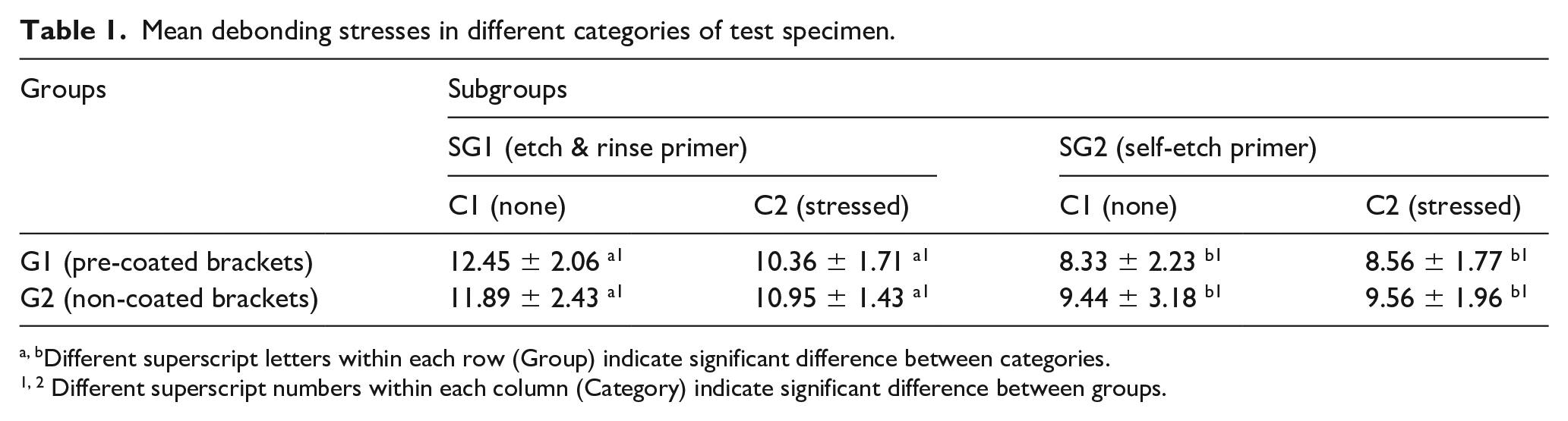
Different superscript letters within each row (Group) indicate significant difference between categories.
Different superscript numbers within each column (Category) indicate significant difference between groups.
Micro-visual assessment of the deboned specimens indicated that most specimens in all divisions showed favorable debonding patterns (ARI scores 0 and 1); however, a few showed unfavorable scores (ARI scores of 2 and 3) (Figure 2). Nevertheless, the ARIs of the tested specimen categories did not differ significantly (Table 2).
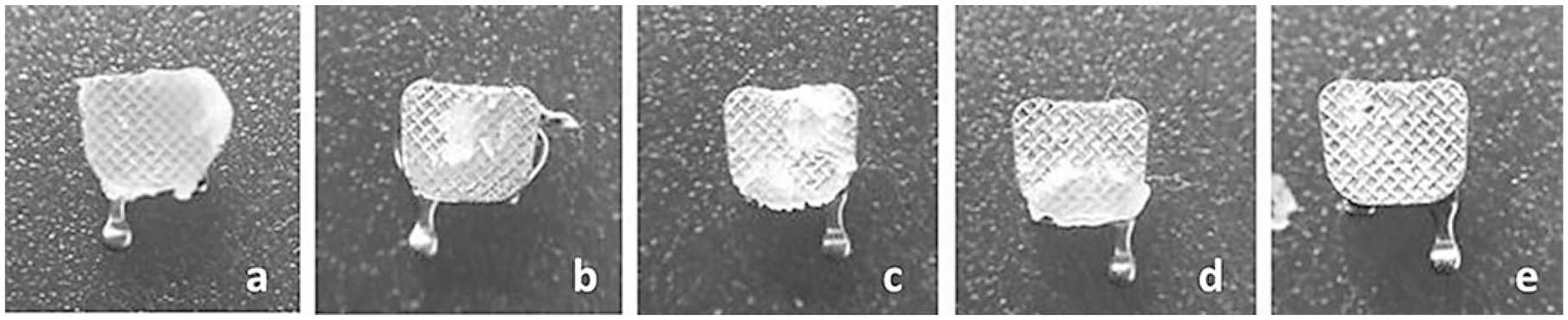
Recorded adhesive remnant scores: (a) 0; (b, c) 1; (d) 2; (e) 3.
Incidences (%) of adhesive remnant scores in different categories of test specimens.

C1: non-stressed specimens; C2: stressed specimens; G1: pre-coated brackets; G2: Non-coated brackets; SG1: etch-and-rinse primer; SG2: self-etch primer.
Score 0: no adhesive remained on tooth enamel; Score 1: <50% of the adhesive remained on tooth enamel; Score 2: >50% of the adhesive remained on tooth enamel; Score 3: all the utilized adhesive remained bonded to tooth enamel.
A lower ARI indicates higher percentages of favorable debonding patterns.
Similar superscript letters indicate no difference between the ARI of different categories of test specimens (χ2, H = 2.73).
Discussion
Although adequate orthodontic bracket bonding is necessary for force application in orthodontics, favorable debonding is also crucial for enamel safety.2, 5 The minimally required value for clinically successful bracket bonding has been estimated to be 5.9–7.8 MPa, which can be easily achieved using currently available bracket–adhesive systems. 17 However, many studies have indicated that bracket bonding strength to enamel is decreased by fluctuating intraoral stresses.12, 13 Therefore, the bracket and adhesive combination must be compatible, to withstand fatigue at the enamel–bracket–adhesive junction that may arise from stress exposure. 18 In this study, debonding stress values and the ARIs of different combinations of commercially available brackets and adhesive systems were evaluated after their cumulative exposure to simulated intraoral stresses. Test subgroups were found to be comparable, regardless of the types of brackets and adhesives regimen used. Moreover, there were no significant differences in the debonding stresses and the ARIs between stressed and non-stressed bracket–adhesive system combinations.
Although previous studies have not evaluated the influence of cumulative intraoral stresses on brackets’ debonding values and ARIs, the effects of both thermocycling and cyclic fatigue loading had been separately tested in previous in-vitro studies, but often yielded contradicting findings. Ribeiro-Neto et al. 19 and Rosolen et al. 20 found no effect of thermocycling on bracket bonding strengths, and found that enamel damage was likely to occur during debonding when etch-and-rinse primer was utilized to bond composite adhesives to enamel. Elekdag-Turk et al. 21 recorded no effect of thermocycling on bonding strengths after using etch-and rinse primers, although they found a significant reduction in bracket bonding strength to enamel when self-etch primer was used. In contrast, favorable debonding was recorded in both these studies. Flores et al. 22 reported that bracket bonding strength to enamel, and accordingly ARIs, were influenced by the primer and bonding technique used and by thermal cycling. These results were found to be in harmony with those of the etch-and-rinse primer subgroups used in the current study but differed from those obtained with the self-etch primer subgroups. This may be due to the short-term exposure of the tested specimens to thermocycling (5000 thermal cycles) in this study, as Jurubeba et al. 13 stated that prolonged thermal fatigue (>7000 thermal cycles) is necessary to compromise bonding of metallic orthodontic brackets. In this study, no statistically significant influence of thermal cycling on ARIs of the debonded specimens was noted in the different test categories, although the stressed specimens exhibited favorable debonding.
In support of our findings, Mansour and Bamashmous 23 have reported equally efficient performances of both etch-and-rinse and self-etch primers when subjected to different types of cycling mechanical stresses. Conversely, Daratsianos et al. 9 reported a significant adverse effect of fatigue on bracket bonding strength to natural tooth enamel. The difference from the current study results may involve the uncertain compatibility between the bracket and adhesive systems utilized in their study, as these were obtained from different manufacturers. Another study by Mansour et al. 24 recorded significant reduction in bond strength for both etch-and-rinse and self-etch primers to bovine enamel after cyclic fatigue, with no statistically significant change in the recorded ARIs. The difference of these results from our current study may relate to the use of human tooth enamel. Moreover, a study by Abdelnaby 15 has also confirmed that a difference in bonding substrate (ceramic or composite) could affect results, and Abdelnaby 15 reported significant reductions in bracket debonding stresses, together with an insignificant change in the ARI after applying cyclic fatigue loading. However, no study considered the currently available pre-coated brackets.
Resin-based adhesive systems show a degree of fluid sorption and loss, depending on the surrounding environment. The present results showed no effect of wet or dry storage of test specimens on either the debonding stress values or ARIs. The amount of hydraulic stresses developed at tooth–adhesive–bracket interfaces could plausibly be related to the values of dimensional changes that would result from the amount of fluid taken up or lost by the resin-based adhesive materials. 12 Moreover, some authors have indicated that water sorption may affect the modulus of elasticity of adhesives and promote their softening. 11 A study conducted by Palacios and Espínola 25 indicated that a resin composite-based orthodontic adhesive, “Transbond XT”, exhibited a lower water sorption, solubility, and film thickness than either acrylic or glass-ionomer-based adhesives. Studies by Malacarne et al. 26 and Itoh et al. 27 have shown that the amount of water sorption and the water diffusion coefficient of self-etch methacrylate-based primers are material-dependent properties. The recorded amount of sorption in any of the tested materials seemed to have minimal or no adverse effect on adhesive–tooth bond durability. 27 Additionally, a single study by Abdelaziz 12 had evaluated the effect of cyclic wet–dry storage on the quality of adhesive bonding to tooth structure, and found no significant adverse effects of short-term cyclic wet–dry storage on the bond durability of different generations of resin primers or restorative adhesives. These previous findings may indirectly support the results of the current study, as all the tested characteristics indicate minimal dimensional changes within the adhesive layer and, consequently, minimal stresses at the bonding interfaces. However, the difference in chemical nature of the primers and adhesives utilized in all of these studies should be taken into consideration.
Although the findings of this study may indicate the success of utilized bracket–adhesive system combinations, the compatibility of these combinations could be related to their manufacturing origin. Manufacturers usually utilize similar chemical technology, with minimal changes, when developing different products in their ranges. The level of consistency, accordingly, could be reflected in the performance of the selected bracket and adhesive system combinations after their cumulative exposure to simulated intraoral stresses. Therefore, further studies evaluating the performance of different systems originating from different manufacturers under the same test conditions are warranted. Moreover, the influence of prolonged stress on the performance of different bracket–adhesive system combinations should also be addressed in future studies. In-vivo study design should be preferred to extrapolate the findings of the present in-vitro study.
Conclusion
Short-term cumulative intraoral stresses had no adverse effects on the debonding values of either pre-coated or non-coated brackets when using either etch-and-rinse or self-etch primer for bonding. However, exposure of the bonded brackets to these types of stress reflects favorable debonding patterns.
Footnotes
Acknowledgements
We would like to thank the Dean of Scientific Research at King Khalid University, Abha, Saudi Arabia.
Contributorship
KMA and IAS: Data collection, study design, manuscript writing, and final manuscript approval.
MAK: Data collection, study design, manuscript drafting, data analysis, and manuscript approval.
KMA and AA: Data collection, manuscript approval, and data interpretation.
MAK and AA: Data collection, writing, revision, editing, and final manuscript approval.
Declaration of conflicting interests
The author(s) declared no potential conflicts of interest with respect to the research, authorship, and/or publication of this article.
Funding
The authors disclosed receipt of the following financial support for the research, authorship, and/or publication of this article: This work was supported by the Collaborative Center of Maxillofacial Research and Treatment Modalities (Max Center), College of Dentistry, King Khalid University, Abha, KSA (grant number MRMC 01-017-011).
Guarantor
Ibrahim Alshahrani (IAS)
