




Abstract
Polycarbonate is a good material for covering and protecting cultural heritage sites because of its durability, mechanical properties, and transparency. However, polycarbonate degrades under environmental weathering with a significant decrease of physical and mechanical properties and loss of transparency. In this work, the contemporary presence of ultraviolet irradiation and different temperature and moisture conditions have been taken into account to study the environmental degradation of this polymer with regard to its mechanical and optical properties. The photo-oxidation reactions cause a decrease in the molecular weight and the formation of many oxygenated species. The hydrolytic scission, instead, gives rise to a remarkable reduction in the molecular weight. These two different degradation mechanisms do not seem interconnected because at the lowest degradation temperature and high humidity levels, the reduction of the molecular weight is more pronounced than that observed at the highest temperature but at a lower humidity level. Transparency decreases with the degradative processes, but even after severe degradation the loss of transparency is only about 10%. The yellowness index increases during the first stages of degradation, which has been attributed to the fast formation of carbonyl groups due to photo-oxidation.
Introduction
Polycarbonate (PC) is an amorphous and transparent polymer that is often used to preserve, consolidate, and protect cultural heritage sites thanks to its durability, physical, mechanical, and optical properties. PC also finds application in building and construction as a lighter and tougher substitute for glass or metal in roofing and glazing because it shows high transparency, good electrical properties, light weight, exceptional toughness, and dimensional stability over a wide range of temperatures. 1 Like other polymers, PC undergoes deep processes of degradation due to the variations of temperature, stress, and, in particular, humidity and ultraviolet (UV) irradiation. The final results of degradation due to environmental weathering are discoloration, embrittlement, loss of toughness, and transparency.2–4
Photo-degradation is the main cause of the loss of PC’s properties. The photo-degradation of this polymer has been widely studied in the literature5–15 and involves two different mechanisms: photo-Fries reaction and photo-oxidation. The photo-Fries mechanism is due to wavelengths below 310 nm with the scission of the carbonate linkage. This involves the formation of two primary free radicals 7 that can rearrange and crosslink. The molecules produced during photo-Fries reactions can also undergo photo-oxidation, creating other products of lower molecular weight. 10 The photo-oxidation mechanism proceeds through three different routes: side chain oxidation, ring oxidation, and ring attack. This mechanism produces chain scission, a decrease in molecular weight, and the formation of oxygenated groups. 16
Another important cause of the decrease of the mechanical properties of PC is due to moisture that, when linked to high temperatures (>70°C), leads to the hydrolysis of PC and causes the breakdown of the polymer, reducing its molecular weight.3, 17–22 Finally, the formation of carbonyl groups can give rise to some yellowness in the polymer, which is important in applications such as covering cultural heritage sites. Indeed, some polymers, particularly PC, are used as material for both modern artworks and protective shields for cultural heritage sites.23–28
The main objective of this work is to evaluate the durability of PC in covering and protecting cultural heritage sites, studying its mechanical and optical properties after UV irradiation in the presence of different amounts of humidity at different temperatures.
Materials and methods
The material used in this work was a sample of PC with a viscosimetric molecular weight (Mv) of about 21,000 Da.
For the photo-oxidation tests, sheets of PC samples were prepared by compression molding at T = 280°C, P ~ 250 bar, time = 4 min in a Carver Laboratory press after drying the pellets overnight under a vacuum at 120°C.
The sheets were exposed to accelerated weathering in a Q-UV chamber (Q-Labs Corp., USA) containing eight UVB lamps for times of up to 1000 h, except for sample 50UVRH100, which, after 528 h, was completely degraded. The weathering tests were carried out under different combinations of exposure cycle parameters (time, temperature, and relative humidity (RH)). In particular, as shown in Table 1, the weathering was carried out by continuously irradiating the samples or alternating two steps: UV exposure (8 h) followed by condensation (4 h). Some tests were also carried out by keeping some samples in an oven at T = 70°C at an RH of 100%.
Sample codes and conditions of weathering.
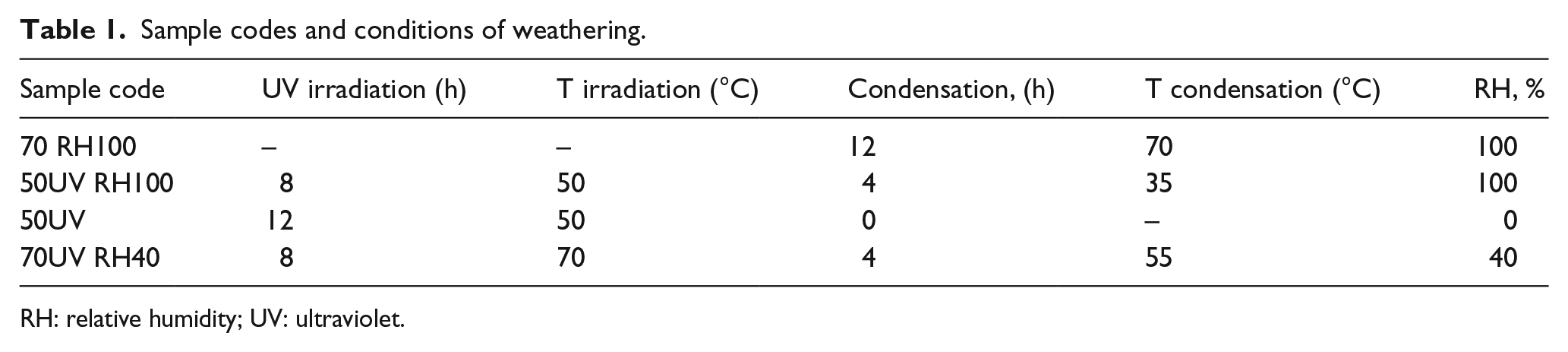
RH: relative humidity; UV: ultraviolet.
The weathering conditions and the sample codes are shown in Table 1.
The intrinsic viscosity [η] was measured by an iVisc Capillary Viscometer LMV 830 (Lauda Proline PV 15, Lauda-Königshofen, Germany) instrument equipped with a Ubbelohde capillary viscometer (K = 0.005) in an oil bath at 25°C.
To prepare the solution at a concentration of 0.2 wt %, each material was dissolved in tetrahydrofuran (THF) by stirring at room temperature for 1 h. Flow time measurements were performed in triplicate for each sample until the standard deviation was below 0.5 s.
The intrinsic viscosity values were calculated according to the Solomon-Ciuta equation (1): 29

where c is the concentration of the polymer solution and [η], ηsp and ηrel are intrinsic, specific, and relative viscosity, respectively. The solution viscosity of each sample was obtained by averaging five flow measurements. The Mv was calculated using the Mark–Houwink equation (Equation (2)):

The parameter values of the Mark-Houwink constants, a and K, depend on the specific polymer solvent system. For PC-THF (25°C), K = 4.90 × 10⁻⁴ and a = 0.670. 30
Stress-strain curves were measured using a universal testing machine model 3365 (Instron). The elastic modulus was measured at a speed of 1 mm/min until the deformation was 10%. Then, the crosshead speed was increased to 100 mm/min until the specimen broke. The values of elastic modulus (E), tensile strength (TS), and elongation at break (EB) were calculated as the average of 10 tests.
Fourier Transform Infrared Spectroscopy Attenuated Total Reflectance (FT-IR ATR) spectra were obtained with a Perkin-Elmer (USA) Spectrum One spectrometer, using Spectrum software. The spectra were obtained through 16 scans with a 4 cm−1 resolution. Measurements were obtained from the average of triplicate samples. The ATR spectra were normalized using the peak located at 1013 cm−1 due to the aromatic CH in-plane bend. 11 To monitor the oxidation during the tests, the band centered at about 1713 cm−1, due to the aliphatic chain acids, was measured.15, 22
Light transmission and haze were measured by using a spectrophotometer UV-VIS JASCO model V-650. The haze was measured according to EN 2155-5, with the yellowness index (YI) according to ASTM E313.
Results and discussion
The Mv of the PC sample is reported as a function of the irradiation time in Figure 1. Because the weathering conditions are different, the total exposure time is, of course, different between the different tests. In particular, for the test with a condensation step, the value of the total exposure time is the irradiation time multiplied by 1.5.
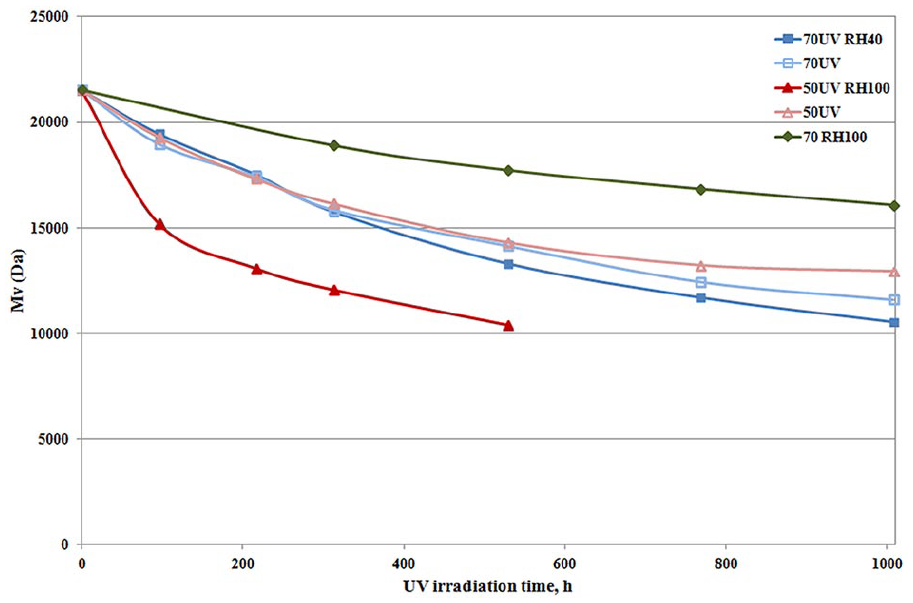
Viscosimetric molecular weight (Mv) as a function of the irradiation time. For the sample kept in the oven, the time is that spent in the oven.
The molecular weight decreases with irradiation time and with increasing temperature, but this reduction is much more pronounced in the presence of a high level of humidity over the same the irradiation time. The more pronounced reduction of the molecular weight is observed for aging carried out at the lowest temperature and at the highest level of humidity. This can be interpreted by considering that, at these temperatures, the presence of water can give rise to hydrolytic chain scission magnifying the effect of the photo-oxidation. Confirmation of this behavior is given by the values reported in the same figure for the sample kept in the oven at T = 70°C, RH = 100% without irradiation. Indeed, Mv decreases with increasing time, but the decrease is very small with respect to that measured in the same conditions of temperature and humidity but without irradiation.
The ATR spectra of samples photo-oxidized after 528 h, Figure 2, show a broad peak at 3200 cm−1 that indicates the presence of bonded hydroxyl (e.g. in carboxylic acids). Broad peaks at 2600–2900 cm−1 were formed, masking the absorption of aromatic species. At the same time, the absorption in the carbonyl region (1500–1760 cm−1) increased with new peaks formed at 1434, 1602, 1690, and 1713 cm−1 related to alcohol and acid bonds. This is evidence of the formation of a range of photo-oxidation products, with substituted phenols, aromatic esters, aromatic aldehydes, heteroaromatic structures, carboxylic acids, and aliphatic esters absorbing in this region. 8 The peaks related to the oxidized species increase along with the temperature, but the oxidation does not seem influenced by the presence of the humidity and, indeed, the largest rise of the carbonyl and hydroxyl groups occur at the highest temperature and the curves at the same temperature and different relative humidity are similar, although the presence of humidity slightly increased the oxidation. No oxidation is shown by the sample aged without UV irradiation.
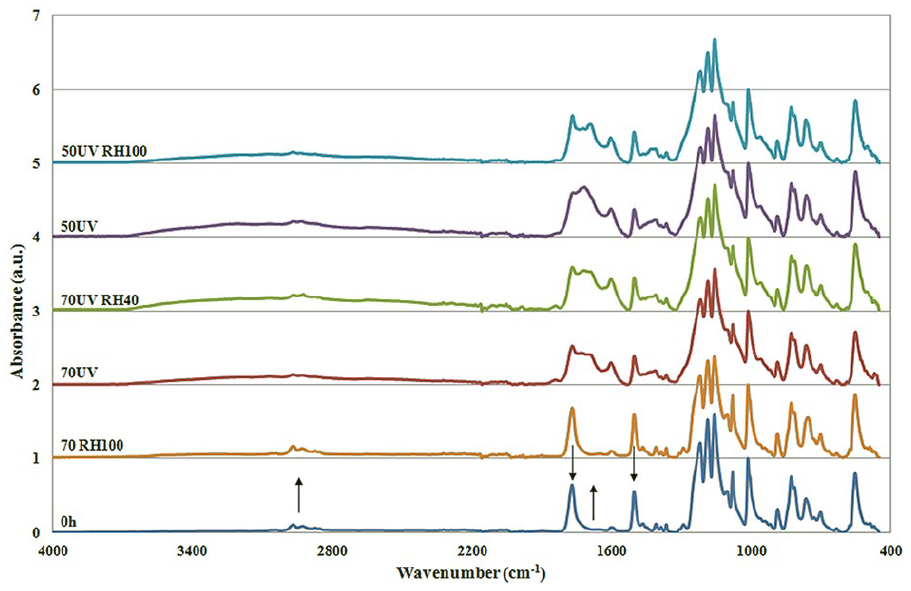
ATR spectra of virgin polycarbonate (PC) and after 528 h of irradiation.
This is better put in evidence in Figure 3, where the peaks at 1713 cm−1, considered by Rivaton and Gijsman15, 22 as aliphatic chain acids, have been reported as a function of the irradiation time.
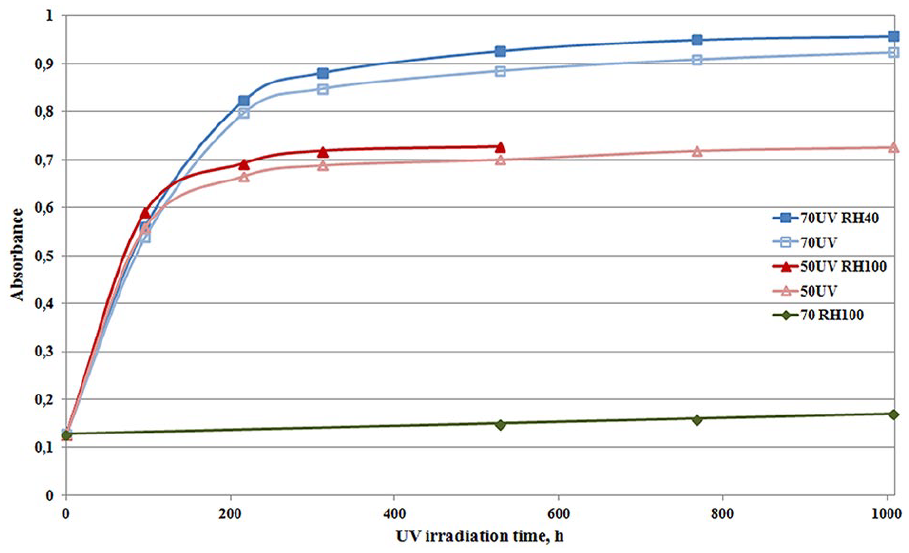
Height of the peak at 1713 cm−1 as a function of the irradiation time.
As the oxidation of PC can give rise to different oxidation species, in Figures 4 and 5 the area under the ATR curve between 1860–1500 cm−1 and in the range 3700–2400 cm−1 region are reported as a function of the irradiation time. In these spectra, the area was normalized with respect to the unit value given to the sample at zero time. All the oxidation species follow the same trend: they depend mainly on temperature, they increase alongside temperature, and they do not seem to depend on the level of humidity.
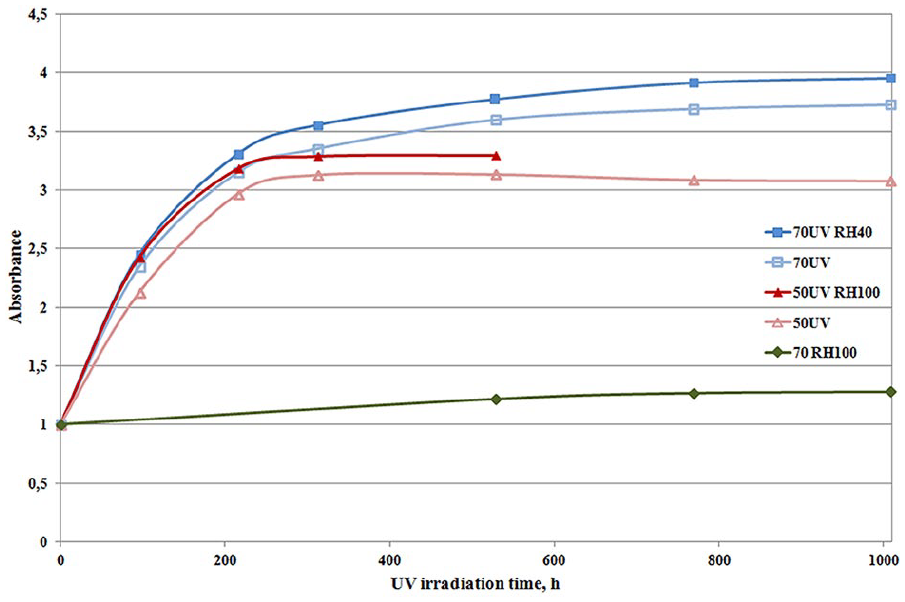
Normalized area of the peak in the region 1860–1500 cm−1 as a function of the irradiation time.
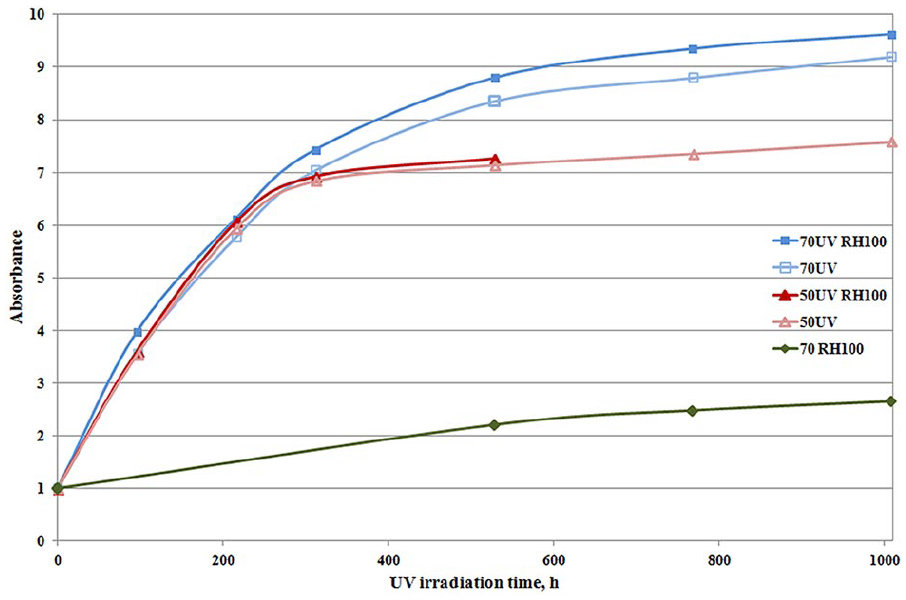
Normalized area of the peak in the region 3700–2400 cm−1 as a function of the irradiation time.
All the previous results seem to be in contradiction as the molecular weight is strongly dependent on the presence of humidity whereas the oxidation is dependent only on temperature. The photo-oxidation is certainly responsible for both the oxidation and reduction of molecular weight, whereas hydrolytic chain scission is responsible only for the decrease in molecular weight. It is then possible to argue that the two mechanisms, namely photo-oxidation and hydrolytic chain scission, are superimposable and seem to act separately without any significant or with very small interactions.
The degradation has a deep effect on the mechanical properties that can change dramatically during photo-oxidation. In Figures 6 and 7 TS and EB are reported as a function of the irradiation time.
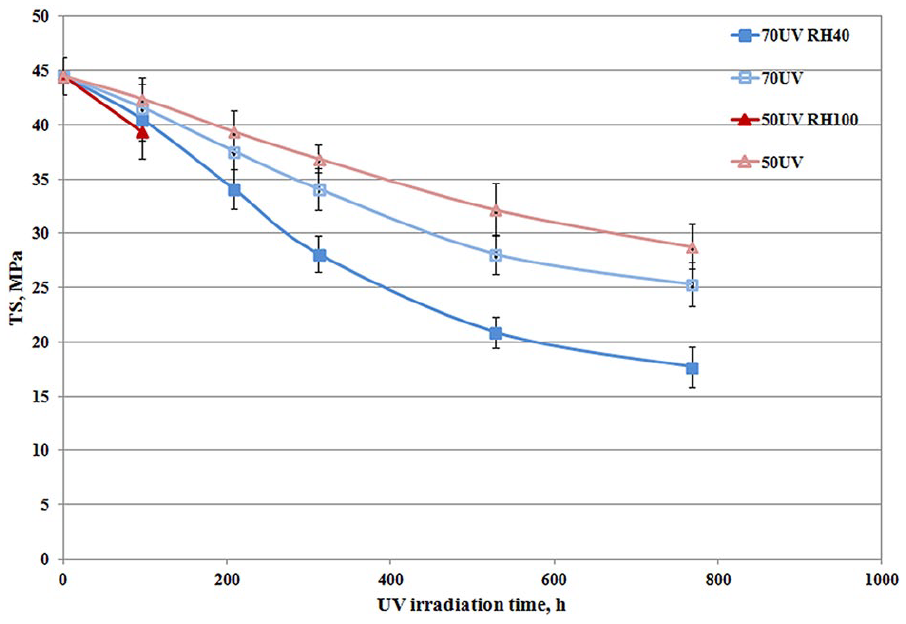
Tensile strength as a function of the ultraviolet (UV) irradiation time.
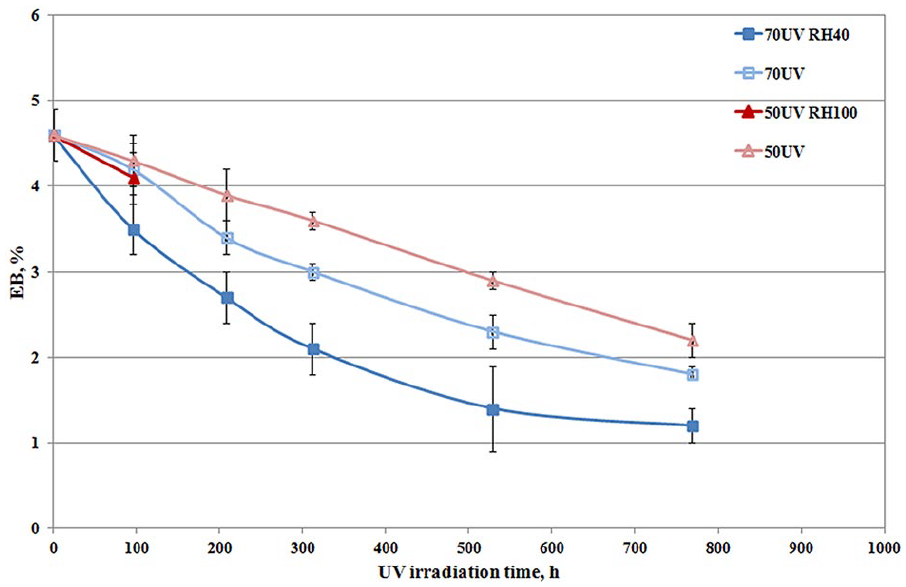
Elongation at break as a function of the ultraviolet (UV) irradiation time.
The tensile test of sample 50UVRH100 had a weathering time of 96 h because the specimens were too fragile for the mechanical tests of larger weathering times.
Due to the reduction of the molecular weight, the tensile strength decreases with the UV irradiation time. The reduction is more pronounced for the samples irradiated at a higher temperature and humidity.
The behavior is similar for the elongation at break, Figure 7. The PC becomes more fragile due to the reduction of molecular weight and, in particular, to the change of chemical structure of the polymer with the photo-oxidation, which causes a photo-oxidative damage localized within a few microns on the surface 31 with the creation of a “defect gradient” along the thickness that acts as a stress concentrator during the mechanical tests and causes the failure of the sample. 32
Due to PC’s use in covering cultural heritage sites, its optical properties take on a very important role. In particular, the light transmitted, the haze, and the YI can change with molecular differences undergone during photo-oxidation. These changes can worsen the usability and view of the cultural heritage sites protected by these sheets. In Table 2 the values of total light transmission (TLT), haze, and YI are reported. The TLT decreases then the transparency decreases with increasing severity of the photo-oxidative degradation and for the more degraded sheet it is about 10% lower than that measured for the virgin samples.
TLT, haze, and YI of PC samples.
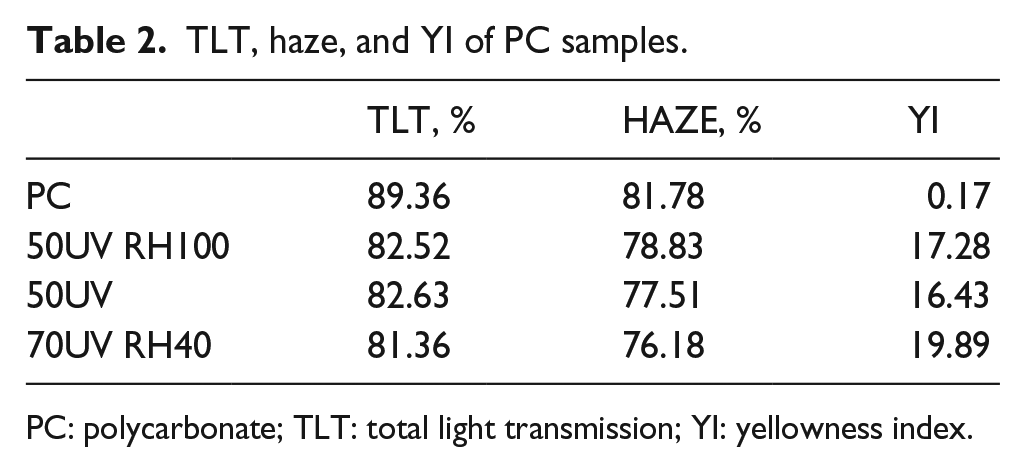
PC: polycarbonate; TLT: total light transmission; YI: yellowness index.
The YI remarkably increases even for the less-degraded samples. This is due to the formation of carbonyl groups that, as evident in Figure 3, increase immediately in a very short time and then become almost flat with a final value not too different between the different photo-oxidized samples. 8
Conclusions
PC is a good material for covering and protecting cultural heritage sites because of its durability, mechanical properties, and transparency. However, the contemporary action of UV irradiation, temperature, and humidity can cause dramatic degradation that gives rise to the loss of mechanical properties and transparency. In this work, the contemporary presence of UV irradiation, temperature, and humidity have been taken into account to study the environmental degradation of this polymer with regard to the properties that are important for this scope. The photo-oxidation reactions give rise to a decrease in molecular weight and the formation of many oxygenated species. The hydrolytic scission gives rise to a remarkable reduction in molecular weight. The two different degradation mechanisms do not seem to have any interaction. In particular, at the lowest degradation temperature and high humidity levels, the reduction of the molecular weight is more pronounced than that observed at the highest temperature but at lower humidity level. Considering the reduction of the molecular weight, the humidity seems to play a more important role than UV irradiation in the adopted experimental conditions. On the contrary, the UV radiation plays a more important role in the formation of oxygenated species that are not made because of the humidity level. The transparency decreases with the degradative processes but even after severe degradation, the loss of transparency is only about 10%. The YI increases during the first stages of degradation, which has been attributed to the fast formation of carbonyl groups due to photo-oxidation.
Footnotes
Acknowledgements
The authors would like to thank Dr. Marco Cascone and Ing. Augusto Balloni of AGRIPLAST for the optical measurements.
Declaration of Conflicting Interests
The author(s) declared no potential conflicts of interest with respect to the research, authorship, and/or publication of this article.
Funding
The author(s) disclosed receipt of the following financial support for the research, authorship, and/or publication of this article: This work was supported by MIUR, PRIN 2015WBEP3H “Monitoraggio, Consolidamento, Conservazione e Protezione di Beni Culturali”.
