




Abstract
Background:
This in-vitro study examined the impact of storage solution, storage duration, and storage temperature on discoloration of three tooth-colored CAD/CAM materials for final restorations.
Methods:
Specimens (N = 288; n = 96 per material) with a thickness of 1 ± 0.03 mm of the following CAD/CAM materials were fabricated: resin composite (Lava Ultimate, 3M), polymer-infiltrated ceramic (VITA Enamic, VITA Zahnfabrik), and leucite ceramic (IPS Empress CAD, Ivoclar Vivadent). After baseline measurement, specimens were stored in red wine, curry solution, cress solution, and distilled water at 37°C or 55°C. The discoloration was measured using a spectrophotometer (Lambda 35 Perkin Elmer, Perkin Elmer Inc.) after 1 and 7 days storage. Data were analyzed using four-way ANOVA followed by the Scheffé post-hoc test and partial eta squared (ηP²) test (p < 0.05).
Results:
The highest influence on ∆E was exerted by storage duration (ηP² = 0.295, p < 0.001), followed by storage solution (ηP² = 0.171, p < 0.001), CAD/CAM material (ηP² = 0.049, p < 0.001), and storage temperature (ηP² = 0.033, p < 0.001). Specimens stored for 7 days in staining solutions showed more discoloration than those stored for just 1 day. Higher ∆E values were achieved for specimens stored in curry solution, followed by red wine, cress solution, and distilled water. Resin composite Lava Ultimate showed larger ∆E values compared with the resin hybrid ceramic VITA Enamic and leucite ceramic IPS Empress CAD. Specimens stored at 37°C showed significantly less discoloration than those stored at 55°C.
Conclusions:
The degree of coloration of the materials depends on food and temperature and was most pronounced with Lava Ultimate.
The dental trend is toward highly esthetic tooth-colored restorations, preferably imitating a natural tooth appearance combined with minimally invasive tooth preparations. Thin restorations should provide sufficient mechanical strength as well as stable color matching. Besides the manual fabrication process, the computer-aided design and computer-aided manufacturing (CAD/CAM) technique offers restorations fabricated from polymer material blanks with improved mechanical properties, higher wear resistance, lower polymerization shrinkage, lower discoloration rates, and better biocompatibility than manually polymerized polymers.1–4 The improved material quality, with higher edge strength, for example, stems from an optimized fabrication process with a constant high pressure and temperature, making thin restorations for minimally invasive treatment options possible.1–4 With continuous development in this class of material, concerning its compositions, it further represents an alternative solution to ceramic restorations as a long-term possibility. Besides the mechanical aspect, optimal color stability is a key factor, after long-term intraoral use in the aqueous oral surrounding.
Polymer networks generally tend to absorb water,5, 6 which can lead not only to mechanical weakening, but also to higher discoloration rates with an esthetically compromised outcome through accumulation of various food colorants in the deeper material surface.7–9 The CAD/CAM polymers represent different compositions and variable percentages of matrix or filler components, depending on material type.1–4 The dental market offers, on the one hand, CAD/CAM materials based on poly(methyl methacrylate) (PMMA) with either pure or microfilled PMMA and, on the other hand, CAD/CAM polymers, such as nanohybrid composites with great variations in their polymer compositions, also including high-performance polymers, such as nanoceramic and polymer-infiltrated ceramic networks. These last-mentioned polymers should apparently exhibit different discoloration rates even in differently tempered food dissolutions. Discolorations can be distinguished as extrinsic, which are completely removable, or intrinsic discolorations. Intrinsic stains are deeper-reaching, consequently representing permanent material discoloration. 10 Discoloration diversities commonly depend on exogenic and endogenic factors and might lead to necessary final restoration replacement at higher discoloration rates. Exogenic factors can be the material’s surface properties, water absorption, dietary composition, and oral hygiene, whereas endogenic factors represent the polymer composition of matrix and fillers, as well as polymerization time.1, 11
There is little information in the current literature on the impact of storage temperature on a material’s discoloration. It could be conceivable that an elevated temperature (55°C versus 37°C) accelerates staining and thus reduces the storage times for in-vitro studies. Discoloration rates (∆E) can be analyzed using a spectrophotometer, considering ∆E values below 3.3 as clinically undetectable. 12 Hitherto, storage medium exerted the highest influence on ∆E, closely followed by CAD/CAM polymer or material. 13
The aim of this study was the investigation of color stability and the impact of differently tempered (37° or 55°C) food dissolutions on three different tooth-colored CAD/CAM materials for final restorations after 7 days storage in red wine, curry solution, cress solution, and distilled water. The tested hypotheses were:
All CAD/CAM materials show no impact of storage medium and aging level on discoloration rates (∆E) after 24 h and after 7 days storage at 37°C or 55°C.
After 24 h and after 7 days’ storage at 37°C or 55°C in red wine, curry solution, cress solution, and distilled water, the ∆E values of all tested CAD/CAM materials are in the same range.
Storage duration shows no impact on the discoloration of tested CAD/CAM materials.
Storage at different temperatures (37°C or 55°C) shows no difference in ∆E values.
Methods
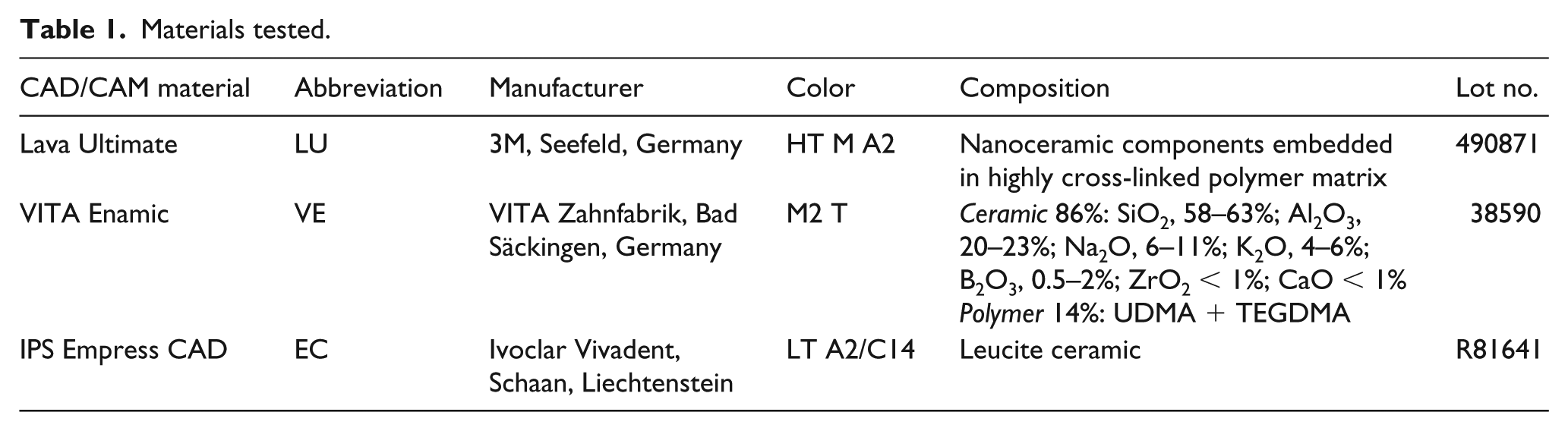
A total of 288 specimens (n = 96 per material; n = 12 per group) were fabricated from three different CAD/CAM materials (Table 1): a CAD/CAM resin composite (LU; Lava Ultimate, 3M, Seefeld, Germany), a CAD/CAM polymer-infiltrated ceramic (VE; VITA Enamic, VITA Zahnfabrik), and a CAD/CAM leucite ceramic (EC; IPS Empress CAD, Ivoclar Vivadent). Specimen fabrication and measurements in the in-vitro study were performed by one single examiner. The CAD/CAM blanks were mechanically cut (Secotom 50, Struers) into disc-shaped rectangular specimens under constant water cooling using a diamond cutting disc (Cut-off wheel M1D13, Struers) for an initial thickness of 1.4 mm (constant speed: 3500 r/min; forward feed: 0.13 mm/s). Afterwards, all specimens were mechanically polished according to a previous study 14 on both sides with ascending grinding diamond disks up to P4000 until a final thickness of 1 ± 0.03 mm was reached. The thickness was measured using an analog U-bolt (IP 65 Coolant proof, Mitutoyo Corp.). After cleaning in an ultrasonic bath filled with distilled water for 10 s and drying with a microfiber cloth (Wepa Professional), the color was immediately determined after fabrication (baseline) using a spectrophotometer before storage (Lambda 35 Perkin Elmer, Perkin Elmer Inc., Massachusetts, USA). After baseline measurement, each specimen was inserted in a polystyrene disk (Styropor) for upward positioning for complete wetting in the different storage media boxes (330 mm × 190 mm × 110 mm, Clear, Rotho). All specimens were stored in the respective test medium in a scaled chamber at a constant temperature of 37°C (Hera Cell 150, Heraeus) or 55°C (BE500, Memmert) and were divided into subgroups (n = 12) according to the storage media:
Red wine. La Tendo Rioja, 2012 (Bodegas Riovinsa, Alberite, Spain); pH = 3.65;
Curry solution. (Ostmann, Dissen a.T.W.) 40 g curry powder was boiled with 1 l of water for 10 min and then filtered through a fine tea strainer; pH=6.98;
Cress solution. 174 g tamped fresh cress was boiled with 1 l of water for 10 min and then filtered through a fine tea strainer; pH = 6.32;
Distilled water. (Aqua Bidest. Kerndl, Weissenfeld, Germany) pH = 6.44.
Materials tested.
The storage media were not changed and the specimens remained static during the 7 days of aging.
Color measurement
Color was measured initially to perform a baseline, as described, and after 1 day and 7 days storage, using a spectrophotometer (Lambda 35 Perkin Elmer, Perkin Elmer Inc.). The spectrophotometer was calibrated before each measurement to produce 100% transmission as a baseline for all values. Quantitative measurements were made of the definite transmission of light (wavelength varying between 400 and 700 nm; scan speed: 960 nm/min; slit width: 2 nm) through each specimen, respectively. Furthermore, the parameters L (brightness), a (red–green axis), and b (yellow–blue axis) were measured in front of a standardized white background. The transmission (illuminant D65) was calculated using the UV WinLab 2.8 software program (Perkin Elmer Inc.). All ∆E values were analyzed using the Color Application Software v. 1.00 (Perkin Elmer, Inc.) according to the following formula of ISO 12647 and ISO 13655, with respect to Euclidean distance
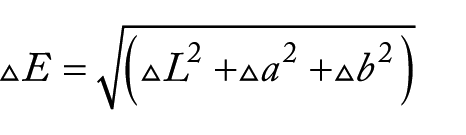
with ∆L, the difference in brightness, ∆a, the difference in the red–green axis, and ∆b, the difference in the yellow–blue axis.
Statistical analysis
The measured data were analyzed using descriptive statistics, such as mean and standard deviation, with 95% confidence intervals. The normality of the data distribution was tested using the Kolmogorov–Smirnov test. Four-way analysis of variance (ANOVA) followed by the Scheffé post-hoc test was computed to determine significant differences between CAD/CAM material, storage solution, storage temperature, and storage duration. The statistical analysis was performed using SPSS version 23.0 (SPSS Inc.). Statistical significance was considered for p < 0.05 in all tests performed.
Results
The highest influence on the ∆E values was exerted by storage duration (partial eta squared ηP² = 0.295, p < 0.001), followed by storage solution (ηP² = 0.171, p < 0.001), CAD/CAM material (ηP² = 0.049, p < 0.001), and storage temperature (ηP² = 0.033, p < 0.001) (Figure 1). The effect of the binary, ternary, or quaternary combinations of the four parameters was significant only for the combinations of storage solution with storage duration (ηP² = 0.151, p < 0.001), storage solution with storage temperature (ηP² = 0.067, p < 0.001), storage solution with CAD/CAM material (ηP² = 0.048, p < 0.001), storage duration with storage temperature (ηP² = 0.016, p < 0.001), storage temperature with CAD/CAM material (ηP² = 0.052, p < 0.001), and storage solution with storage duration coupled with storage temperature (ηP² = 0.040, p < 0.001).
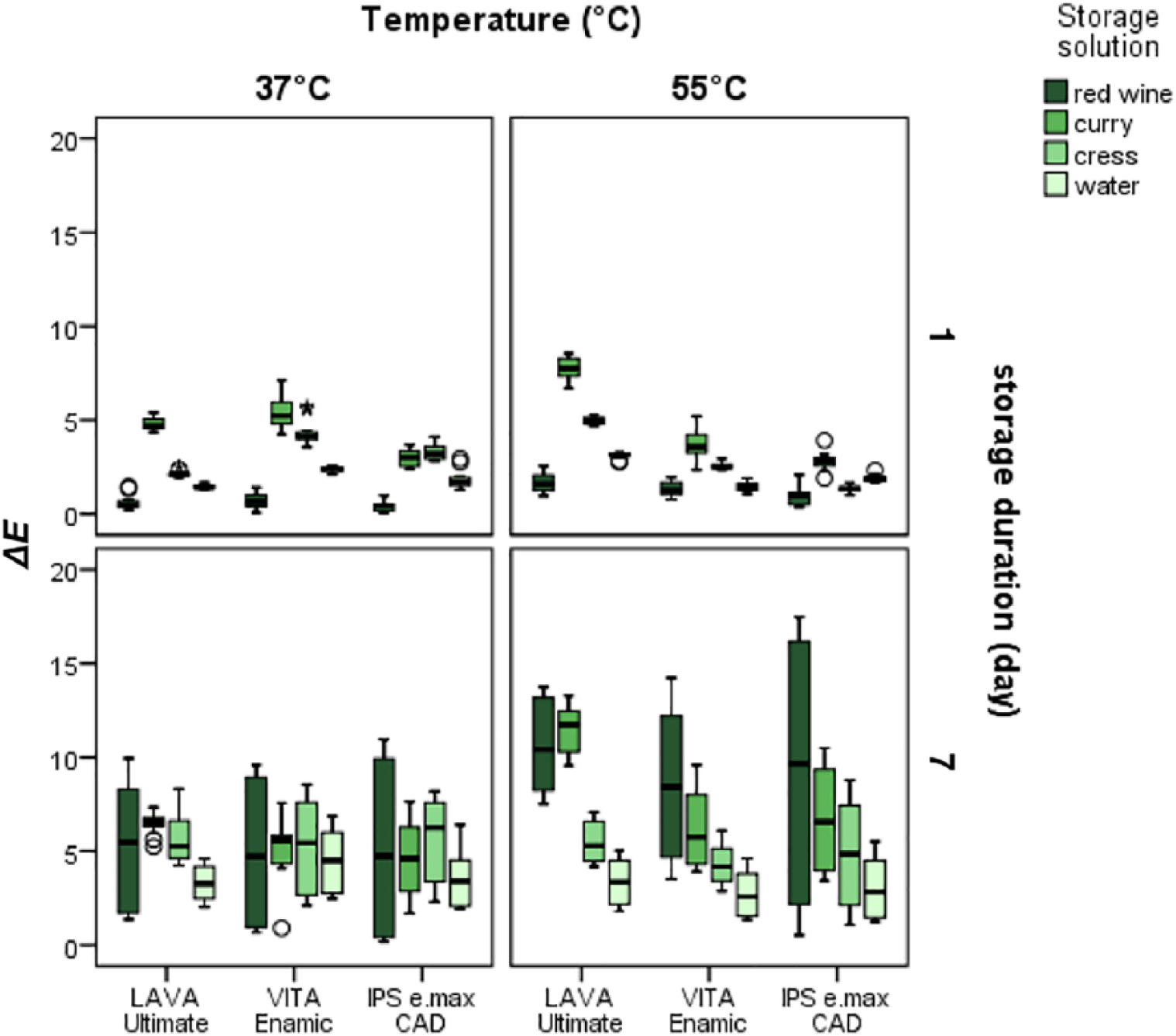
Presentation of all measured ∆E values using boxplot graphics.
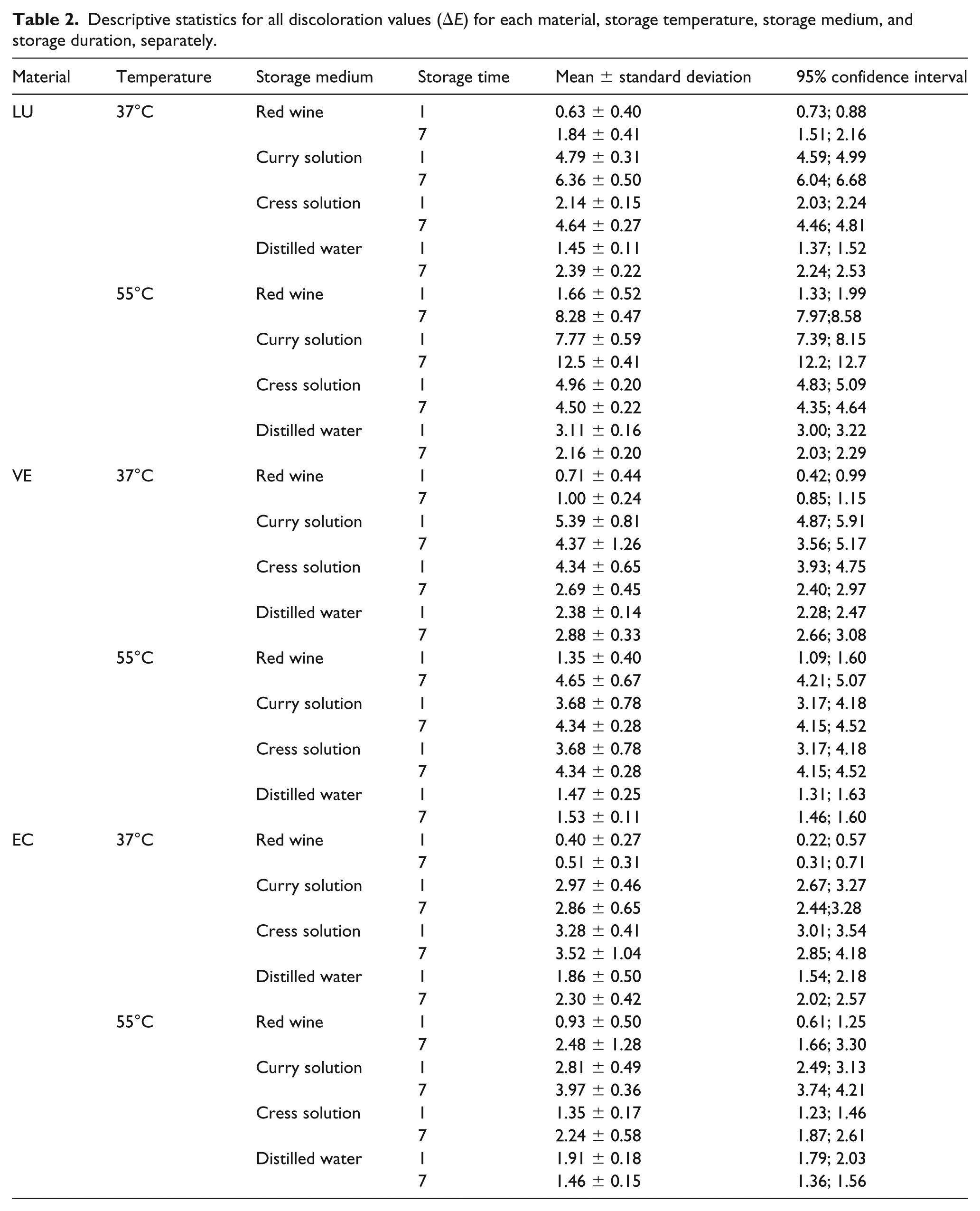
Specimens stored for 7 days in the solutions showed significantly more discoloration than those stored for only 1 day. In terms of the storage solution, significantly larger ∆E values were achieved when specimens were stored in curry solution, followed by red wine and cress solution. The lowest ∆E values were recorded for specimens stored in distilled water. Resin composite Lava Ultimate showed larger ∆E values compared with the resin hybrid ceramic VITA Enamic or leucite ceramic IPS Empress CAD. Specimens stored at 37°C showed significantly less discoloration than those stored at 55°C (Table 2).
Descriptive statistics for all discoloration values (ΔE) for each material, storage temperature, storage medium, and storage duration, separately.
Discussion
Over the last decade, the opportunity to fabricate the material class of polymers via a CAD/CAM technical process has opened a new treatment world for dentists and dental technicians. According to their mechanical and optical properties, this material class has changed from long-term provisional restorations to definite prosthetic treatment options. With the long-time use of these so-called high-performance polymers, reliable optical properties have become a subject of scientific focus. In-vitro studies have already been conducted to investigate the discoloration behavior of CAD/CAM polymers or resin-based cements after storage in different media.1, 11, 13, 15–17 These studies have focused mainly on discoloration measurements after aging in red wine,11, 13 coffee,11, 15 black tea, 11 and combined staining solutions 16 at one constant temperature (37°C). There are, however, hardly any studies that investigate the discoloration rates for storage in cress solution and curry solution stored at two different temperatures (37°C and 55°C), and these achieve comparable results.13, 17 In addition, investigations of the impact of different storage temperatures on the discoloration rates of CAD/CAM materials are not known to the authors. The highest ∆E values could be obtained for coffee, black tea, or red wine.1, 11, 13, 15–17 These results cannot be compared with the present results, since the highest values were obtained for specimens aged in curry solution, followed by red wine, cress solution, and distilled water after 7 days’ storage. The storage time of 7 days selected in this study corresponds to the requirements of the standard DIN EN ISO 4049. The authors chose this shortened period, in contrast to the studies already mentioned, since even continuous storage for 7 days in the different media does not comply with clinical reality, but is already different. Later in this section, transferability to the clinical situation is discussed in more detail. However, only one of the mentioned studies 13 used the same storage media, but the ΔE values were analyzed after 14 days of storage. It may well be that the storage in red wine shows an increased discoloration rate in relation to curry after an extended storage time. Curry solution consists of almost 100% dissolved curcumin powder. Red wine, in contrast, contains additional acids, such as lactic acid, which might lead to greater surface roughness and greater extrinsic discoloration. However, this could not be confirmed, but maybe would have had a higher impact for longer storage times. In the present study, storage in curry solution led to colorant deposits on the surface of the test specimen that were visible to the naked eye after a short time. Here, the specimens’ surfaces were only carefully dried with soft paper before the measurements in the spectrophotometer were carried out. The layer of curcumin still partly existed and consequently had an effect on the results. A stronger purification of the surface of the stored specimen could have significantly altered the results. None of the other storage media led to such deposits, but all ΔE values increased with increased storage time. This agrees with the results of the studies already mentioned.1, 11, 13, 15–17 It is well known that polymer-based materials absorb water molecules on the surface to different extents, and these are absorbed into deeper layers, contributing to the sorption and solubility of the material.5, 6, 18–20 The dye molecules can, in addition, be transported. It is clear that this is strongly related to the composition of the polymers, since water absorption takes place exclusively in the matrix of the polymers, especially at the OH− groups.5–7, 21, 22 With the increased storage time and increasing water intake, the deposits of the coloring molecules of cress solution and red wine could have influenced the ∆E values more than the superficial curcumin deposits, as compared with the other studies. For this purpose, further studies with the various CAD/CAM polymers should be carried to support the available results.
The CAD/CAM composite LU presented higher discoloration rates after 7 days’ storage than the polymer-infiltrated ceramic VE, followed by the ceramic control group in this study. These results are comparable to other investigations, in which the discoloration rates of VE and LU were also tested after 12 days and 7 days per 1 month of storage in a mixed staining solution (cranberry juice, coffee, and black tea) or coffee. All ∆E values of LU were greater than those of VE (coffee, 1 week, LU: 2.7 ± 0.3; VE: 0.8 ± 0.3 and staining solution, 12 days, LU: 1.51 ± 0.51; VE: 0.83 ± 0.41).15, 16 Compared with the present mean ∆E results of the specimens stored in red wine (LU: 1.84 ± 0.41 at 37°C and 8.28 ± 0.47 at 55°C; VE: 1.00 ± 0.24 at 37°C and 4.65 ± 0.67 at 55°C) and curry solution (LU: 6.36 ± 0.50 at 37°C and 12.5 ± 0.41 at 55°C; VE: 4.37 ± 1.26 at 37°C and 4.34 ± 0.28 at 55°C), the comparative studies mainly produced lower values. This could be due to the slightly different specimen fabrication and polishing of all studies performed. In addition, the transfer of the specimens from the storage media boxes and the different drying characteristics (light or hard wiping of the surfaces) contributes to these differences. Here, efforts should be made to carry out studies with more standardized conditions in order to obtain a better comparison. The fundamental difference in the discoloration rates of LU and VE lies in the different composition of the materials. On the one hand, VE consists of a ceramic fixed structure of 86%, which is infiltrated with 14% polymer content of urethane dimethacrylate (UDMA) and tri-ethylene-glycol-dimethacrylate (TEGDMA). Thus, the ceramic content of this material is very high. On the other hand, LU involves nanoceramic components embedded in highly cross-linked composite matrix. The polymer content is consequently higher than for VE. Since ceramic materials do not exhibit any water absorption and, therefore, no dye molecules can penetrate into the surface, it is not surprising that LU has higher ΔE values after storage. Even the low ΔE values of the ceramic control group are therefore traceable.
The different temperature-controlled storage in the staining media at 37°C and 55°C in this study should illustrate the impact of different temperatures on discoloration rates. For future studies, it would be desirable for the higher temperature to lead to more severe discoloration. This could only be confirmed to a limited extent and should be investigated further in future studies. The results of this study showed that ΔE values were lower at 37°C than at 55°C. Also, storage time generally had the highest effect on the ΔE values, followed by storage medium, restorative material, and temperature. These results could be different under extended storage and should be investigated in further studies. In summary, all tested hypotheses could be rejected.
A further limitation of the study is the 1 day storage in the various storage media. In the case of food intake, absorbed beverages or solid food components are diluted rapidly by the human saliva. On the one hand, the solutions can only be applied to the restorative materials in pure form, and these are quickly swallowed intraorally. On the other hand, the temperature fluctuations of hot drinks and hot food also tend to have a short-term impact. Therefore, the 1 day storage represents an extreme situation, which does not completely correspond to clinical reality. This should definitely be further investigated in in-vivo studies. With the materials used as long-term restorations, knowledge about different discoloration behavior is essential for the dental team.
Conclusions
Within the limitations of this in-vitro study, some conclusions could be drawn:
The longer the storage duration, the more intense the discoloration.
Storage in curry solution showed the highest discoloration rates.
The resin composite Lava Ultimate showed higher ∆E values compared with the remaining tested materials.
Specimens stored at 37°C showed significantly less discolorations than those stored at 55°C.
Footnotes
Declaration of conflicting interests
The author(s) declared no potential conflicts of interest with respect to the research, authorship, and/or publication of this article.
Funding
The author(s) received no financial support for the research, authorship, and/or publication of this article.