




Abstract
Introduction:
Printing inks oil selection is related to the desired nature of the varnish in the ink production. Petroleum-derived mineral oils and vegetable oils can be used in offset inks.
Methods:
In this study, the behaviors of vegetable- and mineral oil-based inks on uncoated and coated paper surfaces were investigated in terms of printability. Solid tone test prints were done with offset printing of these inks. Print gloss of the printed samples was measured and a light fastness test was implemented on these samples in order to determine the resistance to fading. Absorption behavior and contact angles of the ink-printed films on the test papers were measured with the sessile water drop method depending on time, and surface energies were calculated.
Results:
On both paper types, linseed–soybean oil-based vegetable ink gave the highest brightness value. The lowest print gloss results on the paper were obtained from soybean oil-based inks. The lowest color change was recorded with mineral oil-based inks on gloss-coated papers. According to the ink-film–surface relation, when the contact angle is high, surface energy decreases and the absorbency of the ink-film is lower.
Conclusions:
In this study, the behaviors of vegetable- and mineral oil-based inks on different paper surfaces, and the effect on the quality of printability as well as differences, have been evaluated, taking environmental and health factors into consideration.
Introduction
Printing inks basically consist of a carrier medium (such as water, solvent, or oil), colorant (pigment or dyestuff) and also a binder (resin). 1 Print substrate and printing type are determining factors in ingredients of inks. In the production of offset lithographic printing ink, drying vegetable oil—such as linseed, tung, oticia, and olive—and non-drying petroleum minerals at different resolutions are used. 2 In the making of offset printing ink varnish, nonvolatile oils serve as a solvent for the solid resins and bring important characteristics to the alkyd resins. Oil selection is related to the desired nature of the varnish in the ink production. Petroleum-derived mineral oils are aliphatic solvents and mainly naphthenic and paraffinic ones are used in ink. A typical sheet-fed offset lithography printing ink contains 50–70% mineral or vegetable oil as a solvent.
A lot of raw materials are used in the production of printing ink and the number of these materials is increasing continuously. Until recently, companies that produce printing ink used to obtain the raw materials, except the solvent, from natural products. Today, synthetic products produced by the chemical industry have taken the place of natural products in many areas. However, because synthetic products cause environmental and health problems, the demand is increasing for natural products. For this reason, nowadays the use of synthetically structured mineral oil is decreasing. 3 Petroleum-based oils are known to emit volatile compounds harmful to the environment, all creatures, and humans, and to cause problems in recycling print substrates.
The most important vegetable inks are mainly produced from soybean and linseed oil. Soybean oil is generally preferred due to its compatibility with the ink system and lower price. Other vegetable oils used in ink production are utilized for their different rich compositions and features. The Soybean Association reported in 1988 that the supply of vegetable oils was too limited in the early 1970s, so petroleum products took the lead in the ink production market. 4 Thanks to technology advancements and developments, today oil-producing plants are cultivated in huge amounts, and oils are easily extracted and refined to desired quality. 2
Mineral oils present in the print substrate tend to settle rapidly and also display saponification, as well as causing pollution during the printing process. 5 Mineral oil-based inks should contain some solvents for dissolving rosin, as this ingredient gives lower viscosity values. By comparison, vegetable-based inks require non-harmful solvents and do not cause operational problems in processes such as cleaning. Some water and a little solvent are enough to clean machinery after printing. 6
Today’s regulations and requirements regulate the use of harmful organic chemicals (volatile organic compounds, or VOCs) in ink and dyes to prevent solvent emissions. VOCs, which evaporate and expand at room temperature, are chemicals with high vapor pressures. 7 Harmful organic compounds are usually associated with global warming due to their greenhouse effect. For this reason, ink manufacturers are moving in the direction of organic oily inks because of the harm caused by these gas-emitting materials. Current environmental concerns and legislation principally target reduction and ultimately elimination of solvent emissions, expressed as volatile organic content, from paints and printing inks. 8 There is now consumer pressure to use renewable rather than petroleum-based resources. 9 Therefore, the reduction of VOCs in petroleum-based printing inks to meet environmental regulations without sacrificing functional properties presents a technical challenge.8,10
One of the major alternatives is to use vegetable oil-based products as bio-renewable raw materials. On cost grounds, these oils can compete well with the petrochemical-derived ingredients normally used to form polymers. Particularly in the printing ink industry, pressure has been created in the last few years to replace the mineral oil in inks with vegetable oils and their derivatives. 8
Since the evaporation point is higher, the inks produced with vegetable oils have less oil, and so fewer harmful organic compound emissions. 11
When buying food, end users of the product decide by looking at the taste, robustness for a long time, low cost, having no health risk, and being nature compatible. Vegetable oils are less scented than mineral oil-based inks. 3 Vegetable oil’s general use in food is another factor that gives users a sense of safety about the production of ink. For these reasons, instead of mineral oils our goal is to formulate, produce, and increase the use of VOC-free offset printing ink. 8
Although vegetable oil-based inks can be more advantageous in terms of health and environment than mineral oil-based inks, the effect of sheet-fed offset printing ink with different oil content on printability behaviors and printing quality in the print substrate has not been studied enough. The objective of this study is to determine the printability characteristics of offset printing inks containing mineral oil, soybean oil, and linseed–soybean oil. Printability evaluations on papers with specified surface properties were carried out according to the criteria of gloss contrast, light fastness water absorption of the printed ink-film, surface energy, and contact angle.
Methods
In this study, gloss-coated paper and wood-free uncoated papers were used as the print substrate. The properties of the paper surface were determined following TAPPI (Technical Association of the Pulp and Paper Industry) and ISO (International Organization for Standardization) test methods. Roughness was measured using a Bendtsen roughness tester and Parker Print-Surf (PPS) as per ISO 8791-2 and ISO 8791-4 respectively. Gloss of paper was determined using a micro-gloss 75° with BYK-Gardner GmbH Geretsried Germany, according to TAPPI T480 om-92. The characteristics on printed and non-printed paper surfaces were determined with volume change and contact angle (TAPPI T558 om-97). Measures functions of time (50 data/min.) were determined using distilled water as the wetting liquid (sessile water droplet method) İn a TMI Pocket Goniometer Model PG-X (FIBRO Systems AB Stockholm, Sweden). Images of water droplets were recorded using a charge-coupled device (CCD) video camera. Surface “free” energy (SFE) was calculated according to the ASTM D5946-0 standard test method, depending on the contact angle.
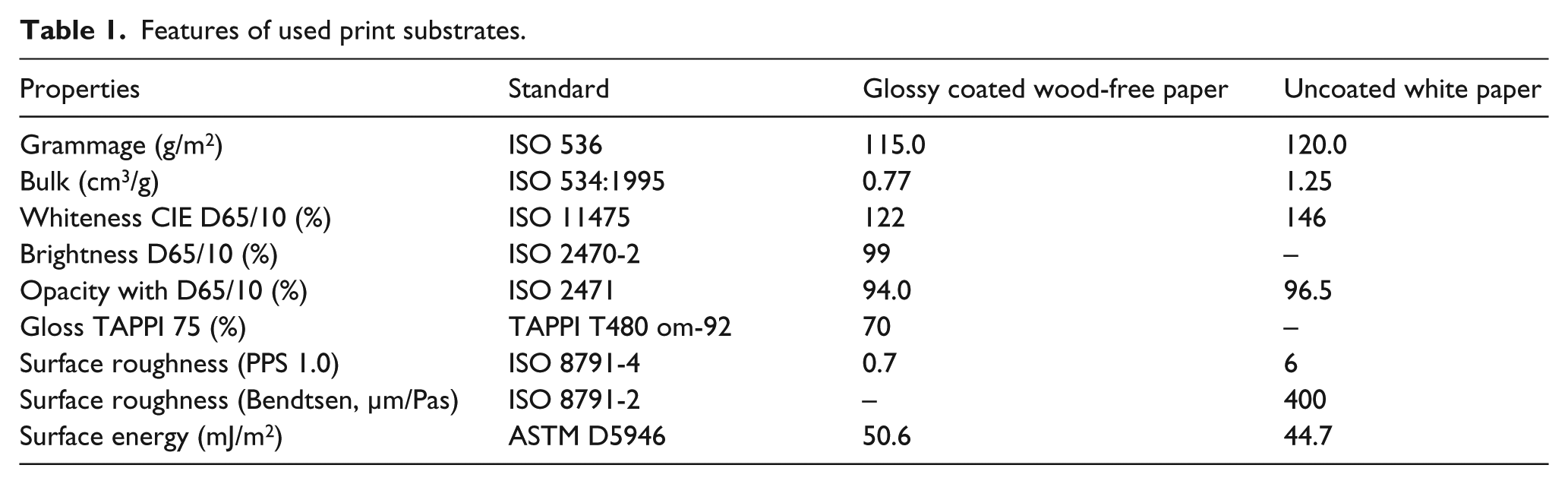
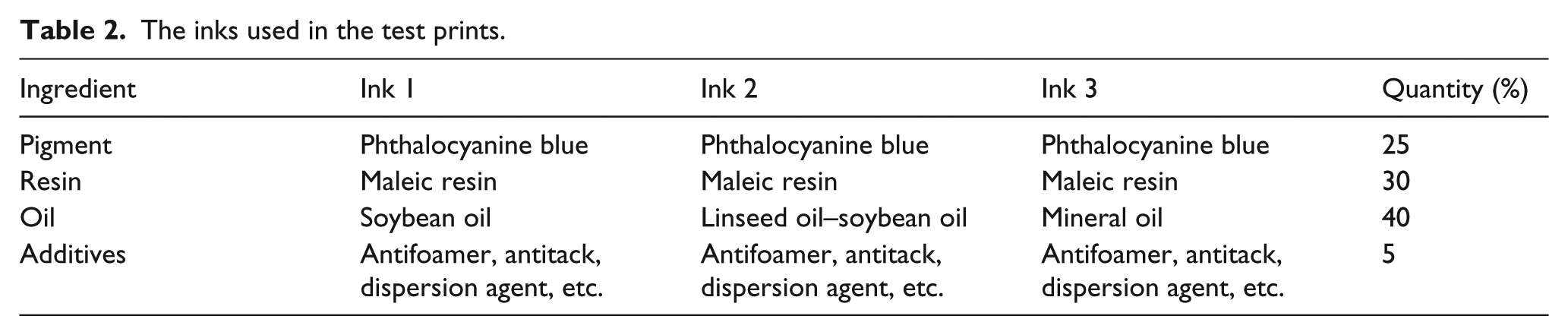
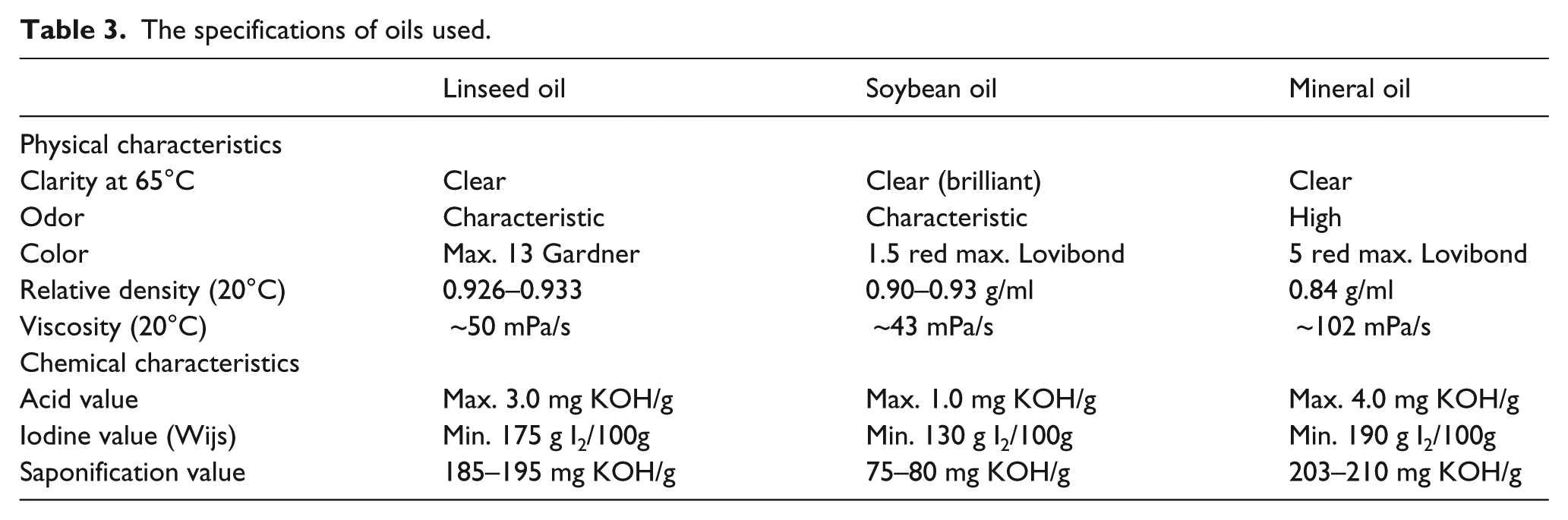
The features of glossy coated, wood-free paper and uncoated, white papers used in this study are given in Table 1. The details of the three different process cyan layers containing different oils are given in Table 2. The specifications of the oils used are given in Table 3.
Features of used print substrates.
The inks used in the test prints.
The specifications of oils used.
Papers were conditioned before printing at 23 ± 1°C and 50 ± 3% relative humidity for 24 hours. Solid printing was done on glossy coated, wood-free and uncoated white papers with three different offset printing inks (process cyan color) in line with ISO 2846-1 standards and containing soybean oil, 50% linseed and 50% soybean oil, and mineral oil. These were left to dry under print room conditions. Test printing was carried out using a Komori LITHRONE LS 540 H Model 5 color unit offset printing machine Tokyo, Japan at 10,000 layer/hour print speed in accordance with ISO 12647-2:2004.
Standard conditions were preserved in the measurements after printing. The CIE L*a*b* (CIELAB) colorimetry of the test prints was carried out with a x-rite Gretag Macbeth SpectroEye Spectrophotometer Michigan, USA using a Gretag control strip. The measurements were performed using D50 illuminant, and 2° observer on 0/45 geometry and white backing specified by CGATS.5 for 192 hours periodically. Over the same period of time, changes to the print gloss were measured at a micro-TRI-gloss 60° angle using the BYK-Gardner GmbH Geretsried, Germany Glossmeter.
Lightfastness measurements of the inks used in test printing were made in accordance with British Standards (BS) 4321. Printing samples were kept in the light fastness cabin for 192 hours and evaluated according to the Blue Wool Scale (BWS). Changes in CIELAB values of inks were recorded before and after the test and color differences (ΔE*ab) in three-dimensional color space were calculated mathematically.
Results
Printability properties
Gloss contrast
The quality of an ink-film can be described by optical properties such as gloss and optical color density. These optical properties are determined by parameters relating to the surface of the film and are influenced by the film setting. 12
Gloss value, which relates to quality and printability features, is directly related to the oil in the print ink. It is known that the type and quality of oil affect the brightness value, which is important in terms of the printability of ink. In order to detect this effect, printing with different oil-content inks was carried out on different papers with different surfaces.
Brightness values belonging to solid prints made on glossy coated wood-free paper and uncoated white paper with soybean oil, linseed–soybean oil, and mineral oil inks are shown in Figure 1. There are big differences in print gloss depending on ink content in both paper types. On both paper types, linseed–soybean oil-based vegetable ink gave the highest brightness value. The lowest print gloss results were obtained from soybean oil-based inks. When mineral oil-based ink is compared to the vegetable inks, on both paper types mid-level brightness results were obtained. As a result, linseed oil was recorded as increasing the brightness.
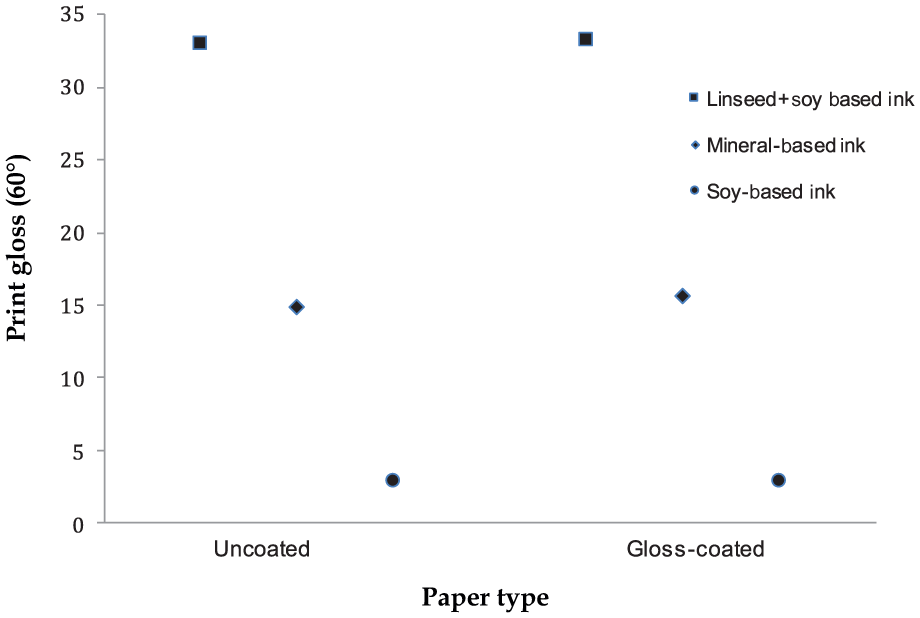
Print gloss changes of different inks on coated and uncoated papers.
The print gloss difference between inks is closely related to the molecular lengths of ink solvents, evaporation temperatures and ink drying speed. Linseed oil is a fast-drying oil, so it gives the fastest-drying ink for printing. With quick-drying ink, the liquid phase of the ink solidifies on the surface before the paper gets very wet and ink components can penetrate the paper. Accordingly, the print gloss of these inks was high on two papers because a greater amount of oil remains on the surface.
Lightfastness
Changes in ink color occurs over the long term when printed materials are exposed to daylight. The smaller the change, the better printability quality. In this study, lightfastness tests were performed according to the BWS, CIELAB values of ink-films were measured, and ΔE values of colors were calculated before and after lightfastness tests with a spectrometer in order to determine differences in color changes between vegetable and mineral inks over the same time period.
The smallest color change was recorded for mineral oil-based inks on gloss-coated papers, whereas for soy-based inks it was on uncoated paper. Flotation of the ink on the surface of glossy paper is lower than for the uncoated white paper, and in the mineral oil structure there are fewer double bonds than in the structure of vegetable oil. Since these inks have more molecules that will undergo oxidation over time, they form a duller surface. This increases the difference in color changes. The least change occurred in the mineral oil-based ink, which contains the fewest double bonds. However, the effect of oil on color changes decreased on the white paper as oil in the ink penetrated the paper. When the oil is lower on to the paper surface, the oxidative polymerization is low and penetration of oil is minimum. In this, pigments are not drags into the paper. This effects lower color change. Thus, color change on the uncoated, white paper is lower in soybean oil and higher in mineral oil.
Volume change
In order to measure the behavior of printed ink-film surface absorption, the sessile water droplet method was used. The volume of the droplet and the contact angle were calculated using the algorithms available in the measuring device. These calculations were based on the measurements of the profile of the sessile droplet and on the assumption that the profile of the droplet is a circle (or ellipse in some cases). 13 Volume changes of distilled water droplets sitting on the surface of test samples over time provided excellent information on water absorbency properties of printed ink-film.
The paper used for offset printing should have a certain level of absorption to give the ink good adhesion. Achieving the second consecutive printing is also important for the adhesion of the printed ink. The level of absorption of the printing ink should not be too high. The absorption is an important property of the printing process. 14
In the process printing, the speed of absorption is determined by the time that the second color ink (e.g. magenta) needs to penetrate into the first printed color ink film (e.g. cyan). For the offset process this property is very important. If absorption is too slow, it may result in smearing because the ink does not dry fast enough. If absorption is too fast, it may have a negative impact on the dry ink properties.
During the time-dependent measurements of the volume change with the sessile drop method on the test printed areas with the linseed–soybean oil-based ink on coated and uncoated paper surfaces, it was identified that liquid absorption was reduced on both papers. It was observed that soybean oil-based ink has more absorption on both paper types compared to the other inks. The liquid absorption of printed ink-film with mineral oil-based inks was observed to be at the mid-point on both paper types when compared with the other inks (Figures 2 and 3). According to the results of this study, linseed oil printed on coated and uncoated papers resists liquids, reducing absorption; it can be said that this should be taken into consideration for prints on top of other inks and packaging products.
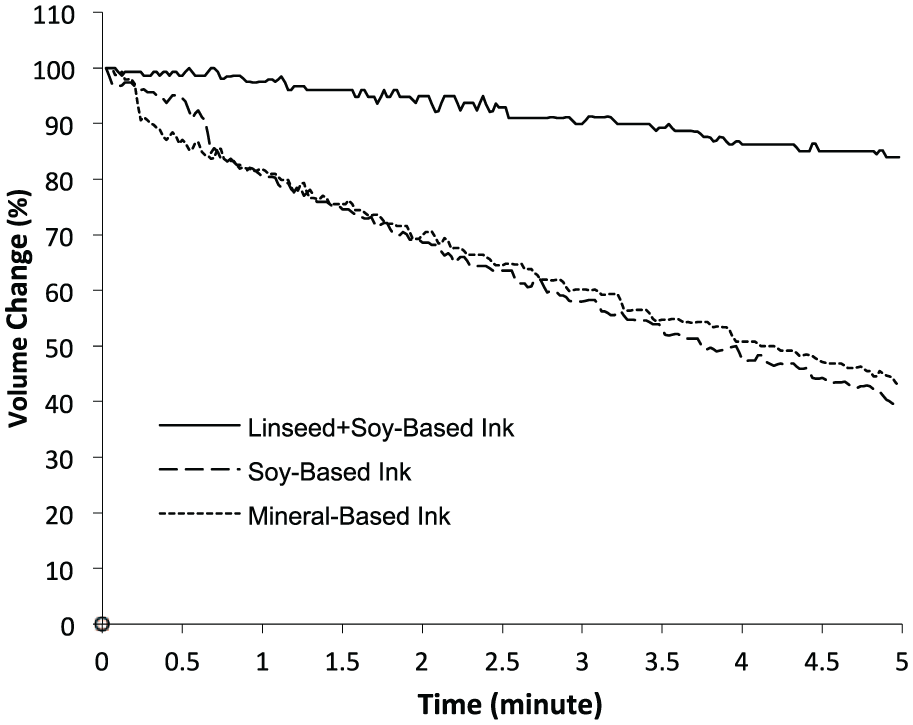
Drop volume change curves on gloss-coated paper printed ink-film surfaces.
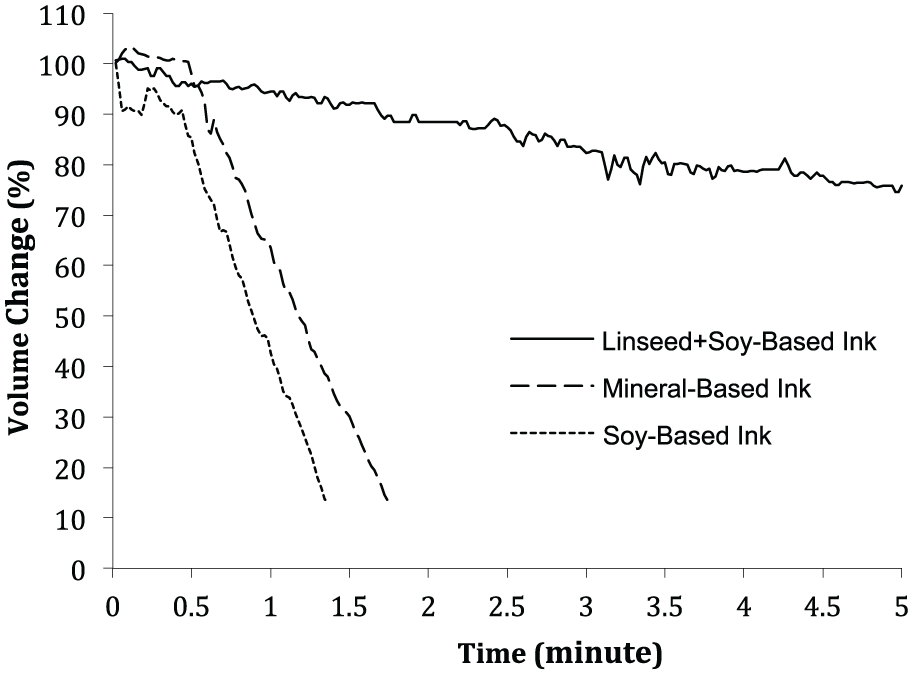
Drop volume change curves on uncoated paper printed ink-film surfaces.
Wettability is an important property of the substrate. In this study, the wettability was determined using an automated contact angle with water. Images of water droplets were recorded using a CCD video camera (Figure 4).
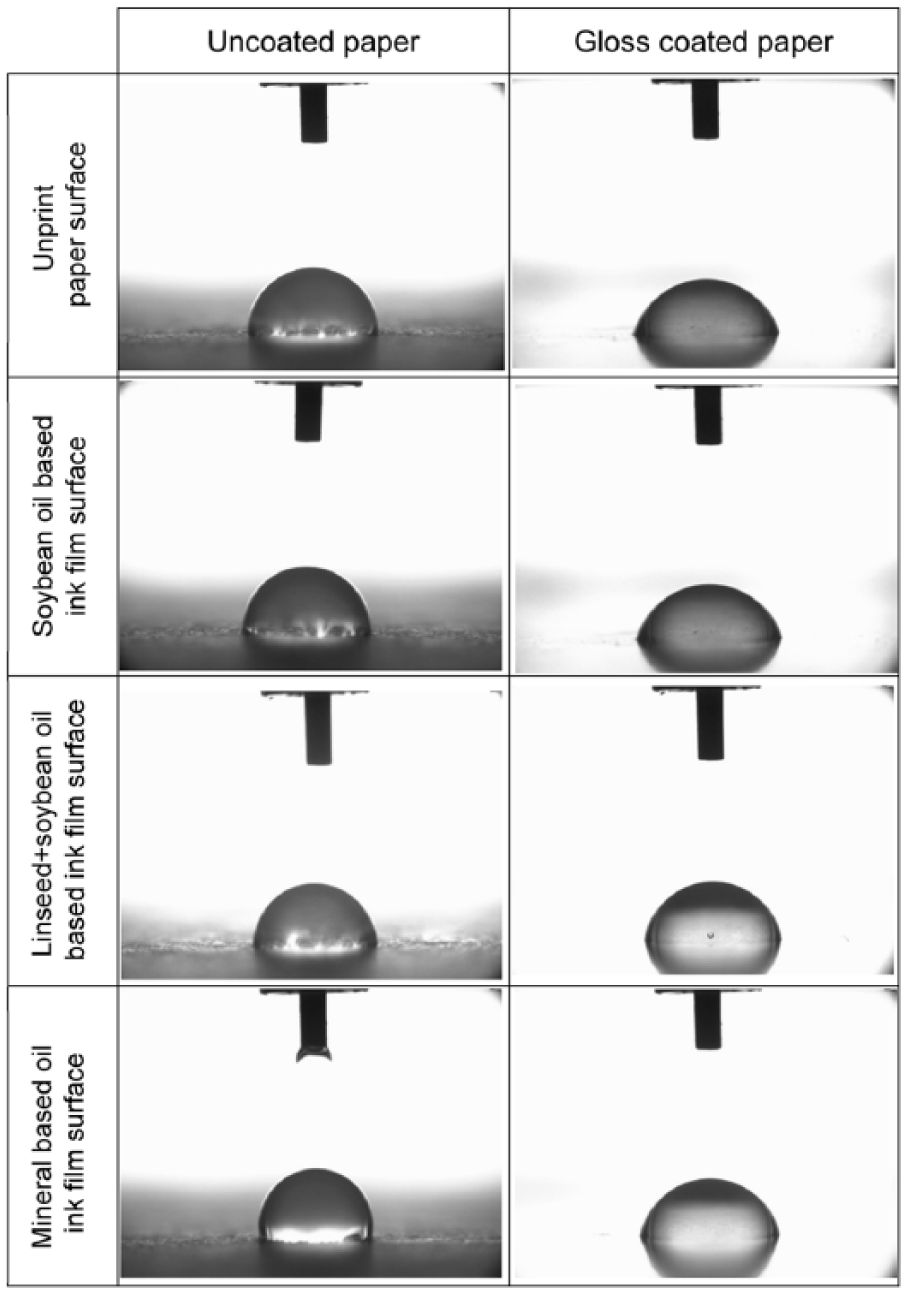
Water drops on the same, but differently prepared, ink-film.
Contact angle
The area of contact between an ink droplet and print substrate surface is expanded parallel to ink spreading, which is defined as the tone value. The ink on a paper surface simultaneously travels in both vertical and horizontal directions.1,15,16
To determine the absorptive capacity of printed paper for liquid, it is necessary to define clearly which liquid it concerns, how long the contact time will be, and under what conditions the test is implemented. In most cases in which a liquid droplet is applied to a solid material, an angle is formed at the point of contact between the droplet and solid—the so-called wettability angle or contact angle. This contact angle is an indication of the wetting performance of liquids applied to solids. This contact angle must be determined immediately, because the liquid could penetrate rapidly into the pores of the printed ink-film surface. Many printing inks, oils, paraffins, and similar products have a rather low surface tension and spreading immediately on the surface. 14
Surface energy
The surface energy of paper is commonly determined by contact angle measurement. SFE is the force available on a solid surface to attract liquid molecules. In contrast to surface tension, SFE cannot be measured from an observation; it has to be calculated from contact angle measurements.
The contact angle shows the relationship between the contraction force (surface tension), which holds the liquid molecules together, and the attraction force (SFE), which tries to conquer liquid molecules with its free bonds at the surface. To reduce the contact angle, one can reduce the surface tension or increase the SFE, or both. Addition of surface active agents (surfactants) will lower the surface tension. 17
In the measurements carried out for ink-film surfaces printed on glossy coated papers used in this study, it was realized that there is a relation between contact angle, surface energy, and absorption. According to this relation, when the contact angle is high, surface energy decreases and absorbency of the ink-film lowers (Figures 2, 5, and 6).
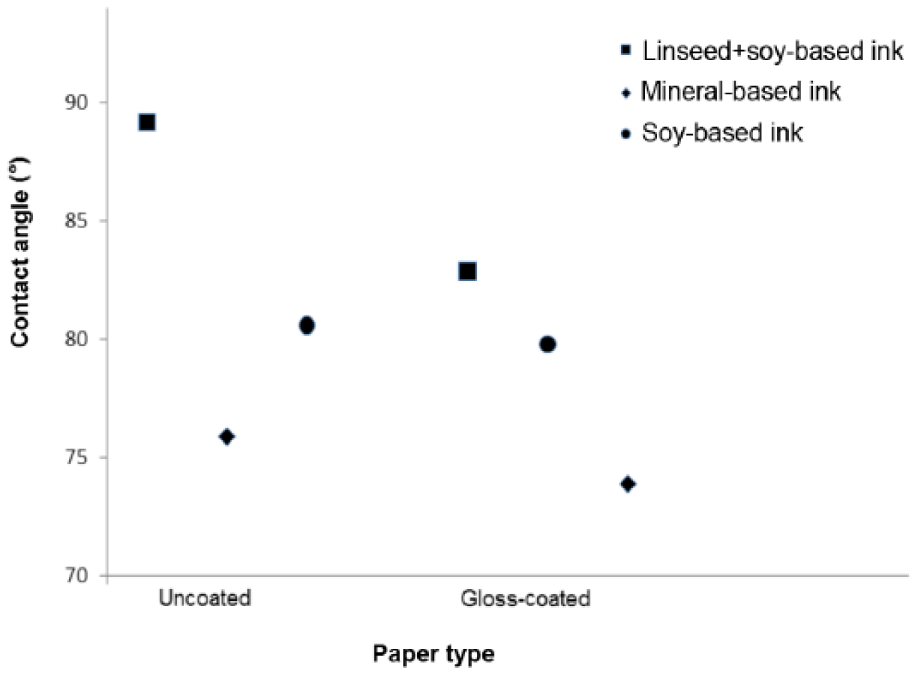
Contact angle, uncoated and gloss-coated papers.
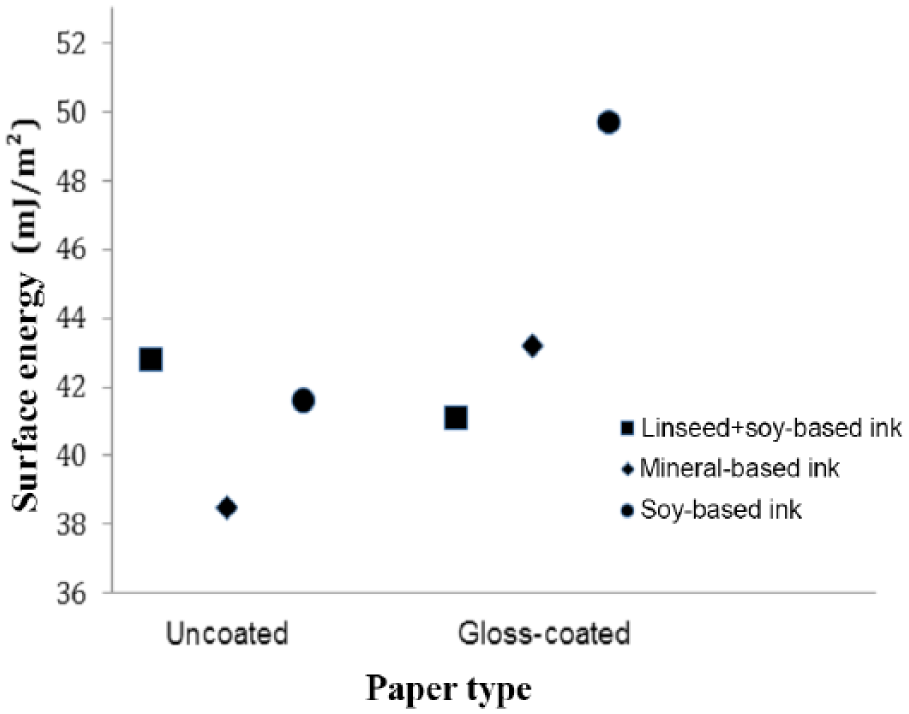
Printed ink-film surface energy, uncoated and gloss-coated papers.
Conclusions
On the coated and uncoated papers, the linseed–soybean oil-based ink-films showed the lowest absorption, while the soybean oil-based ink-film showed the highest. When considered in terms of overprinting or printing on surfaces that use water-based coating practices, linseed oil is a factor in reducing the absorbency of the ink.
It was determined that vegetable inks containing linseed oil, in particular, are more glossy than mineral oil-based inks on all types of paper. From this result, it is understood that fast-drying linseed oil is an effective factor for glossy printing. For all paper types for which high printing brightness is expected, inks that have a fast-drying solvent oil component such as linseed oil should be used.
In terms of lightfastness, mineral oil-based inks undergo less change in color on coated papers, while vegetable oil-based inks undergo less change in color on uncoated papers.
Since oils in the content of the ink affect different aspects of printing, when desired features cannot be met with one vegetable oil, hybrid inks should be produced by mixing two or more vegetable oils.
What is expected from printing ink is quality, being trouble-free, economical, and efficient. Because vegetable and mineral oil-based inks show similar printing performances on coated and uncoated papers in terms of printing quality, the determinant for ink choice should be the environment and health.
Oils used in ink production should be preferred according to their environmental impact, ease of recycling, problem-free printing, and having little impact on taste and smell, especially for food packaging.
According to this study, today the use of vegetable-based printing inks is relatively low compared to mineral oil-based inks. Due to increasing environmental and health problems, petroleum-derived mineral oil-based inks should be replaced by vegetable-based inks.
The use of vegetable oil-based inks should be a target to aim for and should be encouraged for reasons such as being eco-friendly, not containing harmful VOCs, not posing serious side effects through food contact, use of easy, practical, and economic machinery, easy equipment cleaning and operation, being organic and renewable, and being preferred in the packaging industry because of their use in food.
Footnotes
Declaration of Conflicting Interests
The author(s) declared no potential conflicts of interest with respect to the research, authorship, and/or publication of this article.
Funding
The author(s) received no financial support for the research, authorship, and/or publication of this article.