



Abstract
Background:
The Information Mobilized for Performance Analysis and Continuous Transformation (IMPACT) approach model was introduced to promote the generation and utilization of quality data for evidence-based decision-making. Thus, this study aimed to determine the influence of the IMPACT approach and healthcare workers’ knowledge on the availability of antenatal care (ANC) commodities.
Methods:
The research was carried out from July to August 2023 in Itilima District, Simiyu, Tanzania. Mixed methods were employed in a quasi-experimental and case study design. The data were collected by a self-administered questionnaire and complemented by in-depth interviews for the qualitative component. Longitudinal changes were assessed via paired sample t-tests.
Results:
Of 90 participants in a quantitative design, the majority (64.8%) reported having good knowledge of the IMPACT approach. All health facilities had adequate stock of ANC health commodities. Compared to the baseline year, that is, 2019, significant differences were observed in the performance trends, particularly in 2022, with a mean (SD) of 17.1 ± 36.0, p < 0.001. The qualitative findings indicate that awareness of the IMPACT approach is widespread among healthcare workers, with most describing it as a tool for strengthening data-driven decision-making and improving supply chain visibility.
Conclusion:
This study revealed that most healthcare workers have good knowledge of the IMPACT approach. The IMPACT approach was reported to improve the availability of ANC commodities. A strong emphasis should be placed on the use of health commodities data for decision-making.
Introduction
The majority of maternal deaths can be avoided since clinically proven methods to prevent or manage potential complications are well understood. Antenatal care (ANC) refers to the routine health services provided to pregnant women to prevent, detect, and manage pregnancy-related complications. Therefore, ANC must be accessible to all women. 1 In settings with scarce resources, where rates of pregnancy-related death and morbidity are most prevalent, the potential advantages of ANC are most noteworthy. 2 Although there is an evident need for access to reproductive health commodities, supply chain challenges and unavailability have prevented access from becoming fully achieved. Less than 50% of ANC commodities were reported to be available in sub-Saharan Africa (SSA) in the previous research. 3
In Tanzania, challenges such as limited verification of reported health-facility data, weak feedback mechanisms, and inconsistent use of data for planning have hindered accountability. These gaps often result in delays in identifying stock-outs, poor quantification, and limited corrective actions. 4 The scarcity of necessary ANC items has been caused by stock-outs, wastage, expiry, and pilferage. 5 This prompted the Tanzanian government to adopt the Information Mobilized for Performance Analysis and Continuous Transformation (IMPACT) approach model in 2018 to instill a data-use culture.6,7 The approach guides healthcare workers on how to use data to plan, quantify, and procure health commodities in the right way. Healthcare workers’ knowledge regarding the IMPACT approach is a critical determinant of its success in improving the availability of medicines. 8
Previous studies that were conducted in Tanzania reported on the influence of the IMPACT approach in financial resource mobilization to improve the availability of essential health commodities and its role in minimizing wastage during antiretroviral (ARV) regimen transitions. According to the research, the IMPACT method is essential for improving data-driven decision-making when identifying problems in the supply chain and developing feasible solutions.6,7
Since its inception and implementation, the effectiveness of the IMPACT model approach has not been evaluated as a tool for improving ANC commodity availability across public health facilities in Tanzania. Thus, this study aimed to determine the Influence of the IMPACT approach and healthcare workers’ knowledge of ANC commodities Availability in Itilima district, Simiyu region, Tanzania. This study addressed three key research questions: To what extent do healthcare workers in Itilima District possess knowledge of the IMPACT approach? How has the implementation of the IMPACT approach influenced the availability of essential ANC commodities? And what are healthcare workers’ perceptions and experiences regarding their role in improving ANC commodity availability?
Methods
Study setting
The research was carried out from July to August 2023 at the Itilima District Council. Itilima District is one of five districts in the Simiyu Region. Administratively, Itilima District is divided into 4 divisions, 22 wards, 102 villages, and 581 hamlets. According to the 2022 National Household and Population Census reports, Itilima District has a population of 419,213, of which 221,656 are females, and 197,557 are males. The district has a total of 40 health facilities, of which 36 are publicly owned and 04 are privately owned. Among the public facilities, the council has a council hospital, 4 health centers, and 32 dispensaries. The ANC is provided across all 36 public health facilities, with an average of 26,045 expectant mothers attending the health facilities annually. Itilima District was selected because it is among the earliest districts in the Simiyu Region to implement the IMPACT approach, beginning in 2019. At initiation, 29 healthcare workers from 29 public facilities received formal IMPACT training, while other staff were oriented through internal facility meetings and Council Health Management Teams (CHMT) supportive supervision. Thus, implementation has been ongoing for more than 4 years by the time of data collection.9,10
Study design
The study used a mixed methodology, involving both qualitative and quantitative approaches. In the quantitative study, a quasi-experimental methodology was employed to ascertain changes in the performance of the ANC essential health commodities indicators among public health facilities. For the qualitative method, a case study design was employed to explore knowledge, perception, and practice using an IMPACT approach. The quantitative and qualitative data were collected concurrently, analyzed separately, and integrated during interpretation to enhance the comprehensiveness of findings. The reporting of this study conforms to the Strengthening the Reporting of Observational Studies in Epidemiology (STROBE) statement 11 (Supplemental File 1) and the Consolidated criteria for reporting qualitative research (COREQ) guideline 12 (Supplemental File 2).
Quantitative research methods
Study population
Healthcare workers from all public health facilities were included in the study. Healthcare workers recruited within 6 months were excluded.
Study sample and sampling procedure
The sample size was calculated by using the Taro Yamane formula, that is, n = N/(1 + N (e^2)). Where N = 107 and e = 0.05. Thus, the minimum sample size was 84 healthcare workers. The study employed a convenience sampling procedure.
Data collection
(i) A structured, self-administered questionnaire (Supplemental File 3) was used to collect data on knowledge, perceptions, and practices from healthcare workers at public health facilities implementing the IMPACT approach. To make sure the questionnaire items sufficiently covered the content domain the study intended to measure, two experts from the School of Public Health reviewed and validated the questionnaire’s content. 13 Reviewers were instructed to evaluate each item for each category independently and to make a note of any questions that they thought were poorly drafted or irrelevant. A scoring method was used in the knowledge assessment. Correct responses earned 1 mark, incorrect ones 0. Participants scoring four or higher out of six questions were deemed to have good knowledge, while those who scored less than four were categorized as poorly knowledgeable.
(ii) The observational checklist for the assessment of the influence of the IMPACT approach on essential commodity availability was modified from the standard validated tool by the World Health Organization. 14 The checklist assessed the availability of the following four selected essential ANC health commodities: iron and folic acid (FEFOL), sulfadoxine-pyrimethamine (SP), albendazole/mebendazole, and the SD BIOLINE Syphilis kit.
(iii) Documentary (Desk) Review: During the study facility performance report on ANC health commodities indicators was reviewed. The facility performance trends for specific ANC indicators were extracted from the District Health Information Software 2 (DHIS2) and Electronic Logistics Management Information Systems (eLMIS) and reported in a special form showing trends of ANC facility performance from 2019 (the baseline) to 2020 to June 2023.
Data analysis
Using SPSS version 25, descriptive continuous variables were summarized using the mean and standard deviation (SD), while categorical variables were summarized using frequencies and proportions. Longitudinal changes were assessed via paired sample t-tests, exploring performance indicators over 4 years. p-Values < 0.05 were considered statistically significant.
Qualitative research methods
Sample size and sampling procedure
The study involved 16 key informants from public health facilities; the number is within the recommended range of 15–40 interviews. 15 A convenience sampling method was employed. The health facilities in charge were informed 1 day before by the district pharmacist and co-investigator, and met at their respective facilities, where the purpose and other procedures of the study were explained.
Data collection
In-depth interview guide
The key informant interview (KII) was conducted at the health facility; the informants were the health facility’s in-charges. The KII was conducted using an interview guide (Supplemental File 4), which took 30–45 min. A digital recorder was used to document data during the interview, while the research assistant was also taking notes to enhance transcription accuracy. The interview guide consisted of main and probing questions that included knowledge of the IMPACT approach and the availability of essential ANC health commodities in general. The key informant was notified of the selection of a suitable time for the interview at each selected facility and the perceptions of healthcare providers on the IMPACT approach. The key informant was notified of the selection of a suitable time for the interview at each selected facility. The Swahili language was used during the interview since it is a common language for most people in Tanzania. The interview stopped when saturation to capture the range of views was attained.
Data analysis
Key informants interview analysis
The audio files from the key KII were transcribed verbatim, later translated into English, and back-translated to Kiswahili to ensure the original meaning was not distorted. The content analysis was employed using five key steps, as detailed below:
i. Data organization and data from KII transcripts were organized and familiarized. The data obtained were organized responses under each topic and specific questions individually; this enabled picking up emerging concepts.
ii. Finding and organizing concepts and identifying recurring concepts, patterns, and ideas was done. During the review of responses, the recurring ideas were noted and allocated into specific categories.
iii. Creating codes and inductive coding were done by two people, and then the sequential phases of codes were compared to refine codes and capture emerging themes.
iv. Building themes from available data, each response might pertain to different themes; different concepts, therefore, fall into either of the themes obtained.
v. Presenting themes, the emerging themes were described, as well as the relationship between themes; this was done by individuals who are experts in data interpretation.
Themes from the KII were integrated to gain a comprehensive understanding of how the implementation of the IMPACT model influenced the improvement of essential health commodities in antenatal care. Throughout the analysis, NVivo version 12 was employed to enhance data analysis.
Results
Results for quantitative study
Knowledge of the IMPACT approach
A total of 90 participants were included in this study. Among them, 54.7% accurately defined the IMPACT approach, 17.8% identified its core features, and 75.6% differentiated it from other healthcare approaches. 90.1% knew the IMPACT Team composition, 48.9% knew supply chain indicators were monitored, and 95.6% recognized essential tools for real-time ANC data extraction. The majority of participants (64.8%) had good knowledge of the IMPACT approach (Table 1).
Knowledge of the IMPACT approach among the study participants.

ANC health commodities availability status
This study included 35 health facilities. The majority (80.7%) had an adequate supply of FEFOL, 83.0% had adequacy in SP availability, 77.3% had a sufficient supply of Albendazole/Mebendazole, and 81.8% reported adequate availability of Syphilis test kits (Figure 1).

ANC health commodities availability status.
Facility performance trends of ANC essential commodity indicators
Performance trends of ANC essential commodity indicators before and after implementing the IMPACT approach
Paired sample t-tests were employed to assess the performance trends of ANC essential commodity indicators across 4 consecutive years, compared to the baseline national targets. The paired sample t-tests were conducted to compare the performance of ANC essential commodity indicators in each year with the baseline (2019). Significant differences were observed in the performance trends. In Year 1 and Year 2, performance decreased significantly compared to the baseline (p < 0.001). However, subsequent years showed statistically significant improvements in performance compared to the baseline (p < 0.001) (Table 2).
Performance changes compared to baseline.

Performance trends of ANC essential commodity indicators compared to the national target
The paired samples t-tests uncovered significant variations in the performance trends across the years compared to the baseline national targets. In both Year 1 and Year 2, there were substantial and statistically significant decreases in performance compared to the targets (p < 0.001). In contrast, Year 3 and Year 4 displayed performance indicators with mean differences of 0.70 and 0.80, respectively, from the baseline targets, without significant differences (Table 3).
Performance changes compared to baseline national targets.

Findings for the qualitative study
Sixteen KII, which included health care workers who were in charge of facilities, were conducted in the Itilima District. Thematic content analysis of the interview data revealed two main themes, with their findings presented in the Table 4 below.
Main themes and findings.
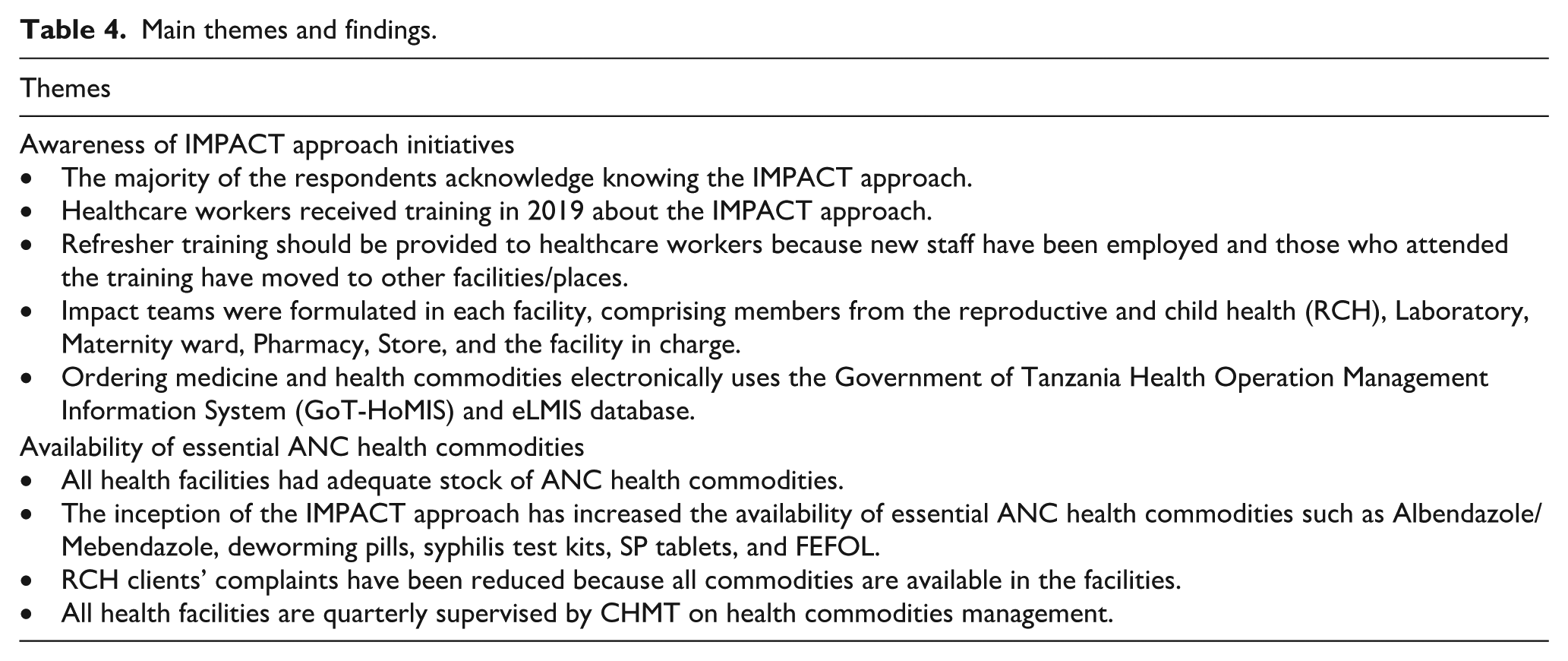
Theme 1. Awareness of the IMPACT approach initiatives
All respondents said they are aware that the IMPACT approach was initiated to improve the availability of essential ANC health commodities in health facilities. Some of the respondents said: “Impact approach deals with the availability of medicine and health commodities in health facilities. . .we started implementing it in the year 2020, since we came back from the training” [K1]. “It is an approach that helps us to ensure provision of services and availability of medicine. . .it is a supply chain that helps to easily identify challenges when they arise and how to solve them” [K2]. “I know that the IMPACT approach focuses on improving supply chain management and drug storage” [K4]. “Impact is a tool used in health facilities to analyze data that will help in making decisions and eventually solve problems where there are gaps” [K9].
Sub-theme: IMPACT monthly meetings
In the facility, health care workers were required to formulate an IMPACT team, which included members from all departments. In most facilities, the facility in charge is the chairperson of the impact team. The team should also include members from the RCH, laboratory, maternity ward, and HIV care and treatment (CTC). This was supported by one respondent who said: “There should be the chairperson, secretary, and body members, previously we were told the chairperson should be the pharmacist and the secretary should be the laboratory in charge then other health workers should be body members which means the facility in charge, matron, and other departments in charges, eventually there were changes and impact of the meetings so the chairperson was changed to be the facility in charge” [K3]. “Previously, we did not have meetings that discussed these commodities; we used to wait for quarterly meetings, but now we are meeting monthly. This has helped us discover the gaps and make follow-ups on time” [K 13]. “Putting minutes in the files, we used not to implement things that we had discussed, but after we started implementing impact, we saw the importance of documenting and reviewing the files. In case one staff member moves to another place, we can still use the document for review” [K14].
Sub-theme: Uses of data
Interview data revealed that healthcare workers have been using data to order commodities since the inception of IMPACT. In their meetings, they are using facility data when they want to order to avoid having an overstock of commodities or under stock between months. In the facility store, there is a store ledger, bin card, requisition, issue vouchers, and report and request (R and R) forms for proper documentation of issued medicine and commodities. Respondents said: “The main agenda of those meetings was to use our data to order health commodities that we need” [K8]. “We have also seen the benefits in proper use of ledger and bin card. . .this has helped us not to have under stock in our stores and it has ensured full availability of these commodities within two to four months” [K5]. “I am trying to influence them to manage that store so that in our monthly meetings, we know the stock status of our store, also with the help of CHMT” [K3]. “Speaking of data, we have bin cards, ledger, prescription forms, all these must be uniform, and we are achieving this through an IMPACT approach; there is an increase in the number of clients” [K5]. “The proper documentation of data, meaning the R and R, prescription and dispensing, has improved” [K8]. “We normally have books/registers, for example, the ANC register. . . Every month, we have an indicator that we monitor, and we may evaluate how many pregnant women have gotten FEFOL in that particular month, and if there were enough” [K9]. “We look at the availability of that particular medicine because initially, we used to just order without looking at our data by knowing how many patients we have and how many pregnant women are eligible to get FEFOL, then we order” [K15]. These findings indicate that awareness of the IMPACT approach is widespread among healthcare workers, with most describing it as a tool for strengthening data-driven decision-making and improving supply chain visibility. The monthly meetings highlight how routine data review has become institutionalized, fostering collaborative problem-solving, accountability, and improved documentation practices. The Uses of Data illustrates how improved data literacy has translated into more accurate forecasting and reduced risks of over- or under-stocking of ANC commodities.
Theme 2. Availability of essential ANC health commodities
Results showed that the IMPACT approach has helped increase the availability of ANC health commodities in the health facilities, as they said, “We have made sure that maternal and child health commodities are available one hundred percent” [K1]. “It is a good thing when a customer comes to the facility and gets all the services that he expected to receive” [K7]. “We have enough FEFO, SP Albendazole, and Mebendazole that match our population” [K16]. “Maybe family planning indicators are the ones that are low, but FEFOL, syphilis tests, HIV tests, Mebendazole, SP are enough” [K2].
Another one added that, “IMPACT has helped in the availability of health commodities because every department orders, and most of them are in charge of their departments; these meetings are very helpful in ANC health commodities ordering” [K3].
The availability of ANC health commodities has helped in the reduction of clients’ complaints, as it was said. “We do have a comment box where clients put their complaints, some do come directly to complain when for example they miss some drugs or when they have not been attended well, if a client comes personally, we sit and discuss with him if he put his complain in the comment box then we report it in an exercise book” [K1]. “There is positive feedback because you will be aware of the status, pregnant women get medicines when they come to the clinic, and services have improved” [K6]. “Our clients are satisfied because they have gotten all the services they expected to get. . . I haven’t heard them complaining they are missing anything; we have health care workers in every village in this ward. . . community health care workers do pass in their houses, but we haven’t heard complaints about ANC health commodities” [K7]. “Most of them are happy because those medicines are available compared to the past. Now, when they come to the clinic, even when they come to deliver, we will give children vitamin A and iron” [K10]. “In the past, there were complaints because clients were told to buy some medications that were not available in the facility” [K12]. The IMPACT approach significantly improved the availability of essential ANC commodities across health facilities. Healthcare workers reported consistent stocks of FEFOL, SP, Albendazole/Mebendazole, and syphilis test kits, attributing this to strengthened data use, routine stock monitoring, and more coordinated ordering processes. Improved availability reduced stock-outs and enhanced client satisfaction, as pregnant women now reliably receive required medicines and services. Overall, the IMPACT approach enhanced supply chain efficiency and contributed to better-quality ANC service delivery.
Discussion
The IMPACT approach aims to strengthen data use and improve pharmaceutical supply chain outputs and outcomes. 16 This study highlights the influence of the impact approach and healthcare workers’ knowledge on antenatal care commodity availability. Almost two-thirds of participants in this study had good knowledge of the IMPACT approach. Findings from KII revealed that the majority of the respondents acknowledged knowing the IMPACT approach; they received training in 2019 about the IMPACT approach. Further, they highlighted the need for a refresher and on-the-job training, particularly for new staff. This result is important because the IMPACT approach likely plays a crucial role in improving healthcare service delivery, particularly in antenatal care commodities. A good knowledge of this approach among the majority of healthcare workers suggests that they are well-equipped to implement it effectively, which could lead to better management and availability of essential health commodities.17–21 This could also imply that training and educational programs around the IMPACT approach have been successful in this region, potentially leading to better performance after 2 years following the implementation of the program.
The majority of health facilities had an adequate supply of FEFOL, SP, Albendazole/Mebendazole, and Syphilis test kits. These results were also supported in KII. This indicates that the IMPACT approach may have positively influenced the availability of these critical supplies, ensuring that pregnant women receive the necessary care during antenatal visits. The availability of SP was similar to the previous study conducted in Arusha, Tanzania, which reported that SP was available in 87.5% of health facilities. 22 On the contrary, a qualitative study that was conducted in Ubungo district, Tanzania, by Mollel et al. reported a frequent shortage of antenatal care commodities. 23 A significant improvement in supply chain performance was reported in years three and four after the implementation of the IMPACT approach. This improvement suggests that the approach has had a long-term positive effect on the management and distribution of antenatal care commodities, which is crucial for maintaining the health of pregnant women and their unborn children.24,25 Findings from a study in Sikonge District, Tanzania, focused on essential health commodities in general rather than ANC-specific items, likewise reported improved commodity availability after the IMPACT approach was implemented. 6
The IMPACT method was launched to increase the availability of essential health commodities in health facilities, according to all respondents in KII. This is due to the improvement of data-driven decision-making. Interview data revealed that healthcare workers have been using data to order commodities since the inception of IMPACT. Effective decisions for performance enhancement are the main goal of supply chain decision-making. Decision-makers in the pharmaceutical sector typically base a significant amount of their decisions solely on their extensive experience or knowledge in the field. 26 eLMIS databases and GoTHoMIS are two examples of technological solutions that are used in the impact approach to ensure the availability of ANC commodities. Addressing issues of pharmaceutical supply is a critical part of what healthcare facilities do. The task is to completely manage (plan, document, monitor, and control) medications from the ordering stage to the dispensing stage, via all organizational and hierarchical hospital management levels, to the patient. The implementation of techniques in the planning and administration of operations that guarantee the clinical and financial effectiveness of health systems is implied by sustainability-focused management for healthcare organizations. 27
Strengths and limitations
This is the first study in Tanzania to assess the influence of healthcare workers’ knowledge and the IMPACT approach on the availability of ANC commodities. This study’s strength is its combination of quantitative and qualitative data collection techniques. Through the integration of statistical analysis and KII, the study presents a thorough comprehension of the IMPACT approach and the knowledge of healthcare staff. By using a variety of data collection/generation techniques (questionnaire, checklist for observations, document review, and interview), it is possible to minimize any biases in responses. However, when interpreting the findings presented in this study, a few limitations have to be considered. First is the use of the cross-sectional design, as it does not establish causality. Second, the study’s focus was limited to a single district, which would limit the generalizability of the results to other Tanzanian healthcare facilities. Finally, the reliability measure for the questionnaire (Cronbach’s alpha) was not computed.
Conclusion
This study revealed that most healthcare workers have good knowledge of the IMPACT approach. However, there remains a need to enhance the skills of healthcare workers in these facilities, particularly for new employees. The IMPACT approach was reported to improve the availability of ANC commodities. A strong emphasis should be placed on the use of health commodities data for decision-making.
Supplemental Material
sj-docx-1-phj-10.1177_22799036261427033 – Supplemental material for The influence of the IMPACT approach and healthcare workers’ knowledge on antenatal care commodities availability in North Western Tanzania
Supplemental material, sj-docx-1-phj-10.1177_22799036261427033 for The influence of the IMPACT approach and healthcare workers’ knowledge on antenatal care commodities availability in North Western Tanzania by Anold Musiba, Stanley Mwita, Eliada Kajelly, Anthony Kapesa, Boniphace Marwa and Domenica Morona in Journal of Public Health Research
Supplemental Material
sj-docx-2-phj-10.1177_22799036261427033 – Supplemental material for The influence of the IMPACT approach and healthcare workers’ knowledge on antenatal care commodities availability in North Western Tanzania
Supplemental material, sj-docx-2-phj-10.1177_22799036261427033 for The influence of the IMPACT approach and healthcare workers’ knowledge on antenatal care commodities availability in North Western Tanzania by Anold Musiba, Stanley Mwita, Eliada Kajelly, Anthony Kapesa, Boniphace Marwa and Domenica Morona in Journal of Public Health Research
Supplemental Material
sj-docx-3-phj-10.1177_22799036261427033 – Supplemental material for The influence of the IMPACT approach and healthcare workers’ knowledge on antenatal care commodities availability in North Western Tanzania
Supplemental material, sj-docx-3-phj-10.1177_22799036261427033 for The influence of the IMPACT approach and healthcare workers’ knowledge on antenatal care commodities availability in North Western Tanzania by Anold Musiba, Stanley Mwita, Eliada Kajelly, Anthony Kapesa, Boniphace Marwa and Domenica Morona in Journal of Public Health Research
Supplemental Material
sj-docx-4-phj-10.1177_22799036261427033 – Supplemental material for The influence of the IMPACT approach and healthcare workers’ knowledge on antenatal care commodities availability in North Western Tanzania
Supplemental material, sj-docx-4-phj-10.1177_22799036261427033 for The influence of the IMPACT approach and healthcare workers’ knowledge on antenatal care commodities availability in North Western Tanzania by Anold Musiba, Stanley Mwita, Eliada Kajelly, Anthony Kapesa, Boniphace Marwa and Domenica Morona in Journal of Public Health Research
Footnotes
Acknowledgements
The authors thank the healthcare workers who participated in this study.

Ethical considerations
The study obtained ethical approval from the Joint Catholic University of Health and Allied Sciences (CUHAS) and Bugando Medical Centre (BMC) Research and Ethics Review Committee, with permit number CREC/684/2023, approved on 4th July 2023.
Consent to participate
Written informed consent was obtained from all subjects involved in the study.
Author contributions
Conceptualization, A.M.; Methodology, A.M., A.K., and D.M.; Supervision, D.M. and S.M.; Data curation, A.M. and B.M.; Formal analysis, A.M., E.K., and S.M.; Writing—original draft, A.M., B.M., and S.M.; Visualization, D.M., A.K., and E.K.; Writing—review and editing, S.M., E.K., and D.M. All authors have read and agreed to the published version of the manuscript.
Funding
The authors received no financial support for the research, authorship, and/or publication of this article.
Declaration of conflicting interests
The authors declared no potential conflicts of interest with respect to the research, authorship, and/or publication of this article.
Data availability statement
The data presented in this study are available upon request from the corresponding author.*
Supplemental material
Supplemental material for this article is available online.
References
Supplementary Material
Please find the following supplemental material available below.
For Open Access articles published under a Creative Commons License, all supplemental material carries the same license as the article it is associated with.
For non-Open Access articles published, all supplemental material carries a non-exclusive license, and permission requests for re-use of supplemental material or any part of supplemental material shall be sent directly to the copyright owner as specified in the copyright notice associated with the article.
