




Abstract
Background:
Improper medication disposal poses environmental and public health risks. Despite global efforts to promote safe disposal practices, public awareness and adherence remain inadequate. This study aims to assess the knowledge, attitudes, and practices of UAE residents regarding medication disposal and identify barriers to proper disposal methods.
Methods:
A cross-sectional survey was conducted among UAE residents. Data were collected using an online questionnaire assessing participants’ demographics, knowledge, disposal practices, and preferred educational platforms. Statistical analysis was performed to evaluate associations between knowledge levels and various demographic factors.
Results:
A total of 538 participants were surveyed; 60.2% were male and 39.8% were female, with a mean age of 37.44 years. Only 41.4% demonstrated adequate knowledge of proper disposal methods, and 29.2% were aware of pharmacy take-back programs. Although 76.2% recognized the environmental risks of improper disposal, 61.5% discarded solid medications in household garbage, and 47.2% disposed of liquid medications in sinks. Social media (61.9%) was the most preferred educational platform, followed by pharmacists (54.6%) and physicians (28.4%). Key barriers included limited awareness and accessibility to disposal programs. Statistically significant predictors of awareness included medical background, prior advice, and routinely checking expired medicines (p < 0.05), while interest in learning was associated with higher income, checking expiry, larger household size, and female gender (p < 0.05). Unused medication accumulation was linked to education, employment, and presence of chronic disease in the household (p < 0.05).
Conclusion:
Despite understanding environmental risks, improper disposal remains widespread. Public education, pharmacy-based disposal initiatives, and policy interventions are essential to address these challenges. Future research should assess the impact of awareness programs on behavioral changes and environmental outcomes.
Background
The prevalence of unused medications in general population households has substantially increased recently, which can lead to medication wastage. 1 Improper disposal of unused medications has been reported as a global issue. 2
The use of pharmaceuticals is projected to increase due to increased population age and lifespan, economic growth in developing countries, new clinical practices, engineering of new medicines, intensification of agricultural practices, and climate change.3,4 The pharmaceutical industry’s revenue is projected to grow at a compound annual growth rate (CAGR) of 4.77% from 2025 to 2029. 5
It is reported that out of every three-prescription medication in the United States, two of them end up unused. 6 A study conducted in Saudi Arabia found the prevalence of unused or expired medications within the community to be 89%. 7 A study conducted at Kuwait University in 2006, found that nearly all their 300 respondents had unused medication in the home, with 40% of the respondents expressing that they felt further public education on the topic was needed. 8 Other studies conducted in the Gulf region revealed a significant number of households and individuals do not properly and regularly dispose of unused or expired medications.9–11
Around 10% of manufactured pharmaceutical products are an environmental hazard. The Product Stewardship Council announced in 2019 that one-third of the 4 billion prescription products in the United States of America had become waste. 12
The environmental impact of improper medication disposal is expected to be higher in countries with poorly functioning waste management schemes, such as the Middle Eastern, Asian, and African countries. 2 A South Korean study done to evaluate the environmental risk of drugs in waste water treatment plants (WWTPs) found presence of ibuprofen, carbamazepine, ketoprofen, gemfibrozil, acetaminophen, and sulfamethoxazole posing toxic risk to fish and green algae. 13
Alongside the environmental determinants, improper storage and/or disposal has been known to result in misuse by users for whom the medication was not intended, leading to accidental poisoning. 14
Several countries have developed policies for the disposal of unused and expired medications to combat these issues. The agencies providing guidance on unused medication disposal includes the Food and Drug Administration (FDA) and the United Kingdom National Health Service (NHS), which requires that selected pharmacies accept unwanted medicinal products from patients.15,16
Research on medication disposal in the UAE is growing, with recent studies highlighting both disposal patterns and gaps in proper practices. Early research briefly mentioned drug disposal in the context of over-the-counter medications, but with little elaboration. 11 More recent studies highlight both awareness and gaps in proper disposal practices. While many individuals recognize the importance of appropriate medication disposal, common methods still include discarding medications in household waste or flushing them, raising environmental concerns. 17 Antibiotics, in particular, are frequently disposed of in the trash or toilets, despite the risks of antimicrobial resistance and contamination. 18 Pharmacists in the UAE largely support initiatives to improve public awareness and advocate for national guidelines to standardize disposal practices, emphasizing the need for collaboration with public health agencies. 19
Regarding precautions while disposing hazardous products, it was found that 59.8% reported that they do not take any precautions and throw them in the general waste and 92.3% reported that they never received counseling from pharmacists on safe disposal of expired and unused medications. 20
Building on existing research, this study seeks to further examine medication disposal practices in the UAE, highlighting areas for improvement and supporting efforts to promote safer disposal methods.
Methods
The study is a cross-sectional study conducted among 530 patients visiting a tertiary care university hospital, in the Northern Emirate of the UAE. A structured survey form was developed and reviewed by a panel of experts, including faculty, clinical preceptors, clinical pharmacists, and a physician from the university hospital for content validity.
Along with the demographic information, the questionnaire included questions to evaluate respondents’ knowledge, attitudes, and practice relating to the disposal practices of unused and expired medications of the study population. After content validity, the questionnaire was piloted in a smaller sample of respondents for face validity. All the comments and feedback provided were used in formulating the final questionnaire that was distributed to our respondents.
The survey was conducted by the research team using Google Forms. The survey consisted of questions with the objective of assessing the knowledge, attitude, and practices of drug disposal among patients visiting the university hospital. Of these, five questions evaluated knowledge, six questions assessed attitudes, and ten questions explored disposal practices, while the remaining items captured demographic information such as gender, level of education, employment status, work in the medical field, emirate of residence, and monthly household income level. For detailed mapping of questions under each domain, please refer to Tables 1 to 5. The questionnaire was in English and was distributed through QR code to patients after explaining the purpose of the study and acquiring consent. The study was conducted over a period of 2 years with a data collection period from November 2022 to April 2024.
Demographic details of the participants.

The knowledge of the participants about medication disposal.

The attitudes of the participants toward medication disposal.

Question allowed participants to select multiple options, reflecting a broader range of responses.
The practices of the participants toward the medication disposal.

Question allowed participants to select multiple options, reflecting a broader range of responses.
Binary logistic regression predicting awareness of safe medication disposal (N = 538).

AOR: adjusted odds ratio; CI: confidence interval; SE: standard error.
Model χ2 (9) = 226.61, p < 0.001; Nagelkerke R2 = 0.463; Hosmer–Lemeshow χ2 (8) = 8.81, p = 0.36; overall classification = 80.3%.
The study included adult patients (18+ years) visiting the university hospital for health consultations who could read English and provide voluntary consent. The institutional review board of Gulf Medical University approved the study protocol (IRB/COP/STD/38/Nov-2022).
The data was encoded and analyzed using Statistical Package for the Social Sciences (SPSS, version 29, Chicago, IL, USA). Descriptive statistics was used to describe the study variables using frequencies and percentages. To identify independent predictors, binary logistic regression was performed for awareness of safe medication disposal, and interest in learning about proper medication disposal practices. Multinomial logistic regression was used to predict the presence of unused, leftover, or expired medications in the household. Adjusted odds ratios (AORs) with 95% confidence intervals (CIs) were reported for all regression analyses.
Results
The study included 538 participants with a mean age of 37.44 years (SD = 10.99). The gender distribution of participants was 60.2% male and 39.8% female. Majority (66.5%) were graduates and around 16.7% of participants worked in the medical field. Most participants were employed (72.5%), with smaller percentages being unemployed, students, or retired. Household income levels varied, with 29.6% earning 5000–10,000 AED/month. The detailed demographics of the participants are presented in Table 1.
Knowledge of participants about medication disposal
The study assessed participants’ knowledge regarding medication disposal. Among the 538 participants, 41.4% were aware of what safe medication disposal means. A slight majority (56.5%) were aware of the dangers associated with improper drug disposal, and 51.7% reported that wastewater treatment does not remove most medicines from the environment. However, awareness about the correct method of returning unused or expired medications to the pharmacy for disposal was low (29.2%). Notably, 76.2% recognized that improper disposal of medications could adversely affect the environment and public health. The percentage responses of participants on various knowledge related questions are presented in Table 2.
Attitudes of participants toward medication disposal
The study explored the attitudes of participants regarding medication disposal. When asked to rate the danger of unneeded or expired medications at home, with one being not dangerous and five being extremely dangerous, the median response was 3, with an interquartile range (IQR) of 2–5. Opinions regarding acceptability of disposing solid medicines (such as tablets, capsules, and patches) in the garbage were acceptable to 61.5% of participants. Similarly, 47.2% thought it acceptable to dispose of liquid medicines by throwing them in the sink. Finally, the study found that 43.9% of participants expressed an interest in learning about proper drug disposal practices. When asked about the best methods for providing education on medication disposal, the use of social media was the most preferred method chosen by 61.9% of participants. Other preferred methods included education from pharmacists (54.6%), physicians (28.4%), and awareness campaigns (25.5%). Majority of participants (69.1%) believed that healthcare professionals are responsible for poor drug disposal practices. The percentage responses of participants on various attitude related questions are presented in Table 3.
Practices of participants toward medication disposal
The practices of participants towards medication disposal, are presented in Table 4. Approximately 50% of participants reported having leftover or expired medications at home, with most of these being prescription drugs. The primary reasons for unused medications include the self-discontinuation of treatment after a condition resolves (47.2%), changes in treatment by the physician (33.5%), and being dispensed more medication than needed (28.3%). Regarding disposal practices, the majority of participants (75.1%) reported discarding unused or expired medications in the garbage. Furthermore, 18.8% disposed of medications by flushing them down the toilet, while 15.2% reported disposal via the sink. In contrast, only 8.9% returned unused medications to a pharmacist, and 2.8% utilized secured collection containers.
Participants from the medical field were more likely to be aware of safe disposal practices (AOR = 3.10, 95% CI (1.67–5.74), p < 0.001), those who had previously received advice were substantially more likely to be aware (AOR = 17.33, 95% CI (10.56–28.46), p < 0.001), those who regularly checked for expired or unneeded medicines also demonstrated greater awareness (AOR = 1.81, 95% CI (1.13–2.90), p = 0.014). Gender, education level, employment status, household income, and chronic disease status were not significant predictors (p > 0.05; Table 5).
Participants with higher household income were more likely to express interest to learn about proper drug disposal practices (AOR = 1.32, 95% CI (1.12–1.56), p = 0.001). Those who regularly checked for expired or unneeded medicines also demonstrated greater interest (AOR = 1.79, 95% CI (1.22–2.64), p = 0.003). Larger household size increased the interest (AOR = 1.15, 95% CI (1.01–1.32), p = 0.035). Male respondents were significantly less likely than females to be interested (AOR = 0.62, 95% CI (0.42–0.91), p = 0.015). All other demographic, medical, and behavioral factors were non-significant (p > 0.05; Table 6).
Binary logistic regression predicting interest in learning about proper drug-disposal practices (N = 538).

AOR: adjusted odds ratio; CI: confidence interval; SE: standard error.
Model χ2 (13) = 45.53, p < 0.001; Nagelkerke R2 = 0.109; Hosmer–Lemeshow χ2 (8) = 4.44, p = 0.82; overall classification = 64.5%.
Participants with higher education levels had greater odds of having unused medicines (aOR = 1.56, 95% CI (1.05–2.33), p = 0.028). Employment was associated with markedly lower odds (aOR = 0.15, 95% CI (0.03–0.75), p = 0.021). Having a household member with a chronic condition also reduced the likelihood of unused medicines (aOR = 0.18, 95% CI (0.10–0.33), p < 0.001). Respondents reporting one to two unused medications were more likely to have leftovers (aOR = 2.46, 95% CI (1.00–6.03), p = 0.049), whereas having no leftover prescriptions strongly decreased the odds (aOR = 0.27, 95% CI (0.11–0.64), p = 0.003). Fewer unused OTC medicines also predicted lower odds (aOR = 0.72, 95% CI (0.60–0.87), p = 0.001). Participants expressing interest in learning proper drug-disposal practices were significantly less likely to have unused medicines (aOR = 0.54, 95% CI (0.32–0.90), p = 0.018; Table 7).
Multinomial logistic regression predicting presence of unused, leftover, or expired medicines (N = 538).
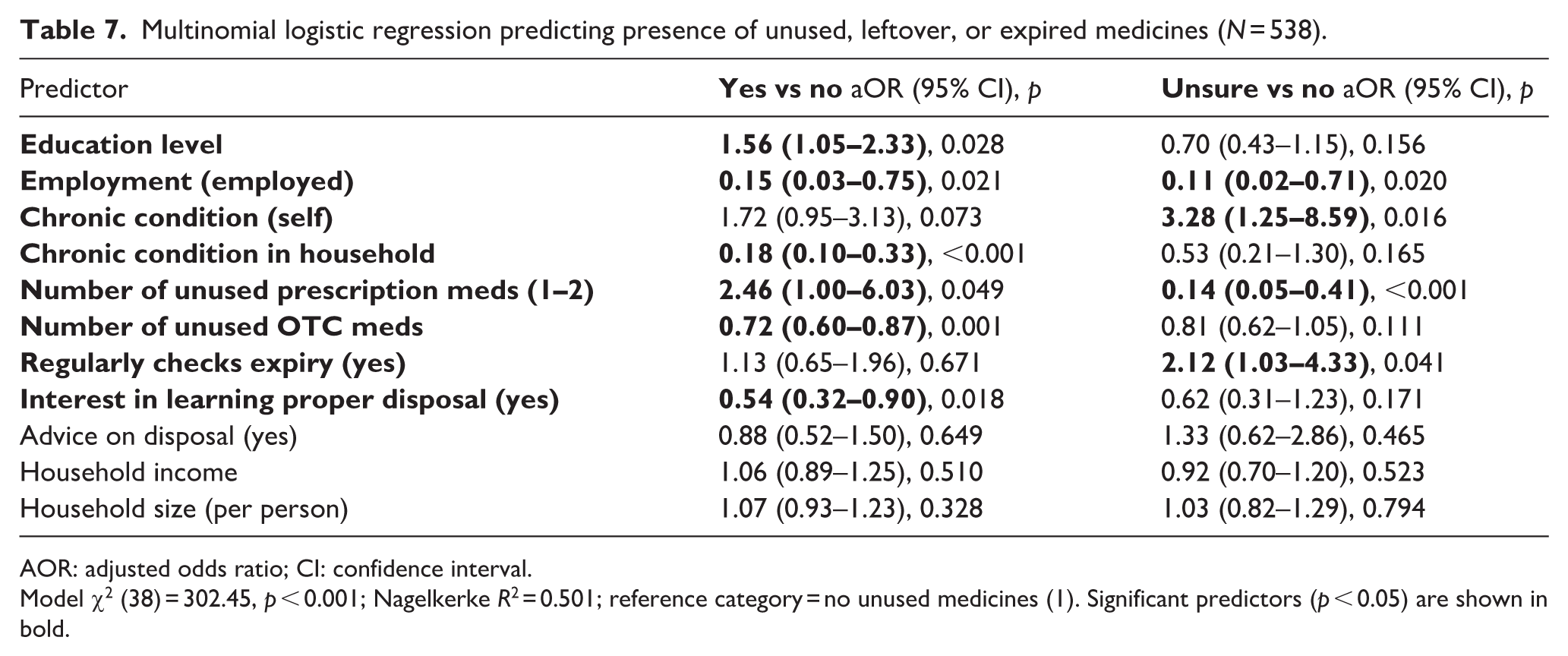
AOR: adjusted odds ratio; CI: confidence interval.
Model χ2 (38) = 302.45, p < 0.001; Nagelkerke R2 = 0.501; reference category = no unused medicines (1). Significant predictors (p < 0.05) are shown in bold.
Discussion
This study examined the knowledge, attitudes, and practices of UAE participants regarding medication disposal, providing insights into their understanding and behavior toward this important public health issue. The gender distribution of 60.2% males and 39.8% female is representative of the national population, which consists of 68.58% males and 31.42% females. Additionally, our mean age was 37.44 years which also represents the majority of the population in the UAE with 64% of the population being between 25 and 54 years. 21
In contrast, one study reported a female-dominant sample (76% female, 24% male), while another had a nearly even distribution (54.8% female).17,20 Additionally, our study population had a mean age of 37.44 years, whereas a previous study had a predominantly younger age group, with 47.5% of participants aged 17–25 years. 20
Knowledge of participants about medication disposal
Only 41.4% of participants demonstrated an understanding of safe medication disposal. Dweik et al. found that the majority of participants (76%) had good knowledge of drug disposal practices. 17 This huge variation is concerning in two studies done in the UAE. Previous studies highlight the insufficient knowledge as a common barrier to proper disposal practices among the general population. 2
Although 56.5% of participants recognized the dangers associated with improper drug disposal. This lack of understanding could contribute to practices that endanger ecosystems and human health, such as flushing medications down toilets or discarding them in household waste. Improper disposal introduces pharmaceutical compounds, including antibiotics, analgesics, and hormones, into water systems where they persist due to the limitations of wastewater treatment. These compounds disrupt aquatic ecosystems by affecting the growth, reproduction, and survival of aquatic organisms. Exposure to pharmaceutical pollutants has been linked to hormonal imbalances in fish, reduced biodiversity, and the development of antibiotic-resistant bacteria, which further threaten ecological balance. 22 Only 51.7% of participants understood the limitations of wastewater treatment in removing pharmaceutical waste. This finding underscores a knowledge gap that may lead to over-reliance on existing waste management systems. Conventional wastewater treatment plants (WWTPs) are not designed to completely remove pharmaceutically active micropollutants, such as antibiotics, hormones, and analgesics. These compounds often escape treatment processes like filtration, sedimentation, and biological degradation, ultimately persisting in aquatic environments and contributing to environmental contamination and potential health risks. 23
Seventy-six point two percent of participants recognized that improper medication disposal could harm the environment and public health. This suggests a general awareness of the problem but insufficient actionable knowledge about proper disposal methods such as take-back programs.
This is further evidenced by the finding that only 29.2% of participants were aware that unused or expired medications could be returned to pharmacies for disposal. This low awareness may reflect inadequate promotion of take-back programs, which are among the most effective and environmentally friendly disposal methods. Barriers to participation, such as limited accessibility and lack of awareness, have been documented in other studies. For instance, a study exploring pharmacists’ perspectives in Indonesia identified challenges including a lack of personnel, financial constraints, geographical constraints, lack of facilities, and inadequate knowledge, all of which hinder the initiation of medication take-back programs. 24
Attitudes of participants toward medication disposal
While 61.5% of participants considered it acceptable to dispose of solid medicines in the garbage, and 47.2% supported disposing of liquid medications in the sink, these practices are inconsistent with environmentally sustainable disposal recommendations. These findings suggest a normalization of unsafe disposal practices, which may be influenced by a lack of access to or awareness about safer alternatives such as take-back programs. This aligns with studies suggesting that convenience and habit significantly shape disposal behaviors, even when individuals are aware of potential risks. 2
Only 43.9% of participants expressed interest in learning about proper drug disposal practices, while a majority (56.1%) indicated no interest. However, 76.2% of participants agreed that improper disposal of medications affect the environment and public health. This may indicate perceived sufficient knowledge or a gap between awareness of consequences and the willingness to act. This suggest that awareness alone does not always lead into behavioral change without structured interventions. Regarding methods for education, participants favored multiple channels, with social media (61.9%) and pharmacists (54.6%) being the most preferred sources of information, followed by awareness campaigns (25.5%) and physicians (28.4%).
Pharmacists as play a crucial role in educating the public about proper medication disposal, with community pharmacies frequently serving as accessible points for drug take-back programs and disposal resources.25,26 Pharmacists are positioned to provide immediate, practical guidance to patients and families regarding safe disposal methods, and are recognized as key stakeholders in public health efforts to prevent medication misuse and environmental harm.19,26
Literature highlights the need for more active patient and pharmacist engagement and development of robust interventions. 27 Less traditional or passive channels, such as newspapers, education booklets, and mass media, were less preferred in our participants, highlighting the need for targeted, engaging, and trusted sources of information rather than generic awareness campaigns.
Practices of participants toward medication disposal
In our study, ~50% of participants reported having leftover or expired medications at home, with most of these being prescription drugs. The accumulation of unused or expired medications in households is a prevalent issue, with studies indicating that ~58% of respondents have expired medications at home.74% of these households possess drugs that were never utilized. The most commonly unused medications are analgesics (34%), followed by cosmetics (27%) and antibiotics (26%). 28
Regarding the reasons for unused medications in households, self-discontinuation after the resolution of the condition was the most common cause (47.2%), followed by treatment changes by physicians (33.5%) and over-dispensing (28.3%). Leftover over-the-counter medications (28.4%) and expired medications (17.3%) were also notable contributors. Less frequently, participants stopped medications due to side effects (7.8%) or switched to herbal remedies (5.9%). These findings are supported by previous studies that report patient-initiated discontinuation, over-prescription, and leftover OTC drugs are major reasons of household medication waste.29–31 Self-discontinuation can be particularly problematic, especially for chronic conditions, as it may lead to complications or relapse. 32 Treatment modifications by physicians, while often necessary, contribute to excess medication if patients are not adequately informed about proper disposal methods. Providing excess medications to patients, whether due to cautious prescribing or patient demand, further exacerbates medication waste. 1
Majority of participants reported unsafe methods of medication disposal including throwing medications in the garbage (75.1%), flushing down the toilet (18.8%), or throwing down the sink (15.2%). Only a small proportion returned medications to pharmacies (15.2%) or used secured collection containers (2.8%). This method of disposal poses environmental and health risks, as pharmaceuticals can leach into the water system, leading to contamination of waterways and potentially affecting drinking water supplies. Additionally, improper disposal can contribute to the development of antimicrobial-resistant bacteria, posing further public health challenges. 23 The low utilization of formal collection systems underscores the need to strengthen public access to proper disposal programs and enhance awareness of safe disposal methods. Pharmacist-led interventions and municipal collection programs have been shown to improve adherence to safe disposal practices and reduce environmental risk.26,33
In the UAE, the government has initiated various projected to improve the appropriate disposal of pharmaceutical wastage. Since 2013, Duba Health Authority (DHA) has held a recurring “Clean Your Medicine Cabinet” campaign to invite residents to drop off their expired or unused medicines at DHA pharmacies in primary health centers and DHA hospitals. DHA also provides a “Request Medication Disposal” service for community and hospital pharmacies.34–37
Ministry of Health and Prevention (MoHAP) operates e-services that authorize pharmaceutical companies and health facilities to dispose of expired/unusable medicines as medical waste, including controlled drugs, with inspection and documentation requirements. 38
The Department of Health (DoH), Abu Dhabi publishes a public brochure on the safe disposal of unused medicines at home and links to facility standards on expiry handling and disposal responsibilities across licensed providers.39,40
Collection programs are widely implemented in Abu Dhabi, where secured containers are available in pharmacies and healthcare facilities. 18 The UAE Ministry of Health supports take-back initiatives in alignment with the country’s sustainability goals, particularly Goal 16, which promotes responsible consumption and disposal practices. 41 Expanding medication collection programs and increasing public awareness are essential steps toward safer disposal and environmental protection. The demographic analysis of factors influencing knowledge, attitudes, and practices revealed several statistically significant associations. Males demonstrated less interest in learning about proper drug disposal practices than females. This finding could reflect variations in health-seeking behavior or awareness levels between genders. A recent study in the UAE found no significant difference between gender and knowledge and practices. 17 Hajj et al. found that higher knowledge scores were significantly associated with the female gender, which also reflects in our study. 42
Participants from the medical field were more aware of safe medication disposal practices compared to those outside the medical field. This outcome is expected, given their specialized education and exposure to medication-related knowledge. However, this specific comparison was not assessed in the recent UAE studies.
Households with chronic patients were less likely to accumulate unused medicines, possibly reflecting continuous medical follow-up and routine use. A 2024 community-based cross-sectional study found that households with chronic disease had a significantly increased odds of having unused medicines at home (adjusted odds ratio (AOR) = 5.897, 95% CI: 3.667–9.484), indicating that chronic illness is a strong predictor of unused medication accumulation. 43 This discrepancy could be as our respondents were individuals visiting the hospital and the other studies were conducted in the community.
Limitations and future directions
While this study provides valuable insights into the knowledge, attitudes, and practices regarding medication disposal, it is not without limitations. The self-reported nature of the data may introduce bias, particularly in terms of participants’ disposal behaviors. Although, we had a representation of study population from all the seven emirates in the UAE, the cross-sectional data collection was conducted in a specific geographic region, which may limit the generalizability of the findings. Future research should consider longitudinal studies to assess the long-term effectiveness of public health interventions aimed at improving medication disposal practices. Expanding awareness campaigns and providing more accessible disposal solutions could help reduce the environmental and public health risks associated with improper disposal.
Conclusion
This study underscores significant gaps in public knowledge and behavior regarding medication disposal in the UAE. Although most participants recognize the environmental and health risks of improper disposal, unsafe practices remain widespread. Limited engagement in educational initiatives suggests that awareness alone is insufficient to drive behavioral change. Strengthening pharmacist-led counseling, integrating take-back systems in community pharmacies, and leveraging digital platforms such as social media for education can enhance public participation. Future strategies may include the use of smart collection bins, digital reminders for safe disposal, and intersectoral collaborations between healthcare providers, environmental agencies, and technology partners to ensure sustainable and scalable medication waste management.
Footnotes

Author contributions
Conceptualization and study design: S.M.G., V.M.M., R.A. Data collection: V.M.M., M.M., M.K., J.A. Analysis: R.A., S.M.G. Manuscript drafting and revision: V.M.M., M.M., M.K., J.A., R.A. Manuscript revision: R.A., S.M.G.
Funding
The authors received no financial support for the research or authorship of this article. The publication fee was covered by Gulf Medical University, UAE.
Declaration of conflicting interests
The authors declared no potential conflicts of interest with respect to the research, authorship, and/or publication of this article.