




Abstract
Since the onset of war in Syria, the occurrence of child marriage has risen from 13% in pre-war Syria, to approximately 35% among Syrian refugee girls. Economic instability, societal norms, and safety concerns all contribute to this practice. This study examines the underlying causes of child marriage by analyzing the association between participant sex and perceptions of child marriage among Syrian refugees in Lebanon. Data were obtained from a cross-sectional, mixed-methods study conducted in Lebanon in 2016. Multivariate logistic regression was used to evaluate the association between participant sex and attributing child marriage to safety concerns or, independently, attributing child marriage to financial insecurity. We analyzed 560 micronarratives, 52.1% of which were provided by women, with the majority of participants being under the age of 35 (78.2%). Men were found to have lower odds of attributing child marriage to safety concerns (OR = 0.54, 95% CI = 0.29–0.98), and higher odds of attributing child marriage to financial insecurity (OR = 1.76, 95% CI = 1.06–2.92), compared to women. When stratified by location in Lebanon, men in Tripoli had a higher odds of attributing child marriage to financial insecurity (OR = 2.68, 95% CI = [1.11, 6.50]). Given these differences in perceived reasons for child marriage between men and women, gender-specific messaging and initiatives could be utilized to address the underlying issues that lead to child marriage, and reduce the occurrence of this practice, particularly in Tripoli.
Introduction
Child marriage is defined as any marriage in which one or both spouses are under the age of 18. 1 This occurs more commonly with young girls, and can have negative effects on their health, education, and future prospects.2,3 Child marriage is considered a form of gender-based violence, as children are not able to provide valid consent for sexual relations. 4 Furthermore, girls who marry young are more likely to experience intimate partner violence and/or sexual abuse. 5 Research suggests the prevalence of child marriage is increased by armed conflict and forced displacement, such as the Syrian crisis. 6 In pre-war Syria, approximately 13% of girls under the age of 18 were married. Since the onset of war, however, the occurrence of child marriage has risen to approximately 35% for Syrian refugee girls.6,7 The United Nations Population Fund (UNFPA) and the United Nations International Children’s Emergency Fund (UNICEF) predict these numbers will continue to rise over the next decade as a result of the COVID-19 pandemic, 8 with an anticipated additional 10 million girls being vulnerable to child marriage globally. When combined with pre-pandemic projections, it is estimated that approximately 110 million girls will enter into child marriage by 2030. 9
Economic need, societal norms around gender and sexuality, and concerns for the safety of young girls all contribute to child marriage.10,11 Further, the COVD-19 pandemic, which resulted in severe economic instability, a reduction in educational opportunities, and limited access to reproductive health services has further contributed to the increased prevalence of child marriage. 9 Often, parents are looking to ensure their daughter’s financial security, while also hoping to ease their own financial burden. 10 Once a girl is married, she is able to leave the household, which significantly reduces the family’s expenses.10,12 Additionally, marriage may bring a dowry to the bride’s family, improving their economic situation. 10 Apart from financial concerns, many parents believe marrying their daughter will offer her protection from sexual violence and harassment, premarital sexual activity, unwanted pregnancy, and sexually transmitted infections.10,12,13
Lebanon continues to host a large population of displaced Syrians amid ongoing regional instability, but the context has changed significantly in recent years. As of 2025, the Lebanese government estimates there are approximately 1.4 million displaced Syrians, including about 722,000–750,000 registered with UNHCR. 14 The vast majority of these refugees live in precarious circumstances, with recent data indicating that nine out of every ten Syrian refugee families in Lebanon live under the poverty line, 15 and many struggle with food insecurity and extremely limited income opportunities. Formal refugee camps are still absent in Lebanon. Most Syrians rent accommodation, but high costs and deepening economic vulnerability have forced many into makeshift structures, unfinished buildings, or informal tented settlements, 16 especially in the Beqaa Valley and other regions. Overcrowding and escalating rental prices often push families into shared spaces, with some facing eviction or exclusion from shelters due to rising anti-Syrian sentiment and limited resources.
Lebanon remains the highest per capita host of refugees globally. The influx has placed extraordinary pressure on the country’s fragile economy, public services, and social cohesion, particularly since the 2019 financial crisis. Only 20% of displaced Syrians held legal residency in 2024, complicating access to employment, education, and basic social services. 17 Tensions persist between Syrian refugees and the host Lebanese community, often driven by competition over scarce resources, jobs, and access to public assistance. 18 Amid deteriorating living conditions and regional conflict spillover, thousands of Syrians have registered to return home under new U.N.-backed plans, though many remain in Lebanon due to continued insecurity in Syria and barriers to return. 19
Most previous studies on child marriage in Lebanon have focused on thematic, qualitative analysis from focus group discussions and interviews. One descriptive quantitative study found that men perceived child marriage to be a financial issue, while women associated it with safety concerns. 11 However, the analysis did not account for any other demographic variables that may act as potential confounders. Other studies have suggested that region, religion, marital status, and parental status may also affect perceptions around child marriage.11,20,21 For example, Kohno et al. identified religion as a major theme, stating individuals cited interpretation of religious rules as justification for child marriage. 21 Bakhache et al. suggested there were variations in the perceptions of child marriage across Lebanon, specifically noting different perception patterns in Tripoli compared to other locations when identifying factors linked to child marriage. 22 Similarly, there is evidence that rates of child marriage vary in the Middle East. 23 Such discrepancies have also been well documented in areas such as Bangladesh, where economic and safety disparities created significant regional variations. 24 These factors could have important influence on the reasons for child marriage, but were not accounted for as potential confounding variables in earlier descriptive studies. 11 Our study seeks to address this knowledge gap by conducting a quantitative analysis of the association between participant sex and perceptions of child marriage among Syrian refugees in Lebanon, while controlling for relevant demographic factors. Specifically, the primary objectives are to evaluate the association between participant sex and attributing child marriage to safety concerns, and the association between participant sex and attributing child marriage to financial insecurity. As a secondary objective, the specified analysis will also be stratified by location in Lebanon.
Methods
Study design and setting
Data were obtained from a cross-sectional, mixed-methods study conducted by the ABAAD Resource Center for Gender Equality and Queen’s University in Lebanon in July and August of 2016. 11 Interviewees were asked to share a micronarrative about the experiences of Syrian girls in Lebanon, and to interpret the events of the micronarrative with a series of pre-defined questions. 25
Study participants
Study participants were selected using a convenience sample and had to be 13 years of age or older. To capture a range of perspectives, six subgroups were included: married Syrian girls (under 18 years of age), unmarried Syrian girls, Syrian mothers, Syrian fathers, as well as married men (Syrian, Lebanese, or Palestinian), and unmarried men (Syrian, Lebanese, or Palestinian). While the study primarily focused on Syrian refugees and migrants in Lebanon, Lebanese and Palestinian men were included to capture their perspectives as husbands or potential husbands of Syrian girls under age 18. As this was an exploratory study rather than a hypothesis-driven analysis, no formal sample size calculation was conducted; however, subgroup sizes were intentionally determined to prioritize Syrian girls and their parents, who are the key decision-makers around marriage.
To be included in the analysis, participants must have shared a micronarrative about child marriage, identified their sex, and described why they believed the events occurred (i.e. responded to the question asking what had caused the events in the micronarrative with possible options of safety, financial resources, or expectations of the community). Additionally, the participant must have provided all demographic information. Those who did not provide an answer, or responded “prefer not to say,” were excluded from the analysis.
Data collection
The interviews were conducted in July and August 2016 by 12 trained research assistants (six Syrian females, three Syrian males, and three Lebanese males) in three regions of Lebanon: the greater Beirut area, Tripoli, and Beqaa. All interviews were completed in Arabic, in a private setting, and were audio-recorded. Demographic data were also collected for each participant, including age, sex, marital status, parental status, religion, home region, location in Lebanon, and time in Lebanon.
Survey instrument
Data from the parent study were collected using Cognitive Edge’s SenseMaker® software, a mixed methods data collection tool, via handheld tablets. 26 The software was accessed through a paid subscription. Participants were first asked to share a brief micronarrative in response to an open-ended question inquiring about the experiences of Syrian refugee girls in Lebanon. For our purposes, a micronarrative was taken to be a first- or third-person account shared by an individual about a specific experience, providing insight into their perspectives and contextual realities. Participants were then given a series of follow-up questions to evaluate the experiences shared in the micronarrative. Responses to the interpretation questions were quantified by the software, providing statistical data accompanied by an explanatory micronarrative. A sensemaking approach was well-suited for our study because it allowed participants to frame and interpret their own experiences, thereby capturing diverse community perspectives on the complex social, cultural, and economic factors that influence child marriage among Syrian refugee girls.
Exposure and outcomes
The exposure variable for this analysis was participant sex, separated as male and female. The outcome variables are based on the SenseMaker® interpretation question shown in Figure 1, which asked interviewees to indicate why the events of the micronarrative happened. To do so, participants moved a marker on the tablet between three answer options: safety, financial resources, and expectations of the community. From the response, a percentage was generated, indicating how strongly they attributed the described events to each of the three possible responses. This percentage was used to dichotomize the outcome variables as safety: yes or no, and financial resources: yes or no, using a dichotomized cut point of 80%. 27 A sensitivity analysis was conducted to evaluate this cut point to dichotomize the outcome variable.

Triad from SenseMaker® survey. Participants were asked to place a point on the triad based on why they felt the events in their shared micronarrative occurred. The data from this triad was used to create the outcome variables of attributing child marriage to safety or attributing child marriage to financial resources.
Statistical analysis
Descriptive statistics were first generated in Microsoft Excel (Version 16.59) to evaluate the data. Bivariate analysis was then conducted using chi-squared tests in RStudio (Version 1.4.1106) to identify potential confounding variables. Inclusion in the model was determined by p < 0.10.28,29 Additionally, location in Lebanon, religion, and time in Lebanon were selected a priori and included in the regression model as covariates, as they have been previously shown to impact perceptions of child marriage.11,21,22
Multivariate logistic regressions were completed in RStudio (Version 1.4.1106) to examine the association between sex and attributing child marriage to financial insecurity or to safety concerns. Two regression models were constructed to individually evaluate the association between participant sex, and each dichotomized outcome variable.30,31 Location in Lebanon, religion, and time in Lebanon were included in the model as covariates to account for any confounding. Odds ratios and confidence intervals were generated for both outcome variables. A p-value <0.05 was considered statistically significant. The data were also stratified by location in Lebanon, and the regression models were again run for each individual outcome, within the strata. While the same covariates were included in these stratified models, religion was not included in the model for the Beqaa stratum, as all participants self-identified as Sunni.
Ethics
The original parent study was approved by the Queen’s University Health Sciences and Affiliated Teaching Hospitals Research Ethics Board. Informed consent was reviewed in Arabic and obtained from participants by ticking a consent box on the tablet. Written consent was waived given the low risk posed by the study. All interviews were kept confidential and no identifying information was collected. While each participant has a unique identifier, these cannot be linked to a specific individual. Any names that were shared in the story provided were not transcribed and are not included in the data.
This analysis was also approved by the Queen’s University Health Sciences and Affiliated Teaching Hospitals Research Ethics Board (6014981). The requirement for written informed consent was waived, as the study was deemed low risk given that all questions were open-ended and focused on the experiences of Syrian girls in Lebanon.
Results
Characteristics of the study population
Demographic data for study participants are summarized in Table 1. There were 560 micronarratives shared about child marriage. The majority of participants were female (52.1%), and were primarily under age 35 (78.2%). Most respondents self-identified their religion as Sunni (85.4%) and were married (64.1%). No statistically significant differences were observed between participant characteristics and the outcome of attributing child marriage to safety. However, participant sex (p = 0.01) and location in Lebanon (p = 0.02) both showed statistically significant bivariate associations with the outcome of attributing child marriage to financial insecurity.
Characteristics of the study population (n (%)).

Chi-square test of association used to evaluate differences.
Bolded values indicate statistical significance (p < 0.05).
Association between participant sex and attributing child marriage to safety
Table 2 presents the unadjusted and adjusted models of the association between participant sex and attributing child marriage to safety concerns. Men were associated with lower odds of attributing child marriage to safety in the adjusted model (OR = 0.54, 95% CI = [0.29, 0.98]), as compared to women.
Association between sex and attributing child marriage to safety.
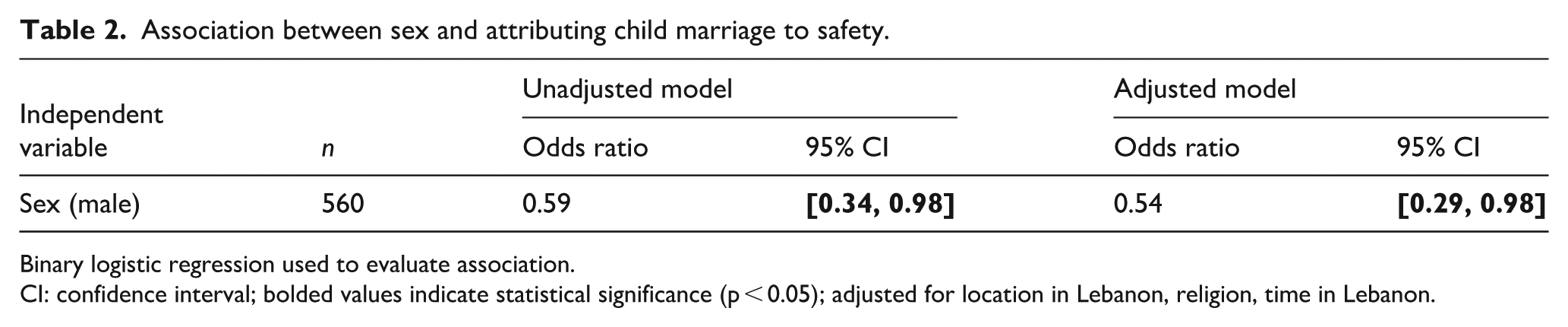
Binary logistic regression used to evaluate association.
CI: confidence interval; bolded values indicate statistical significance (p < 0.05); adjusted for location in Lebanon, religion, time in Lebanon.
Association between participant sex and attributing child marriage to financial insecurity
Table 3 presents both unadjusted and adjusted models for the association between participant sex and attributing child marriage to financial insecurity. Men were associated with higher odds of associating child marriage with financial concerns than women, controlling for potential confounders (OR = 1.76, 95% CI = [1.06, 2.92]).
Association between sex and attributing child marriage to financial resources.

Binary logistic regression used to evaluate association.
CI: confidence interval; bolded values indicate statistical significance (p < 0.05); adjusted for location in Lebanon, religion, time in Lebanon.
Association between sex and reasons for child marriage based on location in Lebanon
Both binary logistic regression models were stratified by location, with results summarized in Tables 4 and 5. Table 4 presents the stratified analysis for the outcome of attributing child marriage to safety by location. No significant results were found.
Association between sex and attributing child marriage to safety, stratified by location.
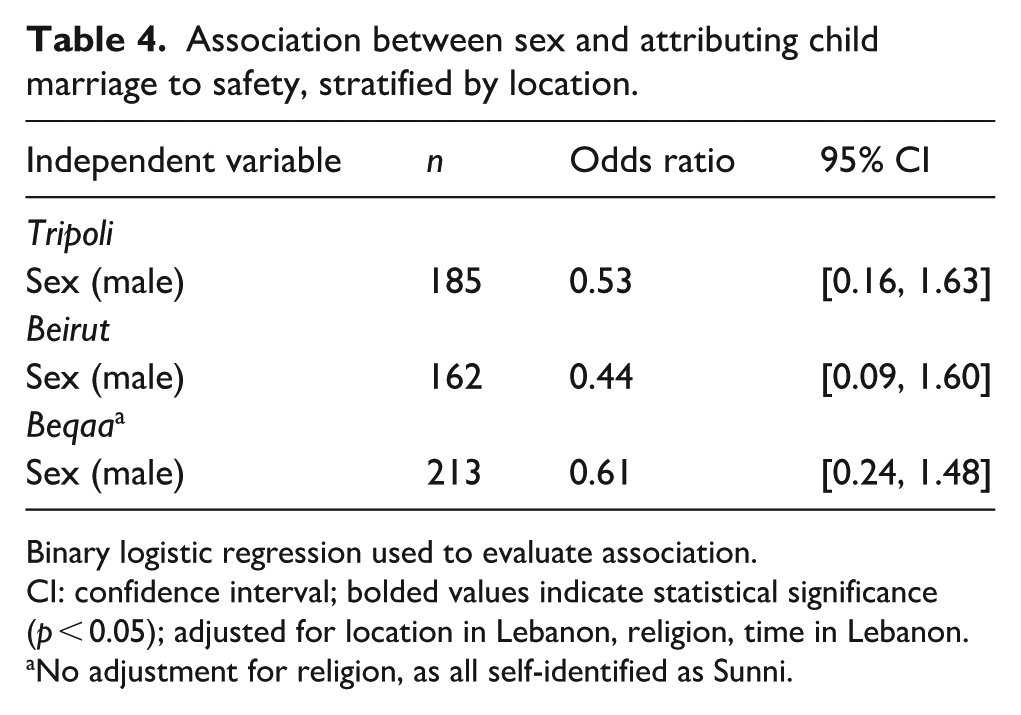
Binary logistic regression used to evaluate association.
CI: confidence interval; bolded values indicate statistical significance (p < 0.05); adjusted for location in Lebanon, religion, time in Lebanon.
No adjustment for religion, as all self-identified as Sunni.
Association between sex and attributing child marriage to financial resources, stratified by location.

Binary logistic regression used to evaluate association.
CI: confidence interval; bolded values indicate statistical significance (p < 0.05); adjusted for location in Lebanon, religion, time in Lebanon.
No adjustment for religion, as all self-identified as Sunni.
Table 5, providing the stratified analysis for the outcome of attributing child marriage to financial resources by location, shows men were associated with higher odds only in Tripoli (OR = 2.68, 95% CI = [1.11, 6.50]), after controlling for other confounders. No significant results occurred in other regions.
Discussion
This study evaluates the association between participant sex and attribution of child marriage to either safety or financial concerns, while controlling for sociodemographic factors. Results of the overall analysis show that men are less likely than women to attribute child marriage to safety concerns, and more likely than women to relate child marriage to financial insecurity. However, the results of the sensitivity analysis do not support the associations found for the safety outcome, thus, these results should be interpreted with caution. Additionally, the stratified analysis suggests Tripoli may be driving the association between male sex and the attribution of child marriage to financial resources.
The findings described are consistent with those of previous qualitative studies. Earlier research identified financial concerns as a predominant driving factor for child marriage. 10 In many regions where child marriage is common, there are strict social gender roles for men and women, with men being responsible for providing for their family financially. 32 These fathers often cite frustration at their inability to improve their family’s economic situation. 33 As such, they may be more likely to consider marriage for their daughters as a means of easing their financial struggles.
Researchers have also described an important link between safety concerns and child marriage. More specifically, war and displacement have been found to heighten the real and perceived threat of sexual harassment, as well as create an increased sense of vulnerability. 3 It has been suggested that families believe child marriage will help protect the girls from sexual assault, pre-marital pregnancy, and sexually transmitted infections.3,13,32 Therefore, families facing conflict and displacement, such as those fleeing the Syrian crisis, may resort to child marriage as a form of protection for their daughters.
Bartels et al. found men were more likely to cite financial insecurity as being the primary motivation for child marriage. 11 Conversely, they suggested women were likely to link child marriage to a combination of safety, financial insecurity, and expectations of the community. The results of this study imply that despite a more even distribution of perceptions, women are still more likely than men to attribute child marriage to safety concerns. This could indicate that men were less likely to consider safety as a reason for child marriage, focusing instead on the economic needs of their families and daughters. However, given the results of the sensitivity analysis for the safety outcome, these results should be replicated in further studies.
Implications of study findings
One of the most effective ways to prevent child marriage is through education for young girls, as enrollment in school is often viewed as being incompatible with marriage. 32 Unfortunately, due to limited access and poor quality of schools, in conjunction with perceived social norms, parents often question the value of their daughter’s education. 34 In many regions, there are limited prospects for women and girls to translate their education to long-term employment. As such, even with improved educational programs and supports, societal pressures often discourage girls and their parents from considering higher education as a viable pathway. It is important to highlight the ways in which education can provide financial security to both the girls and their families, especially when addressing men or fathers in the community. 11 Another significant barrier to education for young girls in refugee communities is the risk of sex and gender-based violence (SGBV) on the way to, and within schools. 35 While education does have a potential protective effect, the associated risk often outweighs the potential benefits, which discourages girls from pursuing further schooling.11,35,36 Implementing safety initiatives to address concerns about SGBV in schools may be beneficial for increasing school attendance for young girls.35–37 This includes safe transportation to and from schools, more female teachers, and better supervision in school. 35 As the results of this study suggest, women are more likely to cite safety concerns as a reason for child marriage, thus these systemic changes would help alleviate their fears and may help reduce the incidence of child marriage.
Implementing community engagement initiatives and providing educational resources may also help improve awareness and reduce reliance on child marriage as a negative coping strategy. Given the important link between financial insecurity and child marriage, economic support programs and increased financial aid may alleviate the perceived need for daughters to find suitable husbands before the age of maturity. 32 A systematic review from 2016 found a notable decrease in the rate of child marriage following the implementation of incentivized participation in school, such as cash-transfer programs.38,39 By reducing the costs associated with attending school, or providing additional financial support to families with girls who remain enrolled, school retention rates rise which will ultimately help reduce the incidence of child marriage.32,38 While this study did not include Lebanon specifically, early pilot programs by NGOs and UNICEF in Syrian refugee communities showed promise. 38 These programs would likely appeal especially to fathers of young girls, as they appear more likely to turn to child marriage as a result of economic instability. The COVID-19 pandemic further exacerbated economic hardship and disrupted schooling worldwide, both of which are well-established drivers of child marriage, and its effects have continued to heighten the vulnerability of girls in many settings.8,40,41 Since 2019, Lebanon has been experiencing the most severe economic crisis in their country’s modern history.42,43 Globally, this is the worst financial collapse that has occurred since the mid-19th century. 44 It is expected that children in the region will experience substantial adverse effects to their overall well-being, including increased rates of child marriage.43,45 Many service providers cite a lack of financial support as a significant barrier to providing assistance in the community, including important programs to combat child marriage. 38 Consequently, providing financial support and economic initiatives is imperative to help alleviate these concerns. This is especially important in Tripoli, where poverty rates are extremely high. 22 Currently, monetary support for Syrian refugees in the region is limited. As such, increased economic programs are needed to help reduce the occurrence of child marriage.
In conjunction with financial support, there needs to be increased education on the harms associated with child marriage. As previously described, the need for protection is strongly tied to the practice of child marriage, especially from the perspective of women. Unfortunately, in reality, the marriage itself often results in substantial risk for young girls. The occurrence of intimate partner violence is particularly high among those who marry before the age of 18. 46 Child marriage is also often accompanied by teenage pregnancy and childbirth, which is the leading cause of death among girls aged 15–19 in resource-limited countries. 47 Finally, with limited access to reproductive health services and education, and reduced autonomy, child brides are at increased risk for sexually transmitted infections, including HIV/AIDS. 11 By educating parents, especially mothers, on these inherent dangers, they may be less inclined to view child marriage as protective for their daughters.
Similarly, while many parents feel as though marriage will secure financial stability for their daughters, reports suggest child marriage is, in reality, driving poverty. 48 Unfortunately, early marriage often means girls leave school at a young age, limiting their literacy skills and future income-earning potential. While larger families are valued in some cultural contexts as sources of pride, support, and continuity, in our study participants more often described the economic challenges associated with having more children. This perpetuates a cycle of child marriage and intergenerational poverty. It is important to clearly outline the realities of child marriage to ensure parents understand the associated consequences. UNICEF’s Communication for Development (C4D) strategies can be utilized in this type of public education program to ensure messaging reaches many levels of the community, which helps encourage change. 38 These types of directed initiatives are anticipated to be more effective in preventing child marriage, and reducing its prevalence among Syrian refugee communities. The findings of this study will help target messaging to the specific concerns of men and women, as it is evident they differ.
Strengths and limitations
This study has several limitations. First, a cross-sectional study presents some inherent limitations. While it can demonstrate the existence of an association, causality cannot be proven. 49 Furthermore, the use of a convenience sample is a potential source of selection bias, and limits the results of this study from being generalized to a broader population. 11 The data may not be applicable to other individuals, and may only be representative of the specific sample interviewed. Additionally, with the use of SenseMaker triads, participants tend to provide answers to the extremes (typically corners or borders of the triad), introducing response bias. 25 This could skew the data in the triad, and lead to inappropriate conclusions, despite the fact research assistants were trained to mitigate these risks. Further, while our triad questions focused on financial and safety-related concerns, reflecting themes commonly raised in formative research with Syrian families, this approach may not fully capture the broader cultural and social dynamics that also shape decisions around early marriage. Finally, although our data were collected in 2016, we believe the findings remain relevant given the current context in Lebanon. Many of the vulnerabilities that contribute to child marriage, such as economic hardship, displacement, and gender inequities, persist today. While newer data would strengthen the evidence base, these enduring structural and social determinants suggest that our results continue to provide important insights into the factors shaping child marriage in this setting.
Irrespective of the limitations, there are also numerous strengths to this study. Using SenseMaker as a data collection tool is beneficial, as it allows participants to self-interpret their shared micronarrative, reducing researcher bias. 25 Additionally, social desirability bias was limited because within any given question, possible response options are either all positive, all negative, or all neutral, with no one response option viewed as better than another. Reporting bias was limited by allowing participants to share a micronarrative of their choosing, without guiding their response in a specific direction. Lastly, various sub-groups within the population were interviewed, including married Syrian girls (under 18 years of age), unmarried Syrian girls, Syrian mothers, Syrian fathers, married Syrian, Lebanese, or Palestinian men, and unmarried Syrian, Lebanese, or Palestinian men. This provided a number of unique perspectives regarding the experiences of Syrian girls, and ultimately improves the credibility of the results.
Significance for public health
Since the onset of war in Syria, the occurrence of child marriage has continued to rise, due to increased armed conflict and forced displacement, which leads to economic instability and safety concerns.6,10,11 The instability created in the wake of the COVID-19 pandemic has intensified these concerns, and contributes to the rising prevalence of child marriage. 9 The results of this study can be used to better understand the perceived reasons for child marriage among men and women, which can be used to inform gender-specific messaging. This type of messaging has been shown to be more effective in addressing the underlying causes of child marriage, and may ultimately be utilized to reduce the occurrence of this practice. 32
Conclusion
This study highlights the association between participant sex and perceptions of child marriage, demonstrating the different perspectives of males and females. By examining the associations between sex and child marriage while controlling for demographic variables, we validate and expand upon earlier descriptive research. The stratified analysis showcases disparities among various regions of Lebanon, and suggests there is a greater need for economic initiatives in Tripoli. The results also demonstrate the importance of gender-specific messaging when working to address the underlying issues of child marriage, as the perceived reasons behind the practice differ between men and women. By working with community stakeholders, we recommend additional opportunities for Syrian girls and their families to help address their needs, with the ultimate goal of reducing the occurrence of child marriage.
Supplemental Material
sj-docx-1-phj-10.1177_22799036251401943 – Supplemental material for An evaluation of the association between participant sex and perceptions of child marriage among Syrian refugees in Lebanon
Supplemental material, sj-docx-1-phj-10.1177_22799036251401943 for An evaluation of the association between participant sex and perceptions of child marriage among Syrian refugees in Lebanon by Claire Healey, Melanie Walker, Saja Michael and Susan A. Bartels in Journal of Public Health Research
Footnotes
Acknowledgements
The authors wish to acknowledge the team members of the original study from which the data was obtained. The authors are extremely grateful to all participants who shared their experiences and insights. The authors would also like to recognize all the interviewers, and Laurie Webster from QED insight, for their work and commitment. Thank you to Ghida Anani of the ABAAD Resource Center for Gender Equality, as well as team leads Katia Ghandoura, Clara El Warrak, and Salma Atwi for their support.

Author contributions
SAB and SM conceived of the study idea, secured funding, and designed and pilot tested the survey. SM oversaw recruitment of interviewers and the original data collection. Analysis was done by CH with supervision by MW and SAB. CH drafted the initial manuscript with all authors contributing to writing. All authors read and approved the final manuscript.
Funding
The authors disclosed receipt of the following financial support for the research, authorship, and/or publication of this article: Sexual Violence Research Initiative (SVRI) and the World Bank Group’s Development Marketplace for innovation on GBV prevention (in memory of Hannah Graham).
Declaration of conflicting interests
The authors declared no potential conflicts of interest with respect to the research, authorship, and/or publication of this article.
Supplemental material
Supplemental material for this article is available online.
References
Supplementary Material
Please find the following supplemental material available below.
For Open Access articles published under a Creative Commons License, all supplemental material carries the same license as the article it is associated with.
For non-Open Access articles published, all supplemental material carries a non-exclusive license, and permission requests for re-use of supplemental material or any part of supplemental material shall be sent directly to the copyright owner as specified in the copyright notice associated with the article.
