




Abstract
Background:
Adolescent-to-Parent Violence (APV) is acknowledged as a form of family violence, wherein the conventional parent-adolescent relationship is disrupted. The Adolescent-parent relationship dynamic can be shaped by the conservative and collective nature of Jordanian culture.
Aim:
This qualitative study aimed to explore adolescents’ views on violence towards their parents in the context of Jordanian culture.
Methodology:
Constructivist grounded theory methodology guided this study. Four focus group discussions with adolescents (aged 10–19 years) from early, middle, and late stages were conducted; adolescents were recruited from one private and one public school in Amman. Data were collected and analyzed simultaneously.
Findings:
The main findings were categorized into five main themes: Types of violence, Causes of violence, Consequences of violence, Managing violence, and Violence-specific characteristics.
Conclusions:
This is the first study in Jordan that highlights the phenomenon of APV in Jordan, including different types of violence, the causes from adolescents’ views, the consequences of violence, how adolescents manage it, and specific characteristics of APV. APV breeds further violence towards others. Additional research is needed to explore APV parents’ perceptions. Moreover, exploring the best possible ways to minimize violent incidences within the community is necessary.
Introduction
Adolescent-to-Parent Violence (APV) is acknowledged as a form of family violence, wherein the conventional parent-adolescent relationship is disrupted. This phenomenon highlights instances where adolescents engage in aggressive or violent behavior 1 toward their parents. The victimization dynamics may not always be associated with traditional patterns of family violence. 2 Lately, this issue has become a remarkable phenomenon and has increasingly turned into the focus of scientific research. Globally, the prevalence of APV was estimated to range from 5% to 21% for physical violence and a much higher rate of 33%–93% for psychological violence 3 ; however, parents were reluctant to report the incidence, and it was estimated that the prevalence rate is under-reported. 4 Previous studies recognized the main risk factors for APV as inter-parent violence, drug abuse, parenting behavior during child raising, parenting style, suicidal ideation among adolescents, and historical aggression toward the child.1,5–8 In terms of adolescent gender differences in APV, there seemed to be a gender difference in APC; some studies highlighted more verbal and psychological violence among girls. 9 Whereas physical violence was more common among boys.10,11 Other studies found no gender differences at all.12–14
Jordan’s population is predominantly Muslim, with around 95%, and 4% being Christian. The society is divided into different groups based on lifestyle: Bedouins, conservatives, and urbanites. Bedouins are considered the most conservative, adhering closely to traditions, while conservatives follow traditions moderately, and urbanites tend to adopt more Westernized lifestyles. The social structure revolves around tribes, with the father figure serving as the head of the family, responsible for upholding community traditions, customs, and values that have been passed down through generations. 15 The father is often considered the primary financial supporter of the family, even though many women are also working. Unfortunately, Jordan is considered among the lowest female labor-force participation rates worldwide. 16 Women are taking on the roles of raising children and household roles. In the Jordanian culture, there is a widespread belief that providing children with a fostering environment is essential for their development into responsible and productive adults who are prepared to contribute to the growth and development of the country. 17
Adolescents in Jordan are expected to be mindful of their family’s reputation, knowing that their behavior reflects not only on their immediate family but also on their extended family. This awareness can create a perception of family relationships being shaped by potential consequences, negative criticism, and a sense of control. 18 On the other hand, Arab families are directly involved in their children’s decisions concerning marriage, subject to study, and career, as they view their adolescents as immature and need support, control, and monitoring. 19 A study by Al-Tamimi and Al-Qudah 20 found that Jordanian parents in the 21st century are adopting a more democratic parenting style, one based on open communication, active listening, and support, as well as warm relationships with their children. However, they still use an overprotective parenting style, especially for girls, employing control of their daily activities, and doing specific tasks for their children when these tasks are supposed to be performed by the children themselves. 20 An overprotective parenting style may hinder children’s development, responsibilities, and independence.
This study aims to address a significant research gap in the literature regarding APV in Jordan. This topic has seen a lack of studies, particularly in the context of Middle Eastern cultures. While existing literature has focused on violence towards adolescents, there has been insufficient exploration of the counter-violence directed at parents by their children. By examining the perceptions and experiences of adolescents in Jordan regarding APV, this research aims to shed light on this underexplored phenomenon, providing valuable insights into the dynamics of family relationships within the Jordanian cultural context.
Methods
Design: Constructivist grounded theory principles were used to guide the study. 21 The constructivist approach acknowledges the role of researchers in the process of exploring the phenomenon of interest. Experienced researchers in qualitative research who worked with adolescents collected the data. Three researchers (two female and one male) collected data.
Setting: Two schools, one private, and one public, were selected to participate in this study. To cover the whole range of adolescence (10–19 years old), adolescents from the following grades were approached: grades 7, 9, and 11. This covers early, middle, and late adolescence.
Sampling and sample size: Two schools (one private and one public) were approached to participate in the study. Then, gatekeepers (school principals or department heads) helped in introducing possible adolescent participants from grades 7, 9, and 11. The study aim was explained to potential adolescents using participant information sheets, and consent forms were provided for them to obtain consent from their legal guardians. Any questions were addressed to the research team via gatekeepers. Then, time and place were set for data collection with gatekeepers. All focus groups were conducted in a private room within the school premises. Four focus group interviews were conducted in each school: one for adolescents in grade 7, two for adolescents in grade 9 (boys and girls), and one for adolescents in grade 11. Each focus group consists of 8–10 participants.
Data collection: Focused groups, guided by a semi-structured topic guide, were used to collect data. Three researchers were available for each focused group. Data was collected conversationally, and questions from the topic guide helped to initiate the conversation; however, researchers were open to what participants wanted to share. Furthermore, a psychologist was available in case any participants were willing to share and discuss any sensitive topics in the session or privately.
Topic guide: See Appendix 1 for topic guides. These topic guides were flexible means that it helped in the data collection process. They evolved through the processes of data collection and analysis based on the information shared by participants.
Data analysis: Four levels of coding according to Charmaz, 21 the approach of constructivist grounded theory methodology, constant comparative analysis, and writing reflective memos. Three researchers who had regular meetings to discuss the coding process soon after conducting focus group interviews coded the data. Reflective memos were written regularly and helped in understanding the codes and connecting them. Furthermore, theoretical saturation was considered throughout the data collection and analysis processes.
Ethical considerations: Ethical approvals from the Applied Science Private University (IRB No. Faculty 2023-2024-2-1) and all involved schools were obtained before starting the study. All participants were asked to sign a consent/assent form before participating in the study. Moreover, all adolescent participants and their parents were required to sign consent forms for their participation, as they are under 18 years of age. Participation was voluntary, and participants could withdraw from the study at any time without explanation. See. Confidentiality was assured. As this topic is sensitive and may trigger negative emotions in some participants, a psychologist was involved in the study to provide support when needed.
Trustworthiness: The credibility of this study was enhanced by the following: more than one researcher was involved in collecting and analyzing the data, writing critical and reflective memos, theoretical sampling was considered to maximize the range of obtained data, transcribing the interviews, and providing a detailed description of the study setting.22,23
Findings
Four focus groups with adolescents from different periods were conducted. The first focus group included 10 boys from grade 11. The second focus group included 10 girls from grade 7. The Third focus group included 10 girls from grade 9. The last focus group included eight boys from grade 9. The duration of each session was between 1 and 2.5 h.
The analysis of the transcripts revealed the following themes: Types of violence, Causes of violence, Consequences of violence, Managing violence, and Violence-specific characteristics.
Types of violence
Participants expressed several types of violence toward their parents. This included one or a combination of the following: verbal, behavioral, emotional, and psychological violence. Verbal violence included talking back to parents. Behavioral violence included actions such as slamming doors. Emotional violence involves doing something to make parents feel guilty about their adolescents. Psychological violence included threatening parents by suggesting that adolescents might harm themselves, such as leaving the house without telling parents where they are going or how long they will be gone.
When I get angry with my parents, I won’t study, I go out from home, or go out for smoking. . .this would hurt them more (boy from grade 11).
Causes of violence
Participants shared their views on what caused violence toward their parents. Participants mentioned several factors, including the home environment, the generational gap between adolescents and their parents, and parents favoring one child over another. The home environment meant that there was violence at home, usually from a father toward his children or his wife, which, in turn, caused violence from adolescents towards their parents. Many participants also discussed the generational gap between adolescents and parents. It meant that this gap created an environment of disagreement between adolescents and their parents, which could lead to violence. The disagreements included different views on studying, lifestyle, and other aspects of life. Some participants expressed that their parents favored another child over them, with some adolescents experiencing different treatment from their parents, which led to violence against their parents.
My parents don’t accept that things are different now. Times are easier now, but they were used to the hardships they had in the past. My mom never got to go out with her friends as a child, so she forbids me from doing so too. (girl from grade 9) I felt angry that my mother bought a new mobile for my younger brother, I didn’t understand why she trusted my brother more than me. (boy from grade 11) I know that my parents might have great experiences in life and they know better than me, but they just give orders without explanation, probably because this is how they were raised, life has changed. (boy from grade 11)
Moreover, participants in grade 9 mentioned and agreed that comparing achievements with others, especially relatives or close friends, was among the causes of violence towards parents.
Consequences of violence
Participants discussed one major consequence of violence, which is that “violence breeds violence.” This violence can be directed not just towards parents, but also toward their siblings or peers at school.
When my parents provoked me as a child, I knew I couldn’t take it out on them, so I noticed I became more aggressive towards other people at school. (boy from grade 11) It accumulates over time. I only act out after feeling frustrated for a while and feeling like there is no other way. (boy from grade 11) I feel guilty and bad when I hurt my parents or annoy them. (girl from grade 7)
Managing violence
All participants were asked about their methods for managing violent incidents. Several methods were discussed. However, the most common method was “communication.” Participants from different stages of adolescence shared that communication is key to managing violence and the generational gap with their parents.
My parents usually have a valid point of view, like when forbidding me from doing something, but they fail to explain it to me. Instead, they say that they know what’s best for me. I would prefer it if they would just explain it to me. (girl from grade 9)
Turning to another person (who was usually a grandparent) was another way to manage violence among some participants. Adolescents ask grandparents to intervene in a situation that could easily escalate into a bigger problem and could result in violent behavior. One participant shared: When I disagreed with my parents about choosing my school major, I initially tried arguing with them. When they didn’t agree, I asked my grandmother to intervene and convince them of what I wanted. (boy from grade 9)
Other ways of managing violence include using phones/social media, smoking, exercising, relying on friends, and turning back to religion.
I am easily provoked, but as an athlete, I always let it out while playing sports instead of on my parents or people around me. (boy from grade 11) God commanded us in the Quran to be good to our parents, so we shouldn’t act out against them, even if the violence started from them first. (boy from grade 11)
Violence-specific characteristics
Participants shared specific experiences about violence, including specific characteristics of violence. These characteristics were as follows: First, there was a clear distinction between violence towards mothers and fathers. Participants shared that violence toward their mothers was usually emotional or psychological, whereas violence towards their fathers was usually behavioral.
When my dad is unfairly violent toward me, I end up running away from the house for a couple of days. I feel bad because this scares my mom a lot, so I started telling her where I’m staying when I leave the house. (boy from grade 11)
Second, there was a clear distinction between the gender of the adolescent and the gender of the parent in terms of violence. Male adolescents were more violent toward their fathers, while female adolescents were more violent towards their mothers.
My mom is the communication link between us. I feel like I can tell her things without her getting mad at me, and she then delivers the message to my father in a better way. (boy from grade 11) My dad is calmer and more approachable than my mom. When I have a problem, I go to him because he is more helpful compared to my mom, who gets mad at me. (girl from grade 7)
Third, the period of adolescence (early, middle, and late) also played a role in violence. Older adolescents seemed more violent towards their parents compared to younger adolescents.
The disagreements with my mom increased a lot as I got older. When I see the way she treats my younger siblings, I get jealous because it’s nothing like how she treats me. (girl from grade 9)
Fourth, when adolescents’ feelings regarding violence towards their parents were explored, most participants expressed feelings of “guilt.” Participants recognized that their parents were usually doing their best to care for their children’s best interests despite the disagreements.
After a heated argument with my mom, I go to my room, but I feel bad after a while, so I go to her and start talking about random topics as if nothing happened. (girl from grade 7)
Discussion
The findings of this study highlight various aspects of AVP in Jordan, revealing the types of violence prevalent in these relationships, including verbal, behavioral, emotional, and psychological violence. These results align with previous research, such as that by Junco-Guerrero et al., 24 Seijo et al., 14 and Nam et al., 25 which similarly categorize the manifestations of violence in parent-adolescent dynamics. The study identifies several contributing factors to AVP, including: home environment: the familial atmosphere plays a critical role in shaping adolescent behavior. A chaotic or abusive home environment can lead to increased instances of violence. Generational gap: differences in values, beliefs, and communication styles between parents and adolescents can create tensions that may escalate into violence. Parental favoritism: Perceptions of favoritism among siblings can lead to feelings of resentment and anger, which may contribute to violent behavior. Media influence: exposure to violence in media can desensitize adolescents and normalize aggressive behaviors, influencing their interactions with parents. 26 The reciprocal nature of parent-child relationships is noted, where parents’ behaviors can influence their children’s actions, leading to a cycle of violence. The study emphasizes that violence in families can stem from various sources, including parental authority issues, cultural expectations, and social dynamics.
The findings further reveal that adolescents tend to exhibit different types of violence toward their mothers and fathers. Emotional or psychological violence is more common towards mothers, while behavioral violence is more frequently directed at fathers. This distinction may reflect deeper cultural dynamics within Jordanian families, where traditional gender roles and parenting styles play significant roles. 20
Culturally, the study notes that Jordanian families often adhere to authoritarian parenting methods that stress discipline and obedience. This approach may inadvertently contribute to AVP by failing to foster open communication and emotional understanding. The prevailing cultural values in Jordan prioritize familial honor and respect for authority, creating an environment where negative behaviors are often not openly addressed or resolved.
Moreover, the influence of Islamic teachings on child-rearing is highlighted, suggesting that such teachings can provide a framework for moral development but may also contribute to low levels of AVP when they align with positive parenting practices. 27
The causes of violence in adolescents are multiple, and the violence that adolescents are exposed to through the media and through TV, such as witnessing violent acts, is considered one of the sources of the occurrence of violence in adolescents. 26 Studies show a substantial correlation between parents’ violence towards children and adolescents’ violence toward parents in the future. 25 Rising evidence indicates that exposure to violence is a causal factor in the development of aggressive or violent behavior issues in adolescence. 28 Violence in families can occur even before a child is born, and hereditary elements can influence an aggressive or violent disposition in adolescents. 29 It is common for the impacts of parent–child behavior to be reciprocal, meaning that parents both influence and are impacted by their children. An AVP may arise from a parental inability to set and enforce limits for their child’s conduct, which can both raise the likelihood of behavioral issues and encourage them, especially to AVP. 30
Violence between parents has harmful direct and indirect consequences for both mothers and their children, especially children. The major consequence of violence, based on participants’ opinions in this study, is that “violence breeds violence.” This violence can be directed toward parents, and or toward their siblings or peers at school. Experiencing or watching violent situations during childhood can frequently lead adolescents into a pathway of violence in the future, especially AVP. 28 The family’s psychosocial situation influences the stress response system, resulting in an effect on the development of children. 29 Adolescents’ decisions to use violence can be influenced by a variety of factors, including parenting techniques, the generational transmission of violence, and parental comportment. 31 Violence to which children are subjected by others had an effect on them and may be a cause for the occurrence of AVP. 24 This result was in agreement with the findings of studies by Nam et al., 25 and Curtis et al. 6
Managing violence among some adolescents ended by asking grandparents to intervene in a situation that could easily deteriorate into a bigger problem and could result in violent behavior. Adolescents’ violence in the current study has specific characteristics; adolescents’ violence toward their parents depends on the parent’s gender. Therefore, violence towards their mothers was usually emotional or psychological, whereas violence toward their fathers was typically behavioral. In the Middle East, and specifically in Jordan, Arab and Jordanian families commonly share similar cultural values and parenting beliefs. Normally, they favor a firm authoritarian parenting style characterized by strict discipline of children, critical feedback, and restrictive parental authority. This approach emphasizes the importance of obedience, conformity, and family honor within familial relationships at all stages of life, especially in adolescents. 32 Parenting practices are often influenced by the socio-political structure of the culture in which they are practiced. In Jordan, parenting is influenced by Arab traditions, culture, and Islamic religion. Islamic education creates a psychological environment where children can learn about the world and develop their actions, and standards guide them as they progress through developmental phases, monitoring their moral growth. Thus, it leads to low levels of AVP. 27 Despite scientific and ethical challenges related to social barriers, research on violence toward adolescents in the Arab region highlights pervasive instances of physical and emotional violence toward children from their parents. Data from nine Arab countries indicate higher rates of violence toward children compared to global averages, with the Eastern Mediterranean exhibiting the highest prevalence of parent violence toward adolescents. The review consistently shows higher levels of violence among males, including physical violence. 33 Furthermore, it was observed that fathers’ inclinations toward collectivism exhibited an association with the expression of warmth. Notably, conformity values did not manifest a statistically significant correlation with either parenting practices or the adaptive functioning of children. 27 Parents in Jordan value their traditions, customs, and social norms, viewing them as a guide for raising their children. Jordanian parents hold the belief that it is their responsibility to pass on cultural values and customs to the next generation in order to preserve cultural heritage. They also feel that children should be safeguarded and valued, taught to respect authority, and instructed to prioritize the needs of their families when making decisions. This view rejects any negative behaviors by adolescents towards parents, especially AVP. 34
Conclusion
This study highlighted as important phenomenon of APV. This, in turn, breeds further violence toward others. Several types of violence were identified. The causes of violence from adolescents’ view were also explored. Furthermore, the consequences were identified, which is further violence toward others. Therefore, this phenomenon needs attention from educators to prevent further violence. Moreover, policymakers should prepare educators with the needed training to help educators work with adolescents who are violent towards their parents or are experiencing violence. Furthermore, additional research is necessary to gain a deeper understanding of this phenomenon, as studies on this topic are still in their early stages within the context of Jordanian culture. Probably, in the broader context of the Arab world. Future research should focus on others’ views, such as parents and other family members, on this phenomenon, and explore the best possible ways to minimize violent incidences within the community.
Limitations
The study faced two main limitations, including organizing the focus group, as the study was limited to the students who received approval from their parents. However, we assume that many students might be willing to participate but cannot obtain approval from their parents. The second limitation is the student’s image in front of their peers, as they tend to be idealistic and show the best of themselves (social desirability bias).
Supplemental Material
sj-docx-1-phj-10.1177_22799036251395253 – Supplemental material for “Violence breeds violence”: A qualitative study exploring adolescents’ views on violence towards their parents in Jordan
Supplemental material, sj-docx-1-phj-10.1177_22799036251395253 for “Violence breeds violence”: A qualitative study exploring adolescents’ views on violence towards their parents in Jordan by Enas A. Assaf, Abdulrahman Alsawafta, Raghad Hussein Abdelkader, Fatima Gh. Alfaqieh and Aaliyah Momani in Journal of Public Health Research
Supplemental Material
sj-docx-2-phj-10.1177_22799036251395253 – Supplemental material for “Violence breeds violence”: A qualitative study exploring adolescents’ views on violence towards their parents in Jordan
Supplemental material, sj-docx-2-phj-10.1177_22799036251395253 for “Violence breeds violence”: A qualitative study exploring adolescents’ views on violence towards their parents in Jordan by Enas A. Assaf, Abdulrahman Alsawafta, Raghad Hussein Abdelkader, Fatima Gh. Alfaqieh and Aaliyah Momani in Journal of Public Health Research
Footnotes
Appendix
The topic guides for parents and adolescents.
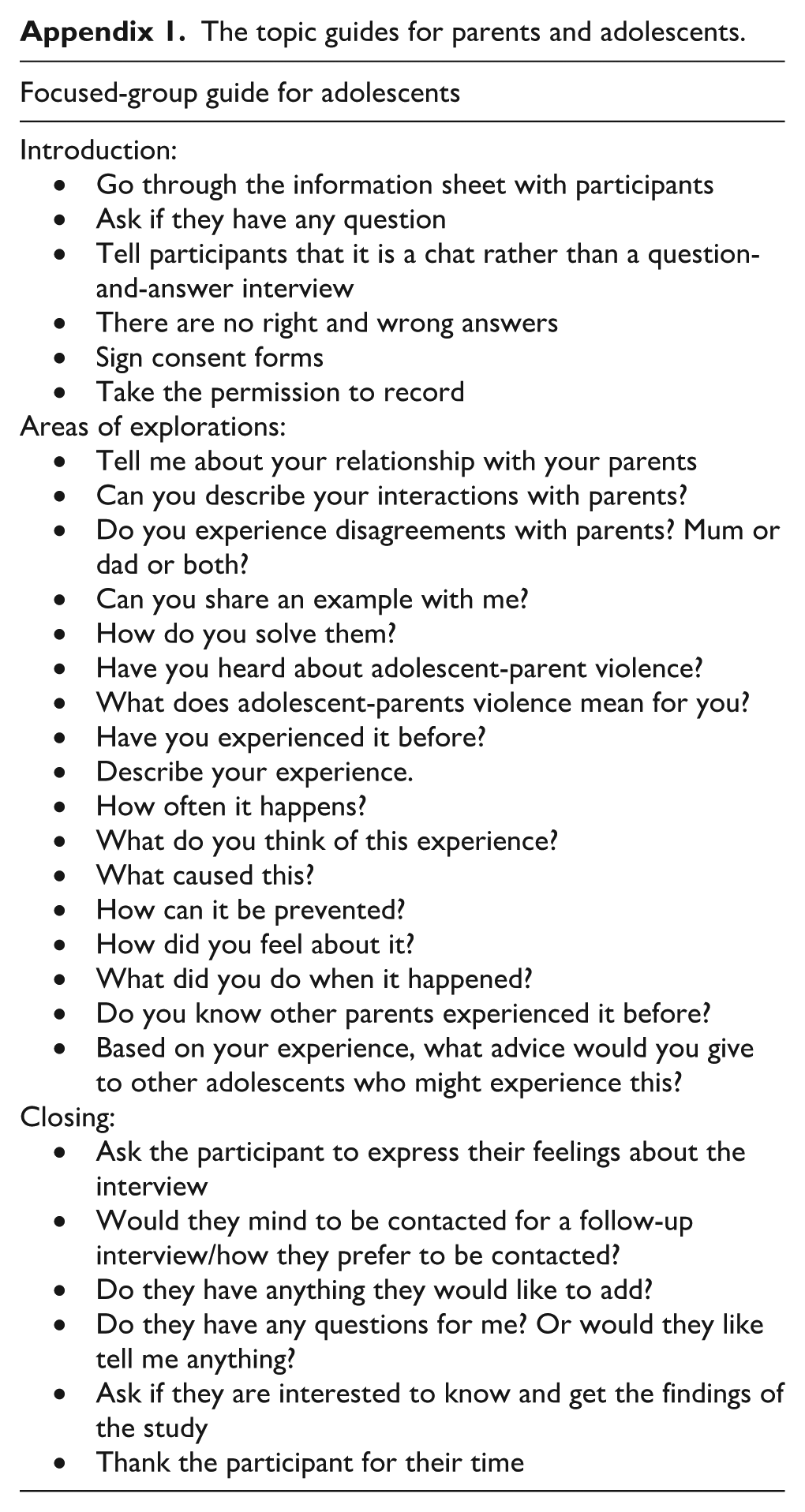
| Focused-group guide for adolescents |
| Introduction: • Go through the information sheet with participants • Ask if they have any question • Tell participants that it is a chat rather than a question-and-answer interview • There are no right and wrong answers • Sign consent forms • Take the permission to record Areas of explorations: • Tell me about your relationship with your parents • Can you describe your interactions with parents? • Do you experience disagreements with parents? Mum or dad or both? • Can you share an example with me? • How do you solve them? • Have you heard about adolescent-parent violence? • What does adolescent-parents violence mean for you? • Have you experienced it before? • Describe your experience. • How often it happens? • What do you think of this experience? • What caused this? • How can it be prevented? • How did you feel about it? • What did you do when it happened? • Do you know other parents experienced it before? • Based on your experience, what advice would you give to other adolescents who might experience this? Closing: • Ask the participant to express their feelings about the interview • Would they mind to be contacted for a follow-up interview/how they prefer to be contacted? • Do they have anything they would like to add? • Do they have any questions for me? Or would they like tell me anything? • Ask if they are interested to know and get the findings of the study • Thank the participant for their time |
Acknowledgements
The authors would like to thank the participants for their dedication and participation. We would like to acknowledge the role of the schools in coordinating and facilitating the overall group discussion activities.

Author contributions
Conceptualisation: Enas A. Assaf. Design: Enas A. Assaf and Aaliyah Momani. Data collection: Enas A. Assaf, Aaliyah Momani, Abdulrahman Alsawafta, and Fatima Gh. Alfaqieh. Data analysis: Enas A. Assaf, Aaliyah Momani, and Abdulrahman Alsawafta. Manuscript writing: Enas A. Assaf, Aaliyah Momani, Abdulrahman Alsawafta, and Raghad Hussein Abdelkader. Manuscript submission: Enas A. Assaf.
Funding
The authors received no financial support for the research, authorship, and/or publication of this article.
Declaration of conflicting interests
The authors declared no potential conflicts of interest with respect to the research, authorship, and/or publication of this article.
Data availability statement
Due to the sensitivity of this topic, data are available only upon request from the corresponding author.
Supplemental material
Supplemental material for this article is available online.
References
Supplementary Material
Please find the following supplemental material available below.
For Open Access articles published under a Creative Commons License, all supplemental material carries the same license as the article it is associated with.
For non-Open Access articles published, all supplemental material carries a non-exclusive license, and permission requests for re-use of supplemental material or any part of supplemental material shall be sent directly to the copyright owner as specified in the copyright notice associated with the article.
