



Abstract
Background:
Occupational hazards in the veterinary field are a significant concern due to the nature of the profession. Veterinary students are particularly vulnerable, as they often engage in clinical and laboratory activities before completing their degrees and may lack adequate experience. This was the first attempt to assess the knowledge, attitudes, and practices regarding occupational hazards among veterinary students.
Design and methods:
A cross-sectional study was conducted among 330 veterinary students from two conveniently selected institutions in Bangladesh. Third- to fifth-year students were approached to participate in a self-administered survey. Data were analyzed using descriptive and inferential statistics, including the chi-square test, Spearman’s correlation, and logistic regression to identify associated factors.
Results:
Among participants, 77.9% were familiar with the term “occupational hazard,” and over half of them had a lower level of knowledge (53.7%). More than half (54.2%) demonstrated poor attitudes among total respondents. Notably, 8.5% never used personal protective equipment, and 23.6% were not vaccinated against potential occupational diseases. Recapping needles after use was reported by 87.3% respondents. Familiarity with occupational hazards was associated with educational institution and curricular education exposure. Academic levels, formal training outside the curriculum, and curricular education exposure were linked to knowledge. Moreover, the current year of study and exposure to formal training outside the curriculum were associated with attitude.
Conclusion:
The findings from the study highlight the need to strengthen veterinary students’ knowledge, attitudes, and practices regarding occupational hazards by integrating theoretical and practical training into the curriculum prior to clinical exposure.
Background
Occupational hazards in the health sector are any potential sources of risk or harm or adverse health effects that healthcare workers might be exposed to in the workplace. 1 They can pose a significant threat to both the economy and the health of healthcare workers worldwide. The cost of occupational illness and injuries among healthcare professionals can exceed that of many other sectors, with an estimated expenditure of US$3.38 billion reported in Great Britain in 2017. 2 The severity of the burden of occupational risks extends far beyond economic loss, putting workers’ lives at risk. Such risks are even higher among healthcare personnel in the developing nations, as evident by the 60% prevalence of occupational injuries in their career. 3 Thus, occupational safety and health (OSH) has become a major concern, especially in developing countries like Bangladesh, where workplace infrastructure and safety measures are not up to standard. 4
Veterinarians, by nature of the profession, get exposed to a myriad of occupational hazards since they interact with a wide variety of animal species in working environments. 5 These can manifest across different dimensions, including physical, chemical, biological, ergonomic, and psychosocial.6,7 According to the CDC, 8 60% of all infectious diseases and 75% of all emerging and reemerging diseases in humans are transmitted via animals. In Bangladesh, some of the common zoonotic concerns include anthrax, avian influenza virus, and Nipah virus infection, which are potentially life-threatening for humans. 9 Veterinary professionals may serve as a link for such disease transmission between animals and the general population, thus risking the entire population. 10 Although zoonotic diseases remain one of the primary occupational concerns in the veterinary profession, other workplace risks, such as animal bites and sharp injuries, must not be neglected.
Veterinary students are particularly at a greater risk, as they have yet to complete their clinical training and may lack experience handling animals and substances. 11 Although veterinary students usually do not regularly interact with patients during the pre-clinical and para-clinical stages of their education program, they partake in laboratory and other practical work, thereby exposing themselves to various potential hazards. During clinical stages, students interact with animals routinely, which puts them at an increased risk of zoonotic infection if proper precautions are not taken.
Knowledge regarding veterinary occupational hazards is crucial in preventing unfortunate incidents. The curriculum could be an excellent source of information if it includes courses regarding veterinary occupational safety before exposing them to a practical environment. 12 Acquiring this knowledge may eventually improve their attitude and practices, as they are often found to be correlated. 13
Thus, it is vital to evaluate the current knowledge, attitudes, and practices (KAP) of veterinary students in Bangladesh to gain a comprehensive understanding of their awareness of occupational hazards and to identify specific knowledge gaps. Despite veterinary students being a vulnerable group, they remain understudied, especially in the context of Bangladesh. While a few studies in the developed nations explored occupational risks among veterinary students,14–16 they rarely explored KAP specifically. To date, no studies in Bangladesh have examined the KAP of veterinary students on the subject matter. Therefore, this study aims to assess the knowledge, attitudes, and practices regarding occupational hazards, along with their associated factors among veterinary students in Bangladesh. Addressing these research gaps is essential for developing evidence-based strategies, policies, and curricula that promote the safety and well-being of students.
Design and methods
Study design and sampling
A cross-sectional study was designed to assess the knowledge, attitudes, and practices (KAP) regarding occupational hazards among undergraduate veterinary students in Bangladesh. Eligibility criteria for participants included third, fourth, and fifth year veterinary students in Bangladesh at the time of the survey, as they mostly start their clinical duty in the third year of the program and are vulnerable to different occupational hazards, being in contact with animals regularly without complete knowledge of the subject matter. Firstly, two Bangladeshi universities were selected conveniently for data collection, referred to in this study as (i) Vet School 1 (VS1) and (ii) Vet School 2 (VS2). Subsequently, all the students in the third, fourth, and fifth years of their academic program were approached in the classroom to participate in the survey. All students who were present and voluntarily consented to participate were included in the study. For an estimated 2100 concurrent undergraduate veterinary students in Bangladesh (the total number of third, fourth, and fifth year students in Bangladesh), a total of 337 valid responses were collected after obtaining written informed consent. Finally, 330 responses were retained for final analysis after eliminating incomplete data.
Inclusion and exclusion criteria
Inclusion criteria for this study were:
Veterinary students (DVM or B.Sc. Vet. Sci. & A.H.) in their third, fourth, and fifth academic year
Students who were present in the classroom during data collection
Those who consented to participate in the survey
Exclusion criteria for this study were:
Students from disciplines other than veterinary medicine
Veterinary students in their first or second academic year
Those who were absent on the day of data collection
Those who declined to participate or did not provide consent
Sample size calculation
The required sample size was calculated using Cochran’s formula. 17 Due to the absence of prior studies from Bangladesh, the following assumptions have been made: 50% proportion (p), 95% confidence interval (Z = 1.96), and 5% margin of error (e).

However, as the estimated population size for the study was approximately 2100 (total number of third, fourth, and fifth year veterinary students in Bangladesh), which was less than 10,000, we used the following correction formula 18 :

Where,
n = corrected sample size,
N = finite population size.
However, to ensure adequacy, the final sample size was rounded up to 330.
Data collection tool
A structured self-administered questionnaire consisting mainly of closed-ended questions was constructed following a comprehensive literature review and validated by five subject matter experts. Afterward, the questionnaire was piloted among five students to ensure clarity and accessibility. The questionnaire had five main sections: (i) socio-demographic and other information, (ii) familiarity with occupational hazards, (iii) knowledge about occupational hazards, (iv) attitude toward occupational hazards, and (v) practices regarding occupational hazards. A detailed questionnaire is provided in Supplemental Appendix A.
Ethical considerations and consent to participate
Ethical approval was taken from the Ethical Committee of Chattogram Veterinary and Animal Sciences University (CVASU) (Ref: CVASU/Dir(R&E)EC/2024/763/7). Written informed consent was obtained from each participant before data collection, which outlined the study’s objectives, benefits, estimated duration, participants’ right to withdraw at any time without repercussions, and assurance of strict confidentiality.
Data collection process
The printed copies of the self-administered questionnaire were distributed to the students in the classroom, along with proper instructions. Data collection took place from 25th August to 10th September 2024.
Measures
Socio-demographic and other information
The predictive factors encompassed variables such as institution, sex, religion, source of financial support, accommodation, current year of study, formal training on occupational safety and health (OSH) outside the curriculum, and curricular education on OSH. Information regarding socio-demographic variables was collected, as factors such as religion and financial status are often associated with knowledge, attitudes, and practices in various contexts, as socio-economic and cultural conditions can shape these outcomes and may also influence KAP related to occupational hazards.19,20 Participants were asked to self-report their sex as male, female or other. Participants who belonged to Buddhism and Christianity were merged into the “others” category in the religion variable. Formal training outside the curriculum in this study indicated structured seminars or workshops organized by recognized institutes, NGOs, or professional associations, which are optional, extra-curricular activities rather than mandatory academic modules.
Familiarity with occupational hazards
The familiarity with the term “occupational hazard” was assessed using one question: “Do you know what occupational hazard is?.” Participants with a “Yes” response were assumed to have a primary familiarity with occupational hazards, and they were then requested to respond to the knowledge-related questions. On the contrary, those without familiarity with occupational hazards were asked to skip the knowledge-related questions and were requested to proceed with answering only attitude and practice-related questions.
Knowledge about occupational hazards
The participants’ knowledge about occupational hazards was assessed using 19 items. Each correct answer was marked with 1 point, whereas partially correct answers were marked with 0.5 points, and incorrect answers with 0 points. Responses to multiple-answer questions with at least one correct answer were regarded as partially correct. Marks for all 19 questions were summed up to obtain the total knowledge score for each respondent. The score ranged from 0 to 19. Respondents were then categorized into two groups based on the median score of 14.5 as the cut-off point. Participants with a score above 14.5 were classified as having a higher level of knowledge, whereas those with a score ≤14.5 were considered to have a lower level of knowledge. 21 Cronbach’s alpha for the knowledge scale is 0.70, demonstrating good internal consistency.
Attitudes toward occupational hazards
To evaluate the attitude, respondents were given eight statements to respond to on a 5-point Likert scale, where strongly disagree was scored 1, disagree 2, neutral 3, agree 4, and strongly agree 5, with a score ranging from 8 to 40. The cut-off point for categorizing the responses into higher and lower levels of attitudes was based on a median score of 32, where a score ≤ 32 was classified as a lower level of attitude, and a score > 32 as a higher level of attitude. The attitude scale demonstrated good internal consistency, with a Cronbach’s alpha value of 0.84.
Practices regarding occupational hazards
In the case of practice-related items, there were seven questions with varying response formats. While responses for items such as “Do you recap needles after use?” were dichotomous, others (e.g.
Statistical analysis
Data were initially entered into Microsoft Excel. Missing data were minimal, and participants with incomplete responses were excluded from the analysis. All data analyses were conducted using IBM SPSS version 25 for Windows, while the 95% confidence intervals were calculated using STATA version 17. The analysis undertaken included both descriptive and inferential statistics. Descriptive statistics included frequencies, percentages, mean, and standard deviation, whereas the chi-square test, Spearman correlation, and logistic regression were utilized for inferential statistics. Multivariable logistic regression was conducted using a manual backward elimination technique, where variables with the highest p-value were removed from the model at each step until only significant variables remained, thereby accounting for potential confounders. To check multicollinearity among the study variables, Variance Inflation Factors (VIF) and tolerance values were used. A VIF cut-off < 5 and tolerance > 0.2 were considered. No significant multicollinearity was observed among the variables. Model fit was assessed using the Hosmer and Lemeshow goodness-of-fit test. A significance threshold of p < 0.05 was adopted for all statistical analyses, and 95% confidence intervals were provided with the logistic regression results.
Results
Characteristics of the participants
Of the 365 students approached, 337 agreed to participate in the survey, yielding a 92.3% response rate. A total of 330 responses were included in this study following the removal of incomplete responses. The study included undergraduate veterinary students studying in their third year (37.0%), fourth year (17.3%), and fifth year (45.8%) of the academic program. Among them, 43% of these participants were from VS1, and the rest (57.0%) were from VS2. The mean age of the total participants was 23.55 (± 1.238) years. Males comprised 64.8% of the participants, while females accounted for 35.2%. The majority of respondents (79.9%) adhered to Islamic beliefs, whereas 16.1% followed Hinduism and 4.0% followed other religions. Among the respondents, 60.6% were financially dependent on their families, 13.3% were self-earning, and 26.1% had mixed sources of income. Most of the participants (81.7%) lived on-campus, with 18.3% living off-campus. Only a small proportion of participants received any formal training on occupational safety and health (OSH) outside their curriculum (18.2%), whereas 57.0% of the participants received OSH education through their curriculum (Table 1).
Distribution of the predictor variables according to familiarity, knowledge, attitudes, and practices regarding occupational hazards.

Bold values indicate statistically significant differences (p < 0.05).
Frequency of familiarity, knowledge, attitudes, and practices regarding occupational hazards
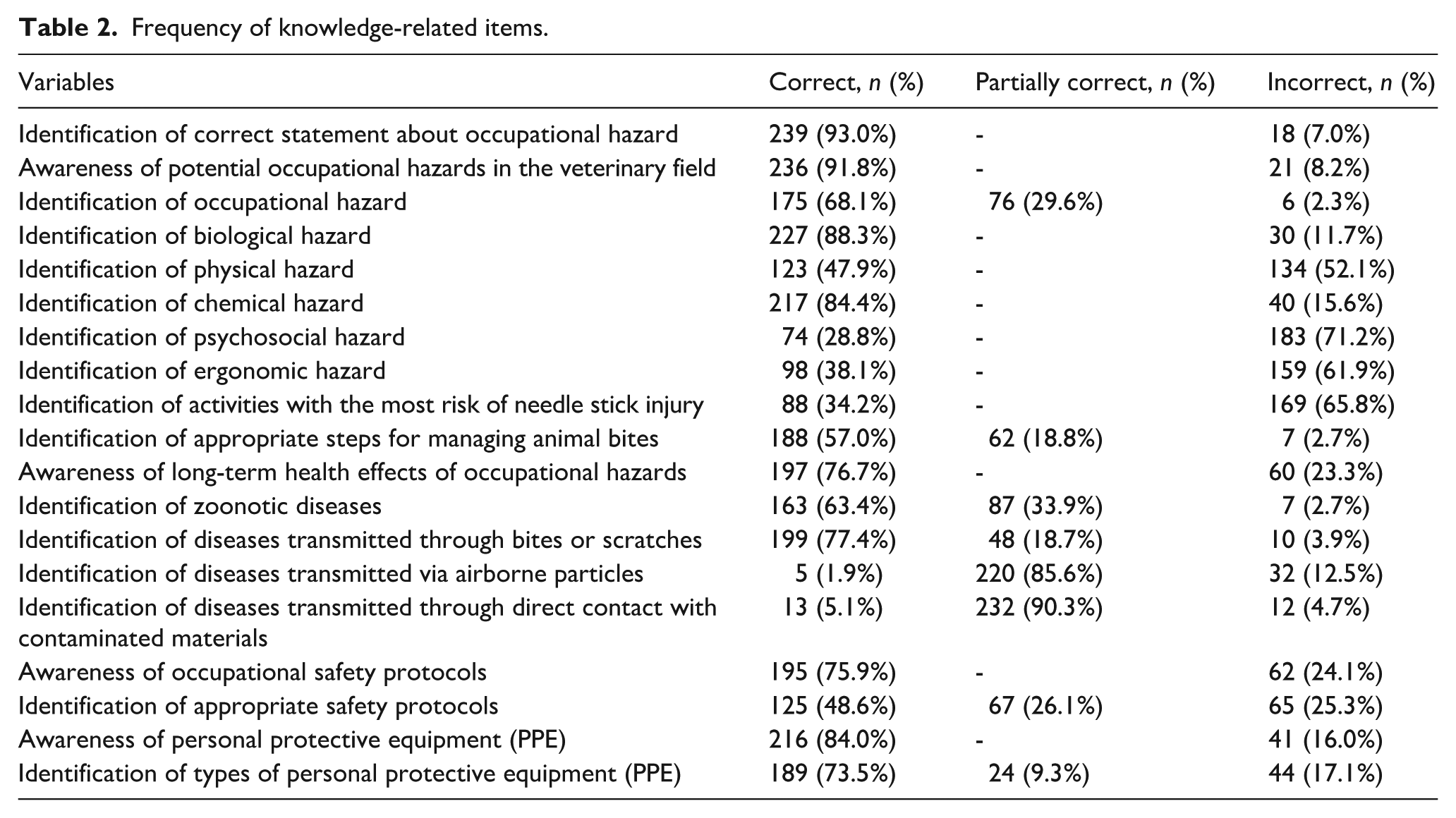
The majority (77.9%; 95% CI = 73.1%–%) of participants claimed familiarity with the term “occupational hazard,” and among them, only 46.3% (95% CI = 40.3%–%) demonstrated a higher level of knowledge. Regarding attitudes among the total samples, 45.8% (95% CI = 40.4%–%) had a higher level of attitudes regarding occupational hazards. A more detailed description of individual items for knowledge and attitudes is provided in Tables 2 and 3.
Frequency of knowledge-related items.
Frequency of attitude-related items.

In the case of practices, 8.5% and 27.0% of the students reported never and rarely using PPE during practical sessions or clinical work, whereas 36.1%, 15.5%, and 13.0% of the participants reported using it sometimes, often, and always, respectively (Table 4). Gloves, masks, goggles, and lab coats were worn by 50.3%, 58.8%, 13.0%, and 68.5% of the students (Figure 1(a)). Almost three-fourths (73.0%) of the participants claimed to dispose of hazardous materials. However, the majority (87.3%) of the students reported that they recapped needles after use. 76.4% of the respondents stated that they were vaccinated against potential occupational diseases (Table 4), whereas 40.0%, 34.8%, and 28.8% of the students were vaccinated against rabies, hepatitis B, and tetanus, respectively (Figure 1(b)). Moreover, 59.7% of the students reported practicing correct body positioning during clinical practice (Table 4).
Frequency of practice-related items.

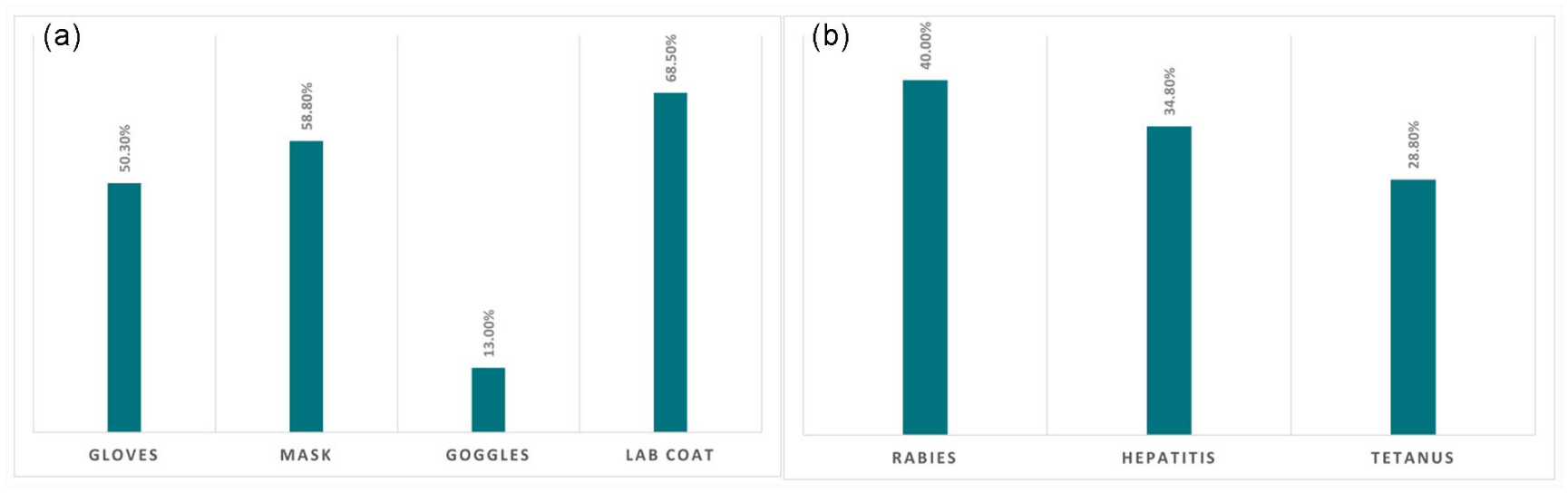
Distribution of types of personal protective equipment used and vaccinations taken. (a) Distribution of the type of personal protective equipment used. (b) Distribution of the types of diseases students are vaccinated against.
Distribution of the predictor variables according to familiarity, knowledge, and attitudes regarding occupational hazards
Familiarity with occupational hazards varied according to educational institutions, with a significantly higher proportion of VS2 students (88.3%) reporting familiarity compared to VS1 students (64.1%) (χ2 = 27.531, p < 0.001). Students in their fifth academic year (88.1%) demonstrated more familiarity with occupational hazards than third (69.7%) and fourth (68.4%) year students (χ2 = 16.849, p < 0.001). Those with OSH education incorporated into their curriculum reported greater familiarity with the subject matter than their counterpart (χ2 = 24.791, p < 0.001).
As for knowledge, VS2 students (51.2%) exhibited a higher level of knowledge about occupational hazards than VS1 students (37.4%) (χ2 = 4.530, p = 0.033). Higher knowledge level was observed among participants belonging to higher academic levels (23.5% vs 46.2% vs 60.9% for third, fourth, and fifth year, respectively) (χ2 = 29.132, p < 0.001) (Table 1). Moreover, more senior-level students reported receiving curricular education on OSH than students at lower academic levels (40.2% vs 45.6% vs 74.8% for third, fourth, and fifth year students, respectively) (χ2 = 36.713, p < 0.001). Female students (54.4%) were observed to have better knowledge than males (41.9%), although the difference was not statistically significant (χ2 = 3.692, p = 0.055). Exposure to both formal training outside the curriculum (χ2 = 5.108, p = 0.024) and institutional education through the curriculum (χ2 = 26.156, p < 0.001) was significantly associated with knowledge (Table 1).
In relation to attitudes, VS2 students (52.7%) were found to have better attitudes toward occupational hazards than VS1 students (36.6%) (χ2 = 8.386, p = 0.004). Furthermore, there was a significant difference in attitude among third (45.1%), fourth (22.8%), and fifth (55.0%) year students (χ2 = 17.279, p < 0.001). Those who attended formal training (31.7%) on OSH outside the curriculum demonstrated a lower attitude level than those who did not (48.9%) (χ2 = 5.866, p = 0.015) (Table 1).
Additionally, the correlation coefficient revealed a significant, weak, positive correlation between knowledge and attitude (r = 0.297, p < 0.001).
Univariable and multivariable logistic regression to evaluate the factors associated with familiarity, knowledge, and attitudes
The multivariable logistic regression analysis utilizing the backward elimination technique assessed the factors associated with familiarity, knowledge, and attitudes. All three adjusted models demonstrated good fit based on the Hosmer and Lemeshow test: familiarity (χ2 = 0.681, p = 0.712), knowledge (χ2 = 2.140, p = 0.829), and attitude (χ2 = 0.059, p = 0.996).
Findings from the adjusted logistic regression model suggested that VS2 students were more likely to be familiar with occupational hazards than VS1 students (AOR = 3.66, 95% CI = 2.05–6.52, p < 0.001). Students with OSH education incorporated into their curriculum demonstrated 3.34 times (CI = 1.88–5.93) more familiarity with the term than their counterparts.
Regarding knowledge, fifth and fourth year students were 3.58 times (CI = 1.87–6.87) and 2.95 times (CI = 1.27–6.87) more likely to have a higher level of knowledge than third year students. Surprisingly, students receiving formal training on OSH (AOR = 0.34, 95% CI = 0.16–0.69, p = 0.003) demonstrated a lower level of knowledge than their counterparts. On the contrary, students who received education on the subject matter in their curriculum had 3.91 times (CI = 2.09–7.29) higher odds of having a higher level of knowledge than those without it.
In terms of attitude, fifth year students had 1.48 times (CI = 0.92–2.40) higher odds of reporting a higher level of attitude, whereas fourth year students (AOR = 0.38, 95% CI = 0.18–0.77, p = 0.001) had lower odds than third year students. Moreover, students with formal training outside the curriculum were less likely to report positive attitudes (AOR = 0.52, 95% CI = 0.28–0.96, p = 0.037) toward occupational hazards than those without formal training or education. (Table 5).
Factors associated with higher levels of familiarity, knowledge, attitudes, and practices regarding occupational hazards.

Bold values indicate statistically significant differences (p < 0.05).
Discussion
Veterinary students are vulnerable to various occupational hazards in their academic and clinical environments. In this first attempt to evaluate the knowledge, attitude, and practice toward occupational hazards among veterinary students, we included undergraduates across the third to fifth year, as they are more vulnerable to occupational hazards due to their frequent contact with animals during clinical duties. The findings of the study revealed a lack of knowledge and attitudes regarding occupational hazards among a significant proportion of the participants and their associated factors.
Although the majority (77.9%) of the respondents were familiar with occupational hazards, more than half of them demonstrated a lower level of knowledge (53.7%) regarding the subject matter. Among the participants, 54.2% were observed to have poor attitudes. In an Egyptian study, Helal et al. 22 reported that 31.3% of veterinary healthcare workers had poor knowledge regarding occupational hazards. The discrepancies in the findings might be attributed to the fact that both studies vary in several aspects, including differences in study population (veterinary students vs veterinary health care workers), region (Bangladesh vs. Egypt), and sample size (330 vs 64). Students might be less aware of various occupational hazards compared to professionals as they have yet to complete their academic training and lack field experience, which explains the relatively higher proportion of poor knowledge observed in the current study.
Students from VS2 were 3.66 times more likely to be familiar with occupational hazards than students from VS1, which might be attributed to differences in curriculum design. Curriculum design, the inclusion of occupational health and safety (OSH) education into the curriculum, and the depth of the content can vary across institutions. 23 The curriculum design of VS2 might include more structured and in-depth discussions on occupational health topics. Moreover, differences in faculty expertise and resources can also contribute to this variation. The finding highlights the need to ensure consistency in the curriculum across the institutions, so that all veterinary students, regardless of where they study, are adequately prepared to recognize and manage occupational risks in professional life. However, detailed institutional and curricular data were not collected in this study, nor was such information publicly available for comparison. Therefore, while plausible, these interpretations remain speculative and should be regarded as tentative explanations. Future research should gather institutional and curriculum-specific data to explore the drivers for such institutional discrepancies.
In relation to the year of study, fifth year students demonstrated 3.58 times better knowledge and 1.48 times better attitudes, whereas fourth year students were observed to have 2.95 times more knowledge but a lower level of attitudes than third year students. A similar finding was found by a survey among Nepalese dental students, where students at higher study levels had higher mean knowledge scores compared to lower study levels. 24 This association can be linked to the fact that senior-level students may have received more curricular education on OSH than their juniors, indicating the need to introduce training and courses related to OSH at an earlier stage of the program. Moreover, upper-level students having more practical experience through internships and clinical duties can also influence the result. Meanwhile, the surprising dip in attitude among fourth year students might be due to burnout and stress from increased academic and clinical duty demands in the final year of theoretical study. However, there was less representation of the fourth year students compared to other academic levels, as there was no fourth year cohort in VS2 at the time of data collection, whereas there were two fifth year cohorts at the same time. This discrepancy in the distribution of the participants might have affected the findings as well.
Unexpectedly, students who received formal training outside the curriculum reported poorer knowledge and attitudes than those who did not. This may be due to the training programs being poorly tailored and lacking in-depth and hands-on practical applications. Such limitations may not only fail to improve the knowledge but also may reduce students’ motivation and engagement, thereby negatively influencing their attitudes toward occupational safety. Findings from our previous study also found that students receiving formal training outside the curriculum reported higher exposure to occupational hazards, which may indicate that such training may increase recognition of hazards, but does not necessarily translate into improved safety attitudes. 25 A systematic review and meta-analysis on the effectiveness of occupational health and safety training also highlighted that generic classroom-style training is often ineffective in enhancing knowledge and changing attitudes and behaviors. 26 Moreover, the effectiveness of the training programs depends on factors such as delivery method, trainer credibility, and how well the content aligns with students’ needs and motivation. Further investigation is warranted to explore the reason behind such a counterintuitive finding to explain why certain training programs may inadvertently result in weaker attitudes toward occupational safety among veterinary students.
Furthermore, those who had attended academic courses regarding occupational hazards had 3.34 times higher odds of reporting greater familiarity and 3.91 times higher odds of demonstrating more knowledge than their counterparts, signifying the need for the incorporation of OSH education into the curriculum. In our study, not all students reported OSH education in their curriculum. This variation in curriculum might be attributed to differences across institutions and academic years. Students in their earlier academic years might not have yet reached courses where occupational hazard topics were introduced. Our finding is consistent with the findings of Qaraman et al. 27 where students who attended safety precaution courses during clinical training demonstrated better knowledge. A study on technical education students also supported the finding, as their knowledge level improved significantly following health education intervention. 28 While students who received OSH education in the curriculum were associated with a higher level of knowledge, this exposure was not significantly linked to attitudes in the current study. This might be linked to the fact that OSH education alone can improve knowledge, but without an interactive, contextually relevant, and emotionally engaging approach, it may not significantly shift attitudes. 29 Future research should identify which elements of interactive training are most influential in changing attitudes.
The study also found a weak positive correlation between knowledge and attitude. This is consistent with a study among Chinese nurses, where a significant weak positive correlation between knowledge and attitude was observed. 30 This implies the role of having a better understanding of occupational hazards in enhancing attitudes among students, which might eventually translate into improved safety practices.
Regarding practice, the study found that 36.1%, 15.5%, and 13.0% of the participants sometimes, often, and always wear PPE during their clinical duties or practical classes. The usage of protective equipment among veterinary students in the current study is lower compared to the 44.2% of veterinarians in Nigeria who reported always using PPE. 31 The discrepancy might be due to the lack of professional experience among veterinary students. In the present study, half of the students reported using gloves, one of the most crucial protective equipment in preventing hazard exposure. This is in line with the 43.6% usage of gloves among Canadian veterinary workers. 32
In the present study, an overwhelming proportion (87.3%) of the veterinary students reported practicing recapping needles after use. This is in line with a study conducted at a university veterinary teaching hospital in New Zealand, reporting that three-quarters of the participants practiced two-handed needle recapping after use. 33 This is particularly concerning since recapping needles is associated with a higher prevalence of needle-stick injury, which can not only cause physical injury but also transmit bloodborne organisms. 34 This finding also aligns with the fact that 65.8% of veterinary students did not recognize recapping needles as the riskiest activity for needle-stick injury.
Moreover, 40.0%, 34.8%, and 28.8% of the students reported that they had received vaccinations against rabies, hepatitis B, and tetanus, respectively. These proportions are higher compared to the findings among Ethiopian veterinary students, where 12.3% and 6.5% of the participants were immunized against rabies and tetanus. 35 On the contrary, in developed countries like the USA, preexposure vaccination against rabies is mandatory prior to enrollment into veterinary programs. 36 This variation might be attributed to differences in institutional policies and resource availability across countries.
Proper disposal of hazardous materials was reported by three-fourths of the students in the present study. This is in accordance with a Bangladeshi study in tertiary hospitals in Dhaka, where 58.3% and 89.7% of the respondents from two separate hospitals demonstrated good waste management practices. 37 While the proportion in our study is higher than that of healthcare workers in one hospital, it is lower than in the other, indicating variability in waste management across different settings and institutions. This underscores the need for uniform training to enforce proper waste disposal protocols. Moreover, 59.7% of the students reported correct body positioning. A study among healthcare workers in the UAE also found that 63.5% of the participants demonstrated good ergonomic practices, which was significantly associated with years of experience. 38 Although the proportions are similar, the slightly higher rate of good ergonomic practice among healthcare workers might be attributed to their greater practical experience as professionals, which highlights the importance of integrating ergonomic training early to build proper habits among students before they enter the workforce.
The strength of the study lies in its comprehensive assessment of knowledge, attitude, and practice regarding occupational hazards among veterinary students for the first time. However, the study has its limitations as well. The cross-sectional study design limits the ability to establish a causal relationship between the factors and the outcomes. In particular, the absence of longitudinal designs restricts the determination of the directionality of associations and changes over time. As the data were self-reported by participants, it might induce recall bias. Moreover, the non-probability sampling method may introduce selection bias and limit the generalizability of the findings to a broader population. Specifically, the convenient selection of two academic institutions may not capture the diversity of academic, socio-economic, and regional characteristics present among veterinary students across Bangladesh. As such, the generalizability of the findings, especially those derived from inferential statistics, should be interpreted with caution. In addition, detailed institutional and curricular data were not collected in this study, which limited our ability to explain the specific differences in the curriculum. As such, the comparisons should be interpreted as students with curricular training versus those without, rather than formal training versus curricular training. Future studies should collect detailed curricular and institutional data to clarify these distinctions.
Despite these limitations, given the exploratory nature of the research, these inferential findings can still offer valuable insights into this understudied topic and target population. These insights can serve as a foundation for future, more representative studies utilizing a random sampling method. Future perspectives for this study could include nationwide or even worldwide studies to identify international educational standards and policies in preventing occupational hazards among veterinary students. Furthermore, a longitudinal assessment would provide a more comprehensive understanding of temporal trends across different academic levels, including the directionality of the associated factors. Additionally, future research with larger and more diverse samples can explore subgroup differences (such as sex and institutional variation) to obtain deeper insights into potential disparities.
Conclusion
To summarize, this study offers a comprehensive understanding of knowledge, attitudes, and practices, as well as the associated factors, regarding occupational hazards among undergraduate veterinary students in Bangladesh. A significant proportion of students had no familiarity with occupational hazards, whereas more than half of the students who were familiar with them had poor knowledge. Besides, a large portion of students had poor attitudes, alongside notable gaps in practical behaviors, showcasing the need for targeted interventions. To address this issue, integrated education, including both theoretical and practical knowledge emphasizing One Health principles regarding occupational safety and health prior to joining clinical duties, is of paramount importance.
Significance for public health
The study aimed to assess the knowledge, attitudes, and practices, as well as their associated factors, regarding occupational hazards among veterinary undergraduates in Bangladesh. The analysis of data from 330 participants revealed that a significant proportion of the students lacked familiarity with occupational hazards, while most of them had lower levels of knowledge and attitude, along with inadequate practices. The study also identified factors influencing the levels of the outcomes. The findings of the study will provide academic authorities with an understanding of the current status and gaps in the knowledge, attitudes, and practices regarding occupational hazards. By addressing the factors associated with these outcomes, policymakers and academic authorities can develop targeted interventions and enhance the curriculum and training programs to ensure the safety and well-being of students.
Supplemental Material
sj-docx-1-phj-10.1177_22799036251388585 – Supplemental material for Knowledge, attitudes, and practices on occupational hazards among veterinary students in Bangladesh: A cross-sectional study
Supplemental material, sj-docx-1-phj-10.1177_22799036251388585 for Knowledge, attitudes, and practices on occupational hazards among veterinary students in Bangladesh: A cross-sectional study by Pronab Das, Muhammad Abdul Mannan and Sharmin Chowdhury in Journal of Public Health Research
Footnotes
Acknowledgements
We would like to thank all the participants and team members involved in the project. We thank all the students who helped us in the data collection process.

Ethical considerations
Ethical approval was taken from the Ethical Committee of Chattogram Veterinary and Animal Sciences University (CVASU) (Ref: CVASU/Dir(R&E)EC/2024/763/7).
Consent to participate
Each participant provided informed written consent, and they were free to withdraw from the survey at any time.
Author contributions
Pronab Das: Conceptualization, Data curation, Formal analysis, Investigation, Methodology, Software, Visualization, Writing – original draft. Muhammad Abdul Mannan: Supervision, Writing – review and editing. Sharmin Chowdhury: Conceptualization, Methodology, Project administration, Supervision, Writing – review and editing.
Funding
The authors received no financial support for the research, authorship, and/or publication of this article.
Declaration of conflicting interests
The authors declared no potential conflicts of interest with respect to the research, authorship, and/or publication of this article.
Data availability statement
The dataset will be made available to appropriate academic parties upon request to the corresponding author.
Supplemental material
Supplemental material for this article is available online.
References
Supplementary Material
Please find the following supplemental material available below.
For Open Access articles published under a Creative Commons License, all supplemental material carries the same license as the article it is associated with.
For non-Open Access articles published, all supplemental material carries a non-exclusive license, and permission requests for re-use of supplemental material or any part of supplemental material shall be sent directly to the copyright owner as specified in the copyright notice associated with the article.
