



Abstract
Background:
Job satisfaction among physicians is a critical issue in public health care due to its impacts on the ability to deliver care and job turnover. The purpose of this study was to assess job satisfaction (JS) and intention to leave among radiologists in Jordan and identify demographic characteristics influencing them, and to investigate correlation between JS and intention to leave.
Methods:
This study included 123 Jordanian radiologists. The questionnaire consisted of three parts concerning sociodemographic characteristics, JS, and intention to leave. An independent t-test, one-way analysis of variance, and Pearson correlation tests were used for analysis.
Results:
Most participants were male (64.2%), worked at public hospitals (71.5%), in general radiography (61.0%). Only 4 (3.3%) were satisfied with their jobs, 27 (58.5%) were ambivalent and 47 (38.2%) were dissatisfied. JS was significantly associated (p-value = 0.02) only with the type of hospital employment, radiologists working at private hospitals were more satisfied than radiologists who worked at public hospitals. JS was inversely related to intention to leave and was significant for all domains except for fringe benefits and operating procedures.
Conclusion:
The majority of Jordanian radiologists were either ambivalent or dissatisfied. Job dissatisfaction was seen to inversely correlate with radiologists’ intention to leave. Given the worldwide shortage of radiologists, it is in the interest of healthcare management to improve radiologists’ JS and decrease their intention to leave by formulating strategies that include maintaining adequate staffing, improving work environment, addressing financial expectations, and offering appropriate remuneration and promotions.
Introduction
The term Job satisfaction (JS) describes how satisfied a person is with their job, how well it fulfills their expectations, and how much satisfaction they usually get from it. 1 If the employee’s expectations are met, they become more satisfied. Negative job satisfaction is highly important because of its association with the intention to leave an organization. 2 Intention to leave is the desire to leave an organization and can be used as an indicator of actual turnover, which has adverse organizational impacts, including inadequate staffing, and increased costs associated with recruiting and training new workers. 2
Job satisfaction is influenced by various individual and organizational factors such as high workload, quick introduction of change and low remuneration. It can be measured in general (overall job satisfaction) or by measuring satisfaction with specific job dimensions such as pay, promotion and position supervisor. Hence, satisfaction is linked with efficiency of job performance, while dissatisfaction may contribute to problems such as delays in completing tasks, increased worker complaints, less work motivation and high staff turnover. 3
Health care professions are known to be stressful due to difficult working conditions, long working hours, difficult cases and exposure to occupational health and safety hazards. These stressors also apply to physicians, including radiologists and may affect their stress levels, work motivation, job performance and intention to leave. This may lead to shortage in the number of radiologists and can be reflected negatively on health services provided. 4 Therefore, radiologists’ JS is an important topic of health research as it is crucial to identify and best manage the contributors of JS to sustain workforce. 1 Since JS also has a significant effect on the patients’ satisfaction, quality of care, and organizational performance understanding radiologists JS is also vitally important to the delivery of healthcare. 2
Radiologists, like other health care professionals, play an important role in the health care system, however their work related stressors are somewhat unique. 5 Radiologists often contact with other clinicians more than patients compared to other clinical specialties, hence important components of their work stress and satisfaction differ from other physicians. 6 Moreover, isolation in the work place is a known risk factor for radiologists burnout, with advances in imaging and reporting technology such as digital image acquisition including the use of picture archiving and communication system (PACS) increasing this isolation. 7 Furthermore, among radiologists, heavy workloads and concerrns about how diagnostic reporting errors may affect patients have also been identified as major drivers of occupational stress.8,9
Recently, changes in radiology such as the increased availability of diagnostic modalities and interventional procedures and rapid advances in technology have resulted in a higher number of radiological examinations being performed per day and more difficult and longer reporting times. 10 This may result in less job satisfaction associated with higher job stress as reported previously. 9 This increased demand on radiologists has exacerbated the longstanding gap between demand and capacity. Importantly, higher workload and occupational stress has the known potential to compromise patients’ safety. 10
Several studies have been undertaken to evaluate JS among physicians in general,9,11 –16 however few studies have focused on the JS of radiologists.9,17 Due to their unique working conditions, the results of JS among general practitioners and specialists should not be generalised to radiologists. This is the first study focusing on Jordanian radiologists’ JS and intention to leave.
Questions of interest
This study aims to assess JS and intention to leave levels among radiologists in Jordan, identify demographic and professional characteristics affecting them and to determine the correlation between them.
Methods
Ethical approval to this research was obtained from human research ethics committee at Jordan University of Science and Technology (Research number: 20180332). Written informed consent was obtained from all participants.
A cross sectional survey was administered in the period from February to June 2021 in all three regions of Jordan, north, central, and south including the major governmental, private, and military hospitals with the highest bed capacity from each region. Three research assistants visited all targeted hospitals and distributed paper-based surveys to all radiologists on duty the day of the visit. Surveys were collected on the same day of the visit or on another arranged day by the same research assistant. Two hundred and ten radiologists were invited face-to-face to participate in the study, a self-administered questionnaire was completed by 123 radiologists resulting in a response rate of 58.6%. Written informed consent was provided by all radiologists who agreed to take part in the study
Before starting the study, the questionnaire was tested on 15 radiologists to make sure it was clear and easy to follow. Since no changes were suggested, the same version was used in the study. The questionnaire consisted of three parts: sociodemographic and job characteristics; JS and intention to leave. Job Satisfaction Survey (JSS) developed and validated by Paul E. Spector consisting of 36 questions distributed into nine sections was used to assess radiologists’ JS. These sections are: ‘pay, promotion, supervision, fringe benefits, contingent rewards, operating procedures, coworkers, nature of work and communication’. 18 All participants were asked to answer all question using a six point Likert type scale with scores ranging from 1 ‘Disagree very much’ to 6 ‘Agree very much’. Similar tool was used in previous studies on radiographers and emergency medical services clinicians.19, 20 Intention to leave was measured using four items asking about the radiologists’ intention to keep their job using a five points scale from (‘Strongly agree’ to ‘Strongly disagree’). These questions were adapted from a previously published work. 21
Data were analyzed using Statistical Package for Social Sciences (SPSS) software version 11. Before data analysis, radiologists’ responses on JS were coded from 1 to 6 or from 6 to 1 for positively and negatively worded questions respectively. Radiologists were categorized as satisfied, dissatisfied or ambivalent in each section according to the mean JS score of that section.; score of 4 or more was considered as satisfied, a score of 3 or less was considered as dissatisfied and a score between 3 and 4 was considered as ambivalent.
Regarding intention to leave, the average score was measured for each statement after coding the responses from 1 to 5 and combining ‘strongly agree’ and ‘agree’ to calculate the proportion of agreed respondents and combining the ‘strongly disagree’ and ‘disagree’ to calculate the proportion of agreed respondents.
For data analysis, independent t-test and one-way analysis of variance (ANOVA) were used to examine the difference in JS responses between two and three groups respectively.
Relationships between JS domains and intention to leave scores were tested using Pearson correlation analysis. Pearson’s correlation coefficient ranges from −1 to 1, value of −1 indicates strong negative correlation and +1 shows strong positive correlation. Statistical significance was set at p-value < 0.05.
Results
The sample in our study included 123 radiologists. Demographic and professional characteristics of study participants can be found in Table 1. The respondents were mainly aged between 23 and 40 years (112, 91.0%); male (79, 64.2%); worked in general radiography (75, 61%) and had 1–6 years of experience (86, 69.9%).
Socio-demographic and professional characteristics of respondents (N = 123).

NM: nuclear medicine; CT: computed tomography; MRI: magnetic resonance imaging.
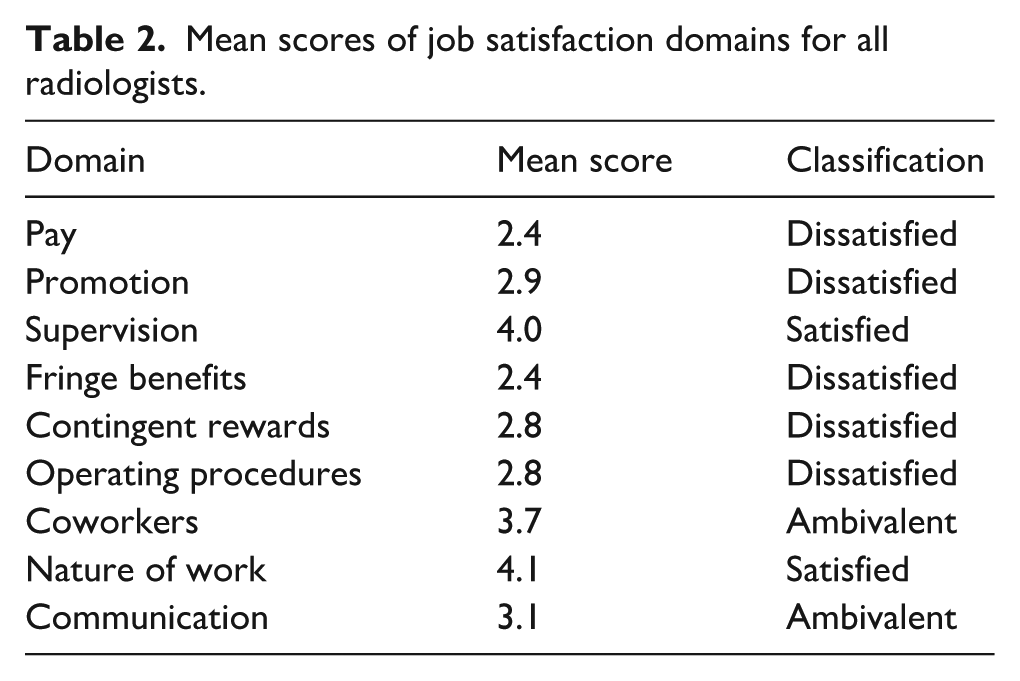
Table 2 reports the overall mean JS scores for each domain. These scores show that radiologists were satisfied (mean score ≥4) with their level of supervision and nature of work, ambivalent (mean scores 3–4) with coworkers and communication, and dissatisfied (mean scores ≤ 3), with pay, promotion, fringe benefits, contingent rewards, and operating procedures.
Mean scores of job satisfaction domains for all radiologists.
Tables 3 and 4 show the number and percentage of satisfied and dissatisfied participants classified according to the mean JS score and displayed according to socio-demographic and professional characteristics in each domain. Considering the total number of radiologists in each domain, more than half the participants were dissatisfied with pay (96, 78.0%), promotion (70, 56.9%), fringe benefits (97, 78.9%), contingent rewards (80, 65.0%), operating procedures (83, 67.5%), and communication (63, 51.2%). However, more than 50% of respondents were satisfied with their level of supervision (64, 52.0%) and nature of work (72, 58.5%). Similar results were found for subgroups of radiologists based on socio-demographic and professional characteristics with the highest percentages of satisfaction in supervision and nature of work and the highest percentage of dissatisfaction was in Pay.
Number and percentage of satisfied radiologists in each Job satisfaction domain according to sociodemographic characteristics (N = 123).

Number and percentage of dissatisfied radiologists in each Job satisfaction domain according to sociodemographic characteristics (N = 123).

Table 5 shows the outcome of radiologists’ intention to leave. Eighty-three participants (67.5%) indicated that they intended to keep their job for the next 2–3 years, 67 (54.5%) of participants were planning to keep their job for as long as possible, 48 (39.1%) would not quit even if their jobs do not meet their expectations and 43 (35.0%) agreed to the item ‘Under no circumstance I would leave my present job’.
Agreement of participants among intention to leave statements. (N = 123).

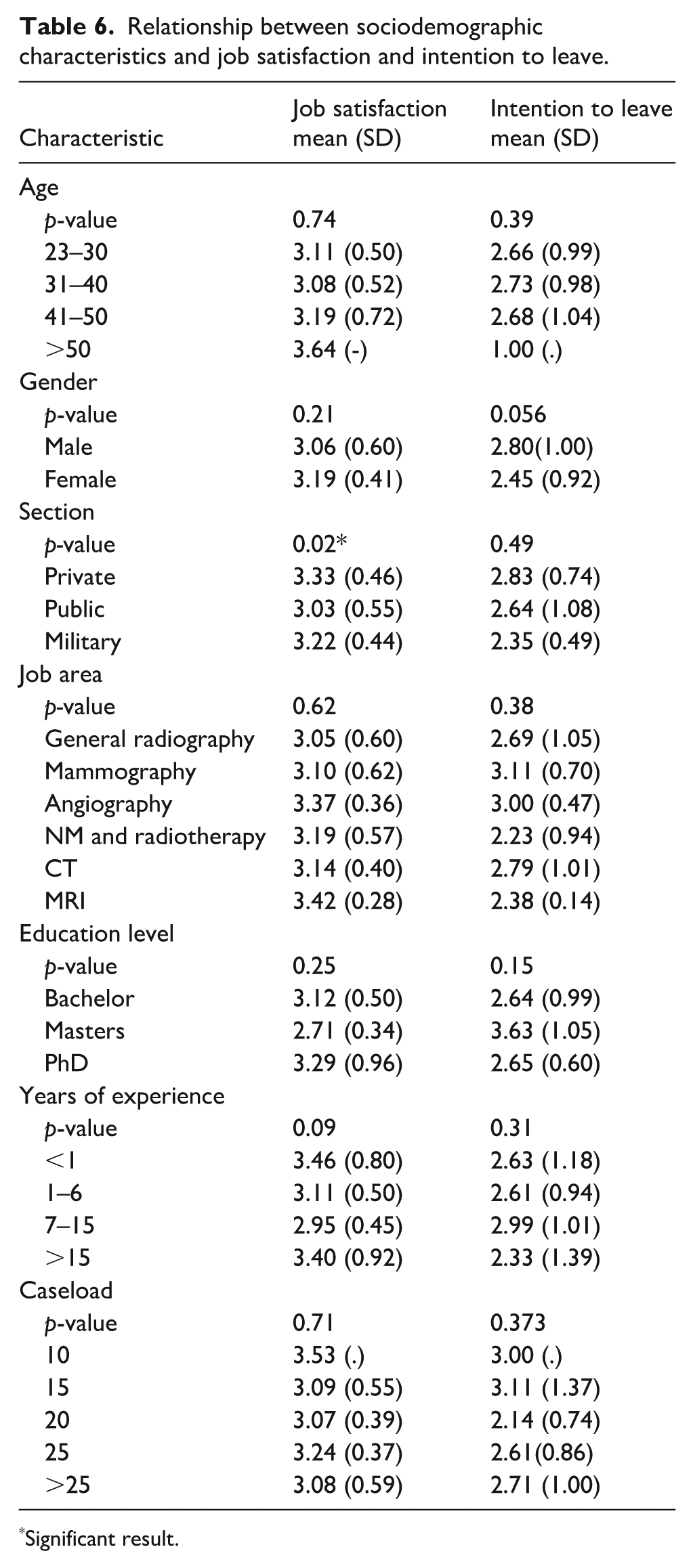
The results of the association of JS and intention to leave with sociodemographic characteristics of radiologists are summarized in Table 6. Job satisfaction was significantly associated (p-value 0.02) only with the type of hospital facility the radiologists were working. Radiologists working at private hospitals were more satisfied (mean JS score 3.33) than radiologists who work at public hospitals (mean JS score 3.03).
Relationship between sociodemographic characteristics and job satisfaction and intention to leave.
Significant result.
Table 7 shows the correlation between radiologists’ job satisfaction and intention to leave. The results show that all job satisfaction domains were inversely related to intention to leave. This correlation was significant for all domains except for fringe benefits and operating procedures.
Correlation between radiologists’ job satisfaction domains and intention to leave.

Correlation is significant at the 0.01 level (2-tailed).
Correlation is significant at the 0.05 level (2-tailed).
Discussion
Job satisfaction among physicians is a critical issue in public health care due to its impacts which may affect the ability to deliver care, work-related decisions and the quality of care provided. 17 Worldwide focus on physicians’ JS showed that good quality care is related to high JS whereas job dissatisfaction is related to the decreased consistency of care for patients and increased patient dissatisfaction.13,22. It is worth mentioning that previous studies have proved that job dissatisfaction is the main factor which influences an individual’s desire to leave their jobs. 2 The topic of radiologists’ JS is of specific interest, and has been highlighted by the American College of Radiology (ACR), with a worldwide radiology workforce shortage that is predicted to worsen. 23
Our study results regarding the overall job satisfaction of Jordanian radiologists revealed that, of the 123 radiologists who participated in this study, 47 (38.2%) were dissatisfied with their job and more than half of them (72, 58.5%) were ambivalent (neither satisfied nor dissatisfied). The dissatisfaction of Jordanian radiologists may be explained by the lack of staffing, low average income, the wide range of job stressors, professional isolation and the excessive workload associated with their jobs. In contrast with our findings, there have been numerous studies that reported high job satisfaction amongst radiologists including in Japan, the United States, Germany, Switzerland, and Poland. This may be due to better financial renumeration and more comfortable lifestyles in these countries compared to Jordan.22 –26
Among JS domains, our findings showed that radiologists were satisfied with their level of supervision and the nature of their work. This might be due to relatively flexible working conditions and appropriate working environment especially with the integration of the digital technologies including electronic medical records (EMR), the picture archiving and communication system (PACS) and radiological information system (RIS) which better facilitate completion of tasks. 27 Similar to our study, a study in Poland reported that radiologists’ job satisfaction was high in the domain of supervisor and colleagues. 26 Another study in the United Kingdom (UK), stated that radiologists were more satisfied in terms of co-workers. 9
The findings of our study showed that Jordanian radiologists were dissatisfied with pay, promotion, fringe benefits, contingent rewards and operating procedures. This can be attributed to, lack of sufficient financial sources and radiologists comparatively average salary in Jordan. In line with our study, another study conducted in Ethiopia reported that 15% of radiologists were dissatisfied and 53.8% were indifferent with their current monthly income. 28
Worldwide, the intention to leave among healthcare workers has become more common, threatening the overall success of many healthcare systems, particularly in developing countries. 29 Importantly, the majority of radiologists in our study claimed that they intended to keep their present job for the next two to three years and that they also planned to work at their present job for as long as possible. This finding could be explained by radiologists’ satisfaction in specific job domains such as nature of work and their level of supervision, as mentioned previously or a sense of social responsibility. As an investment policy, managerial interventions are required to motivate radiologists to stay in their current position through improved job satisfaction until the end of their careers.
It must be emphasized here that even though a minority of radiologists were satisfied with their jobs in seven out of nine doamain, the reported risk of leaving their job was low (74.1% are indicating they are staying). Whilst this is important concerning the radiologists’ workforce, having unsatisfied radiologists practicing their jobs may impact patient care and the quality of service provided. A future study of the correlation between radiologists’ JS and patient satisfaction should be performed.
According to the literature, Lim and Pinto performed a survey that compared radiologists' job satisfaction between public and private practices and found that in private practice radiologists had significantly higher levels of job satisfaction. 6 In our study, radiologists’ JS was significantly associated with their workplace (public-private). Radiologists working at private hospitals were more satisfied. Lower public hospital radiologist satisfaction may be explained by the higher public hospital workload, as public hospitals in Jordan, attract a higher number of patients compared to private hospitals as the majority of Jordanian citizens have health insurance that covers public health only. We should acknowledge that the lack of statistical significance in some groups such as education level, modality area, and years of experience may be attributed to uneven group sizes rather than the absence of an actual association. This highlights the importance of interpreting these results with care. Future studies should include more balanced sampling to ensure the ability to detect differences across all demographic and professional characteristics.
Our study found that the overall job satisfaction scores were inversely associated with radiologists’ intention to leave. Across all job satisfaction domains, only fringe benefits and operating procedures were found not to be associated with an intention to leave. These results are consistent with other studies which found a significant negative correlation between radiologists’ JS and intention to leave.30,31
Limitations of this study include that data were cross-sectional and self-reported, so answers to questions may be biased. Further studies with longitudinal and prospective designs are required to fully understand the relationships between radiologists’ job satisfaction and the intention to leave to make causal inferences. A further limitation is that the study was not inclusive of all regions in Jordan. One limitation of this study is the absence of narrative data within the surveys. It would be beneficial to include interviews or focus groups, which can provide more in-depth understanding of the radiologists’ perspectives. It could also be valuable to explore the workplace environment more closely, as this might help explain some of the reported results.
The findings of the current study may be used to raise awareness among healthcare organizations and radiology departments about work-related issues that negatively affect Jordanian radiologists’ JS. The current study has demonstrated that the majority of radiologists were either ambivalent or dissatisfied in their positions. Radiologists were in particular not satisfied with pay, promotion, fringe benefits, contingent rewards, and operating procedures. Job dissatisfaction has a known negative impact on radiologists’ intention to leave. Given the worldwide shortage of radiologists, it is in the interest of healthcare management to improve radiologists’ job satisfaction and decrease their intention to leave by formulating strategies that include maintaining adequate staffing, improving the work environment, addressing financial expectations, and offering appropriate remuneration and promotions.
Further research is needed to validate the results of this study and should be undertaken with an emphasis on the key domains identified as contributing to job dissatisfaction and to include radiologists working in academia. Future work should also consider assessing the relationship between job stress and satisfaction.
Footnotes

Ethical considerations
The study protocol was reviewed and approved by the human research ethics committee at Jordan University of Science and Technology [research number: 20180332].
Consent to participate
Written informed consent was obtained from all participants.
Funding
The authors disclosed receipt of the following financial support for the research, authorship, and/or publication of this article: This research was supported by Deanship of Research at Jordan University of Science and Technology [grant number: 20180332].
Declaration of conflicting interests
The authors declared no potential conflicts of interest with respect to the research, authorship, and/or publication of this article.
Data availability statement
Data is available upon request