




Abstract
Context:
Consumption of water from dubious alternative sources or from improved sources contaminated during collection, transport, or storage presents significant health risks. This study aims to assess drinking water management practices in households in Dschang, a city faced with rapid urbanization and water infrastructure problems, compounding public health concerns.
Methodology:
This descriptive, cross-sectional study was carried out between March and May 2023 in six neighborhoods of Dschang, Cameroon, including both urban and rural areas. A sample of 261 households was selected using a health inspection form based on WHO guidelines, using a non-probability convenience sampling technique. Data analysis was carried out using descriptive statistics and chi-square tests to assess significant differences between areas, with a significance level of p < 0.05.
Results:
The results show that jerrycans are the most commonly used containers for water storage, with a prevalence of 29% in rural areas and 64% in urban areas. In urban areas, 70% of households used containers considered unhygienic, compared with 55% in rural areas (p < 0.05). The drinking water storage environment was classified as unhygienic in 43% of urban households and 68% of rural households (p < 0.05). In addition, 45% of urban households and 70% of rural households used unhygienic utensils for water collection (p < 0.05). Containers without lids were frequently observed, representing 85% in urban areas versus 70% in rural areas (p > 0.05).
Conclusions:
These results highlight the factors contributing to the deterioration of drinking water quality in the home, and provide decision-makers with a basis for developing strategies to combat water-borne diseases. It is recommended that water distribution infrastructures be improved and that the population be made aware of good water management practices.
Introduction
The sanitary quality of drinking water is essential to meet the demand and supply of drinking water. 1 Indeed, the Union of Water Treatment Professionals defines drinking water as water that can be consumed without presenting a risk to health. 2 Water plays a crucial role in a variety of aspects, including social and economic, making it a top priority in the United Nations’ Millenium Development Goals (MDGs). 3 This priority emphasizes the importance of ensuring access to safe drinking water as an essential foundation for improving health, reducing poverty, and fostering sustainable development. In referring to the MDGs rather than the Sustainable Development Goals (SDGs), it is essential to contextualize that the MDGs, which were enforced until 2015, focused on specific objectives to combat poverty and improve living conditions, while the SDGs broaden this approach to include more global and interconnected challenges related to sustainable development. However, storage of drinking water at home is common in developing countries and contamination can be introduced at the source, during collection, transport, or storage. Drinking water management practices refer to the different methods and behaviors adopted by households to collect, store, and maintain the quality of drinking water, which has a direct impact on public health outcomes.
According to a joint WHO/UNICEF report, an estimated 2.3 billion people worldwide suffer from diseases linked to poor water quality, and more than 5 million die each year as a result. 4 Furthermore, 60% of child mortality worldwide is due to parasitic and bacterial infectious diseases linked to unsafe water. 4 In Africa, more than 80% of diseases are attributed to degraded water quality. 5 In the sub-Saharan African region, poor water quality, lack of hygiene, and inadequate sanitation are responsible for the majority of diarrheal infections, leading to nearly 1.7 million deaths per year. 5 Cameroon is no exception to this reality. Despite the efforts made, a significant proportion of the Cameroonian population remains without safe access to drinking water. According to data from the World Bank and the Ministry of Water and Energy, around 34% of the population has no access to an improved source of drinking water, a situation that is even more worrying in rural areas, where the rate exceeds 50%. 6 This inaccessibility, combined with inadequate storage practices, contributes to the persistence of water-borne diseases. Water-related diseases are thus a major public health problem in Cameroon, with frequent outbreaks of diarrhea observed in many parts of the country, including Dschang.6,7 According to reports from the Ministry of Public Health and the WHO, the mortality rate attributable to unsafe water and its poor quality is estimated at 45.2 deaths per 100,000 inhabitants in Cameroon.8,9 In Dschang, as in many localities in the Western Highlands, growing demographic pressure, weak water infrastructure and widespread use of untreated sources exacerbate the situation. Many households rely on rivers, natural springs, or boreholes, which are often poorly maintained, increasing the risk of exposure to pathogens.
In countries with limited resources, the management and storage of drinking water at home are essential practices for guaranteeing access to quality water. 10 These practices vary considerably according to socio-economic and environmental contexts. For example, in sub-Saharan Africa, many families rely on untreated water sources, which exposes them to contamination risks.11,12 Households often use plastic or metal containers to store water, but the quality of these containers can influence the safety of the stored water.13 –15 Studies show that storing water in unhygienic conditions can degrade water quality by up to 70%. 16 In countries such as India, community initiatives have been put in place to improve water storage practices. For example, awareness-raising programs encourage the use of clean containers and the disinfection of water before storage. 17
The supply of drinking water in Cameroon generally requires people to travel between their homes and the collection point. However, this travel remains difficult either because of the load, the distance, or the uneven terrain. 18 In order to reduce this chore, storing water for several days in various types of containers is an adequate solution. 19 This storage though constitutes the balance point between continuous consumption and occasional supplies, it also represents a significant factor in water contamination which leads to a degradation of quality of up to 70%. 20 This contamination depends on the following parameters: the type of container, the storage location, the duration of storage, and the level of hygiene of users. 21 However, the study of the factors causing the degradation of water quality in developing countries when it exists is carried out primarily on the catchment points. 18 To date, very little attention has been paid to water management within households.
The rural areas around Dschang, although located outside the city proper, have distinct characteristics that justify their classification. This study compares water management practices between urban and rural households to highlight disparities in water infrastructure and socio-economic variations. Indeed, urban areas generally benefit from better water supply infrastructures, but this does not necessarily guarantee superior water quality due to potential contamination. By contrast, rural households, often faced with limited access to improved water sources, are more dependent on alternative resources, which accentuates health risks. Understanding these contrasts is crucial to developing tailored strategies that meet the specific needs of each environment while promoting sustainable water management in Dschang. This study aims to evaluate the practices of drinking water management in households in the city of Dschang. It is part of a logic to raise awareness among households on the importance of good water management practices and health care improvement.
Methodology
Presentation of the area and study duration
This study was conducted between March 2023 and May 2023, in six (6) districts of the city of Dschang divided into urban areas (Keleng, Ngoua, Toulah-Ndizong) and rural areas (Fotchouli, Bamki, Apouh; Figure 1). Dschang, the capital of Menoua Division is located in the West Region of Cameroon. It culminates at nearly 1400 m above sea level on the south-eastern slope of the Bamboutos Mountains (2740 m). It is located between 5° 25'and 5° 30' latitude in the North; and 10° and 10° 5' longitude East. Dschang has a total population of 120,207 inhabitants spreading over an area of 262 km2. 22 Its urban area has 20 communities and the rural area has 96.

Geographic presentation of the study areas.
Dschang enjoys a high-altitude tropical climate, characterized by two main seasons: a long rainy season from mid-March to mid-November, and a dry season from mid-November to mid-March. The city is experiencing rapid population growth, fueled by the rural exodus, educational opportunities, and administrative development. It is home to the University of Dschang, a major university hub attracting thousands of students from all over the country, contributing to a young and dynamic population. In socio-economic terms, the majority of the population lives in agriculture, petty trade, and informal activities, especially in rural areas. Urban areas benefit from better access to infrastructure, but inequalities persist in terms of access to water, sanitation, and waste management. The environmental context, marked by rugged terrain, natural springs, and several rivers, is increasingly exposed to pollution due to growing urbanization and poor waste management. These demographic, economic, and environmental dynamics make Dschang a relevant setting in which to study water-related collection, storage, and hygiene practices.
Study design and population
The study was descriptive and cross-sectional in nature, and the study population was made up of inhabitants residing in the city of Dschang for at least 12 months prior to the study period. The minimum sample size was determined using the Lorenz formula, which estimates the number of households required to obtain representative results. We set a precision of 5% and a confidence interval of 95%. Using a prevalence of 58.6% of home water storage practices considered insufficient, 23 the following formula was applied: n = Z2 p(1-p)/E2, where n is the search value, Z corresponds to the confidence interval (1.96 for 95%), p is the estimated prevalence (0.586), and E is the margin of error (0.05). By inserting these values into the formula, we obtained a sample size of around 246 households. To take account of an estimated 5% non-response rate, we finally included 261 households in our study, which ensured sufficient representativeness of the results while taking account of possible nonresponses.
Data collection technique and tool
The data collection technique was the household survey using a health inspection form designed on the basis of WHO guidelines. 24 It consisted of three main parts: the first part concerned general information about the household and the second part concerned questions concerning the evaluation of water management practices at home such as; types of containers used to store drinking water, physical environment of drinking water storage, sanitary state of storage containers, presence of lids on storage containers and sanitary quality of utensils used to collect drinking water.
The article is based on the World Health Organization’s (WHO) Guidelines for Drinking Water Quality, which recommend safe practices for the storage and management of drinking water, particularly in rural communities. Criteria for assessing the safety of water storage practices include the physical integrity of containers, the cleanliness of storage areas, and the absence of contamination by unhygienic materials or liquids. For example, the presence of cracks or leaks in containers, animal access to the storage area, and exposure of containers to light are risk factors that can compromise water quality. 24
In addition, the cleanliness of the containers was judged by observing their condition, in particular the presence of residues or dirt. As for the environment, investigators assess cleanliness by checking for the absence of waste and debris, and rodent accessibility, in particular by ensuring that there are no points of entry for these animals. Unhealthy utensil storage environments include damp areas, poorly ventilated areas, or spaces where waste is accumulated, encouraging contamination of drinking water. These guidelines aim to ensure that water used for human consumption is clean and safe, thus helping to prevent water-borne diseases. 24
Sampling technique
The sampling technique used in this study was non-probability quota sampling, targeting a total of 261 households spread across six districts in the city of Dschang. Each district contributed 44 households, with a balanced representation of urban and rural areas. Urban areas were defined as having direct access to water supply infrastructure, while rural areas were characterized by limited access. This stratified sampling approach allowed for a comprehensive comparison between urban and rural environments in terms of water collection, storage, and use.
Data collection took place in March 2023, targeting six selected districts—three urban (Keleng, Ngoua, Toulah-Ndizong) and three rural (Fotchouli, Bamki, Apouh). These districts were chosen based on their socioeconomic diversity, access to drinking water infrastructure, and environmental conditions. The urban districts showed increasing urbanization and unequal access to services, while the rural districts faced precarious conditions and dependence on natural water sources.
Households were recruited using a non-probabilistic method, prioritizing convenience, respondent availability, and willingness to participate. To limit selection bias, a minimum distance of 100 m was maintained between surveyed households, ensuring the independence of responses. Interviewers began their routes from central points, such as markets or schools, and followed a random path while respecting this distance requirement.
Data collection process
Upon arrival at each household, the surveyors introduced themselves, explained the objectives of the study, and answered participants’ questions. With the participants’ consent, an inspection form was completed after a detailed observation, and photos were taken if necessary. Consent was verbal, an approach chosen due to the potential skepticism of rural populations about signing a document. Data collection was conducted anonymously, with each household identified by a code to ensure confidentiality.
To ensure data consistency and integrity, all interviewers underwent extensive training on standardized methodologies and ethical considerations. They practiced simulated interviews to improve their skills. Quality control measures were put in place, including regular checks by supervisors during data collection and validation of a subset of the data by a separate team. This rigorous training and quality control protocols were designed to produce high-quality data that accurately reflected the population under study.
Criteria for safe drinking water management at home
The criteria for safe drinking water management are based on several fundamental elements that guarantee water quality and hygiene. First and foremost, it is essential that the container used to collect and store the water is in good condition, with no cracks, leaks, or signs of contamination. An unhygienic container can introduce pathogens into the water, making it unsafe for consumption. In addition, the container must not be used to store other liquids, particularly those of lesser quality, to avoid cross-contamination.
Secondly, the physical integrity of the container is crucial. It must have a lid in good condition to protect the water from external contaminants. The position of the container is also important: it should not be placed at ground level, where it is more likely to be contaminated by debris or animals. The environment around the container must be clean and free of garbage, and animal access must be restricted to prevent contamination.
Finally, other factors need to be taken into account, such as the container’s exposure to light. Light can encourage the proliferation of algae and bacteria, affecting water quality. The utensils and taps used to remove water from the container must also be hygienic. In addition, regular cleaning of the container is recommended to maintain high hygiene standards. By complying with these criteria, you can ensure safe, efficient management of drinking water in the home.
The study was authorized by the Department of Animal Biology at the University of Dschang [038–01/23/UDS/FS/DBA]. Given that rural populations might be skeptical, we opted for verbal consent. This verbal informed consent was approved by the Institutional Ethics Committee for Human Health Research of the Faculty of Health Sciences of the Catholic University of Central Africa [No. 2023/025073/CEIRSH/ESS/MSc]. Participants were given the opportunity to ask questions and were informed that their participation was voluntary and that they could withdraw at any time without consequence. To ensure anonymity, all data collected were anonymized, with personal identifiers removed or replaced with codes. The research protocol was also approved by a subcommittee of professors from the Faculty of Sciences at the University of Dschang, thereby ensuring compliance with all ethical standards.
Data analysis
Once the field phase was completed, the data was entered using Microsoft Excel version 10.0 software and imported into XLSTAT software version 2018.x for analysis. During the analysis of this study, pie charts were generated to describe the practices of drinking water management at home. The Chi-squared test was used to determine whether there is a significant difference between the rural area and the urban area. The different indicators were estimated with a degree of significance alpha (α) = 0.05.
Results
Types of containers used by people to store drinking water in rural and urban areas
Water containers commonly used in both rural and urban areas in Dschang included bottles, jerry cans, and buckets (Figure 2(a)). In rural areas, 46% of households used jerrycans as water storage containers, 29% used bottles, and 25% used buckets (Figure 2(b)). On the other hand, in urban areas, 64% of households used jerrycans as water storage or collection containers, 6% used bottles and 30% used urban buckets (Figure 2(c)).

Types and proportions of containers used by households. (a) Types of containers. (b) Proportions used in rural areas. (c) Proportions used in urban areas.
Household drinking water sources in rural and urban areas
In rural areas, 46% of households used a single source of drinking water and 54% used more than one source (Figure 3(a)). Similarly, 65% of households used a single source of drinking water and 35% used more than one source in urban areas (Figure 3(b)). Analysis of variation between rural and urban areas showed no significant difference (p > 0.05).
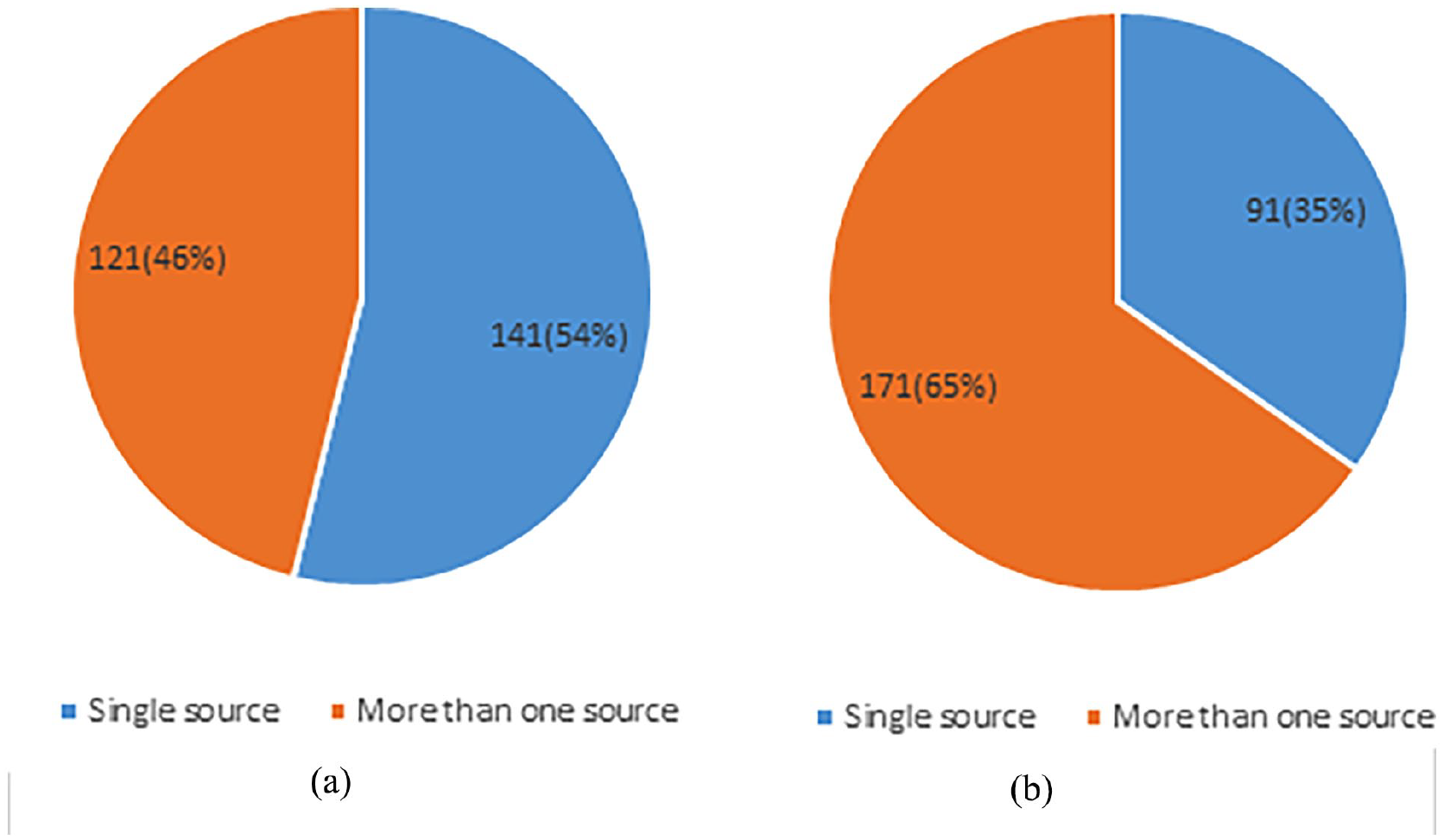
Drinking water sources used by households. (a) Rural areas. (b) Urban areas.
The sanitary state of drinking water storage containers in rural and urban areas
The sanitary state of drinking water storage containers categorized based on their cracks or leaks and cleanliness were shown to be significantly different (p < 0.05) between the rural and urban. In urban areas, 70% of households used had cracks, and leaks, and were not clean while 30% used had no cracks, or leaks and were clean (Figure 4(a)). In rural areas, 45% used had no cracks, or leaks and were clean and 55% had cracks, or leaks and were not clean (Figure 4(b)). However, a statistically significant difference was observed in the sanitary state of the storage containers between rural and urban areas

Sanitary state of drinking water storage containers (a) Urban area. (b) Rural area.
Assessments of the physical environment of drinking water storage containers in rural and urban areas
An environment where drinking water storage containers were kept was assessed in terms of their cleanliness, presence or absence of cracks on walls, and accessibility to rodents and straying animals (Figure 5(a)). This environmental state was classified as either hygienic or non-hygienic. In urban areas, the drinking water storage environment was hygienic in 57% of households and unhygienic in 43% (Figure 5(b)). On the other hand, it was hygienic in 32% of households and unhygienic in 68% in rural areas (Figure 5(c)). A significant variation in the drinking water storage environment was observed between urban and rural areas (p < 0.05).

State of the physical environment of drinking water storage containers. (a) Environmental location of drinking water storage containers. (b) Environmental state in urban area. (c) Environmental state in rural area.
Sanitary quality and state of utensils used to collect drinking water in rural and urban areas
Utensils used in collecting water from storage containers included cups and small bowls. The quality and state of these utensils were also assessed. Some of these utensils were found stored in unsanitary environments, such as placed on the ground or dirty surfaces (Figure 6(a)). The state of the utensils was classified as hygienic or non-hygienic based on assessments of their cleanliness, preservation condition, and environment found. In urban areas, 55% of households used hygienic utensils, and 45% used non-hygienic utensils (Figure 6(b)). In addition, 30% of households used hygienic utensils, and 70% used non-hygienic utensils in rural areas (Figure 6(c)). An analysis of the variation in the sanitary quality of utensils between rural and urban areas showed a significant difference (p < 0.05).

Sanitary quality of utensils used to collect water from the container. (a) Utensils used for collecting drinking water. (b) State of hygiene of utensils in urban areas. (c) State of hygiene of utensils in rural areas.
Presence of lids on drinking water storage containers in rural and urban areas
Figure 7(a) and (b) present the proportion of households using drinking water containers with lids in the city of Dschang. From this figure, in urban areas, 85% of households used containers without lids and 15% with lids. On the other hand, 70% of households use containers without lids and 30% with lids in rural areas. The analysis of the variation in the use of containers with or without lids between the rural and urban areas showed no significant difference (p < 0.05).
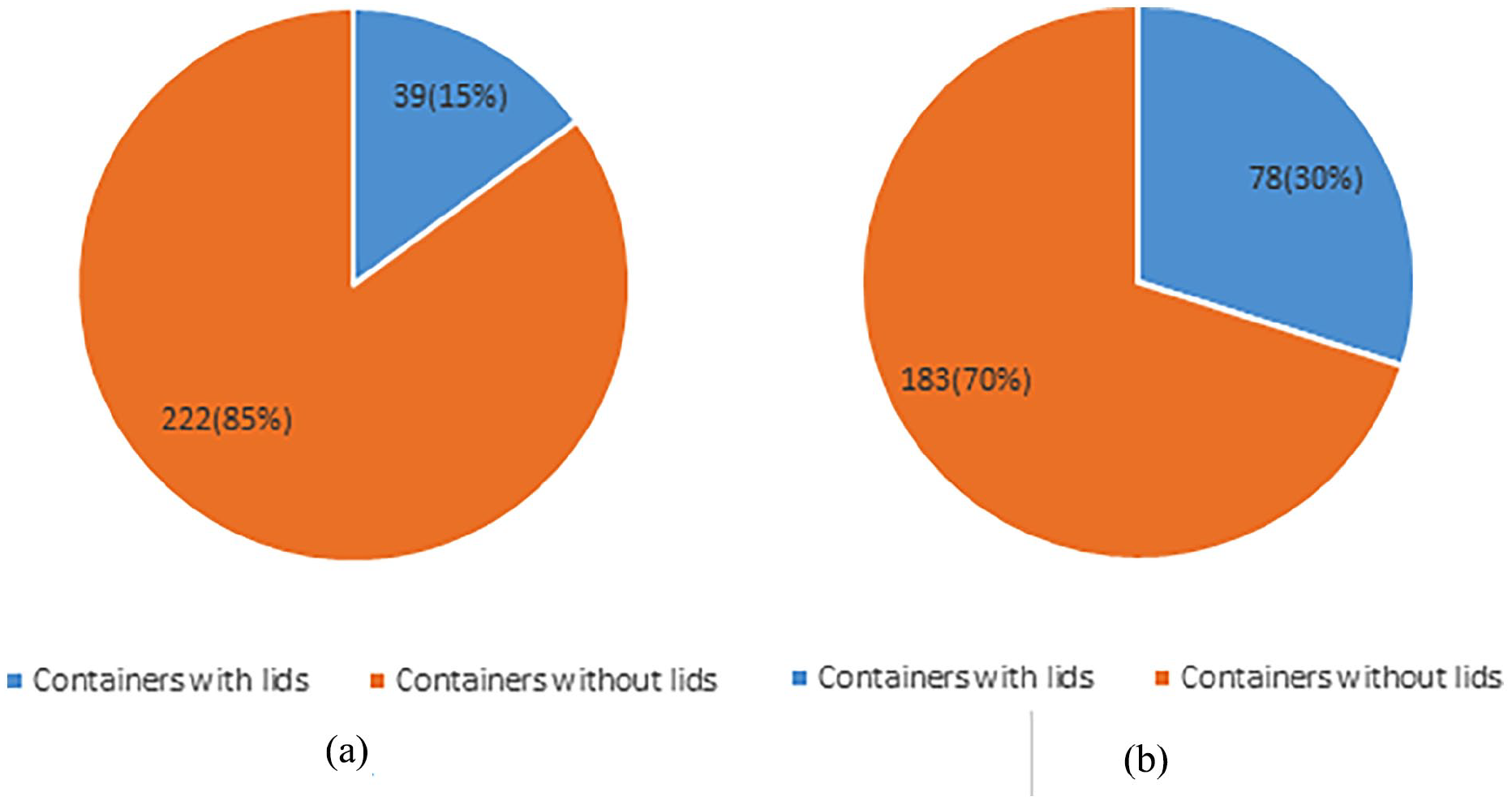
Presence of lids in containers. (a) Urban area. (b) Rural area.
Discussion
Containers are the most commonly used containers for storing drinking water, both in rural and urban areas in the city of Dschang. This choice can be explained by several factors: on the one hand, jerry cans with screw caps reassure users that there will be less loss during transport, and on the other hand, they allow water to be collected and stored for long periods of time. This observation is confirmed by the work of Tsafack et al., 7 who points out that almost all households in Dschang prefer jerry cans for collecting, transporting, and storing drinking water, mainly because of their practicality and safety. Conversely, Misenga et al. 25 report that in the Democratic Republic of Congo, the majority of households prefer to use plastic basins for these same tasks. This practice poses significant risks to public health, as basins, often left uncovered, expose water to various sources of contamination, such as insects, dust, and other pathogens. The lack of effective closure devices in these containers also promotes bacterial growth, thereby compromising water quality.
These differences in water storage behaviors reflect not only cultural variations but also disparities in infrastructure and education. In Dschang, the use of jerry cans can be attributed to the influence of hygiene and public health awareness campaigns, which emphasize the importance of safe water storage. In contrast, in the DRC, the low level of education regarding good storage practices may explain the preference for plastic basins. 26 These differences highlight the need to promote the adoption of safer containers, such as jerry cans with lids, to protect people’s health and improve access to safe drinking water.
In urban areas, most households obtain their water from several sources, unlike in rural areas, where this trend is less pronounced. This diversification can be explained by several factors, including the unavailability or irregularity of water resources, insufficient distribution by the relevant services, and seasonal phenomena such as drought or climate variations. In addition, rapid urban population growth puts additional pressure on existing infrastructure, making access to safe drinking water more difficult. This situation is corroborated by the work of Nola et al., 27 who observed similar challenges in the city of Yaoundé. Urban households are therefore often forced to turn to alternative sources, such as private wells, public fountains, or even rivers, exposing populations to health risks related to water quality.
In rural areas, households mainly depend on more traditional and less diversified sources, such as rivers or natural springs, which can be vulnerable to environmental conditions. This lack of diversification limits households’ resilience to crises such as prolonged droughts or local contamination. These disparities between urban and rural areas can be explained by socioeconomic factors such as household income, education level, access to infrastructure, and cultural practices. For example, in rural areas, low household income limits investment in suitable containers or water treatment solutions. In addition, the lack of adequate infrastructure and educational initiatives hinders the adoption of safer water management practices. Conversely, urban areas, although better informed and more aware, face structural constraints related to population density and distribution network saturation.
These findings have important implications for public health in Dschang. Poor drinking water management, particularly in terms of storage, significantly increases the risk of microbiological contamination and the transmission of waterborne diseases. The maintenance of containers used for water collection and storage has been found to be largely inadequate, especially in urban areas. This is evident in the use of damaged (cracked or worn) containers and the lack of regular cleaning, both inside and outside the containers. Such practices compromise water quality and expose households to waterborne diseases, with serious consequences for public health.
The lack of awareness of the risks associated with the use of poorly maintained containers exacerbates the situation. Household heads may be unaware of the health implications of these practices, which limits their willingness to take steps to improve container hygiene. In addition, the responsibility for collecting water is often delegated to children, who do not always have the necessary knowledge to ensure proper storage. The findings of Ntangmo Tsafack et al. 7 confirm that this delegation can reduce attention to hygiene, as children do not always follow the appropriate protocols for keeping containers clean.
The majority of households do not install their storage containers on appropriate supports, contrary to current recommendations. This finding confirms the results of Ntangmo Tsafack et al. 7 on the impact of collection and storage techniques on the quality of drinking water in households in Dschang. While placing containers on the ground facilitates access to water for all members of the household and helps keep the water cool, it nevertheless poses considerable health risks. The World Health Organization warns against storing containers on the ground, especially in the presence of domestic animals or in poor sanitary conditions, as this promotes contamination of the water by fecal matter. In addition, the lack of suitable supports creates an environment conducive to the proliferation of bacteria and other pathogens through dust, insects, or organic debris.
Finally, it was observed that the majority of households used containers without lids for storing water at home. This observation is consistent with the results of a study conducted in Abidjan, where the majority of households also used uncovered containers. 28 This situation can be attributed to a widespread lack of awareness about the proper management and conservation of domestic water. Many households do not perceive the health hazards associated with the use of open containers, such as contamination by insects, dust, or pathogens. The absence of lids can also be explained by cultural or economic reasons: in some communities, these containers are perceived as more accessible or practical, regardless of the risks involved. In addition, financial constraints may prevent some households from purchasing appropriate containers with secure closure systems.
In conclusion, the water management practices observed in Dschang have significant implications for public health. Improving drinking water distribution infrastructure, promoting sustainable management practices, and raising community awareness of the importance of hygiene in water storage is essential to ensuring equitable and safe access to drinking water in both urban and rural areas. These actions must be adapted to the socio-economic and cultural realities of each context in order to be fully effective.
Study limitations
The water management practices observed in Dschang have significant implications for public health. Improving drinking water distribution infrastructure, promoting sustainable management practices, and raising community awareness of the importance of hygiene in water storage is essential to ensuring equitable and safe access to drinking water in urban and rural areas. However, this study has limitations that should be taken into account when interpreting the results. First, data collection was based on household self-assessments, which may introduce response bias due to the subjectivity of participants. In addition, the study was conducted during a specific period, which limits the generalizability of the results to other periods or regions. Although the sample of 261 households is substantial, it may not fully reflect the diversity of water management practices in Dschang, particularly in less accessible neighborhoods. Future research should address these limitations by including a wider range of households and using objective measures to assess water management practices. Tailoring interventions to the socioeconomic and cultural realities of each context will also enhance their effectiveness.
Conclusion
The study on drinking water management practices in the city of Dschang highlights significant gaps in hygiene and safety in water storage. The results reveal a high prevalence of unhygienic containers and inadequate storage conditions in both urban and rural areas. Although the use of jerry cans is practical, it does not compensate for the health risks associated with poor maintenance and potential water contamination. Data analysis also indicates that the absence of lids on containers and the use of unhygienic utensils increase the risk of spreading waterborne diseases. In light of these findings, targeted interventions are urgently needed. It is recommended that water hygiene awareness campaigns be implemented specifically in rural areas while improving storage infrastructure. In underserved urban neighborhoods, it is crucial to improve water supply and provide adequate containers with lids. In conclusion, this study provides essential information for decision-makers and public health professionals to develop effective strategies to improve drinking water quality and reduce the health risks associated with its management. Concerted action is needed to promote safe storage practices, strengthen household hygiene education, and improve access to quality water resources.
Footnotes
Acknowledgements
We would like to thank the Applied Biology and Ecology Research Unit of the University of Dschang for permission and monitoring of this research work. In addition, we would also like to thank the research participants for voluntarily agreeing to participate in this study.

Ethical considerations
The study was authorized by the Department of Animal Biology at the University of Dschang. The research protocol was also approved by a sub-committee of professors from the Faculty of Science at the University of Dschang, ensuring that all ethical standards were met.
Consent to participate
Participants’ consent was obtained verbally after a detailed explanation of the study objectives and procedures. Participants were given the opportunity to ask questions and were informed that their participation was voluntary and that they could withdraw at any time without consequence. To guarantee anonymity, all data collected was anonymized, with personal identifiers removed or replaced by codes. This ensured that individual responses could not be linked to specific households. In addition, data was stored securely, accessible only to the research team, to further protect the privacy of participants.
Author contributions
H.N. Tsafack, J.W. Kwekap, G.R.P. Djoko, F.R. Wamba, P.A. Tamfuh, T.E. Akwa, and E. Temgoua contributed significantly to all stages of this research. H.N. Tsafack directed the study, designed the methodology and supervised data collection. J.W. Kwekap, F.R. Wamba and G.R.P. Djoko participated in data analysis and drafting of the manuscript. J.W. Kwekap, G.R.P. Djoko and F.R. Wamba contributed to field data collection and assessment of water management practices, P.A. Tamfuh and T.E. Akwa helped interpret the results and revise the text. Finally, E. Temgoua made important contributions to the discussion and conclusion of the article. All authors reviewed and approved the final version of the manuscript.
Funding
The author(s) received no financial support for the research, authorship, and/or publication of this article.
Conflicting interests
The author(s) declared no potential conflicts of interest with respect to the research, authorship, and/or publication of this article.
Data availability
The dataset used and/or analyzed for this study are available from the corresponding author upon reasonable request.