




Abstract
Background:
Nurses in the intensive care unit are responsible for the continuous assessment and management of physiological parameters associated with head trauma. Nurses have a vital and significant role in the care of patients suffering from moderate-to-severe head trauma, both during acute and non-acute care.
The purpose of this study was to investigate the Knowledge and Practice of nurses regarding the care of patients with head trauma in an intensive care unit.
Design and methods:
The study was designed as a cross-sectional study. The study recruited 165 nurses who work at intensive care unit (ICU) nurses in Palestinian hospitals. The data collected by a self-administered questionnaire developed by the researcher.
Results:
Among the 165 intensive nurses, the study findings revealed the majority of nurses 99 (60.0%) have low level knowledge regarding Care of Patients with a head trauma, and showed that most of the nurses 115 (69.7%) have poor level practice regarding Care of Patients with a head trauma.
Conclusions:
According to the results of the current study, approximately two-thirds of the studied nurses had unsatisfactory knowledge level regarding head trauma care. More than two-thirds of the studied nurses had poor level practice regarding head trauma care. Also, the study confirmed no statistical significant relation between knowledge and demographic characteristics. There was significant differences between total practice scores and both experience in general and experience in ICU.
Introduction
Head trauma is a global public health problem and one of the main causes of mortality and disability. 1 Head trauma and traumatic brain injury (TBI) are used interchangeably. Because head trauma encompass such a broad range of injuries, there are several reasons that might result in brain injuries, including physical assaults, falls, accidents, or traffic accidents. 2
The head trauma is considered an external force insult to the brain leading to lethal pathological brain development. The primary direct effects of trauma apply to traumas induced by injury and secondary damage related to hospitalized hypoxia contributing to ischemia. 3 More severe head trauma are unreasonably more costly. 4
With the severity of the trauma, the risk of complications is increasing. 5 Nevertheless, even minor traumatic brain injuries can cause several problems including physical, neurological, emotional, and disorder of the personality, including social relationships, work, and daily life, as well as disruptions of neuro- functional circuits that are not detectable by standard structural MRI and must be taken seriously in clinical and forensic evaluations. 6
Nurses play a crucial role in the management of patients with moderate-to-severe head trauma in both acute and non-acute care settings. 7
Intensive care unit (ICU) nurses are in charge of the constant maintenance and monitoring of physiological variables that contribute with Head trauma. Therefore, the purpose of the study was to investigate the Knowledge and Practice of nurses regarding the Care of Patients with head trauma in intensive care unit (ICU) in West Bank hospitals.
Method
A cross-section study was conducted in the period of April to September, 2021. The target population included all intensive care unit nurses from hospitals in West Bank/Palestine.
Instrument
The Data was collected by a self-administered questionnaire developed by the researchers. The questionnaire is composed of three parts
The first part: demographical data composed of age, gender, educational level, working experience in nursing Profession, how long have you been working as a nurse in ICU.
Second part: Knowledge about the Care of Patients with head trauma: composed of 18 Close-ended questions developed by researchers after critical reviewing the literature. Questions were answered “Yes,” “No,” and “I don’t know.” Yes was scored as 1 and no or I don’t know scrod as 0. The knowledge scores were converted into percentage scores by dividing the respondents’ results by the potential maximum scores and multiplying by 100. The total score of each result was calculated using Bloom’s cutoff point. 8 The degree of knowledge was categorized into three categories based on the aggregate scores: low level knowledge (less than 60%), moderate level knowledge (60%–79%), and high level knowledge (80%–100%).
Third part: Practices for traumatic brain injury patients in critical care unit. Developed by researchers and composed of eight items rating with four 5 Liker scale (Never = 1, Rare = 2, Sometimes = 3, Frequent = 4, Always = 5).The practice scores were converted into percentage scores by dividing the respondents’ scores by the potential maximum scores and multiplying by 100. The total score of each result was calculated using Bloom’s cutoff point. 8 Based on the aggregate scores, the degree of practice was classified as Poor Practice (less than 60%), Fair Practice (60%–79%), and Good Practice (80%–100%).
Validity of the questionnaire was assessed by sent the questionnaire with covering letter concerning study and paper contain instruction about the study, main aim, objectives, the field of the study, and other relevant information to experts who are experienced and expert in the field, they were asked to estimate and revised the items in the questionnaire in terms of sufficiency the questionnaire in relation to study, accuracy, and its relevancy. Feedback was obtained from experts and modification accordingly was done by the researchers.
Data collection
After obtaining the permission to conduct the study from the administrators of the hospitals, the researchers visited the hospitals and met the head nurses of intensive care units. They explained to them the objectives of the study and asked them to prepare names list of nurses in the intensive care units and the schedule duty to meet the nurses. The researchers explain the objectives of the study to the nurses. The nurse who agreed to participate assigned the informed consent and then completed the questionnaire.
Ethical consideration
Ethical approval was attained from the Arab American University before beginning data collection. Participation by the nurses was voluntary and their involvement was confidential. All nurses who interest in participating assigned the consent form.
Data analysis
Statistical analysis was performed using the Statistical Package for Social Sciences (SPSS) version 23. The mean, standard deviation, frequency, and percentages were calculated. In addition, an independent t test and ANOVA were utilized to examine the differences between study variables. The study findings were considered statistically significant at a p-value ≤ 0.05.
Results
One hundred sixty-five nurses participated in the study. The mean age of the participants was 32.1 (SD = 7.3) years with a minimum 21 years and maximum 55 years. Most of them 100 (60.6%) were below 32 years old. More than half of the participants 96 (58.2%) were males and the majority of them 128 (77.6%) had bachelor degree. Also, the analysis revealed that 65 (39.4%) have less than 5 years’ experience and more than half of them 97 (58.8%) have less than 5 years’ experience in the ICU. Also, the analysis showed that most of the participants 110 (71.4%) reported that there is no Guidelines or protocols available in your unit with regard to the management of raised intracranial pressure (Table 1).
Distribution of socio demographic variables among nurses (N = 165).

Also, the majority of nurses 99 (60.0%) have low level knowledge and 115 (69.7%) have poor level practice regarding Care of Patients with a head trauma, as seen in Table 2.
Description of the nurses’ Knowledge and practice regarding the Care of Patients with a head trauma (N = 165).
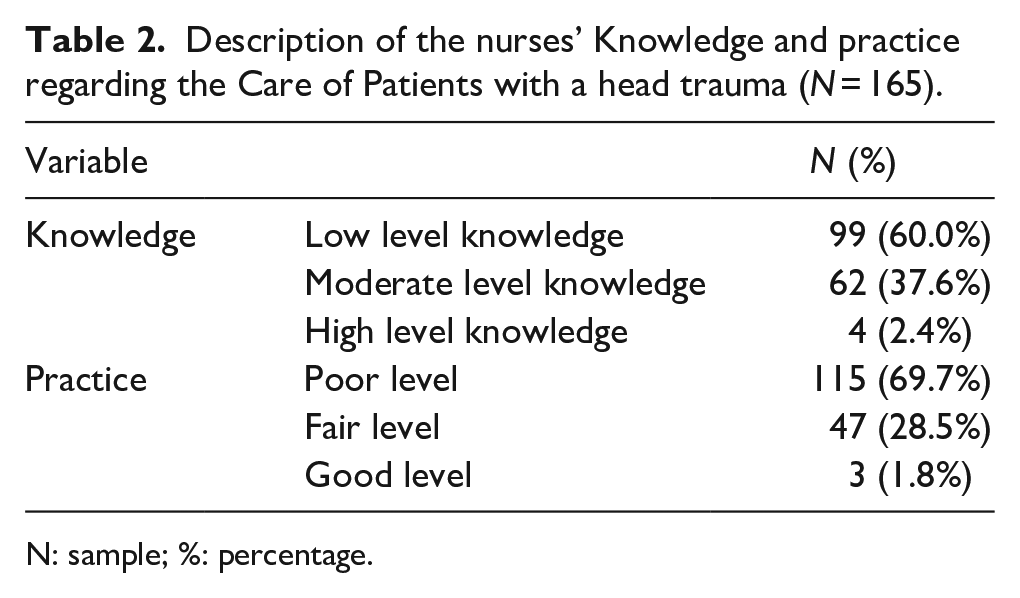
N: sample; %: percentage.
In addition, the analysis revealed that there was no significant difference between nurses’ knowledge regarding the Care of Patients with a head trauma and the demographic characteristics (p > 0.05), as shown in Table 3.
Differences between knowledge mean and demographic characteristics (N = 165).

M: mean; SD: standard deviation; t: student t test; F: one way ANOVA.
Moreover, the analysis revealed that there was significant difference between nurses’ practice regarding the Care of Patients with a head trauma and the experience as general and the experience in the ICU (p < 0.05), as shown in (Table 4).
Differences between Practice mean and demographic characteristics (N = 165).

M: mean; SD: standard deviation; t: student t test; F: one way ANOVA.
Significant p < 0.05.
Discussion
Intensive care unit nurses are responsible for the continuous monitoring and maintenance of physiological values associated with head trauma and therefore are the members of the health care team best positioned to detect and prevent brain injury.
The analysis indicated that the majority 60.0% of the intensive care unit nurses have low level knowledge and 69.7% have poor level practice regarding Care of Patients with a head trauma. Similarly, Shehab et al. indicated that the total mean knowledge and practice scores of nurses regarding care of traumatic brain injury patients were unsatisfactory before the program implementation and satisfied post program implementation. 9 Also, Seliman et al. reported that the mean knowledge and practice scores of nurses increased rapidly after the protocol’s adoption, with a statistically significant difference. 10 Another study supported the current study findings conducted by Ahmed et al. who indicated that nurses had unsatisfactory level of knowledge and practice about trauma patients during golden hour of care. 11
On the other hand, these findings contradicted the findings of Oyesanya et al. who classified nurses into three homogeneous groups based on perceived knowledge items: low, moderate, and high perceived knowledge. 12 The low perceived knowledge group received 27.4% of the sample, the intermediate perceived knowledge group received 45.7% of the sample, and the high perceived knowledge group received 26.9% of the sample. Also, another study conducted by Farg et al. who found the studied nurses had adequate knowledge and performance about traumatic brain injury. 13
Also, the current study revealed that there was no significant difference between nurses’ knowledge regarding the Care of Patients with a head trauma and the demographic characteristics. These findings supported by Ahmed et al. who found no significant relationship between total nurses’ knowledge with personnel data such as age, training and year’s experiences. 11
On the other hand, these findings inconsistent with Farg et al. who found a significant difference found between nurse’s knowledge and their level of education. 13 This might due to postgraduate studies didn’t focus on neurological and neurosurgical system and may didn’t discussed in depth. It is expected that nurses with postgraduate degree in nursing were more knowledgeable than nurses with a diploma degree. Findings in a study done in the United States found that hospitals with a higher proportion of nurses with Baccalaureate degrees, have shown to have lower in-patient, lower 30-day mortality, as well as lower failure to rescue and cardiac deaths. 14
According practice and demographic characteristics, the analysis revealed that there was significant difference between nurses’ practice regarding the Care of Patients with a head trauma and the experience as general and the experience in the ICU. These findings inconsistent by Ahmed et al. who found no significant relationship between total nurses’ performance with personnel data such as years of experiences. 11
The study recommended continuing educational programs for nurses caring for patients with head trauma be planned on a regular basis in order to improve nurses’ knowledge and practice and accomplish high quality of care. Also, nursing educators should create and distribute a manual procedure book for all nurses working in critical care units, which includes standards of practices that must be used and followed.
Conclusion
According to the results of the current study, approximately two-thirds of the studied nurses had unsatisfactory knowledge level regarding head trauma care. More than two-thirds of the studied nurses had poor level practice regarding head trauma care. Also, the study confirmed no statistical significant relation between knowledge and demographic characteristics. There was significant differences between total practice scores and both experience in general and experience in ICU.
Footnotes
Acknowledgements
The authors would like to express their thanks to the nurses who participated in the study
Declaration of conflicting interests
The author(s) declared no potential conflicts of interest with respect to the research, authorship, and/or publication of this article.
Funding
The author(s) received no financial support for the research, authorship, and/or publication of this article.
