




Abstract
Background:
The implementation of the COVID-19 vaccination is still being carried out in Indonesia to enhance immunity against SARS Cov-2 infection. However, the information about vaccination service satisfaction is still very limited. This study aims to assess how satisfied Covid-19 vaccination service users are in Indonesia.
Design and methods:
This is an analytic study with a cross-sectional design was conducted through an online survey in the third week of June 2022. People with a minimum age of 17 years, having received at least one COVID-19 vaccination, and residing in Indonesia were allowed to participate in this study. We used the SERVQUAL model as an instrument, measuring five aspects covering tangibility, responsiveness, reliability, assurance, and empathy. The analysis carried out included univariate analysis and bivariate test using chi-square statistical test.
Results:
A total of 509 respondents were included in this study. The findings of this study revealed that there was not much of a difference between the satisfied (50.1%) and dissatisfied categories (49.9%) of vaccination users. Of the five dimensions measured, the highest level of dissatisfaction is in tangibility particularly on facility (48.7%), while the highest level of satisfaction is in reliability (the vaccination service following applicable procedures; 59.7%). We find out that vaccination location (p = 0.038), provision of refreshment/reward/incentives (p = 0.001), providing emergency contact post-vaccination (p = 0.000), and observation time post-vaccination (p = 0.000) were associated with the satisfaction of users.
Conclusion:
Many respondents in this study are still dissatisfied with the COVID-19 vaccination services, so it is necessary for taking continuous efforts to raise the quality of vaccination services to increase user satisfaction.
Introduction
Since being declared by the World Health Organization as a pandemic on March 9, 2020, the disease caused by Severe acute respiratory syndrome coronavirus 2 (SARS CoV 2) has had a tremendous impact, particularly on world health. 1 Globally, the COVID-19 epidemic has caused a great loss of life and poses an unparalleled threat to public health, the economy, and social life. Travel limitations, social exclusion, and self-isolation have all contributed to a decreased workforce across all economic sectors and countless job losses. 2 Numerous prevention and control measures have been taken to stop the disease’s spread and lessen the pandemic’s consequences. Starting from the use of masks, social distancing, washing hands with soap, and several other health policies. 3 A significant step has been done by the world to control the Coronavirus-diseases-19 (COVID-19) pandemic through massive vaccine implementation. In the past, vaccinations were shown to be an efficient way to control a variety of infectious diseases.4,5
The Indonesian government has launched the COVID-19 vaccination program in January 2021, by mass vaccination of the Indonesian population. 6 The vaccination program in Indonesia was divided into two phases: the first phase, which was scheduled to last from January to April 2021, was intended for 40.2 million healthcare workers, public servants, and the elderly, while the second phase, which was scheduled to last from April 2021 to March 2022, was intended for the general public. The Indonesian government offers vaccinations free of charge. 7 Currently, Indonesia is promoting a booster vaccine to increase the immunity of the Indonesian people against coronavirus infection. To expedite the vaccination implementation, the Indonesian government used key public spaces, public and commercial offices, and private sector engagement. To quicken the process, the government implemented several novel strategies, such as educating people, providing transportation from their homes to the immunization center, and engaging in door-to-door persuasion through neighborhood associations. 8
Research on the satisfaction of the COVID-19 vaccination service is still very limited, particularly in Indonesia. This information is very useful for providing input to the implementers of the vaccination program. Service user satisfaction is the user’s perception of how happy or satisfied they are with the services they receive. Satisfaction is closely related to expectations and also the reality of the experience when they received health services. 9 The quality of immunization services in Indonesia can be determined by how satisfied COVID-19 vaccine users are. Knowing this is crucial since, in a nation like Indonesia, the COVID-19 vaccination program targets a sizable portion of the populace. With a population of 275,77 million people, it takes hard work and cooperation from numerous parties to be able to organize this COVID-19 immunization program. By 15 July 2022, at least 423,291,029 doses of COVID vaccination have now been given to Indonesia. Considering that each person requires two doses, that would be sufficient to immunize 78.2% of the population of the nation. 10 Therefore, we are interested in researching the satisfaction of COVID-19 service users in Indonesia. We use the SERVQUAL model as an instrument to measure satisfaction with COVID-19 vaccination services. This instrument was designed by Zeuthamlai, Parasuraman, and Barry in 1985 to assess service quality for non-medical sectors. This instrument has five dimensions, namely, tangibility, reliability, responsiveness, assurance, and empathy. 11 Later, this instrument is also widely used in the world of health, especially to assess health service satisfaction. 12
Materials and methods
Study design and sampling
This is an observational study with a cross-sectional design, which was conducted in Indonesia to assess satisfaction with COVID-19 vaccination service. Subjects were recruited through an online survey between 20 and 30 June 2022. Respondents were invited through random sampling. Eligibility requirements were the age of 17 years or older, having received at least one Covid-19 vaccination, and having residence in Indonesia. The reason for this research is to take respondents from the age of 17 years because that age is considered to be able to understand the language and the contents of the questionnaire in the study and have the freedom to express their opinion on a matter. Interested respondents returned signed consent forms by clicking “willing to participate” and fulfilling the questionnaire. Responses from respondents who do not meet the criteria, the answers will not be processed for analysis.
Study instruments
The variable satisfaction of the COVID-19 vaccination service was measured based on five dimensions, namely tangibility, responsiveness, reliability, assurance, and empathy. The instrument contains 44 questions which are divided into several sections. The first section is information on the characteristics of respondents (1–8) consisting of a name (optional), sex, level of education, occupation, health insurance ownership, contact number, and marital status. Then questions related to several data fields such as vaccination status, vaccination site/location, reasons for vaccination, sources of information, side effects, observation time, contact for side effects after vaccination observation, and also refreshment. The questionnaire section to measure satisfaction with covid-19 vaccination services is categorized based on five dimensions of satisfaction which include Tangibility, Responsiveness, Reliability, Assurance, and Empathy. This section consists of 20 questions to measure 5 dimensions of satisfaction. The answer response choices are based on a Likert scale from 1 to 5. Each dimension consists of favorable and unfavorable questions which are converted into numerical data through coding. The satisfaction in this study is categorized into two, based on each dimension and based on all dimensions. Satisfied and dissatisfied categories are assessed based on the median obtained so that the satisfied category is obtained if the score is median while the dissatisfied category is if the score is <median.
Data collection procedure
Questionnaires were distributed through various networks and channels such as social media (Facebook, Instagram, and Twitter), and what apps groups between 20 and 30 June 2022. The answers of respondents were only limited to one time filling out the link provided to maintain the validity of the answers. A total of 509 respondents were willing to fill out the questionnaire link at the end of the link distribution period, then the responses were downloaded and checked for completeness of the data. Respondents come from various provinces in Indonesia (Figure 1).

Distribution of respondents’ location most of the respondents carried out the COVID-19 vaccination in Java, as many as 449 people (88.2%). The total number of respondents in this study is 18 provinces which are divided into 6 provinces in Java and 12 provinces outside Java.
Statistical data analysis
The results of the study were analyzed using statistical software, Statistical Package for the social science (SPSS) version 23. The socio-demographic data and COVID-19 vaccine details of the respondents were analyzed descriptively. The analysis carried out included univariate analysis and bivariate correlation test using chi-square statistical test. Statistical significance was set to be at 5% level (p < 0.05).
Ethical considerations
The study was approved by the Ethical Review Board of the Faculty of Medicine, Jenderal Soedirman University Ref 035/KEPK/PE/V/2022.
Results
Sociodemographic characteristic
A total of 509 respondents participated in the study by filling out a form distributed during the study period. Figure 1 shows the location distribution of respondents from 18 of 34 provinces in Indonesia. Characteristics of respondents are presented in Table 1, most of the respondents are female (73.9%), between 17 and 25 years old (33.40%). Furthermore, 51.1% have a bachelor’s degree, and 24.8% work as civil servants. 88.6% of respondents have health insurance and 56.1% of respondents are married. The characteristics of the respondents in this study are slightly different from the overall country’s population. The percentage of the female population in Indonesia is 49.66% and 50.34% for males. This difference is possible because women are more willing to participate and spend their time filling out questionnaires online than men. Based on their level of education, the respondents in this study had a higher level of education compared to most levels of education in Indonesia. According to statistical data for 2023, the Indonesian population who never attended school is 3.4%, did not finish primary school (9.09%), primary school/equivalent (24.83%), junior high school/equivalent (22.56%), senior high school/equivalent (29.97%), university (10.15%). 13 This difference is possible because when sharing online questionnaire links, many platforms are accessed more by people with higher education. People with higher education are also more familiar with filling out online questionnaires.
Socio-demographic characteristics and the category of satisfaction.

Based on the analysis, only marital status is related to COVID-19 service satisfaction. Married people tend to be satisfied with the Covid-19 vaccination service compared to unmarried respondents (p = 0.0018). We also asked some questions about the COVID-19 vaccination status of the respondents, and the details can be seen in Table 2.
COVID-19 vaccine details and the category of satisfaction.

Inability to assess due to respondents’ ability to select more than one response.
The majority of respondents had received doses of 1, 2, and booster (72.9%), and 60.6% of them had never been infected with COVID-19. Most respondents carried out the COVID-19 vaccination at the Community Health Center (181 people/35.6%), also at public service places which included government offices (Health Office and Port Health Office), private companies, resort and sector police, religious places, village meeting hall, and vaccination posts. Social media is the most widely accessed source of information about COVID-19 vaccination by respondents (262 people/22.4%). Respondents who were vaccinated at educational institutions were more satisfied with the vaccination services provided (66/67%), while respondents who were vaccinated at the village hall were the most dissatisfied. Village meeting hall is a village-owned building where villagers usually gather when holding community meetings. However, during the COVID-19 pandemic in Indonesia, the village hall was also used as a vaccination location to speed up the implementation of vaccinations. The location of the study, providing emergency contacts for post-vaccination reporting, post-vaccination observation time, and also providing refreshment/reward/incentives were analytically related to satisfaction with COVID-19 vaccination services.
In this study, user satisfaction was measured across five dimensions: tangibility, responsiveness, reliability, assurance, and empathy. We analyze a total of five dimensions into satisfied and dissatisfied categories and then also analyze each dimension separately. As many as 50.1% of users said they were satisfied, and still, 49.9% said they were not satisfied. The dimension with the highest dissatisfaction is tangibility, while the highest satisfaction is in the responsiveness dimension (Table 3).
COVID-19 vaccination service satisfaction.

We also believe that it would be interesting to look in more detail at each dimension. In the tangibility dimension, respondents considered that officers using personal protective equipment (masks, gloves) when serving users (76.2%) is the most satisfying thing. While the availability of promotional media as a source of information on COVID-19 vaccinations such as posters, standing banners, etc is still limited. On the reliability dimension, respondents said that the officer administering the vaccine at the recommended dose was the most pleasing thing (73.9 %). Meanwhile, they still think that the waiting time for services is still too long (Table 4).
Details of response on each dimension.
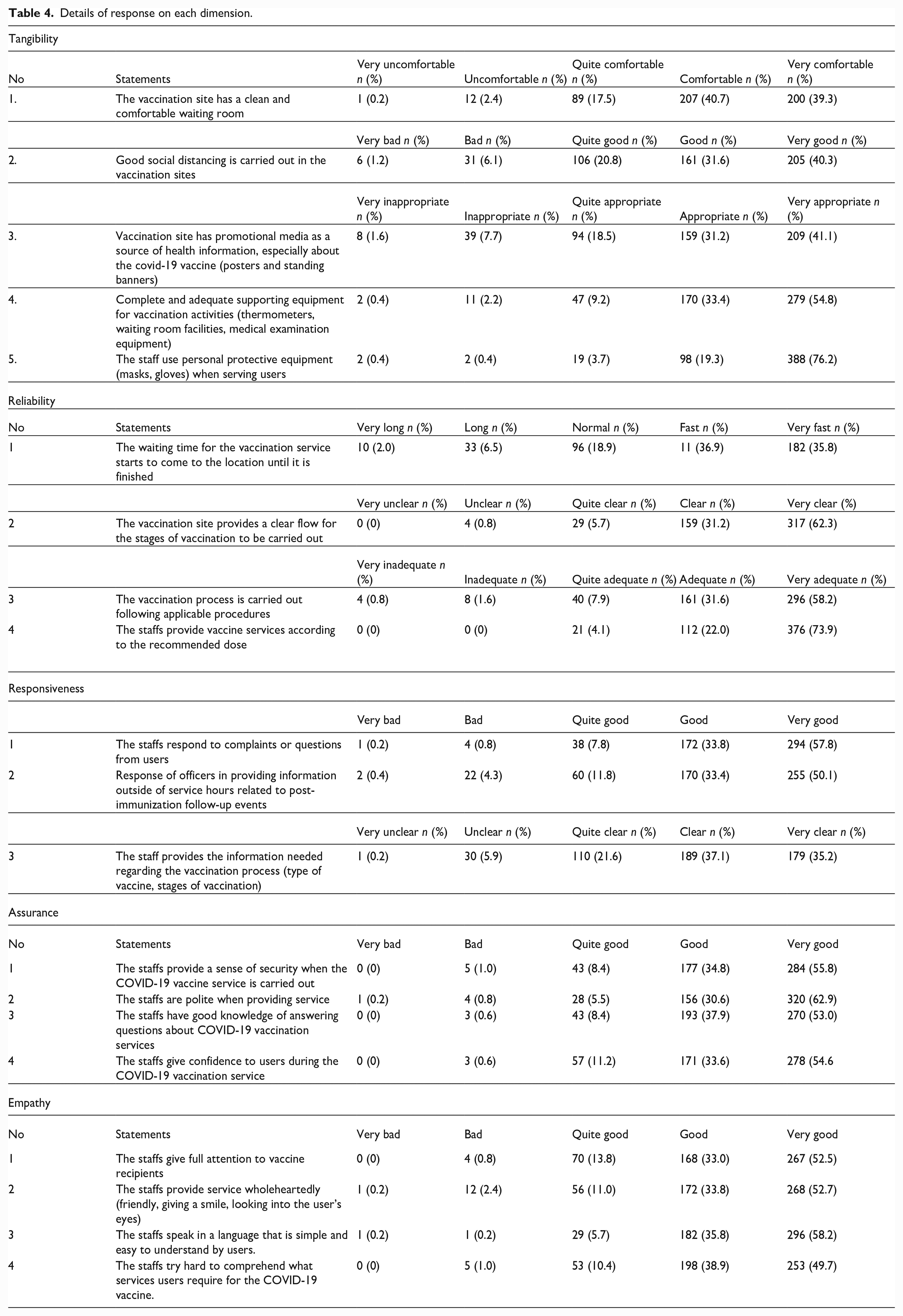
In the responsiveness dimension, 294 respondents (57.8%) were satisfied with the highest percentage in terms of officers responding to complaints or questions from users. Meanwhile, they are not pleased with how the staff has responded when they have been asked to provide information about post-immunization follow-up activities outside of service hours. In the assurance dimension, respondents are very satisfied with how the staff provides security to users during the COVID-19 vaccination service (55.8%), while in the empathy dimension, respondents are very satisfied because the staff provides service wholeheartedly and speaks in a simple language and easy to understand by users.
Discussion
A total of 509 respondents participated in this study of user satisfaction with the COVID-19 vaccination service in Indonesia. User satisfaction is measured based on five dimensions, namely tangibility, reliability, responsiveness, assurance, and empathy. The results of the study revealed that the satisfied and unsatisfied categories were not much different, 50.1% said they were satisfied and 49.9% said they were not satisfied. This confirms that the implementation of the COVID-19 vaccination still requires improvement in service quality. Several strategies such as staff training, monitoring, and improvement of facilities can increase user satisfaction.14,15 Of the five dimensions measured, the highest level of satisfaction is in the reliability dimension (59.7%), while the highest level of dissatisfaction is in the tangibility dimension (48.7%). Tangibility is tangible assets that are usually in physical form, which in this study include waiting rooms, provision of information media, and adequate supporting equipment. 16 The tangibility aspect looks at how the vaccination waiting room is, the application of social distancing, the existence of educational media at the vaccination site, and the supporting facilities used in the COVID-19 vaccination. Based on the details of the question on the tangible dimension, it is known that the least thing according to the respondents is the limited information media about COVID-19 vaccination at the vaccination location. This is reinforced by earlier research that shows how clients consider tangible elements like the facilities offered when assessing service satisfaction.17,18 The high satisfaction in the reliability dimension shows that respondents are satisfied with the service following applicable procedures. The perception of the quality of health services is related to the reliability dimension, therefore it is important to improve the competence of staff and technical skills professionally. 19
Based on location, it was discovered that most of the respondents were satisfied with the COVID-19 vaccination service which performed in schools/educational institutions (66.7%), clinics (62.5%), and hospitals (58.62%). Respondents who reported dissatisfaction with the COVID-19 vaccination program were primarily observed getting their shots in the village hall (only 35% said they were satisfied, and 64.71% said they were not). This is possibly correlated with the tangible dimension which is found to be rated by the most dissatisfied respondents. The village meeting hall turned out to be the vaccination site where most respondents were dissatisfied, this was possible because of the limited facilities such as a decent, spacious, and clean waiting room. The provision of good health facilities is correlated with the satisfaction of health service users.20,21 The interesting thing found in this study is that there is no difference in user satisfaction between respondents who carry out vaccinations in Java and those outside Java. This shows that the quality of services provided regarding vaccination is almost the same. Previously, there was an assumption that health services outside Java still had many limitations. 22
An interesting finding in this study is that the provision of refreshments, rewards, or incentives such as drinking, food, shopping vouchers, or door prizes is associated with all dimensions of user satisfaction. Giving presents to people who are willing to get the COVID-19 vaccine is one of the methods used in Indonesia to raise public interest and willingness. Some regions provide prizes such as lottery prizes, shopping vouchers, cooking oil, and food needs to increase the enthusiasm of residents in carrying out COVID-19 vaccinations. This is supported by the study’s findings, which show that this strategy raises user satisfaction with COVID-19 immunization. 23 Another study also stated that monetary incentives increased vaccination rates in Sweden, providing a 24 USD voucher could result in a 4-point increase in vaccine uptake. 24 Although the incentives offered can enhance people’s willingness to get immunized, a study in Germany stated a considerable increase also requires a lot of incentives. Of course, this could lead to a rise in the cost of the vaccine program. 25 However, some studies show that providing financial incentives is also not able to increase the willingness to vaccinate. This shows that the strategy of providing incentives must take into account the demographic characteristics, culture, and local customs. 26 In cases where an individual’s actions benefit others, paying people to engage in activities like vaccination can make sense. However, other research demonstrates that payments in some circumstances can suggest that a course of action is undesired, unpleasant, or even dangerous and is not worthwhile doing for personal gain alone. 27 A recent systematic review from 24 publication concluded that high financial incentives are responsible for a higher vaccination rate, whereas low financial incentives, other lotteries, and persuasive messaging have little or negligible benefits. 28
In this study, simple forms of refreshment such as the provision of snacks, drinks, and family food needs were able to increase the level of satisfaction with the COVID-19 vaccination service. This is interesting because the things that are considered additional services in vaccination have more influence on the level of service satisfaction. This is consistent with a prior study, which found that patient satisfaction was influenced by how staff members treated patients in a customer-focused manner. 27 Several variables are correlated with user satisfaction such as vaccination location, provision of refreshment/reward/incentives, providing emergency contact post-vaccination, and observation time post-vaccination. This demonstrates that responders also pay attention to the requirements for standard immunization implementation, such as a minimum observation period of 15 min following vaccination and the presence of emergency contacts to track post-immunization follow-up events. 29 This study emphasizes how vaccination services must be improved to increase consumer satisfaction. The results of this study may be influenced by user perceptions and social backgrounds that affect how they perceive satisfaction with the services they receive. The limitation of this study is that the information gathered related to the type of refreshments, rewards, and incentives is still vague. It would be interesting to conduct more research on the types of rewards/incentives that can boost customer satisfaction with COVID-19 immunization services. Another limitation is this study is a cross-sectional study and not longitudinal so that it only describes the satisfaction of users of the Covid-19 vaccination at the time of the study. The sample also was not randomly drawn, and as such the results may not necessarily represent the feelings of the larger Indonesia population (individuals who do not use social media would inherently be excluded from the recruitment); and relatively small sample size given the overall size of Indonesia. A future study would be interested to include qualitative data gathering (e.g. questions that get at the “why,” whether satisfaction or dissatisfaction would impact a person’s choice to get another booster) could be a good follow-up to the present study, possibly strengthening its findings.
Footnotes
Declaration of conflicting interests
The author(s) declared no potential conflicts of interest with respect to the research, authorship, and/or publication of this article.
Funding
The author(s) disclosed receipt of the following financial support for the research, authorship, and/or publication of this article: We thank the University of Jenderal Soedirman for funding this research through Basic Research Scheme 2022 Number 1134/UN23/PT.01.02/2022
Author contributions
Siwi Pramatama Mars Wijayanti: Responsible for designing research, compiling a teamwork division, data collection, and writing a draft manuscript. Yuditha Nindya Kartika Rizqi: Responsible for developing instruments for data collection, and assisting in data analysis. Dwi Sarwani Sri Rejeki: Responsible for data collection and analysis, providing input on the manuscript. Devi Octaviana: Assist in data collection and data analysis, providing input on the manuscript. Sri Nurlaela: assisting in data analysis and interpretation, providing input to articles.
Significance for public health
To the author’s knowledge, this study is the first study to examine vaccination user satisfaction in Indonesia. With Indonesia’s geographical area and very large population, the COVID-19 vaccination program is not an easy job. Therefore the information from this study is very important. The results of the study confirm that there is still a large percentage of users who express dissatisfaction with the implementation of the COVID-19 vaccination, especially the facilities which are still limited. This information is important to be able to improve the quality of vaccination implementation, especially booster vaccinations which are still ongoing in Indonesia.
Availability of data and materials
The datasets analyzed in this study are available from the corresponding author on reasonable request.