




Abstract
Background:
An environmental intervention with focus on Decision Guidance was implemented in a university canteen. It comprised the offer of a health promoting food option (HPFO), including a health promoting lunch option and health promoting snacks.
Design and methods:
Possible changes of food consumption and nutrient intake of student canteen users (substudy A), perception of the HPFO by canteen users (substudy B.1), and possible changes of their satisfaction regarding the canteen (substudy B.2) at least 10 weeks after the start of the intervention were examined. Substudy A used a controlled pretest-posttest-design (paired sample). The students were assigned to intervention group (canteen visits ≥ once/week, n = 27) or control group (canteen visits < once/week, n = 39). Substudy B.1 used a cross-sectional design, and substudy B.2 a pretest-posttest-design (paired sample). Only canteen users (≥once/week) were included (substudy B.1 n = 89, substudy B.2 n = 30).
Results:
Food consumption and nutrient intake did not change (p > 0.05) in the intervention group versus control group (substudy A). In substudy B.1 canteen users were aware of the HPFO, appreciated it highly, and were satisfied with it. In substudy B.2 canteen users were at posttest more satisfied regarding service and health value of offered lunches (p < 0.05).
Conclusions:
Although the HPFO was positively percepted, no effects on the daily diet were observed. The offered proportion of the HPFO should be increased.
Keywords
Significance for public health
Changes in the food environment are a good way to promote favourable dietary behaviour across all social groups. The application of measures from the Decision Guidance category, for example, uses nudges and incentives to influence unconscious behaviour. Our study uses the example of a university canteen to evaluate to what extent food consumption, nutrient intake, the satisfaction with a health promoting food option and satisfaction with the canteen can be influenced. Based on these results, further interventions in the food environment can be designed.
Introduction
In the German population as well as in other western societies an unfavourable diet is common. It is associated with a high risk of diseases, disability, and premature mortality. 1 The German diet is generally characterised by a consumption of less vegetables and fruit and more meat than recommended. 2 As a result, the mean fibre intake is below and the fat intake above the German recommendations for nutrient intake. 2 Previous efforts for example, behavioural counselling and health education have not been sufficient enough to change the food consumption profoundly over the last years.2,3 In addition, the success of these interventions depends on personal resources. 4 For example less-educated individuals consume vegetables to a lesser extent than those who are higher educated. 5 However, also well-educated groups, for example, university students, predominantly fail to meet the dietary recommendations.6–8
A current societal trend is an increase in eating out of home. 9 University students in western countries often eat lunch out of home.10,11 Lunch accounts for approximately 25% of the daily energy intake. 12 Therefore, university canteens are particularly well suited for interventions. Interventions in such food environments have the advantage that they do not only work on the conscious behavioural level and support desirable decisions (Decision Support). Unconscious decisions can also be guided, for example, through nudges or incentives (Decision Guidance). In addition, regulations in a setting can shape the offer and thus the choice (Decision Restriction). Based on the model outlined above according to Jürkenbeck et al. 13 , an intervention with a focus on Decision Guidance was carried out in a university canteen. The German Nutrition Society (DGE)’s Guidelines on Quality Standards (DGE-GQS) 14 served as a reference for the development of a HPFO.
After introducing the environmental intervention with focus on Decision Guidance in the university canteen at the University of Education in Schwäbisch Gmünd the aim of this study was to evaluate whether food consumption and nutrient intake of canteen users (intervention group; IG) changed compared to non-canteen users (control group; CG). It was the hypothesis that the consumption of vegetables, fruit and meat would improve in the IG compared to the CG. Also an improvement regarding the fat, and fibre intake was expected. Furthermore, the awareness, acceptance, and use of the health promoting food option were assessed cross-sectionally. The last research question addresses the possible changes of the satisfaction in canteen users while introducing the HPFO.
Design and methods
Overview of the study design
To evaluate the effectiveness of the environmental intervention with focus on Decision Guidance the implementation in the canteen at the University of Education in Schwäbisch Gmünd was accompanied by a controlled intervention study (see Figure 1).

Study design according to substudies.
The study was divided into two substudies: substudy A comprised a dietary assessment to measure food consumption and nutrient intake of the study cohort (i.e. canteen users and non-users) before and after the implementation of the environmental intervention. Substudy B focused on the awareness, acceptance and use of the HPFO by the canteen users and their satisfaction with the canteen in general.
Intervention
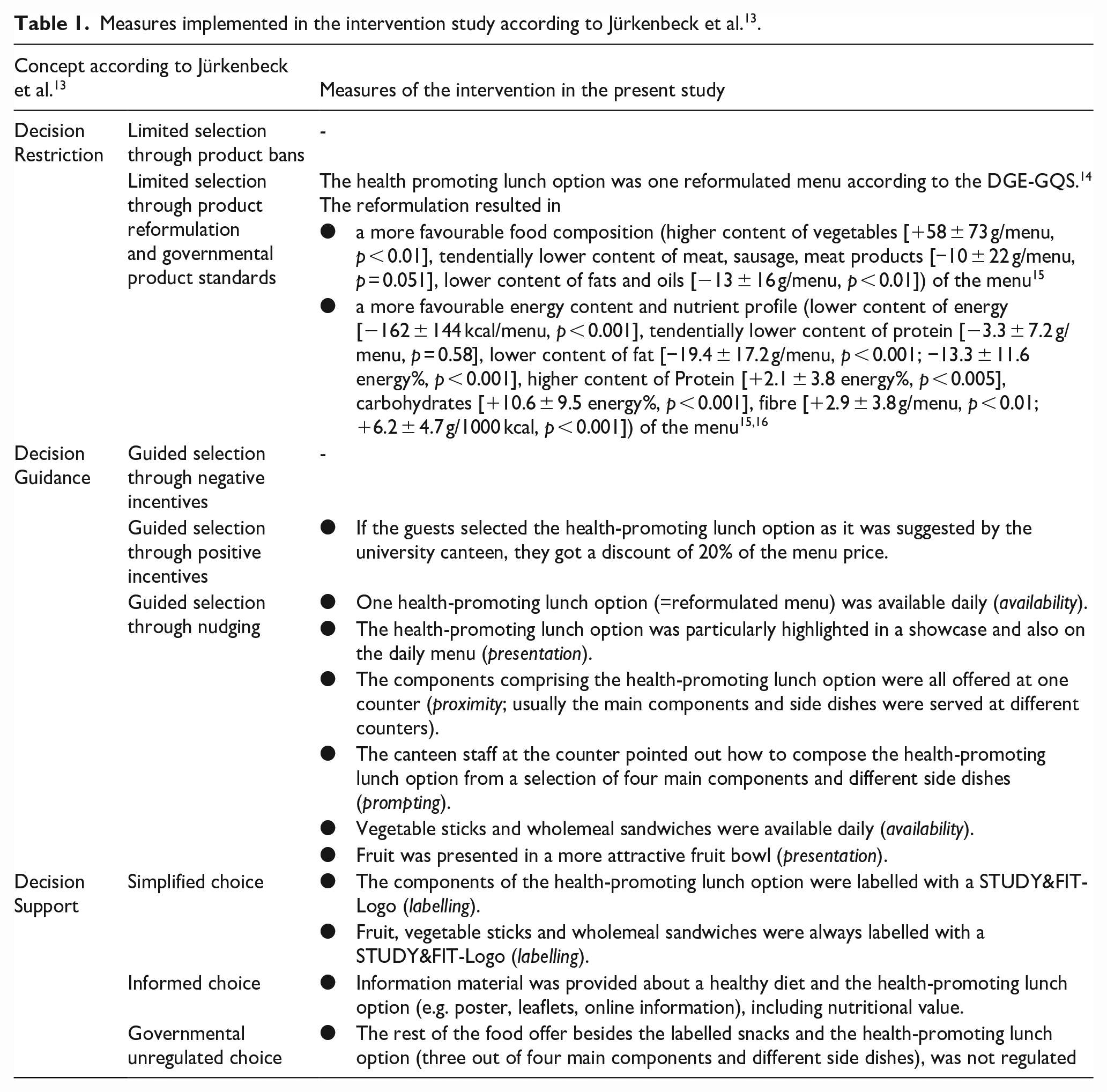
As Table 1 shows, the university canteen implemented various measures, classified in the model of Jürkenbeck et al. 13 . One out of four self-combinable menus was reformulated according to the DGE-GQS and then offered as a health promoting lunch option (see Figure 2). In addition, the HPFO included health-promoting snacks. The university canteen was awarded with the highest certification (PREMIUM-Certification) of the DGE for the implementation of the DGE-GQS. 14 Before the intervention the entire canteen offer was unregulated.
Measures implemented in the intervention study according to Jürkenbeck et al. 13 .

Example of the health promoting lunch option consisting of one main component (linguine pan with spinach and cherry tomatoes) and side dishes (fresh salad, strawberry-yoghurt dessert).
Substudy A: design, assessment methods and participants
To measure the possible changes in food consumption and nutrient intake a dietary assessment was conducted in a controlled pretest-posttest-design with a paired sample. Data collection was proceded before (t0) and at least 10 weeks after (t1) the introduction of the HPFO. A validated 3-day estimated dietary record 17 was applied for dietary assessment. The nutrient calculation was based on the German Nutrient Database II.3. Outcomes of primary interest were the consumption of vegetables, fruit, and meat, as well as the intake of fat and fibre. Secondary outcomes were the consumption of further food groups, the energy, protein, and carbohydrate intake. The Healthy Eating Index of the German National Nutrition Survey II (HEI-NVS) was used 18 to break down the complex food consumption to one marker for nutritional quality.
In order to describe the study population gender, age, body weight, body height, the personal presence at the university, the use of the canteen for lunch and its health promoting lunch option were assessed by questionnaire (online and paper-pencil). The Body Mass Index (BMI) was derived from weight divided by height in metres-squared.
Initially, all students enrolled at the university (~2500) were contacted via e-mail, the learning management system, a flyer, during lectures, or face-to-face contact. A sample size of 33 participants was aimed using the tables of Bortz and Döring
19
for repeated measures analysis of variance (assumptions: statistical power of 80%, α = 0.05, δ = 0.5, correlation of
At t0 and t1 66 students took part in the dietary assessment. In Table 2 the participants’ characteristics at t0 according to study group are displayed. The table shows, that BMI, presence at the university, the canteen visits for lunch and the use of the health promoting lunch option were significantly higher in the IG compared to CG.
Characteristics of participants at t0 according to study group.
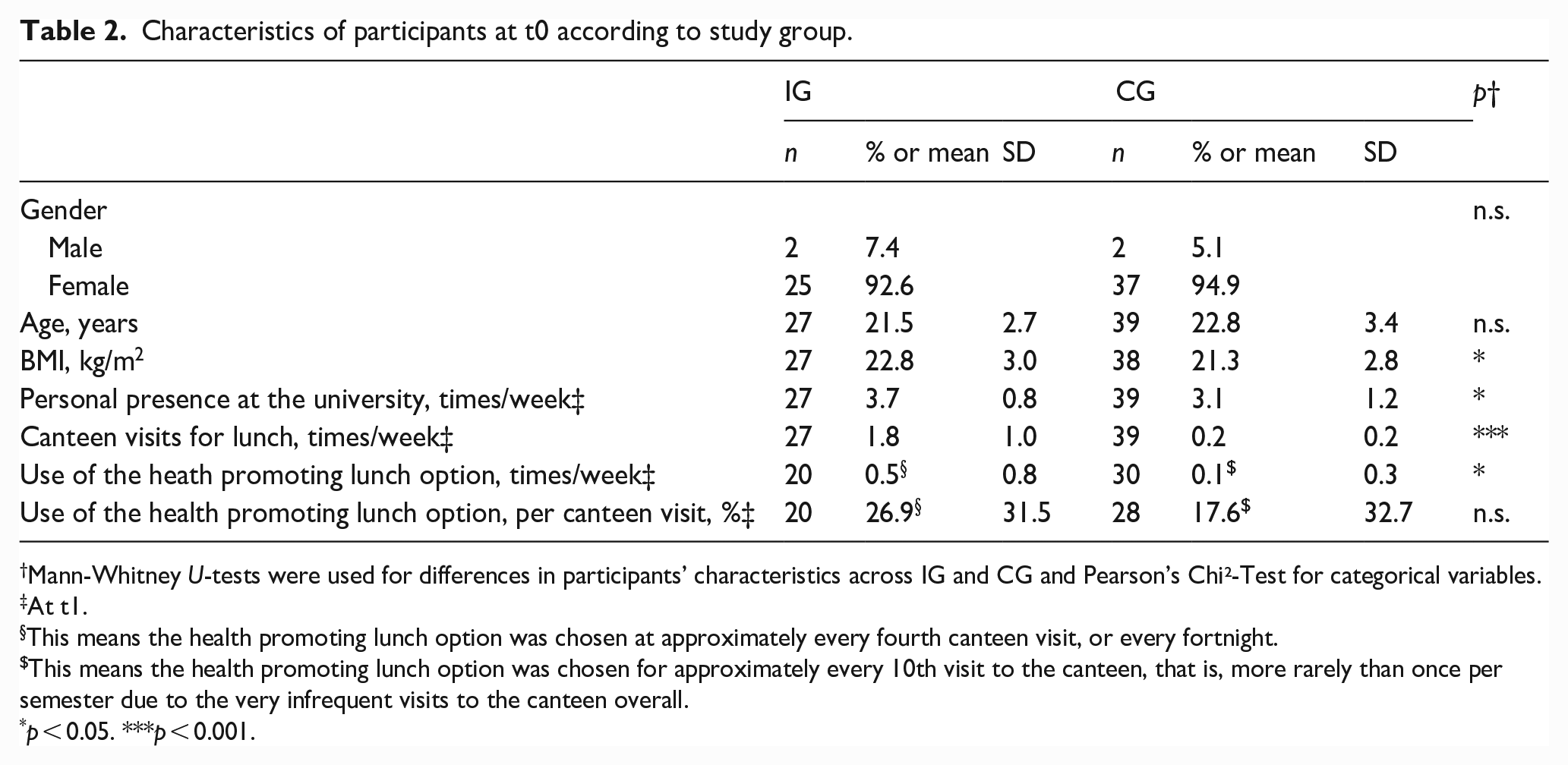
Mann-Whitney U-tests were used for differences in participants’ characteristics across IG and CG and Pearson’s Chi²-Test for categorical variables.
At t1.
This means the health promoting lunch option was chosen at approximately every fourth canteen visit, or every fortnight.
This means the health promoting lunch option was chosen for approximately every 10th visit to the canteen, that is, more rarely than once per semester due to the very infrequent visits to the canteen overall.
p < 0.05. ***p < 0.001.
Substudy B (B.1 and B2): design, assessment tools, and participants
Substudy B is divided into substudy B.1 and substudy B.2.
Substudy B.1
Substudy B.1 aimed to assess the awareness, acceptance, and use of the HPFO. It was a cross-sectional analysis after the introduction of the HPFO. Data collection took place at least 10 weeks after the introduction of the HPFO (t1, see Figure 1). The procedure was as described in substudy A. Enrolled students were included in the analysis, if they ate at least one hot lunch in the canteen per week (canteen user). A standardised questionnaire (online and paper-pencil) with a 7-point Likert scale was used to gather the information about the appreciation (−3 very bad, . . . 0 = partly so/partly so, . . . 3 = very good), and the influence on the choice of dishes (−3 = no, never, . . . 0 = sometimes, . . . 3 = yes, always). To characterise the study population gender, age, the personal presence at the university, the use of the canteen for lunch, and its health promoting lunch option were also assessed.
One hundred ninety-three students took part at substudy B.1 and filled out the questionnaire, 89 participants (77.5% female, 23.5 ± 4.3 years) met the inclusion criteria. They were 3.7 ± 0.9 times/week present at the university and ate a hot meal 2.0 ± 1.0 times/week in the canteen.
Substudy B.2
Substudy B.2 examined the satisfaction with the canteen in general by the canteen users. It used a pretest-posttest-design with a paired sample. According to Bortz and Döring
19
a sample size of 33 participants was aimed (assumptions: statistical power of 80%, α = 0.05, δ = 0.5, correlation of
At t0 417 students completed the questionnaire, at t1 193 students. Complete data sets are available for 30 students (86.7% female, 23.5 ± 6.3 years), who met the criteria described above (canteen user, paired sample). On average, they were present at the university 3.8 ± 0.9 times/week and visited the canteen 2.0 ± 1.1 times/week for lunch.
Statistical analysis
Statistical analyses were performed using SPSS statistics version 24 (IBM Corp., Chicago, IL, USA). Between-group comparisons were tested using Mann-Whitney U-tests for continuous variables and Pearson’s Chi²-tests for categorical variables. To detect possible changes from t0 to t1 an analysis of variance (ANOVA) with repeated measures was conducted. In Substudy A the intervention status (IG vs CG) was applied as a covariable. Results are considered statistically significant when p-values are <0.05.
Ethical considerations
This study was conducted according to the guidelines of the Declaration of Helsinki. It was approved by the Ethics Committee of the University of Education Schwäbisch Gmünd (2016 September 27). The analysed data included only participants who gave their written informed consent.
Results
Substudy A: Food consumption and nutrient intake
Table 3 shows the food consumption and nutrient intake according to study group and time. In the course of time no significant changes occurred, which were attributable to the intervention. In both study groups the vegetable consumption increased significantly. In addition, both study groups showed a significant decrease of carbohydrate intake and a shift to a higher fat and protein intake.
Food consumption, HEI-NVS and energy and nutrient intake according to study group before (t0) and after (t1) introduction of the health promoting food option.
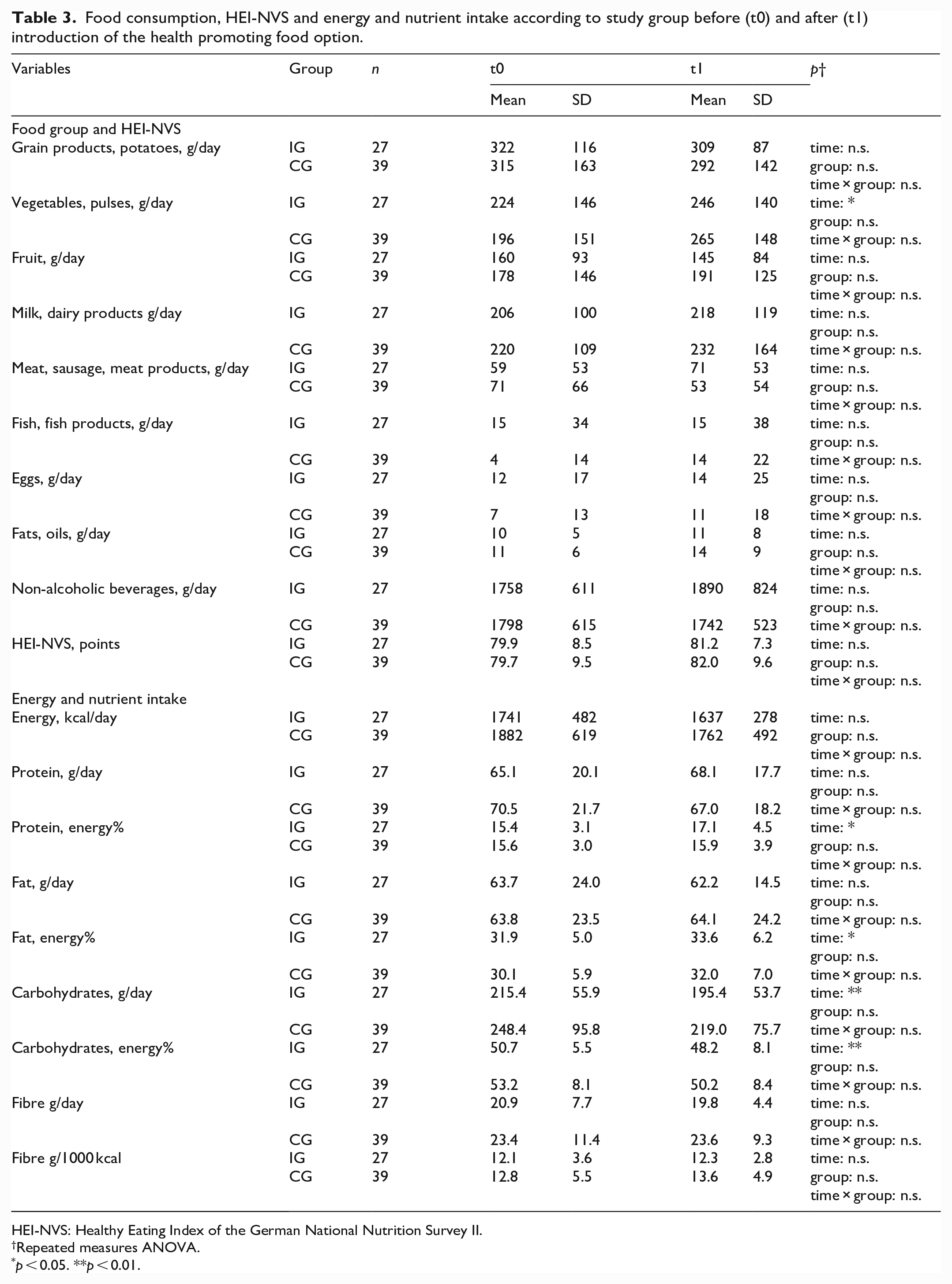
HEI-NVS: Healthy Eating Index of the German National Nutrition Survey II.
Repeated measures ANOVA.
p < 0.05. **p < 0.01.
Substudy B1: Awareness, acceptance, use of the health promoting option
About 75.3% of the participants in substudy B.1 were aware of the logo which labelled the HPFO. In general, introducing a HPFO was highly appreciated (mean: 2.2 ± 1.1). To a lesser extent the canteen users were satisfied with the HPFO (mean: 1.3 ± 1.3). On average the health promoting lunch option was bought 0.8 ± 0.9 times/week, which represents HPFO every third (34.8 ± 34.1) of all meals bought in the canteen. The influence of the labelled HPFO on meal choice of canteen users was classified as ‘rarely’ (−0.8 ± 1.9).
Substudy B2: Satisfaction of the canteen users
Figure 3 shows the satisfaction at t0 and t1. After the introduction of the HPFO (t1) the canteen users were significantly more satisfied with the service of the canteen and the health value of the lunch offered compared t0.

Satisfaction of the canteen users before (t0) and after (t1) introduction of the health promoting food option.
Discussion
Frame and comparative studies
Environmental interventions in canteens with focus on Decision Guidance, particularly with an actual increase in the availability of health promoting options, are rare. Our study shows that a HPFO is appreciated by the guests. Furthermore, canteen users were after its introduction (t1) more satisfied with the health value of the lunch offered than before (t0). Although the HPFO was known and highly appreciated no effects on the daily food consumption and nutrient intake were observed.
These results are unexpected, because the reformulation led to considerable improvements of the food composition and the nutritional value of the menus.15,16 Moreover, the health promoting lunch option was regularly chosen by our participants. The canteen also recorded an increase in the number of vegetable components sold per main component, as well as an increase in the number of fruit and fruit sold per main component. 20
However, some cafeteria users criticised that the health promoting lunch option was relatively large or included too many components. The fixed menu composition associated with receiving the 20% discount was also criticised (data not shown). 15
As shown in our 20 and other studies,21–23 a positive incentive is a good way to increase sales of desirable foods. A 20% discount is also a desirable level, 24 but discounting a bundle of foods seems to be less effective. 25 So there was unlikely to be any effect on consumption in our study.
Another decision guidance strategy used, nudging particularly with an actual increase in the availability of health promoting options, has the potential to change the choice of canteen users.26,27 Further intervention studies that focused on the dietary intake at the canteen found contradictory results. Whereas in some studies the fruit 28 and vegetable consumption29,30 could partly be increased, others failed to show clear effects.31,32 In three 29,31,33 out of four 32 studies the fat intake on-site declined by availability-interventions.
To fully evaluate the impact of nudging-interventions, possible compensatory behaviours, for example, omitting the vegetable consumption in other eating situations outside the canteen, should be taken into account. Nudging-interventions that increased the availability of desirable foods in canteens and assessed the intake over the whole day provided contradictory results.32,34–37 Possibly, too many occasions for compensatory behaviour existed. Additionally, in our study, only one of four main components was reformulated. Therefore, in our study there were many occasions to make a conventional choice as well. Perhaps this is the main reason why the intervention was not effective with regard to food and nutrient intake.
Strengths and limitations
Our study is one of the few studies on decision guidance in canteens, particularly on the availability of health-promoting options. In addition, it assessed the impact on total daily consumption and the application of the DGE-GQS made the intervention transparent and replicable. A further strength of our study was the controlled pretest-posttest-design of substudy A. A downside of this study design is the relatively small study population, as a certain proportion of participants dropped out from t0 to t1 for example because they graduated. In addition, participants in the present study consumed less hot meals in the canteen than the average German student. 11 In combination with the rather low proportion of reformulated menus, this could be the reason that no effect of the intervention on food and nutrient intake could be demonstrated.
Furthermore, the validated dietary record is a strength of this study. Despite a certain extent of underreporting, dietary records are often used as a gold standard method for measuring food consumption and nutrient intake.38,39 Even though the applied 3-day estimated dietary record might have contributed to a lesser precision of the measurements, it was an effective way to collect the dietary data in a constant quality.
Finally, the assessment of awareness, acceptance, use of the HPFO, and guest satisfaction is an additional advantage. The results of substudy B complete the view on the intervention and encourage practitioners in canteens to apply the criteria of the DGE-GQS.
Conclusion
The HPFO was highly appreciated, but did not result in any changes in food consumption. However, the lunch offer of the canteen was only partly reformulated – three out of four main components were not regulated. It can be assumed that if a larger part or the entire lunch offer were reformulated, this would lead to considerable changes in dietary behaviour.
Against the background of the above mentioned unfavourable diet of students in general, as well as in the whole population, an exclusive health promoting offer is recommended from a health promotion point of view. At least a higher proportion of health promoting menu components in university canteens is desirable. Whether the effects on consumption would be more substantial needs to be examined in further studies.
Furthermore, the intervention in the university setting is promising, because of the future social responsibility of university students. As future leaders they are involved in shaping more or less healthy environments – a strategy to change dietary habits more equally over all social groups.
Footnotes
Acknowledgements
M.S. would like to thank all stakeholders who contributed to the study, which is part of her dissertation. 15 A special thanks goes to the study participants for their repeated participation.
Author contributions
MS: involved in study design, oversaw data collection, responsible for data analysis, and primary contributor of manuscript content. CN: oversaw data collection, contributed edits to manuscript. AC: involved in study design, contributed edits to manuscript. PL: involved in study design, supervised data analysis, contributed content and edits to manuscript, and primary contributor of manuscript content. All authors contributed to manuscript revision, read and approved the final draft.
Declaration of conflicting interests
The author(s) declared no potential conflicts of interest with respect to the research, authorship, and/or publication of this article.
Funding
The author(s) disclosed receipt of the following financial support for the research, authorship, and/or publication of this article: This work was supported by an intern support programme of the University of Education [2013 December 10]; and the Studierendenwerk Ulm [student services Ulm; 2015 June 22].
Ethics statement
This study was in accordance with the declaration of Helsinki and approved by the Ethics Committee of the University of Education Schwäbisch Gmünd (2016 September 27). The participants provided their written informed consent to participate in this study.

Availability of data and materials
The data used to support the findings of this study are available from the corresponding author on reasonable request.