



Abstract
Background:
The widespread of COVID-19 causes serious distress on the mental health of the students during the lockdown period. The present study aimed to identify anxiety levels among students during the COVID-19 crisis.
Design and methods:
A cross-sectional web-based survey was carried out among university students aged 18–47 years. The 7-item Generalized Anxiety Disorder Scale (GAD-7) was used to assess anxiety symptoms.
Results:
Among the 1252 participants, the mean age was 28.82 (±7.28) years and 72.6% were female. Based on the results, 22.0% of the participants had no symptoms of anxiety, 25.2% had mild anxiety, 29.6% moderate anxiety, and 23.2% severe anxiety. Moreover, being a female (OR = 0.480, 95% CI = 0.257–0.704), younger age (OR = 0.359, 95% CI = 0.132–0.586), undergraduate level (OR = 0.493, 95% CI = 0.288–0.698), and stability of monthly income (OR = 0.516, 95% CI = 0.308–0.723) were found to be a protective factor against anxiety suffered by the participants. However, having a COVID-19-infected relative or acquaintance was a risk factor for anxiety (OR = 21.870, 95% CI = 21.870–21.870). The results revealed that the level of anxiety symptoms was positively associated with COVID-19 related stressors such as effects on daily living (r = 0.163, p < 0.001), economic stressors (r = 0.153, p < 0.001), and educational consequences (r = 0.150, p < 0.001), however, social support (r = 0.472, p < 0.001) was negatively associated with the anxiety.
Conclusion:
The psychological status of university students should be followed during times of health emergencies. It is essential to design a health program for influenced students to assist them to stay resilient throughout perilous situations.
Background
The global spread of the severe acute respiratory syndrome coronavirus2 (SARS-CoV-2) has resulted in unprecedented lockdowns. Although the severity of these restrictions has varied among and within countries, they have a significant impact on people’s daily life around the world, influencing their job, leisure activities, livelihood, and ability to engage in in-person social connections. Many studies conducted during this pandemic concluded that the COVID-19 pandemic has a significant impact on people’s anxiety level and behavior, 1 with only a few studies suggesting otherwise. 2 During the COVID-19 pandemic, mental health hotlines in the world experienced marked increases as most individuals were under stress because of the lockdown. 3
People often experience the fear and panic of becoming infected with a disease during health problems, leading to feelings of sadness, anxiety, and stress. 4 People who are afflicted with diseases for which there are no therapies or vaccines will experience panic and become stressed, unhappy, and anxious. People have experienced psychological anguish and mental health difficulties as a result of the COVID-19 crisis. As a result, people’s mental health should be closely evaluated, and early actions should be implemented to maintain health during these critical periods. The World Health Organization (WHO) has issued guidelines for dealing with mental health problems that might lead to suicide. Wang et al. 5 revealed that the Chinese had a high level of psychological suffering during the lockdown period. The majority of research undertaken in several nations during the COVID-19 crisis revealed significant psychological difficulties among participants. 6
Despite the fact that the COVID-19 pandemic and its preventive measures have a significant impact on all populations, particularly in socially disadvantaged communities, university students are among the most severely impacted by the virus because of concerns about academic achievements and future employment during university. Even prior to the COVID-19 pandemic, students were also experiencing increasing levels of anxiety, negative well-being, depression, stress, and psychosomatic difficulties. 7 As a result, students may require another resources to cope with the consequences of disease. If university administrators had a greater understanding of COVID-19s effects and the risk factors for its psychological effects, they could better serve students. These consequences are so serious that they require mental health measures aimed at prevention and treatment. 8 It was reported that university students have been underutilized the services of psychiatric and counseling. 9 Knowing which category may suffer from psychological influences can help with targeted interventions, effective treatment, and coping methods for those who are most at risk.
The recent studies revealed that the COVID-19 period has psychological impacts on university students.10 –13 As a result of the changing learning methods, submitting and receiving the educational instructions, fear of failure, technical problems of online lessons, being away from home, lower family income, and future work, many students experience heightened anxiety. 14
During the current pandemic, students’ psychological well-being was severely impacted by abrupt university closures. According to Hamza et al., 11 the COVID-19 pandemic had a significant impact on university students’ mental health and well-being. Furthermore, Saravanan et al. 13 and Romeo et al. 12 proved that the coronavirus diseases has a detrimental psychological impact on university students, reporting the prevalence of anxiety among them. According to a study conducted in France, 15 two-thirds of students experienced increased anxiety during confinement, and Students were subjected to a wide range of stressful situations. Furthermore, Al-Tammemi et al. 10 conducted a study in Jordan on a sample of 381 university students aged 18–38 years during the first phase of the lockdown. They found that most of the students had severe psychological distress and were anxious and distressed by the electronic learning system. Half of the students confirmed that they had no motivation to continue their learning through distance learning.
On March 5, 2020, the Ministry of Education and Higher Education (MOEHE) has decided the closure of all educational bodies in order to combat the spread of this virus and prevent widespread infection among students. Students shifted to online education using electronic educational platforms during the closure of universities 16 and to take precautionary precautions such as wearing masks, staying at home, sanitizing their hands regularly, and avoiding gatherings.
In the Gaza Strip, studies of the effects of COVID-19 on anxiety levels among university students have been limited in their generalizability due to the focus on certain institutions or populations only, where the previous Palestinian studies highlight the effects of COVID-19 on anxiety levels among nursing students, 17 healthcare providers 18 and whole Palestinian community. 19 These studies have reported the prevalence of anxiety and other psychological states in the study samples during the COVID-19 pandemic. However, there is no studies have been carried out with university students at multiple universities, colleges and institutions during the current pandemic in our country. Therefore, we aimed to identify the impact of COVID-19 on anxiety levels among university students during this pandemic. These universities, colleges and institutions represent a unique context within the education. The Gaza Strip educates large numbers of Palestinian students who live in the governorates of the Gaza Strip. Procedures for teaching students to manage their emotions during times of crisis (such as public health crises) have become a pressing issue for universities.
Methods
Study design and setting
The study employed a cross-sectional web-based survey design. The required data was collected from April 9th to May 12th, 2020 (Table 1), the month after the lockdown of universities and schools due spread of COVID-19 in Palestine; therefore the data was gathered using an online survey tool. Depending on the authors’ relationships with university students, a poster was disseminated on the groups of different social media to enable the participation of the largest possible number of students. This poster contained an overview of the objectives of the study, procedures and methods, voluntarily participation and declarations of confidentiality and anonymity. There were no perks or incentives offered in exchange for participating. During this period, participants were ordered to provide informed consent before being asked, “Are you willing to engage in the current study voluntarily and freely?.” If the participants answered “no,” they were immediately sent a blank survey form. The participant was given access to the survey form if he or she answered “yes”.
Timetable for the steps of the current study.

The questionnaire was translated into Arabic and then back-translated it into English by an expert translator to assure accuracy. To achieve justice and credibility, the final version was piloted with five members of the community. The required questionnaire was sent to a group of six experts, including parents, teachers, and a mental health expert, who checked it for length, correctness, clarity, and comprehensiveness. Expert recommendations led to changes to the questions and responses choices. The participants required at least 3 min to complete the survey. To ensure data confidentiality and dependability, the surveys were made anonymous.
In the Gaza Strip, students are studying in private, public or governmental universities universities/colleges/institutions (Table 2). Private, public and governmental universities are under the management of the Ministry of Education. Some students are studying in the UNRWA College which is supervised by the United Nations Relief and Works Agency for Palestine Refugees in the Near East (UNRWA). According to the recent statistics of the MOEHE, 20 a total of 19,501 students have been enrolled in all Palestinian higher educational institutions (i.e. universities/colleges/institutions) in the Gaza Strip.
Distribution of higher education institutions in the Gaza Strip (2019/2020).
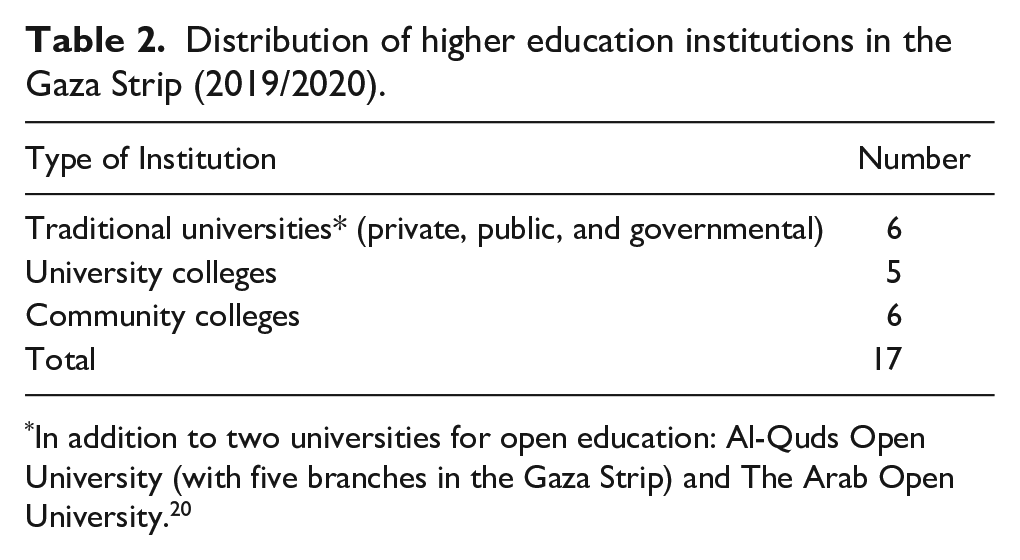
In addition to two universities for open education: Al-Quds Open University (with five branches in the Gaza Strip) and The Arab Open University. 20
Sample size determination and sampling procedure
Due to the potential risks associated with the widespread infection, data were collected through a web-based questionnaire. The authors acknowledge that this strategy has a selection bias and that the sample reported cannot be representative of the real population; however, at this critical time, it was the best method for prevent large scale infections.
We conducted a pilot study before applying the online survey to determine the practicality of the questions and identify weaknesses in the study. The probability equation and confidence interval were used to estimate the sample size. Viechtbauer et al. 21 developed an approach for calculating sample size for pilot studies that ensure high confidence in determining potential problems. The level of confidence is 95%, which corresponds to a 5% significance level. Equation (1) describes the formula for calculating the sample size in pilot studies as follows:

Where:
N refers to the number of participants,
Π refers the confidence level.
For a = 0.05 probability, the pilot study required n = ln(1 – 0.95)/ln(1 – 0.05) = 58.40, or 59 students, such that the problem could be determined with high confidence. The questionnaire was sent to the participants when the pilot study was applied.
The targeted population were university students who were enrolling at the time of the study. The target sample size was calculated based on WHO recommendations for the minimum sample size required for a prevalence investigation. 22 Based on 95% of confidence interval, 0.5 of standard deviation, and 5% margin of error, a sample size of 385 students was required for this study.
Measures
The required data was gathered through a self-related and structured questionnaire that contained socio-demographic information, the preventive behaviors regarding COVID-19, and a psychometric scale (GAD-7) to evaluate psychological status.
Socio-demographic measures
Socio-demographic information was gathered during the study including age, educational level, place of residence, gender, live with parents, steady family income, and relatives infected with coronavirus. The educational level of the students was classified into undergraduate or postgraduate. The place of residence was classified into five places based on the number of governorates of the Gaza Strip (North Gaza, Gaza, Middle Gaza, Khan Younis, and Rafah). In addition, the income of the family was divided into two categories: having a steady income or not. This division was based on the general economic status of Palestinian families living in the Gaza Strip, as most of them without steady work (daily paid workers) and a low proportion of families have a stable occupation (i.e. have a formal job in the UNRWA as well as government or private sector).
Generalized Anxiety Disorder Scale (GAD-7)
This scale is a module of the Patient Health Questionnaire (PHQ), which was the first questionnaire created for primary care to assist the diagnostic of problems. The GAD-7 scale is one of the most well-known tools used to screen and detect anxiety disorders. 23 Due to its diagnostic efficiency and dependability, the GAD7 is still the most extensively used anxiety measure in clinical studies. 24 It can be used to diagnose and screen for anxiety disorders, panic disorder, and post-traumatic stress disorder, as well as to determine the severity of these diseases. The GAD-7 is a 7-item questionnaire that assesses worry and anxiety symptoms over the previous 2 weeks. 23 University students have to report their symptoms using a 4-point Likert scale ranging from 0 (never) to 3 (every day), with total scores ranging from 0 to 21, with higher scores showing greater anxiety severity. 23 Scores above 10 are considered to be in the clinical range. Cronbach’s alpha coefficient for the overall GAD-7 scale was 0.71 in this study, indicating that our sample had adequate internal consistency. 25
COVID-19-related stressors
Participants were inquired about their cognitions and preventive practices toward coronavirus diseases. They were asked about the availability of social support and their concerns about the impacts of coronavirus on the daily living, economy, and education.
A reliability test (Cronbach’s alpha test) was employed to assess the questionnaire’s internal consistency. A Cronbach’s value of 0.890 was obtained, indicating an acceptable level of reliability.
Statistical analysis
Descriptive analyses were conducted to present the frequency, mean, standard deviation, and percentage of the background characteristics and anxiety level of the study participants. The Chi-square (χ2) test was applied to compare the differences in categorical variables. Univariate analysis was applied to examine the relation between demographic characteristics and the anxiety level. In univariate analysis, the significant variables were included in multivariate logistic regression analyses. Multivariate ordinal logistic regression analyses were applied to calculate the odds ratio (OR) with a 95% confidence interval to explore the association between different socio-demographic variables and anxiety levels. Spearman’s correlation coefficient (r) was used to determine the association between anxiety level and coronavirus-related stressors. For all tests, values of p < 0.05 were considered statistically significant. All statistical tests were conducted using the SPSS.22 package.
Ethical considerations and informed consent to participate
Students proved that they have given their informed consent to take part in this study. The Ethics Committee of the MOEHE gave their approval to our study protocol and procedures before we started the formal questionnaire. The procedures followed in this study were in accordance with the Declaration of Helsinki’s principles for human subject research.
Results
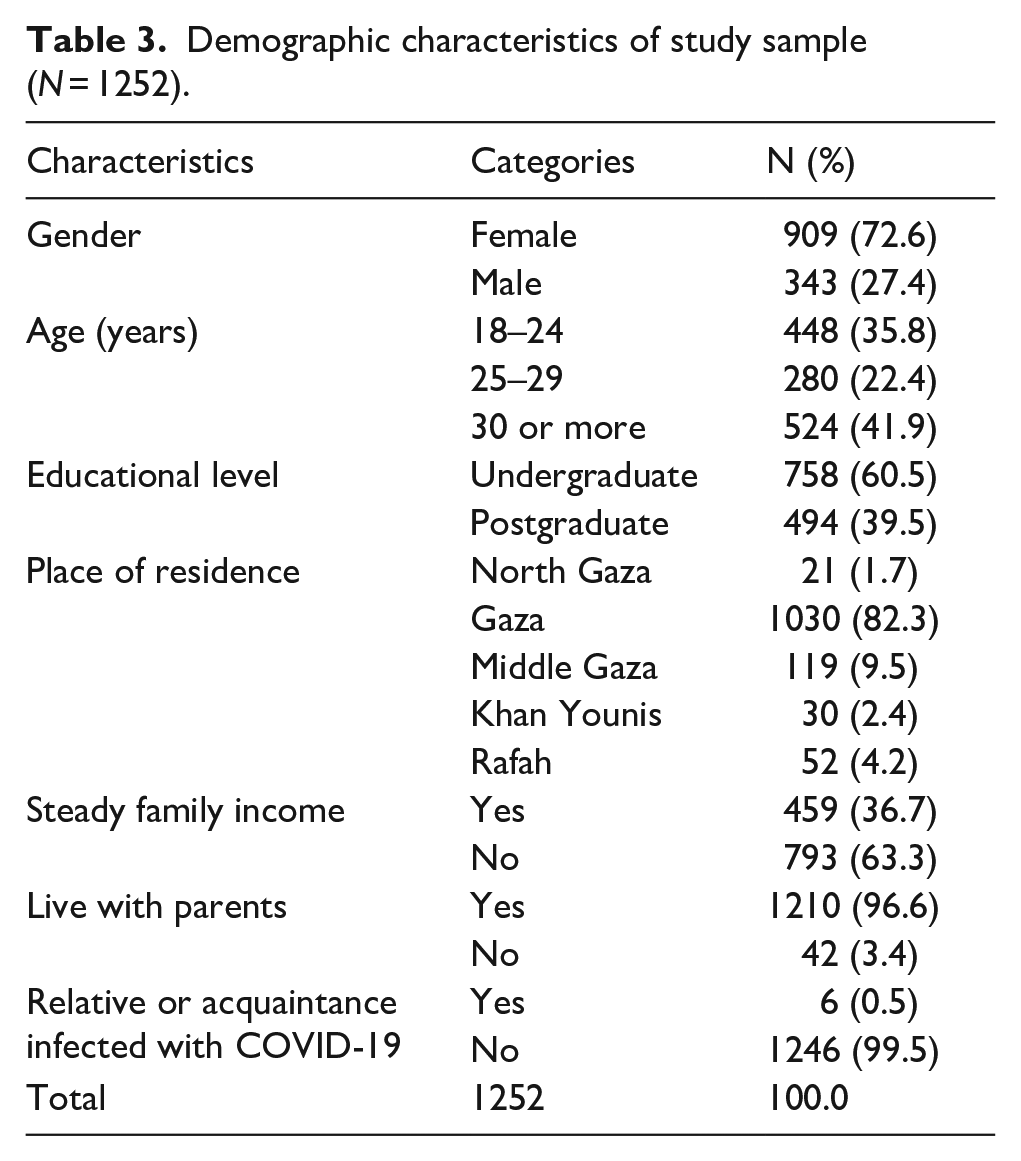
The background characteristics of the participants are reported in Table 3. Our study collected 1252 completed questionnaires from participants ranging in age from 18 to 47 years old. Females represented 72.6% of the sample. Out of the total, 524 (41.9%) aged 30 years or more, 1030 (82.3%) resided in Gaza governorate, 758 (60.5%) are undergraduate students, 793 (63.3%) of students from a family with no steady income, and 1210 (96.6%) are living with their parents. Most students (99.45%) had no COVID-19-infected relatives.
Demographic characteristics of study sample (N = 1252).
Anxiety levels among university students
Table 4 reveals how the COVID-19 pandemic impacted the mental health of university students to varying degrees. Of the 1252 university students, there were 22% of the students who reported no anxiety symptoms, whereas the percentages of students with severe, mild, and moderate anxiety were 23.2%, 29.6%, and 25.2%, respectively.
Anxiety levels among the study participants (N = 1252).

Factors affecting the anxiety of university students during the COVID-19 pandemic
Univariate analysis
The relationship between demographic characteristics and anxiety is presented in Table 5. Gender had a significant effect on anxiety, with females having more anxiety (p < 0.001). The results revealed that living with parents has no significant effect (p = 0.435) on anxiety. Moreover, students who were age 30 years or more (29.2%) and those at the post-graduate level (30.8%) were more likely to suffer from severe anxiety (p < 0.001). In addition, Students living in Gaza Governorate (25.0%), or their families have a precarious income (28.6%), or their families have contracted a COVID-19 (100.0%) were more likely to suffer from severe anxiety (p < 0.001).
Univariate analysis of students’ anxiety about the COVID-19 pandemic.

Calculated by Chi-squared (χ2) test.
Ordinal regression analysis
Table 6 presents the findings of the ordinal multivariate analysis of factors related with anxiety of students during the coronavirus diseases. Non-significant variables at the univariate analysis were excluded from this analysis. The results indicated that, in comparison to older age, younger age was a protective factor against anxiety (OR = 0.359, 95% CI = 0.132–0.586). Female (OR = 0.480, 95% CI = 0.257–0.704), undergraduate level (OR = 0.493, 95% CI = 0.288–0.698), and family income stability (OR = 0.516, 95% CI = 0.308–0.723) were also found to be protective variables against anxiety. On the other hand, having a COVID-19-infected relative was found to be a risk factor for anxiety (OR = 21.870, 95% CI = 21.870–21.870).
An examination of factors influencing students’ anxiety using ordinal logistic regression.

CI: confidence interval; OR: Odds ratio; SE: std. error.
Statistically significant p < 0.05 values are in bold.
Reference group.
Correlation between anxiety levels and COVID-19-related stressors
Concerns about the economic consequences of coronavirus was positively correlated to the levels of anxiety in university students (r = 0.153, p < 0.001). Also, concern about educational consequences (r = 0.150, p < 0.001) and COVID-19s impact on daily living (r = 0.163, p < 0.001) were positively correlated with anxiety levels (Table 7). The results confirmed a correlation between the availability social support and levels of anxiety among university students during the current pandemic (r = 0.472, p < 0.001).
Correlation analysis between the COVID-19-related stressors and university students’ anxiety (N = 1252).

r: correlation coefficient.
Discussion
Based on the previous pandemics and epidemics and outbreaks, it was reported that the imposed emergencies related to them have a variety of psychological effects on students such as fear, worry, anxiety, stress. 26 This study was aimed to assess university students’ psychological condition during the COVID-19 pandemic and to identify the factors that influenced their anxiety. The findings confirmed that the highest percentages of the university students (78.0%) were experienced anxiety due to this pandemic. Of those students, 26.9%, 25.2%, and 23.2% experienced moderate, mild, and severe anxiety, respectively. The impact of COVID-19 on university students’ education and future employment may have contributed to their anxiety about the COVID-19 virus. 5 In the contrast, the students’ anxiety could have been exacerbated by the quarantine’s ever-increasing distances between people. According to Xiao, 27 anxiety disorders are more likely to develop and worsen when there is a lack of interpersonal contact between people.
According to recent studies, the increasing percentages of infected cases and the widespread of COVID-19 among cities and countries has heightened public concern about becoming infected in the pandemic, leading to increased anxiety and feel fear, stress, and panic. 28 Furthermore, the scarcity of masks and disinfectants, as well as the wide spreading of misinformation, rumors, racism, and fake news have added to the worry and panic. 29 The findings of this study revealed that the anxiety of university students respecting the COVID-19 pandemic was correlated to their educational level, place of residence, age, parental income source, gender, and if a relative had been infected with the coronavirus. These results were in harmony with the findings presented in the studies of Shevlin et al. 30 and Elbay et al. 31 They found out that gender, age, education are significant factors that affect the level of anxiety during this pandemic. However, the results showed that living with parents did not correlate with the anxiety of university students. This result disagreed with the result reported in the study of Cao et al., 32 they confirmed that living with parents was considered a protective factor against anxiety, as one of the risk factors for anxiety is not living with parents.
The results of the current study revealed that family income stability was a significant factor in university students’ anxiety. This finding was in harmony with the finding presented in the study of Cao et al., 32 they revealed that students from families with no stability in income had greater increases in anxiety scores than those from families with stable income. Similar findings were reported in the study of Goularte et al., 33 they pointed out that family monthly income is a significant factor in determining the level of individuals’ anxiety during the COVID-19 pandemic, as families with lower and unstable income were more likely to develop higher levels of anxiety as compared to families with good and fixed income. Furthermore, Ribeiro et al. 34 found that the prevalence of anxiety symptoms is expected to be lower in families with fixed income than in families with variant income. This is due to the fact that students from low-income families have a challenging financial situation and are unable to supply the electronic resources required to continue their education remotely, causing them to accumulate obligations and educational tasks. These circumstances lead to an increase in student anxiety, affecting academic attainment and performance, particularly among those who would graduate from universities, where they are under pressure to achieve acceptable marks in order to register for job examinations. This finding is consistent with the findings of Moghanibashi-Mansourieh. 35 They noted that during the COVID-19 lockdown, low-income families and those who have instability incomes had limited access to basic supplies. Most families lose their job as a result of the lockdown, therefore, they lose their income and leaving them unable to provide the necessary things to their families. Individuals of those families are concerned about the long-term consequences and economic challenges, as they are active members of the community who are disproportionately affected by lockdowns like layoffs and wage loss.
The results also found out that the anxiety of university students about the COVID-19 pandemic was influenced by relatives who had been infected with coronavirus diseases, which could be related to the novel coronavirus pneumonia’s high contagiousness. This finding was found in harmony with the finding mentioned in the study of Soraci et al. 36 They showed that people who have relatives or family members infected with coronavirus were more likely to develop higher levels of anxiety and fear. In addition, in the study of Mazza et al., 37 they pointed out that having a family’s member or relative infected with coronavirus was related with high levels of depression and stress, therefore having a high level of anxiety, fear and panic. As expected, people are afraid that they or their family members may become ill during the pandemic and they are unsure of the pandemic’s consequences. Furthermore, stigma and discrimination associated with infectious disorders may cause people to be afraid of infection, therefore, affecting their mental health and anxiety level.
The various stressors related to this virus was positively related with anxiety levels in Palestinian university students. According to McKee and Stuckler, 38 they confirmed that this pandemic has a negative influence on the economic status of the community. As a result of lockdown period, many Palestinian lost their income, and students was under stress about paying the required fees or being unable to continue their education through electronic platforms due to absence the required equipment.39,40
It is worthy to mention that in this study, the concern about educational influences has been revealed as one of the significant stressors. It was positively related with anxiety levels in Palestinian university students during the widespread of the coronavirus diseases. This finding was expected since preventive measures were put in place to stop the spread of COVID-19, such as university closures that were extended to avoid widespread infection. During the lockdown period, the students shifted to distance learning in order to maintain continuing their education through distance learning resources. Students face several problems related to using distance learning platforms such as the inability to learn all lessons, complete tasks, and organize their time. Students were also worried about their academic achievements. Besides the negative effects of the coronavirus, the Gaza Strip continues to face significant issues in all sectors of life due to the Israeli occupation’s tight blockade, which has been imposed since 2007. Students and their families face numerous challenges in life, including extreme poverty, cutting of power, infrastructure destruction, food insecurity, pollution of water and soil, high percentages of unemployment, job loss, acute shortage of clothing and medication, and other many problems. The majority of students came from families suffering from hard poverty and have very low monthly income, therefore their guardians are unable to provide them with the technology tools (internet connection, laptop, tablet, etc.) that are considered necessary to maintain their learning through distance education tools. All of these problems made it difficult for students to transition to virtual classes.
One of the COVID-19-related stressors is the disease’s influence on daily living, which has been linked to anxiety symptoms in Palestinian university students. During the pandemic, parks, universities, markets, malls, clubs, and recreational places were closed, and protective procedures were imposed, forcing students to stay at home for extended periods of time, resulting in psychological problems such as stress, loneliness, anxiety, sadness, and depression.29,39 This result was consistent with the findings of Sundarasen et al. 14 During the lockdown COVID-19 period, pupils exhibited high levels of stress, despair, and anxiety, according to the study.
Finally, the outcomes of this study revealed that the availability of social support was adversely related with anxiety among university students, which is similar with the findings of Cao et al. 32 They mentioned that having social support available during the COVID-19 crisis can make students feel less stressed. During this pandemic, social support not only relieves psychological stress, but it also alters students’ perceptions of social support and how they seek aid. This result demonstrates the importance of effective and powerful social aid during public health emergencies.
Conclusions
About 78.0% of the university students were suffering from anxiety due to the COVID-19 pandemic. Being a female, younger age, undergraduate level, and stability of students’ family income were collectively a protective factor against anxiety experienced by the participants. However, having a COVID-19-infected relative was a risk factor for anxiety. The level of anxiety among university students was positively correlated with COVID-19 related stressors such as economic consequences, impacts on routine life, and educational status, however, social support was negatively associated with their anxiety. University students’ mental health suffers greatly when confronted with public health issues, necessitating the attention, aid, and support of society, families, and universities. It is recommended that the government and institutions collaborate to find a solution to this issue so that university students can obtain a urgent care in a timely manner.
Practical implications
According to this study, this pandemic causes psychological problems to university students. This raises the alarm for parents, professors, policymakers, lecturers, and managers. The psychological consequences of COVID-19 on students’ mental health must be prioritized and addressed by relevant authorities. Apart from paying close attention to the design of learning materials and monitoring their progress during university closures, psychological support sessions should be established, as well as thorough amusement relief activities. Due to the difficult economic conditions, educational authorities must appeal to donor parties for material and help to implement these programs. These programs are seen to be critical in supporting students in recovering rapidly from crises and, as a result, contributing to their overall well-being.
Limitations
This study was carried out during the lockdown period due to COVID-19. This study has various limitations. The first limitation is due to the lockdown time, which made systematic data collection and face-to-face interaction with participants impossible. The second example is the use of online Google forms for data collection, which inhibits students without access to mobile phones or limited internet connection from participating. The final point is that the statistical character of the study leaves no indication of causality between the connections discovered. However, such causal relationships are plausible as they are consistent with psychology theory on these topics.
Footnotes
Acknowledgements
We would like to express our gratitude to the Staff of the Islamic University of Gaza as well as the supervisors, principals and teachers who supported this study.
Authors’ contributions
ER, AR, and MA designed the framework of the study. WR, MA, EA, and AR gathered the required data. ER and AR conducted the statistical analysis. EA and WR reviewed the manuscript. All authors approved the final version of the study.
Declaration of conflicting interests
The author(s) declared no potential conflicts of interest with respect to the research, authorship, and/or publication of this article.
Funding
The author(s) received no financial support for the research, authorship, and/or publication of this article.
Ethics approval and consent to participate
This study was approved by the Ethics Committee of the MOEHE in the Gaza Strip, Palestine. We conducted the present study according to the Helsinki declaration. Signed informed consent was obtained from all students.
Participants consent for publication
Consent from the participants for the publication was taken before collecting the data from them.
Informed consent
Students give their informed consent to take part in the current research. The Ethics Committee of the MOEHE gave their approval to our study protocol and procedures before we started the formal survey. The procedures followed in this study were compliant with the Declaration of Helsinki’s principles for human subject research. All participants were given informed consent for publishing after the study’s goal was clarified.
Significance for Public Health
The coronavirus diseases has a severe psychological impact on all university students. This study contributed to highlighting the anxiety levels of students in the Gaza Strip, as well as the factors and stressors associated with their anxiety during COVID-19 pandemics. It also presented recommendations for the education officials to maintain the welfare of students’ mental health during the upcoming waves of the health diseases.

Data availability statement
The authors will provide the original data upon reasonable request.