




Abstract
Vaccination against COVID-19 is crucial in the attempt of containing the virus’ spread, but facing a viral pathogen with such a high prevalence means that vaccination strategies are facing an unprecedented situation. People that use illicit drugs may have elevated risk of adverse outcomes from COVID-19 given their high prevalence of underlying medical conditions, including respiratory and pulmonary disease, chronic liver disease, cardiovascular and cerebrovascular conditions, diabetes, and compromised immune systems. Despite a widespread distribution on the Italian territory, a large presence of health personnel and a long-standing experience in vaccinations, addiction clinics have yet to be involved in the vaccination campaign against COVID-19. The aim of this study was to investigate the beliefs of drug users attending some Italian addiction clinics, in order to envisage any vaccine administration strategies involving the services themselves. A questionnaire used for the Italian general population to investigate the relative importance of some factors in influencing the propensity to vaccinate against COVID-19, was administrated to drug users in a multicenter survey. The majority of respondents expressed general confidence in vaccines and a good willingness to undergo vaccination. Given strong peer networks, high coverage of treatment and harm reduction interventions, Italian public addiction clinics could play a strategic role in administering the vaccine in this hard-to-reach population, usefully aiding the global campaign against the virus.
Introduction
Humanity is faced with a new reality. The COVID-19 pandemic is putting a strain on health, life, relationships, the economy, and health systems of every country in the world, outlining a global scenario that was difficult to imagine until 2 years ago. 1
The difficulty of curbing the various waves of contagion, which were barely contained by lockdown policies that yielded transitory results and were often opposed by social protests due to their serious economic, educational, and social consequences, have identified mass immunization as the only strategy to overcome this global health crisis. 2
Vaccination against a viral pathogen with such a high global prevalence is without precedent. However, it remains certain that as long as vaccines remain effective, a higher vaccine uptake will reduce the number of COVID-19-related deaths, stem the spread of the transmissible strain of the virus, and reduce risk of the evolution of other, even more virulent strains in the future. 3
Some priority populations have been identified in international vaccination efforts. 4 Phase 1 of the programs will immunize priority populations, including frontline healthcare workers, quarantine and border staff and nursing home and disability care residents and staff, followed by delivering doses to people aged from over 80 to 60 years, younger adults with underlying medical conditions and critical and high-risk workers. 4
In the most developed countries, vaccination campaigns have started rapidly, using health personnel and often atypical places of mass administration. In Italy, for example, pharmacists, retired doctors, doctors in training of all specialties were involved, also using large spaces such as barracks and exhibition pavilions. 5
But whilst the vaccination campaigns are being rolled out worldwide, new virus variants are likely to continue to evolve. Higher transmission rates require a higher level of immunity to bring R0 below one and more transmissible virus strains require more people to be vaccinated in order to keep the viral spread and the disease under control. 3 Furthermore, higher transmission rates increase the evolutionary potential of the virus by increasing the input of new mutations, potentially giving rise to even more virulent strains. 6
A major concern is that mutations could eventually give rise to vaccine-resistant strains. Such vaccine mutants can potentially be favored during protracted infections in patients with a weakened immune response.3,6
COVID-19 has disproportionally affected racial/ethnic minority groups and persons who are economically and socially disadvantaged. Ensuring equitable COVID-19 vaccine coverage is a worldwide priority. Continued monitoring of vaccination coverage by social vulnerability metrics is critical for developing tailored, local vaccine administration and outreach efforts to reduce COVID-19 vaccination inequities.7,8
People reporting use of illicit drugs and alcohol may represent a high-risk population in this respect, given their high prevalence of comorbid health conditions.9,10 In particular, people who inject drugs may be at elevated risk of adverse outcomes from COVID-19 given their high prevalence of underlying medical conditions, including respiratory and pulmonary disease, chronic liver disease, cardiovascular and cerebrovascular conditions, diabetes, and compromised immune systems. Last but not least, they reported the highest prevalence of tobacco smoking ever. Importantly, such conditions may be underdiagnosed in this population.9 –13
In times of crisis, these communities face challenges such as being unable to access health services or receiving the same quality of health care as others due to high rates of social and economic disadvantage, stigma and discrimination from healthcare providers.12,13
Since the early 80s of the last century, Italy has had a widespread network of public services, denominated SerD (Dependency Services), created to counteract the spread of addiction to illicit drugs and alcohol. These publicly funded services provide counseling, treatment for drug withdrawal, methadone and buprenorphine maintenance programs, drug-free programs, psychotherapy, and other services. These centers also provide care for medical problems related to addiction, as well as HIV, HCV, and HBV testing. 14
In Italy, with a population of 58,000,000, there are 558 SerD, each with a coverage area of some 100,000 inhabitants, on average. Currently, 6624 operators are active in these services, such as health personnel, 1470 doctors and 1970 Professional Nurses. Also considering the staff who provide psycho-social support, in SerDs there is one operator every 20.5 drug users (DUs). Globally, in Italy, there are 136,320 subjects in charge of SerDs, with an average age of 41 years. 15
The Italian SerDs, especially in the 1990s, significantly contributed to provide clinical data on the response to vaccinations, especially anti-hepatitis ones, in injection DUs, considered the subjects, by far, at greatest risk of contracting such infections. Indeed, up to now more than half of the international scientific literature on vaccination of injection DUs, in terms of both adherence to programs and efficacy in the immune response, comes from the basic research of these services.16–18 Furthermore, their widespread distribution on the Italian territory, their ongoing activity over the years, the presence of multi-professional teams and the completeness of the care provided have resulted in the highest levels of compliance to vaccination campaigns in the world.19–21
Aims
Despite a widespread diffusion on the Italian territory, a large presence of health personnel and a long-standing experience in the vaccination of their users, the SerDs have still not been involved in vaccination campaigns against COVID-19. The aim of this study was to investigate the beliefs of DUs attending some Italian SerDs, looking for possible comparisons with the data available in the general Italian population, in order to envisage any vaccine administration strategies involving the services themselves.
Methods
A recent document from the World Health Organization tried to systematize the main behavioral mechanisms that can influence adherence to the COVID vaccination campaign. The document identified three types of factors that can increase the propensity for effective vaccination. 22
The first factor encompasses the enabling conditions. Numerous studies have shown that reducing barriers and making it easy to get vaccinated improves adherence to vaccination campaigns. Especially in those who are not strongly opposed to vaccination, it could be crucial to reduce the inconvenience of getting vaccinated, identifying the actions that can be taken to make it easy to get vaccinated as well as increasing the accessibility of the vaccination sites and simplifying logistics.
The second group of factors refers to social influences and is based on studies showing that social networks have an impact, both positively and negatively, on people’s behaviors in the decision to get vaccinated. It is possible to hypothesize that communicating the importance of vaccination by health professionals and opinion leaders can increase the propensity to get vaccinated.
The third behavioral category that influences the propensity to vaccinate is the individual motivation. Scientific evidence underlines the need to build trust in the initial stages of vaccination campaigns, to foresee the negative consequences generated by the lack of vaccination, and emphasize the positive impact on others deriving from the vaccination of the individual.22,23
Based on these premises, the present study explored: first, the attitude toward vaccinations of the DUs of some Italian SerDs who have joined the initiative, promoted by the Addiction Medicine Service of the GB Rossi University Hospital of Verona and by the Italian Society for Drug Addiction (SITD) toward vaccines and vaccination against COVID-19, in order to explore the profile of those who are more or less inclined to get vaccinated.
Second, the issues related to vaccine and vaccination against COVID-19 on which this particular type of population requires more information and their desired communication channels.
Third, the relative importance of some factors in influencing the propensity to be vaccinated against COVID-19, which was assessed with a questionnaire.
The questionnaire, based on the one proposed to a sample of the Italian general population by the Management and Health Laboratory of the Sant’Anna School of Advanced Studies and the National Agency for Regional Health Services—AGENAS, 23 was proposed to the DUs of some Italian SerDs. Participation in the research was free and anonymous, completely without benefits for patients. The study began on 1st April, 2021 and ended on 20th April.
The observational sections of the questionnaire asked the participants to express their degree of agreement with respect to a series of statements, on a 1–5 Likert scale whose extremes represent strong disagreement and strong agreement. In other observational questions, participants were able to select one or more options from a predefined list of answers. 23
Results
About 525 males (81.3%) and 121 females (18.7%) participated in the study, for a total of 646 subjects. The mean age was 41.14 years (SD 11.48).
Question 1. The risks associated with the COVID-19 disease are greater than the possible side effects of the vaccine.
Totally or partially disagree: 23.2%
Neither disagree nor agree: 19.8%
Partially and totally agree: 57%
Question 2. The COVID-19 vaccine is a big business for pharmaceutical companies and therefore it cannot be trusted.
Totally or partially disagree: 34.9%
Neither disagree nor agree: 21.9%
Partially and totally agree: 43.2%
Question 3. The COVID-19 vaccine was developed too quickly to be sure it is safe and effective.
Totally or partially disagree: 30.4%
Neither disagree nor agree: 20.6%
Partially and totally agree: 49%
Question 4. The COVID-19 vaccine is the quickest way to return to normal life
Totally or partially disagree: 18.6%
Neither disagree nor agree: 12.4%
Partially and totally agree: 69%
Question 5. Vaccines are among the safest pharmaceutical products
Totally or partially disagree: 23.3%
Neither disagree nor agree: 13.6%
Partially and totally agree: 63.1%
Question 7. I think it is right to have your parents or elderly family members vaccinated against COVID-19 as soon as possible.
Totally or partially disagree: 12.7%
Neither disagree nor agree: 11%
Partially and totally agree: 76.7%
Question 8. I think it is right to have your children vaccinated against COVID-19 as soon as possible
Totally or partially disagree: 19.4%
Neither disagree nor agree: 17.3%
Partially and totally agree: 63.3%
Question 9. I think it is right to introduce limitations for those who, despite having the chance to be vaccinated, decide not to get the vaccine against COVID-19
Totally or partially disagree: 32%
Neither disagree nor agree: 20.1%
Partially and totally agree: 47.3%
Question 10. On a scale of 1 (poor) to 5 (excellent), how do you rate the level of your knowledge on vaccination against COVID-19?
1–2: 35.8%
3: 38%
4–5: 26.2%
Question 11. On a scale from 1 (totally discouraged) to 5 (totally encouraged), encouraged would you feel about getting vaccinated if you felt you were properly informed about the risks of vaccination?
1–2: 17.7%
3: 22.9%
4–5: 59.4%
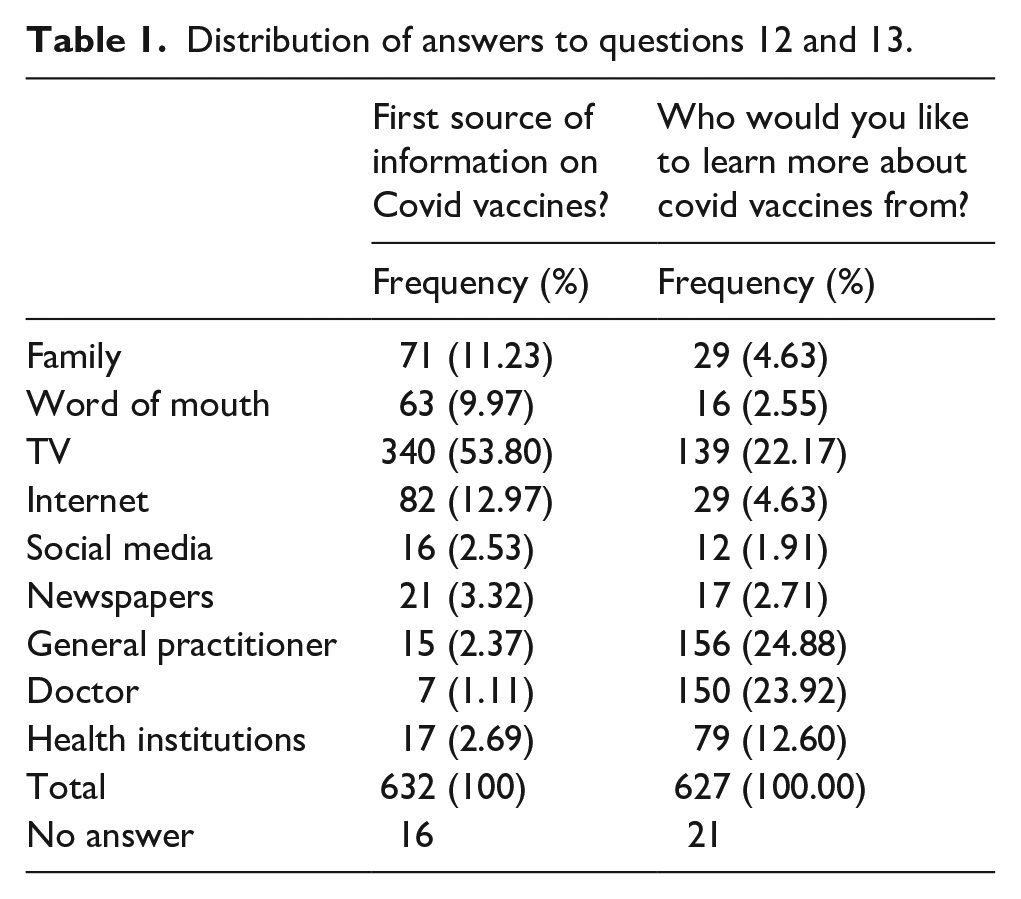
Distribution of answers to questions 12 and 13.
Question 14: what would you like more information on?.

Discussion
Although the importance of vaccinating even the most socially vulnerable people against COVID has been stressed by several official organizations, given that they are more difficult to reach there is no scientific literature regarding the vaccination of DUs directly at their own clinics. To the extent of our knowledge, this is the only work that has evaluated the opinion of these subjects regarding the COVID vaccination.
It is difficult to compare this study with the corresponding national study (AGENAS) for a number of reasons: the first is methodological—the national study was of a sample type and analyzed factors related to age, education and region of origin. It started in December 2020 and ended in January 2021, involving 12,322 people. 23 The second is linked to the fact that, from a social point of view, those who are addicted to substances are much more marginalized than the average citizen. With these precautionary premises, it can be affirmed that our study, while pointing out a slightly greater opposition toward the anti-Covid vaccination, globally, compared to the sample study on the Italian population, underlines a substantial greater propensity to be vaccinated, compared to opposing it, with a wide range of undecided.
Keeping these caveats in mind, we can affirm that our study, while highlighting a slightly greater opposition toward the vaccine in this population compared with the national survey results, within the DU group has found a greater proportion of people willing to be vaccinated compared to those that oppose the vaccine, with a wide range of undecided subjects.
However, some important points should be made. If we match the general population sample to the age and level of education (the lowest) of our sample, the results of the two questionnaires tend to overlap. Indeed, in the national questionnaire, the older population was clearly more favorable to vaccination, probably feeling to be more at risk of serious complications from COVID-19; likewise, the less educated groups of the general population were more opposed to the vaccine. 23
There is also another very important note to make; the AGENAS study ended before concerns broke out regarding some particular vaccines. Indeed, since 2012, while millions of citizens from all over the world were being vaccinated, several cases of thrombocytopenia, following the Moderna, Pfizer, but above all Astra-Zeneca vaccines have been added to the Vaccine Adverse Event Reporting System (VAERS) in the US and in many other countries.
So far, two mRNA and two adenovirus-vectored vaccines have received a conditional marketing authorization in the EU and other countries.
The Astra-Zeneca vaccine, in particular, has attracted media attention. Directly or indirectly, this has led to its suspension in some countries, including Italy, with subsequent restrictions related to its supposed thrombotic risk. Some Northern European countries have even ordered it to be withdrawn from trade.24–27 The great media coverage that has been given to these events has, in all likelihood, influenced the result of our study, which took place during this period of great uncertainty about the safety of some vaccines, not only limited to Astra-Zeneca.
The majority of respondents expressed general confidence in vaccines as pharmaceutical compounds, perhaps because they were reminiscent of previous effective vaccination campaigns targeting drug addiction risk factors, such as hepatitis. It should be noted that the universal vaccination against hepatitis B, which for almost three decades has been compulsorily administered to newborns, has, in fact, led to less attention toward vaccine prophylaxis, 12 while the recent campaigns for the eradication of hepatitis C, which saw the active participation of the SerDs, did not see an equal attention toward vaccination against hepatitis from virus A, however highly recommended in liver disease and DU. 26 The sharp decrease in the circulation of the HIV virus among DUs has also led to a sharp decline in serological surveillance in SerD. 12
Two thirds of DUs have however expressed a clear intention to vaccinate and vaccinate their children, while the vaccination intention regarding their parents rises to three quarters of the sample being in favor, strongly convinced that vaccination is the fastest way to return to normal.
One of the most negative data is the low level of information reported by DUs, especially if we consider the fact that they continuously attend highly medicalized services and that, in SerDs there is an operator/user ratio of 1:20. It seems surprising that the vast majority of the interviewed subjects learned the information about vaccines from television; only a small part has received information from the doctors of the service they attend. On the other hand, the majority of respondents indicated the service doctors as the source from which they would like to be informed. The topics of greatest interest were, in order, the importance of vaccination against COVID, its side effects and, to a much lesser extent, the possibly serious adverse reactions to vaccines.
Despite these aspects, the Italian SerD could represent an excellent vaccination opportunity for a population that would otherwise be difficult to reach outside the usual healthcare context.28,29 The presence of multi-professional teams, the possibility of carrying out and storing blood samples, and the past experience of targeted vaccination campaigns, candidate Italian addiction clinics for a leading role in the containment of the spread of COVID among drug addicts in Italy, as was the case for anti-hepatitis vaccinations.28–30
This opportunity should not be considered exhausted with the attainment, hopefully in the immediate future, of herd immunity. As reported above, the issues with respect to the persistence of valid antibody coverage, with the necessary serological checks and any recalls, in addition to the possible emergence of new variants resistant to common vaccines, see new importance given to the role of SerDs in delivering healthcare in a general sense among this disadvantaged population.
Equity of access to interventions to prevent, diagnose and treat COVID-19 means ensuring that vaccines are accessible and available free of charge to everyone everywhere, especially to those who are under-served and at increased risk of adverse health outcomes. 30 Given strong peer networks, high coverage of treatment and harm reduction interventions, and the availability of other access points which could serve as settings for COVID-19 immunization and/or points of contact for vaccine education and referral, Italy is well positioned to ensure DUs attending SerD are not left behind.
The faster we adapt, the better our long-term prospects will be. We must stop the evolution and spread of more virulent virus strains now, but we must also be prepared for the future. It is therefore critical to support public health policies with strict control measures in order to protect our healthcare systems, our individual wellbeing, and, in other words, our future. Leaving no one behind.
Footnotes
Author contributions
ED, LS, LZ, FL, were responsible for the study concept and design. GICS, SC contributed to the data acquisition. LZ, assisted with the data analysis and interpretation of findings. ED, FL, FF drafted the manuscript. All authors critically reviewed the content and approved the final version of the manuscript for publication.
Declaration of conflicting interests
The author(s) declared no potential conflicts of interest with respect to the research, authorship, and/or publication of this article.
Funding
The author(s) received no financial support for the research, authorship, and/or publication of this article.
Limitations of the study
Given the above, this work presents a few limitations:
– no power analysis to estimate the necessary sample size was carried out;
– no standardized questionnaires were used.
Significance for public health
Addiction is a common health problem. In Italy there are more than 550 SerD (Dependency Services), with 128.000 patients. This number is not unimportant and COVID-19 vaccination could increase the quality of life of these patients.
Compulsory declarations
Verona-Trento-Rovigo ethics committee, approve this study, protocol number 2822CESC.