




Abstract
This article explores adverse and unintended consequences (AUCs) of setting-based public health interventions to prevent illicit drug use, including the mechanisms leading to these AUCs. Additionally, the reporting of AUCs in systematic reviews was assessed. Therefore, we conducted a systematic review of reviews and searched four big databases were searched. We included systematic reviews concerned with setting-based interventions to prevent illicit drug use. We used AMSTAR 2 to rate the overall confidence of the results presented in the reviews. Data on study characteristics, types and mechanisms of AUCs were extracted. An a priori categorisation of consequences drew on the WHO-INTEGRATE framework, and the categorisation of mechanisms on the Behaviour Change Wheel. For reviews reporting AUCs, the same information was also retrieved from relevant primary studies. Findings were synthesised narratively and in tables. Finally, we included 72 reviews, of which 18 reported on AUCs. From these, 11 primary studies were identified. Most of the reviews and primary studies were conducted in educational settings. The most prevalent AUCs reported in systematic reviews and primary studies were paradoxical health effects (i.e. increase of drug use). Potential mechanisms discussed primarily focussed on the change though social norms and practices. Changes of knowledge and perception were also mentioned. Concluding, the identified reviews and primary studies paid insufficient attention to AUCs of public health interventions to prevent illicit drug use. Where reported, it was mostly as an afterthought and narrowly framed as health related. No mentions of potential broader social consequences were found.
Introduction
Illicit drug use represents a major public health challenge. This can lead to substance addiction, a chronic and often relapsing behavioural disorder with medical and social implications for individuals, families and society at large.1–3 Primary prevention tends to focus on reducing or delaying first use or on preventing the transition from experimental use to addiction.4–6 According to the international standards on drug use prevention by the United Nations Office on Drugs and Crime (UNODC) and the World Health Organisation (WHO), setting-based approaches such as those concerned with families, schools, universities, communities and workplaces are of particular importance in making individuals less vulnerable to drug use and associated risky behaviours. 6
Interventions aiming to prevent illicit drug use, as well as public health interventions in general, need to balance intended (or unintended) beneficial effects against any adverse effects. To do so, decision makers need to take into consideration adverse or unintended consequences (AUCs) – where unintended consequences could be beneficial or harmful – resulting from public health interventions, so that harm can be prevented or mitigated. Importantly, they need to take into account that AUCs are not limited to health but might become manifest in multiple other areas or sectors (e.g. social consequences, economic consequences). 7 However, uncertainties remain regarding how to identify AUCs of public health interventions in a comprehensive manner8,9 and how to evaluate them best. 10
The documentation of adverse events is well established in trials of clinical interventions, but even here, studies have shown that these are often insufficiently reported or underreported.11,12 In fact, the ability of short-term clinical trials to detect a broad range of adverse events is limited, and studies are usually powered for efficacy, but do not have sufficient power to detect adverse events.13–15 In contrast, the AUCs of public health interventions are very rarely studied and poorly reported.11,12,16 In recent years, researchers have begun to identify and describe harms and to suggest typologies or classifications of such harms7,17; these imply that the potential impact of harmful effects caused by public health interventions may be considerable.14,18
As the majority of adults with illicit drug use problems start using drugs during their adolescence, most prevention efforts are concerned with settings where young people live, learn or socialise (e.g. schools, family).4,19,20 Multi-component interventions aiming to prevent or stop young people from using illicit drugs tend to be complex and interact with the characteristics of the settings in which they are implemented21,22 representing a range of sources of uncertainty.22,23 It is important to take these complexities and sources of uncertainty into account and to acknowledge the multitude of intended and unintended consequences when planning or evaluating setting-based interventions to prevent illicit drug use. 24
Therefore, this systematic review of reviews has the primary objective to assess and categorise the AUCs of setting-based interventions to prevent illicit drug use, and to describe the mechanisms examined or hypothesised to lead to them. As a secondary objective, this study seeks to assess the reporting of AUCs in systematic reviews and to describe differences in the reporting of AUCs.
Methods
We conducted a systematic review of reviews of setting-based interventions to prevent illicit drug use and additionally retrieved relevant primary studies reported in the identified reviews. We used an unregistered predefined protocol.
Definitions and terminology
We use the term ‘adverse or unintended consequences’ or AUCs to describe events that were noticeable or observable and are assumed to be related to the intervention of interest. These AUCs are not necessarily health-related but may extend beyond health (e.g. economic, social, environmental). The judgement of whether an AUC is beneficial or adverse, will be made by taking the perspective of the affected individuals and/or the researchers reporting on the consequence into account. It is often not possible to establish or rule out a causal relationship between an AUC and the intervention of interest (e.g. when a suicide occurs in the intervention arm of a school-based drug education intervention), so we consider every observed AUC as potentially caused by the intervention.
For the purposes of this review, the term ‘illicit drug use’ refers to the use of psychoactive substances outside of their legitimate use for medical or scientific purposes. 6 We will focus on psychoactive substances such as cannabis, inhalants (e.g. nitrous oxide often called ‘laughing gas’, nitrides often called ‘poppers’), and new psychoactive substances (so-called ‘legal highs’ or ‘smart drugs’). Although considered illegal in some jurisdictions, this review will not address drugs such as coffee/caffeine, tobacco/nicotine or alcohol.
Search methods for identification of studies
Searches of articles published up to 14 June 2020 in MEDLINE, EMBASE, the Cochrane Library and Epistemonikos were performed, using two linked blocks of key terms associated with (1) illicit drug use and (2) setting-based prevention. Results were limited to systematic reviews and meta-analysis. The search strategy was adapted for each database (see Supplemental Appendix Tables 1 and 2). The language was restricted to English and German. Citations of included systematic reviews were subsequently hand-searched for additional relevant studies.
Identification of eligible systematic reviews
Screening of titles and abstracts and screening of full texts was initially performed according to predefined inclusion and exclusion criteria regarding Population, Intervention, Comparison and Study design (Table 1). All eligible systematic reviews were subsequently screened for reporting on AUCs, that is, outcomes. The corresponding full-texts of all primary studies reporting on AUCs were retrieved and assessed for eligibility (Table 1). Screening was performed independently by two researchers (JS, RB) using the software Rayyan.25 Any discrepancies were discussed and resolved by consensus.
Eligibility criteria for reviews.

Data extraction and management
Data extraction was performed by one author (RB) using a pre-defined form and checked by a second author (JMS) for accuracy and comprehensiveness. The following information was extracted for systematic reviews and primary studies: (1) general information about the study (i.e. title, reference, publication year), (2) objective of the study and study characteristics, (3) approach to assessing the quality of included studies, (4) whether or not the study reports on AUCs, (5) the type, scope and scale of the AUCs (6) the reported mechanism leading to the observed effects, (7) conflicts of interest statements and funding sources. We extracted the following additional information for included primary studies: (1) characteristics of the intervention under investigation, (2) characteristics of the population and context.
Authors of included studies were contacted and requested to provide any missing data. Where the data available or provided was insufficient to decide on eligibility, the study was excluded.
Quality assessment
The confidence in the results of eligible systematic reviews was assessed using the AMSTAR 2 checklist and rating scheme. 26 We did not conduct a risk of bias or quality assessment of primary studies.
Data analysis
The assessment and analysis of the type, scope, scale and potential mechanisms leading to the AUCs from systematic reviews and primary studies was done independently by two authors (JMS, RB); conflicts were resolved through discussion. Findings are presented narratively and through tables.
Classification of AUCs
We classified AUCs according to their type and scope (e.g. adverse health-related effects such as injuries; or beneficial social outcomes such as reduced unemployment rates). We used the WHO-INTEGRATE framework, an evidence-to-decision framework,27–29 as it explores public health interventions from a complexity perspective going beyond health effects and explicitly considering societal consequences. We directly applied the six criteria of the framework as first-order domains but adapted the so-called sub-criteria of the framework as second-order domains (Table 2). Whenever the classification of a given AUC was unclear or if it fitted into more than one domain of the adapted WHO-INTEGRATE framework, this conflict was resolved through discussion within the research group.
Framework used to categorise consequences.

Classification of mechanisms leading to AUCs
Where potential mechanisms of AUCs were reported or discussed, these were categorised using a framework based on the Behaviour Change Wheel (BCW). 30 The BCW was chosen as it is the most widely used approach for examining behaviour change and its influences at individual as well as societal levels. For the purposes of classifying mechanisms, we focussed on the nine intervention functions of the BCW and derived potential mechanisms leading to AUCs (e.g. through restrictions, through improving skills and abilities, through changing perceptions and attitudes) (Table 3). In Table 3 we present an adapted version of the proposed framework.
Framework used to categorise mechanisms.

Assessment of the reporting of AUCs in systematic reviews
We used data on the year of publication (before/after the year 2010) as well AMSTAR 2 rating of the systematic reviews to identify differences in the reporting of AUCs over time and according to systematic review quality. The year 2010 as chosen as the first PRISMA statement was published 2009 and the authors encourage to also consider adverse effects in systematic reviews. 31 We assumed that that this publication has changed the reporting within systematic reviews and that the implementation might have taken some time. Additionally, we investigated whether the reviews specified AUCs as an outcome of interest (in the Methods section) and whether they reported AUCs in the Results or Discussion section.
Results
Characteristics of included reviews and studies
After the removal of duplicates, the literature searches identified 2422 records. The full texts of 162 records were reviewed in more detail and 72 reviews met the criteria for inclusion (see Supplemental Appendix Table 3 for a list of excluded references). A total of 18 systematic reviews reported on AUCs of setting-based interventions to prevent illicit drug use (see Table 4)4,32–48; from these 11 eligible primary studies were retrieved (see Table 5).49–59 The PRISMA flow-chart 31 visualising this process is presented in Figure 1.
Characteristics of review reporting on AUCs.

AUCs: adverse and other unintended consequences; n.s.: not specified.
Review reported AUCs in the Results section.
Review discussed the presence or absence of AUCs.
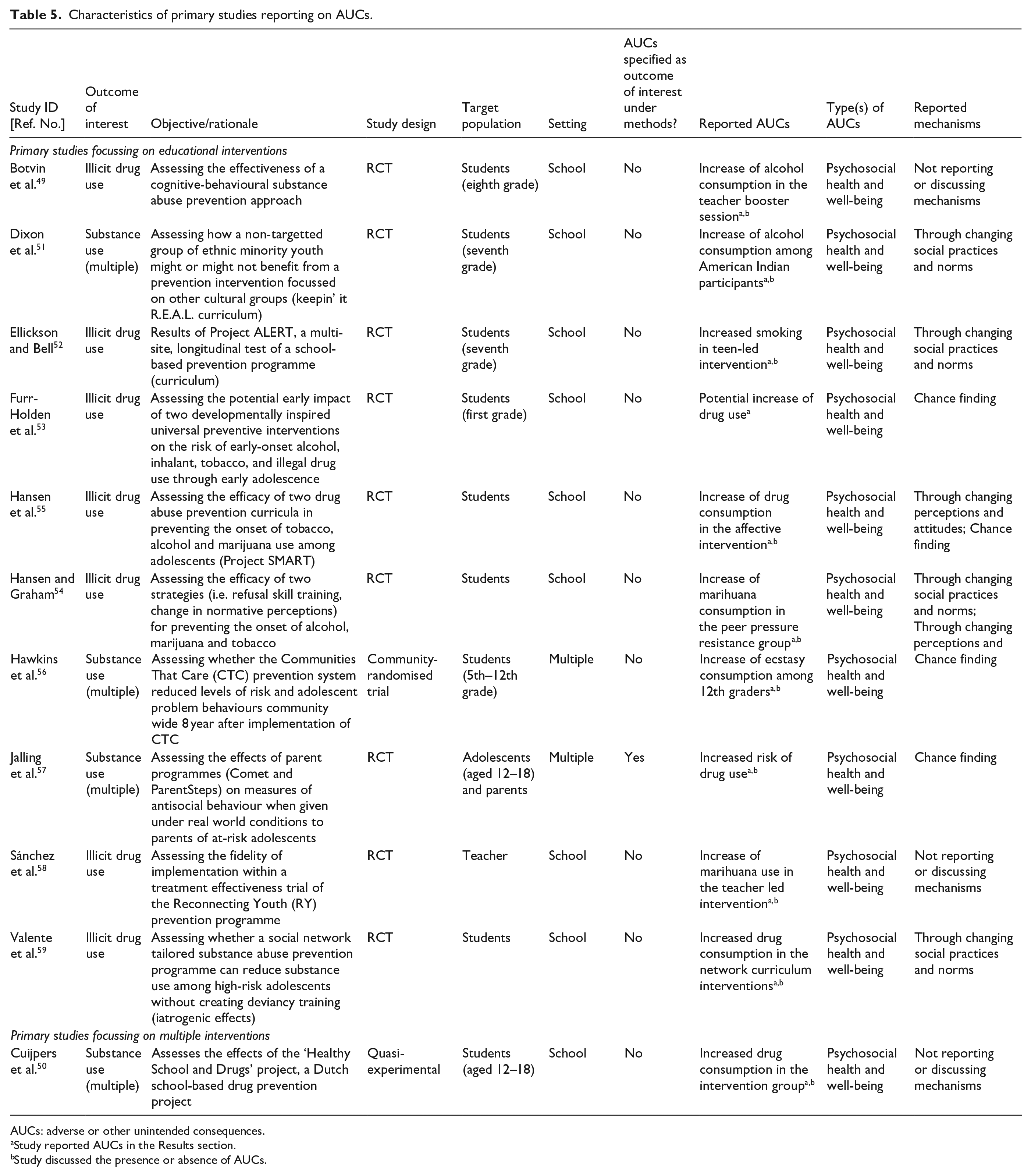
Characteristics of primary studies reporting on AUCs.
AUCs: adverse or other unintended consequences.
Study reported AUCs in the Results section.
Study discussed the presence or absence of AUCs.

PRISMA flow-chart. 31
Reviews
Seventy two reviews were included. Of these 34 investigated interventions based in an educational setting (pre-school, school and higher education),4,34,35,39–41,44,46,48,60–84 three in a family setting,85–87 three in a community setting,37,88,89 one in a church 90 and 31 in multiple settings.32,33,36,38,42,43,45,47,91–113 Most reviews used the age of participants as an inclusion criterion, resulting in 62 studies focussed on children and adolescents.4,32–41,43–48,60–70,72–85,87,89,92–95,97–107,110,113 The types of interventions varied between the reviews but mostly focussed on educational interventions (n = 16)32,34,40,47,61,62,64,66,67,70,72,75,77,81,83,110 or included multiple interventions (n = 42).4,33,36–39,41–44,46,48,60,65,68,69,71,73,74,76,78–80,82,84,85,87,88,90,95–100,103–105,107,108,111,113 Some interventions employed computer-based approaches to prevent substance abuse (n = 4).47,94,109,112 Some of the included reviews focussed on interventions in certain countries, especially the United States (n = 18).46,61,62,66,67,70,72–74,77,83,88,90,95,96,101,106,111 Detailed characteristics of all included reviews are presented in Supplemental Appendix Table 4. The subset of 18 reviews reporting on AUCs is presented in Table 4.
The overall confidence in the results of 56 out of 72 reviews was rated ‘critically low’,32–34,37,40–48,61–73,77–81,83–91,94–96,99–101,103–113 10 reviews were rated ‘low’,60,74–76,82,92,93,98,102 one was rated ‘moderate’, 39 while six reviews were rated ‘high’4,35,36,38,45,97 (see detailed assessment in Supplemental Appendix Table 5). The five reviews rated ‘high’ were mostly Cochrane reviews,36,38,45,97 with one being a regular peer-reviewed publication. 35 Reviews performed most poorly concerning the following AMSTAR 2 items:
- Reporting sources of funding for included studies (36 out of 72)
- Use of satisfactory risk of bias assessment (42 out of 72)
- Establishing review methods prior to review conduct (54 out of 72)
- Justification for excluding individual studies (65 out of 72)
Primary studies
In total 11 primary studies49–59 reported AUCs of interventions aiming to prevent drug abuse. Nine primary studies were concerned with multi-component interventions.49–55,57,58 These interventions sought to prevent and reduce the consumption of multiple drugs (illicit drugs, tobacco, alcohol). All interventions, apart from two implemented in multiple settings,56,57 were based in schools (n = 9/11).49–55,58,59 Ten out of 11 studies assessed educational interventions (n = 10/11)49,51–59, one study investigated multiple interventions (e.g. education, school regulation). 50 Characteristics of included primary studies are presented in Table 5.
Adverse and unintended consequences
All included reviews and primary studies were analysed using the a priori frameworks described in the method section. The results of the categorisation are presented verbally in the following text and tables. The text passages which were used to assign a category of the framework are presented in the Supplemental Appendix.
Among 18 reviews reporting on AUCs, an increase in substance use (no differentiation between illicit drugs, alcohol, or tobacco) was the most prevalent AUC (n = 8/18).4,34,39–41,46–48 Similarly, an increase of illicit drug consumption was frequently reported (n = 4/18).37,38,43,44 Both AUCs were assessed as an effect on the outcome of interest with an unexpected negative or paradoxical direction. Even though the AUCs described above do not imply an established disorder, we categorised these under ‘Psychosocial health and well-being’.
Only one review reported on a different AUC, describing a change in expectations regarding drug consumption among some of the participants (i.e. positive drug and alcohol expectations) through identifying with ex-addicts and was therefore categorised under ‘Social norms and values’. 32
Five reviews did not observe any AUCs related to illicit drug prevention in the school setting, but did report AUCs in other settings or in other substance prevention interventions.33,35,36,42,45
Among 11 primary studies retrieved from the included reviews and reporting AUCs, an increase in substance consumption (drug use included) was most prevalent (n = 8/11).50,53–59 Other AUCs were an increase in alcohol consumption (n = 2/11)49,51 and smoking (n = 1/11). 52 Therefore, all AUCs reported in primary studies were categorised under ‘Psychosocial health and well-being’.
Mechanisms leading to AUCs
Mechanisms were only reported in a minority of the identified reviews (n = 7/18) The mechanisms described were most often categorised as ‘Through changing social practices and norms’ (n = 6/18).32,34,36,39–41 Authors discussed the interaction of social norms, peer pressure, deviance training, ethno-cultural backgrounds and personal beliefs. AUCs were then described as a potential consequence of supposedly unfavourable interactions. Some reviews considered the observed AUCs a ‘Chance finding/bias’ (n = 3/18)4,38,46 as a result of statistical effects or design issues. One review discussed the potential effects of the delivered information/content as well as the didactic methods used 34 was therefore coded as the mechanism ‘Through increasing knowledge or understanding’.
A majority of the primary studies discussed mechanisms of AUCs (n = 8/11). In 4 out of 11 primary studies the observed AUCs were described as a ‘Chance finding’,45,53,55–57 referring to the small number of participants and potential measurement error. Other mechanisms discussed were categorised as ‘Through changing social practices and norms’ (n = 4/11)45,51,52,54,59 based on discussions of group differences, social influence of teachers, ethno-cultural differences, peer influence and social acceptability in the primary studies. Two primary studies discussed the mechanism ‘Through changing perceptions and attitudes’,54,55 suggesting that misinformation and a change in perception might have led to AUCs.
Reporting of AUCs
Reporting and discussion of AUCs differed substantially in the identified reviews and primary studies. Most of the reviews (n = 64) did not report or discuss any AUCs. Many of the 18 reviews and 11 primary studies reporting AUCs did not assess these as an outcome of interest, nor did they report them in the Results section.
We observed among the seven reviews with an AMSTAR 2 rating of ‘High’ or ‘Moderate’4,35,36,38,39,45,97 all but one 97 reported on AUCs but only three reviews referred to these AUCs in the discussion.4,36,39 The 65 reviews with a ‘Low’ or ‘Critically Low’ AMSTAR 2 rating varied in their reporting and discussion of AUCs. Only 11 reviews33,34,37,40–44,46–48 with such rating reported AUCs and six discussed these findings33,34,40,41,46,48 (see Table 6). Therefore, studies with a higher AMSTAR 2 rating were found to be more likely to report on AUCs. We also observed a higher rate of AUCs reported in reviews published before 2010 compared to reviews published after or in the same year (see Table 6). The complexity and scope of the discussion differed between the studies. Some reviews (n = 7/18)4,34,39–41,46,48 and primary studies (n = 7/11)45,51,54–59 reported AUCs in the results section and briefly discussed these finding but only a fraction considered AUCs as an outcome of interest (i.e. five reviews,4,33,35,36,38 one primary study45,57). Several studies specifically referred to the occurrence of AUCs as a chance finding and did not expand on the possibility that the AUC might be causally related to the intervention under investigation.
Comparison of selected review characteristics.

AUCs: adverse or other unintended consequences.
Discussion
This systematic review of reviews assessed AUCs of setting-based interventions to prevent illicit drug use and explored the mechanisms leading to these AUCs, as reported or assumed in the included studies. We found that the majority of the reported AUCs were paradoxical health consequences and a few broader societal consequences, that is, the intervention led to an unintended increase rather than the intended decrease in drug use, and identification with ex-addicts. Potential mechanisms discussed primarily focussed on the change though social norms and practices, but knowledge as well as understanding and the change of perception were also mentioned.
The social mechanisms leading to unintended deviant behaviour caused by prevention or treatment interventions are often referred to as ‘deviancy training’.16,93,114,115 This phenomenon describes that group interventions may lead to AUCs or generate harms by promoting interaction between people who are in higher behavioural risk groups and change the perception of social norms.115,116 As discussed by Lorenc and Oliver, 7 social norms and contexts play a role with regards to AUCs but are often neglected in the evaluation of health interventions.
Additionally, this systematic review of reviews described differences in the reporting of these AUCs across included reviews. Reviews with a higher AMSTAR 2 rating, especially Cochrane reviews, reported AUCs more often than reviews with a lower AMSTAR 2 rating; similarly, more recent reviews (i.e. those published after 2010) were more likely to examine AUCs.
The majority of reviews or studies did not anticipate the occurrence of AUCs (e.g. AUCs specified as an outcome of interest under Methods section) or discussed these findings extensively. Most of these AUCs could, however, have been anticipated. Different strategies to do so or at least acknowledge the possibility of AUCs in public health interventions (e.g. dark logic models) have been discussed by multiple authors.93,117,118 Acknowledging the broader social and environmental context as the complex system in which individuals and interventions interact plays a key role in trying to understand the potential mechanisms leading to AUCs.21,22,24 As discussed by Morell 117 and Oliver et al.,9,10 stakeholders initiating evaluations tend to prefer a ‘narrative of success’ 9 which might lead to a publication bias, explaining the low reporting of AUCs across studies. The lack of reported harms requires careful interpretation as reasons may be diverse. AUCs might not have occurred (actual null event), not have been investigated or might have been observed but not reported (reporting bias). 14 Additionally, the reporting of AUCs in systematic reviews depends on the reporting of AUCs in primary studies. Even in clinical research reporting of AUCs is an important issue as reporting guidelines exist but AUCs are nevertheless not reported in all cases.14,24,119
Strengths and limitations
To the knowledge of the authors, this review made use of the best available a priori frameworks to categorise AUCs and potential mechanisms. This allowed us to systematically investigate AUCs and identify potential gaps in the available data. Both consequences and mechanisms were examined not only from an individual and biomedical but also from a societal perspective. We used a predefined protocol to conduct this review and used a standardised review approach.
Despite these efforts, this review and its findings can only be as good as the underlying evidence base. The reporting and exploration of AUCs was scarce and in most cases focussed on individual health rather than society at large. It is likely, that further AUCs or mechanisms leading to them were not identified and/or not reported in the primary studies. This is not doing justice to the scope of AUCs and the likely mechanisms leading to AUCs.
Conclusion
All health interventions potentially lead to AUCs. However, while it is widely accepted that clinical interventions lead to AUCs or complications, this is not always the case for public health interventions.7,24 Safety studies or harm reviews are often conducted in clinical research (i.e. health technology assessments, safety trials, real-world trials) but have not yet been established to the same degree in the broader health sciences.7,18,24 When primary studies fail to assess AUCs, these cannot be documented in subsequent reviews. Existing tools like the Cochrane Handbook for Systematic Reviews of Interventions 120 or the PRISMA Harms Checklist 121 as well as dark logic models 93 informed by existing frameworks (e.g. WHO-INTEGRATE 27 ) can be useful tools in the planning and evaluation of public health interventions as these to highlight the complexity if public health interventions and can help to acknowledge the occurrence of AUCs. Systematic reviews and primary studies evaluating certain interventions (especially such in complex systems) should be aware of different types of AUCs, the scope of the AUCs and potential mechanisms so that these can be assessed systematically.7,24 These frameworks could also be used to develop study protocols so that AUCs can be assessed systematically taking multiple domains/categories into account, which is particularly important in public health interventions, as these tend to be complex and integrate multiple factors consequently aggravating the anticipation of potential AUCs. This is important as AUCs will most probably not be identified if one is not searching for it or at least considering the existence of such consequences.
Supplemental Material
sj-docx-1-phj-10.1177_22799036221103362 – Supplemental material for Adverse and other unintended consequences of setting-based interventions to prevent illicit drug use: A systematic review of reviews
Supplemental material, sj-docx-1-phj-10.1177_22799036221103362 for Adverse and other unintended consequences of setting-based interventions to prevent illicit drug use: A systematic review of reviews by Renke L Biallas, Eva Rehfuess and Jan M Stratil in Palliative Medicine
Footnotes
Declaration of conflicting interests
The author(s) declared no potential conflicts of interest with respect to the research, authorship and/or publication of this article.
Funding
The author(s) disclosed receipt of the following financial support for the research, authorship and/or publication of this article: This work was partially supported by a grant to develop an integrated framework of unintended consequences of public health interventions by the German Ministry of Education and Research (BMBF).
Significance for public health
This review is one of the very few that presents adverse and unintended consequences (AUCs) of setting-based interventions to prevent illicit drug use and uses a priori frameworks to categorise them and explore possible mechanisms. This allowed us to systematically examine AUCs and identify potential gaps in the available data. Both consequences and mechanisms were examined not only from an individual and biomedical perspective but also from a societal perspective. This review promotes the importance of recognising AUCs in the design, implementation and evaluation of public health interventions.
Supplemental material
Supplemental material for this article is available online.
References
Supplementary Material
Please find the following supplemental material available below.
For Open Access articles published under a Creative Commons License, all supplemental material carries the same license as the article it is associated with.
For non-Open Access articles published, all supplemental material carries a non-exclusive license, and permission requests for re-use of supplemental material or any part of supplemental material shall be sent directly to the copyright owner as specified in the copyright notice associated with the article.
