



Abstract
The COVID-19 pandemic has hastened the progress of digitalization where the public is forced to embrace paradigm shifts on how we function in a digital society. The way we work, learn, live, and play daily has drastically changed with the revolution of digital systems from their analog predecessor. This transformation warrants the digital environment as a social determinant of health. It comprises the whole continuum from the tangible aspects of the computing devices, their programing and information system, the network technologies connecting them, and the product of interactivity between people to people and people to the digital interface. Despite permeating the everyday life of each level of society, the digital environment has yet to be scrutinized comprehensively in terms of health. A review of the literature produces fragmented results where different specialties within and beyond the medical field lay claim to the various aspects of digitalization. We proposed five domains within the digital environment namely digital transformation, digital health, digital technology, digital identity, and digital media that exerts diversified pressure on the digital environment through human activities. Their subjacent linkage to human health and environmental impact is further discussed by using the DPSEEA framework. Challenges that crossed all domains were discussed including the widening gap of inequalities secondary to the limited availability of, and accessibility to digitalization. Considering the rapid speed at which we propel to a fully immersive virtual world, a timely transformation of environmental health to include the digital environment as part of its main components is inevitable.
Introduction
The world entered its digital age in the mid of the 20th century. Starting from the crude binary computing system to circuit chips, home computers, the Internet, the World Wide Web, social media platforms, and most recently smartphones, digital technology has revolutionized how we work, learn, play, and socialize daily. As the initial phase of the digital revolution emphasizes the digital advancements in administrative and economic sectors, the international, regional, and national governments are among the first to develop plans to employ digital technology and digital information. Examples include the Digital Development Global Practice by the World Bank, The Digital Transformation Strategy for Africa by the African Union, and the Public Sector Digitalization Strategic Plan 2021–2025 by the Malaysian government.
The COVID-19 pandemic declared by the World Health Organization in 2020 has hastened the progress in digitalization where the general population is forced to embrace paradigm shifts on how we function in a digital society. Propagated by the phases in movement restriction orders by nations across the world, working from home, online learning, and electronic shopping have become the new normal. Virtual conferences have replaced physical meetings and electronic wallets have replaced cash. As transformation from analog to digital systems becomes more compact, affordable, and diverse, their utilization has also changed from a luxury to a necessity. Now, accessibility to digital technology is considered a social determinant of health and thus should be scrutinized through the piercing perspective of human health.
The digital environment
Computer engineer Yannis defined the digital environment as “a context or a ‘place’, that is enabled by technology and digital devices, often transmitted over the Internet, or other digital means.” 1 Conversely, Dresang’s approach to the digital environment as being ubiquitous and permeating everyday life goes beyond the digital material, arguing that even nondigitized media are being impacted and taking on digital characteristics. 2 Building on this concept, the digital environment comprises the whole continuum from tangible aspects of the computing devices, their programing and information system, the network technologies connecting them, and the product of interactivity between people to people and people to the digital interface.
Digital environment and environmental health
Approximately 23% of the global deaths are linked to the environment with 8.2 million deaths being due to non-communicable diseases. 3 Environmental health is the branch of public health that studies the interrelationship between people and their external environment. Traditionally, the external environment includes but is not limited to the natural environment covering the air, climate, water, chemicals, and radiation, the working environment resulting in occupational risks, and the built environment including the provision of sanitation and hygiene. Preservation of the balance within these environments is a prerequisite for good health that promotes human health and well-being and fosters healthy, sustainable, and safe communities.
In recent years, concern regarding the impacts of digitalization on health has sparked global interest leading to various research in the field of medicine. However, these studies are disjointed with fragmented specialties taking claim over the subject. The use of digital systems for health is evaluated under the branch of the health system and management whilst the effectiveness of digital tools is studied under epidemiology or the respective medical specialty. Psychology has led the studies on the impact of usage and exposure to digital devices on mental health and children’s development. Broader impacts of digitalization either by its availability or accessibility are further studied in various fields beyond the medical fraternity such as economics, businesses, political governance, and social sciences. With how digitalization is shaping the global landscape as a driving force of health determinants, it is high time for environmental health to delve into the health impacts brought forth by the digital environment.
Five domains are proposed in this article that exerts diversified pressure on the digital environment through human activities. The domains are composed of (1) digital transformation, (2) digital health, (3) digital technology, (4) digital media, and (5) digital identity. Linkages of these domains to their subjacent environmental state, exposure, and health effects are demonstrated by the DPSEEA framework (Figure 1).
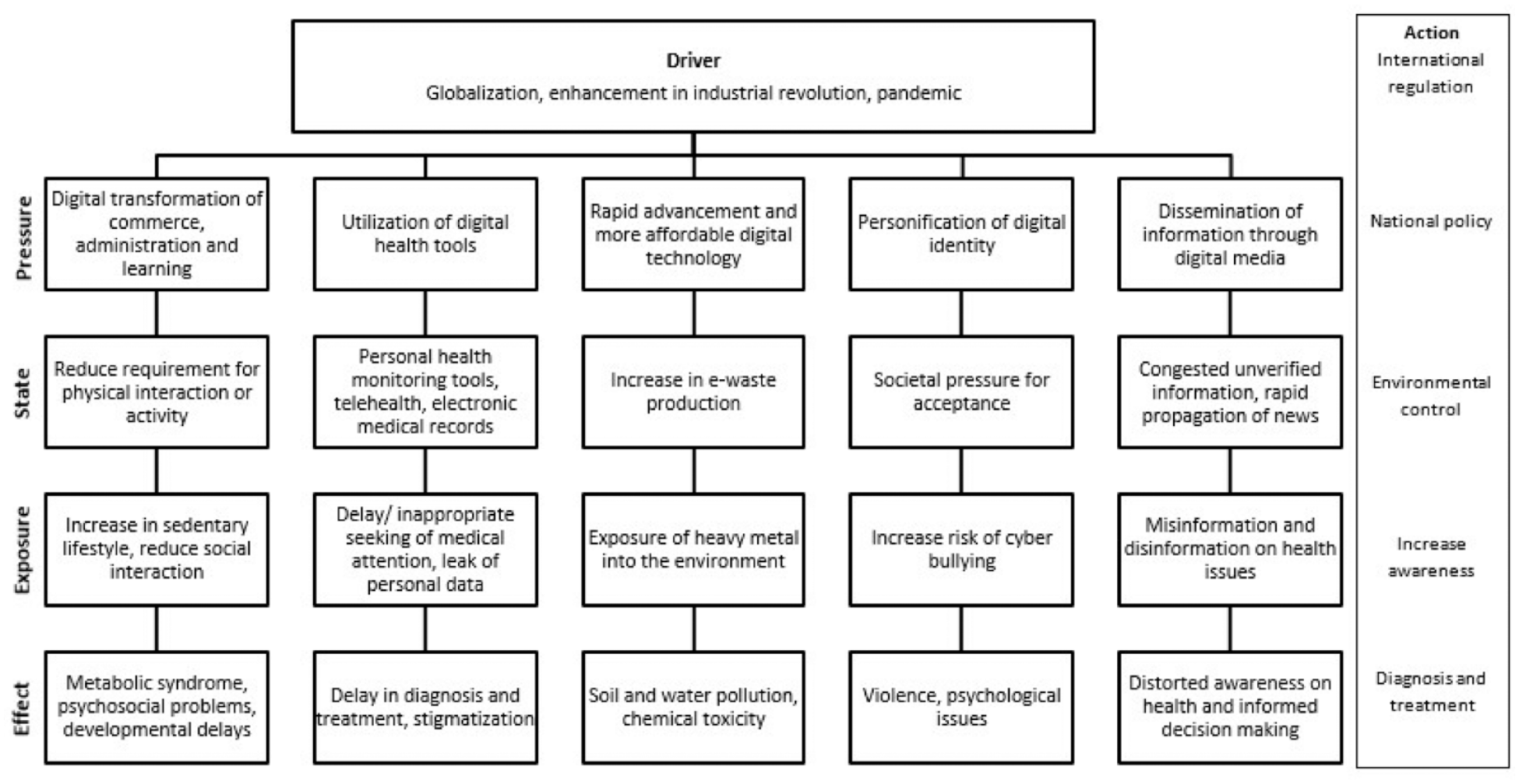
DPSEEA framework on the digital environment.
Digital transformation
Digital transformation was initially proposed in the business world that describes the foundational change of an organization enabled by applications and services (Figure 2) that involves the use of automation to improve productivity by reducing cost, time, and error, collection, and analysis of digital data to generate information and knowledge, subsequent dissemination of information through networking to facilitate decision making, and the transparent access to digital customers. 4 The concept of dynamic rethinking in utilizing resources that are driven by changes in client demand and expectations is the cornerstone of digital transformation that has not only spurred the boom in electronic commerce but also digitized governments, virtual learning platforms, distance learning, and social networking. As practicality is won over by convenience, the need for physical interaction diminishes. Traveling for work, trips to the store, going to school, or even visiting family and friends are being replaced by clicks to websites, scavenging digital databases, and swipes on mobile applications.

The digital radar with its enablers and corresponding applications and performances. 4
Emerging hazards such as increased sedentary lifestyle and social isolation have led to an increase in non-communicable diseases namely metabolic syndrome, 5 and depression. 6 A study in Korea among adolescents has shown that the daily use of smartphones and social networking services are significant predictors (p-value < 0.01) for smartphone addiction. 7 Prolonged awkward postures from frequent computer use are significantly (p-value < 0.05) associated with increased musculoskeletal disorders. 8 Inappropriate anatomical placement of laptops has been observed to increase the exposure to the low-level electronic magnetic field that was previously associated with possible adverse pregnancy outcomes and sleep disturbances. 9
Digital health
Digital health is a methodology that uses information and communication technology to personalize more efficiently and address precisely, the various health problems faced by the public. 10 Provision of digital health services generally facilitates the collection of individual data on their health condition, analyzes these data for pre-clinical or clinical evaluation, and provides the personalized intervention or monitoring for an area of interest of the individual or a community. 10 Various tools have been developed for this purpose including smartphones, mobile applications, wearable gadgets, personal health records, electronic medical records, and telemedicine.
Advancements in digital health have purportedly improved access to healthcare services, empower patients for informed decision making, improve patient education, and increase compliance to medication.10,11 However, the influx of data gained from digital health tools can also negatively affect individuals either by inappropriate timing in seeking medical attention driven early by anxiety or later by desensitization of faulty readings, or delay in treatment due to complexity in information retrieval from the electronic medical records. 12 Another issue arising from digital health includes the collection of personal data that may infringe on an individual’s rights. For example, unauthorized access to or manipulation of these health data can lead to the publication of an individual’s stigmatizing diagnosis which in the future may detrimentally deplete the public’s trust in the health system. 13
Digital technology
Any technological device that relies on the use of micro-processes functioning through a binary computational code such as mobile phones, tablets, laptops, and computers is collectively termed digital technology. 14 The innovation in digital technologies has reached 50% of the global population within the past two decades and has positively negated social equality by enhancing connectivity, financial inclusion, and access to trade and public services. 15 However, those who are yet to be connected face systematic exclusion from the benefits which will later be discussed under the subheading of inequalities in technological advancements.
From an environmentalist perspective, increasing affordability with rapid innovations of portable digital technology has induced demand for tech-savvy life leading to the rising consumption of electronics. Major adverse ecological effects were observed secondary to the crude processing methods for the extraction of precious metals needed for gadget production and improper disposal of electronic waste generated in large quantities following discarded devices.16,17 Leaching of hazardous substances released from e-waste such as acids and heavy metals has continuously contaminated the air, water, and soil. Not only the direct vicinity of the landfill be affected, but bioaccumulation and biomagnification of these hazardous substances may occur as they enter the food chain leading to acute and chronic health effects that can transcend generations.18,19
Digital identity
Identity is a complex concept that begs the understanding of what it means to be who one is, grounded by attributes, motives, experiences, and beliefs, that distinguish them as a person or a group from others. 20 Digital identity is thus the digital representation of an individual, a community, or an organization encompassing all the online footprint of the given entity. 21 Previously seen as an extension of an identity card, the link between real-world identity and digital identity has since then become increasingly blurred. 22 A growing number of people form multiple digital identities to accommodate their personal and professional networking requirements. Having a personal and work-related email account or registering accounts in different social networking services such as LinkedIn, Facebook, and Twitter are various ways that individuals manage their digital identities. Although some may find the interchange between the different identities effortless, others may find it challenging to disentangle between the identities leading to their inevitable convergence. 23
Contrarily, recent studies have shown that the online environment of today not only reflects and complements, but also reinforces an entity’s offline relationships, practices, and processes. 24 Adolescence and young adults were shown to have increased self-esteem and social capital when identity exploration was conducted safely digitally or in the real world. 24 Despite the positivity of engaging in digital networking, negative associations have been documented such as cyberbullying and exposure to developmentally inappropriate content that can contribute to the development of depression and social anxiety.25,26 Other rising concerns over digital identities include cybercrime which shows an appalling 4.8 million identity theft and fraud cases reported to the Federal Trade Commission resulting in a loss of $3.3 billion whereas leakage of personal information in the digital environment may place individuals vulnerable to physical harm in the real world.
Digital media
Digital media are media encoded in a digital, machine-readable format. 27 It can typically be created, viewed, stored, listened to, and broadcasted via electronic devices. Studies reveal that the current generation is constantly consuming information in a steady stream throughout the day as compared to setting aside time to update on news read in printed materials. 28 They are as likely to receive information about a major event from an acquaintance’s text as from the television screening of the news. Being constantly connected to each other and multiple digital media sources, the lines between news, scientific update, entertainment, and gossip are precariously eroded.
The field of cyberpsychology has recently emerged examining the psychology of digital media, particularly on individual’s virtual activities. Acerbi proposed in his review on the cultural transformation that information in the digital age faces transmission biases that are prestigious and popular. 27 Prestige-biased social learning institutes a risk when there is no correlation between the prestige of an individual or organization and their skills. A phenomenon frequently observed with the rise of social media influencers. Popularity-biased, on the other hand, explains how the perception of something popular makes it preferable to others in their attempt to conform to the society by following the majority such as the norm of viral posts. Both these biases have shaped our digital information landscape. The abundance of unverified information, misinformation, and disinformation has given rise to an infodemic, where too much information including false or misleading information has flooded the digital and physical environments during a disease outbreak as seen in the current COVID-19 pandemic. 29 Public health responses are jeopardized as confusion occurs due to harmful and contradictory messages that are amplified through rapid dissemination in the form of digital media. Risk-taking behaviors are subsequently engaged and mistrust of the health authorities continue to grow.
Challenges of the digital environment
Despite the meaningful advancements in the digital environment, the push into a fully synchronized digitalized world also brings with it a host of new challenges. The known and unknown variables are constantly changing as the population transforms synchronously with the expansion of the digital environment. Here are some of the key challenges highlighted in the literature:
Inequalities in digital advancement
The benefits of the digital environment are just as good as the accessibility and availability of these technologies for the general population. Those who are yet to engage in the digital environment remain stunted in their developmental process. Women, the elderly, persons with disabilities or from ethnic or linguistic minorities, indigenous groups, and residents of poor or remote areas are considered high-risk groups of being left behind. 15 For example, differential exposure to the home digital learning environment produces differential outcomes in child development. Further limited by political instability and budget constraints, the race to reduce the inequality gap has spurred the inclusion of digital advancements in its various domains in international and national policies.
Inadequate opportunities for acquiring adaptive skills tailored to the digital age
The learning and working environments require drastic adaptations to the digital age. Higher education attainment and computing skills may be required for future generations to remain relevant in the workforce, especially with the diminishing need for service workers who are being replaced by automation. 30 Information-seeking skills need to be cultivated among youth who collectively have a higher tendency of choosing to browse over planned or systematically guided search which is essential for academic success. Acquisition of these skills, however, is opportunity dependent and may not reach the most vulnerable populations.
Limitation in interdisciplinary and prospective research
The interplay between humans and the digital environment is in dire need of research. Studies on how the digital environment impacts human health, dose-response of emerging digital hazards, health impact assessments, the adaptation of the society toward digital transformation, and the environmental impacts of human digital activities require interdisciplinary involvement. Cohort studies of the millennial generation who were born and raised in the digital age should highlight not only their usage of digital materials, but also their roles as a tester, informant, and designer of digital material that suits their needs. 2
Conclusion
The digital environment is a complex field that enables the encroachment of real-world issues onto the virtual platform and vice versa. It is fast changing the health landscape by anchoring itself as a determinant of health and how we perceive our daily activities. It is high time for us to engage in the prospective possibilities and negative implications of a fully immersive virtual world expedited by evolution in the digital environment. This article serves not as a conclusive evaluation, but rather, as an exploratory foundation on how the digital environment should be part of environmental health and its cascading effects on healthcare services, societal livelihood, symbiotic environment, and individual health. As with other advancements, the key to sustainable development lies in the delicate balance between the benefits and the detriments of over-exploitation of a necessary tool in population transformation.
Footnotes
Contribution
Both authors came up with the conceptual idea of the article. ASM conducted the literature review and drafted the manuscript. NRNH revised the manuscript and provided important intellectual content. Both authors approved the final manuscript for publication and agreed to be accountable for all aspects of the manuscript.
Declaration of conflicting interests
The author(s) declared no potential conflicts of interest with respect to the research, authorship, and/or publication of this article.
Funding
The author(s) received no financial support for the research, authorship, and/or publication of this article.
Significance for public health
Since the mid-20th century, digitalization has rapidly become a social determinant of health with increasing importance being placed on its equitable accessibility and availability worldwide. However, the vast majority of the public is unaware of the comprehensive impact of the digital environment on human health and environmental health leading to pockets of the vulnerable population even within urban or developed areas. Conceptualizing the framework for the digital environment allows systematic exploration of the topic through the lens of public health thus assisting current and future healthcare professionals in mapping and addressing the environmental health risk of a fully digitalized world for the next generation.