




Abstract
This case study examines how stakeholder engagement supports the process of generating urban ecosystem services. As our empirical case, we study the Vuores stormwater system in a new urban residential district in Finland. The Vuores site is interesting and valuable for a case study, as it is one of the most comprehensive urban stormwater systems in Finland and it generates a variety of ecosystem services. The empirical data consists of interviews with 10 planners and designers of the Vuores site, representing both public and private organizations. Qualitative content analysis is used in the data analysis. The findings of the study present how the key stakeholders, namely business organizations, the public sector and the local community, engage within the case. The case study provides a deep understanding of stakeholder engagement, that is, the aims, practices and outcomes of stakeholder relationships, in the process of generating urban ecosystem services.
Keywords
Introduction
The quality of urban environments will determine the quality of life for almost half of the world’s population (United Nations, 2014). As cities grow larger and denser, natural areas within cities are increasingly required to provide life-supporting environments for city dwellers. As the remaining blocks of natural habitat are insufficient for keeping cities liveable in the future, urban ecosystems must be actively generated (Elmqvist et al., 2013). Urban ecosystems provide benefits, that is, ecosystem services, such as fresh air and water, nutrition, health, recreation and well-being for people living in cities (Standish et al., 2013).
A well-known conceptualization of ecosystem services is presented by the Economics of Ecosystems and Biodiversity (TEEB) framework, in which ecosystem services are defined as services that humans can derive from nature (Daily, 1997; TEEB, 2010). TEEB focuses on ‘making nature’s values visible’ by assigning a value to the benefits provided by ecosystems and biodiversity (TEEB, 2010, p. 25). TEEB views ecosystem services as the goods and products of ecosystem processes, and it primarily emphasizes monetary valuation and transactions to link business and other stakeholders with biodiversity (TEEB, 2010).
As the TEEB approach is not specifically developed for urban conditions, it ignores the specificity of urban nature in two fundamental ways. First, urban nature is increasingly produced in socio-ecological interaction, often resulting in novel ecosystems (Standish et al., 2013); however, this is scarcely addressed in the existing research (Elmqvist et al., 2013). Instead, urban nature is frequently equated with stable green areas set aside from human impact, which is too narrow an understanding of biodiversity and ecosystem services in cities (Puppim de Oliveira et al., 2011). Research has only very recently analysed what kind of new conceptualizations of urban nature are needed, for instance in new water paradigms in cities (Franco-Torres et al., 2020) or how business organizations can contribute to the generation of ‘new’ urban natures, often called nature-based solutions (Kooijman et al., 2021).
Second, urban ecosystem services are generated in multi-stakeholder interactions where ecological and social processes take place simultaneously (Heikkinen et al., 2019; Menzel & Teng, 2010). Indeed, stakeholder engagement has been given increasing attention in the management literature in recent years (Freeman et al., 2017; Kujala & Sachs, 2019), and researchers have recognized the importance of stakeholder engagement in generating ecosystem services (Hauck et al., 2013; Menzel & Teng, 2010).
The purpose of this study is to examine the following research question: How does stakeholder engagement support the generation of urban ecosystem services? In our empirical analysis, we follow previous research in which stakeholder engagement refers to the aims, practices and outcomes of stakeholder relationships (Sachs & Kujala, 2021). Thus, the findings of our case study are not presented in the form of a simple model, process or practice; instead, they consist of a manifold and complex description of the aims, practices and outcomes of stakeholder relationships with a discussion of how they relate to various types of ecosystem services.
The stakeholder concept refers to groups and individuals who can affect or can be affected by the actions of an organization (Freeman, 1984). We recognize that not only human entities—such as businesses, authorities or local residents—but also non-human entities—such as the natural environment—can be given stakeholder status (Driscoll & Starik, 2004; Heikkinen et al., 2019; Kujala et al., 2019). However, in this study, we build on Hörisch et al. (2014, p. 336) and consider ‘human beings, groups, and organizations as stakeholders who analyse and interpret developments of nature’. Thus, these human stakeholders can act as representatives of the natural environment.
As our empirical case, we study an integrated stormwater system in the city of Tampere, Finland. Integrated stormwater systems in cities, also called green stormwater infrastructures (Prudencio & Null, 2018), are an ecological innovation replacing conventional pipe solutions and combining climate-related flood protection, the enhancement of urban ecosystem services and sustainable urban planning. The systems vary across cities and planning schemes, but the basic idea is to instigate ecological and social processes and to revitalize urban environments. The focus of our study is the Vuores stormwater site, which uses a multi-scale-landscape approach incorporating local, national and foreign expertise. The Vuores site is interesting and valuable for researchers as it is one of the most comprehensive urban stormwater solutions in Finland and it generates a variety of ecosystem services for the residents of the area. We provide a deep analysis and understanding of how stakeholder engagement emerges in the development of the stormwater site and examine the aims, practices and impacts of various stakeholder relationships that constantly evolve in the dynamic process of generating urban ecosystem services (Harrison & Wicks, 2013; Kujala et al., 2012; Sachs & Kujala, 2021).
The rest of the article is organized as follows. First, we provide a theoretical discussion of stakeholder engagement. Then, the research case is introduced, and the research methods are clarified. Subsequently, we describe the findings of the case study. The study concludes by discussing the aims, practices and outcomes of stakeholder engagement regarding the generation of ecosystem services.
Stakeholder Engagement
Stakeholder engagement has become a popular construct to examine various organizational activities, such as value creation (Harrison et al., 2010; Harrison & Wicks, 2013) or social (Baltazar Herrera, 2016) and sustainable innovations (Todeschini et al., 2020). While stakeholder engagement may have multiple meanings (Greenwood, 2007), most of the stakeholder engagement literature builds on stakeholder theory, focusing on the relationships between firms and other societal actors (Freeman et al., 2017). Accordingly, stakeholder engagement can be described through involving stakeholders and stakeholder relationships in organizational activities and decision-making (Sachs & Kujala, 2021).
In a more detailed examination of stakeholder engagement in an urban stormwater site, we follow Sachs and Kujala (2021), who define stakeholder engagement as consisting of the aims, practices and outcomes of stakeholder relationships. Paying attention to the aims of stakeholder relationships means that stakeholder engagement is considered to be an intentional activity consisting of stakeholder interests and expectations (O’Riordan & Fairbrass, 2014). The aims of stakeholder relationships may relate to, for example, gaining a knowledge-based foundation for decision-making (O’Riordan & Fairbrass, 2014), working with risk management and conflicts of interests (Girard & Sobczak, 2012) or improving stakeholders’ welfare (Miska et al., 2014).
Practices of stakeholder relationships relate to informing, consulting, dialoguing with and learning from stakeholders (Greenwood, 2007; Hine & Preuss, 2009; Lehtimäki & Kujala, 2017) and to the ways that sustainability (Hine & Preuss, 2009), goodwill, consent, control, cooperation, accountability, trust and fairness (Davila et al., 2018) are considered. Stakeholder engagement practices may also relate to identifying drivers and barriers of sustainability management (Harclerode et al., 2016).
Finally, outcomes of stakeholder relationships relate to the impacts of stakeholder engagement on the participating stakeholders and beyond. The literature highlights the importance of positive and constructive stakeholder relationships (Freeman et al., 2010; Harrison & Wicks, 2013). Moreover, the significance of joint interests in creating reciprocal relationships and achieving value with and for stakeholders is emphasized (Bosse et al., 2009; Kujala & Korhonen, 2017; Sachs & Rühli, 2011; Tapaninaho & Kujala, 2019). The outcomes of stakeholder relationships are also manifested in the form of stakeholder inclusion, conflict resolution and consensus building (Abosag et al., 2016; Novoa et al., 2018).
The Case
The Vuores stormwater system is situated in the Vuores residential area in Tampere, Finland, approximately 10 kilometres from the city centre. The area is growing fast. In 2019, it had over 5,000 residents, and it is estimated to have 14,000 residents by 2025. The story of Vuores started when the city of Tampere and the neighbouring town of Lempäälä agreed that a new housing area should be built. The first city plans were accepted in 2006 and the first residents moved to the area in 2010. The area is known for its modern take on city planning, which includes a variety of novel stormwater solutions, and it hosted the Finnish Housing Fair in 2012.
The Vuores site represents an integrated stormwater system, which is a new way to manage stormwaters in an urban area and generate various ecosystem services. The purposes of integrated stormwater systems are to delay, filter and purify rain and melt water, as well as to promote biodiversity preservation, flood protection and climate resilience and to foster aesthetic and ethical values (Cettner et al., 2013). These aboveground systems replace the old, piped solutions in stormwater management. Integrated systems combine the management of stormwaters with urban nature and the landscape by using various water elements, such as wetlands, ponds and creeks.
The stormwater solutions were already included in the plans for Vuores in 1999 when the planning process started. In 2003, the main guidelines for stormwater solutions were completed. The design and building of the stormwater site were assigned to an international design studio and a Finnish infrastructure and environmental consulting company. The construction of the stormwater site was completed in 2016. As the stormwater system covers the large central park of the Vuores housing site, it is a prominent part of the neighbourhood and is accessible to multiple stakeholders.
Method
This study utilizes the single case study method, which allows for producing comprehensive and significant evidence concerning the studied topic (Eriksson & Kovalainen, 2015; Stake, 2005). By following the well-established tradition of the single case study method (Eriksson & Kovalainen, 2015; Stake, 2005) and the qualitative content analysis procedure (Elo & Kyngäs, 2008; Graneheim & Lundman, 2004), we were able to capture a rich and deep description of the examined phenomenon and to provide substantial evidence for the findings of the study. To guarantee a deep and thorough understanding of the phenomenon, two datasets were collected: personal interviews and public documents from city planning. Besides the two datasets, the findings of the study were endorsed through researcher triangulation, as the data analysis and interpretation of the findings were conducted by a multi-disciplinary research team (Eriksson & Kovalainen, 2015).
Data Collection
The primary dataset consists of 10 expert interviews with the main planners, designers and developers of the Vuores site. We interviewed experts from two organizations: the city of Tampere and a consulting organization. Most of the interviews were conducted in the field at the stormwater site and used the walking interview method (Anderson, 2004), in which the researcher and interviewee observed the stormwater site while discussing it. This ensured that the data included observations and nuances from the stormwater site and the ecosystem processes and services. In addition, this method guided the interviewees to remember the stakeholders and stakeholder relationships in the case. The first interview was conducted in September 2014 and the last in August 2017. The interviews lasted from 77 minutes to 135 minutes. After transcription, the final interview dataset totalled 144 text pages. Table 1 depicts the interview dataset.
The Interview Dataset
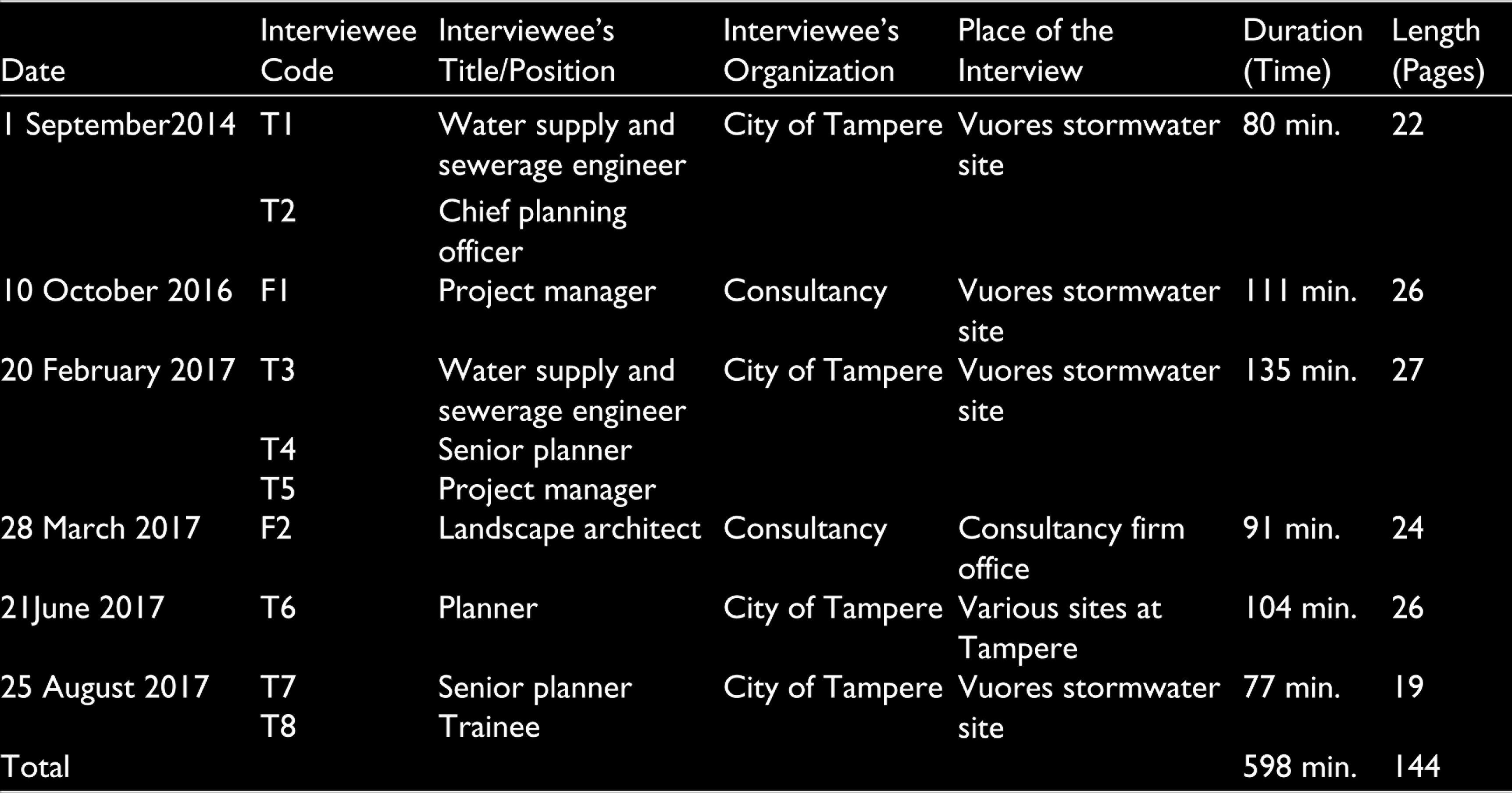
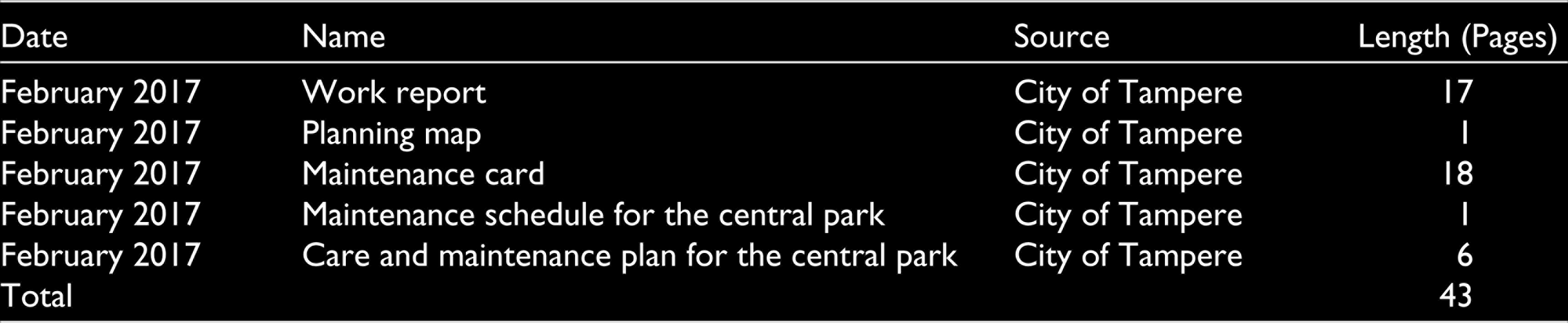
The secondary data consists of public documents from the city of Tampere, including a work report and planning map, a maintenance card, a schedule and a plan for the central park. In total, the document dataset consists of 43 pages of text (Table 2).
The Documentary Data Set in the Vuores Case
Data Analysis
A qualitative content analysis was used in the data analysis (Graneheim & Lundman, 2004). The aim of the analysis process was to create a thorough description of the key stakeholders and stakeholder engagement in the case. We build on the argument that qualitative content analysis is an appropriate method for analysing textual data as it is both systematic and flexible and allows for reducing and analysing data to create a concise description of the studied phenomenon (Elo & Kyngäs, 2008; Graneheim & Lundman, 2004).
The data analysis followed a collaborative process. After the data collection, all the research team members familiarized themselves with the data by reading it. In addition, the case was frequently discussed in collaborative research group meetings. The data analysis was begun by one researcher, who first identified all the stakeholders mentioned in the interview dataset and then counted the mentions that stakeholders received in the data. Based on the frequency of stakeholder mentions, ‘business organizations’, ‘public sector’ and ‘local community’ were identified as the key stakeholders of the case.
Subsequently, two researchers analysed the data separately. The expressions related to stakeholder relationships and stakeholder interests were used as the unit of analysis (Graneheim & Lundman, 2004). First, the expressions related to stakeholder relationships and stakeholder interests were inductively identified and coded from the data. Second, the coded data was categorized through a second-order analysis (Gioia et al., 2013) into aims, practices and outcomes based on the theoretical definition of stakeholder engagement. Third, the contents of aims, practices and outcomes were thematized and summarized into subcategories and linked to key stakeholders. The findings of the analyses were discussed and synthesized in several collaborative research group meetings to use researcher and data triangulation to validate the findings. Finally, the findings were discussed in relation to ecosystem services to explicate how stakeholder engagement supports the generation of urban ecosystem services.
Findings
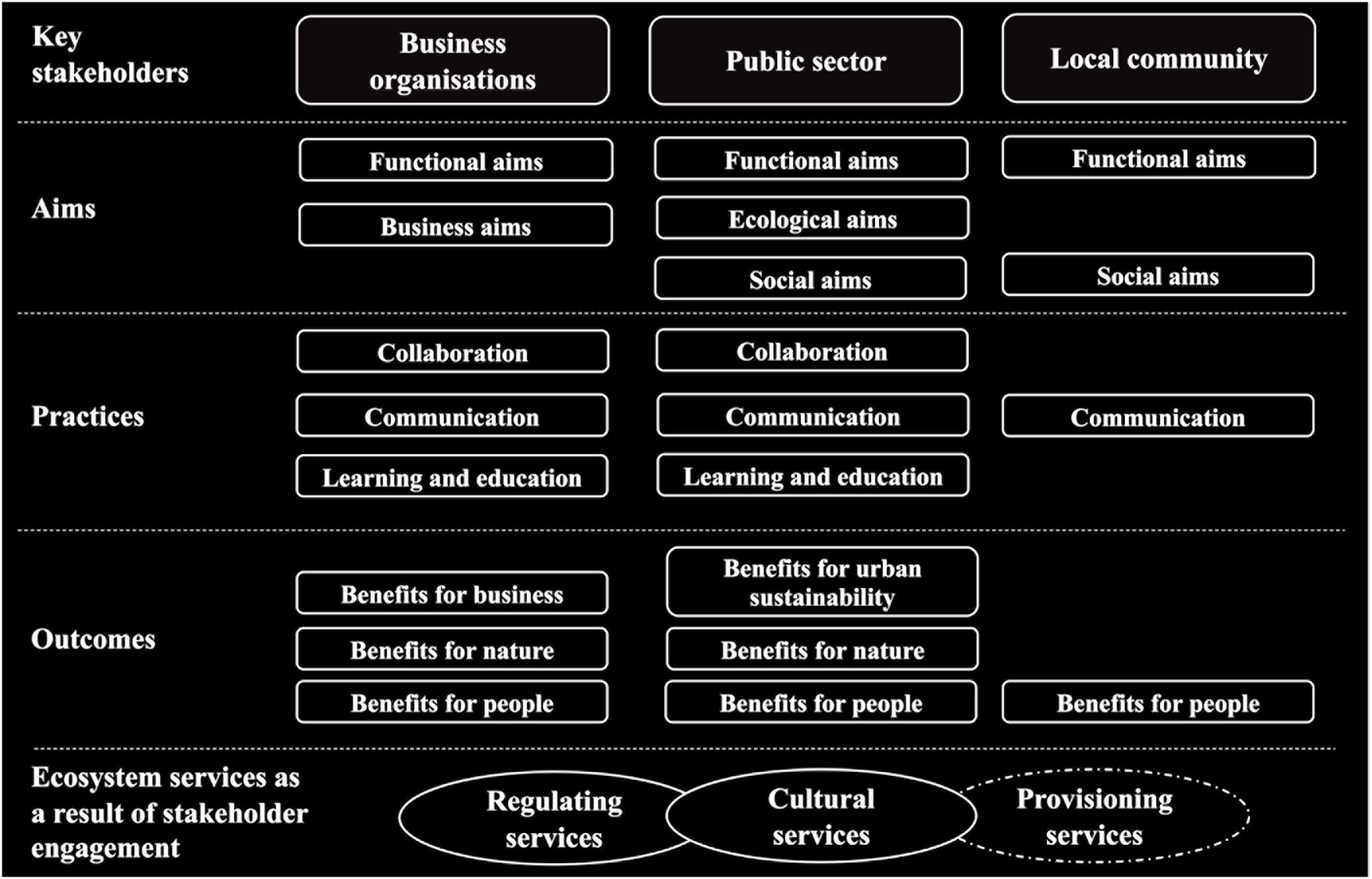
The analysis focused on three key stakeholders of the stormwater system at Vuores: business organizations, the public sector and the local community. Business organizations refer to the consulting and construction companies that participated in the planning, designing, construction and maintenance of the Vuores stormwater site. The planning of the Vuores stormwater system was started by the public sector, that is, the city administrators, civil servants and researchers working for the city of Tampere. The local community includes the residents of the area, and the groups and associations representing the people living within the impact area of the site. These groups not only spoke for themselves but also, in many cases, gave voice to the natural environment (Hörisch et al., 2014). Figure 1 synthesizes the findings of the study.
Aims of Stakeholder Relationships
The aims of stakeholder relationships were quite manifold. Typically, the aims concerned the intention to plan and construct an integrated stormwater management system. This novel and innovative solution builds the reputation of the participants as forerunners in combining ecological and economic values in the process. Table 3 presents a synthesis of the aims of stakeholder relationships related to the Vuores case from the key stakeholders’ perspectives under four subcategories: functional aims, business aims, ecological aims and social aims.
The Aims of Stakeholder Relationships Related to the Case
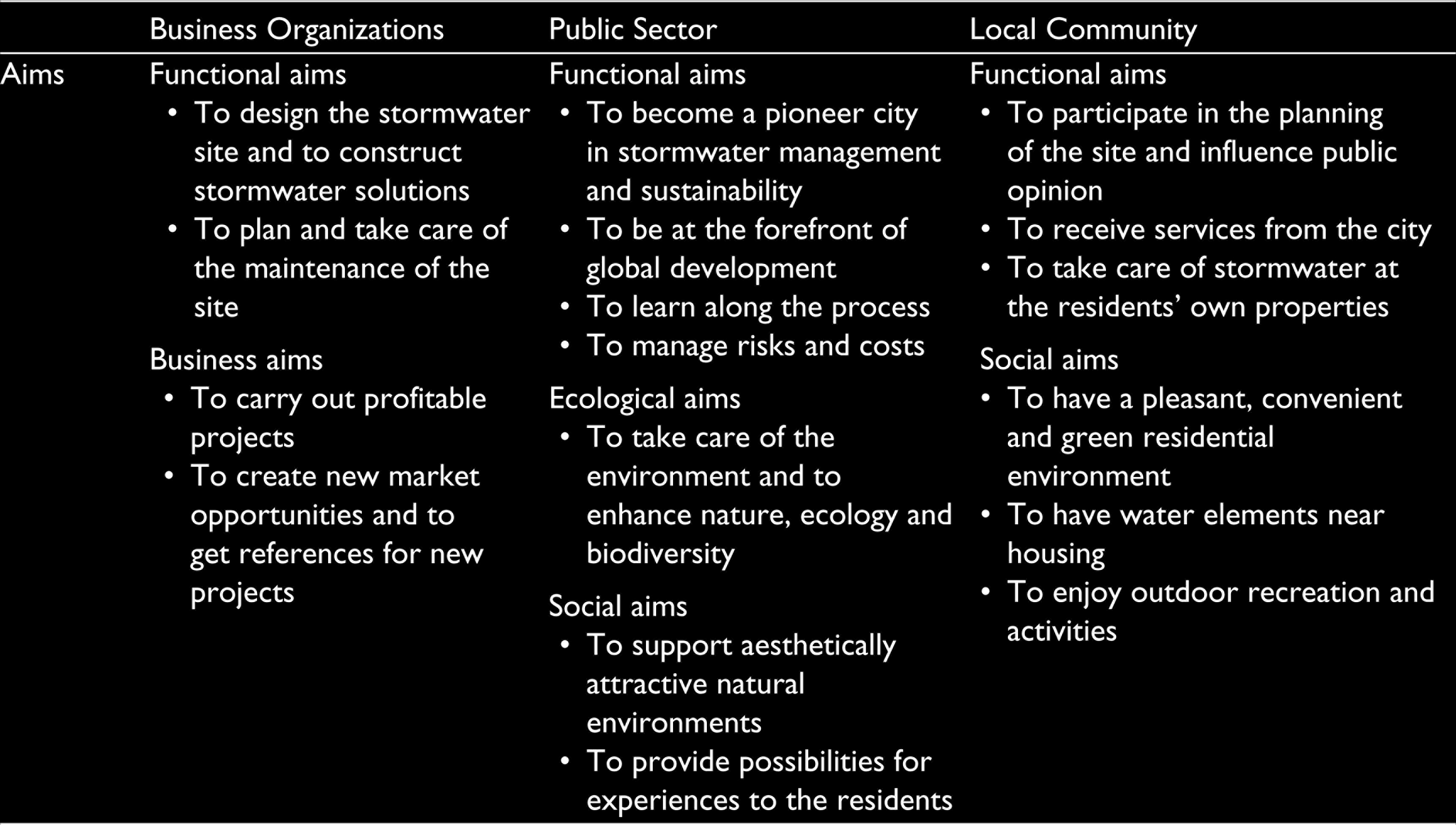
The aims of the business organizations in the Vuores site were to design and construct an integrated stormwater management system with high functionality and to plan the maintenance of the system. The firms wanted to carry out profitable projects and create new market opportunities regarding future projects in the field of stormwater management. They understood that the Vuores case would act as a reference for future customers regarding the development and design of stormwater systems and would enhance their reputation as sustainable and innovative business operators. Hence, the aims of the companies mainly focused on their own business and business development without compromising the functionality of the stormwater system.
The public sector was the initiator of the planning and designing process of the new integrated stormwater system in Vuores. The city of Tampere funded the project, and the city wanted to become a forerunner in stormwater management and sustainability. The city officials and administrators coordinated the planning process, and the city was responsible for controlling the construction and maintenance of the site. Thus, they needed to manage the risks and costs related to the project. In addition, the city offered an opportunity to do research on the stormwater site and experiment with stormwater management solutions. This was valuable, as Vuores is a pioneer stormwater management site in Finland. Stormwater management was seen as a way to reduce risks of floods and climate change and to manage costs that may affect the city. The interviewees emphasized that they needed to ensure safety on the site, as schools and day care centres were near the water areas. City planners wanted to create beautiful, sustainable stormwater solutions that offer experiences for residents, while ensuring that they generate sites where vegetation could develop naturally. The findings show that the aims of the public sector comprise functional, ecological and social aims, which should be achieved at a reasonable cost.
The local community wanted to participate in the planning of the site and influence public opinion. The aim was to have a pleasant and green residential area. They wanted to have water elements near housing, to enjoy outdoor recreation and activities, and to take care of stormwater management at their own property. They also expected the city to provide them with services related to stormwater management. Hence, for the residents, the project enabled the advance of functional aims regarding stormwater management and social aims concerning an enjoyable living environment.
Practices of Stakeholder Relationships
Various forms of collaboration and communication were described as important practices of stakeholder relationships. In addition, learning and education were highlighted. Table 4 presents a synthesis of the practices of stakeholder relationships related to the Vuores case from the key stakeholders’ perspective.
Business organizations continuously collaborated with the public sector in developing instructions for site management, as well as in planning and building the site. They also communicated with the area residents at the beginning of the project. Collaboration among designers and planners was intense in the planning phase, while collaboration among planners, builders and subcontractors continued throughout the building of the site. Often, collaboration was formal, such as receiving orders and making contracts and subcontracts, but more informal collaboration was also described, such as communication with residents and learning from each other in seminars and fairs.
The Practices of Stakeholder Relationships Related to the Case
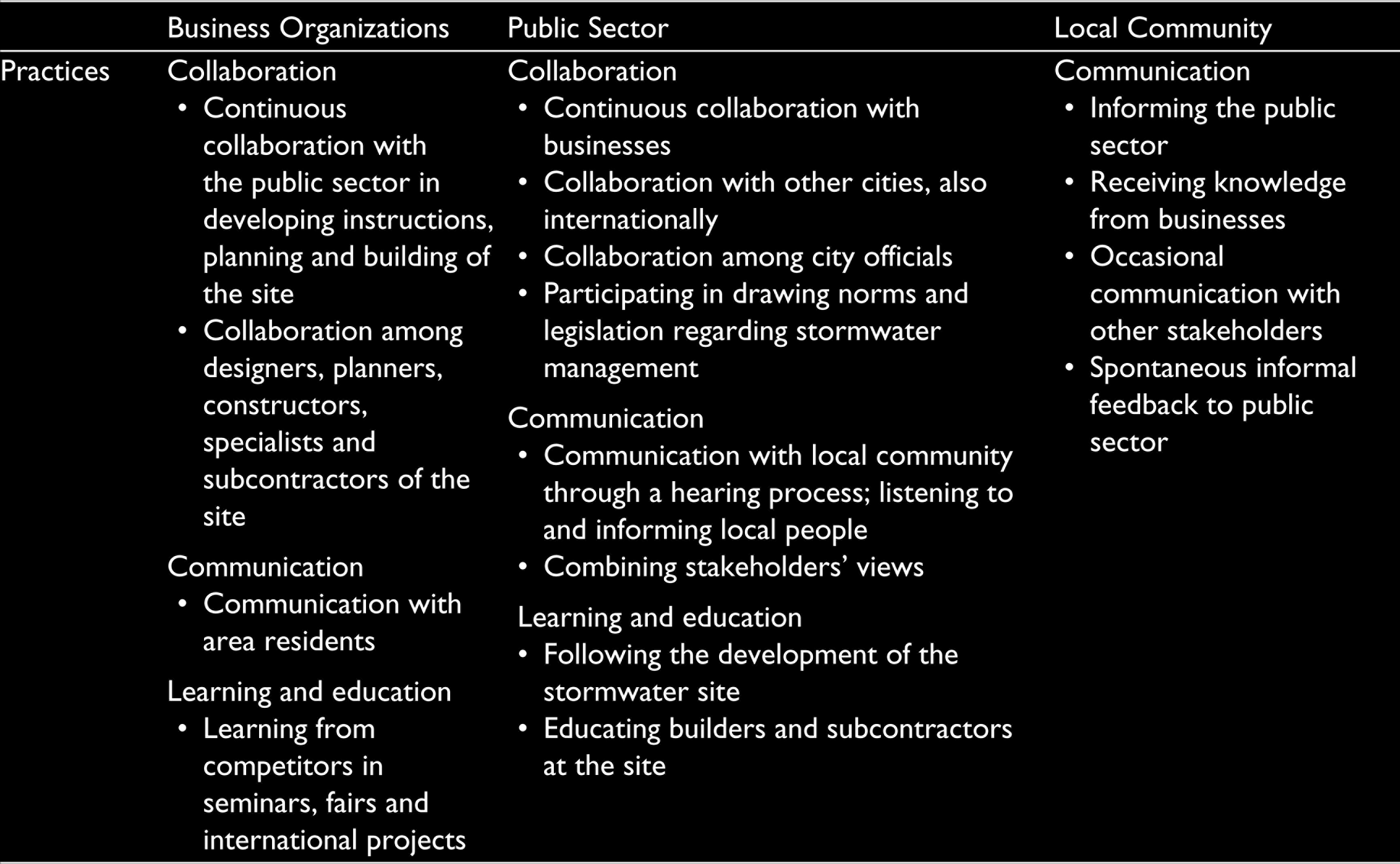
The city officials communicated with local people through an official hearing process at the beginning of the project, and they also listened to residents throughout the project. The city also formally informed the local people about the project and its development. The authorities maintained continuous communication with other actors, especially with the participating companies. Public sector officials were keen to follow what was happening in the industry and teamed with other cities, both in Finland and internationally, to be informed on the most recent developments in stormwater management. The city also participated in drawing norms and legislation regarding stormwater management in Finland. City officials communicated and collaborated vigorously with each other. The authorities followed the development of the Vuores stormwater site closely, and they often thought they needed to educate the builders and subcontractors on the site about the importance of stormwater management and the advantages of the integrated stormwater management system.
Instead of being active participants in the project, the residents only had occasional communication with other stakeholders. Local residents were a source for the public sector’s information for planning and a target of business organizations’ activities. The residents were invited to give feedback, but it was not formally organized. In addition, the residents were not directly asked about their opinions or experiences with the stormwater site. Instead, they gave spontaneous, informal feedback to the public sector.
Outcomes of Stakeholder Relationships
Stakeholder relationships were described as having various outcomes, especially for business organizations and the public sector. Interestingly, impacts on the local community were described less often. Table 5 presents a synthesis of the outcomes of stakeholder relationships related to the Vuores case from the key stakeholders’ perspective. The outcomes are divided into subcategories related to the benefits for urban sustainability and for business, nature and people.
The Outcomes of Stakeholder Relationships Related to the Case
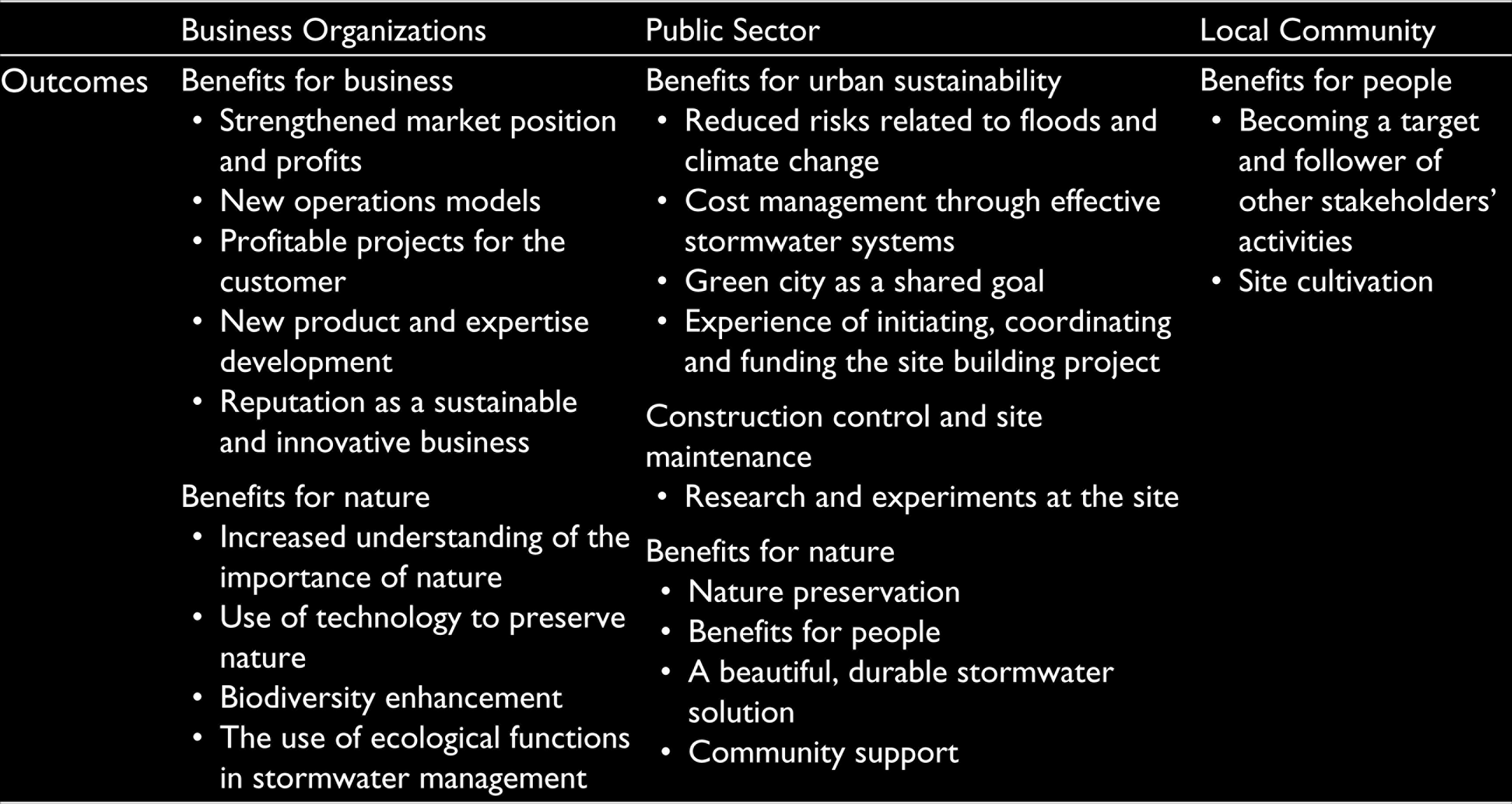
Through stakeholder engagement, businesses can strengthen their market positions and make profits. The firms developed new operation models for stormwater management for the city and delivered profitable projects for their customers. The site also allowed research and development in stormwater management to develop new products and expertise. The case was also seen as an opportunity to enhance the firms’ reputations as being sustainable and innovative in the field of green building and infrastructure. Some interviewees even used the project as an opportunity to educate their peers about the importance of nature. The case enabled the firms to combine the ideas of technology and of the preservation of nature and endangered species. Despite showing such intrinsic valuation of the natural environment, nature was often seen as having an instrumental value, as ecological functions were used in stormwater management for managing flood risks for people. In summary, the outcomes from business organizations’ perspective intertwine positive benefits for both business and nature.
As noted, the public sector demonstrated an interest in establishing Tampere as a forerunner in stormwater management and sustainability in Finland and internationally. The interviewees highlighted that the whole experience was a learning process for them. The city also had more practical outcomes for the project, such as controlling stormwater management costs and risks in the housing area and integrating stormwater management into city governance. However, the interviewees also emphasized the intrinsic value of nature. They discussed the importance of ecological recovery and the aesthetics of flora and fauna in enabling recreational and other opportunities for the local residents. Hence, the outcomes from the public sector perspective convey benefits for urban sustainability, nature and people.
At the beginning of the project, the local community had many expectations for the stormwater management site. One of the main goals of the Vuores site was that the residential environment would be pleasant and the water elements near housing would create various ecosystem services for the residents. Vuores was marketed to potential new inhabitants as a pleasant and green residential area where the residents would have an opportunity to influence the planning of the site. However, in the later phases, the residents became targets and followers of the other stakeholders’ actions and activities who received services from the city. Nevertheless, the residents were the users of the stormwater site, and by creating informal paths, dams and bridges, for instance, they became part of the site’s cultivation. The outcomes from the local community’s perspective manifested mainly as benefits for themselves and, hence, as social benefits.
Discussion
The findings of the study reveal how stakeholder engagement, that is, the aims, practices and outcomes of stakeholder relationships, support the generation of urban ecosystem services. The case demonstrates how business organizations, the public sector and the local community join in planning and constructing a stormwater management site and, consequently, support the generation of urban ecosystem services (Hauck et al., 2013; Heikkinen et al., 2019; Menzel & Teng, 2010). In particular, the activities of business and public organizations enabled the creation of multiple benefits for urban sustainability, businesses, nature and people. This finding highlights the importance of collaboration between stakeholders in advancing the understanding of the importance of nature and novel solutions such as integrated stormwater systems. For instance, the initial aims of business organizations mainly focused on business objectives that developed during a project that embraced nature, its preservation and a better understanding of ecosystem services as benefits derived from nature-based solutions. Thus, the case is an example of stakeholder engagement and collaboration for the strategic development of urban sustainability (Jokinen et al., 2018).
For a more detailed discussion of how stakeholder engagement supports the generation of urban ecosystem services, we use the categorization presented by the Millennium Ecosystem Assessment (2005) and divide direct ecosystem services into provisioning services (e.g., food production, provision of fresh water and production of wood or fibre), regulating services (e.g., water quality or quantity regulation, air purification and maintenance of biodiversity) and cultural services (e.g., recreation, education and inspiration). In the studied case, regulating and cultural services were especially identified and created within the stakeholder relationships (see Figure 1 and the results in the Findings section).
While provisioning services are commonly recognized ecosystem services, surprisingly, no provisioning ecosystem services were identified in this case. This contrasts with Prudencio and Null (2018), who found in their worldwide review that provisioning services are the most common type of ecosystem services discussed in stormwater management studies. While the whole case addresses the problem of water handling, ecosystem services such as the provision of drinking water or using clean water for agricultural purposes were not discussed in this case. This is natural because there is usually no shortage of drinking or irrigation water in Finnish cities, even in the hottest summer periods. Thus far, there is no specific need to secure the water supply in the design of stormwater systems, as is the case in many other countries. However, we recognize that stormwater detention can also solve some irrigation problems in green area management and urban gardening in Finland. Depending on water purification, other provisioning ecosystem services are possible. For example, ecologically connected urban stormwater systems can become habitats for crayfish and trout populations in the future (Sarvilinna et al., 2017).
Moreover, the findings illustrate that the local residents, as the main end users of the site, were not fully engaged in the planning and construction processes of the integrated stormwater system. This might have inhibited the depiction of potential provisioning services for them or citizens in general. Of course, the choices in the planning phase affect what kinds of benefits are looked for and enabled, and might be linked to the individual designers’ knowledge, competences, awareness and, finally, all the stakeholders engaged in the process. As stakeholders usually participate in the generation of ecosystem services based on their expertise, they may identify and value diverse ecosystem services. In addition, being able to identify provisioning services could help provide a deeper understanding of the importance of the ecosystem in the area.
Regarding the regulation of ecosystem services, the site allows businesses to promote the preservation of endangered species and use ecological functions in stormwater management. Moreover, the site enables the residents to follow the recent developments of stormwater management and take care of stormwaters on their own property, which is already taking place in Vuores (Tahvonen, 2018). The site also helps the public sector to take care of the environment and enhance nature, ecology and biodiversity.
In this case, cultural ecosystem services were most supported by the building of the site. For businesses organizations, the site enables educating people about nature’s importance, and for the public sector, it supports an aesthetic and attractive natural environment. For the local community, the site provides cultural ecosystem services such as a pleasant, convenient and green residential area; water elements near housing; and the ability to enjoy outdoor recreation and activities.
The findings of this study show how stakeholder engagement related to the building of the stormwater management site enhanced the development of urban nature at the site and thereby supported regulating and cultural ecosystem services. This research indicates that the development of urban ecosystem services is deeply embedded in local stakeholder engagement and its aims, practices and outcomes. The collaborative development of the natural environment with and for stakeholders (cf. Freeman et al., 2010) resulted in unique local solutions that can be used as a pilot case for developing standardized business products and routinized planning practices in municipalities.
Finally, the case shows how business and public organizations can build expertise and develop their activities and reputations as forerunners in sustainability. Stakeholders’ value efficient stormwater management solutions (i.e., technical value) as well as a pleasant and stimulating living environment (i.e., recreational and cultural values). While human interests were the main drivers in the process of generating ecosystem services, the intrinsic value of the natural environment was also acknowledged.
Limitations and Future Research
The presented case study is subject to some limitations. The first limitation is that the findings are based on the views of city officials and business professionals. While the viewpoint of the local residents was often discussed in the interviews, the study would have benefited from direct information from the residents of the area. In addition to better stakeholder coverage, the research could also focus on stakeholder identities to examine stakeholder relationships and their dynamics more profoundly (cf. Lehtimäki & Kujala, 2017).
The second limitation relates to the element of time (Bansal & DesJardine, 2014). While our case covered three years (from almost the beginning of building the site to the point when the integrated stormwater management system had been functioning for a few years), the generation of ecosystem services related to the site is a much longer process, and the ecological development of the site towards a more natural state will continue for years to come. Therefore, it will be important to conduct a follow-up study to consider the longitudinal effects related to stakeholder interests and engagement in stormwater management. In addition, the case study could be further developed to better cover the temporal aspect by focusing on not just the emergence but also the evolution and dynamics of stakeholder engagement.
Finally, as a single case study, the generalizability of this research is limited. The implications of the study would be more relevant if it were built on the examination of several stormwater management sites (cf. Eriksson & Kovalainen, 2015). Examining more than one case would build a larger dataset and allow comparisons between cases. To improve the generalizability of the results, we recommend future studies on urban ecosystem services to use a multiple-case study approach and build between- and within-case comparisons.
Conclusion
This case study examines how stakeholder engagement, that is, the aims, practices and outcomes of stakeholder relationships, can support the generation of urban ecosystem services. We present a case study of an integrated stormwater system in Finland. The primary goal of stormwater management is to mitigate rain, melt water and manage water quality in urban areas. Moreover, integrated stormwater systems support the generation of various ecosystem services. In this case, cultural and regulating ecosystem services such as recreational benefits, landscaping and biodiversity were emphasized, while the most common ecosystem services in many other countries, provisional services, were not recognized. The main findings of this case study demonstrate that stakeholder engagement is a useful research perspective for explaining the generation of ecosystem services. It is particularly helpful in urban circumstances, where ecosystem services emerge from entangled social, technological and ecological processes. We conclude that achieving the full benefit of this research approach requires that all three characteristics of stakeholder engagement—the aims, practices and outcomes of stakeholder relationships—are thoroughly analysed.
Footnotes
Declaration of Conflicting Interests
The authors declared no potential conflicts of interest with respect to the research, authorship and/or publication of this article.
Funding
The authors disclosed receipt of the following financial support for the research, authorship and/or publication of this article: The authors gratefully acknowledge the financial support from the Academy of Finland (Decision number 298663) and the Strategic Research Council at the Academy of Finland (Decision numbers 320194 and 320206).