




Abstract
This case study examines how top academic managers make sense of entrepreneurship at the university. Based on semiotic analysis, the findings outline three management narratives. The entrepreneurial narrative emphasizes management by experience, the humanistic narrative focuses on management by networks and the development narrative highlights management by vision. Unpacking the dynamics of each narrative, our analysis sheds light on the conflicted role of academic managers at a crossroads between traditional academia and entrepreneurial management.
Research Questions/Objective
How top academic managers make sense of entrepreneurship at the university through narratives?
Links to Theory
The conceptual and theoretical framework of this case study is built based on academic entrepreneurship and narrative theory.
Phenomenon Studied
Academic entrepreneurship
Case Context
Academic top managers of a Finnish multidisciplinary university
Findings
The findings outline how top academic managers make sense of academic entrepreneurship through three management narratives. The entrepreneurial narrative centres around the idea of management by experience and emphasizes the manager’s own entrepreneurial experiences. The humanistic narrative centres around the idea of management by networks highlighting how the managers can guide and assist others who act as entrepreneurs. Finally, the development narrative centres around management by vision and focuses on the overall picture of the entrepreneurial university.
Discussions
The case study implies that academic entrepreneurship (AE) is understood and conceptualized by the managers in multifaceted and sometimes contradictory ways. Representing the frontline of academic management and changes in Finnish universities, the top academic managers are confronted with tensions between the ideals of traditional academia and the contemporary entrepreneurial developments in universities. This study contributes to the field of academic management by highlighting the much-needed experience-based perspective of top academic managers in relation to AE.
Keywords
Introduction
This article presents a management case that focuses on top academic managers in the Finnish university context. More specifically, this case examines how managers make sense of entrepreneurship in universities. Due to their key role in strategic planning and implementation in universities, academic top managers (rectors, deans, programme directors) have a central role in how entrepreneurial activities in universities are carried out. Here, academic top managers are referred to as the representatives of executive positions at the university and faculty level. In this context, academic entrepreneurship (AE) refers to processes of commercialization and spin-offs, fostering entrepreneurial education, and the creation of societal impact in universities. The contribution of this study lies in highlighting the previously somewhat unexplored AE experiences of academic top managers. In addition, previous qualitative studies on AE utilizing narrative methods have been scarce.
Finnish university management is an interesting case of new managerial practices leading to academic capitalism (e.g., Kauppinen & Kaidesoja, 2014). These new practices include the development of enterprising subjects through academic education and the rise of performance evaluation and novel ways of applying academic knowledge (Rinne & Koivula, 2005). Due to global trajectories, the ideals of AE are fast becoming a doctrine for universities that infiltrates all aspects of the academic live. The current entrepreneurial developments challenged the traditional role of universities in societies and positioned the top academic managers in a new way. In this context, the top academic managers can be regarded as representatives of both the traditional values of managed academics and the recent neoliberal and managerialist ideals regarding universities (Winter, 2009). Despite these changes, little is known about how the top academic managers understand and conceptualize AE.
The findings outline three different narratives of academic entrepreneurship: the entrepreneurial narrative emphasizes the manager’s own experience as the founder of a university spin-off company, the humanistic narrative describes how the manager can help others who act as entrepreneurs and the development narrative focuses on the big picture of the entrepreneurial university. The entrepreneurial narrative emphasizes management by experience, the humanistic narrative focuses on management by networks and the development narrative highlights management by vision. Each of these narratives includes descriptions of the goals and motives of AE in universities, and the factors that either help or oppose its development. The findings highlight the dynamics of the goals, motives, helpers and opponents described in each academic entrepreneurship narrative. The findings also shed light on how academic managers perceive their roles in AE processes as they navigate in the field of academic and entrepreneurial responsibilities.
In the following section, we introduce the conceptual and theoretical framework of this study, followed by a brief overview of previous studies. Then, we present the data, the methodology and the findings. Finally, we discuss our findings and provide the conclusions.
Conceptual and Theoretical Framework
The conceptual and theoretical framework of this case study is built based on AE and narrative theory. In its broader sense, AE refers to the entrepreneurial objectives within universities stemming from developments in academic capitalism and knowledge-based economies (Jessop, 2017). These objectives include organizing university funding partly according to entrepreneurial logic, fostering commercialization and spin-off processes, emphasizing entrepreneurial themes in education and the creation and evaluation of societal impact (Shattock, 2005). According to previous studies (see Djokovic & Souitaris, 2008), AE can be understood as entailing micro-, meso and macro-level processes. The micro-level of AE focuses on AE at the university level highlighting the role of university-based companies, local networks and the role of different local actors of AE. The meso-level perspective focuses on the various support mechanisms and structures of AE within universities. Finally, the macro-level perspective identifies the key macroeconomic elements of AE, such as government and industry support mechanisms. Previous studies on AE have mainly focused on the meso- and macro-level perspectives, although micro-level investigations have received more attention in recent years (e.g., Montonen, 2014; Siivonen et al., 2019).
This study approaches the micro-level of AE and adopts narrative theory as its theoretical framework to investigate top academic managers’ understandings of entrepreneurship in university organizations. According to narrative theory, narratives are means for individuals and collectives to make sense, understand and interpret their experiences, share their experiences in a group or a community or construct and enforce their own identities (e.g., Boje, 2008; Czarniawska, 2004). The narrative approach challenges the idea of singular and unilateral identities and organizational realities. Instead, the meanings associated with the everyday lives of organizations and the individuals therein are characterized as constantly constructed and challenged. In these sense-making processes, narratives can be regarded as representational devices and as objects of analysis because they ‘represent experience in an organized fashion in order to produce persuasive messages, meanings and also to motivate or legitimate actions’ (Robert & Shenhav, 2014, p. 5). The narrative approach to entrepreneurship focuses on sense making in entrepreneurial experiences and identities as well as on the manifold conceptualizations of entrepreneurship alongside its processes (Johansson, 2004). Such a method enables investigating not only the micro-level but also the macro-level elements of entrepreneurship practices. Accordingly, the surrounding cultural reality can be considered as a resource for the narrative construction of individual and collective experiences, understandings and identities (e.g., Czarniawska & Rhodes, 2006).
From the multitude of analytical approaches within narrative theory and research, this study adopts the structural analysis of AE narratives. In general, structural approaches emphasize the plurality of possible agents and components of narratives that are bound together by a thematic plot and structure. We adopt the basics of actantial narrative analysis that originates in structural semiotics (Greimas, 1983). This semiotic approach emphasizes the dynamics within a narrative by categorizing ‘not only the relations among actants within it but also the actantial positions that its characters may take from one moment to the next’ (Wang & Roberts, 2005, p. 53).
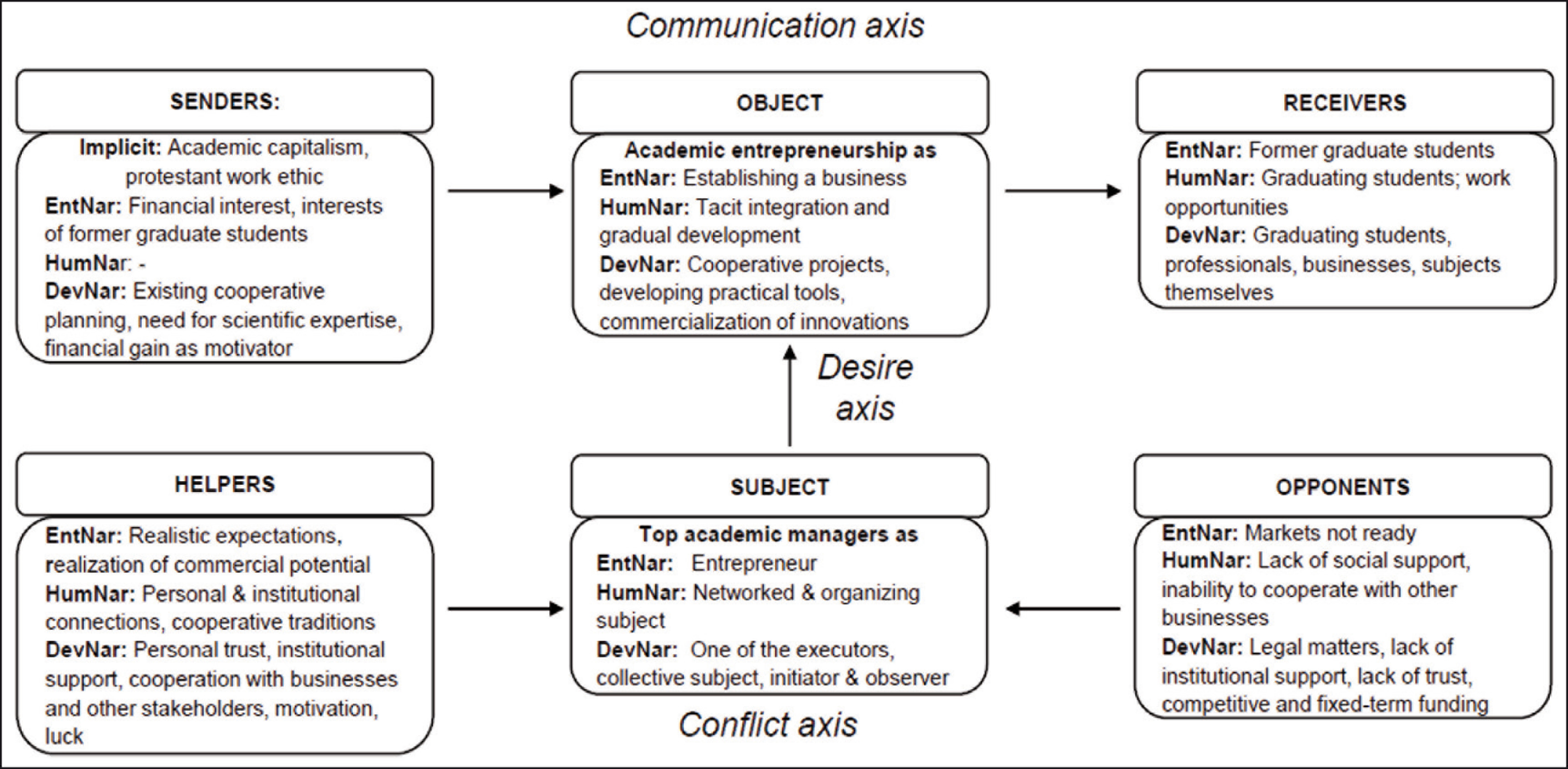
The actantial model aims to identify the structural dynamics of a given narrative by focusing on the relations between the subject and the object of the narrative. In addition, the model sheds light on what kinds of elements the narrator regards as helpful or detrimental in achieving the object. Furthermore, the model describes the motivational aspects of the subject as well as who benefits from the achievement of the overall object of the narrative. These elements of the narratives are referred to as actants, and their reciprocal dynamics are outlined along three axes: the desire axis describes the relationship between the subject and the object, the conflict axis describes the dynamics of the helpers and opponents in relation to the subject and the communication axis describes the relationship between the sender and the receiver of the narrative.
Previous Narrative Studies
Despite the vast number of narrative studies on entrepreneurship and organizations, there are only a few studies that use structural actantial analysis. Overall, the usefulness of the narrative framework in this context has been established by numerous studies ranging from, for example, the analysis of family-business identities in transgenerational narratives (Parada & Dawson, 2017) to the narrative analysis of entrepreneurial failures of organizational stakeholders (Mantere et al., 2013). The actantial model has been utilized in studies on, for example, institutional adaptation to a new local context (Ritvala et al., 2017) and macro-level analysis of changes in corporate governance discourse (Hartz & Steger, 2010). Utilizing the actantial analysis, Ritvala et al. (2017) analysed the introduction and possible adaptation of an art institution to a new local context. Their analysis demonstrated how the different narratives of institutional expansion in a new community were shaped by the dynamics of subjects and objects as well as helpers and opponents at the intersection between the institution and the local community. Similarly, albeit on a more macro scale, Hartz and Steger (2010) utilized the actantial perspective to shed light on changes in corporate governance discourse. Their findings highlight the changes in corporate governance narratives in relation to the broader economic context and how such changes could be indicated in terms of the semantic features of the narratives.
Although the usefulness of the structural narrative approaches to the analysis of the current understandings of entrepreneurship in different contexts has been established (Larty & Hamilton, 2011), such approaches have been scarcely used in actual investigations. In addition, previous research on academic management has focused on the middle and junior management levels (Hancock & Hellawell, 2003; Mercer, 2009), leaving out almost entirely the top academic managers in university organizations. Inspired by the actantial studies of entrepreneurial narratives of pitching (Lurtz & Kreutzer, 2014) and entrepreneurial identity and personal-growth stories (Maula et al., 2017), we set out to apply the structural analysis to the context of AE and top academic managers. We examined how the academic managers make sense of AE through narratives and how they position themselves and their objectives in the narratives in relation to the helpers, opponents, senders and receivers.
Data and Methods
This case study draws on the data from one academic organization in the Finnish university context. These data were originally collected in 2016 as part of a larger corpus of thematic interview data focusing on top academic managers’ perceptions and understandings of AE in the Finnish university context (37 interviews with rectors, deans and programme directors of Finnish universities). The participants represented different scholarly backgrounds and disciplines. Our case study focuses on one of the universities and utilizes the interview data with two rectors and three deans from the case university. The amount of overall data and details concerning the case study are presented in Table 1.
Overall Data Set and Participants of the Case Study

Although Greimas (1983) did not explicitly outline the methodological steps for the actantial analysis of narratives, the centrality of the desire axis can be considered a fundamental starting point in understanding the structure and overall dynamics of narratives. Drawing on the theoretical underpinnings of previous studies that used the Greimas methodology (e.g., Lurtz & Kreutzer, 2014; Wang & Roberts, 2005), we divided our analysis into four procedural phases. The first phase consisted of a thematic reading of the data and the identification of the self-narratives of the academic managers. The second phase focused on the deductive identification of all actantial codes within the narratives. The third phase consisted of categorizing and labelling the narratives. Finally, we constructed the actantial model of each narrative.
Each of the five interviews contained explicit narratives concerning AE and its background, processes and aims. However, the concept of AE was understood broadly as the top academic managers included descriptions of economic and social activities at the university, developing practical tools and innovations for commercialization purposes or establishing businesses.
Findings
Based on the actantial analysis of the narratives, we identified the following three types of AE narratives: the entrepreneurial narrative, the humanistic narrative and the development narrative. Each of these narratives entailed a variety of actantial classifications based on the three dimensions of the actantial model (Subject vs. Object, Helper vs. Opponent and Sender vs. Receiver). The narratives were labelled mainly based on the desire axis of the actantial model, which highlighted the subject–object relations of the narratives. The other dimensions highlighted the multifaceted and often tense dynamics of the assisting and resisting factors as well as motivational and beneficiary components in AE narratives.
Particularly the senders or the motivational aspects of AE were implicitly present in the narratives. Overall, all the top academic managers had adopted a neoliberal ideology of academic capitalism, which can be considered to be a major motivational factor for AE. In addition, the narratives included features of the Protestant work ethic (valuing hard work and discipline) the as one of the motivational elements of AE. The following detailed descriptions of the three narratives present the content of the AE narratives using the framework of actantial dynamics discussed earlier. A compilation of the key findings according to the actantian model, with examples of each narrative’s actants, is presented in Figure 1.
The Entrepreneurial Narrative of AE
The entrepreneurial narrative of AE focused explicitly on commercializing academic research and establishing a business around it. Such an attitude emphasizes management by experience as the academic manager positions themselves as a business-oriented entrepreneur in the narrative. In actantial terms, the entrepreneurial narrative represented the desire to achieve and obtain financial revenue for the individual parties.
In this narrative, we identified few ‘Helpers’ that assisted managers in realising their goals; the realization of commercial potential was mentioned explicitly as a ‘Helper’, whereas realistic expectations of the ones taking part in the AE activities were viewed as an implicit ‘Helper’. Perhaps in accordance with the somewhat confident and optimistic tone of this narrative, the novelty of the developed innovation was considered as an ‘Opponent’. These ‘Helpers’ and ‘Opponents’ of commercial potential and the novelty of the innovation formed a tense dynamic within the narrative. This tension, in addition to some elements of the ‘Senders’ and ‘Receivers’, is described in the following extract by one of the rectors (R2):
I’ve also been an entrepreneur, so, to collect research findings. We found that, it turned out that it has a lot of commercial potential, but it was so novel, a different kind of solution, that it did not sell. It was pretty tough to establish a business by yourself and to start to commercialise it. And when that was done, then the business was sold relatively easily, and you reached that concrete phase.… We established it together, there were a few of my previous graduate students with whom we then, they took it forward. They did the practical work there, so [I was] a founding member on the board. (R2)
Achieving financial interests and helping the graduate students taking part in AE activities formed the motivational core of this narrative. In other words, these elements were the ‘Senders’ of the narrative. As a counterpart to this, the students and their possible gains were considered as the ‘Receivers’ in the entrepreneurial narrative. Although financial interest was referred to as a motivator in this narrative, the academic manager did not explicitly regard themselves as a financial receiver in the narrative. The core of this narrative centred around management by experience, emphasizing the manager’s own AE experiences.
The Humanistic AE Narrative
Focusing on management by networks, the humanistic AE narrative involved descriptions related to helping and providing opportunities for others. Perhaps contrary to the self-related and personal descriptions with humanistic undertones, this narrative highlighted personal relationships and the intersubjective nature of AE practices. The manager’s subject position was therefore characterized as organizing managers with a variety of interpersonal networked relations. The aim of this narrative was to gradually develop and integrate AE into university practices. The following data extract demonstrates these dynamics, with one of the deans (D2) explaining their experiences:
Well, I would consider that I know and take care. Especially in [name of the city deleted] I know these chemists. They do have, for example, this co-operation with the medical industry. For example [name deleted]. I know her well.… And then in a similar fashion there has been cooperation with [name of the business deleted]. Those kinds of collaboration networks have taken place for ages. And by way of that they have also received research funding.… And then also it is, for many people, a question of employment. The case is for them that traditional jobs might not necessarily be available. (D2)
Concerning the dynamics of ‘Helpers’ and ‘Opponents’ of the humanistic narrative, the already-established collaborative practices and traditions as well as the plurality of social networks, including personal and institutional relations, were mentioned as the ‘Helpers’. In accordance with the social and intersubjective nature of this narrative, the ‘Opponents’ were a possible lack of social support and the inability to cooperate with other businesses. In this narrative, explicit ‘Senders’ were not presented. Nonetheless, taking AE more or less as self-evident and presenting it as a natural part of contemporary academia and the work of academic managers, the ideals of academic capitalism and the Protestant work ethics can be regarded as the implicit senders of this narrative. The humanistic overtone of the narrative was depicted by the ‘Receiver’ of the narrative. In this case this meant the creation of future work opportunities for graduating students can be regarded. This evidently highlights the core of the humanistic narrative and how AE in academia also has a prosocial purpose and underscores the idea of management by networks.
The Development AE Narrative
Three of the top academic managers’ AE narratives were categorized as development narratives highlighting the ideal of management by vision. Looking at the aims, or the desires, of the protagonists of these narratives, different elements were emphasized depending on the manager’s subject position. The ambition, and the pressure, to promote entrepreneurial processes within contemporary academia was one of the key catalysts of the narratives. More specifically, the ‘Objects’ included descriptions of developing or establishing entrepreneurial practices within the university or generating practical tools that could be used by different stakeholders. In one of the development narratives, the academic manager explicitly described the object as a process of commercializing an innovation. In addition, the narratives included three kinds of protagonists. One of the managers positioned themselves as a ‘Subject’ who was merely one of the executors in the narrative. In this case, the object of the narrative was to create collaborative relations within and outside the university. In another development narrative, the manager did not refer to themselves explicitly as a manager but positioned themselves as a member of a collective through we-positioning. The third subject position characterized the manager as an initiator and observer who was merely overseeing others as they continued with established AE practices. The following data extract presents an example of the latter development narrative, highlighting particularly the dynamics of the ‘Subject’ and ‘Object’ as described by one of the deans (D1):
Or I did not have to support anymore, I mainly asked that do you want to be a part of this. And from there on the boys established this [name of the business deleted] business and begun to commercialise those innovations that they had achieved in their research, and they are still doing that, yes. And my role now is very small, and my contribution is little. My contribution has diminished as other funders have joined in, but, in the beginning, then, yes, because I always believed that something could come out of this. Well, then, of course there are these individual [cases] that I have closely observed and the researchers of my own research group have done. (D1)
The three development narratives entailed a variety of ‘Helpers’ and ‘Opponents’. For example, both external and internal factors were mentioned as ‘Helpers’ of AE entrepreneurship. The external ‘Helpers’ included descriptions of institutional support, such as equipment and facilities, cooperation with surrounding businesses, external funding, personal connections and even luck. Individual characteristics, such as the motivation and commitment of the managers and co-workers, were considered as internal ‘Helpers’. In one of the narratives, interpersonal trust was an implicit ‘Helper’ assisting the protagonist in reaching their goals. The ‘Opponents’ included descriptions of legal matters (e.g., patenting limitations), competitive funding resulting in uncertain employment and contradictions and conflicts in expectations amongst the collaborators. Institutional support was also mentioned as an ‘Opponent’ in one of the narratives. This characterizes the tense and contradictory relations between the ‘Helpers’ and ‘Opponents’. In this case, the opponent role of the university institutions was intertwined with the financial issues as the university was considered to lack the means to offer the necessary financial and procedural support.
The motivation in these narratives could also be described through the implicitly assumed ideals of academic capitalism and the Protestant work ethic. In addition, financial gain, the need for scientific expertise and existing operational planning were the ‘Senders’ of these narratives driving the managers forward. Possible job opportunities for graduating students, professionals and businesses utilising the developed products and the financial gain for the managers themselves were mentioned as the ‘Receivers’ in the development narratives. These dynamics of motives and beneficiaries accentuate the ideals of management by vision in the development narratives.
Discussion and Conclusion
The analysis of the management narratives sheds light on the multifaceted and occasionally contradictory forms of how AE is understood, conceptualized and managed in Finnish universities. The findings identify three different management narratives regarding AE: management by experience, management by networks and management by vision. In each of these narratives, the social processes of AE entail a variety of dynamics between the assisting, resisting and motivating elements of AE-related practices. In the entrepreneurship narrative that emphasizes management by experience, AE was discussed through the personal experience of an entrepreneur and regarded as a means to achieve financial gain. In the humanistic narrative that describes management by networks, the objective of AE was to ensure future opportunities for others who acted as academic entrepreneurs. In the development narratives, the meanings associated with AE were centred around the vision of developing future businesses and projects of commercialization at the university level.
Concerning the actants of the narratives, some cautious overarching interpretations can be made. The dynamics of the conflict axis demonstrated the correspondence bias of overemphasizing personal attributes as positive traits and external attributes as negative traits. Similar dynamics have been identified in the context of knowledge commercialization at the university (e.g., Palo-oja et al., 2017). The dynamics of the desire axis revealed individual responsibilities, helping others and achieving personal objectives as the main facets of the academic managers’ subject positions. The communication axis of the narratives shed light on the instrumental adoption of or a taken-for-granted attitude towards the ideals of academic capitalism and the entrepreneurial logic within academia. This became evident in the paucity of explicit senders and receivers in the narratives.
The Finnish university culture emphasizes three basic tasks for universities: education, research and the ‘third task’. Over the past few decades, these tasks have been complemented by an increasing emphasis on the working-life orientation in university education, cooperation with companies in teaching and the research and wider acceptance of the entrepreneurial culture. This has been reasserted by the new Universities Act that came into effect in 2010, which emphasizes the financial independence and active societal engagement of the Finnish universities (Kauppinen & Kaidesoja, 2014). The top academic managers in this study are at the centre of these ongoing changes, including the management of AE. Whereas the findings paint a picture of three alternative narratives of AE management, the meanings associated with AE in these narratives represent a tension between the traditional ideals of academia and the contemporary entrepreneurial developments.
Footnotes
Acknowledgements
This paper is part of the Academic Entrepreneurship as a Social Process (ACE) research project (project number 295958) funded by the Academy of Finland and the University of Eastern Finland.
Declaration of Conflicting Interests
The authors declared no potential conflicts of interest with respect to the research, authorship and/or publication of this article.