




Abstract
Circular economy (CE) entails a radical change in companies because new ways of thinking and doing business are required for value-creation opportunities. There is a lack of empirical studies on how companies themselves see and develop the CE business. Furthermore, the dynamics between the changes required when pursuing a circular business model (CBM) have not been sufficiently studied. This intensive case study examines the strategic business decisions of a forerunner company in CE over 20 years.
Keywords
Introduction
The global economy and society face a significant sustainability challenge that sets novel demands for sustainable business models. In 1987, the World Commission on Environment and Development defined sustainability as development that meets the needs of the present without compromising the ability of future generations to meet their needs (WCED, 1987). Drawing attention to profit, people and planet, this definition has become established as the triple-bottom-line of sustainability, according to which the performance of a company is to be evaluated based on social, ecological and economic sustainability over time.
Circular economy (CE) is one attempt to address the sustainability of society. It departs from the current take-make-waste extractive industrial model that has created a linear throughput flow economy with physical flows of materials and energy. Approximately, 75 per cent of global energy production is based on non-renewable and emissions-intensive fossil fuels, the combustion of which does not adapt to the biosphere’s reproductive cycles. In other words, resources are extracted from nature, processed, used and discarded back into nature in a harmful form (Korhonen et al., 2018). CE entails reducing the use of natural resources, reusing material to sustain value as long as possible, recycling more efficiently and seeking to build closed material, energy and nutrient cycles.
CE principles are applied from the top down with national and international policies and from the bottom up with company innovations (Ruggieri et al., 2016). In this study, we focus on the bottom-up application of CE and provide an in-depth account of the strategic decisions made in a forerunner company in CE over a 20-year period. The case study we present is on a company that operates in construction waste recycling and management business. Being established in 1998, it is a forerunner company in CE. An intensive case study method (Eriksson & Kovalainen, 2016) was chosen to enable generating an in-depth understanding of the business decisions and their outcomes. The strength of the case method is that it generates insights on an empirical context and allow for a rich understanding of the phenomenon (Halinen & Törnroos, 2005).
The results of this study contribute to the existing literature by showing how company-internal and company-external factors support and challenge business model innovation in CE. While previous literature has focused on company-internal and company-external factors affecting the adaptation of business models to CE principles (e.g., De los Rios & Charnley, 2016; Lewandowski, 2016; Piispanen et al., 2020; Weissbrod & Bocken, 2017), there is a lack of empirical studies on how companies themselves see and develop the CE business (Liu & Bai, 2014). Also, the dynamics related to pursuing a circular business model (CBM) have not been sufficiently studied (Lewandowski, 2016).
The article is structured as follows. In the following section, we briefly review previous literature on CBM and strategic capabilities in the CE business. Then, we describe the data collection and analysis process. Next, we analyse the strategic decision-making process of the company over a 20-year period and show the dynamics between path dependency and CBM strategies. Finally, we draw together theoretical and practical implications of the study.
CBM and Strategic Capabilities in the CE Business
We define CBM as a business strategy in which the logic for value creation builds on utilizing the residual economic value of products’ post use in the production of new offerings (Linder & Williander, 2017; Mattila et al., 2019; Piispanen et al., 2020). Previous literature emphasizes that the implementation of CBMs requires comprehensive knowledge on creating new business strategies (Lewandowski, 2016), because integration of business models, product design, supply chain and product life cycle management is needed (Lieder & Rashid, 2016). Literature also emphasizes the importance of collaboration with other companies (Witjes & Lozano, 2016). This entails participation in collaborative networks and engagement with suppliers, manufacturers, retailers, service suppliers and customers to comprehend where and how value is created in CE (Lacy et al., 2014).
In addition to external capabilities, organizational capabilities have been shown to play an important role in the adaptation of a business model to CE principles (Lewandowski, 2016). These include human-resource-related capabilities, such as team motivation and organizational culture, knowledge and transition procedures (Lewandowski, 2016; Liu & Bai, 2014; Rizos et al., 2016), activity-related capabilities such as renewable material inputs and product design (Lacy et al., 2014), and sales and marketing capabilities that are needed for developing novel ways of involving customers in using and disposing of products properly (Lacy et al., 2014). The role of after-sales capabilities is important in supporting service levels, managing life cycles and maximizing retained value (Lacy et al., 2014). Information and communication technologies are needed for product monitoring in multiple life cycles (Lieder & Rashid, 2016). Overall, strategic decision-making has been considered as a key capability in creating and exploiting CE business opportunities and innovating CBM strategies (Bocken et al., 2016).
For the CBM to be successful, cost efficiency and resource planning capabilities and (Gebauer et al., 2016) and risk management (Linder & Williander, 2017) are needed. The reduction of logistics and waste management costs, increased consumer retention with good end-of-life return programmes, operating according to government regulations, quality control capabilities and the determination of the optimal return and reprocessing chain become emphasized in CE business (Lacy et al., 2014). Risk taking is needed because reverse logistics systems to closed material loops must be created (Lewandowski, 2016).
Although previous literature has identified a multitude factors important in CBM implementation, the understanding of the connection between changes required for circular business development and the factors that play into the dynamics of the change are still limited (Lewandowski, 2016). In this study, we draw from theorizing on path dependency and lock-in to examine the connection between strategic decisions and internal and external factors that play into the decisions. Path dependency refers to the self-reinforcing mechanisms that narrow down the scope of actions within an organization and in the market. It is a process where prior activities and events can result in lock-in due to, for instance, investments made to heavy machinery. Such lock-in may lead to inability to make the needed strategic decisions for business development or organizational renewal (Schreyögg & Sydow, 2011). In addition to events and activities in the past, also internal and external factors in business contribute to path dependency and shape the potential for innovation and renewal (Korhonen et al., 2018).
Methodology
We conducted an intensive case study (Eriksson & Kovalainen, 2016) to gain an in-depth understanding of a company perspective on CE business. The primary data comprise a semi-structured interview with the CEO (CEO, 2017) and development manager (DM 2017) of the case company. The interview was conducted in Finnish and recorded and transcribed verbatim. It was conducted as open ended to elicit the managers’ interpretations of the history, current state and future of the business. The interview provided insight on the CE business the company was involved in and on the strategic decisions the company made in relation to CE business and CBM innovation. The primary data consists of a 34-page transcription of one 81-minute interview and our observations during the interview. The secondary data includes the company’s public website. This data was used to contextualize the interview data.
Two researchers collected the data and three researchers participated in its analysis. The data were analysed using the qualitative content analysis technique with both inductive and deductive reasoning (Eriksson & Kovalainen, 2016). First, one researcher individually and inductively identified key strategic decisions, and then all three researchers collectively discussed the findings to assess the reliability and validity of analysis (Stake, 1995). The analysis resulted in the identification of six key strategic decisions related to CE. Second, a deductive orientation guided the analysis and resulted in identifying company-internal and company-external factors in strategic decision-making. A detailed analysis was made on how company-internal and company-external factors either supported or tested the CBM. Third, the process of strategic decision-making was analysed through the lens of the path-dependency theory.
The Case Study of a Forerunner CE Company
Strategic Decisions in CE
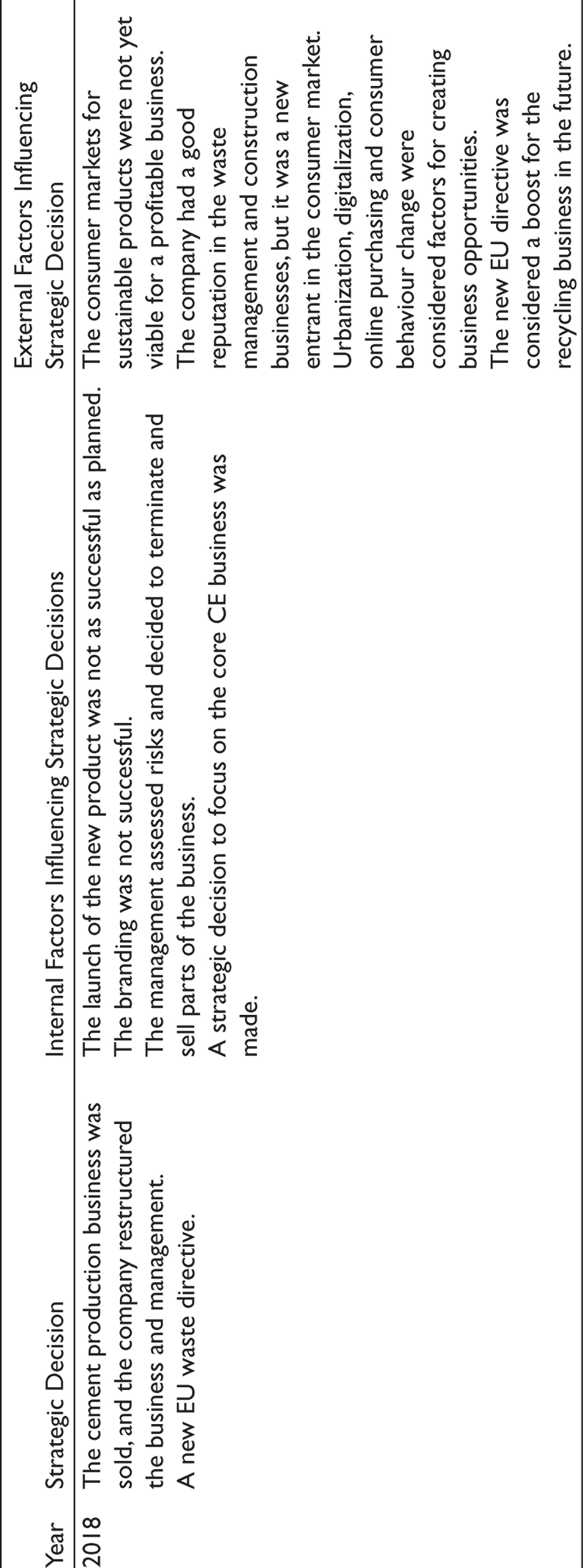
In Table 1, we summarize the analysis of the data. The first two columns show the timeline of strategic decisions related to the CE business in a chronological order. The next-two columns present our analysis on the company-internal and company-external factors that influenced the strategic decisions concerning the CBM innovation. The internal factors were related to strategic management, organizational, technological and business model capabilities. The external factors were connected market events, such as changes in regulation at national and European Union (EU) level, and interpretation of business potential in the CE and recycling business.
Company-Internal and Company-External Factors in Strategic Decisions Related to the CBM Innovation
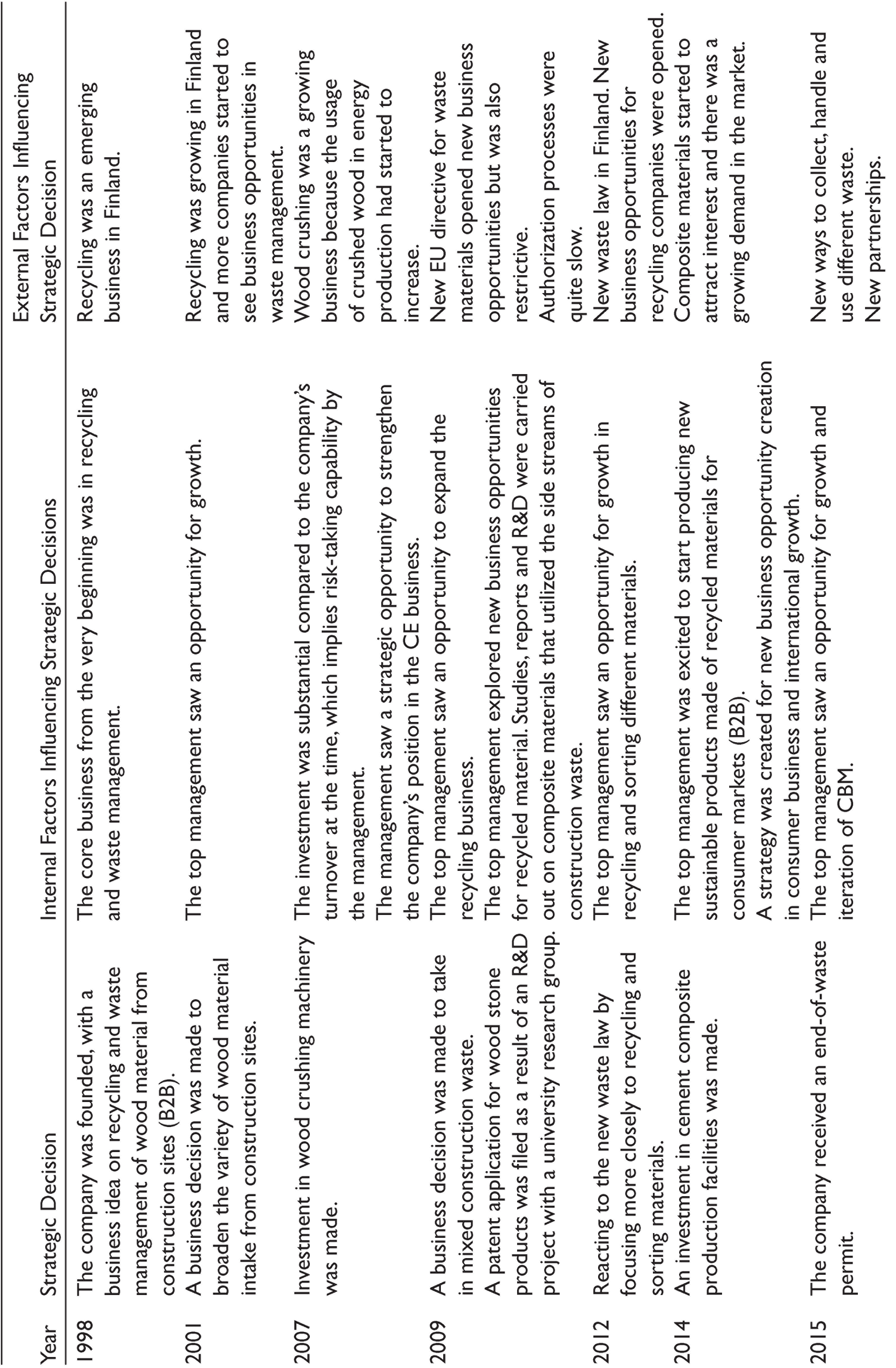
The case company, Destaclean Ltd, operates in the construction waste recycling business (destaclean.fi). The company’s core business is the recycling of mixed construction, wood, wholesale and industrial waste. The company provides waste collection services to the construction industry and it processes recycled raw materials for energy and heat production, further processing of metals and for paving stones to be used in gardens. The recycling rate of the material is close to 100 per cent, with only 1–2 per cent of materials going to final waste processes. The company has built a long-term business partnership with other companies with a mission to provide benefits for all partners in learning about the recycling business and creating a profitable, environmentally responsible business. At the time of data collection, in 2017, the company employed 20 people directly and 20–30 people through contractors with a turnover of approximately EUR 8 million. The main office and four recycling centres are located in Southern Finland, near the largest cities in the country.
The company was founded in 1998 by two entrepreneurs. At the time, industrial recycling was an emerging business sector in Finland and the entrepreneurs recognized business opportunities in the field. At first, the business model was primarily based on recycling wood, but soon, the business expanded to the intake of a broad variety of waste produced in the construction industry. The decision to broaden the intake of wood materials accelerated the growth of the business. The challenge at the time was that the market for reused materials was not very big, and capturing value from waste was difficult other than selling to energy and heat production, as the CEO explained in the interview:
It started with wood—stumps, dry twigs, and wood waste from construction. From there the business grew steadily. (CEO 2017) Most of the [wood waste] went to energy and heat production [burning]. (CEO 2017)
To strengthen the CE business, the company made a strategic decision in 2007 to invest in wood crushing technology. The CEO described this decision as ‘a big, and well, a risky opportunity for the company. The investment was bigger than the annual turnover of the company’ (CEO 2017). While risky, the investment turned out to be the most important and defining strategic decision for the company’s CE business development, because, as a result, the growth of the recycling business accelerated. In 2009, the company started to take in a broad variety of construction waste and explore business opportunities for different recycled materials, such as construction materials, wood, composites, plastics and cement. The company engaged in the research and development of composite materials with a university research group and with national technology and innovation funding. The studies resulted in selecting cement composites as the line of business to be developed further and the company filed a patent application to be used in developing wood stone products that combined wood fibres and recycled stone materials.
If you think about the size of our company and line of business, well, it was a very big investment in product development. A very big investment. (CEO 2017)
The company developed a social responsibility Destaclean® concept, which consists of solutions for different materials in CE as an approach to management and procedures. Strict regulation on the use of recycled materials had an impact on the speed of business development, as reflected on by the DM:
And especially in those cases, when we want to improve our [business] and to make it better for the environment. The regulative process (…) could take over half a year (…) or perhaps a year and more. (DM 2017)
In 2014, the company invested in cement composite production facilities with great enthusiasm due to the positive results from R&D. In 2015, the company received an end-of-waste permit, which meant that they had a legal permit to handle waste as a business and value creation opportunity. The permit was extremely important for their future CE business. A strategic decision to develop a new business line to sell wood stones to be used in landscaping was made. Soon, however, this line of business turned out not to be as successful and profitable as anticipated. The company faced numerous difficulties in R&D, the commercialization process was not successful, and the return on investment turned out to be weak. The CEO reflected on the difficulty of entering a new market:
Launching a new product, bringing a new product to markets (…) it was a huge work. We were known for waste management, in our own business (…) but not [known] in the way that we sell [these kinds of consumer products]. (CEO 2017)
In 2018, a major restructuring of the business was carried out as the company decided to sell the cement production business and concentrate on its core CE business. Managerial and expertise positions were reorganized, and a new CEO was appointed because they felt that a new vision and expertise was needed for the new direction of the company. The most important reason for this strategic decision was a new waste directive by the EU which demanded that 7 per cent of all construction and demolition waste must be recycled by 2020. This created business opportunities for companies like Destaclean that had a proven track-record of operating in the recycling business. The company considered that there would be growth in the CE business in the future.
Company-Internal and Company-External Factors in CBM Innovation
First, the results of the analysis show that company engaged in both closing and slowing resource loop business model strategies in the CE market. Business models for closing resource loops focus on capturing value from ‘waste’ in business (Bocken & Short, 2016; Linder & Williander, 2017). Business model strategies for slowing resource loops, in turn, focus on extending a product’s or material’s life cycle and reuse.
When the company was founded, recycling was a growing and emerging business in Finland. Moreover, waste management business was considered as a viable business opportunity and industrial actors started to invest in it. Thus, over the first 10 years, Destaclean had a closing resource loop strategy with which the company invested in capturing value in the recycling and waste management of construction waste (see Table 1, column 1). For the company, this period meant that the new EU directives made new investments possible, because waste material became more desirable for value creation, for example, creating new sustainable products. Thereafter, for a period of close to 10 years, 2009–2018, the company explored slowing resource loop business model strategy with R&D on wood stone products, investment in cement composite production facilities and branding and entering the consumer markets. However, the chosen business strategy and model was not successful, and the company shifted back to the closing research loop strategy. The chosen strategy for the transition from business-to-business (B2B) sales to business-to-consumers (B2C) sales was difficult, and eventually, the company divested the B2C product line and discarded the strategic plan of becoming a company with a major part of its turnover coming from products, as this was not as successful as had been planned.
Second, the results of the analysis imply that the path dependency in the market was too strong, and the company was not able to break the path dependency of the closing loop strategy. Path dependency and lock-in create difficulties for CE innovation breakthroughs in the market (Korhonen et al., 2018). By introducing a new CE innovation to the market, the company had to fight hard to gain acceptance, because it was a new entrant with a novel solution. The established companies in the market put effort into holding their ground in the market, and companies and consumers alike continued with the old ways of doing things rather than venturing into new ways of doing things. According to the path dependency and lock-in theory, this happens even if the novel solution is environmentally, technologically and practically superior to existing products and solutions. Businesses, consumer practices, and technologies that have gained a leading position in the market will not easily adopt other new solutions, models or practices (Korhonen et al., 2018). In the Destaclean case, path dependency and lock-in explain the difficulties in the slowing resource loop strategy and the failed attempts to enter the B2C market. It was easier for Destaclean to maintain the closing research loop strategy and stay with the original core business idea of providing recycling and waste management services to construction businesses and selling waste material for energy and heat production.
The case company was able to challenge the path dependency and lock-in in the closing resource loop strategy with internal factors that included strategic management such as making decisions within the current market conditions, organizational such as new positions and knowledge, technological such as investments to improve and upgrade recycling and waste management efforts, and business model innovation capabilities (see Table 1, Column 2). Also, external factors in the market supported the exploration of the slowing loop strategy. External factors include emerging business opportunities in recycling, growth in recycling and wood crushing business, new EU directives, slow authorization process, new waste law in Finland, growing demand for composite materials, new waste management practices, new partnerships, lack of interest for novel garden products in consumer markets and new EU directives on recycling (see Table 1, Column 3).
Finally, it can be concluded that the path dependency theory draws attention to a potential strategic risk in the environmental sustainability of Destaclean’s future business. As the company has positioned itself in the CE business and relies on selling wood waste and other waste material from construction sites as an environmentally friendly source of energy, it runs a risk of lock-in in the use of virgin materials (Korhonen et al., 2018). This may lead to a strategic focus on increasing the use of virgin materials that is not desirable from the perspective of environmental sustainability. Also, the lock-in might result in business difficulties when the CE transition starts in the construction industry and the industry starts lengthening material life cycles and engaging in the reuse of materials, thereby reducing the availability of waste flow to be used in closing resource loop strategies, that is, creating value from waste flows.
Conclusion
CE entails a radical change in companies because new ways of thinking and doing business are required (Bocken & Short, 2016). The concept has become popularized in recent years, and academic research on CE is only emerging (Korhonen et al., 2018). This case study presented an in-depth analysis of strategic business decisions of a forerunner company in CE over a 20-year period and provided insight on how company-internal and company-external factors support and test CBM innovation. This study contributes to earlier research on CBM by showing how path dependency play into strategic decisions and the outcomes of closing and slowing resource loop business model strategies in the CE market. Path dependency in the market prevented the company to fully engage in the closing loop strategy, but path dependency in the internal factors allowed for challenging the closing resource loop strategy and explore with slowing resource loop strategy. In a long term, a combination of strategic management capabilities, organizational capabilities, technological capabilities and business model innovation capabilities are needed to overcome difficulties in the slowing resource loop strategy in CE.
The results of this study suggest that path dependency theory is useful in projecting future risks in CBM innovation. Further research is needed on interactions and resonance between internal and external factors to better understand the dynamics of change and complexity in CE and how companies can innovate CBMs.
Footnotes
Acknowledgements
The authors gratefully acknowledge the financial support from the Strategic Research Council at the Academy of Finland (decision number 320209), Foundation for Economic Education, Foundation for Private Entrepreneurs and The Paulo Foundation.
Declaration of Conflicting Interests
The authors declared no potential conflicts of interest with respect to the research, authorship and/or publication of this article.
Funding
The authors received no financial support for the research, authorship and/or publication of this article.