




Abstract
This study is based on field research conducted by an international team of researchers investigating the opportunities for social upgrading of smallholder farm owners and tenants and their workers in the Global South. The main objective has been to assess the influence of crop characteristics, end markets, and value chain governance (including product and process standards), as well as national political, economic, and cultural contexts, on the conditions of farmers and farmworkers. Accordingly, the selected crops differ along the axes of domestic versus international end markets and short versus long shelf-life: coffee (cash crop), rice (staple crop), and mangoes (perishable crop). The selected countries are Bangladesh, Brazil, Colombia, Ghana, India, Pakistan, and Vietnam. Our main findings relate to the importance of collective action by key stakeholders, including smallholders and a supportive state, for economic and social upgrading.
Introduction
Farmworkers and the so-called smallholder farmers generally suffer from insufficiencies in earnings, social protection, political participation, and health and safety precautions (Jha et al., 2021; Radon & Scherrer, 2019; Scherrer & Verma, 2018). A commonly proposed solution to the plight of smallholders is their integration into global agricultural value chains (VCs). For example, the Food and Agriculture Organization of the United Nations (FAO) stated in 2020, “[B]y participating in global value chains, smallholder farmers can boost their food production and income (Food and Agricultural Organization of the United Nations, 2020).” Participation in such chains is supposed to provide access to better-paying end markets and lead to the adoption of more efficient agricultural techniques (Lutz & Olthaar, 2017; World Bank, 2007). The coalition calling for the integration of smallholders into the global market includes not only international organizations such as the FAO and the World Bank but also powerful corporations both upstream (such as the agricultural input industry) and downstream (such as retailers) of VCs (Felsted, 2010; World Bank, 2018).
However, research has indicated certain risks for smallholders in participating in global value chains, such as high initial investments to meet phytosanitary and other quality requirements, rejection of produce that does not meet these requirements, higher levels of indebtedness due to commercially purchased inputs, and volatility of world market prices. Even in cases of successful participation in global supply chains, smallholder value capture remains limited at best, with smallholders receiving only a small fraction of the price paid by the end consumer (Evers et al., 2014; Willoughby & Gore, 2018). Based on 114 articles on contract farming, Bellemare and Bloem identify the highly heterogeneous and context-dependent effects of contract farming and conclude that there is insufficient evidence to draw “broad policy-relevant conclusions” (Bellemare & Bloem, 2018, p. 268).
Together with an international team of researchers, we set out to investigate the possibilities of social upgrading for owners and tenants of small farms and their workers. The concept of “social upgrading” is used as a means of assessing improvements in the conditions of farmworkers and smallholders. For us, social upgrading means improving decent work deficits, that is, increased and more stable earnings, some form of social protection, access to political decision-making bodies (or some form of social dialogue), and better health and safety precautions (ILO, 2017). 1
Our research takes a crop and country comparative perspective, methodologically informed by Ragin (2014, pp. 51–52) and Bryman (2012, p. 75). One of the premises of our research was that the characteristics of the crop, the end markets, and the governance of the VCs (including product and process-related standards), as well as the national political, economic, and cultural contexts, influence the contours of the respective VCs and thus the social and economic conditions for peasant farmers and farmworkers. Accordingly, we have chosen crops that are predominantly produced by smallholders in the Global South, but that differ along the axes of domestic versus international end markets and short versus long shelf-life. We chose coffee as a cash crop primarily for export and rice as a staple crop primarily for domestic consumption. While coffee and rice can be stored for a long time in their processed form, fresh fruits perish quickly. Since this is especially true for mangoes, we chose them for a product with a short shelf-life. The case studies are listed in Table 1.
The Matrix of Case Studies.
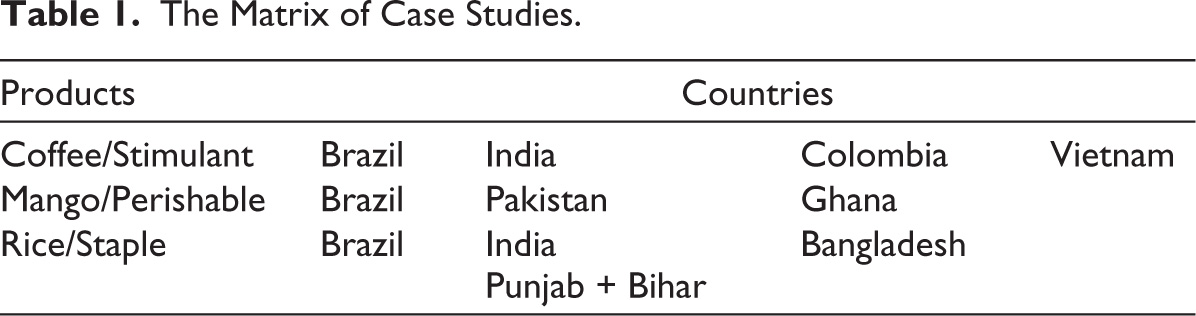
The selection of countries (see Table 1) was less based on conventional criteria and more on the established network of researchers. However, the selected countries are major producers of one or more of our selected agricultural products and are sufficiently diverse to provide interesting insights into the influence of a country’s economic, political, and social characteristics on the possibilities for social and economic upgrading.
Our main findings relate to the importance of collective action by key stakeholders, including smallholders and a supportive state, for economic and social upgrading. On their own, smallholders face barriers to entry into global agricultural VCs, and when they are included, their value capture is marginal. Strong actors (e.g., large retailers) in the chain act collectively. Through their associations and well-established links with local, national, or international public bodies, they can successfully pursue their own collective interests.
We begin our article by clarifying some key concepts. We continue with a brief account of the problems faced when trying to measure the impact of VC participation on smallholder farmers. This is followed by a rationale for our selection of case studies. The following presentation of the case studies is organized according to these factors. Special attention is given to the role of the state in promoting social upgrading. The conclusion emphasizes the importance of collective action for social upgrading.
Definition of Social and Economic Upgrading
In our analysis, economic upgrading refers to the processes by which coffee, rice, and mango producers move into relatively high-value activities and thus capture a greater share of the value generated in global VCs (Barrientos et al., 2011). Drawing on the literature on global VC and network analysis, we identify four distinct, albeit interrelated, types of economic upgrading: chain, functional, process, and product upgrading.
Chain upgrading at the lower end of VCs generally occurs when producers (smallholders/large farmers) move into new but related products or begin to pursue product differentiation. For example, smallholders may have upgraded their VCs by diversifying from monoculture to polyculture using one of the products. Functional upgrading occurs when producers take on more lucrative tasks in the VC. For example, according to a study of mango VC in Pakistan (Mehdi et al., 2016), when smallholders market their high-quality mangoes directly to high-end retailers, the benefit-cost ratio increases. Instead of selling through a commission agent, some producers have taken over the task of marketing, thereby capturing more value in the VC. Process upgrading refers to increasing the efficiency of crop production by adopting new techniques, increasing inputs, using more machinery, investing in land improvement, and/or skills training. Product upgrading generally refers to switching to higher value crops. An appropriate case would be farmers switching from non-Basmati rice to Basmati rice, which is richer in nutrients and flavor.
We use the concept of social upgrading as a means of assessing improvements in the conditions of farmworkers and smallholders. The four pillars of the International Labour Organization’s Decent Work Agenda provide a benchmark for assessing the livelihoods and working conditions of people involved in agriculture: (a) employment creation and enterprise development; (b) social protection; (c) standards and rights at work; and (d) social dialogue. For us, social upgrading means reducing decent work deficits.
Measuring the Benefits of Joining Agricultural VCs
A major reason for the lack of clear evidence on the benefits for smallholders of joining global agricultural VCs, as mentioned in the meta-study by Bellemare and Bloem (2018), is the difficulty in measuring the effects of joining a contractual arrangement compared to not joining. It starts with the observation that joining such an arrangement is not a random matter, neither for the firm nor for the farm. Measuring the welfare effect is also challenging. The common indicator, profits, defies straightforward identification for a number of reasons. One cannot rely on market prices for smallholders’ inputs and outputs because they do not operate in perfect markets (Barrett et al., 2012, p. 720). Labor time, a key input, is particularly difficult to observe from the outside. Surveys can help, but their validity depends not only on how willing smallholders are to reveal their cost structure and sales successes but also on their ability to account for input costs. Furthermore, what may seem profitable in the short term may be costly in the long term, for example, soil and water depletion due to overuse (Swain, 2016).
Another problem is the fallacy of composition. Scaling up the benefits of participation in an agricultural VC may face the obstacle of insufficient growth in demand to accommodate all those who have been encouraged to join the chain by the success of some of their peers. Buyers can also encourage participation by offering attractive contract terms to the first movers in the region. Once they have signed up enough participants, they may offer less attractive terms to latecomers or in the next round (Barrett et al., 2012, pp. 725–726).
While the welfare effect of joining global supply chains is difficult to measure for smallholders, there is more certainty about the barriers smallholders face in entering export markets. Meeting the high quality and phytosanitary standards, as well as the expected volume of crops to be delivered, requires substantial investment by smallholders. They usually lack the financial resources to make such investments. If they are eligible for credit, they run the risk of falling into a debt trap due to the vagaries of the natural environment and the volatility of world market prices (Evers et al., 2014; Willoughby & Gore, 2018).
The response to the uneven distribution of value creation within the chain has been the proliferation of certifications that purport to offer a more equitable distribution. Certification is a market-based intervention mediated by consumer awareness. Demand plays the most important role in third-party certification schemes. In fact, the basic assumption is that the certified product will be treated preferentially by consumers, who will then be willing to pay more if the product in question complies with certain standards. The fair-trade system is perhaps the best known of the certification schemes that seek to increase the value of smallholders. Certification signals that smallholders and their communities will receive a fair share. But it also has some limitations. Recent studies have shown that workers who work for smallholders do not benefit from fairer treatment by their employers, even if they are members of fair-trade associations (Besky, 2008; Cramer et al., 2016; Siegmann et al., 2019).
Case Selections
By using more or less identical methods and the “search for invariance” (Bryman, 2012, p. 75), the country-product comparisons allow us to identify the distinguishing characteristics of the cases (Ragin, 2014, p. 52; see Table 2) and thus the key factors influencing opportunities and potential strategies for social and economic upgrading.
Similarities and Differences: Case Studies.
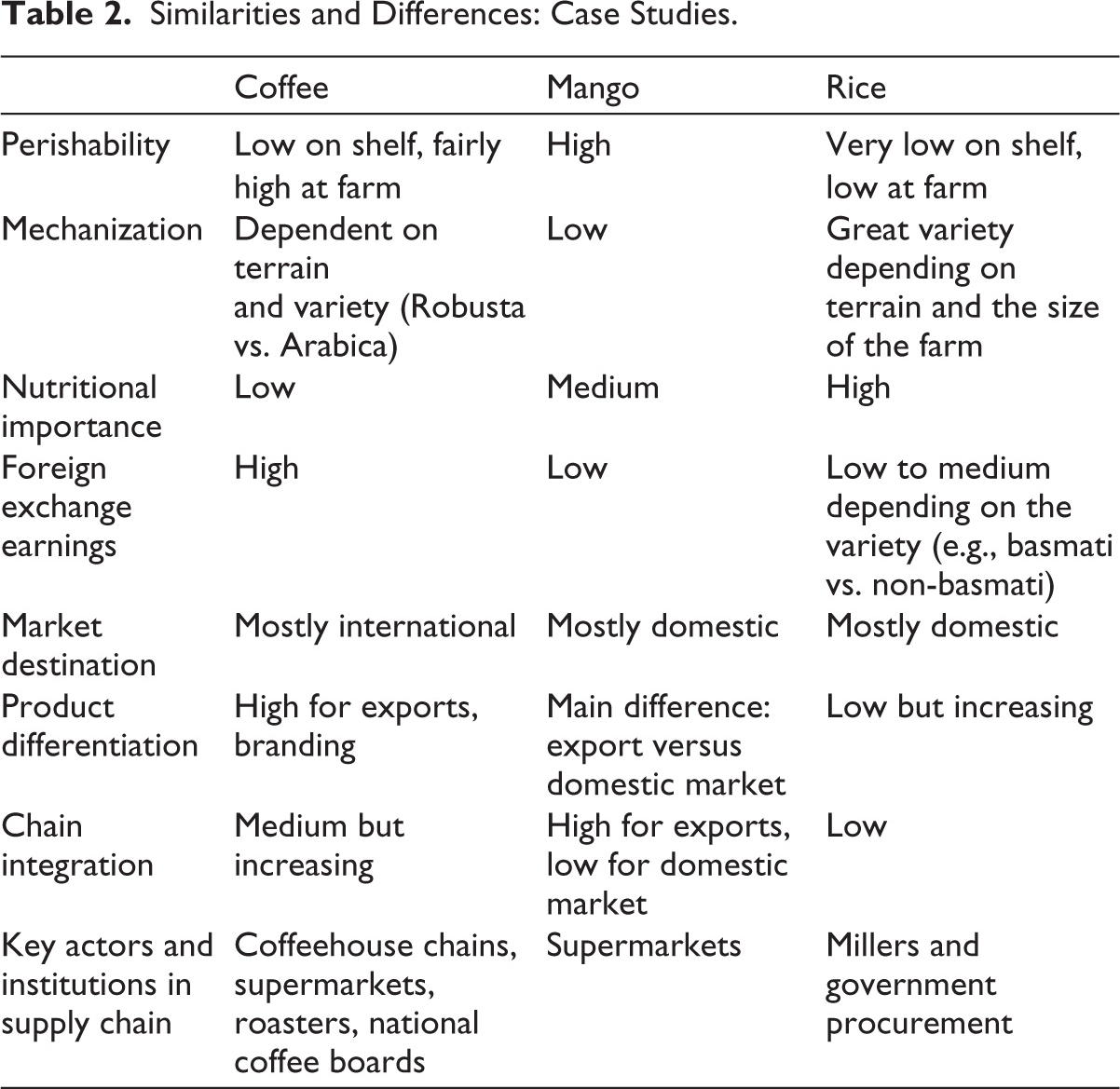
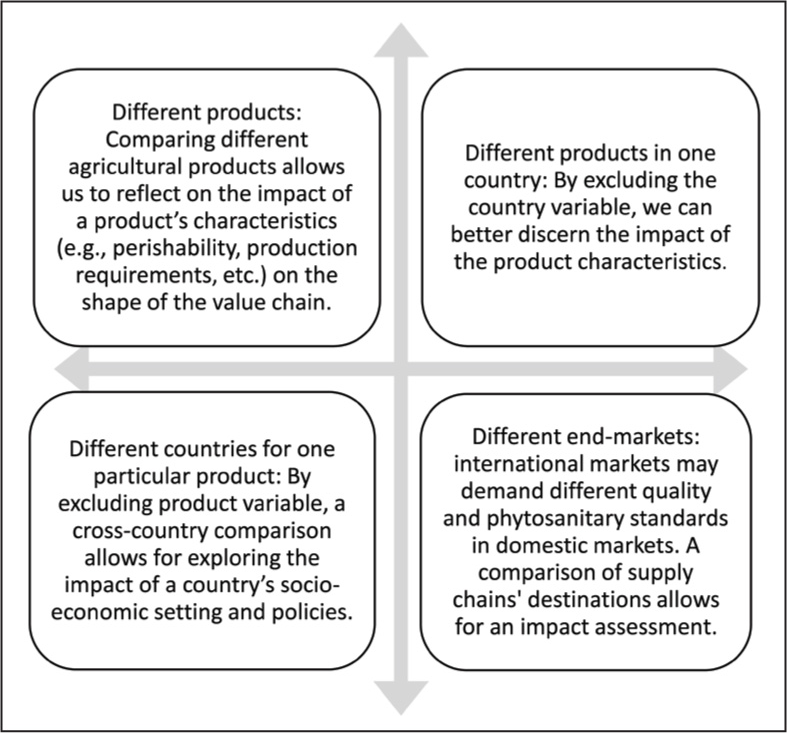
The specificities of agricultural supply chains and the associated variations in social and economic conditions in rural areas can be clearly captured through four axes of comparison, as shown in Figure 1.
The Axes of Comparison.
The study on the rice VC was conducted by Jakir Hossain in Bangladesh and Manish Kumar in two Indian states, Punjab and Bihar, which differ in their specialization and the end markets they serve. Rosa Maria Vieira Medeiros, Michele Lindner, and Sergio Schneider studied a rice cooperative in Rio Grande do Sul. Mubashir Mehdi, Burhan Ahmad, Thales Penha, Walter Belik, Valdênia Apolinário, Francis Enu-Kwesi, Angela Akorsu, and Khiddir Iddris analyzed the opportunities and barriers for economic upgrading and social conditions of smallholders and farmworkers in the mango orchards of Brazil, Ghana, and Pakistan. Coffee production was studied by Dan Hawkins, Clésio Marcelino de Jesus, Antonio Cesar Ortega, Bruno Benzaquen Perosa, Santosh Verma, and Do Quynh Chi, in Brazil, Colombia, India, and Vietnam.
The analysis in these studies involved mapping the tasks and responsibilities of, and relationships between, key actors in agricultural VCs. This included, but was not limited to, the role of mediators, exporters, financial actors, supermarkets, packers, and so on, and their differential capacity to capture value. We started from the a priori knowledge that the asymmetric power relations among actors along with agricultural VCs (from downstream to upstream) have important implications for the social conditions of smallholder farmers and landless farm workers. In these studies, expert interviews were systematically conducted with relevant stakeholders in the VCs. In addition, field research was conducted in each case at different time intervals throughout the research period. The methodology included extensive use of focus group discussions and participatory observation.
The Phantom of Upgrading in Agricultural Supply Chains: Lessons for the Future
In the following, we first present the findings from the crop and country case studies, 2 as well as social and economic upgrading, according to the above-mentioned factors that allegedly influence the possibilities of social upgrading for smallholders and agricultural workers. This is followed by reflections on power asymmetries in VCs and the key role of the state in social upgrading.
Working and Livelihood Conditions
Smallholder farmers and farmworkers in the rice VCs of Bangladesh and India suffer from severe decent work deficits. Farm workers are deprived of basic rights and decent wages. Women are paid even less for the same work. They also face serious health problems due to pesticide spraying and fertilizer application without safety measures. This is particularly true for informal workers, who face higher occupational health risks due to a lack of training and inadequate protective equipment.
In the case of coffee, the living conditions of smallholders are generally better than those of workers. Most Brazilian smallholdings are profitable, even those smaller than 10 hectares. In India, even the much smaller farms seem to survive. In Colombia, many of the small farmers also have to work on other farms to make a living. In Vietnam, smallholders rely mostly on family labor. The average farm income per person working in the household is above the rural poverty line in most cases. Differences in the living conditions of smallholder coffee growers are mainly the result of whether they belong to the majority or minority population and whether they belong to a growers’ association. On average, indigenous coffee growers are less educated and poorer. The same is true for indigenous (Scheduled Tribes in India) and lower caste (Scheduled Castes and Other Backward Classes) growers.
The situation of small-scale mango producers and agricultural workers in Pakistan is similar to that of rice farmers in India. As in Pakistan, Brazilian small-scale mango producers mainly use family labor to assist in the production process. In contrast to Pakistan, Brazilian large-scale producers are more like businesses, and mango production is their source of income. They comply with the legal ban on child labor and the requirements for global food certification. On the large farms, women are concentrated in the packing houses, while field workers are mostly men.
Social and Economic Upgrading
In the case of coffee, the impact of economic upgrading on social upgrading also varied from country to country. In Brazil, economic upgrading resulted in more permanent jobs and significantly fewer temporary jobs. In Colombia, social upgrading was limited to farmers and did not extend to hired workers, despite their significant numbers. The new ducts for transporting berries uphill make work easier for the pickers. In Vietnam, social upgrading took the form of a rapid expansion of the industry, which provided more employment and higher returns to small farmers than their previous crops. The indigenous farming population was left behind. Meanwhile, there has been no social upgrading in India.
Most South Asian rice farmers own very small plots of land due to uneven land distribution and rapid population growth. Small-scale production hinders mechanization and access to extension services. Cooperatives and common ownership of equipment are rare. Compared to Bangladesh and Bihar, Punjab (India) offers better conditions for its small farmers. In addition to favorable environmental conditions for Basmati, rice farmers enjoy more government support (see below). But this comes at a price. The higher yields in rice production translate into higher land rents. Higher yields require more inputs in the form of hybrid seeds, fertilizers, pesticides, and machinery, which require a solid capital base or access to low-interest loans. Both land rent and capital requirements crowd out marginal farmers.
Some of Pakistan’s mango growers, especially medium to large ones, are benefiting by equipping themselves with the skills and technologies needed to access export markets. They and their partners down the chain have captured more value. However, the adoption of best practices is limited among small producers, who mainly sell to commission agents/wholesalers in the local market. In Brazil, the economic upgrading of large-scale farmers has been accompanied by some improvements in worker conditions, but improvements in decent work conditions are still limited to formal workers on large-scale farms and result in fewer jobs (see below).
Land Size Matters
The studies confirmed the frequently cited barriers that smallholders face in linking with global VCs. While some large-scale farmers have succeeded in process and product upgrading in all crops and countries studied, there is little evidence of process or product upgrading at the smallholder level. Process and product upgrading require a certain level of know-how, capital, and social networks to access high-value markets. The desired standards for export markets can only be achieved through substantial investment in mango orchards, coffee plantations, rice fields, and post-harvest management. In the case of mangoes, smallholders also face the high cost of refrigeration for transport. In addition, we see that certification (and other codes and standards) can exclude smallholders from international markets because certification requires both capital and knowledge. In the absence of coordination and collective action in the form of cooperatives and government support, smallholders are overwhelmingly dependent on intermediaries.
Rice growers in Bihar and Bangladesh were particularly limited in their ability to upgrade because their weak bargaining power left them with no surplus for investment. Colombian and some Vietnamese smallholder coffee growers were able to overcome some barriers to economic upgrading through strong associations or cooperatives.
On average, farmworkers have not benefited from the gains made by large-scale farmers. The exception is Brazil, where some improvements in working conditions for mango workers have been associated with economic upgrading. However, the improvements have been limited to formal workers on large estates. This is because the relevant state authorities can only monitor the large farms; they do not control the medium and small production sites, where informal labor relations remain prevalent.
Perishability Worsens the Bargaining Power of Smallholders
As a perishable agricultural product, exporting mango to high-end markets requires the coordination of a series of tasks in the pre- and postharvest phases. Various interrelated tasks—from the use of pesticides to harvesting, marketing, certification, and demand management—cannot be organized by small producers because they lack cooperatives and/or the capital and investment needed to meet the demands of international markets. In the absence of capital or cooperatives, technical assistance is inadequate, especially with regard to training on the risks of the activity (e.g., irregular use of pesticides, lack of protective equipment).
In the case of mango, there is a great asymmetry between small farmers and mediators, since small farmers may be left with spoiled products if they try to bargain hard. They also run the risk of not being considered as suppliers for the next harvest. What we have seen in the case of Pakistan and Brazil is that smallholders delegate the harvest to buyers/mediators who end up squeezing the revenue out of them. The small coffee farmers are exposed to bargaining losses due to perishability, as fewer fresh beans mean lower prices. The inverse power argument may not be true. While extended storage in the case of rice would theoretically allow producers to wait for better prices, smallholder rice producers in India and Bangladesh have typically either exhausted their savings before harvest, are indebted to their buyers, and/or lack storage space.
However, the perishable nature can give farm workers more bargaining power. Higher wages for seasonal workers are not the result of collective bargaining, but of labor market shortages during the harvest season. In the case of Brazil, for example, pickers earn up to USD18 a day during the harvest season, with informal workers earning slightly more.
Mechanization Leads to Social Upgrading and Downgrading
Scale is crucial for mechanization to lead to significant labor productivity gains. This strategy, therefore, is largely reserved for farmers with more land or cooperatives. The crop should also allow it. In coffee, the huge Robusta farms on relatively flat terrain in Brazil allow for much higher levels of mechanization than the hilly terrain that dominates Colombia, or the tiny plots in India. Vietnamese coffee cooperatives have also achieved a higher level of mechanization, while nonmember farmers have not been able to afford it.
However, smaller machines (such as power tillers in India), especially the motorization of transport (or the installation of ducts to transport coffee berries uphill in Colombia), also increase the labor productivity of smallholders. Depending on the size of the investment in machinery, farmers run the risk of falling into a debt trap if market prospects do not materialize as expected. This risk can be mitigated by government action, such as financing irrigation systems and providing subsidized energy to run them, as in the case of Punjab.
Large-scale mechanization leads to a bifurcation of the labor market. Mechanized farms employ fewer permanent workers who have the skills to operate machinery. On Brazilian coffee farms, mechanization reduced the demand for temporary labor by about two-thirds between 2007 and 2016, while permanent labor increased by about one-third. On Brazilian coffee plantations, temporary workers are now employed for shorter periods of the year.
Nutritional Importance Does Not Always Translate into Sufficient Government Support
As expected, governments are much more involved in rice production than in the mango VC. However, the level of government support to smallholder farmers varies widely across countries and provinces. The level of government support depends on two factors, among others: institutional and financial capacity and political mobilization. At one pole, we have the Brazilian government under the PT, which provided the land, irrigation, storage capacity, and public procurement needed for the organic rice cooperative Grupo Gestor do Arroz Ecológico, founded by the Movement of Landless Rural Workers in Brazil (MST). The motivation, however, was not to ensure food security. Rather, it was a response to the problems of a large landless agricultural labor force and its ability to mobilize. At the other end of the spectrum is the government of Bangladesh, which guarantees a minimum price for rice through its public procurement system. However, the government procurement centers are not accessible to small rice farmers, but only to producers and millers.
Between strong support and no support, we find India, but with major differences between the two states studied: Punjab and Bihar. The state government of Punjab offers more generous support. It provides for irrigation and an accessible public procurement system for paddy. In Bihar, there is no such government support for irrigation and the public procurement system is dysfunctional. The public procurement system even works differently in different regions of Punjab because of political orientation. In Patiala, Punjab, the state procures all non-Basmati rice varieties from farmers, which is 95% of the total paddy production. Patiala is in the Malwa region of Punjab, where farmers are politically organized and where most of the leaders of the ruling and opposition parties come from. To keep their vote bank intact, public procurement continues to function efficiently in this region. The limited and inefficient support provided by the governments of Bihar and Bangladesh results in higher levels of poverty among rice farmers in these regions than in Punjab. The more prosperous Punjabi farmers face different problems. Their greater market orientation requires higher levels of commercially purchased inputs such as hybrid seeds, fertilizers, pesticides, and machinery. This puts them at greater risk of over-indebtedness. In addition, heavily subsidized irrigation has led to a significant lowering of groundwater levels.
Prospects of Foreign-exchange Earnings Attract Government Involvement
Foreign-exchange earnings are a central issue in some countries of the Global South due to their trade deficits. Coffee, as one of the most traded commodities, attracts the attention of governments in terms of foreign-exchange earnings. Under the leadership of Brazil and the accommodating position of the United States, coffee-producing countries were able to stabilize international coffee markets and prices between the 1960s and the 1980s by means of the International Coffee Agreement (ICA). After the collapse of the ICA, states lost their importance in the coffee trade: in Brazil, the purchase and sale of coffee were privatized; in Colombia, the state-supported Colombian Coffee Growers’ Confederation (FNC) gave up its export monopoly; and in India, the monopoly of the government-appointed Coffee Board was abolished, and the sector was left to its own devices. In addition to the international roasters, future traders and retailers at the top end of the global retail market (mainly in Europe, the United States, and Japan), the liberalization of the coffee market also opened up opportunities for certain countries. Vietnam’s rise in the international coffee market is the result not only of market forces, but also of deliberate government support for coffee growers. The state-organized migration of the Kinh (the majority group) to the land development centers, accompanied by the flow of credit to coffee production, facilitated Vietnam’s export success.
Brazil’s success in exporting mangoes is based on government-funded irrigation projects, particularly in the Petrolina-Juazeiro and Açú-Mossoró regions. In Ghana, mango producers have not received government support. Its mango exports account for less than six percent of Brazil’s exports.
The Limited Impact of End Markets and Certification
In the case of rice, our analysis shows that the end market may be important for smallholders. In general, however, other actors, including exporters, millers, or middlemen, capture the gains along the VC when rice is destined for high-value markets. Producing rice for export or for urban areas does not automatically lead to social and economic improvements for farmers. For example, Punjabi farmers who grow Basmati earn more than non-Basmati farmers. However, there is no difference in income whether the Basmati rice is sold domestically or abroad. Farmers sell paddy in the market to unknown procurers through commission agents. The procurers are usually agents of rice mills who may sell rice in India or abroad.
In the case of mango, smallholders’ access to the international market is severely restricted by the need for international certification. The market-mediated quality attributes and phytosanitary standards of high-end markets create barriers to participation for smallholders. As a result, improved sanitary standards are limited to those able to meet certification requirements.
The impact of certification on coffee farmers is largely positive. Certification is a prerequisite for access to more profitable markets, but it does not guarantee a better price if the quality of the product does not meet expectations. The certified farms, usually the larger ones, achieve higher yields. In Dak Lak, the largest coffee-growing province in Vietnam, the coverage of certified coffee farming is still limited to about one-fifth of all farms. Certified farms receive a premium of up to 15%, but not all certified coffee can be sold as such due to limited demand for certified coffee.
For coffee workers, the benefits of certification are less clear. In general, workers receive more training and better protection against occupational health risks, not least through improved hygiene conditions. In practice, however, certification does not enforce compliance with labor laws. In Colombia, half of the workers surveyed in a sample could not identify whether the farm where they worked was certified.
Significant Power Asymmetries Limit Social Upgrading
All of the case studies have highlighted the power asymmetries that exist in their respective production systems. The least powerful are the landless farmworkers, a powerlessness that translates into dire working and living conditions. From a power resources perspective (Scherrer & McGuire, 2015; Schmalz et al., 2018), they score low in all categories of power resources: market, logistical, associational, institutional, and discursive power. The market power of farmworkers tends to be low for most of them, as they are often in fierce competition with each other. For more and more categories of products, they can be easily replaced by machines. However, those who can operate the machines have more power in the labor market, especially in remote areas where people have few modern skills (see the case of Brazilian workers on coffee and mango plantations). Their logistical power, that is, their ability to disrupt the flow of the production process, is theoretically greater, especially at harvest time and when handling perishable products.
Exercising logistical power requires concerted efforts based on the power of associations. Although there are farmworker unions, the overall union density among rural workers is very low. As the case studies have shown, in many places, various factors undermine their capacity for collective action: traditional feudal relationships, patronage, seasonal work, remote locations, low-income levels, the urgent need for income, and others. These obstacles to collective action are compounded by the lack of institutional power of rural workers. In many countries, labor legislation does not cover agriculture; farmworker associations are not covered and protected by law. Even when they are covered by the law, effective labor inspections are usually lacking (with the exception of the social democratic PT government in Brazil). This lack of labor law protection reflects the minimal political representation of agricultural workers. It also reflects their limited ability to form alliances with other social actors or movements (i.e., social power). Although the violation of their human rights can potentially generate sympathy and support due to their low levels of formal education (and political awareness), they also find it difficult to frame their concerns in a way that resonates with different audiences: other farm workers, social activists, and political communities (i.e., discursive power).
The case studies also show that the marginalization of farm workers is exacerbated if they lack literacy skills or belong to a group that faces communal discrimination, such as women, migrants, and indigenous people (or lower caste status in India). Small farmers also suffer from intersectional discrimination. However, their power resources are usually less constrained, although the size of their holdings does matter. The tiny plots prevalent among rice and mango smallholders in India and Bangladesh leave them especially vulnerable.
A critique of the status quo must go beyond a narrow economic assessment of dyadic relationships within the supply chain. The relationship between two actors is embedded in a complex web of institutions. The power of input suppliers, distributors, and retailers rests on their legal status as juridical persons, on intellectual property rights enforced by international treaties, and on trade agreements that protect them from discrimination against local competitors. These institutions are part of the neoliberal historic bloc. Changing the balance of power in favor of smallholders, therefore, requires overcoming this historic bloc (Scherrer, 2023).
The Key Role of the State for Social Upgrading
The limited impact of private agricultural VC governance on social upgrading calls for attention to public governance. Our case study findings suggest that labor and social protection laws, as well as their enforcement, affect the social conditions of agricultural workers.
Brazil and India, under the social-democratic Lula (2003–2010) and Hindu-nationalist Modi (2014) governments, respectively, can be taken as two different examples in this regard. In India, thanks to the progressive elites of newly independent India, the laws were (and are) largely pro-labor. The Plantations Act of 1951 is a case in point. However, current enforcement of labor laws is far from effective, especially in rural areas. The relevant government agencies are poorly organized and lack the financial resources to cover the vast areas of rural India. The close links between political society, trade unions and landowning elites prevent better enforcement (Saha et al., 2023).
The lack of enforcement predates Modi’s Bharatiya Janata Party (BJP), and what distinguishes the BJP from other parties is its adherence to economic liberalism. This ideology is deeply rooted in its core base, primarily composed of upper castes and the bourgeoisie, including traders (Karatepe, 2021). A notable illustration of this inclination is evident in the passage of four labor codes by Parliament between 2019 and 2020, reflecting a commitment to liberalize the labor market.
In Brazil, the institutional arrangement to protect rural workers came three decades later. The post-dictatorship Brazilian Federal Constitution of 1988 granted rural workers the same social rights as urban workers. However, effective enforcement of the law did not begin until the Lula presidency. Improvements in real wages, collective agreements, the frequency of labor inspections, and access to health services led to better economic and social conditions for rural workers. The MST has contributed to these improvements. From the beginning, the movement sought access to land for the poor in rural Brazil, where land distribution is extremely unequal. Going beyond traditional rural movements that seek land reform, the movement calls for gender and income equality, as well as an ecologically sustainable way of life. Using a bottom-up approach, the MST has organized many land occupations. Throughout the 1990s, the state and landlords often tried to prevent MST actions through violent means. However, the MST was able to develop counterstrategies to overcome the state’s coercive measures and enjoyed a degree of public sympathy. The movement was initially able to mobilize allies inside and outside Brazil. However, it found even more space to pursue its goals during the governments of the Workers’ Party (Partido dos Trabalhadores, PT; Gilbert, 2015).
For all crops studied, Brazilian farmworkers appear to enjoy better economic conditions than those in other countries studied. However, despite the state’s efforts during the PT era, coverage of labor law enforcement is limited. Our findings in the mango case suggest that only large farms could be inspected for compliance. Working conditions in small and medium farms in remote areas are generally not inspected due to lack of staff, vehicles, etc. Informal labor relations are prevalent in small and medium orchards. Brazilian family farmers often prefer to hire labor informally because they run the risk of losing their status as a family farm and the privileges associated with that status (e.g., subsidized loan rates) if they hire more workers on a permanent basis. The workers of the formal contractor who are covered by the labor law are entitled to a pension, while the informally employed are excluded from these benefits. This loophole testifies to the generally weak representation of landless workers in the Brazilian state. Overall, the distribution of value within the mango chain has changed only slightly; the workers’ share of the value distribution remains small.
However, the impeachment of Lula’s successor in the presidency, Dilma Rousseff, by right-wing forces in 2016 (Carbonai, 2019) led to significant labor reforms in 2017. Michel Temer’s government modified over a hundred provisions in the Consolidation of Labor Law (Silva, 2017). The reform ultimately undermined working conditions in rural areas. Perhaps the most impactful measure is the facilitation of direct negotiations between employers and workers, replacing the existing labor. This change in labor law has empowered employers, who now have significantly more bargaining power than farmworkers. The livelihoods of these workers are closely tied to their wages, making the imbalance in bargaining power particularly impactful. In addition, the labor reform streamlined the hiring process for temporary workers, even for longer periods of time. While this increased flexibility in rural areas, it also led to a reduction in rights and social protection.
In sum, labor laws, the state’s institutional capacity to enforce them, and its position in the labor market as an employer are crucial to social upgrading.
The Importance of Collective Action
Collective action shapes power relations and changes the bargaining power of actors. The conclusion we draw from the case studies is that without collective mobilization, smallholders and farm workers will not achieve social upgrading.
The coffee VC, with its few large multinational roasters and hundreds of thousands of smallholders, is a showcase for the importance of collective action. Since the late 1980s, the FNC has helped its approximately 570,000 members meet the challenges of liberalizing coffee markets by insisting on quality and successful marketing, which has ensured that Colombian coffee consistently commands premium prices on world markets. This has allowed the FNC to resume its policy of guaranteed purchase of all its members’ coffee, based on a minimum reference price. In addition, it provides free technical assistance on a large scale and advice on how to access government subsidies, while also providing some social and investment infrastructure, and has launched a high-end retail chain for its own brand. Among the FNC members, coffee producer cooperatives provide complementary services to those offered by the FNC. The case study highlighted the Cooperativa de caficultores de Andes, which operates processing plants, has its own coffee shops, has developed its own brands, and exports its coffee directly. Colombia’s less organized farmworkers have not experienced such social upgrading.
Most farmers and farmworkers in Brazil are part of a collective organization. The case study focused on the Cerrado Federation of Coffee Growers, which has 3,500 coffee growers as members. This federation successfully obtained a geographical indication for its members’ products, thereby establishing a common brand name. Unlike individual farmers, members of the Federation’s cooperatives receive protective clothing, partial health insurance, fertilizer, seedlings, and training, among others.
Collective organizations also play an important role in the certification of their members’ coffee farms. They support certification by providing advice and technical assistance to help their members adapt their production processes to meet the requirements of the various certificates. However, not all smallholders have the means to comply with certification requirements, especially those outside of associations or cooperatives. The requirements of some of the more ambitious certificates, such as the Rainforest Alliance, are too costly for many smallholders.
Our findings suggest that most smallholders and farmworkers do not have cooperatives and unions through which to attempt collectively to improve their social conditions. As a result, they lack a political voice and have little bargaining power vis-à-vis well-organized, powerful actors in VC, such as large-scale producers, input suppliers, and retailers. In contrast, owners of capital or land seem to be aware of the importance of collective action. Through their associations, their well-established links with universities and local, national or international public bodies, etc., they successfully pursue their own collective interests.
Without collective action, agricultural VC has little to offer smallholders. Grassroots movements such as La Via Campesina have long been aware of this. Their call for “food sovereignty,” that is, the prioritization of local agricultural production, deserves more intellectual and practical support.
Conclusion for a Radical Agenda
The constraints on decent work in the rural areas of the Global South are human-made and can be reversed. Some steps have ostensibly been taken. However, corporate social responsibility or fair trade initiatives address far too narrow a segment of this historic bloc to achieve their stated goals. Their function, perhaps unintentionally, is to serve as a buffer, an absorber of criticism of current standard business practices. Our role as citizens is reduced to that of “ethical” consumers who buy Fair Trade certified coffee. This “new ethics” complements, but does not replace, neoliberalism.
The focus on economic upgrading in much of the literature on GVCs remains within the confines of the neoliberal historic bloc, thus contributing to its legitimacy. The claim that economic upgrading automatically leads to social upgrading is not only empirically unfounded, or theoretically weak but also politically disempowering. This claim reproduces the dominant discourse of the unproductive nature of collective action by workers and marginalized peasants. It serves the interests of those who benefit from the power asymmetry and who stand to lose economic and political privileges as a result of collective action by the currently underprivileged in the VC.
Owners of capital and land seem to recognize the importance of collective action in advancing their interests. Through their associations, affiliations, or well-established links with universities and local, national, or international public institutions, they can effectively pursue their collective interests. Conversely, many smallholders and agricultural workers lack cooperatives, unions, and similar organizations that would enable them to collectively seek improved social conditions. As a result, they have limited political influence and little bargaining power vis-à-vis well-organized, influential actors in the VC, such as large-scale producers, input suppliers, and retailers.
A historic bloc, however, is not permanent. It does not freeze hegemonic struggles. Failure to deliver promised results, shifts in material capabilities, the spread of new ideas, and new strategies of resistance are among the factors that can lead to a “critical juncture,” a situation of disrupted power relations. Whether such a relatively open situation can be exploited by the current “weak interests,” those at the bottom of the U-shaped “exploitation curve,” depends on too many factors to predict. It requires an examination of their ability to fully mobilize their power resources, including their alliance strategies. Practices of transnational solidarity such as fair trade and human rights discourse, can then become resources in the struggle for a more just global economy.
At the current juncture, the historic neoliberal bloc is fraying. The direction in which it is moving points more toward the rise of authoritarian competition states. In support of market share and profit opportunities for their corporations, a growing number of governments are instrumentalizing state power to suppress the organization and voices of those who must sell their labor or toil on their own land.
The rise of authoritarian states is typically accompanied by regressive ideologies that exacerbate gender inequalities and exert additional cultural and political pressure on minorities. This not only weakens solidarity between different groups, such as male and female workers or migrant and local workers, but also creates new hierarchies of winners and losers rooted in rural identities. The conflicts between different identities further strengthen the power of authoritarian states.
Footnotes
Declaration of Conflicting Interests
The authors declared no potential conflicts of interest with respect to the research, authorship and/or publication of this article.
Funding
The authors disclosed the following funding for the publication of this article: the article received financial support for the research of this article from the International Center for Development and Decent Work, University of Kassel.