




Abstract
This article highlights the importance of collective action and the role of the state in upgrading the social and economic conditions of farmworkers and smallholders. It is argued that economic upgrading does not automatically translate into social upgrading for workers and small producers and explores the conditions conducive to social upgrading. The asymmetric power relations among actors in the agricultural value chain erect barriers that hinder social upgrading of smallholders and farmworkers. Collective actions of those who are currently underprivileged in the agricultural value chains and the efforts of states can dismantle these barriers. Drawing on theories relating to power resources and the state, the article documents three successful examples from Pakistan and Brazil where collective action and state involvement have partially dismantled barriers against upgrading.
Introduction
Nearly a third of the world’s workforce is still employed in agriculture. In many of the countries in the Global South, the percentage is much higher. In India, for example, 60 percent of the working population is employed in the agricultural sector. Waged agricultural workers, self-employed farmers, and self-employed workers make up the agricultural workforce. The boundaries between these categories are not clear-cut. Quite a number of self-employed small farmers depend on casual wage work on other farms for survival. Most of those active in agriculture are part of a smallholders’ family. Yet, out of the 1.3 billion people working in agriculture, an impressive 450 million are waged agricultural workers (International Labour Organization [ILO], 2017a, pp. 3–4).
The plight of smallholders and agricultural workers in the Global South is well-documented (Food and Agriculture Organization [FAO], 2011; International Labour Office [ILO], 2017a; Scherrer & Verma, 2018). One frequently proposed solution for smallholders is to become part of what is usually called global value chains (McMichael, 2013). Participating in such chains is supposed to provide access to better paying end-markets and lead to the adoption of more efficient farming techniques (Lutz & Olthaar, 2017; World Bank, 2007). However, many studies have shown the limited impact of such a strategy. First, participation of small actors is not easily achievable because of barriers, such as costly certifications among others. Second, the value capture of the smallholders in such chains remains at best rather limited, that is, they receive only a tiny part of the price the final consumer pays (Evers, Maggie, Stephanie, Krishnan, & Amoding, 2014; Willoughby & Gore, 2018). A recent study has also shown that even workers working for smallholders do not profit from the fairer treatment of their employers, even though they may be members of fair-trade associations (Cramer, Deborah, Bernd, Carlos, & John, 2016).
Given the ample evidence that participation in such chains does not necessarily lead to the expected benefits, we see no point in adding further to the evidence. Instead, we want to explore the conditions under which economic and social upgrading can be achieved. For this purpose, we draw on three upgrading successes in rather different settings. Two of our success stories are from Brazil, one in melon, the other in rice production, and the third one in Pakistan in the production of mango. The melon story is about state infrastructure measures, corporate farming, and effective labor law enforcement (Apolinário, Filho, Penha, & Amaral, 2018; Penha et al., Belik, João Matos, & Oliveira, 2018). The rice case explains the collective action of landless workers supported by a somewhat responsive state (Lindner, Medeiros, & Branco, 2017).The mango story relates the concerted efforts of the Australia–Pakistan Agriculture Sector Linkage Program (Mehdi, Ahamad, & Ahsan, 2018). 1
The key insight that can be drawn from these cases is that their success relies on collective action among a number of actors with a stake in the production process. The necessity for collective action shows that there are countervailing powers that need to be overcome through a template for action and with newer and creative strategies. Therefore, we will not be able to offer replicable strategic advice beyond the already stated. What we offer is rather a general observation stressing that neither economic nor social upgrading is possible without collective action. It is surprising to see that there is a little emphasis on collective action in relevant literature, considering its importance in the rural areas of agro-food systems (except for some studies on farmers’ cooperatives, e.g., Orsi, de Noni, Corsi, & Marchisio, 2017). The bulk of upgrading literature focuses on end-market product and process standards and farmers’ ability to adopt these standards (see, for instance, Van Melle, Coulibaly, & Hell, 2007). It is generally taken for granted that once farmers in the South have fulfilled the standards and engaged in export markets, they and their workers will benefit from it.
This article will briefly describe the cases and discuss in more detail the lessons that can be drawn from these cases. The interpretation here will be guided, on the one hand, by economic development theory, and, on the other, by labor market and power resources theories. The article begins with theoretical considerations by analyzing the preconditions that have to be met for successful economic upgrading, before exploring why social upgrading does not follow automatically economic upgrading. It is argued that collective action is necessary to achieve both economic and social upgrading. The argument is then illustrated by presenting one case from Pakistan and two cases from Brazil.
The Prerequisites for Economic Upgrading
Authors use different names for the coordination of the deepened spatial fragmentation of production and distribution as well as consumption processes across the globe. Some use the term supply chain as a politically neutral expression (ILO, 2016) or to highlight the power of the end user (Burch, 2007). Others prefer the term value chain for discussing the value capture of the various actors in the chain, either as consultants to those who want to increase their share of the value (Porter, 2004) or as critical observers scandalizing the unequal distribution of profits along the chain (Gereffi & Korzeniewicz, 1994). The metaphor ‘chain’ does not quite capture the complexity of modern production; therefore, others have coined the term production networks (Henderson, Dicken, Hess, Coe, & Yeung, 2002). While we consider the term production networks overall more suitable, however, for the purpose of highlighting the differential profit share of the actors in the network, we will use the term value chain. Economic upgrading, in our analysis, denotes all forms of processes by which producers move to relatively high-value activities and thus obtain more of the value generated within the value chain (Barrientos, Gereffi, & Rossi, 2011; Evers, Amoding, & Krishnan, 2014). In the rural areas of the agricultural value chains, an introduction of a new machinery or pesticide or shifting to a more demanded produce can lead to economic upgrading. We use the concept of social upgrading as a means of assessing the improvement of the conditions for farm workers and smallholders. The four pillars of ILO’s decent work agenda provide a yardstick for the assessment of livelihood and working conditions of persons engaged in agriculture: (a) employment creation and enterprise development; (b) social protection; (c) standards and rights at work; and (d) social dialogue. The following 10 substantive elements correspond to these four strategic pillars: (a) employment opportunities; (b) adequate earnings and productive work; (c) decent working time; (d) combining work, family and personal life; (e) work that should be abolished; (f) stability and security of work; (g) equal opportunity and treatment in employment; (h) safe work environment; (i) social security; and (j) social dialogue and employers’ and workers’ representation (ILO website). 2 For us, social upgrading means reducing decent work deficits.
Economic upgrading is a major challenge for producers at the lower ends of the agricultural value chains. The dominant players in the value chains leave them only thin margins, if at all. These margins are not sufficient for the investments necessary to achieve economic upgrading. Besides forming cooperatives or business associations, state support is crucial concerning trade routes, know-how transfer, qualified staff, and access to finance and physical infrastructure (Stiglitz, 2016).
Contrary to much of the economic upgrading literature, social upgrading might not come second but can be a prerequisite for economic upgrading. From an institutional perspective in economics, workers’ rights contribute to long-term sustainable development. The stimulatory growth effects of workers’ rights can result from the economic demand side and the supply side. From a demand-oriented perspective, highly unequal income distribution is regarded as an obstacle to sustainable development (Herr & Ruoff, 2016). First, it is argued that a high level of economic inequality impedes the emergence of a mass market in durable consumer goods. Second, the concentration of national income in the hands of a few people produces an excessively high savings ratio, such that growth-stimulating investment is too low. Rich people have a much higher propensity to save than poor people. Whether they will invest their savings for productive means depends on their expectation concerning whether demand will increase or not. If wages stagnate, then an increase in demand is less likely. Third, the high savings ratio also increases the likelihood of capital flight, especially in poor countries where elites frequently prefer to keep their savings in hard currency, that is, abroad (Ndikumana & Boyce, 2003). While fiscal policies might redistribute market income, workers’ collective power can limit inequality already at the market level. Thus, freedom of association and the right to collective bargaining are necessary pre- conditions for a more equal distribution of income (Gross, Hoffer, & Laliberté, 2016).
The supply-side institutionalists cite two reasons for a positive effect on a country’s economic development prospects by minimum social standards and resulting higher wages. First, higher wages promote the development of ‘human capital’, without which no economic development is possible. Wages close to, or below, the minimum subsistence levels make it impossible for workers to invest in their own education, or that of their children. Besides, such a wage level is often insufficient to pay for even very essential healthcare. Higher wages, on the other hand, may not only enable workers to maintain and enhance their qualifications but might also increase the incentive to attend school and adopt performance-oriented behavior (Sengenberger, 2005). There is evidence that the early involvement of children in work can have serious consequences for their health and development (Moccia, 2009).
Second, the supply-side institutionalists argue that social standards are necessary for making the transition from an extensive to intensive use of labor (Piore, 1994). Under the prevailing system of casual agricultural labor, employers have no particular interest in using labor intensively. This is largely because the workers are paid not by the hour but by the amount of land they till or the amount of produce they harvest. This implies that there are no fixed costs of labor. Capital stock is usually small and consists of outdated machinery that cannot be used more efficiently. The resulting low labor productivity, in turn, precludes raising wages. In such a situation, minimum social standards could increase interest in measures to raise productivity by changing the structure of incentives for agricultural employers and workers. For the employers, this would make the extensive use of labor less attractive, and for workers, it would be rewarding to strive for the success of the agricultural enterprise.
In sum, while mainstream literature claims that social upgrading follows economic upgrading, we argue, inspired by institutional economics, that economic upgrading requires social upgrading. Workers’ with rights to collective bargaining can support the development of a domestic market by negotiating higher wages. Higher wages and social standards can in turn incentivize employers to use labor power more efficiently, that is, upgrading the production process.
Why Economic Upgrading Does not Automatically Translate in Social Upgrading for Workers?
Much of the economic literature proposes that the benefits of economic upgrading will trickle down to the workers employed in the economic units that successfully upgraded. This proposition is based on two assumptions: first, that upgrading leads to more value capture of the value created in the global supply chain; and second, that the product and labor markets are tightly connected. The extent to which economic upgrading leads to more value capture depends not only on the specific mode and degree of upgrading, but also on the responses of competitors and the power resources of the buyers. If many competitors follow the upgrading trajectory of the supplier firm, the key buyers remain in a powerful situation vis-à-vis all these upgraded suppliers. Unless the suppliers win access to the final consumers, they will remain dependent on the buyers. The buyers’ control of access to the end markets will provide them with the power to dictate the purchasing prices and other conditions, and thus to capture the main part of the value generated in the chain. Thus, the initial greater value capture by the first mover supplier firm will be whittled away through competition and the buyers’ continued control of the supply chain.
Even less realistic is the assumption of a close connection between product and labor markets. While more value capture potentially allows for higher wages and for better working conditions, it is not at all guaranteed that the additional value capture will be equally shared by owners, managers, and workers. The reason is that on the level of a firm, success in the product market has little impact on the demand conditions in the labor market. Only at a more aggregate level, that is, when many firms engage successfully in economic upgrading, their collective success might lead to a substantial increase in the demand for labor and, thus, to higher wages. Of course, a firm whose upgrading leads to a rapid increase in labor demand might clear the local labor market. Furthermore, upgrading does not necessarily imply a greater demand for labor. Productivity increases may outpace demand. In addition, the labor market may be not at equilibrium, that is, unemployment may exist. It is, therefore, pertinent to have a closer look at the dynamics of the labor market.
At a basic level, the prices (that is, wages and working conditions) in the labor market are determined by supply of and demand for labor. The supply is dependent on many factors: in countries with a sizable peasantry, its subsistence possibilities influence greatly the number of persons offering their labor power. Combined with a rapid increase in population (mainly due to increased life expectancy) and structural obstacles for industrialization which may absorb the labor surplus, the livelihood challenges of the peasantry will lead to an oversupply of labor power, as shown in a detailed discussion of the labor market absorption challenges in late industrializing countries by Scherrer (2018).
As the skills of peasants are of little use in the modern economy, they start out as low skilled laborers. Their abundance in the case of a lack in demand for labor leads to low wages. As a modern economy depends on skilled labor, skilled labor has a privileged position to profit from any upgrading strategy. The supply of skilled labor is context specific: it depends very much on the degree to which the government is providing training or higher education as a public good with sufficient resources for high standards. Low levels of government support might increase the pay differential for skilled labor, but may also undermine the possibilities for economic upgrading and, therefore, for more skilled jobs (Reeg, 2013).
Supply of, and demand for, labor, differentiated according to levels of skills, however, are not the only factors influencing prices on the labor market. The labor market is also a ‘contested terrain’ (Edwards, 1996), on which actors struggle with each other to share the value generated. The main struggle is between those who demand (that is, employers) and those who supply labor power (workers). This struggle has received a lot of attention and, therefore, needs no further elaboration at this point. However, the struggles among workers have received less attention. These struggles have important implications for the main struggle. In trying to profit from traditional wage or income differentials between groups and/or by forestalling labor solidarity, employers might favor one group over others. They, thereby, might gain support from their favorite group of workers/employees. The latter might join (or even force) employers to discriminate against other groups of workers. These kinds of coalition are most likely to occur under conditions of an oversupply of labor power.
However, employers may also turn to groups traditionally kept out of better paid jobs in order to gain access to cheaper labor power, and, thereby, try to undercut the power of the entrenched group of workers. These kinds of struggles are not confined to the labor market proper, that is, in the hiring phase. They continue during employment, because the exact amount of labor power exerted cannot be stipulated by the labor contract. For this reason, employers prefer piece-rate remuneration, and if this is not possible, they devote considerable resources to the supervision of labor. The need for supervision may actually favor the hiring of traditionally discriminated groups, because they are likely to be either more docile out of enforced habit or more vulnerable to threats of being fired because of fewer alternatives available to them (Lüthje & Scherrer, 2001).
The conceptualization of the labor relations as a contested terrain raises the question of power. Under most circumstances, the labor market is characterized by asymmetric power relations in favor of the employers. Those who can wait have usually the upper hand in a bargaining situation. Provided with means of production and/or land, the employer can wait, longer than the individual who has nothing else to sell but his or her labor power (especially under conditions of a labor surplus). In agriculture, the need to harvest or to sell a perishable produce at a specific time might render the owner of the land or the produce vulnerable to withdrawal of labor power. Yet, owners usually command resources, such as solidarity amongst themselves and access to mostly friendly courts and governments. Especially in remote rural areas, owners may also enlist people willing to subdue oppositional groups by all forms of coercive means (in the case of Colombia, for instance, see Forero, 2012, pp. 66–77).
This asymmetry becomes more visible by exploring the possibilities for farm workers to resist their employers. For this purpose, we will make use of the power resource approach and its differentiation of power resources: market, logistical, associational, institutional, and discursive power (see McGuire & Scherer, 2015; Schmaltz, Carmen, & Webster, 2018). Farm workers’ market power is, for most of them, rather low, because they are frequently in great competition amongst each other. For more produce categories, they can also be easily substituted by machinery. Those able to handle the machinery, however, may have more power in the labor market, especially in remote areas where people possess few modern qualifications. Their logistical power, that is, the ability to stop the flow of the production process, is theoretically higher, especially around harvest time and while handling perishable produce. To actually exert logistical power, concerted efforts are necessary, which rest on associational power. While farm workers’ unions exist, the overall union density is very low among rural workers. Various factors undermine their capacity for collective action in many places: traditional feudal relationships, clienteles, seasonal work, remote areas, the low levels of income, the urgent need for income, among others (Sinaga, 2019). These obstacles to collective action are compounded by farm workers’ lack of institutional power. In many countries, labor legislation does not include agriculture; agricultural workers’ associations are not covered and protected by law. Even if they are covered by law, effective labor inspections are mostly missing (ILO, 2017a). This lack of labor law protection reflects agricultural workers’ minimal political representation. It also shows their limited ability to form alliances with other social actors or movements (that is, social power). Although the violation of their human rights can potentially elicit sympathy and support due to their low levels of formal education (and political consciousness), it is, furthermore, difficult for them to frame their concerns in a way that resonate with different audiences: other farmworkers, other social activists, and policy communities (that is, discursive power).
The state largely mediates the relation between collective action and upgrading. The labor laws, the state’s institutional enforcement capacity, or its position in the labor market as an employer, are all crucial for upgrading processes. Thus, the state should not be conceptualized simply as an actor, but as a social relation, that is, as a terrain, or a battleground, where different strategies compete with each other (Jessop, 2016). On this terrain, agricultural workers and smallholders face more constraints than other groups with command over more power resources. These constraints can be overcome if workers and smallholders succeed in mobilizing their various power resources in pursuit of better working and livelihood conditions, that is, social upgrading. The partially successful struggles of the Landless Rural Workers’ Movement in Brazil (MST, see below) or of the farm workers in the United States (Shaw, 2008) illustrate the possibilities for overcoming these constraints. At the same time, these cases also depict many preconditions for sustained success. A key element to success seems to be the ability to mobilize allies in civil and political society with the aim of securing the favorable institutional climate, especially a favorable legal framework.
To sum it up, there is no economic or social upgrading without collective action. For sustained upgrading, collective action is necessary on many levels. Owners of capital or land are usually well aware of the importance of the collective action to enhance their own interest. For smallholders and farm workers at the lower ends of the agro-food industry, this is frequently not the case. At the grassroots level, workers need trade unions and smallholders need cooperatives. Trade unions for workers without much market power have to rely on workers’ associational power combined with different power resources in order to ensure that the benefits of economic upgrading will also ‘trickle down’ to the workers. Cooperatives may serve in the same way for smallholders. Armed with different power resources, smallholders as well as farm workers may ‘capture’ more of the value generated within the value chains.
Instances of Successful Cooperation for Upgrading
Mangoes in Pakistan
It is generally understood that farmers in the global South have only limited access to export markets. The market-mediated quality attributes and phytosanitary standards of high-end markets erect barriers for the small-scale producers’ participation. The standards and grades facilitate the trade of agricultural produce insofar as they lower the product-related risk. They have been shaped significantly by the powerful actors of the value chain; especially, the growing power of supermarkets in the global agri-food system and their attempts to re-organize production and distribution have largely molded the standards and quality attributes.
Fulfilling standards and desired quality require knowledge, capital, and organizational capacity. The perishability of mangoes heightens these barriers and, thereby, the costs of overcoming them: exporting to the high-end markets requires much more precise coordination involving a series of tasks in the pre- and post-harvest periods. Cooling and packing techniques are especially costly. Most of the small-scale producers are deprived of capital and investments necessary to fulfil the requirements of the international markets.
As described by Mubashir Mehdi et al. (2018), the factors hindering growers’ participation in the global value chain can be eliminated. They show that challenges were overcome for some Pakistani mango growers with the help of a comprehensive program designed and supported by Australia–Pakistan Agriculture Sector Linkage Project (ASLP). Besides the government of Pakistan and the Agricultural University of Faisalabad, the ASLP project was carried out by the Australian Centre for International Agricultural Research, the Trade Related Technical Assistance of the United Nations Industrial Development Organization (UNIDO), and the United States Agency for International Development (USAID).
The supply chain appraisal approach of the ASLP project involved key stakeholders, such as growers, traders, exporters, retailers, extension agencies, and R&D organizations. This exercise identified substandard practices in the management of the mango orchards. The participating core of about 40 growers took part in workshops, ‘walking the chain’ exercises, and trial shipment activity. ‘Walking the chain’ implies that growers observe every step in the chain from export and local markets to their farm. This participatory learning experience led to many changes in the management of the orchards and the marketing of the produce. Researchers from different disciplines identified the right kind of mangoes fitting to the soil in Pakistan, the long transportation distance, and the consumer tastes. Cold storage facilities were designed and constructed. Transport logistics were explored and tested.
This orchestrated improvements in basically all parts of the mango value chain. Above all, such best practices set out premium quality mangoes (blemish free, properly graded) at the upstream of the value chain. The improvements allowed not only the export of mangoes to the European market but also translated in much higher margins for the growers (Mehdi et al., 2018, p. 283, see Table 1). The growers engaged in the project sold their produce to high-end retailers which offered much higher farm gate price in comparison to what other growers, who sell their produce to small fruit retailers/outlets in the domestic market, receive. Not only the growers, but also the farm workers benefited from these improvements. The economic analysis revealed that labor costs were much higher in such best practices. Table 1 compares the cost structure of traditional and improved mango production. Even though the share of labor costs in total on farm costs almost remain the same, the absolute difference is remarkable.
An Economic Analysis of Traditional Versus Best Practices Mangoes
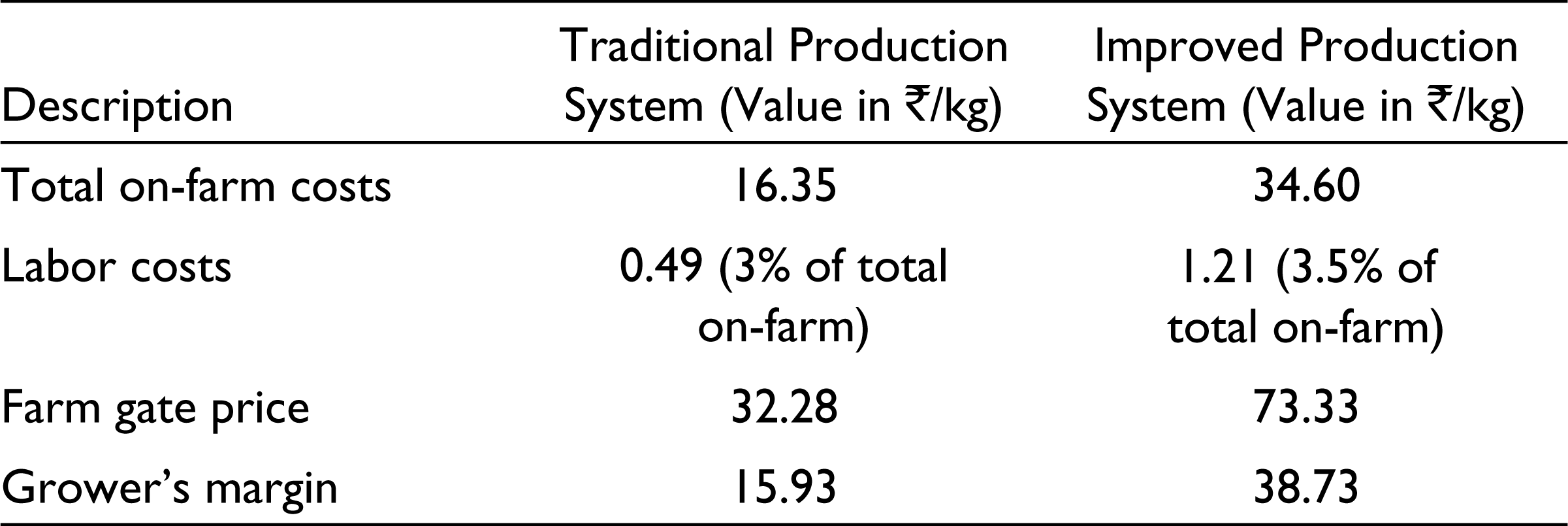
The acceptance of trade unions led to higher wages and compensation payments. Besides, the adherence to higher phytosanitary standards lowered their health risks and the occupational hazards. Regardless of higher labor costs, the growers’ margin was higher on the improved farms. One of the reasons behind the higher profit margin was their capacity to establish direct relation with the end markets, excluding middlemen. Even if they sold their high quality mangoes through traditional channels, the profit earned was higher than that of traditional mangoes.
The concerted efforts of key stakeholders in the global agriculture value chains fostered trust among them which eventually rendered commission agents, wholesalers, and exporting firms unnecessary for any trade activities. Traditionally, exporting firms purchase from commission agents and wholesalers who also demand their share of profit. Their profit share squeezes the margins of the growers who, in turn, pass on the pressure to the farm workers. Besides, the middlemen are reluctant to market premium quality mangoes, because they must convince buyers of the quality attributes of the premium mango. This is a time-consuming process. In addition, selling mangoes of lesser quality allowed them to arbitrarily pay the growers for fewer mangoes than they received. However, as the authors point out, this successful project finds few imitators among Pakistani mango growers. Few farmers are willing to train their workers, or to provide them with better pay and working conditions, in order to achieve more efficiency and higher product quality. Subsequently, the authors argue for government agencies to create an enabling environment similar to the ASLP project so that other farms, as well as the rural workers in the mango chain, can also be a part of this system. The project had limited scope in contrast to what the state could actually provide at regional and national level.
Whether the government agencies can create such an enabling environment for economic and social upgrading is not only a question of institutional and economic capacity of the state. It is also a question of power, as it affects the current actors in agriculture differentially. Middlemen might not be willing to give up their position in the chain; other growers might not like to empower workers as a principle. Which groups might have more influence on state policy is a question of power struggle, and, concomitantly, their collective action capacity.
Melons in North-Eastern Brazil
In recent decades, the Brazilian north-east Açú-Mossoró region has become a major production site for melons. Depleting groundwater resources while enjoying a maximum of sunny days, some growers manage to harvest melons up to six times a year. But it is not just the sun and water, or the shortest distance between Brazil and Europe, that made this area a favorite site for the production of melons for exports. As the research team from the Federal University of Rio Grande do Norte (UFRN) 3 describe it, it is in the first place the result of state intervention (Apolinário et al., 2018; Penha et al., 2018).
The Açú-Mossoró region’s agricultural prowess began with the Brazilian military government’s Integrated Rural Development Plan in the 1970s. This plan included large-scale hydraulic public works for the supply of water, tax incentives, and easy access to credit—along with, to a small extent, land reforms to settle smallholders in the area (Penha et al., 2018). At the same time, the military dictatorship in Brazil (1964–1985) repressed trade unions for both urban and rural workers. Thereby, it ensured the supply of cheap labor for employers. The working and living conditions of agricultural workers in the north-east were appalling in this period. The post-dictatorship Brazilian Federal Constitution of 1988 made rural workers juridically equal to urban workers in terms of social rights. At least according to the Constitution, rural workers were granted some rights which had already been granted to urban workers. However, enacting a law is one thing, enforcing it is another. The enforcement of these rights began only when the former trade union leader and Workers Party’ presidential candidate, Luiz Inácio ‘Lula’ da Silva, was voted into office in 2003 (Apolinário et al., 2018).
Lula’s presidency ushered in a period of improved working conditions, real wage increases, and expansion of social protection in urban as well as rural areas. Agricultural workers started to benefit from collective bargaining agreements and more frequent labor inspections, which have improved workplace health and safety. The government also provided better health services for the smallholders in remote areas and set up a mobile units program to reach out to women facing sexual harassment and violence (Apolinário et al., 2018).
These gains for farm workers are now threatened by a neoliberal labor law reforms undertaken by the Brazilian Parliament after the impeachment of Lula’s successor Dilma Rousseff in 2016. The new labor legislation, enacted in July 2017, arms firms with more bargaining power in the labor market. The maximum length of temporary contracts was prolonged from 6 to 9 months, the 8-hour workday regulation was relaxed, and the workday can be prolonged to 12 hours. Besides, agreements between individual companies and unions can overrule collective agreements and the legislation itself. As noted by Diogo (2017, p. 12), ‘this is a clear sign of liberalization of the labor market: the predominance of enterprise level agreements over sectorial agreements’. Without state protection, workers with limited associational and market power are in a weaker bargaining position vis-à-vis employers. This example shows that social upgrading or downgrading of workers in agriculture depends to a great extent on the actions of the state.
However, even under the improved conditions of the Workers Party’s rule, the value captured by the agricultural workers remained tiny. The research team found that the farm owners captured the largest share of the value of a fresh, whole melon in 2016. Independent of the melon’s final destination, domestic or international, the owners receive more than 40 percent of the final price, while the workers receive only a bit more than 3 percent (Penha et al., 2018). The field research of the UFRN team further revealed differences in labor relations among the three main groups producing melons, corporate farms, medium producers, and family farmers, who were provided with settlements owing to land reform. The corporate melon producers, when compared with rural settlements, are providing working conditions and occupational health and safety measures more in line with the ILO conventions, including on the issue of child and forced labor. A drawback is the lesser demand for workers in relation to the output due to the economies of scale in the corporate farms. The specialization of labor in the corporate farms allows for utilizing less farmworkers per land in comparison to family farms. In contrast to corporate farms, the family farms in the settlements suffer from limited access to basic resources such as credit, training, health assistance, and transportation. The lack of healthcare is especially detrimental for the women in this sector (Apolinário et al., 2018).
Organic Rice Farming in Southern Brazil
Rosa Maria Vieira Medeiros, Michele Lindner, and Cicero Castello Branco Filho (2017) from Universidade Federal do Rio Grande do Sul shed light on an innovative model of rice value chain that overcame several barriers imposed by market forces. The model in Rio Grande do Sul, which currently includes 27 settlements, began in 1999 only with two settlements. Currently, more than 1,300 families are involved in this innovative model. Today, it is regarded as a most important organic rice production site, having its own rice brand, Terra Livre (Free Earth). The model in question includes three local/regional cooperatives 4 and one cooperative for the local commerce. 5 The activities and the coordination between different cooperatives are largely organized by Ecological Rice Management Group (Grupo Gestor do Arroz Ecológico). The group gathers the representatives of the cooperatives as well as representatives of the certification team and technicians four times for each agricultural cycle. The cooperative-related decisions, such as training days and irrigation areas, are taken during these meetings.
In the context of upgrading and collective action, the model has three novel features. First, it is one of the few successful production sites in the world initiated and largely organized by a social movement, that is, by families linked to the MST. The movement strives to provide access to land for rural poor in Brazil, where the distribution of the land is extremely uneven. Going beyond the traditional rural movements seeking land reform, the movement calls for gender and income equality as well as for an ecological way of life. Having a bottom-up approach, MST has organized several land occupations. In the course of 1990s, the state and landlords attempted to prevent the MST’s actions, frequently by violent means. However, the MST succeeded in developing counter-strategies to overcome coercive means of the state and enjoyed some public sympathy. The movement could mobilize allies both in and outside Brazil. During the Workers’ Party government, the MST had finally found more room for its actions.
Second, the model strives to transform the different stages in the rice value chain. It does not only organize the production processes, but also inputs (such as seeds), certification, the preparation of soil, and marketing. Thus, it creates a greater range of employment opportunities for its members, while the organization of a whole production system allows for more value capture along the rice value chain.
Third, the cooperative strives to overcome the dependence on agro-chemicals. This liberates farming activities from expensive input materials. The cost of the input materials is not the only reason. The cooperative articulates a critical sustainability discourse, which connects the economic and social issues with ecological issues. Thus, occupying land becomes much more than just possessing property. The farmers have transformed it according to their collective visions.
The MST-led cooperative’s ability to enlist the support of the state has been a crucial ingredient of its success. The state furnished storage silos and had become a major buyer of its produce. Local and regional states procure organic rice from the cooperatives for programs ranging from school feeding to social welfare schemes against nutrition insecurity, such as the Food Acquisition Program. Besides, the cooperative secured a Venezuelan government contract for exporting its rice. Even though the Brazilian state agencies have bought a substantial part of the cooperative’s rice production, the cooperative’s brand, Terra Livre, is also sold in local supermarkets in Rio Grande do Sul.
It is estimated that its rice is sold at a premium of around 20 to 25 percent. The costs of organic rice production are much lower (estimated as three times lower) than the costs for the conventional production model, which heavily utilize pesticide and other chemical inputs. This leaves a higher profit margin to the organic farmers, even though the productivity is lower than conventional production model.
In sum, the cooperative in question, strongly supported by the state, succeeded in economic upgrading. Arguably, without the collective will of MST or the government agencies’ support during the Workers’ Party period, the project could not have been realized. Its future is endangered by the capture of state power by the right wing.
The economic benefits of the farmers went along with better working and living conditions for its members. Thus, this case highlights a positive interaction between social and economic upgrading. Besides, the model is novel in terms of its relationship with nature as well as its egalitarian governance structure. The model itself, going beyond conventional farming, represents an environmentally friendly farming practice. It is regarded by the authors as participatory and democratically managed production process, which is quite different from purely market-oriented practices.
Conclusion: The Importance of Collective Action
Since economic upgrading does not automatically bring about social upgrading, one must explore the conditions which are conducive for social upgrading (Barrientos et al., 2011). Besides, social upgrading may bring about economic upgrading. Understanding the relation between social and economic upgrading requires an analysis that maps relevant actors, institutions, and structures in the agricultural value chains and explores their impact on the social and economic conditions of smallholders and farm workers. The analysis of structures and institutions unveils their asymmetric power relations among the actors. It sheds light on the barriers that hinder upgrading of producers and farmworkers as well as on possible collective actions that might dismantle these barriers.
We documented three case studies in which collective actions by different actors have successfully, yet not fully, dismantled the barriers against upgrading. These barriers may differ from case to case. The same is true for collective actions required to dismantle them. The lessons that can be drawn from the case studies are far from replicable. The conclusion that can be drawn from the context-sensitive analyses is that associational power combined with different power resources is the key for different stakeholders in the agricultural value chain to overcome the constraints imposed upon them.
The state plays a crucial role in enabling or preventing economic and social upgrading. It is a highly unequal terrain for competing interests. It is unequal because some actors are more privileged in pursuing their own interest at the state level. Especially smallholders and farmworkers generally face more structural constraints than large producers or other powerful actors of the global agricultural value chains in pursuing their interest and realizing their objectives. The constraints should not be assumed to be given or fixed. As shown in the Brazilian case, they are the outcome of social struggles and practices. The rural struggles in Brazil accompanied by a labor-friendly government were conducive to social upgrading on the farms.
The owners of capital or land appear to be conscious of the importance of collective action. Through their associations and their offshoots or their well-established connection with the universities and local, national, or international public bodies, they can successfully mobilize power resources and pursue their own collective interests. In contrast, most of the smallholders and farm workers lack cooperatives or unions through which they can jointly attempt to improve their social conditions. As a result, they lack political voice and possess little bargaining power vis-à-vis well-organized powerful actors in the value chain, such as large producers, input providers, and retailers.
Finally, the claim about economic upgrading automatically bringing about social upgrading is not only empirically unsubstantiated but also politically disempowering. This claim reproduces the dominant discourse of the unproductive nature of collective actions by workers and marginalized farmers. It serves the interests of those who benefit from the power asymmetry and who might lose economic and political privileges in the wake of collective actions of those who are currently underprivileged in the agricultural value chains.