




Abstract
This article highlights the tension between direct actions and electoral politics to explain the formation of an urban poor settlement, often referred to as a kampungkota, an emerging term for settlements beyond the modern, planned part, in North Jakarta, Indonesia. The authors interpret kampungkota as a commune and unpack the process of commune formation with reference to the experience of Kampung Akuarium into three different yet interconnected parts. The first is direct action through land occupation by the urban poor in the 1980s. The second is direct re-occupation after the 2016 eviction and the joining-up of the settlers with a wider urban poor organization (the commune of communes). The third is the rebuilding and legalization of the commune, which is collectively managed through a housing cooperative, facilitated by a political contract in the 2017 Jakarta gubernatorial election.
Introduction: Capitalist Urbanization and Jakarta’s Kampungkota
At its finest, Jakarta, the capital of Indonesia, is par excellence a concrete spatial expression of a manifesto of capitalist urbanization, with its population explosion, congested traffic, flooding, sea-level rise, land subsidence, and economic unevenness. The city’s population grew from 1.5 million in the 1950s to 10.5 million in 2019 (BPS DKI Jakarta, 2019, p. 17), and it would be 30 million if the surrounding urban agglomeration (the Jabodetabek; see Figure 1) were to be counted. According to the DKI (special capital region of) Jakarta Statistics Agency (BPS DKI Jakarta, 2019, p. 24), out of a total of 2,731 neighborhoods (RW) in DKI Jakarta, 445, or 16%, are categorized as kumuh (which literally means seedy, worse than dirty, slum). For Jakarta, the explosion of the urban poor population cannot be separated from massive land concentration and dispossession in Indonesia’s countryside. The lack of access to land pushed rural people into cities like Jakarta. It is hard for most of these rural-to-urban migrants to compete and fill in the formal space of the city in terms of settlements and jobs. That is why most of them live in informal settlements and work in informal sectors. The explosion of the Jakarta urban poor, so to speak, is an extended part of rural problems; it is an “extended agrarian question” (Batubara & Rachman, 2022).
The majority of Jakarta’s urban poor live in a specific socio-spatial arrangement called kampungkota, an emerging term for settlements beyond the modern, planned part of the city (see Kusno, 2020). The kampungkota, together with the modern, planned part, constitutes the city. However, the modern, planned part of the city and the kampungkota embody different development trajectories. The modern, planned block grew from a small pocket of a fortress developed by the colonial Dutch, dating back to the early seventeenth century. The modern, planned parts of the city are mainly used for, or by, the so-called formal economic sector, acknowledged as the formal constituent of the city, and are supported by formal land claims (Kusno, 2020; Leaf, 1994; Putri, 2019).
The kampungkotas, in addition to the preexisting or organic settlements, have been developed lately, mainly through the occupation of marginal spaces (Putri, 2019). The term kampungkota is a sum of kampung and kota. Simply put, kampung is “an indigenous term for rural-agricultural settlements” (Putri, 2019, p. 805), and kota means city. Kampung has an “additional meaning of an unplanned settlement with marginalized and impoverished connotations” (Budianta, 2019, p. 241). Put differently, kota is associated with the modern, planned settlement. In summary, kampungkota is a kampung within a kota, a socio-spatial expression of a concentrated urbanized city center (Kusno, 2020). Kampungkota is always in the process of recreating the commons of both physical spaces, such as streets, and social spaces, such as social relations within communities (Leitner & Sheppard, 2018). Kampungkotas have always been the target of eviction by the government for several reasons, such as flood prevention, beautification, or simply to replace them with more profitable structures through a mechanism of “accumulation through displacement” (Leitner & Sheppard, 2018). The expansion of the formal modern, planned part of the city unevenly erased the traditional kampungkotas (Jellinek, 1994; Padawangi & Douglass, 2015), which have a resilient capacity to adapt to various socio-ecological challenges such as flooding. That is why, currently, unsurprisingly or consequently, the city of Jakarta is more frequently hit by flooding (Gunawan, 2010; Putri, 2019).
This article sheds light on a different story. Through a case study of the Kampung Akuarium, a kampungkota, we show how Kampung’s residents survived the eviction. Its settlers started to build Kampung Akuarium in the 1980s by occupying land owned by the DKI Jakarta Provincial Government. In 2016, it was bulldozed in the name of flood management in the city. The settlers fought back by re-occupying the land and joined the network of Jakarta Urban Poor (Jaringan Rakyat Miskin Kota Jakarta, JRMK). 1 JRMK agreed on a political contract with an eventual winning candidate at the Jakarta gubernatorial election of 2017. Such a political contract expected the urban poor to support the candidate in exchange for the support of the candidate to, among other things, legalize many involved kampungkotas (Savirani & Aspinall, 2018). As a result of the 2017 political contract, the once-evicted Kampung Akuarium is now rebuilt and is collectively managed by its settlers through a system of housing cooperatives. This case, then, can be read as the Jakarta urban poor “always acting politically by virtue of the negotiation and struggle” (Hutchison & Wilson, 2020, p. 272), in an attempt to deal with the extended agrarian question and to overcome the eviction.
Anchored in the Kampung Akuarium experience, we interpret kampungkota as a commune, a civic platform that foregrounds the collective rights of its inhabitants (Biehl, 2016). The collective tradition of the commune fits well with the everyday in Jakarta’s kampungs (within kota), marked by “care networks,” such as “reliance on grandparents, neighbours, or extended family members” (Siagian et al., 2023, p. 389) and “strong relationship ties between community members” (Adianto et al., 2023, p. 394) that enable residents to stay in a Jakarta kampung. Which is why it makes sense to interpret a kampung or kampungkota as a commune. The fact that, at the end of the day, the newly built Kampung Akuarium is managed collectively through a housing cooperative reconfirms our interpretation that a kampungkota is Jakarta’s (or even Indonesia’s) version of a commune.
We explain the formation, eviction, and rebuilding of Kampung Akuarium as a commune formation that flexibly moves alongside a tension of direct actions and electoral politics. We divide this article into three parts: (a) formation of a new kampungkota or commune through direct action in the form of land occupation in the 1980s; (b) land re-occupation after being bulldozed in the 2016 eviction and the growth of citywide urban poor organization, JRMK, which we identify as a “commune of communes”; and (c) rebuilding and legalization of Kampung Akuarium, managed collectively through a housing cooperative facilitated by political contract in electoral politics. But first, we elaborate on our theoretical framework regarding the tension between direct action and electoral politics.
Commune Formation: Tension Between Direct Action and Electoral Politics
Current scholarship on Indonesian agrarian social movements frames many blockades by the Indonesian rural population as a type of direct action, which is seen as resonating with the idea of revolutionary anarchism against the state (Gilbert, 2022). Revolutionary anarchism defines direct action as an act with immediate impact/change on the state or a condition that somebody would like to change (Springer, 2014). Harald Beyer-Arensen (2012, quoted in Graeber, 2009, pp. 207–208) explains direct action as a choice to intervene directly in what matters the most. Beyer-Arensen’s example is a city with a problem of water access, whereby the city’s influential person owns all the surrounding land so that the townsfolk do not have a place to build a well. If someone, alone or in a group, builds a well, irrespective of the existing law, this is, according to Beyer-Arensen, a direct action. However, if someone chooses to target the city’s mayor to change policy, then this is not a direct action.
In this article, we link the notion of direct action with a process of commune formation. We are inspired mainly by the works of ecologist Murray Bookchin. Bookchin (1992) explains that a city at its best, or in its ethical form, is an eco-community. The city as an eco-community embodies a logic of mutualism. All components of an eco-community city are mutually related. In an eco-community city, participation is a must; it is a social counterpart of biological mutualism. Without participation from its elements, a biological ecosystem will collapse, and without participation from its elements/citizens, an eco-community city will also collapse. Citification is a process by which a mutual city as an eco-community is produced through the full participation or direct actions of its citizens. Therefore, what we mean by a city in this article is entirely different from that of urbanization scholars (Brenner & Schmid, 2015). They identify a city as a product of urbanization and question the existence of the city through the lens of socio-spatial relations, for example, how it relates to the non-city or operational landscape (Brenner & Schmid, 2015).
Evaluated against the differences between urbanization and citification, tellingly, the current city of Jakarta is produced through urbanization rather than through a process of citification. Their differences are rampant. Urbanization is a capitalist process by which a capitalist city, or the urban, is produced (Harvey, 1996; Lefebvre, 2000). The majority of urban spaces in Jakarta have been produced out of urbanization through colonial conquest (Abeyasekere, 1989) and postcolonial processes of urbanization, both in the horizontal direction of socio-spatial growth (Firman, 2000, 2004; Hudalah, 2017; Kusno, 2013) and vertically, by space grabbing, that is, the development of skyscrapers above ground (Liong et al., 2020) and expansion of subterranean deep groundwater wells below ground (Colven, 2020). Jakarta’s growth is fueled by capitalist urbanization of its urban area and beyond (Kusno, 2013), within which human and non-human elements are enmeshed in land speculation (Leitner et al., 2022), ecology (Colven, 2022), and wage labor via digital platforms (Nowak, 2021).
In citification, citizens need to transform direct actions into a civic platform within which everyone has the right to live or speak. This civic platform is called a “commune” (Biehl, 2016). For a wider solidarity/movement, a commune needs to be transformed/expanded into a confederation of communes, or “commune of communes” (Biehl, 2016). For revolutionary anarchism, direct action is an immediate political statement to challenge or even to abolish the dominant power, for example, the state. The end goal of revolutionary anarchism is to build a municipal confederation as an alternative to the nation-state (Biehl, 2016).
For Jakarta’s urban poor and peasants in rural Sumatra, Kalimantan, and Java (Afiff et al., 2005; Gilbert, 2022; Lund & Rachman, 2016), direct actions such as land occupation and shutting down the capitalist machines are part of everyday life. It is impossible for the urban poor to live in Jakarta (and the countryside) without directly occupying urban and rural land owned/controlled by the state or corporations. Therefore, it makes sense to us to understand direct action as a “geography of the everyday” (Springer, 2014, p. 249) through which political statements are constantly (re-)made, in order to make the everyday work. In other words, land occupation exists because it is needed. It is performed not for the sake of performance, but to resist the appropriation of “lands and sources of livelihoods” (Patnaik, 2012, p. 252), to sustain life itself.
The elaboration of direct action as a commune formation through the lens of revolutionary anarchism only partially fits with what we need to explain in Jakarta’s urban poor social movement. It fits with the first two parts (commune formation through land occupation and commune-of-communes formation through land re-occupation), but it does not fit with the last part, that is, rebuilding and legalizing a commune through/into a housing cooperative, facilitated by a political contract alongside the state’s electoral politics. It does not fit because the end goal of revolutionary anarchism’s direct action is different from that of Jakarta’s urban poor movement. The former aims to abolish the state, while the latter flexibly steps into it. From Jakarta’s urban poor perspective, this flexibility entirely makes sense, because the goal of Jakarta’s urban poor is the right to housing/settlement. Whether it is outside or within the state does not matter, as long as it helps to achieve the goal.
Therefore, to explain the commune formation by Jakarta’s urban poor, we complement the theory of direct action with scholarship on rural land occupations in Indonesia, whose goal is to gain recognition and be legalized by the state as owners of occupied land (Afiff et al., 2005; Lund & Rachman, 2016). In other words, the goal of land occupations in rural Indonesia is not to abolish the state but to be legally included into it. Both rural land occupation and Jakarta’s urban poor movement then share similar goals in terms of their inclusion into the state. We argue that the flexibility of Jakarta’s urban poor social movement is shaped by the materiality of the state in (post-)colonial Indonesia. The establishment of colonial laws enabled the colonial state to enforce its power, claim the majority of land in Indonesia, and proceed to exclude indigenous populations. This colonial capitalist development infused the postcolonial context, reinforcing the state and transforming it into the biggest landowner in rural Indonesia (Batubara & Rachman, 2022; Lund, 2022) and (perhaps) urban areas as well. The strong power of the state motivates the inclusion of the population in it.
The above theoretical tension between direct action and electoral politics enables us to explain direct actions by Jakarta’s urban poor, including the formation of communes through land occupation from the 1980s and the formation of the commune of communes through land re-occupation triggered by the 2016 eviction, and their involvement in electoral politics via a political contract in 2017, which led to land legalization as a consistent move toward a long process of commune formation with the ultimate aim of securing housing/settlement rights. In terms of theoretical reflection, Jakarta’s urban poor movement can be seen as theoretically inconsistent with a flexible ideology. However, seen from the side of Jakarta’s urban poor, such a movement is coherent with a clear political objective.
This study has used the method of participant observation. The first author began to get in touch with Indonesia’s urban poor movement in 2003, when he worked as a part-time journalist for UPLINK. The second author has been a part of the Urban Poor Consortium (UPC, founded in 1997) since 2004. In 2008, UPC supported the establishment of JRMK. The third author has a long career since the 1990s as a scholar-activist in Indonesia’s agrarian movement and in 2019–2022 helped DKI Jakarta Provincial Government to initiate and direct a new urban policy, Reforma Agraria Perkotaan (urban land reform), to help the urban poor obtain tenure security and adequate settlements. The fourth and fifth authors are faculty members at the Department of Architecture at Universitas Indonesia (UI) and, since 2019, work for Jakarta’s Urban Land Reform Task Force. Our active participation enabled us to better access/record the progress of the movement. For example, most of the material used for the sections on land re-occupation and legalization derives from the second author’s experience and field notes.
Commune Formation by Jakarta’s Urban Poor
This section explains three different yet interconnected parts of commune formation by Jakarta’s urban poor: land occupation, re-occupation and expansion of urban poor organizations, and the rebuilding of communes managed through a housing cooperative and its legalization facilitated by political contracts in electoral politics.
Land Occupation: Formation of Communes
Kampung Akuarium is located in the northern part of Jakarta (Figure 1), in the urban premium space, where the land price per square meter is around half of that in the Central Business District, where the land price is more than IDR 50 million (or roughly EUR 3,000 in December 2022) per square meter (Kompas.com, 2021). We excavate the history of Kampung Akuarium, dating back to the colonial era. In 1905, under colonial rule, Kampung Akuarium was a fisheries laboratory in Batavia, the first marine biological station in the tropics, located at the end of the Ciliwung River, where tropical sediments settled and formed an estuarine island. In 1922, it expanded into a bigger building used for a sea/marine aquarium and housing for researchers. After independence in 1945, the Indonesian government took over the area. The laboratory was managed by the Oceanography Institute, a branch of the Indonesia Institute of Science (then LIPI and now BRIN, by its Indonesian acronym). In 1970, the Oceanography Institute swapped this parcel of land with the DKI Jakarta Provincial Government. By that time, according to oral history, people had occupied that particular plot of land (Herlily et al., 2019; see also Febrian et al., 2017).
Whether by purchasing land or not, residents began to settle on that estuarine island by the late 1970s or early 1980s (Febrian et al., 2017, p. 9; Guntoro, 2020, pp. 47–51). Thereafter, the settlement expanded into a kampungkota, or commune, as indicated above.
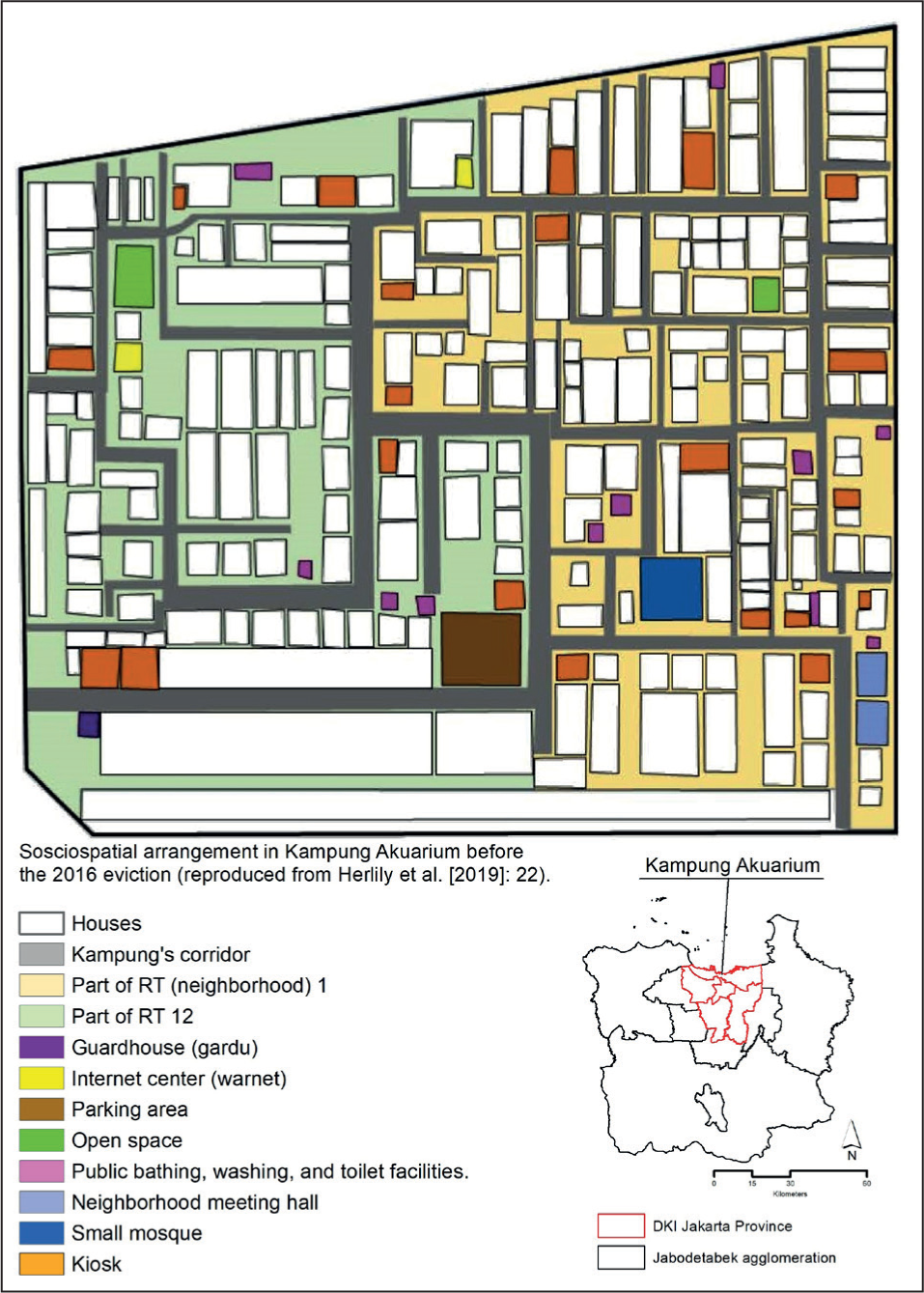
As of 2016, in a total area of 10,384 m 2 , there were 241 buildings in Kampung Akuarium (Herlily et al., 2019, p. 22), where 386 households lived, consisting of 700 people, the majority being informal sector workers, involved in fisheries in particular (Guntoro, 2020, p. 53). In the eyes of the government, Kampung Akuarium was an informal settlement, because the land it occupied belonged to the state. Informal in terms of land claims does not necessarily mean informal in terms of urban services, such as access to electricity and piped water. The electricity network provided by the state-owned electricity company PLN (Perusahaan Listrik Negara) entered Kampung Akuarium at the end of the 1980s, while the first piped/connected-water facility was installed in the early 1990s and expanded at the end of the decade. 2
The years 2015–2016 were a heyday of evictions of kampungs in Jakarta. In 2015 alone, there were 113 evictions, with 40% being rationalized by the city’s flood management (Jakarta Legal Aid Foundation [LBH Jakarta], 2016), which was dictated by a logic of capitalist urbanization of spaces: the development of some spaces and people by sacrificing other spaces and people. The eviction of Kampung Akuarium on April 11, 2016, was also rationalized by flood management. The reason for the eviction, according to the government’s logic, was to pave the way for the installation of a sheet pile dike/dam in order to protect the northern part of the city from flooding. Explicitly then, in the eye of the DKI Jakarta government, Kampung Akuarium was a martyr for the flood management of the city: its spaces and people were to be sacrificed to protect other spaces and people.
Re-occupation: Formation of a “Commune of Communes”
Jeopardized by eviction, some families moved to rusunawa (rumah susun sederhana, a simple or small low-cost rental apartment) owned by the government (Siagian et al., 2023); some lived on boats at sea nearby; some managed to find rented spaces in neighboring areas; and some returned to their natal villages far away from Jakarta. But there were families that fought back. Only a few hours after eviction, around 100 families “re-occupied” the site by immediately setting up plastic tents (Sari et al., 2023, p. 61). This direct re-occupation was vital for signaling that residents were still there, surviving, fighting for their rights, and controlling the land. Re-occupation also made coordination among evictees more manageable.
In order to survive at the location, residents needed to organize their daily basic needs. Their strategy was to set up different plastic tents, for example, tents for sleeping, storing belongings, kitchen, toilet, and prayer rooms. They also installed water and electricity sources and organized activities for children to study and play. They mobilized direct solidarities/supports for food, money, goods, and activities from outside parties to ensure life could continue even though they lived in an emergency situation. Donations came from individuals and organizations, managed in tandem by residents and donors. One month after eviction, residents began transforming plastic tents into temporary settlements (bedeng) made of plywood, used wood, asbestos, iron sheeting, and plastic. Each family started to occupy its own space, while some other families remained in plastic tents. Residents expanded their activities, starting over almost from zero. For those who still had their jobs, they returned to work, and some others became vendors to earn income.
Residents also needed to maintain/organize their re-occupation. They held various demonstrations and press conferences and distributed political statements through social media to condemn evictions and to gain support from the broader public. They demonstrated at DKI Jakarta’s city hall and in front of the presidential palace. They protested against the president (Joko Widodo) because he had promised not to conduct evictions when he ran for the DKI Jakarta gubernatorial election in 2012, before he ran for, and won, the presidential election in 2014. Assisted by the Jakarta Legal Aid Foundation (LBH Jakarta), they also filed a class action lawsuit in the North Jakarta District Court. The evictees demanded that the DKI Jakarta Provincial Government compensate for their losses and give back their settlements. The courtroom of every trial became a site of mass mobilization, flooded by the evictees. 3
A crucial point in this continuous struggle was the capability to imagine/dream of rebuilding a new Kampung Akuarium. After spending time in condemning evictions and withholding—and resisting—political pressure from the ruling authorities, residents reached a point where they had a shared dream of rebuilding their new kampung. Moreover, to realize their dream, they needed an effective strategy: to use the 2017 DKI Jakarta gubernatorial election by formulating and submitting a political contract to one of the running candidates. This required a large base of organized voters and measurable yet doable/pragmatic programs. Amazingly, the mere idea of formulating and submitting a political contract energized the dream of rebuilding the kampung.
Residents operationalized their strategy by building a wider network of kampungs, a “commune of communes” in our theoretical framing, for a bigger group of organized voters. Jakarta’s JRMK and UPC linked and coordinated many kampungs, both the established members of JRKM and the aspiring ones, to set up a task force to get as many kampungs as possible to join the group. This task force was enlarged with a number of “insurgent” architects/planners (Sari et al., 2023) from Universitas Indonesia, the Jakarta-based think-and-act tank Rujak Center for Urban Studies (RCUS), and Architect San’s Frontier Indonesia (ASF-ID). Expertise of architects/planners was needed to explain spatial planning to kampung residents. The task force moved from kampung to kampung, carrying documents such as maps of detailed spatial planning to open discussion in a particular kampung with a specific topic on how the detailed spatial planning envisions the kampung. JRMK invited kampungs to raise the demand for kampung legalization and brought in that demand to the governor candidate. Such demands were discussed jointly between the settlers, task force, and an external party/evaluator to test the do-ability of the demands, including to identify relationships between demands and existing regulations. Final demands for political contracts were made through these processes. One of these demands was to rebuild the new Kampung Akuarium at exactly the same coordinates.
Housing Cooperative: Rebuilding and Legalizing the Commune
Given that the incumbent governor, Basuki Thahaja Purnama (Ahok), evicted Kampung Akuarium, a political contract with DKI Jakarta governor candidates was presented to his challengers, namely, Agus Harimurti Yudhoyono and Anies Baswedan. Anies Baswedan was willing to sign a political contract with JRMK, whose members, in turn, helped him finally win the election. Assisted by RCUS’s activists, Kampung Akuarium residents organized a long series of discussions and meetings to develop a detailed plan/proposal to follow up on the political contract. To endure the struggle, a planning process was carried out through a variety of entertainment events involving children, such as the commemoration of Indonesia’s Independence day on August 17. Together with activists, residents held a competition to make a “dream house,” which involved artists from Japan who, at the time, were residing in Jakarta. Two youths from Kampung Akuarium were also involved as writers in tracing the kampung’s history in a collaboration between JRMK and a collective of Jakarta-based journalists called Kampung Kota Merekam (Irfansyah et al., 2017). Leilani Farha, a UN special rapporteur on the right to housing, was in Kampung Akuarium as a first-hand witness of what happened on the ground and to listen to residents.
After the inauguration of Anies Baswedan as the 2017–2022 DKI Jakarta governor, JRMK immediately stepped in and set up a first meeting with the governor at city hall. JRMK members prepared a list of programs based on the political contract, to be proposed to the new governor. Included in this list were many stages of Kampung Akuarium re-building. Based on JRMK’s proposal, DKI Jakarta governor issued Governor Decree 878/2018, which assigned the Task Force for the Implementation of Kampung and Community Management to carry out a kampung management program. Based on this decree, the DKI Jakarta Provincial Government developed shelters (temporary housing) for the evictees, revived ID cards (Kartu Tanda Penduduk) with local addresses, provided clean water services and electricity networks, as well as built washing facilities and community gardens. A fund to rebuild the temporary housing for Kampung Akuarium was made possible through the corporate social responsibility scheme of PT Jaya Construction (one of the DKI Jakarta Provincial Government–owned construction companies). Temporary houses were made out of disposable materials such as mild steel and glass fiber-reinforced concrete.
The recovery period for Kampung Akuarium required an increasingly intensive preparation of planning concepts. DKI Jakarta Provincial Government rolled out a Community Action Plan program for a participatory plan. The planning concept, previously prepared by the residents with technical assistance provided by RCUS’s activists, was submitted to the Community Action Plan to ensure its results were in line with the residents’ wishes (Pratiwi, 2019). Instead of following the Rusunawa scheme owned and managed by the government (see Siagian et al., 2023), they proposed the kampung susun (elevated kampung) managed by a cooperative.
In the meantime, as part of the JRMK’s organizing strategy, a kampung cooperative, Koperasi Akuarium Bangkit Mandiri (hereafter Akuarium Cooperative or Cooperative), was set up in Kampung Akuarium, through which the involvement of evictees expanded. By then, it not only involved those who had directly re-occupied the site but also reached out to former residents who had moved outside of Kampung Akuarium. The cooperative required that if those who had moved outside wanted to get back in Kampung Akuarium, from then on, they needed to be actively involved in every stage of the struggle, including planning.
In addition to the Community Action Plan, the DKI Jakarta Provincial Government also formed an Urban Land Reform Task Force (Gugus Tugas Reforma Agraria, GTRA) with the main task of legalizing Jakarta’s informal kampungs. Governor Degree 878/2018 listed the targeted kampungs, one of them being Kampung Akuarium. Residents provided a proposal with land information to GTRA. One of the points within that proposal envisioned a cooperative as a subject of urban land reform, or, in more operational terms, it enabled kampung cooperatives to own land in the city. Cooperative ownership was chosen to prevent the sale of soon-to-be-certified lands. Selling collectively owned land of the cooperative logically is harder than selling individually owned land.
In line with a proposal from the Akuarium Cooperative, GTRA produced an academic paper (Naskah Akademis, Herlily et al., 2019) for each kampung, which provided options for land and kampung management. One of those options was for the government to give building use rights (Hak Guna Bangunan) or the right to use (Hak Pakai) through a partnership scheme for land and an ownership scheme for buildings to Akuarium Cooperative. Backed up by the academic paper, the governor agreed to rebuild Kampung Akuarium by mobilizing funds from fines obtained from underperforming property developers.
The construction process was complicated and arduous. The design had to comply with development guidelines in a cultural heritage area, bearing in mind that the government declared the location of Kampung Akuarium part of a cultural heritage area. Residents had to revise their design again and again through meetings with the Cultural Heritage Expert Team (Tim Ahli Cagar Budaya), the Restoration Assembly Team (Tim Sidang Pemugaran), and the Building Experts Team (Tim Ahli Bangunan). This series of meetings was new for the residents. They, however, continued to study and attend those meetings to ensure their interests were not sidelined.
The rebuilding of Kampung Akuarium began with land preparation. Based on the drawings, most residents’ temporary housing had to be demolished to enable rebuilding processes. The DKI Jakarta Provincial Government proposed that residents whose temporary housing was affected by the rebuilding processes move to rusunawas, one of which was Rusunawa Pesakih Daan Mogot. Most residents rejected this idea because such rusunawas are far from Kampung’s construction site. They needed to stay as close as possible to the construction site because they would like to be intensively involved in re-development and monitor the day-to-day processes of re-building. Finally, residents moved toward the sea to make room for construction work. Moving aside was done through cooperation (gotong-royong) by residents, funded jointly by contributions from the residents and developers.
On 17 August, 2020, the governor laid out the first stone for development, and this marked the rebuilding of Kampung Akuarium. In his speech, the governor explained that planning for Kampung Akuarium took a long time because he wanted to ensure that planning was collaborative and fulfilled legal terms. Kampung Akuarium would be built vertically or in layers with five towers of kampung susun. Kampung susun aspires to maintain the friendly and open character of life in kampung. This aspiration is manifested through a vast corridor within the building for residents to socialize, an absence of closed and centrally controlled gates, and free spaces in each unit/flat within the building where residents can restart their economic activities. Residents selected whom they thought had the right to stay in the buildings through the Cooperative. Construction was made possible by funds the DKI Jakarta government gained from unperformed developers. In this way, the rebuilding process was sped up, with no need to enter complicated and lengthy processes of provincial budget allocation.
The first phase of construction developed two towers. These two towers would be for the residents who had re-occupied the site. During construction processes, the Cooperative formed a team to support and supervise construction processes (Supervisory Team, Tim Pengawas). The Supervisory Team carefully studied the drawings and monitored and ensured the implementation stage, as well as the specifications of used materials. The team supported the construction phase and ensured there were no obstacles to the processes by fulfilling the needs of construction, such as land preparation, availability of clean water, and safety for the project. On many occasions, developers/contractors had to disassemble their work upon protest by Supervisory Team members who determined that the quality of the materials used did not meet the plan. Cooperative members opened a food stall for the project’s workers. Meanwhile, during the construction phase, members of Akuarium Cooperative formulated a scheme for residents, including the distribution of units, its maintenance, calculating needed funds, and the relationship between residents and the building manager, in this case, a representative of the Cooperative.
The first two towers of the Kampung susun Akuarium were completed after nearly a year. A week before Independence day, Akuarium Cooperative submitted a letter to the DKI Jakarta Provincial Government. Through this letter, Cooperative members pushed for a clear legal term and the management of units. Reacting to the Cooperative’s letter, the DKI Jakarta Provincial Government refused and replied that those matters would be arranged after inauguration, but the Cooperative members insisted. In the end, the DKI Jakarta Provincial Government agreed to have a memorandum of understanding (MoU), which was drafted and discussed immediately between Cooperative members and the DKI Jakarta Provincial Government. On August 17, 2021, exactly a year after ground-breaking, the DKI Jakarta governor inaugurated the Kampung susun Aquarium. At the inauguration, the head of the Public Housing and Settlement Section, representing the DKI Jakarta Provincial Government, and Akuarium Cooperative’s representative signed the MoU regarding the management of Kampung susun. The MoU stated that Akuarium Cooperative (or its representative) would be the manager of Kampung susun Akuarium.
Following the MoU, the Cooperative prepared for its responsibilities regarding the management of Kampung susun. A technical team became responsible for maintaining machines and other equipment. In dealing with machines, the technical team gained training from contractors/ developers on maintaining water pumps, the waste-water treatment plant, CCTV, fire alarms, and extinguishers. Other tasks included routine security patrol by residents, cleaning shared spaces and corridors, and taking care of plants and the Cooperative’s economic activities. Included in the Cooperative’s economic activities are laundry, homestays, bottled-water refills, catering, and providing spaces for small and medium economic activities. Profit from these economic activities has helped to fund the operational and maintenance costs of Kampung susun; such activities have also helped to maintain the bond and cooperation between residents.
As time went by, such arrangements slowly became a system, codified in mutually agreed-upon standard operating procedures for Kampung susun Akuarium management. As the end of Anies Baswedan’s term as governor approached, the Cooperative aimed to clarify land legality and ownership of the building. They asked the governor to build a special team (Tim Khusus) to study the scheme for controlling and managing Kampung susun. The residents argued that the results of the study would help the governor make a decision on other Kampung susuns in Jakarta. The Cooperative recommended experts among academics and practitioners to become members of this special team. The governor accommodated this proposal by issuing a decree to appoint a special team to study Kampung susun.
Residents asked for long-term security of land rights and ownership of Kampung susun. This aspiration, however, needed to be aligned with the existing regulations. A task for the special team was to provide recommendations, a win-win solution between residents’ aspirations for settlement security and the existing regulations. Based on their study, the special team recommended to the DKI Jakarta Provincial Government the granting of land rights to the Cooperative without relinquishing the government’s assets. According to the special team’s explanation, this could be achieved, given the fact that the DKI Jakarta Provincial Government and the Cooperative were already in cooperation and that the land was being used by residents. On building ownership, the special team recommended to the government that ownership be given to the Cooperative, but preceded by a lease as a preparatory or transitional period. During the transitional period, the Cooperatives, as legal entities, would collectively pay rent to the DKI Jakarta Provincial Government, but not as individuals, different from the lease in the government’s rusunawa or commercial apartments.
The DKI Jakarta Provincial Government and the Cooperative signed an agreement whose crucial point is that both parties agreed on two stages: the transitional period and the transfer period. The transitional period is a lease period/agreement that regulates a rental relationship between the Cooperative and the DKI Jakarta Provincial Government. The Cooperative is obliged to pay a rent in advance for five years in one installment before signing the lease. This rent, divided by the number of available units, equals IDR 34,000 per unit. This cost/rent is far below the rent for rusunawa’s units in Jakarta, which can reach half a million IDR. The Cooperative is responsible for maintaining and repairing the building. Both parties agreed on the criteria so that the building can be given/transferred to the Cooperative, requiring from the Cooperative that it gain financial and technical capabilities, that is, respectively, create a fund of IDR 1 billion as a collateral for building maintenance and a team with technical capacity to carry out maintenance and repair. According to the agreement, once these two criteria are met, the Cooperative can submit an application to the DKI Jakarta Provincial Government for the ownership of a collectively managed building.
Conclusion
Through the Kampung Akuarium case, we have explained Jakarta’s urban poor direct actions—land occupation, re-occupation, and expansion of urban poor organizations—–and the rebuilding and legalizing of a once-evicted settlement, collectively managed through a housing cooperative, as a long process of commune formation. Our documentation and theorization of Jakarta’s urban poor commune formation with an overall aim to create a city that appreciates the fuller interests and participation of its citizens stem from our theoretical explanation that differentiates between urbanization and citification. The former is a capitalist process that produces an urban, capitalist city in which a city’s settlers are equated to customers. The latter is a citizen-based process to produce a city as an eco-community in which citizens’ participation is a must.
Commune formation through direct actions (the first two parts: land occupation and re-occupation) by Jakarta’s urban poor is different from that idealized or theorized by, for example, eco-anarchists such as Murray Bookchin. Bookchin’s theorization of direct action tends to work outside state representative democracy’s paraphernalia (Bookchin, 1982). Jakarta’s urban poor movement has flexibly worked both outside and within/alongside the state. It is outside the state because it began, according to the state’s view, as an illegal land occupation. It is alongside the state because finally residents took part in electoral politics and land legalization. What is more, by the end of 2022, the JRMK network had joined Indonesia’s Labor Party (Partai Buruh) to compete in the upcoming 2024 election. We explained the flexibility of Jakarta’s urban poor social movement through engagement with scholarship on land occupations in postcolonial rural Indonesian, in which the strong state shapes the goal of the land occupation movement to be recognized/legalized by the state’s law (Afiff et al., 2005; Lund, 2022; Lund & Rachman, 2016). Inconsistent in terms of state-related theoretical conversation/evaluation, Jakarta’s urban poor movement is coherent in terms of a grounded political objective: a struggle for a space to live.
Through a brief look, Jakarta’s urban poor’s direct actions for commune formation are also different from those of activists in 1999 in Seattle, who protested the World Trade Organization (WTO) meeting. The 1999 battle in Seattle can be seen as “basically ceremonial,” whereby most of the “real decisions are made elsewhere” (Graeber, 2009, p. 208). It was basically ceremonial because the 1999 Seattle demonstration aimed to produce a public counter-opinion to the WTO. Differently, Jakarta’s urban poor’s direct actions aim to fill the physical and social spaces of the everyday. In this regard, Jakarta’s urban poor movement is more a movement of “the here and now” (Beyer-Arnesen, [2000] 2012) to intervene in capitalist urbanization. Seen from a longer and broader perspective, both movements share similarities. The 1999 protests in Seattle were a culmination point of worldwide social movements. Not so differently, the land occupation by Jakarta’s urban poor is not a single event but a part of a longer and broader ongoing urban poor struggle for land/housing, most notably in the Global South (Satterthwaite, 2009), which involves networks of social movements in Jakarta and beyond.
Footnotes
Acknowledgements
We thank JRMK, UPC, Koperasi Akuarium, RCUS, Architect san’s Frontier Indonesia, LBH Jakarta, Department of Architecture Universitas Indonesia, and Kampung Kota Merekam members/networks for their works in Kampung Akuarium. We are benefited by the supports we got to work out this article from Human Geography and Spatial Planning Department, University of Utrecht, Netherlands, through a project entitled “Following Frontiers of the ‘Forest City’: Towards Sustainable and Inclusive Urbanization in Kalimantan and Beyond” (grant number: 482.20.507), the Indonesia Endowment Fund for Education (LPDP), and a research project entitled “Rumusan Kebijakan Pertanahan Dan Reforma Agraria” (Contract number: PRJ-33/LPDP/2020 and 524/PKS/WR III/UI/2020). We also like to thank the organizers, reviewers, and participants at the 2023 summer school organized by The Sam Moyo African Institute for Agrarian Studies and the Agrarian South Network in Harare, Zimbabwe, for providing space to discuss our work; and two anonymous reviewers whose comments helped to tighten this article. All errors are on us.
Declaration of Conflicting Interests
The authors declared no potential conflicts of interest with respect to the research, authorship, and/or publication of this article.
Funding
The authors received no financial support for the research, authorship, and/or publication of this article.