




Abstract
Roger Felix V. Salditos was among seven Filipino revolutionaries who were summarily executed by police and military forces in San Jose town, Antique, in the central Philippine island of Panay in 2018. Better known by the pen names Mayamor and Maya Daniel, which he used to sign his paintings and poetry, Salditos was a revolutionary intellectual who spent the better part of his life as a cadre of the Communist Party of the Philippines (CPP) since he left the seminary in 1979. This article examines the underground literary and political writings of Salditos to help illuminate the long history of agrarian class struggles of peasants and Tumandok indigenous peoples in one of the Philippines’ top food-producing regions. His narratives highlight the role of Panay as the only place where the Huk peasant rebellion took root outside Luzon in the 1950s, recalling important episodes of revolutionary contestations in the island amid changing conditions under the Marcos dictatorship and the class offensive of neoliberalism. Despite their partisan character and focus on the local and the superstructural, Salditos’s writings provide an important perspective on the persistence of one of the world’s longest-running rural-based insurgencies, notwithstanding the end of the classical era of peasant wars of the twentieth century and shifting spaces for agrarian contestations in the new century.
Introduction
On August 15, 2018, Roger Felix V. Salditos (1958–2018) and six other cadres of the Communist Party of the Philippines (CPP) were summarily executed by police and military forces in San Jose town, Antique, in the central Philippine island of Panay (Mongaya, 2018). Authorities triumphantly claimed the seven were armed “terrorists” who fought back in a “33-minute firefight” that led to their deaths. But a fact-finding mission by human rights organizations shows that the “Antique 7,” as their family and comrades now collectively refer to them, were in fact gunned down at a close range in a gruesome massacre (Burgos, 2018). 1 Better known by the pen names Mayamor and Maya Daniel, which he used to sign his paintings and poetry, Salditos had spent the better part of his life as a CPP cadre active in the countryside of Panay Island since leaving the seminary in 1979. He was a leading cadre of the CPP Panay Regional Committee from 1990 to 2018 (Daba-Daba, 2020).
One of the Philippines’ top food-producing regions, Panay has a long history of peasant unrest and is home to Tumandok indigenous peoples, who have preserved their lifeways amidst the onslaught of colonialism and state-led development aggression. Salditos came of age in the neighboring island of Negros, which had historically benefited from the supply of rural migrant laborers from Panay who worked in its export-oriented sugar plantation hacienda economy (McCoy, 1982). The extreme inequality between a class of haciendero landowners and a large mass of poor, landless farmworkers in the region formed the backdrop to the radicalization of a generation of educated youth during the martial law period under the dictator Ferdinand Marcos Sr. (Rutten, 1996). Salditos, like many of his generation, would join the CPP, which, through its armed wing, the New People’s Army (NPA), had been leading one of the longest-running rural-based insurgent movements in the world.
My encounter with the writings of Salditos first came in the form of his poetry that was anonymously sent to the office of Pagbutlak, the campus paper of the University of the Philippines Visayas in Miag-ao, Iloilo, of which I was editor-in-chief from 2009 to 2011. I read more writings by Salditos when I pursued activist work in the urban mass movement in Iloilo City, after graduating from college in 2011, during the time when he had started to maximize use of the internet to disseminate his literary and artistic works. Having been grounded in anti-imperialist politics, his work colored the scholarship on Philippine social movements that I wanted to do when I pursued graduate studies and eventually started teaching at the university. This conviction pushed me to delve into Salditos’s literary works on the intersection between writing and revolutionary politics. The news of Salditos’s death in 2018 came as a shock to progressive Filipino artists, intellectuals, and activists, but it also spurred efforts by his family and friends to retrieve, translate, and publish his works for a wider public. 2
This article examines the underground writings of Salditos preserved by his family and friends—including essays, reportage, notes, reports, vignettes, and poems—to illuminate the long history of agrarian class struggles of peasants and indigenous peoples in Panay Island. The first section gives a brief sketch of Salditos’s coming of age and eventual joining of the underground resistance in the 1970s. The second section explores Salditos’s retrieval of histories of agrarian struggles in Panay Island that had been forgotten in popular memory. The subsequent sections provide a substantive focus on different periods of class contention in Panay, which Salditos’s writings illuminate. The third section highlights Panay as the only place outside Luzon where the Huk rebellion took root in the 1950s. The fourth section discusses the high tide of the CPP-led movement during the anti-Marcos struggle in the 1970s and 1980s. The fifth section turns to its persistence amidst internal schisms and neoliberal globalization from the 1990s onward. I draw the conclusion on the value of Salditos’s literary and political writings in the last section.
Coming of Age in the Global 1960s
The rise of the former colonial world on the global stage, the perpetuation of neocolonial relations with the United States on the national plane, and the endurance of the hacienda plantation economy at the local level, all served as powerful backdrops to the coming of age of Salditos in the Central Philippine island of Negros. Born in Ilog Town, Negros Occidental, on October 12, 1958, Salditos was the eldest of five siblings in a poor peasant household: Salditos’s father was a seasonal farmer and small fisherman, while his mother worked as a tailor to earn extra income. According to his wife, Ruth Salditos, in a May 29, 2021, Zoom interview, growing amidst the island’s poverty and extreme inequality left an indelible mark on Salditos, who had to help his father in farming, fishing, carpentry, and even selling fish in the town center at a young age to augment their family’s meager income.
In the 1970s and 1980s, 68% of the total sugar production in the Philippines was concentrated in Negros Island (National Federation of Sugar Workers, 1984, p. 7). Yet it had not uplifted the conditions of landless plantation workers, who remained among the region’s major poverty groups (Aguilar, 1984). Negros had been transformed into a hacienda economy focused on cultivating sugar for export in the twilight years of Spanish colonial rule in the nineteenth century (Constantino, 1975; Fast & Richardson, 1979). This economic system persisted under American colonial tutelage and after 1946, when formal independence was conferred on the Philippines, resulting in the concentration of property in an elite landowning class and the pauperization of generations of landless peasants and farmworkers working the land (Lopez-Gonzaga, 1988; McCoy, 1982).
Salditos’s early immersion into the world of labor was balanced by his exposure to the arts through the influence of his mother. A Catholic devotee, his mother also pushed him to eventually enter the Holy Heart Seminary in Bacolod City through a church-run scholarship during the early martial law years (Mongaya, 2021). Yet by this time, heightened anti-systemic contestations were sweeping not only the Philippines but also much of the Third World and other parts of the globe (Christiansen & Scarlett, 2013; Mohandesi, 2022). An “anti-imperialist nationalism” was taking root in university spaces amidst growing frustration over poverty and underdevelopment under continuing US domination. Many intellectual youths were increasingly inspired by the Vietnamese resistance to US aggression as well as the radical rhetoric of socialist renewal by the Chinese revolutionary leader Mao Zedong (Mongaya, 2019). This radical ferment occurred despite the defeat of the peasant-based Huk rebellion that exploded in the 1950s in the northern Philippine island of Luzon (Kerkvliet, 1993) and the propagation of anti-communist ideology and legislation to suppress growing social unrest (Woods, 2020).
One of the key Filipino figures from this era is Jose Maria Sison, an instructor at the University of the Philippines who turned to Maoism as the answer to Philippine social ills. Sison joined the old PKP in 1962 and founded the anti-imperialist Kabataang Makabayan (KM, Nationalist Youth) in 1964. He eventually split with the old Party for its towing of the Soviet line of a “peaceful transition” to socialism (Sison, 2013b). Following the Chinese model under Mao Zedong, Sison founded a new communist party that called for a “national democratic” (ND) revolution to overthrow the neocolonial state, implement agrarian reform, and initiate national industrialization as the first stage toward building a socialist future (Sison, 2013a).
This ND political program was taken up by activist youth organizations, such as the KM and the Samahang Demokratiko ng Kabataan (SDK), that had proliferated across the country, including Negros and Panay (Aguilar, 2008). By the beginning of 1970, these ND youth organizations had set off a wave of protests of tens of thousands of youths in major urban centers across the country that became known as the “First Quarter Storm.” Parallel to these developments, the underground CPP formed the New People’s Army (NPA) in 1969, to spearhead its rural-based military strategy of waging “protracted people’s war.” The imposition of martial law by the dictator Marcos in 1972 was meant to close the lid on what was then widely described as a brewing “social volcano.”
The closing of doors to legal avenues to social change, however, pushed many to embrace the armed struggle of the CPP. Open ND organizations like KM were illegalized as the Marcos dictatorship launched a crackdown on all opposition to its rule. Many young activists from universities in the national capital and those hailing from regional urban centers of Iloilo City, Bacolod City, Roxas City, and Kalibo joined the CPP’s regional organization (Communist Party of the Philippines, 2018). Many radicalized priests, seminarians, and other church people were also brought under the fold of the ND movement via the Christians for National Liberation (CNL), which was also forced underground by military rule (De La Torre, 1986).
It is this backdrop of acute class conflicts that reinforced Salditos’s growing social awareness and activism upon his entry into the seminary. The spread of liberation theology and the promulgation of the Second Vatican Council a decade earlier already had a profound impact on Christian priests, nuns, seminarians, and other Church people (Youngblood, 1993). From a conservative patron of landowning classes, the church in this period underwent a profound transformation as some of its leaders, such as the Bacolod diocese bishop Antonio Fortich, embraced social justice advocacies as part of the task of evangelization (Lopez-Gonzaga, 1991). Church institutions like Social Action Centers were established while church people became actively involved in organizing basic Christian communities among Negros’s rural poor even amidst dictatorial rule. Salditos’s political awakening in the Philippine global 1960s eventually convinced him to leave the seminary in 1979 to become a full-time revolutionary fighter. From his native island of Negros, he would be deployed to the rural areas of neighboring Panay Island.
Remembering Histories of Agrarian Struggles
The literary oeuvre of Salditos had been judged by some scholars to be the finest poetry in Hiligaynon to have emerged from the Philippine revolutionary movement (Talledo, 2018). Despite being labeled an “enemy of the state,” Salditos has justifiably earned public recognition as a distinguished poet and artist (Bañez, 2017; Devilles, 2009; Encontro, 2009; Guillermo, 2005; Mongaya, 2018). Some of Salditos’s poems had been published in commercial publications like the Manila Times (see Salditos, 2016b, 2016c, 2016d, 2016e), but most of his literary writings were self-published as chapbooks circulated among comrades and friends. Salditos’s chapbooks Give Me the Mountains and Other Poems of a Traveller (Salditos, 1995), Kamandag and Other Poems (Salditos, 1996), Sprouts in the Rainy Season: Collected Poems (Salditos, 1997a), Rectification and Other Poems (Salditos, 1997b), and The Response of Lola Pasyang and Other Poems (Salditos, 1997c) were signed with the name Maya Moroporo. 3 Salditos shortened this penname to Mayamor in the chapbooks Commitment: Poems of the Countryside (Salditos, 1998a), Acceptance: Poems of the Countryside (Salditos, 1998b), and Monuments to Be Toppled and Other Translated Poems (Salditos, 1998c). 4 The chapbook To Our Next Coming: Collected Verses and Poems (Salditos, 1999) was signed with the name Karmaganon Saludes (see Figure 1).
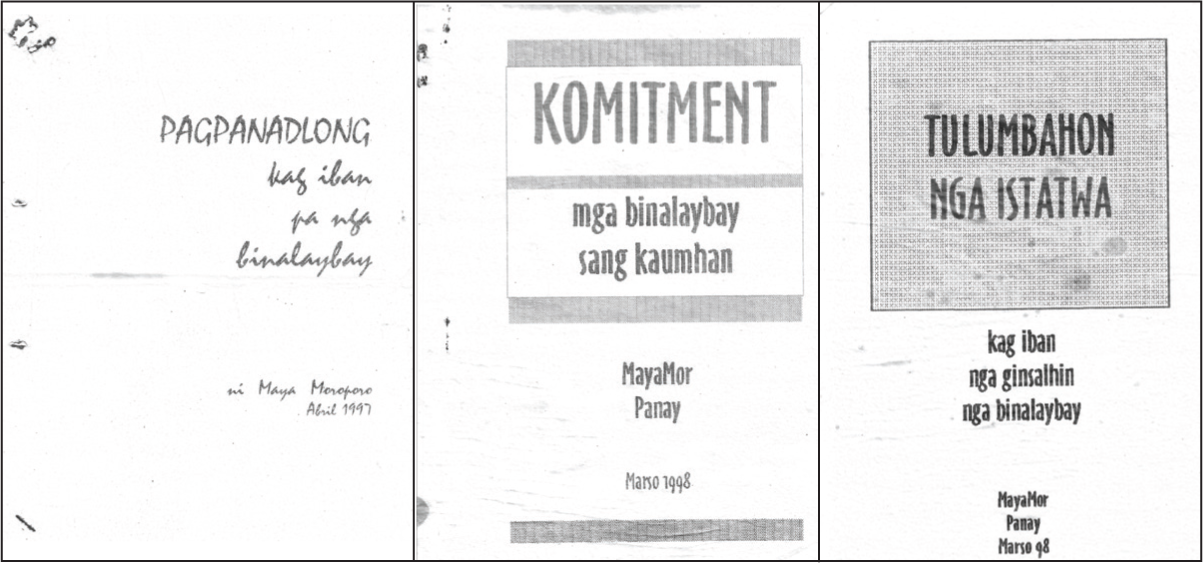
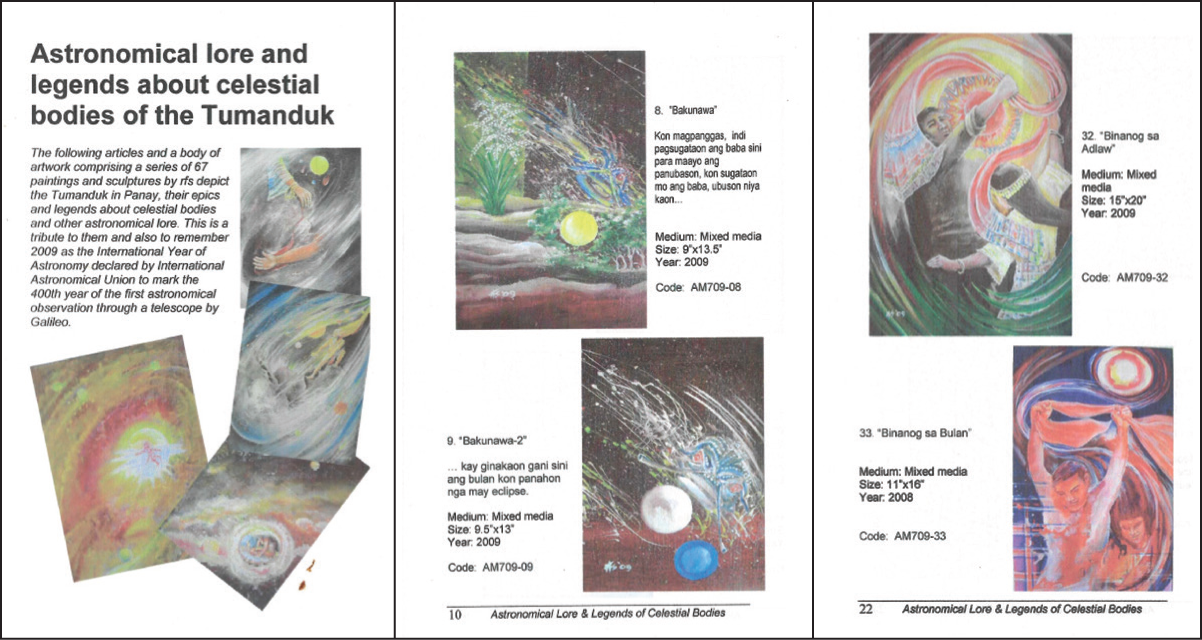
Since 2015, Salditos had circulated his poetic works online through a WordPress website and a Facebook account using the nom de guerre Maya Daniel. 5 Some of his verses also saw print in revolutionary magazines such as Ulos and the Panay-based Sublak. He produced approximately 500 poems as well as dozens of essays, vignettes, reportage, short fiction, and visual art using different mediums. Some of his paintings representing the plight, culture, and struggles of the Tumandok indigenous peoples of Central Panay were publicly exhibited at the West Visayas State University in 2009 and the University of the Philippines Visayas in 2017 (Bañez, 2017; Devilles, 2009; Encontro, 2009). Salditos’s essays “Astronomical Lore and Legends about Celestial Bodies of the Tumandok” (Salditos, 2009) and “River and Ocean Lore of the Tumandok and Ancient Hiligaynons” (Salditos, 2017) are featured in the exhibit booklets for two exhibitions (see Figure 2). A part of this body of work was posthumously published in the poetry collection 50: Mga Binalaybay ni Roger Felix Salditos [50: The Poems of Roger Felix Salditos.] (Salditos, 2020).
Many of Salditos’s writings, namely, investigations, essays, reportage, notes, and reports, were produced mainly in the context of fulfilling his revolutionary tasks in the underground movement and thus “went through the scrutiny of the movement’s responsible leadership organs and circulated through official publications at the national, regional, and sectoral levels” (Guillermo, 1998, p. xxiv). While read in underground gatherings such as tributes to fallen comrades and movement anniversary celebrations, his poetry and literary endeavors were “his own personal initiative albeit encouraged by his party collective” (Mongaya, 2021, p. 101). But regardless of the immediate purpose, Salditos’s positionality as an insurgent meant his writings were all “subject to the material constraints of constant mobility, the pressing demands of other activities, the audience, and the vicissitudes of chance and circumstance” (Hau, 2000, p. 258).
In his writings, Salditos deploys the Marxist historical framework applied by CPP founder Jose Maria Sison in Philippine Society and Revolution (Sison, 2021) into his articulation of the culture and history of people’s resistance in Panay Island. Produced as part of his tasks in the movement, Salditos’s voluminous written works form part of the “rich range of knowledge production from inside of social movements” (Choudry, 2019, p. 28). The significance of his work becomes more apparent in view of the scant historical literature dealing with the long history of revolutionary movements in Panay Island. 6 His work fills this gap but from a partisan Maoist perspective that sees knowledge-making and revolutionary mobilization as being mutually constituted in struggle.
Some of the key events highlighted in Salditos’s writings include the peasant revolts that dotted Panay’s history under Spanish rule. He also underscores the intense class struggles between working people against an ascendant landed comprador bourgeois class lording over the region’s sugar export economy during the American colonial period. 7 The rise of the anti-Japanese guerrilla resistance in the region during World War II is also discussed by Salditos to foreground the wider argument about Panay Island’s strategic and mountainous terrain as being favorable to guerrilla warfare. Salditos zeroes in on the persistence of armed movements in the Panay countryside after formal independence was granted to the Philippines in 1946.
Salditos’s (2013) essay “The Fall of the Panayanon, Forging of a Revolutionary Tradition, and Resurgence by Raising the Level of the Revolution” chronicles the long history of armed resistance in Panay from the period of Spanish colonialism up to the establishment of the CPP in the island in 1971. This historical narrative is presented to demonstrate the precedents that make further revolutionary advances in the island possible. In the essay “Notations on the History of the Development of Revolutionary Cultural Work in Panay,” Salditos (2005) also makes the same historicization in underlining the importance of nurturing a people’s culture of resistance to effectively build “red political power” in the midst of guerrilla fighting in the countryside. 8 Another essay, “Jalaur—The Red River in the History of the People’s Struggle in Panay” (Salditos, 2015a), describes the centrality of the Jalaur River in nurturing resistance movements in Panay. Salditos’s (2016a) essay “Anti-colonial Peasant Uprisings in Panay and the ‘Aswang’ as a Psywar and Counterinsurgency Instrument” meanwhile pays attention to folk and popular culture. In this uncanny piece, Salditos attributes the spread of belief in the “aswang” as a consequence of US colonizers seeking to instill fear to pacify rural hotbeds of peasant unrest in the island. 9
The book 50: Mga Binalaybay ni Roger Felix Salditos (Salditos, 2020), translated by another revolutionary poet Kerima Tariman,
10
is replete with verses that poetically render this now mostly unsung history of agrarian struggles and resistance in Panay. The poem “Bulubundukin” [Upland] (Salditos, 2020, p. 75) exemplifies this theme:
Who owns you? Absolutely not The fascist generals and their men With iron hands who cracked your earth Pierced your heart With fires, bombs and bullets, They bled you dry and lifeless. Remember the billboard: “Beware of stray bullets!” Who owns you but the peasants Whom their forebears were buried Here and their bones and ashes Nourished your earth crust And as history written in their memory Pledges this solemn truth … These peasants will not abandon you They are defending life in you!
In his articulation of these histories of agrarian struggles in the island, Salditos subscribes to the CPP founder’s understanding of semi-feudalism as a distinct mode of production. It is characterized by the domination of foreign capital, which subordinates a predominantly agricultural economy to its interests, the continuing prevalence of tenancy relations in the countryside, and the rise of the comprador bourgeoisie as the dominant class (Sison, 2021; Sison & De Lima, 1998). From this perspective, “capitalist development” is blocked by imperialism, which keeps local productive forces backward and agrarian to make it serve as a “semi-colonial” appendage to advanced capitalist countries. Hence, far from embodying a transitory stage toward capitalism, the penetration of foreign capital combines with archaic forms of production in agriculture to maximize profits for foreign capitalists and their local comprador-landlord partners. 11 Yet the strength of Salditos’s historical and literary writings lies not so much in illuminating class structures in Panay, as Erik Olin Wright (1985) would put it, but in documenting in broad strokes the contending class formations in the island as expressed in particular modes of domination and contentious politics.
From the Huk Rebellion to the “Re-established” Party
One of the significant historical events that Salditos highlights in his works is the fact that Panay Island is the only place where the Huk rebellion took root outside of its traditional strongholds in Luzon in the 1950s. The essays “Jalaur—The Red River in the History of the People’s Struggle in Panay” (Salditos, 2015a), “Remedios Paraiso-Gomez (Commander Liwayway) and Coronacion Chiva-Togonon (Commander Waling-Waling): Women Commanders and Martyrs of the People’s National Democratic Struggle” (Salditos, 2015b), and “The Fall of the Panayanon, Forging of a Revolutionary Tradition, and Resurgence by Raising the Level of the Revolution” (Salditos, 2013) pay homage to this historical particularity of Panay.
These essays give particular weightage to the role of Coronacion “Waling-Waling” Chiva and her husband, Fernandito “Ka Andres” Togonon, two peasant leaders in Panay, for passing the torch of revolutionary struggle from the Huk rebellion to the younger cadres of the CPP. 12 Togonon had begun his revolutionary vocation as a member of the PKP, which had established in Iloilo, its only provincial formation outside of Luzon in the 1930s (Richardson, 2011, p. 255). He helped build peasant unions in the wide friar lands in Zarraga, Barotac Nuevo, and Dumangas towns in eastern Iloilo and the Zulueta Estate in Oton and Tigbauan towns in Southern Iloilo, amidst growing rural unrest in this period (Salditos, 2013).
The Huks were not able to expand beyond Luzon during World War II. Togonon and peasants who were organized under the National Peasant Union (Pambansang Kaisahan ng mga Magbubukid, PKM) thus joined the anti-Japanese guerrilla forces under the direction of the US Armed Forces in the Far East. But when the Huk rebellion reached the shores of Panay after the war, these committed peasant unionists under Togonon would form the first fighting units of the Huks’ Regional Command No. 6 in Panay in 1949. Togonon, then PKP’s provincial secretary, was assisted by Guillermo Capadocia, who was PKP general secretary before the Japanese invasion, in preparing the island for guerrilla warfare. Capadocia facilitated the recruitment of organized workers, including the son, Flavio, of Jose Nava, the national president of Federacion Obreras de Filipinas (FOF), into the fold of the local Huks (Salditos, 2013). 13
In 1950, the PKP central leadership deployed 16 cadres from Luzon led by Neri Ty as well as Remedios Paraiso-Gomez, who had then already earned public renown as the woman Commander Liwayway (Salditos, 2015b). 14 The Huk command established their presence in the hilly interiors upstream of the Jalaur River, leading to its headwaters in the Central Panay mountain range. The hilly areas that border the four provinces of Aklan, Antique, Capiz, and Iloilo thus became the main battlefronts of the Huks in Panay, who had already made arrangements for expanding into neighboring Negros (Salditos, 2015a).
The Huks of Panay were crushed by the weight of counterinsurgency operations. They were also stymied by the deeper problem of failing to prepare the ground for organizing guerrilla forces among the upland peasantry in these localities before clashes broke out with the military. Faced with shortages of arms and fighters, the Huks recruited bandit gangs that quickly led to problems of discipline, from rape to extortion (McCoy, 1978). A Philippine army raid on the Huks’ main headquarters in Taroytoy, Libacao, Aklan, in 1953, led to the massacre of 37 PKP cadres and red fighters and the capture of Togonon and Commander Liwayway. The remaining members of the Huk force, who now gathered under the banner of Commander Waling-Waling Chiva, were also wiped out subsequently in their hideout at Nalbugan, Bingawan, Iloilo, in another raid by the military. Togonon and Chiva were imprisoned in Muntinlupa Jail in the national capital and were able to return to Iloilo only shortly before the declaration of martial law (Salditos, 2015a, 2015b). 15
Historian Alfred McCoy (1978, p. 448) laments that the Huks’ armed adventure ultimately precipitated “the demise of the region’s legitimate labor movement and the loss of an autonomous representative for the needs and aspirations of the rural peasantry and wage labor force.” Salditos (2015a, 2015b), on the other hand, while critical of the failures of the old PKP leadership, nevertheless frames its failed rural revolt in the context of the building of a revolutionary project. Despite its errors and ultimate failure, Salditos recognizes its role in sowing the seeds of armed peasant resistance in Panay that would later be revived in the 1970s. When the first armed squad of the NPA climbed up the Central Panay hills to organize a new armed resistance, Huk veterans led by Togonon and Chiva helped the newcomers to link up with the old veterans in the area. Chiva and Togonon were martyred in 1977 and 1985, respectively, as part of the new CPP-led movement. But by this time, a new generation had carried on the torch of revolutionary struggle bequeathed to them by the Huk veterans (Salditos, 2015a).
Throughout the 1970s, the incipient NPA forces in Central Panay overcame several “nip in the bud” campaigns by the military forces of Marcos’s dictatorship that combed through communities and forested mountain areas to flush out and destroy the guerrillas. Salditos (2015a) chronicles how they overcame their initial difficulties as a small force vulnerable to being crushed by enemy forces by positioning themselves in strategic forested mountainous terrain that borders several provinces before eventually expanding downward to the foothills and plains. This was not always the case. Initial efforts to build guerrilla zones in the eastern plains of Capiz, Panay, in 1971, met with setbacks, as armed action was initiated without an adequate mass base among local peasants. 16 But these difficulties were soon overcome, with armed communist organizations shifting to the more strategic mountainous border areas of Calinog and Tapaz towns in Central Panay by 1973 (Salditos, 2015a).
Unlike the Huks, who confronted a strategic imbalance between its mainly lowland peasant mass bases in eastern Iloilo and a lack of critical support from local communities in its guerrilla staging areas in the Central Panay hills, NPA guerrillas early on engaged themselves in the plight and struggles of upland peasants and indigenous Tumandok in Central Panay. Salditos (2015a) employs the framework set in Sison’s (2017) Specific Characteristics of Our People’s War, a foundational text adapting the Maoist politico-military strategy of surrounding the cities from the countryside to the archipelagic character of the Philippines, into his analysis of Panay Island’s particular spatial and social terrains.
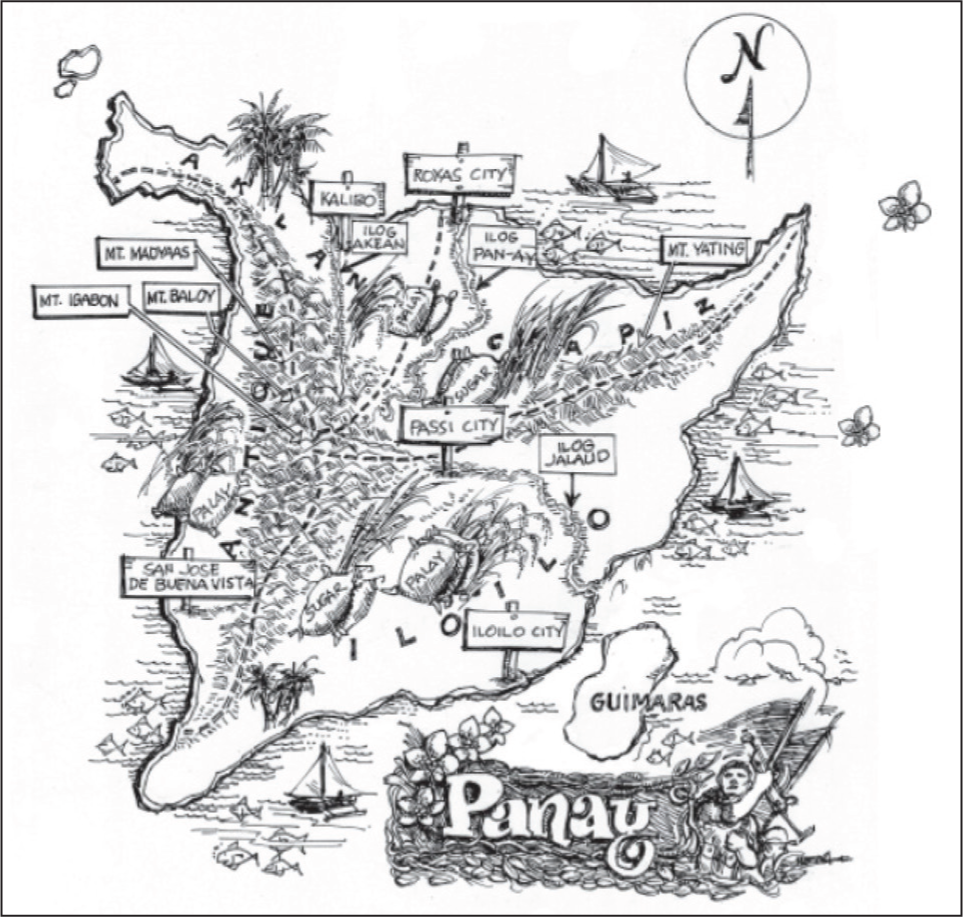
Salditos emphasized the significance of Central Panay as a focal site straddling the borders of all four provinces of Aklan, Antique, Capiz, and Iloilo and the headwaters of the main river systems that flowed down to these provinces (see Figure 3). Salditos (2015a) describes Central Panay as a “strategic zone” that gives insurgent forces the ability “to quickly influence the political situation in the island’s four provinces.” This character, for Salditos, inevitably made it the historical staging area of the various armed liberation movements in Panay’s history and gave the CPP-led guerrillas the capacity to persist through five decades.
Conversely, however, it is my view that this emphasis on upland interiors eventually opens new challenges for revolutionaries seeking to expand into the more populous rural plains. As debates on strategy that wracked the revolutionary movement in the 1990s suggested, agrarian issues affecting peasant communities in the lowlands may also require alternative approaches to organization and mobilization (Franco & Borras, 2009). 17
Revolutionary High Tide in the Anti-Marcos Struggle
A second key historical experience illuminated in Salditos’s works is the unprecedented growth of the CPP-led armed resistance to the Marcos dictatorship during the martial law years. His essays “Notations on the History of the Development of Revolutionary Cultural Work in Panay” (Salditos, 2005) and “In Remembrance of Ka Dodong (Romeo Capalla)” (Salditos, 2014) touch on these details to contextualize the advance of revolutionary cultural work in the island and the experiences of Capalla while active in the armed movement. 18 In these essays, Salditos recalls the importance of this crucial period that saw the furthest extent of national-popular mobilization and cross-class alliances across the rural–urban divide in Philippine history.
At the onset of the 1980s, big guerrilla offensives were already on the offing, alongside the growing mobilization of rural communities in anti-feudal and anti-militarization mass campaigns. The military responded by escalating violence against the peasant population, imposing food blockades, forcibly moving civilians to strategic hamlets, and declaring as free fire zones villages suspected of supporting or harboring guerrillas (Salditos, 2014). Brutal military reprisals led to extrajudicial killings of civilians and unarmed activists. One particularly gruesome incident was the Culasi massacre on December 10, 1981, which killed five protesting farmers (HRVVMC, 2010). Yet the CPP-NPA persisted and grew amidst the Marcos dictatorship’s increasingly vicious campaigns of encirclement and repression.
These military gains by the revolutionary movement could not have been accomplished without popular backing from the rural population amid the worsening economic conditions and political crisis plaguing the Marcos dictatorship. Tangible gains from “anti-feudal” mobilizations in the island were instrumental in its persistence and the consolidation of its rural support bases. As the dictatorship tottered by the middle of the decade, CPP-organized peasant communities were able to push significantly for “minimum” land reform measures. Salditos (2014) stressed that such efforts had resulted in the reduction of land rent to 75–25% in favor of the tenant against the landowner, the increase of farmworker wages by 50–100%, and the limiting of usurious loan interest rates by 50%. 19 Empowered Tumandok communities had likewise begun to refuse paying tumado, a form of land rent in kind that had been collected from them by the Philippine Army. 20
The assassination of bourgeois opposition leader Benigno “Ninoy” Aquino Jr. on August 21, 1983, at the Manila international airport, from his exile in the United States, was an important turning point that spurred the middle classes and unorganized masses into the city streets of the national capital and regional centers like Iloilo City. The upsurge of protests was further sparked by the worst crisis of the Philippine economy as a consequence of the Marcos dictatorship’s subservience to disastrous neoliberal prescriptions and crony capitalism (Bello et al., 1982; Boyce, 1993). By 1985, inflation had spiraled to 49.8%, while official poverty incidence reached 49.2% of the population (IBON Foundation, 2022). In Western Visayas, 73.4% of the population was considered poor, while the inflation rate soared to 26.8% in 1985 (Bureau of Labor and Employment Statistics, 1992, pp. 178, 193).
Salditos (2014) chronicles the revival of the urban mass movement in Metro Iloilo in this period after martial law doused the surge of legal activism in the region a decade earlier. Protests centered on anti-fascist calls, and human rights issues regularly mobilized 3,000–10,000 people in the streets, while ND activists pushed the limits of legality to organize open mass organizations of various sectors. Several chapters of the League of Filipino Students (LFS) were formed in Iloilo City universities in the midst of student boycotts and protests against tuition hikes and for the restoration of student councils and campus papers. The year 1984 saw the founding of the women’s organization Women Rise Up and March for Liberation, or Kababainhan Bangon Lakat sa Kahilwayan (KABALAKA), and the progressive coalition HILIUSA, which would eventually become the local chapter of the New Patriotic Alliance, or Bagong Alyansang Makabayan (BAYAN), in 1985.
Around this time, the CPP central leadership was already pushing for the raising of the level of armed struggle from guerrilla warfare centered on squad and platoon-sized operations into regular mobile warfare waged by bigger companies and battalion-sized military units. The party leadership also envisioned the launch of armed urban uprisings to polarize further the political climate, paralyze the bureaucracy, and compel the dictatorship’s military forces to withdraw from rural guerrilla bases and concentrate on defending its urban strongholds (Caouette, 2004; Liwanag, 2023a). One particularly dramatic armed action took place on August 26, 1984, with the ambush in Guadalupe, Libacao town, in Aklan, that led to the death of Libacao Mayor Sol Legaspi, a local warlord. Ten other soldiers were killed by Communist rebels in this incident, which drew the coverage of the foreign press (United Press International, 1984). An NPA raid was made on the municipal hall of Leon town in Iloilo on May 11, 1984. The following year, the guerrillas raided the Philippine Constabulary headquarters in Pandan, Antique, on June 2, 1985; the municipal center of Sebaste town, Antique, on June 24; and the police station in Dumalag, Iloilo, on December 23 (Salditos, 2014). The NPA also began deploying armed squads in Metro Iloilo by late 1984. The urban guerrillas, popularly known as “Sparrows” from their acronym SPARU (Special Partisan Units), transformed Metro Iloilo into a major battlefront by the following year, killing 20 police, military, and government spies between April and June 1985 (Salditos, 2014).
On the eve of the fall of the Marcos dictatorship in 1986, the CPP claims to have succeeded in establishing presence in 80% of all municipalities in Panay Island. Over 67,000 peasants were said to have been organized in underground revolutionary associations that confronted local landlords and gave direct support to the NPA guerrillas (Communist Party of the Philippines, 2018). Salditos (2014) shares that peasant organizing also gained an open expression with the establishment, in 1982, of the Peasant Movement in Panay Island, or Kahublagan sang Mangunguma sa Isla sang Panay (KAMI-PA), which served as the regional open campaign center. Peasant mobilizations now also carried weight beyond rural areas. Labor Day, on May 1, 1985, saw 25,000 farmers from Cuartero, Capiz, in the north; Leon, Iloilo, in the west; and Miag-ao, Iloilo, in the south converging in the regional center of Iloilo City in a massive lakbayan, or caravan protest. From October 21 to 23 of the same year, a peasant mobilization of 30,000 descended on Iloilo City and completely shut it down for three days as part of a welgang bayan, or people’s strike, that mobilized different sectors to effect the paralysis of entire urban centers (Salditos, 2014). 21
While Salditos’s account recovers the history of the persistence of the anti-Marcos resistance in Panay from obscurity, attention must be drawn to the way the he frames these events from the side of the post-Marcos CPP leadership after its split in the 1990s. From this perspective, the high tide reached by revolutionary forces was stymied by its deviation from the Maoist framework that was codified during its formative years in the early 1970s: “the increases would have been bigger, more solid and stable if the correct ideological, political and organizational lines were followed and had grave errors not occurred hand-in-hand with quantitative growth” (Sison & Rosca, 2004, p. 113). Other perspectives, however, contend that it is precisely the CPP’s single-minded clinging to the protracted people’s war strategy that blinded it from seizing openings presented by the political polarization and revolutionary high tide of the dictatorship’s waning years (see Caouette, 2004; Quimpo, 2016).
The Marcos dictatorship was overthrown in the EDSA popular uprising in February 1986, which also saw big protests in Iloilo City. Yet while the CPP-led armed resistance and massive peasant mobilizations were crucial in undermining the dictatorship, the underground movement mainly sat on the sidelines as largely spontaneous protesters rose up against the dictator. The rigging of the 1986 snap elections was the immediate spark for the EDSA popular uprising. But the CPP and broader ND movement’s boycott of the snap elections rendered it, in this crucial moment, unable to influence the EDSA revolt to push for more radical social transformations that could overturn neocolonial conditions and dominant class relations beyond a return to “bourgeois democracy” (see Caouette, 2016; Mongaya, 2023; Quimpo, 2008; Tadem, 1986).
Persistence Amidst Ideological Schisms and Neoliberal Globalization
The persistence of the CPP-led revolutionary struggle amidst ideological schisms and the neoliberal class offensive is another significant historical highlight in Salditos’s work. This theme is particularly pronounced in Salditos’s (2005) essay “Notations on the History of the Development of Revolutionary Cultural Work in Panay.” His poetic works from the 1990s onward likewise articulate the untold and suppressed histories of peasant and indigenous resistance in the countryside of Panay. These writings responded to a period that was challenging not only for radical movements in the Philippines but also the world over.
The 1990s was the time when the United States declared the triumph of capitalism in the wake of the dissolution of the Soviet Union and the former socialist bloc; the retreat of anti-imperialist movements, projects, and intellectual currents across the world; and the general offensive of neoliberal globalization (Amin, 1997; Bello et al., 2002; Boratav, 2011; Moyo & Yeros, 2011). In the Philippines, the CPP and the ND movement were confronted externally by renewed counterinsurgency programs by the post-dictatorship presidencies, as well as internally by ideological schisms over contending views on the Philippine social formation and debates about revolutionary strategy and tactics.
Peace negotiations had been initiated between the revolutionary forces and the Corazon Aquino government that replaced the Marcos dictatorship. But fighting resumed after some months of ceasefire, as Aquino unleashed her own counterinsurgency program against the guerrillas by 1987. The Aquino regime’s counterinsurgent “Total War” program, inspired by US Low Intensity Conflict doctrine, reorganized Marcos-era paramilitary forces and armed fanatical vigilante groups like the Alsa Masa to attack guerrilla forces and their suspected rural mass bases (McCoy, 2011). Salditos (2005) notes that big military operations in Panay Island in the late 1980s, marked by heavy aerial and artillery bombardment against NPA forces, led to the forcible evacuation of its peasant supporters from their homes in rural guerrilla zones. This meant that the tangible gains that peasant communities secured in the course of revolutionary struggle, being contingent on the politico-military strength of the guerrillas, were largely pushed back in this period. The militarization of urban poor communities meanwhile resulted in the flushing out of urban guerrillas from Metro Iloilo. The urban-based legal mass movement and its capacity to organize and mobilize were also reduced due to the impact of “the militarization of white areas, zonings of communities, harassment, intimidation, and black propaganda” (Salditos, 2005).
The CPP central leadership responded to this crisis by launching what it labeled as a “rectification movement” to reaffirm Maoist tenets and rectify what it tagged as “revisionist” deviations from these principles (Liwanag, 2023b). The 1992 CPP rectification documents penned by the party chairperson under the pseudonym Armando Liwanag (2023a, 2023b) reaffirmed the CPP’s original anti-revisionist line, the analysis of semi-feudalism as applied to Philippine conditions, the program for a national democratic revolution, and the strategy of protracted people’s war. It also accused departures from this line for causing the setbacks that beset the underground in the previous decade after the revolutionary high tide it had reached during the anti-dictatorship struggle.
Like in the rest of the country, the CPP-led revolutionary movement in Panay and Negros Islands would split between Party elements that upheld the “rectification” process as initiated by the central leadership, hereafter known as the “reaffirmists,” and those who cast off Maoist formulations, known as the “rejectionists.” 22 A significant portion of rejectionists in Panay and Negros would regroup under the name Revolutionary Proletarian Army (RPA), which often engaged in violent armed encounters with their erstwhile comrades in the NPA. Arturo Tabara, an RPA leader who was previously with the CPP’s Visayas Commission, was assassinated by the NPA in Manila in 2004 for “crimes against the people” (The Manila Times, 2004).
For Salditos (2005), the 1990s were in the main a period of adjustment for the remaining forces under the umbrella of the CPP-NPA, which focused on its rectification movement until the year 1998. He recalls the impact of this period on revolutionary cultural work in Panay as cadres and activists focused on recovering lost ground and struggling with new ideological rivals among their previous comrades. The production of revolutionary newspapers was temporarily halted, while the remaining cadres and activists who persevered in the revolutionary struggle had to retrieve and recopy “the oral tradition, the songs, and poems memorized by the masses” that had been lost, as well as “those works that comrades left behind in hiding places they can remember” (Salditos, 2005).
It is important to highlight that it was also in this period amidst internal schisms in the CPP that successive administrations of Corazon Aquino (1986–1992) and Fidel Ramos (1992–1998) promoted policies of liberalization, deregulation, and privatization in accordance with the imperatives of neoliberal globalization (Mongaya, 2023). First introduced during the time of the Marcos dictatorship, neoliberalism had become hegemonic as the ideological rationalization of Philippine state policy (Bello, 2009). Neoliberal economics would cause the collapse of the productive sectors, with the shares of agriculture and manufacturing in the GDP diminishing and employment in these areas of the Philippine economy also falling (IBON Foundation, 2014). Agricultural liberalization, likewise, turned the Philippines overnight into a net food-importing country (Borras, 2007a). The economy thus relied more and more on overseas contract work to keep afloat and a bloated service sector where the majority of work is informal and marked by “low and irregular incomes, no labor benefits and protection, and chronic insecurity” (IBON Foundation, 2021, p. 2).
While Salditos (2005) did not elaborate on these structural transformations brought upon by neoliberalism, he did note that its negative consequences for the masses helped provide material conditions for the persistence of agrarian struggles and the resurgence of the urban mass movement, especially among educated youth and the working people. He also underscored the important role of the Tumandok resistance to renewed threats to their ancestral lands in making artists, cultural workers, academics, and other sectors in the urban centers cognizant of the actuality of continuing agrarian contestations in the region.
It must be said that while Tumandok communities had organized against militarization and for land rights during the martial law years, it was in the 1990s that these concerns effectively converged with discourses of indigenous rights and environmentalism that had become current in the country and other parts of the world during this decade (Coronel Ferrer, 2020; Gaspar, 2011; Prasad, 2022). Indigenous communities in Central Panay had by then begun to identify themselves collectively as the Tumandok, which means “native to the area” in the Hiligaynon language, as part of this re-articulation of their struggles for “Land and Life” (Iloilo Legal Assistance Center, 2022). Efforts to forge unity among the Tumandok united with the founding of the Indigenous Farmers Defending the Land and Life, or Tumandok nga Mangunguma nga Nagapangapin sa Duta kag Kabuhi (TUMANDUK), and the holding of its first assembly in 1996.
This bringing to the fore of Tumandok indigenous struggles also made its way into the poetry of Salditos. A recurring theme in many of his poems was the conscious linking of the mythical epic stories of the Tumandok to the long and diverse histories of armed resistance in the island’s rural interiors, a literary operation typified in the poem “Duta’ng Ginapakigawayan” (The Land We Fight For) (Salditos, 2020, pp. 42–43):
This is our land, the land we fight for Daragangang’ Tumanduk, offspring of fearless fighters Datu Humadapnon, Labawdunggon the brave, Engraved in annals, uprisings of the Babailan The Tumanduk in the mountains, deprived of plains to till Kindred peasants who offer their lives As we advance this new resistance.
Conclusion
It cannot be overemphasized how Salditos’s literary and political writings retrieve important histories of agrarian struggles in Panay that had been forgotten in popular memory. Because he was born into a poor peasant family, Salditos’s political awakening and initiation into literary and cultural work were shaped by the wider social conditions of pervasive rural poverty and dictatorial rule and his involvement in the church. As he joined the CPP-led armed resistance to the Marcos dictatorship, Salditos honed his intellectual practice within the fold of the Party’s revolutionary project.
Salditos’s voluminous writings retrace the emergence of peasant and working-class movements in Panay in the early twentieth century. He bridges the break between the Huk rebellion that failed in the 1950s, under the leadership of the PKP, and the resumption of armed struggle in the 1960s, under the CPP. Salditos gives an overview of the shifting fortunes of rural guerrilla resistance in Panay against the Marcos dictatorship and succeeding sitting governments, as well as the internal schisms that engulfed the revolutionary movement in the 1990s amidst the ideological class offensive of neoliberal globalization. These popular mobilizations, which reached their height in the anti-Marcos struggle, became sites that materialized cross-class alliances and unity across the rural–urban divide and effected the bringing of the agrarian and national questions to the fore as the key levers to resolving the crisis of Philippine society.
The political and historical writings of Salditos show how revolutionary intellectual work takes place amidst the material constraints posed by living dangerously in clandestinity and guerrilla contexts (see Shivji, 2018). Despite their partisan character and focus on local and superstructural moments, Salditos’s writings provide an important perspective on the persistence of one of the world’s longest-running rural-based insurgencies after the end of the classical era of what Eric Wolf (1973) called “the peasant wars of the twentieth century” and amidst global conditions marked by shifting spaces for agrarian contestation (Borras, 2023; Moyo et al., 2013).
Footnotes
Acknowledgements
I express my utmost gratitude to Ruth Salditos for giving me permission to access and write about her late husband’s literary and political writings. I thank Cynthia Deduro, Siegred Deduro, Leeboy Garachico, Tomas Talledo, John Ian Allenciaga, my wife, Sheila Mae Pagurayan, the two blind peer reviewers, and the comrades from the SMAIAS-ASN Summer School 2023 for the support and valuable feedback. Finally, I thank Mayamor himself and others like him who suffer with the oppressed and fight at their side.
Declaration of Conflicting Interests
The author declared no potential conflicts of interest with respect to the research, authorship, and/or publication of this article.
Funding
The author received no financial support for the research, authorship, and/or publication of this article.