




Abstract
The Rabha community of Assam, which has been culturally a farming and forest-based community, is one of the most backward scheduled tribe communities in the state. It is assessed that lack of education, lack of access to standard health facilities and widespread poverty have ensnared the tribe to a low standard of living. The present work tries to study the socio-economic status of the Rabha community and measure the human development status of the community by way of constructing a community-specific disaggregated Human Development Index.
Introduction
Human development, as is understood is a process of enlarging people’s choices. 1 The Planning Commission of India in its first National Human Development Report took the help of different indicators to measure the level of human development across states in the country. In the Report, three indices—Human Development Index (HDI), Gender Equality Index and Human Poverty Index—were constructed for measuring human development using a slightly different methodology from that of the standardised United Nations Development Programme (UNDP) methodology (Planning Commission, 2002). As per the Report, all India HDI average stood at 0.427 in 2001 that put the country in the category of low human development. Almost two decades down the line, the recent HDR 2018 places India in the category of medium human development countries with a HDI average at 0.640. Among the Asian countries, even countries like Sri Lanka and Maldives are ahead of India with HDI of 0.77 and 0.717, respectively (UNDP, 2018).
In the above backdrop and inspired by the global Human Development Reports, many states of India including Assam have also started preparing the state level Human Development Reports independently by extensively following the UNDP methodology. Assam published its first Human Development Report in 2003 to assess the inter-district variations in the level of human development in the state. The report arrived at a HDI value of 0.407 reflecting a rather unhealthy state in terms of human development. Only seven districts of the state recorded a HDI value higher than the state average and the remaining 16 districts had HDI values lower than the state average indicating considerable inequalities in the distribution of development opportunities (Planning and Development Department, GoA, 2003). Assam published its second Human Development Report in 2014 with an HDI of 0.557. This report suggested that in terms of the level of human development, Assam is half way through in achieving the desired goal. A probe into the report reflects that there is high degree of disparities among the districts in the state in terms of attainment of levels of human development. Disparities in opportunities with regard to three key dimensions of human development, viz. health, education and standard of living have in fact resulted in loss of attaining potential human to a considerable extent in the state (Planning and Development Department, GoA, 2014).
It is a well-founded premise that the national, state or district level averages sometimes musk the existing inequalities within the nation, state or district (Basumatary, 2010). Also, in the process of calculating the HDI for the nation, state or district, sometimes, one fails to capture the real picture of development down the line. To meet this gap and have a holistic picture of development of a country, disaggregated HDIs have been constructed for different tribes, communities, ethnicity and religion (Buragohain, 2013).
In the state of Assam in India, the tribal population is mostly concentrated in the two hills districts of Dima Hasao and Karbi Anglong. The major schedule tribes residing in the state are the Bodo-Kacharis, Mising, Karbis, Sonowal Kacharis, Tiwas, Rabhas, Garos and Deori. There are also some minor groups like the Hmar, Chakma, Kuki, Nagas, Lushai, Hajong, Singpho and Khamti. These tribes who differ widely in their habitat, level of development, degree of interdependence, modes of production, exposure to market, traditional values etc. have been residing in the state from time immemorial. Among them, the Rabhas, one of the scheduled tribes (STs) in the plain districts of Assam, belong to the Indo-Mongoloid group of people having similarities with members of the Boro group such as Garo, Mech, Kachari and Hajong. The Rabhas are widely concentrated in the districts of Goalpara, Baksa, Kamrup, Kokrajhar and Udalguri in Assam. Besides Assam, the Rabhas are also concentrated in the states of Meghalaya, Manipur and West Bengal. According to 2011 census, the total Rabha population of Assam is 296,189 which constitutes 0.95% of the total population and 7.63% of total ST population of the state. Among the districts, Goalpara has the highest population of the Rabhas with 35.03% followed by Kamrup (R) and Udalguri districts with 30.73% and 10.42%, respectively (Census of India, 2011).
The traditional economy of the Rabha community, in general, is based on agriculture and forest-based activities. In the past, though the community used to practice shifting cultivation, later on, they took to settled cultivation with traditional ploughs. Besides cultivation, hunting and weaving have also been age-old occupations of the Rabha men and women, respectively.
The foundation of the religious beliefs of the community is mainly based on animism. In fact, Friend-Pereira in his Ethnographic Notes as incorporated in 1911 census report, has termed the Rabhas as animists in their religious outlook. But today, a considerable percentage of the community under the influence of Hinduism has integrated with the Hindu culture (Bordoloi et al., 1987). In recent times, a section of the community has embraced Christianity also. According to 2011 census, 96.4% of the Rabha population in Assam follows Hinduism and 3.32% follows Christianity. With 74.63% rural literacy rate and 85.14% urban literacy rate among the Rabhas, the 2011 census records a wide gender gap in literacy rate with 81.45% male literates and 68.66% female literates in the community. Again, Goalpara is one of the worst affected districts in Assam in terms of wide spread presence of witch hunting practices, which is very common among the Rabhas. Witch hunting is a form of gender violence, much ugly; less discussed and largely overlooked (Iqbal, 2015). It is assessed that lack of education, lack of access to standard health facilities and widespread poverty have perpetuated the presence of witch hunting practices among the Rabhas (Kashyap & Saikia, 2017).
It is in this light and in the essence of the foregoing discussion that an attempt is made in this article to study the socio-economic and human development status of the Rabha community by way of constructing a community-specific HDI, identified as one of the most backward schedule tribes of Assam, India.
Objectives
The broad objectives of the study are outlined below.
To examine the contribution of the determinants of socio-economic status of the Rabha community towards their standard of living, To measure the level of human development among the Rabha community by constructing a community-specific disaggregated HDI.
Methodology
This study has been carried out in the Goalpara district of Assam—one of the oldest districts of Assam mostly inhabited by the Rabha community among others. The district has five revenue circles with eight development blocks. Further, the five revenue circles—Balijana, Dudhnoi, Lakhipur, Matia and Rangjuliare—bifurcated into 11 towns and 829 villages (District Census Handbook, Goalpara, 2011). The district being largely rural with 86% of its population residing in rural areas has 50.91% male population, the rest being female. The population density of the district is 553 persons per square kilometre (Census of India, 2011). In 2016, the Government of India named the Goalpara district of Assam as one of the country’s 250 most backward districts (Ministry of Panchayati Raj, 2009). It is one of the 11 districts of Assam currently receiving fund from the Backward Regions Grant Fund Programme.
Among the 23 districts of Assam, the Goalpara district with an HDI value of 0.308 was placed in the 18th position in the Assam Human Development Report 2003, indicating a very low level of human development in the district. However, with an HDI value of 0.591 as per the Assam Human Development Report 2014, the district had improved its position and occupied the 10th rank among the 27 districts of Assam (Planning and Development Department, GoA, 2014).
Sample Design
The samples for the study have been drawn by following the multi-stage sampling technique using both random and purposive methods of sampling.
In the first stage, the Goalpara district of Assam has been selected purposively for the study as the district is inhabited by 35.03% of the Rabha community—the highest in Assam (Census, 2011). In the second stage, three Revenue Circles, viz. Balijana, Matia and Dudhnoi have been selected purposively as sample Revenue Circles as these three Revenue Circles have the highest concentration of Rabha villages. In the third stage, the revenue blocks, viz. Balijana from the Balijana Revenue Circle, Krishnai from the Matia Revenue Circle and Kuchdhowa from the Dudhnoi Revenue Circle have been selected purposively based on concentration of the Rabha villages. In the fourth stage, two villages each dominated by the Rabha community have been selected from each development block randomly. Therefore, a total of six Rabha villages have been selected for this study. Here, a village having more than 50% of its population from the Rabha community has been defined as a Rabha village. In the fifth stage, 20% of the Rabha households have been selected randomly from each of the six villages making a total sample size of 276 households.
Sampling Design.
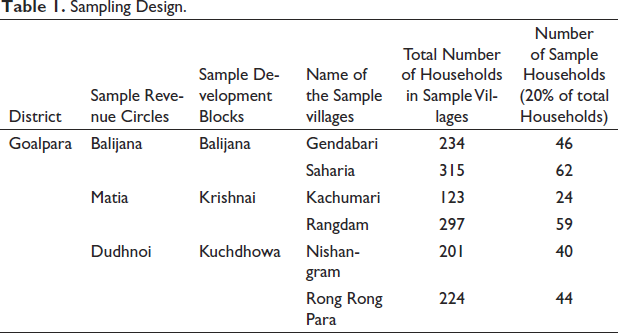
To meet the objectives of the study, the necessary data have been collected through a structured schedule prepared at the household level for the study. For convenience of data collection at the household level, a collective group of household representatives each was interviewed at a common place in the villages identified for the study. For the first objective, the primary data relating to the socio-economic condition of the sample households have been collected and analysed by using the simple statistical measure of percentages. Again, to fulfil the second objective, the HDI for the Rabha community has been constructed by following UNDP’s methodology.
Results and Discussions
Socio-economic Profile of the Sample Population
It is seen that the socio-economic fabric of any society affecting education, health, fertility, mortality, income and so on has huge impact on development as a whole (Buragohain, 2013). A brief analysis of the socio-economic and demographic characteristics of the sample households is, therefore, made here which may affect the development indicators as mentioned. Table 2 depicts the socio-economic profile of the sample households of the Rabha community in the Goalpara district of Assam.
Socio-Economic Profile of the Sample Population.
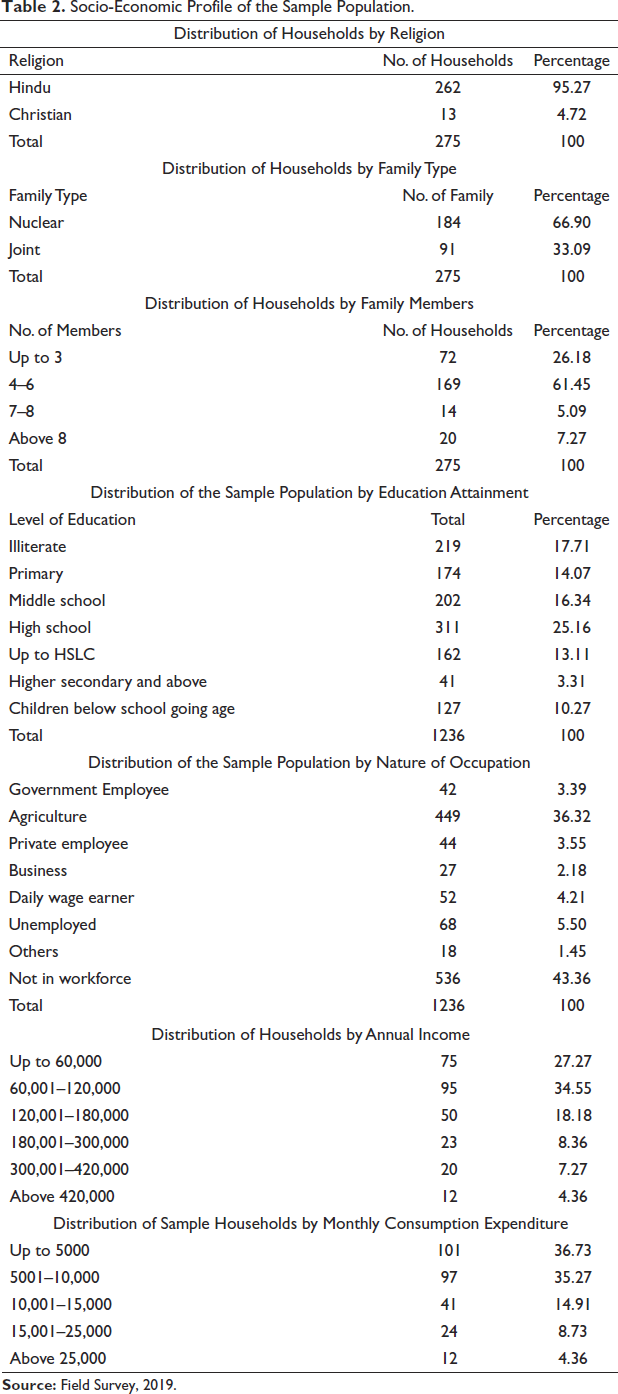
It is found that 95.27% of the sample households are followers of the Hindu religion with 3.27% being Christians. Different studies have shown that the size of the family has a significant positive impact on the consumption expenditure of the family which leads to a decrease in savings to income ratios. Again, the family size also has a negative significant correlation with health and education outcomes of the family (Kiran & Dhawan, 2015; Lundborg et al., 2013). Almost 67% of the sample households have been found to have nuclear families. With the average size of a family being 4.50, it is found that 61.45% of the sample households constitute families with four to six members followed by 26.18% having a family size of up to three members. Only 12.36% of the sample households have a family size of seven and more members.
Attainment of education, an important socio-economic indicator, has a significant impact on the level of economic and human development of the population in any society. Education, which is an investment in human capital, can contribute to economic development, raise income of the poor, increase productivity, promote social equity, contribute towards attaining important development goals like improved health status, increase in life expectancy and reduction in fertility (Psacharopoulos & Woodhall, 1985; Szirmai, 2005). It is found that the overall literacy rate among the sample households is 80.25% which is higher than the state average of 73.18% and national average of 74.04% as per the 2011 Census. However, it is observed that education attainment among the sample households is mostly up to the HSLC level and the percentage of households with attainment of higher education is rather low.
The nature of occupation has a huge impact on health, income and education outcomes. The development of a particular community can be judged from the pattern of occupation of the community (Gopalakrishna, 2008). It is found that among the sample households, employment share as a principal occupation is highest in agriculture at 36.32% followed by daily wage earners at 4.21% and private employees at 3.55%. Therefore, it can be viewed that the Rabhas are predominantly into agriculture as 64.14% of the total working population is engaged in the agricultural sector.
Income is another socio-economic indicator that influences the standard of living of the people. It also influences the demographic behaviour of a population group, their health status and education outcome (Buragohain, 2012). For this study, the annual family income is arrived at by taking into consideration the income earned by the household from different sources. It is found that 72% of the households earn an annual income which is more than ₹60,000. Among them, majority of the households, that is, 34.55% are in the annual income bracket of ₹60,001–120,000 followed by 18.18% in the bracket of ₹120,001–180,000, 8.36% in the bracket of ₹180,001–300,000, 7.27% in the bracket of ₹300,001–420,000 and 4.36% in the bracket of ₹420,000 and above. This shows that 27% of the sample households are therefore earning an income of less than ₹5,000 per month.
In the study, an attempt has also been made to calculate the monthly consumption expenditure of the households as it reflects the standard of living of a household and is positively associated with human wellbeing. The consumption expenditure has been arrived at by taking into account the consumption expenditure of the household on items like food, education, cloth, health, fuel, electricity, telephone and transportation during the last one month. It is found that 36.73% of the households have monthly consumption expenditure up to ₹5,000 followed by 35.27% having a monthly consumption expenditure in the category of ₹5,001–₹10,000 and 14.91% in the category of ₹10,001–₹15,000. Only 4.36% of the sample households are found to spend ₹25,000 and above on consumption per month.
Housing and Household Amenities
Housing and household amenities are considered to be yet another set of significant indicators for determining the standard of living of any household. Housing or house type plays an important role in determining and shaping a person’s mental, physical and emotional health condition with regard to the qualitative dimensions provided by the housing condition (Zainal et al., 2012; Planning and Development Department, GoA, 2014). The housing and household amenities of the sample households are outlined in Table 3.
Status of Housing and Household Amenities of Sample Households.
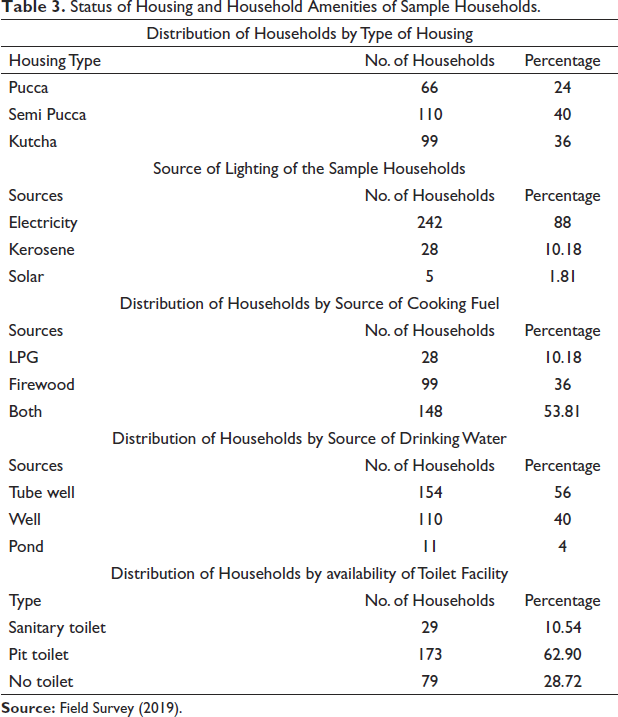
It is found that only around 24% households in the study area have pucca houses, the rest 76% have either semi-pucca or kutcha houses. Quality housing is, therefore, an area of concern among the sample households. With 88% of the households availing the benefits of UJALA Yojana, has electricity as the main source of lighting in the household. However, in terms of cooking fuel, it is found that only 10.81% of the households use LPG as the source for cooking with 36% of the households still using firewood as the only source of cooking fuel. As the kind of source used as cooking fuel can determine the level of indoor air pollution, it can have a decisive impact on the health of women and children in the household. Yet among the other amenities, availability of drinking water and sanitation facilities has an important role to play in determining the health of the members of any household. Among the sample households, almost 96% have tube wells or wells as the source of drinking water. The rest of the households are dependent on ponds. Again, in terms of sanitation, it is found that 28.72% of the households do not have toilet facilities and 62.90% of the households are still using unscientifically designed pit toilets. Lack of accessibility to clean drinking water sources and proper sanitation facilities is the major challenges faced by the sample households in the study area.
Status of Human Development among the Rabha Community
To measure the status of human development among the Rabhas, an HDI has been constructed following the HDI of UNDP.
2
To arrive at the HDI, an index needs to be created for each of the identified dimensions. To calculate these dimension indices, minimum and maximum values also termed as goalposts are chosen for each underlying indicator. Performance in each dimension is expressed as a value between 0 and 1 by applying the following formula:

However, for standard of living, which captures command over resources, the index is to be computed with the help of the following formula:

The HDI is the geometric mean of the three dimension indices.

For this study, as the community level data are not available, therefore, some adjustments are made and proxies are used to construct the HDI for the Rabha community. Considering the modest size of the sample, to construct the health index, infant mortality rate among the sample households has been considered instead of life expectancy at birth (Assam Human Development Report, 2003). For education dimension, adult literacy rate has been taken into account instead of expected years of schooling (UNDP, 1995) and mean years of schooling (MYS) for 15+ years age group is used instead of mean years of schooling of 25 + years age group as in India. Among the Rabha community in Assam, the population is entering into the labour force as early as 15 years of age and with possibilities of making a significant contribution to growth, provided the population is equipped to be productive (Ministry of Women and Child Development, 2009). Here, equal weights are given to each of the sub-indices of education. Again to calculate the income index, due to unavailability of data, per capita income of the sample households is used instead of real GNI per capita. Table 4 outlines the goalposts used for creating the dimension indices.
Goalposts for Calculating HDI.
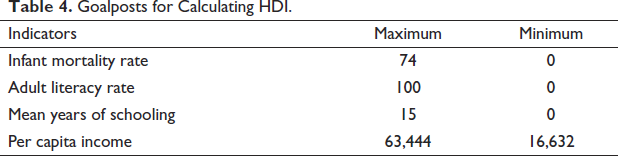
(Infant mortality rate of Kokrajhar district of Assam is taken as the maximum value as Kokrajhar witnessed the highest infant mortality rate in comparison to the other districts of Assam according to the data of Annual Health Survey Bulletin, Assam, 2012–2013. The maximum and minimum values of adult literacy rate are set according to UNDP’s Human Development Reports. Again, maximum and minimum values of MYS are set according to the Assam Human Development Report, 2014. The per capita annual income of Kamrup(M) district of Assam is taken as the maximum value and per capita income (PCI) of Hailakandi district is taken as the minimum value as these two districts have witnessed the maximum and minimum annual per capita income among the districts of Assam as per the Assam Human Development Report, 2014.)
The dimension indices are created next. Performances in each dimension has been expressed as a value between 0 and 1.
Health Dimension
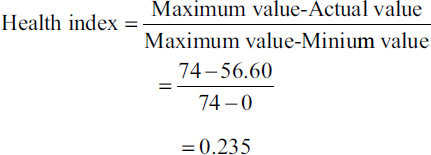
To construct the health index for this study, infant mortality rate among the sample households has been used. The Sample Registration System defines infant mortality rate as the number of children dying before their first birthday. In this study, infant mortality rate of the community is found at 56.60 per thousand live births which is higher than the state average of 44 per thousand live births and national average of 34 per 1,000 live births (NITI Aayog Data, 2019). Since infant mortality rate (IMR) is negatively related to HDI, the following formula has been used to calculate the health index:
Education Dimension
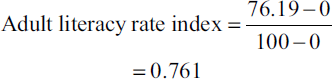
For calculating education dimension, adult literacy rate and MYS for 15+ years age group have been used. Here adult literacy rate is defined as the percentage of population aged 15 years and above who can both read and write together with understanding a short simple statement in his/her everyday life (Planning Commission, 2011). Adult literacy rate for the study is 76.19%.
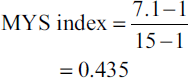
MYS is one of the two indicators used to measure the educational attainment by UNDP. MYS is the average number of completed years of education of a country’s population. However, it excludes years spent in repeating individual grades. For calculating MYS, distribution of population by educational attainment and age is necessary at a given point of time. For the present study, the MYS is found as 7.1 years for the sample population of 15+ years age group.

Income Index
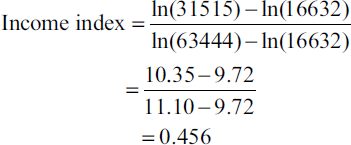
The UNDP Report 2010 while computing the HDI has used gross national income (GNI) per capita to measure the standard of living. And, for comparing the countries, GNI per capita of the countries are adjusted by purchasing power parity ratios. To measure standard of living, the National Human Development Report, 2001, has used per capita real consumption expenditure adjusted for inequality. Owing to unavailability of data on GNI per capita at the community level, this study uses per capita income of the sample households to calculate the income index of HDI. The per capita income of the Rabhas is therefore, found to be ₹31,515.
Now the HDI for the community is
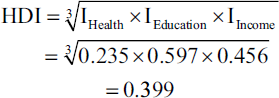
The HDI for the Rabha community of Goalpara district of Assam is thus 0.3999 indicating a very low level of human development in the community. The HDI value of the Rabhas is lower than the national average of 0.640 and state average of 0.605 in 2017 (Sub-national HDI—Area Database—Global Data Lab, 2018). The HDI value of the community is even lower than the average HDI figure of Goalpara district (0.591) signifying that the Rabhas as a community is lagging behind in terms of human development as compared to the other communities in the district.
Conclusion
The socio-economic status of any community has colossal impact on human development. In this study, it is observed that the indicators viz. access to electricity, access to drinking water and literacy rate are contributing to the socio-economic standard of the Rabha households. However, other determinants like per capita income, housing facility and access to sanitary and toilet facility have failed to adequately contribute to the socio-economic status of any community.
In the present study, an attempt has also been made to measure the level of human development among the households of the Rabha community by constructing a community-specific HDI. The HDI for the Rabha community is calculated at 0.3999 reflecting that the status of human development of the community is far from satisfactory. The HDI value of the community is lower than the national average of 0.640 and state average of 0.605 of 2017. The HDI value of the community is even lower than the average HDI value of 0.591 of Goalpara district indicating that the community is lagging behind in comparison to the other communities in the district. The low HDI value of the community that falls in the low human development category signals low attainment in indicators like education, health and income. It is pertinent to bring to fore here that though literacy rate of the sample Rabha households is higher than the national and state averages, the percentage of population having higher education in the community is negligible. Most of the sample community households continue to follow the traditional methods of treatment indicating the need for quality education. The Rabha households mostly practice traditional agriculture that again leaves scope for infusion of modern methods and technology in the sector. For, it is not possible to raise the standard of living of a community without positive and result-oriented interventions in their prime source of livelihood. There is, therefore, a need to come with measures for expansion of human capabilities among the Rabha community.
Last but not the least, a generic HDI may not be applicable for reflecting the aspirations and human development aspects of a community as it is designed to understand the overall human development aspects of the entire district or the state. As each community in the North Eastern region of India has its own culture, agricultural system, livelihood system and economic exchange mechanism, a community-specific HDI may be more reflective of the human development status of the community where understanding of appropriate factors aiding or limiting the prospects of growth of the community is properly identified. This will support in coming up with a more inclusive decentralised plan which is community-specific addressing the aspirations of the community in a more concrete manner. Therefore, community-specific HDI maybe a more precise tool for addressing the development goals specific to a particular community, especially for the socially and economically marginalised tribal communities of the North Eastern region of India to bring them to the level of the other mainstream communities.
Footnotes
Declaration of Conflicting Interests
The authors declared no potential conflicts of interest with respect to the research, authorship and/or publication of this article.
Funding
The authors received no financial support for the research, authorship and/or publication of this article.
