




Abstract
Contestation and participation are commonly viewed as two main constituent dimensions of electoral democracy. How exactly have these two dimensions been conceptualized and measured in the literature? Are they empirically observable and do they matter for democratic development and stability? This article answers the first of these questions and considers their implications for the second by reviewing the literature on these two dimensions. We discuss three issues that affect conclusions about dimensions of democracy and their relevance for understanding democratic development: First, conceptual ambiguities—substantive overlap between the two concepts—obscure the meanings of each of the two dimensions. Such ambiguities led to a second issue, which is a concept-measurement mismatch. The conceptual contributions were never really met with an empirical equivalent that would allow us to properly measure the two dimensions. Scholars continue to invoke theoretical understandings from the 1950s, 1960s, and 1970s, but represent them using measures that were not explicitly concerned with measuring them, which presents the third issue of concept reification. As a result of these three issues, inferences about how democracy has developed and its relevance for democratic stability or for transitions to democratic rule is potentially obscured. Based on these issues, we provide three suggestions for future research concerning the concepts of contestation and participation.
Introduction
The questions of whether democracy consists of multiple dimensions and how they work together have been of theoretical interest to scholars well before empirical measures of democracy became widely available. As political science became more quantitatively oriented, research on the topic sought to bear out the ways in which democracy has changed over time and to relate them to overall democratic development. On the whole, however, such works share little consensus on the defining attributes of democracy and how they characterize political progression.
This article reviews the early theoretical and more recent empirical work on two popular dimensions of electoral democracy: contestation and participation. These features originated with Robert A. Dahl (1956, 1971, 1989), specifically, in Polyarchy (1971), who characterized democracy as the product of institutional guarantees that formed two varying attributes representing the extent of competition and inclusiveness. 1 Dahl (1971) argued that historical developments in the two features shaped a country’s prospects for stable democracy. Scholars have carried forward these ideas by continuing to invoke the concepts of contestation and participation to depict democratic development, which raises the question of how our understanding of them has fared (Coppedge et al., 2008; Miller, 2015; Böhmelt and Ward, 1996; Wong, 2021).
In separate sections devoted to conceptualization, measurement, and inference, we consider how original ideas about these two dimensions have been translated into measures and empirically evaluated. In each section, we also highlight issues that to this day impair our understanding of them.
In the conceptualization section, we argue that the concepts of contestation and participation are fairly open to interpretation. Dahl acknowledged that there was substantial overlap between the two components (Dahl, 1971: 4), and institutional innovations since the “third wave” of democratization have made it difficult to neatly distinguish between the two (Haggard and Kaufman, 2016).
In the measurement section, we highlight that some of the first cross-national measures of democracy (e.g. Gurr, 1974) focused on identifying differences in authority patterns rather than measuring contestation and participation. Additional datasets on democracy that followed were only partially concerned with the notions of contestation and participation and did not use the same indicators to represent components of democracy. Subsequent cross-national work based on those measures nevertheless used them to evaluate arguments about changes in contestation and participation, which represents a divergence between the conceptualization of specific concepts—the motivating theory—and the criteria used to judge them. This occurred despite broad debates about concept and measurement validity in democracy research (Munck and Verkuilen, 2002). There is, therefore, some
In the section on inference, we demonstrate how conceptual ambiguity and concept-measurement mismatch together impair our ability to draw inferences on whether there are empirically observable dimensions of democracy and, if so, how they matter for democratic development. We argue that research on democratic development has largely been influenced by a persistent conceptualization of it (the interplay of contestation and participation) that did not perfectly correspond to the empirical approaches used to demonstrate it. This divergence has had lasting impacts on scholars’ conclusions about democracy across countries. The ideas of contestation and participation continue to be invoked because they are intuitively appealing but they lack clear conceptualization and empirical support, which presents the third issue of
The issues that we raise affect international and comparative political development because they shape conclusions about the impacts of factors such as economic growth on democracy and the likelihood of democratic transitions and democratic survival (Armijo and Gervasoni, 2010; Boix and Stokes, 2003; Miller, 2015; Przeworski et al., 2000; Wright, 2008). Bueno de Mesquita et al. (2005), for example, argued that multiparty competition—rather than the means of executive recruitment—may matter more for reducing human rights abuses. 2 What scholars mean when they talk about “contestation” and “participation” has important implications for crafting effective policy. Improvements in the conceptualization of democracy, the measurement and construction of continuous indices, and methods for validating the dimensionality of the data encourage scholars to more carefully consider whether contestation and participation are distinct dimensions and, if so, how they have changed over time. To this end, we offer three suggestions for future research on dimensions of democracy that may help shed light on how they contribute to important outcomes related to democratic development.
Concepts
This section provides an overview of the way that scholars have evoked and described the concepts of contestation and participation, aside from the broader debate of how democracy as a whole should be conceptualized. Rather, we are concerned with whether there is consistency, (dis-)agreement, or overlap in established conceptualizations of these two dimensions.
The concepts of contestation and participation originated as part of the study of democracy. Notwithstanding ongoing disagreement about the precise concept of democracy, many scholars adopted a view of electoral democracy that saw it as a competitive struggle for votes (e.g. Alvarez et al., 1996; Cheibub et al., 2010; Dahl, 1971; Schumpeter, 1950; Przeworski et al., 2000). 3 Originating with Schumpeter (1950), an accepted “minimal” definition emphasizes regularly held elections to fill positions of authority—namely, the executive and legislature (Alvarez et al., 1996; Przeworski, 1991; Elliot, 1994). The Schumpeterian view of democracy focuses on whether elections can be lost (Alvarez et al., 1996; Cheibub et al., 2010; Schumpeter, 1950; Przeworski et al., 2000). 4 Scholars acknowledged the importance of citizen participation in democracies but took it as given. 5 Though “governmental responsibility either directly to voters or to a parliament elected by them is a defining feature of democracy,” Alvarez et al. (1996) argued that “[i]n the recent cases, the only focus of conflict is contestation” (p. 5).
The recognition of citizen participation as a second component of democracy, however certain, that was separate from but complementary to the quality of contestation was an important nuance that Dahl (1971) added. 6 Dahl (1971) characterized democracy as an unreachable, ideal type based on “continuing responsiveness of the government to the preferences of its citizens” (Dahl, 1971: 1), which differed from other conceptualizations of democracy that emphasized competition. Dahl (1956, 1971) reasoned that eight institutional guarantees were necessary components of a polyarchy, the closest approximation of the ideal type, and were required for citizens to be able to formulate and signify their preferences and to have those preferences weighted equally in the conduct of government. These guarantees include the freedom to form and join organizations, the freedom of expression, the right to vote, the right to be eligible for public office and compete for political support, alternative sources of information, free and fair elections, and institutions that are dependent upon votes and the expression of preferences. Together, the eight conditions “increase the size, number, and variety of minorities whose preferences must be taken into account by leaders in making policy choices” (Dahl, 1956: 132). Thus, in their view, a central quality of democracy is enabling minorities to organize and lobby as well as the presence of elected representatives responding to them.
Dahl (1971) argued that the eight institutional guarantees were divisible into two dimensions—contestation and participation. Differences in the level of contestation and inclusiveness (participation), Dahl (1971) reasoned, represented different types of regimes, with polyarchies, or the most democratic regimes, exhibiting high levels of both contestation and participation. 7 Moreover, they theorized that differences in the development of each dimension over the long term provided a basis for explaining differences in outcomes such as democratic transition and survival. According to Dahl (1971), increasing participation first or together with contestation was more difficult because it entails a need to reconcile the preferences of a large number of people. Distributive pressures should also be greater as well, which increases the threat of dissolution and conflict (Boix, 2003; Huntington, 1968). Instead, increasing contestation first—that is, elites settle the terms of contestation before including the broader public—follows an easier trajectory toward polyarchy. Dahl (1971) anticipated greater stability in the contestation-first pathway to polyarchy, arguing that it should be easier to first establish political consensus among a small group of people with relatively homogeneous preferences and then open up political space.
Contestation and participation became widely accepted dimensions of democracy. This is evident in the way that subsequent datasets aggregated indicators to represent components of democracy. In a review of democracy measures, Munck and Verkuilen (2002) wrote that “the decision to draw [on Dahl’s] influential insight that democracy consists of two attributes—contestation or competition and participation or inclusion—has done much to ensure that measures of democracy are squarely focused on theoretically relevant attributes” (p. 9). 8 They also remained theoretically relevant through efforts to empirically verify them. A number of works assessed whether changes in contestation and participation characterize political development and their potential impacts on outcomes (e.g. Coppedge and Reinicke, 1990; Coppedge et al., 2008; Miller, 2015; Wong, 2021).
Though they came to be seen as fundamental aspects of democratic institutions and of theories of democratic development (Mayhew, 2015), the theoretical appeal of the concepts of contestation and participation can be explained in part by their vagueness. This is something that Dahl (1971) readily acknowledged. They treated suffrage as the core feature of participation but then went on to characterize it as something more complex. For example, they acknowledged that “[t]he right to vote in free and fair elections…partakes of both dimensions” (Dahl, 1971: 4) and that “the right to participate…[is] a characteristic that cannot be interpreted except in the context of other characteristics” (Dahl, 1971: 5). As a result, contestation and participation may have meant different things to various scholars who apply the concepts to explain democratic outcomes. Boese et al. (Forthcoming) discussed how such ambiguities continue to affect empirical measurements of democracy to this day. The overlap and lack of clear delineation between the two concepts present a central issue for the conceptualization of contestation and participation.
Issue I:
Table 1 highlights some of these conceptual ambiguities. While on a high level of abstraction both concepts seem intuitive, the conceptual ambiguities become more tangible as we move down the ladder of abstraction.
Contestation and participation: examples of conceptual ambuigities.
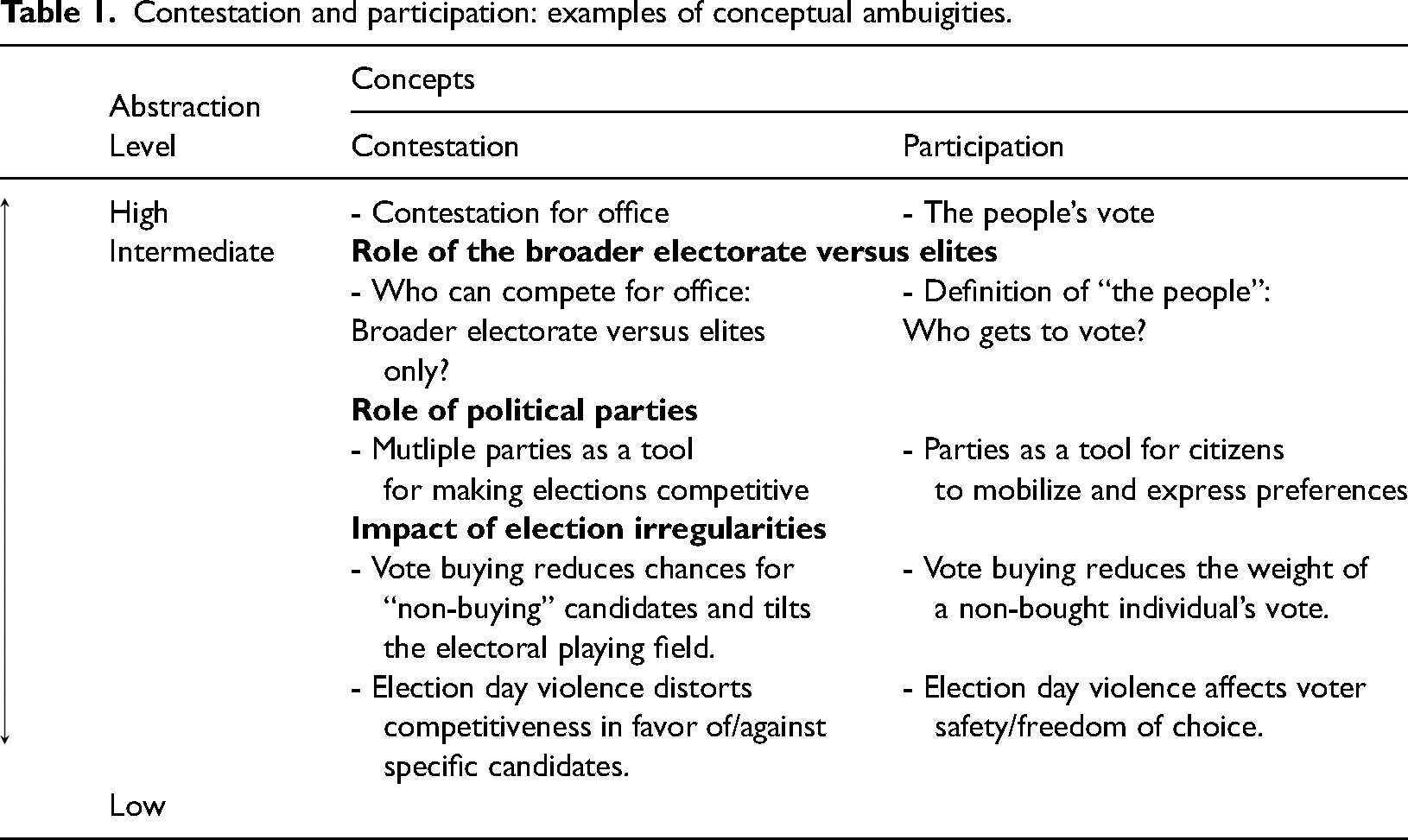
On an intermediate level of abstraction, the question of how parties and the broader public fit into the two dimensions serves as a good example to illustrate such ambiguities. For example, it is not clear how the broader electorate contributes to the contestation dimension. Dahl (1971) has been interpreted as presenting an elite-biased view of democracy in which the institutional guarantees initially applied to a few (Krouse, 1982). In earlier writings (Dahl, 1956, 1961), they describe an inherent tension between democracy and the “authoritarian-minded” nature of the ordinary citizen (Kendall and Carey, 1968; Krouse, 1982). Under competition that is largely restricted to elites, “the rules, the practices, and the culture of competitive politics” 9 as well as “[t]olerance and mutual security” 10 were more likely to develop, Dahl argued. 11 Depicting contestation for elected offices as being restricted to a select few nevertheless overlooks the mobility that enhanced competitiveness offers to ordinary citizens to enter and influence politics. Dahl (1971) recognized this, saying that “as the electorate grows, the traditional, mainly informal arrangements that worked well enough with a tiny group of voters…are simply inadequate” (pp. 24–25) and that “the need to mobilize a bigger electorate triggers off the development of ‘modern’ party organizations” (p. 24), but did not clarify what that meant for contestation and participation.
How do mass-based parties fit into the delineation of the two concepts? If Dahl (1971) was primarily thinking of contestation as elite-based competition—with citizens only choosing between candidates—then greater mass involvement (e.g. a stronger civil society and party institutionalization) represents expanded participation. To this end, Coppedge (2002) argued that “inclusiveness should be more than just voting” (p. 36). If, on the other hand, participation includes suffrage only, then the concept of contestation is much more heavily loaded as an explanatory factor since it includes the ways in which citizen preferences are aggregated and articulated (such as mass-based parties and civil society organizations). An important question therefore concerns whether participation refers solely to the ability to choose between competitors or whether it also represents the ability to be involved in determining the outcomes of elections in other ways. In addition, multiparty systems involve competition for both between and within parties, which may increase the means by which citizens contribute to contestation and participation.
On a lower level of abstraction, obstacles to contestation and participation in the form of voting irregularities that affect individuals further exemplify conceptual ambiguities. These irregularities affect the impact of an individual’s participation/vote while at the same time unfairly tilting the competing field in some candidate’s or party’s favor. 12 For example, up until the 1960s and 1970s, suffrage in the US was effectively circumscribed by ethnicity, with literacy tests, ID requirements, and election-day violence that limited the ability of all citizens to partake in elections but also accrued a disproportionate benefit to one party. Mickey (2015) refers to parts of the American South as “authoritarian enclaves” that operated as one-party states due to restrictions placed on Blacks, despite the formal extension of suffrage at the federal level. At question is not whether improvements in those practices enhanced the quality of democracy, but whether it represented a meaningful change in contestation—the extent to which candidates/parties were fairly competing for votes—or participation—citizens’ ability to cast a vote. Additional irregularities that affect the quality of votes and, by extension, the real competitiveness of elections, include ballot box stuffing and vote buying.
Conceptual ambiguity has important theoretical and empirical consequences. For one, it affects interpretations about the importance of those concepts for explaining outcomes. One interpretation might be that contestation-first development contributes to democracy by ensuring that potentially destabilizing actors first agree on the terms and make bargains that preserve government against pressures from below. If so, it underscores the importance of elite pacts as a key element of state-building and democratization—the need for agreement between parties before citizens choose between them (Higley and Burton, 1989; North et al., 2009; O’Donnell and Whitehead, 1986; Razo, 2008). Multiparty competition may matter here for organizing constituent preferences and preventing unrest. If, however, party development represents expanded participation by citizens, then the implications of contestation-first development might be different. It could be that contestation-first development makes democracy more likely by engendering rules, regulations, and norms that constrain the capacity of those parties to dominate or destabilize elections once citizens become more involved. This recognizes their capacity to serve as vehicles for co-optation, cultivating mass support to establish electoral dominance (Hellman, 1998; Levitsky and Way, 2010; Magaloni, 2008).
What scholars think composes each dimension has downstream implications for how contestation and participation might be measured. For example, previous efforts to demonstrate changes in contestation and participation included the role of political parties under contestation and treated participation as synonymous with suffrage, for which it was often omitted (Coppedge and Reinicke, 1990; Miller, 2015; Wright, 2008). 13 This effectively focused on one dimension. Though Dahl (1971) theorized that democracy may be divisible into two dimensions, other scholars suggested that it might be more complex. Coppedge (2002) argued that “[t]he first dimension…, contestation, has hidden qualities that have been ignored or taken for granted” (p. 36) and that “inclusiveness itself may consist of two dimensions” (p. 37, emphasis ours). Thus, despite their appeal for describing patterns and explaining outcomes, contestation and participation remain rather ambiguous concepts.
Measurement
The ability to bear out early claims about political development and the dimensionality of democracy was initially limited by the newness of empirical approaches and the lack of available data at the time. Within a few years of the publication of Polyarchy (Dahl, 1971), however, notable contributions to the measurement of democracy occurred, beginning with the forebear of the Polity dataset (Gurr, 1974; Eckstein and Gurr, 1975). Gurr (1974) was not directly concerned with characterizing democracy, but with identifying the patterns of authority that induced political stability within a polity. They differentiated between the openness of executive recruitment, decision constraints on the chief executive, extent of political participation, scope of governmental control, and complexity of government structures. Gurr (1974) nevertheless argued that differences in authority patterns enabled one to distinguish between democratic and autocratic polities, respectively characterizable by “multiple institutionalized centers of power” versus “the institutionalized monopolization of power” and anocratic polities, which lack power and institutions. 14
Gurr further developed this notion of authority patterns, leading to the creation of the Polity dataset. They advocated using the categories to develop indicators of “degree” and offered one approach, but noted that “many quite different operationalizations of the dimensions are equally or more appropriate” (Gurr, 1974: 1486). Based on the ordering of qualitative attributes related to the competitiveness of political participation, the openness and competitiveness of executive recruitment, and constraints on the executive, Eckstein and Gurr (1975) created an 11-point Democracy scale as well as a similar scale for Autocracy that also accounted for the regulation of participation. The annual codings of authority traits gained traction in the 1980s to quantitatively represent democracy and autocracy (Harmel, 1980; Lichbach, 1984) and especially so in the 1990s. 15 In a subsequent update and extension of the Polity data, Jaggers and Gurr (1995) subtracted the autocracy and democracy indices to create a single index that others employed to explain outcomes such as regime change (e.g. Gurses, 2011) and conflict (e.g. Chiozza, 2002).
A number of other continuous measures and indices of democracy proliferated in the 1990s, examples of which include Arat (1991), Coppedge and Reinicke (1990), Hadenius (1992), and Vanhanen (1990). 16 Contestation and participation remained prominent notions among emerging democracy measures—see, for example, Munck and Verkuilen (2002); Gates et al. (2006)—, but measures represented them in different ways. Arat (1991), for example, measured “participation” based on executive and legislative selection, legislative effectiveness, and the competitiveness of the nomination process, and “competitiveness” based on party legitimacy and party competitiveness. Many datasets that spanned the post-World War II era also overlooked the participation dimension, since universal suffrage could be taken for granted (Munck and Verkuilen, 2002).
Elsewhere, scholars empirically represented aspects of democracy without reference to contestation and participation as core components. For Alvarez et al. (1996), democraticness was represented by the extent to which the executive and legislature are elected, while others distinguished between political liberties and the selection process (Bollen, 1980). Still others, such as Freedom House, qualified countries based on political rights and civil liberties. Subsequent discussion emerged in the literature about the differences between the various democracy measures and issues related to the concept and measurement validity (Adcock and Collier, 2001; Bollen, 1993; Casper and Tufis, 2003; Elkins, 2000; Munck and Verkuilen, 2002; Schmitter and Karl, 1991). 17
The variety of datasets that present democracy as comprising different components makes it difficult to say whether the concepts of contestation and participation are observable as distinct dimensions across them and whether they have empirical value for explaining democratic development. The scholars who led the charge in quantifying aspects of democracy may have been influenced by the theoretical concepts of contestation and participation but did not share a consensus on how to represent them. Measures of democracy were not equally concerned with including aspects related to contestation and participation and did not measure them in the same way but were later used to test arguments about them. The set of theoretically relevant attributes encompassed by the different datasets is quite broad, for which the ability to use them to validate arguments about specific dimensions of democracy is unclear.
Issue II:
The multiplicity of available measures inspired efforts to identify latent estimates of democracy and associated dimensions from multiple sources (Bollen, 1993; Coppedge et al., 2008; Miller, 2015; Pemstein et al., 2010; Teorell et al., 2019). Some approached the dimensions question by combining related attributes to approximate conceptual dimensions—using latent representations of inclusiveness and competitiveness to bear out arguments about trends in democratic development. 18 Coppedge et al. (2008), for example, used principal component analysis on multiple measures of democracy attributes between 1950 and 2000 and identified two dimensions that they interpreted as representing contestation and inclusiveness, concluding that the placement of regimes and historical patterns validated Dahl (1971). Similarly, Miller (2015) used principal component analysis on a variety of indicators of democracy, closely resembling the approach of Coppedge et al. (2008), to produce composite measures of contestation and participation from 1815 onward, noting that higher levels of contestation over participation occurred in electoral regimes prior to 1940, after which participation overshadowed contestation.
A problem with this approach, however, is that the composite measures differed considerably from theoretical depictions of the concepts that they were supposed to represent. The latent estimates of participation that Coppedge et al. (2008) and Miller (2015) created came from disparate sources that included adult suffrage, legislative selection, women’s political rights, effective executive selection, and an index of participation, while their estimates of contestation incorporated Political Rights from Freedom House, Competitiveness of Participation and Executive Constraints from Polity, and measures of party legitimacy and legislative effectiveness (Banks, 1976). Research on the topic had produced many different measures of democracy that were not necessarily concerned with capturing the same specific attributes, a prime illustration being how Polity was constructed, yet one response was to use the correspondence between them to represent those attributes. This involved making decisions to draw on items that were not clearly associated with one component or the other, such as using Polity’s Competitiveness of Participation index to infer information about competition rather than participation. Such empirical measures of contestation and participation were derived from existing democracy indices that had not been designed to empirically capture theoretically relevant aspects of each of the two concepts.
Though it can help to reduce idiosyncratic errors and uncertainty between measures, the effectiveness of the latent-variable approach as a form of validation depends on whether they are focused on the same concepts. Insofar as various datasets operationalized the concepts of contestation and participation differently (if at all), combining them together using a latent-variable approach incorporates different definitions and measurements that could make the latent indicators less valid representations of specific dimensions. That is to say, it may exacerbate the discrepancy between the definition and measurement of specific concepts, making it less clear what the dimensions are and how they support or undermine specific theoretical expectations. This should be less of a problem for more general, abstract concepts such as democracy than for specific features. The latent-variable approach improved on validating and testing the concepts in some ways but entailed combining several different attributes from varied sources that diverged from how they were first conceptualized by scholars such as Dahl (1971).
There is a variety of measures that characterize democracy and that were guided, to different extents, by the intuition that contestation and participation constitute recognizable aspects of democratic development. They also vary in the extent to which they correspond to each other and to those concepts, in part because of vagueness about how to characterize them (the problem of conceptual ambiguity noted above). The issue is not that there are different conceptualizations and measures of democracy, but that different measures are used to make inferences about specific theoretical concepts. Likewise, constructing composite indices may not be problematic as an approach, but it is if the items being aggregated are not appropriate for the concept being measured. Simply using different indicators to represent each concept does not ensure that they actually do. As a result of concept-measurement mismatch, we argue that few have come close to providing an empirical basis for evaluating whether contestation and participation are distinct dimensions that drive historical democratic development.
Inference
As we discussed above, the concepts of contestation and participation are difficult to define in precise terms and have been measured in different ways that have not been shown to be valid representations of those concepts. It is not yet clear which, if any, measures appropriately align with generally held notions of them. Thus, questions remain (a) whether democracy does in fact consist of two dimensions comprising contestation and participation and, if so, (b) whether and how they matter for democratization and related outcomes. Still, the concepts continue to influence empirical work on democracy and democratic development, with Wong (2021) being a recent example.
Conceptual ambiguity and concept-measurement mismatch are partly responsible for perpetuating the belief that contestation and participation are internally consistent concepts whose changes characterize democratic development. The terms occupy a prominent place in discussions about democracy and connote intuitive ideas. They also seem to be validated by empirical treatments that show variables that move in ways that might be expected of them. However, the fact that the results from analyses that use composite measures “match up” with theoretical expectations about change over time is not incontrovertible evidence that such measures are the most valid representation of a specific object, nor that those objects offer the strongest explanation for an outcome. 19
Scholars may therefore continue to think about democratization in terms of contestation and participation because they have been commonly held as useful or valid—because the concepts themselves have not been challenged or because measures are thought to consistently bear them out. This can also be problematic. Collier and Adcock (1999) noted that “if a particular name resonates primarily due to [a] tacit belief, rather than because it provides an analytically appropriate slicing of reality, then this name can become a slogan that is employed in a sloppy and uncritical manner” (p. 544). Adherence to concepts such as contestation and participation treats them as “bounded wholes” even though they may not represent the most appropriate way to depict democratic development (Collier and Adcock, 1999; Sartori, 1987). This can be considered “reification,” which refers to considering or representing an abstract concept or idea as if it were a concrete thing.
Issue III:
We argue that concept reification constitutes a problem for inference. Considerable importance has been placed on the concepts, but what scholars mean specifically when they assert those concepts is not agreed upon, nor is the most appropriate way to measure them evident. As such, it remains unclear what previous empirical research can tell us about contestation and participation as conceptual dimensions of democracy.
Scholars may continue to think of democracy as involving developments in contestation and participation—and say as much—but do not have a shared sense of what those dimensions entail. When they purport to measure and make statements about them, then, it is unclear whether and how the results contribute to arguments about how those specific aspects of democracy have developed. We suggest here that conceptual ambiguity and concept-measurement mismatch make it difficult to assert generalizable conclusions about how contestation and participation have changed, calling into question what is the combined knowledge about those concepts and why scholars continue to use them. This does not mean that the extant research on democracy is wrong, nor that there the concepts of contestation and participation should be measured a certain way, but that scholars should be more concerned with concept validity if they think that we can measure specific dimensions of democracy and trace their development over time. Extant conclusions about dimensions of democracy rest critically upon decisions about how to empirically represent them. The imperfect overlap between concepts and measures thus begs the question of what exactly it is about democracy that drives outcomes such as growth and regime change (Armijo and Gervasoni, 2010; Boix and Stokes, 2003; Miller, 2015; Przeworski et al., 2000; Wright, 2008).
Findings and ways ahead
Figure 1 summarizes how the interplay of the three issues affects our understanding of democratic development. Dashed lines in the figure indicate that the corresponding components are either non-existent or ill-defined, which are the issues that we described above. 20 Conceptual ambiguity (Issue I) has downstream effects partially driving concept-measurement mismatch (Issue II) and both, in turn, have contributed to concept reification (Issue III): Many scholars continue to think about democratic development in terms of contestation and participation—and think of those concepts as well-established, empirically demonstrated dimensions—but they are not.
Interplay of the three issues.
As the figure illustrates, early conceptualizations of contestation and participation were inspired by and inspired ideas about democracy, but the former remained vaguely defined. Later movements to empirically measure democracy, likewise, were occasionally inspired by notions of contestation and participation, but often they were not explicitly measured or were not the focus of those democracy measures. Hence, other measures (including derivatives of democracy measures) were used to validate claims about contestation and participation. We do not have a proper conceptualization and proper empirical measures that would be necessary to test whether contestation and participation are the relevant dimensions that drive democratic development. Figure 1 shows that measures of democracy have played an instrumental part in empirical tests of contestation and participation. We argue, however, that using a different concept(s) to make inferences about another concept can be problematic.
The three issues provide plenty of reasons to revisit the dimensionality question. As Skaaning et al. (2015) noted, “the goal of reducing the plenitude of characteristics associated with ‘democracy’ to a single unidimensional index is elusive…because the concept itself is multidimensional and because extant indicators are limited in their purview” (p. 1494). Contestation and participation have long been tacitly agreed upon dimensions. However, conceptual ambiguities, concept-measurement mismatch, and concept reification have limited our ability to delineate and uncover theoretically and empirically relevant dimensions. Consequently, the role of these dimensions in providing democratic stability or supporting democratic transitions is not yet clear.
Recognition of the aforementioned issues is an important first step toward establishing more well-defined theoretical constructs and shared standards of evaluation. Outlining them supports several suggestions for advancing research on the cross-national and historical development of democracy. This is valuable for revising the question of how democracy develops, since scholars have portrayed democracy as developing along one, two (Coppedge et al., 2008; Miller, 2015), three (Gates et al., 2006; Boese et al., Forthcoming), or more dimensions. Below, we discuss three avenues for improvement.
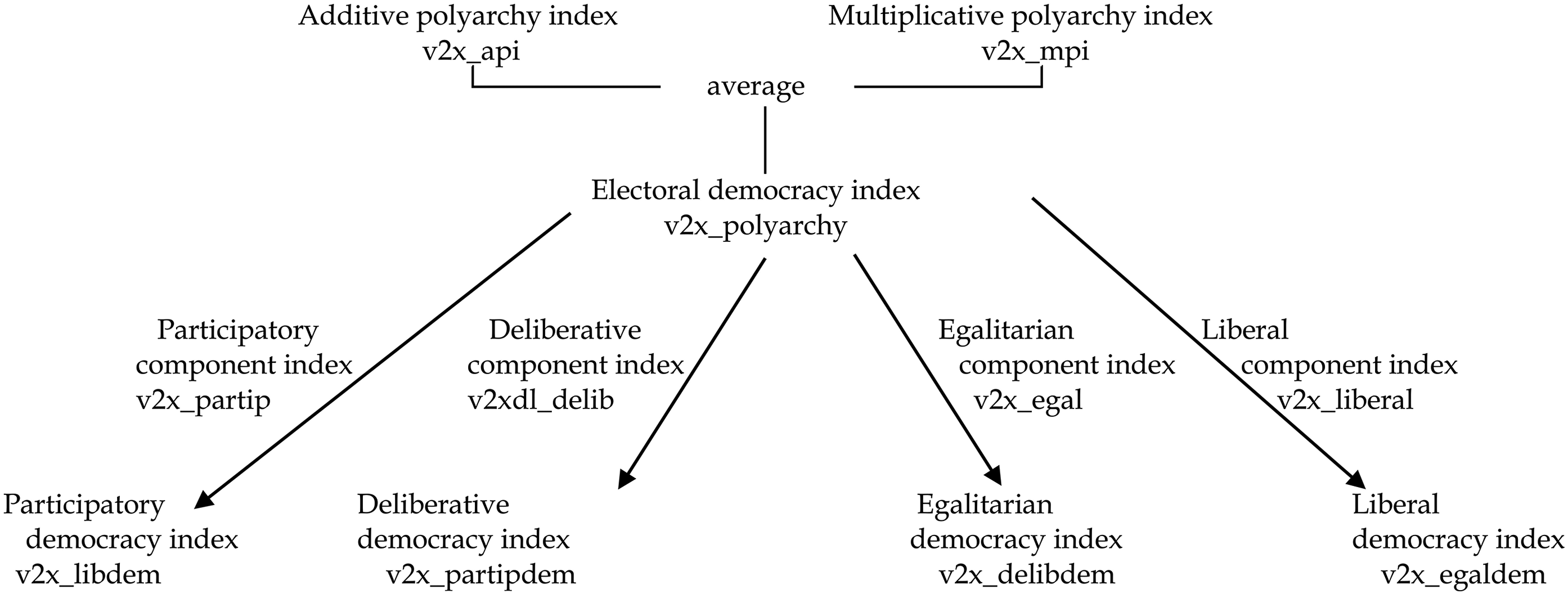
The first suggestion is to closely link theoretically and empirically relevant and consistent attributes of democratic dimensions. Fortunately, advancements in data collection have made it possible to revisit the question of whether different attributes of democratic systems fall into empirically observable dimensions and, if so, whether they correspond to theoretical depictions such as contestation and participation. The start of the Varieties of Democracy (V-Dem) Project (Coppedge et al., 2020b), for example, was informed by theoretical and empirical discussions on the construction of democracy indicators. Scholars who surveyed existing measures to evaluate the validity of Dahl’s arguments were central to the construction of the V-Dem data. Arguing that previous measures did not capture Dahl’s components comprehensively, Teorell et al. (2019) developed the project to estimate qualities associated with the “institutional guarantees.” One of the primary indices measures electoral democracy based on the notion of polyarchy that Dahl (1971) originally promoted (Teorell et al., 2019). According to the codebook,“[the V-Dem Electoral Democracy Index] consists of five sub-components (each of these sub-components being indices themselves built from a number of indicators) that together capture Dahl’s …institutions of polyarchy” (Coppedge et al., 2020a: 27). The disaggregated nature of the V-Dem data and myriad aspects that it measures make it possible to examine relationships between them and the ways in which they covary. This, in turn, supports a reexamination of whether contestation and participation make up empirically meaningful dimensions using measures that more closely match up with the institutional guarantees that are thought to compose them.
The second suggestion is to adapt the meaning of the traditional concepts so that they travel further, which may mean moving up the ladder of abstraction (Sartori, 1970). The conceptual contents of contestation and participation have likely changed over time. For example, while suffrage was a defining component of participation during the 20th century, it has decreased in importance after the fall of the Soviet Union, as almost every country has had full suffrage since (Przeworski, 2008, 2009). Still, many countries are far from offering fully inclusive governance systems: today, barriers to party participation and restrictions on civil liberties remain popular methods for illiberal and autocratic leaders to impede large shares of voters from being fully engaged in the political process (Boese et al., Forthcoming). Freedom of expression and participation by civil society organizations are among the most threatened democratic attributes in the “third wave of autocratization” (Hellmeier et al., 2021; Lührmann and Lindberg, 2019) and thus constitute other ways in which citizens are hindered from being fully included in the political process. How contestation and participation have changed is more of an empirical question than a problem with Dahl’s (1971) model of democratic development. However, scholars who aim to measure these concepts and use them to empirically model democratic developments must demonstrate that they remain conceptually valid across time.
Thus, a crucial element of any successful conceptualization of contestation and participation is a relatively high level of abstraction that allows the attributes to evolve, as opposed to a list of lower-level attributes whose relevance change. To illustrate this evolving nature of different aspects of democracy, Figure 2 plots the five sub-components of the Electoral Democracy Index. At least four major trends are apparent in the average values of those sub-indices over time. The first is the rapid increase in suffrage after World War II, which after around 1980 saw little variation. This evidences the point made above that suffrage has limited explanatory power relative to other features in the 21st century. The second observation is that between 1960 and 1990 the elected officials index was much higher than measures of civil liberties and election fairness. This suggests that more countries were holding elections to fill positions of power but limiting the terms on which they occurred. The third trend is the increase in liberties such as freedoms of expression and association, and election quality after 1990. Finally, a fourth noticeable trend is the greater amount of variance among elements that constitute “free and fair elections.”
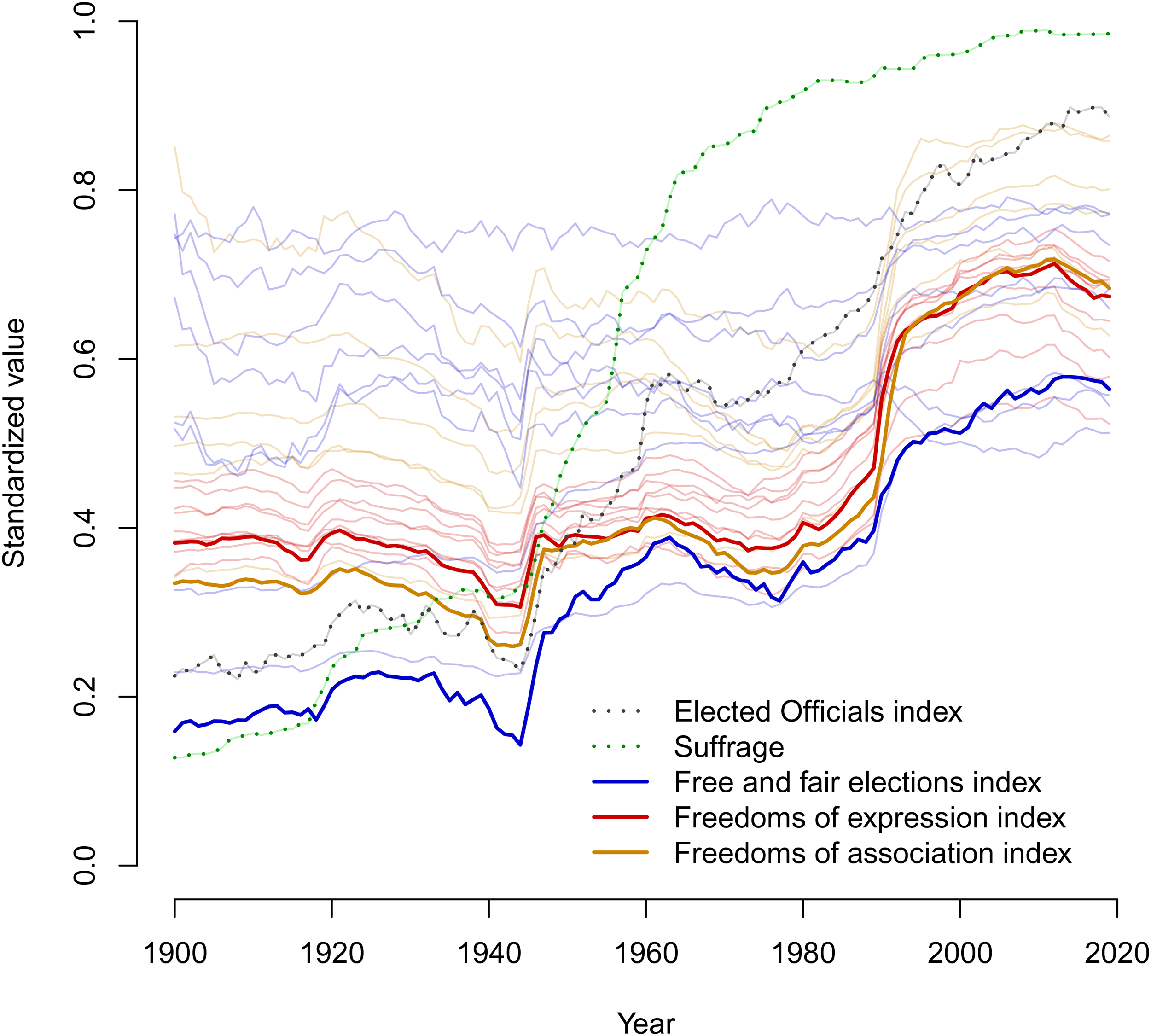
Average values for subindices by year. Faint lines indicate variables that make up each subindex, denoted by color.
These trends underscore the question of how we might conceptualize “contestation” and “participation”: whether participation pertains exclusively to suffrage or whether it should be expanded to include other ways that citizens engage in the political process. Improvements in citizen activity in the form of information and associational life may have bearings on conclusions about the ways they might participate and how the concept of participation has changed, which has not been readily decided.
This points to a third suggestion, which is to abandon the traditional concepts altogether and to rely on empirically derived dimensions that make theoretical sense. If we cannot measure it correctly and if it is not stable in meaning over time—that is, if we cannot overcome the issues of conceptual ambiguities, concept mismatch, and concept reification—, then we need to question the empirical value of those concepts. Instead, scholars might focus on allowing trends in the data to shape the process of abstraction and guide how we describe and think about democratic development. Bollen and Grandjean (1981), who used confirmatory factor analysis to investigate the dimensionality of data on democracy, provided an early example. This offers a potential corrective for some of the issues that we raised here, in that it encourages scholars to develop ideas about dimensions based on patterns in the data before empirically assessing their effects, rather than using potentially incongruent measures to represent dimensions that are assumed to exist in the data.
Conclusion
There is widespread agreement that contestation and participation are fundamental building blocks of democracy (Boix et al., 2013; Cheibub et al., 2010; Przeworski et al., 2000; Schumpeter, 1950). Here, we develop the argument that early conceptualizations about these dimensions—and dimensions of democracy more generally—have been insufficiently tested and verified. Dahl (1971) argued that democracy developed along two lines, but subsequent empirical work became clouded by different focuses and data from alternative sources. There are several issues associated with our understanding of the dimensions of democracy and how they have changed over time, which has important implications for research on democratization and development.
Our survey underscores a divergence between early ideas about how democracy develops (e.g., Dahl, 1971) and the measures that were used to evaluate them. Few datasets were explicitly concerned with creating measures that lined up with the institutional guarantees that Dahl (1971) outlined, making it difficult to validate claims about contestation and participation existing as separate dimensions on the basis of those guarantees. 21 Elaborating on the shape of democracy by constructing dimensions from multiple datasets is further complicated by the challenge of identifying the contributions of various features to each dimension. This, we argue, has had effects on conclusions about the concept of democracy and patterns of democratization. Though the concepts of contestation and participation are theoretically appealing to many scholars, whether they exist as separate aspects of democracy has been obscured by challenges related to concept and measurement validity.
Here, we noted three interrelated issues that affect conclusions about democratic dimensions and about contestation and participation in particular. The first issue is conceptual ambiguity, or ambiguities regarding what contestation and participation actually entail. The second issue is one of conceptual mismatch resulting from variations in the extent to which different measures captured aspects associated with the two dimensions. Finally, the third issue is one of concept reification or the persistence of treating those concepts as confirmed (known) objects. These issues, we argue, have made it difficult to revisit and test some of the original propositions about historical developments in contestation and participation. Scholars who are interested in empirically demonstrating the relationships of contestation and participation to important outcomes should think critically about how they have been measured and represented in the literature, keeping these aforementioned issues in mind. There are nevertheless promising avenues to explore concerning the dimensionality of democracy—including whether other attributes such as constraints matter—for which several potential solutions and new data may help.
Footnotes
Declaration of conflicting interests
The authors declared no potential conflicts of interest with respect to the research, authorship, and/or publication of this article.
Funding
The authors received no financial support for the research, authorship, and/or publication of this article.

Notes
Correction (April 2024):
Figure 1 replaced.