




Abstract
The paper contains analyses of attempts at explaining the profound changes in Eastern Europe after 1989. The analyses are guided by the conceptual framework of social interaction. It covers the micro, meso and macro level of the social organization. The first target is the theory of transition. The diagnosis reveals some constructive features of the theory together with its difficulties to get operationalized and effectively used in explanations. The major deficit of the theory is the absence of a concept of society. Based on the concept of social interaction the conceptual framework of societal transformation efficiently functions as a heuristic tool and as an organizer of knowledge. Is the societal transformations conceptual framework sufficient for a full-fledged explanation of the reform processes in Eastern Europe? The search for an answer leads to increasing relevance of the region’s involvement in the globalization. The conclusion is that the impact of global trends should be integrated in the explanatory procedures of the continuing transformation of Eastern European societies.
Keywords
The events which shook Eastern Europe at the end of the 1980s still retain their relevance for the societies there (Akimov and Kazakevitch, 2020). Their impact on the social sciences will be long lasting too. Studies on the region have become a laboratory for testing and discussing theoretical and methodological issues. Sociologists will continue analysing the reasons for the success or failure of the concepts and conceptual frameworks used in the descriptions and explanations of this profound regional change. The present article continues these debates by focusing on conceptual frameworks which are still in flux. The major task now is to move forward in step with the lessons from studies on the rapidly changing social reality.
During the first period of these profound changes, studies on the processes taking place in the region were mostly guided by the concept of transition. It offered orientations for description but turned out to provide weak guidance for explanations. The concept of societal transformation could meet the explanatory requirements much better. The analysis of the pros and cons under the concept of social or, better, societal transformations reveals the embeddedness of regional processes in globalization. The concluding discussion here is focused on the recent orientation of sociological theorizing and research towards the interpretation of reforms in Eastern Europe as adapting to the dynamics of global trends.
The post-socialist transition
The events at the end of 1989 surprised sociologists for good reason. At that time, the micro-sociological paradigms of symbolic interactionism, phenomenological sociology and ethnomethodology comprised the mainstream of world sociology ‘after Parsons’. These micro-sociological paradigms have had their achievements in investigating the causes and consequences of changes in the thinking and behaviour of individuals. They have also made valuable contributions to the study of interactions in small groups. But they lacked conceptual and methodological tools for the study of macrosocial change. On the theoretically opposing side, macro-sociological orthodox Marxism in the East and West still operated under the explanatory scheme of a progressive replacement of socio-economic formations. Any attempt at applying this conceptual framework to explain the changes that began in 1989 in Eastern Europe could only provoke theoretical and ideological confusion. What progressive replacement of socio-economic formations represented the changes that started with the fall of the Berlin Wall?
The painful recognition of the discipline’s critical situation came about in the context of immensely accelerated social time. It did not allow for calm reflection on previous discussions in order to use some of their outcomes for managing the extraordinary cognitive situation. Hardly anybody considered the option of rethinking the Parsonian conceptual frameworks with a view to the proper description and explanation of these new cognitive and practical configurations. Moreover, Parsons was even ideologically disqualified as a theoretician of social integration and as a scholar who was not particularly competent in the area of societal change and development.
The major conceptual reason for the explanatory helplessness of sociology at the beginning of the radical changes in Eastern Europe was the absence of a well elaborated, widely accepted and efficiently used concept of society. This absence was a serious obstacle in the way of an adequate diagnosis of the ongoing processes. Consequently, sociology couldn’t offer efficient support to the management of processes which would have the potential to shape post-socialist European societies and the future of Eastern Europe for decades to come (Genov, 2016a: 141–142).
Some hopes for getting out of this cognitive deadlock appeared together with the concept of transition. This concept has been successfully used in studies on the transition from authoritarian regimes to democracy in countries in Southern Europe and Latin America. Referring to the experience from researching reform processes in these geopolitical areas, Juan Linz and Alfred Stepan gave strong priority to studies on political processes. The idea was plausible, as the change of political institutions and political behaviour was a priority task on the agenda of Eastern European reforms. Linz and Stepan went further in their argumentation. They assumed that the transition’s completion would be the consolidation of functioning democratic electoral institutions, a stable separation of powers, and the establishment of democratic mechanisms for political mobilization and control (Linz and Stepan, 1996: 3). They also assumed that the consolidation of democratic politics in post-socialist countries should be regarded as the endpoint of such reforms. The anticipated vision of a consolidation of the outcomes of the transition had to serve as a beacon, orienting the content and course of political reforms as well as those of studies on the process.
The transition concept as thus understood immediately attracted followers to the rapidly growing and flourishing community of researchers dealing with post-socialist reforms. While these researchers focused their attention on the political side of the reform processes, they did not underestimate the specificities of Eastern Europe. Most important among them was the high concentration of the means of production under state ownership. This situation turned out to be quite challenging intellectually. But there was an easy solution to the problem. It was simply necessary to add to the popular phrase ‘transition to democracy’ the regionally popular expression ‘and to a market economy’ in order to adapt a broader definition of transition to regional circumstances. In most countries in the region, this transition meant the privatization of industry and services as well as the dissolution of agricultural co-operatives. A full-fledged definition of the post-socialist transition had to include value-normative content, as well. Thus, the concept of the post-socialist transition was completed with economic, political and cultural components and offered to Eastern Europeans as an explanatory framework (Elster et al., 1998).
The emphasis placed on the analytical distinction of these components of the post-socialist transition signalled that detailed studies of their unity, their differences and their interactions were needed. This would be the way to obtain a comprehensive picture of rather complex processes. However, the goal was not easy to attain for two reasons. First, the economic, political and cultural components of the transition were closely interconnected and would interact intensively during post-socialist reforms. Second, these components had different organizing media, as well as different modalities of functioning and change. Their temporal parameters were quite different, too. Ralf Dahrendorf was certainly right in his judgment about the diverging parameters of post-socialist transitions. He argued that the political transition in the region would probably be completed in several years and, while the economic transition would probably take some more time, the value-normative transition might take decades (Dahrendorf, 1990). Taking these peculiarities of the reform processes in Eastern Europe into account was one of the major challenges facing studies on the post-socialist transition.
This complexity of transition processes explains the strong preference of transitologists towards studies on the separate components of post-socialist reform. Detailed studies of the interactions between them were rare. There are substantive reasons for these studies’ one-sidedness, guided as they were by the idea of the post-socialist transition. The idea of the post-socialist transition fosters descriptions, but it allows for explanations to a far lesser extent. This is due to the lack of elaborated concepts referring to the systemic characteristics of transition and the transition of societies in particular. This is the key issue to consider in any assessment of the achievements and failures of the approach to post-socialist processes in Eastern Europe guided by the idea of transition.
The standardized vision of the conditions, aims, means and consequences of post-socialist reforms is typical for the research approaches of transitologists. The stages in each transition process are typically presented in a uniform manner. The economic component of the transition is assumed to undergo the stages of stabilization, liberalization and consolidation under all national circumstances. The distinctions between the stages have been introduced and maintained with the expectation that all components of the reform process will become integrated during the phase of consolidation. In addition, the followers of transitology expect that the vision of a common consolidated outcome will serve as an orientation for research at the different stages of the reform process (Fidrmuc, 2001; Roaf et al., 2014; Schmitter and Karl, 1994).
In the course of the transition, Eastern Europeans had to learn quickly that normative generalizations have rather limited scientific and practical value in two respects. First, generalizations make it easy to overlook the relevance of particular countries’ different path dependence from their socialist past and as a result of the quality of decisions and actions taken under post-socialist reforms. Second, despite the seeming clarity of the generalized notions of democracy and the market economy, it is always necessary to specify the historical conditions and objectives of any given scientific analysis. This need for specification is particularly strong in the context of practical action. Preparing their new constitutions, Eastern Europeans learned that critically important decisions would need to be taken, albeit not necessarily in accordance with the general principles and practices of democracy alone. Local institutional and cultural traditions had to be carefully considered during the preparation of fundamentally important decisions: which form of state organization would be more effective, given the variety of individual and group preferences in each Eastern European country – parliamentary or presidential republic? Would a proportional or a majoritarian electoral system bring about better results under the specific circumstances of the given country? The introduction of a market economy also required the specification of organizational forms and approaches. Which model would be most effective in the country under scrutiny – a liberal market economy or socially oriented market structures and processes (Havrylyshyn, 2020)?
The search for specific local answers raises questions about the teleological constructs within each of the different transition theories. Outlining the expected outcomes of the transition as an orientation for transition activities is an attractive but vulnerable approach, as seen from a methodological point of view. Yet the approach is also vulnerable from a substantive point of view. It is objectively impossible to gather and use accurate information about the future state of the consolidated outcomes of such a transition. The question arises again: if complex future situations can only be known in contours, would it not be more productive to decompose the complex approach down to its economic, political and cultural components and rather focus research on each component separately? The question is well conceived, but its background is the priority of differentiation. In contrast, the resolution of this complex problem requires integrating knowledge about these components with all of their specificities as well as their interactions. The difficulties in decision-making, considering this intellectual situation, are indicative of the complicated task that lies in elaborating on those conceptual frameworks. First of all, there are difficulties stemming from the need to conceptually co-ordinate the course and results of the components’ changes during reforms, especially when conceptually harmonizing their different temporal parameters. This complicated topic has most often been avoided by transitologists.
In addition, studies in this conceptual framework are guided by the assumption that the convergence of national post-socialist reforms in Eastern Europe will consolidate around patterns of liberal social organization. This leading idea among transition theorists is reminiscent of the theories of geopolitical convergence from the middle of the 20th century. These theories were refuted as ideologically biased and manipulative. However, today there is a shared view that theories on the convergence of the Cold War’s competing economic and political systems have enriched scientific discussions, as well. This outcome is due to the orientations, decisions and actions of individuals, groups, organizations and societies confronted with the uncertainties of social change. It also applies to the achievements of later studies on the profound changes in Eastern Europe since 1989 (Blokker, 2005).
Thus, the hopes for making a cognitive breakthrough by applying the theory of transition have not been supported by theoretical arguments or empirical evidence. The variants of post-socialist reforms, which were guided by the theory of transition, remain without clear guidelines for rational decisions or actions. The uncertainties and contradictions resulting from this intellectual development have led to limitations in explanations given and especially in attempts to predict future processes. Linz and Stepan would be very much surprised to notice the return of authoritarianism and the neglect towards the division of powers in Eastern Europe. Moreover, countries which were regarded until recently as models of successful transition, of post-socialist consolidation, and of functioning democracy and market economy are among the most affected by deviations from the rules of democratic governance (V-Dem Institute, 2019: 5).
Its flaws notwithstanding, the theory of post-socialist transition continues to be regarded as a valid framework for descriptions and explanations of the wave of political, economic and cultural reforms that radically changed Eastern Europe after 1989. The theory guides informative studies on these processes (Bastian, 2018; Fekete and Gárdos-Orosz, 2018; Turk, 2014). Thus, the fate of the theory of the post-socialist transition perfectly illustrates the fate of all sociological theories and paradigms with proven limitations of their cognitive contents and power of methodological guidance. Such theories and paradigms do not disappear after having been assessed as unsatisfactory. They remain influential, with diminishing attractiveness, and become publicly visible in attempts at overcoming intellectual and organizational bottle-necks in the cognitive and practical mastery of complex social processes. This situation has continued even though another theory has taken the leading position in Eastern European reform studies. Its focus of interest shifted from exploring the course of the post-socialist transition and its end to the concept of society based on the social interaction paradigm. It guides descriptions, explanations and prognostications of social stability and change. In the case under scrutiny, this paradigm supports the theory of post-socialist societal transformation.
The growing appeal of this research approach to the changes in Eastern Europe, focused on the analysis and argumentation of the concepts of society and societal transformation, is due to two main reasons. The first is the rather limited capacity of the ‘transition’ conceptual framework to support explanatory studies on the region’s movement towards democratic politics, a market economy and pluralist cultures and to efficiently organize the knowledge accumulated in these studies. The second reason concerns the ensuing, rather limited, pragmatic capacities of studies guided by transition theory to provide relevant expertise for scientific support of the management of societal transformations. Decision-makers badly need scientific expertise because of the immense increase in complexity of social structures and processes over the course of these reforms. This is the reason why the cognitive reduction of complexity has become a key requirement of research work. The inadequate or false requirements for reducing complexity tend to provoke unrealistic expectations of rapid positive changes in the conditions for economic and political activity. They result in the rather limited contribution of sociology towards the scientific expertise necessary for managing societal transformations (Kollmorgen, 2013).
Let society back in
The task is not new. Since Auguste Comte called sociology the ‘science of society’, leading sociologists have regularly tried to establish a distinction for the discipline by developing and applying the concept of society. But linking sociology to studies on society opens up a series of questions. They start with the simplest one: ‘what is society?’ Aristotle could only describe society as an aggregate of individuals who have come together in order to satisfy their social instincts. Comte developed an ambitious vision about historical stages in the development of society but no analytical concept of society. Max Weber managed to sociologically conceptualize a large number of social phenomena. Still, in his famous collection Economy and Society – compiled and titled by Marianne Weber – there is one fundamental sociological concept which is not defined. This huge volume does not offer any explicit notion of society. Gerhard Lenski used the level of a society’s technological development as a criterion for distinguishing five evolutionary types – from the society of hunters and gatherers up to the post-industrial society (Lenski et al., [1970] 1995). Drawing conclusions from the experience of various nuances of modernization theory, Edward Shils (1982) reached the point where he was able to describe society as a social entity distinguishable by its territory, its name and history, its own system of governance, and its integration via shared values and norms.
Accepting some descriptive parameters of societies, Talcott Parsons moved in a different direction. He focused his efforts on the elaboration of an analytical concept of society by stressing its highest level of self-sufficiency among the social systems (Parsons, 1971: 8). Given the need to search for new strategic orientations of sociological theorizing and empirical research, revived interest in the detailed conceptualizations of Talcott Parsons concerning society, its functional subsystems and their interplay, etc. have come to the fore in the most natural way. His concept is built around the scheme of four functions, A-G-I-L, and appears to be extremely sophisticated in its development of theoretically grounded descriptions and explanations (Parsons, 1971: 11; Table 1):
Analytical model of society according to Parsons (1971).

The fine distinctions in Parsons’ conceptual framework are impressive. Yet a closer examination of his analytical concept of society provokes confusing questions: Why is it necessary to connect the concept of a social role only or predominantly with the economic subsystem of a society? Should this analytical solution imply that roles in the subsystems of politics and culture are less important in cognitive or practical terms? As seen from another vantage point, social roles are created, internalized and externalized in the context of collective expectations in all action spheres of society. So, why are collectives exclusively connected to a society’s political subsystem in the analytical model? This conceptual distinction can be easily questioned since, by following it, research teams or the symphonic orchestra would remain outside of the analytical scheme. Besides that, the economic and political orientations and decisions for action are typically based on value-normative orientations. In Parsons’ conceptual scheme, however, values and norms are only linked to the subsystem of the preservation of structural patterns.
This simple inquiry has shown that Parsons’ precisely differentiated analytical categories in his theory of society are mostly the product of a highly qualified professional attempt to make use of old, yet newly labelled, cognitive materials. Parsons’ sophistically elaborated concepts could not fulfil the function of organizing theoretical ideas and facilitating their operationalization. The implication is that the suggested analytical concepts would rarely be able to provide empirical proof in explanatory propositions concerning social structures and processes. There is a tentative consensus in the sociological community that Parsons’ understanding of society is not capable enough of being operationalized or helpful in empirical research. Therefore, the applicability of Parsons’ concept of society for the purposes of the systematic explanation of the post-socialist societal transformation is not very promising.
Paradoxically enough, it was Niklas Luhmann who impressively pointed out the internal inconsistencies of Parsons’ analytical concept of society and the extreme difficulties in its operationalization. He was right in his strong judgement that Parsons’ theory of society ‘has nothing to say about the degree of congruence between analytical conceptualization and actual system formation’ (Luhmann, 2012: 4). It is an open question whether Luhmann’s own theory of society should not be evaluated in exactly the same rigorous manner and with critical overtones. Given the conditions and requirements for building a promising concept of society, it is striking to learn that Luhmann seriously intended to lay the foundations of sociological knowledge by performing the ‘transition to radically anti-humanistic, radically anti-regional, and radically constructivist concept of society’ (Luhmann, 2012: 12). Even in its very abstract version, Parsons’ definition of society is closer to social reality than Niklas Luhmann’s understanding of the global system of communication as society per se (Luhmann, 2012: 92). Thus, suggestions about the applicability of either Parsons’ or Luhmann’s concept of society in systematic explanations of post-socialist societal changes would provoke strong reservations.
Looking back at the long history of debates on the concept of society, its structure, functions and cognitive development, as well as at the elaborations on the paradigmatic social interaction concept (Genov, 2020), one may prefer to keep to the descriptive definition of society. As seen from traditionalist vantage point, a society is a distinguishable, basically self-sufficient group of a population living on one territory, having a united political and economic organization, shared culture, and common marriage preferences. However, one may find it preferable to embrace a synthetic definition of society as suggested here. The following analyses and argumentations will be guided by the understanding of society as the system of social interactions which contains the highest variety of integrated events in a historical context of social space and time. However, the central point here is not the coining of nominal definitions. The real and quite intriguing issue concerns the bridging of the concept of society with the concept of social interaction. This means identifying society as a living system with borders and the cross-border exchange of matter, energy and information. Thus far, the social systems of clans, tribes, nation-states and supranational associations all meet the criteria to be regarded as societies. The next step in the identification process is the definition of the actors interacting in the living system of this ‘society’, their dynamic relationships, and the processes that are internal for the system or that happen within the system’s environment.
The diverging interpretations of society shape visions of a good and desirable organization of social life and different modalities of motivation for taking part in spontaneous or organized societal change. Discussions on this broad range of issues are increasingly linked to the idea of societal transformation. This conceptual development is regarded here as more productive for sociological theorizing and research than the transition concept. This is not self-evident, since the widespread judgement reads that ‘social science understandings of transformation are diverse, fragmented and contested’ (Brown et al., 2013: 100). This situation of uncertainty concerning the aims, means, process and results of societal transformation is not acceptable in the long run because it would put the cognitive quality and cumulative development of sociological knowledge into question.
Societal transformations
The need to specify the sociological approach to the transformation of societal systems is so strong because this specification helps maintain the link connecting social reality to the content and logical coherence of sociological knowledge. This is the condition for the development and the functioning of a cognitively strong and practically relevant sociology. That is why the general definition of social transformation as a ‘substantial change of social systems, which may evolve spontaneously but is mostly caused by the decisions of intentionally acting subjects. . .’ (Merkel et al., 2019: 4) deserves understanding and support. However, in order to reach and hold on to high-quality cognitive and practically relevant results from social transformation studies, some additional clarifications are necessary.
First of all, better focusing of the discussion is a methodologically promising approach – it predominantly covers the general issues of social transformations in all action spheres and at all structural levels of social life. This generalization makes it possible to concentrate on the most relevant features of social transformations. This is a useful simplification of approaches to new or changing economic, political, or cultural conditions. But one of the major lessons from the profound changes in Eastern Europe after 1989 is that the cognitive and practical relevance of every possible social transformation is usually rather different. An important conclusion from the research conducted on Eastern European post-socialist reforms reads that the most relevant transformation is that of whole national societies. In other words, by far the largest share of sociological studies on post-socialist reforms is focused on societal transformations. Explaining this is easy: the societal system is at the core of social processes and is therefore particularly relevant for sociological descriptions and explanations.
Thus, elaborating on the analytic concept of society is the most promising option in the selection of targets and tools for approaching the quality of studies on post-socialist transformations. This decision is crucial due to the fact that theorizing and empirical research on societies and societal change belong to the core cognitive tasks of sociology. Theoretical and methodological experience in the study of societal transformations in the region can be used to advance the general theory of social transformations. Vice versa, if interpreted in the current Eastern European context, the general concept of social transformation is the precondition for developing a specific concept of post-socialist societal transformation (Genov, [2010] 2016b: 15; Figure 1):
Interactions in the post-socialist societal transformation.
The scheme is based on the following background of ideas.
First, when talking about societal transformation, we have in mind the transformation of societal systems. Depending on the historical circumstances, a ‘society’ might be represented by different social formations like a clan, tribe, city-state, national society, or supranational association.
Second, the social entity undergoing societal transformation is defined as a living system if it keeps to more or less clear boundaries of its environment and tries to preserve and control the ‘inside–outside’ situation in its interactions with the environment.
Third, there are identifiable and interacting social actors both ‘inside’ and ‘outside’ the societal system.
Fourth, ‘societal transformation’ is the qualitative change of the whole societal system. Subsystems of a society might experience their own qualitative changes – transformations of the economy, politics, or culture by specific actors in these subsystems.
Currently, this is the most productive conceptual tool reflecting on the multidimensionality of qualitative changes in and of societal systems. Contrary to the concept of social transition, the concept of societal transformation has proven heuristic and knowledge-organizing potential which has been developed and is applied on the basis of methodological societalism. This concept has been successfully applied in descriptions and explanations of the changes in Eastern European societies in the building of socialist as well as post-socialist organizations of social life. Turning to the study of a historically specific societal system’s transformation requires the specification of the major parameters of its qualitative change:
the types of societal system undergoing transformation (nation states and supranational associations in the present-day situation);
the actors involved in the societal transformation (individuals, groups, informal and formal organizations, states and supranational associations);
major determining factors of the transformation (environmental, technological, economic, political and cultural factors);
internal and external relations of the societal system;
processes of interaction inside the societal system or between a society and its environment.
All processes which implement societal transformations are ridden with tensions. This is the reason why the implemented qualitative change of societal systems is always full of uncertainty. It is naïve to believe that this type of change might be irreversible as a rule. At a given point in time, the socialist societal transformation was regarded by some observers, inside and outside, as successful and irreversible. Now we know for sure that this was not the case. Today it is obvious that, beginning in 1989, the societies in the region have experienced post-socialist transformations marked by a return to the typical characteristics of a contemporary capitalist society.
Societal transformations in Eastern Europe
Some tests of the heuristic and knowledge-organizing capacities of the social interaction paradigm have been carried out on the basis of the analysis of societal transformation processes in Eastern Europe (Genov, 2000, [2010] 2016b). The tests below follow the major determination chains of social interactions.
At the beginning of the reforms in 1989, the most urgent task in the reform process was the re-organization of political power. Decentralizing power and the division of powers were the reforms which could open the way to further democratization, changes of ownership, and cultural pluralism. In the course of the reforms, the political systems of Eastern European societies have developed and stabilized poliarchic political structures of relatively independent centres of political power (Dahl, 1998). They are qualitatively different from the hierarchical pattern of the political organization of state socialism. This concerns the development and the functioning of the differentiated system of the party representation of group interests. The change became possible alongside the public appearance of new individual and collective political actors, represented by democratically elected politicians and democratically established political parties. New political relations connected actors in domestic politics with political actors from abroad. New types of political processes materialized the dynamic side of relationships between political actors (Lane, 2014).
Political democratization faced resistance from individuals and groups losing their privileges. But the tensions and conflicts in the political transformation of Eastern European societies caused by the quality of decision making and the implementation of political decisions were more intensive. The movement of Eastern European countries towards the consolidation of democratic politics has been accompanied by the phenomena of re-centralized decision making and control together with violations of the division of political powers (V-Dem Institute, 2019: 5). The separation of groups of Eastern European societies within international coalitions has become one of the major elements of this process. Political decisions have determined the questionable outcomes of fundamental economic processes like the privatization of state property (Schwartz, 2006).
The introduction of new forms of economic organization is a common and permanent issue in all modern societies. But very few of the organizational changes in the economy are economic transformations alone. The socialist transformation of the economy had the strategic aim of making productive assets a special kind of common good, with constructive implications for work motivation, productivity and social justice. However, such socialist ideals did not materialize to the extent that the socialist economic organization was made competitive in a world dominated by the ruthless, profit-chasing capitalist competition.
The task of the post-socialist transformation was the opposite. Vast state property assets had to land in private hands in order to secure more efficient management in favour of owners, employees and society. This could not be done by re-establishing a pre-socialist economic organization. Technologies, work organization, educational levels and the population’s motivation for work changed profoundly during socialist times. For these reasons, the transformation of state and collectively owned productive property into private property had controversial effects. This applies to the building of high-quality productive lines by experienced foreign investors, as well. At the same time, the transformation of property rights caused numerous destructive results, like de-industrialization and rising unemployment, crime and the related en masse emigration from Eastern European countries. Disappointments grew particularly strong when modernized productive property was legally transferred to the heirs of previous owners. In most cases, these new owners were strategically interested in receiving rents. Only rarely were they prepared for any creative adaptation of the privatized property to rapidly changing domestic and international technological, economic and political conditions (Appel and Orenstein, 2018; Mencinger, 2013; Zaslavskaya, 2018).
The Soviet transformation model was not literally followed in all Eastern European countries. Poland and Yugoslavia stopped the collectivization of agriculture at the end of the 1940s–beginning of the 1950s. Their path dependence, a specific aspect of their socialist development, gave them an advantage in the post-socialist transformation. The destructive effects of privatization were particularly striking in countries where the return of agricultural lands to private property was carried out as a direct return to the heirs of the land’s previous owners. The heirs had lived in towns for decades without having any links to agriculture. The expectation that they would return back to these rural areas to practise small-scale agriculture was a purely ideological illusion. The countries where the strategy of agricultural collectivization had been carried out suffered serious consequent setbacks in the development of agricultural production as well as that of rural areas. Comparative information registers a substantial diversity of outcomes in the post-socialist commercialization of Eastern European societies from both synchronic and diachronic perspectives. In synchronic terms, data from the Global Competitiveness Index of 2019 positioned Estonia in 31st place and Croatia in 62nd place among its global ranking of competitiveness. In diachronic comparisons, Hungary occupied 39th place in the global rating of competitiveness for 2005 and 47th for 2019, while Poland moved up from 51st place in 2005 to the more respectable 37th place in 2019 (Schwab, 2005: xvii; 2019: xiii).
The socialist transformation of Eastern European societies did not achieve its major goal in the area of the value-normative regulation of social processes. This aim was to develop education and socialization among individuals free from the extremes of individualism, having basic humanistic moral dispositions, and guided by the ideals of equality, justice and international solidarity. The harsh conditions of everyday life – full of deficits, cases of massive injustice being done by ruling individuals and institutions, and the obvious privileges of elites – undermined the legitimacy of socialist ideology in Eastern Europe. At the end of the 1980s, societies in the region were prepared to jettison this socialist ideology as hypocritical and to embrace the supposedly realistic and efficiently motivating value-normative patterns of Western European and North American societies.
In contrast to optimistic expectations held at the beginning of the post-socialist transformation, it turned out that large sectors of Eastern European societies had internalized socialist values and that their replacement or change would require not years but decades (Nadkarni, 2020). Moreover, it became clear that the low dynamics of everyday life in socialist times, general security of life, modest quality of need satisfaction and non-rational social policies had shaped the motivation of millions of Eastern Europeans more strongly than was assumed. Many of them would become losers in the economic and political reforms, perceiving a number of events from the post-socialist transformation as cultural trauma. They have increasingly regarded the new value-normative system emerging around the ideas of universal rights of human individuals and sustainability, in many of its aspects, as foreign and not corresponding to their difficult everyday lives. The new values are currently quite often regarded in Eastern Europe as manifestations of cultural hypocrisy. The values are interpreted as covering destructive trends in value-normative systems and practices. The trends include the spread of the culture of extreme versions of commercialism, consumerism, bureaucratic efficiency without human touch, tolerance for deepening economic and political inequality, foreign dominance, etc. in opposition to traditional and most modern ideals of justice in the organization of social life (Ágh, 2019; Appel and Orenstein, 2018).
An accelerated technological development was at the very centre of programmes led by the ruling parties in Eastern Europe after 1945. The implementation of this strategy followed the example of forced industrialization in Soviet Russia during the 1930s. The social costs of the industrialization of Eastern Europe after 1945 were not that extreme but were still quite high. The ruthless social technologies followed the mood of the age, that all social problems were mostly of a technological nature and had to be resolved by technological approaches and means. Despite the efforts of socialist elites and societies in Eastern Europe to become strong and even leading technological powers in the world, this aim remained wishful thinking. Nevertheless, some genuine achievements, mostly of the Soviet Union in its nuclear and space technologies and particularly in military technology, should not be forgotten. At the end of the 1980s, Eastern Europe had to recognize its defeat in the technological competition with the West mostly due to the rigid organization of the national research and development systems and industrial enterprises. The deficits of motivation for technological and organizational innovations and achievements were the consequence. The organizational clumsiness of state-owned enterprises and state administrations were the major enemies of efficient personal and societal development during the period of state socialism.
Environmental considerations were rarely taken into account during the first decades of socialist industrialization. Even in cases when environmentally-friendly equipment like filters were foreseen in new industrial establishments designed by foreign companies, such installations were usually not built due to financial constraints. Publications of the Club of Rome effectively supported the rise of environmental awareness about the scarcity of the Earth’s resources and the dangers posed by environmental pollution. The value-normative and organizational situation began to change after the publication of the UN Report ‘Our Common Future’ (World Commission for Environment and Development, 1987).. Thus, post-socialist environmental transformations started in the midst of a public understanding that decisive measures were needed in order to stop the destructive effects of industrial and agricultural production as well as that of consumption. The ecological limitations of technological and economic growth (Meadows et al., 2004) became increasingly popular topics for discussion. In practice, the efficient management of environmental problems became possible in Eastern Europe only in the context of the profound change of societal systems. This change opened up access to environmentally-friendly technologies, market-driven calculations of the use of natural resources, and the rational assessment of the environmental consequences of changing patterns of production and consumption. A major step in this direction was the introduction by non-governmental organizations of democratic control over the impacts of technological and economic development on the natural and social environment. Throughout the prolonged period of de-industrialization of the region, researchers and politicians were confronted with a qualitatively new range of options for resolving these problems. Their strategies for coping with them were basically unchanged from case to case. Nevertheless, one may notice a large variety of specific solutions in the course of problem-solving activities (Lane and Myant, 2007).
Concluding remarks
The results of the above analyses are twofold. First, they have provided responses to questions about the need to clarify the reasons for the surprises experienced by sociologists in their efforts to correctly describe and explain macrosocial change. The post-socialist transformation of Eastern European societies after 1989 became a field for testing the validity of assumptions which had guided various approaches to reform processes (Bönker et al., 2002). Second, the meta-theoretical task is intended to test the heuristic and knowledge-organizing capacities of the sociological paradigm of social interaction. It has been successfully applied as a matrix to explain the societal transformations taking place in Eastern Europe.
The resolution of both tasks required the mobilization of classical sociological ideas together with an intensive search for recent studies on the ongoing fundamental social change in post-socialist Eastern Europe. Discussion has been provoked by the observation that sociologists were conceptually unprepared to cope with the sudden and profound changes which started in the socialist countries of Eastern Europe in 1989. Today, we can be sure that the major missing conceptual tool was the well differentiated and integrated concept of society. At the core of the cognitive problems was the absence of a well elaborated conceptual framework of societal systems which would be able to guide the building and application of explanatory models and full-fledged theories.
The attempts at resolving this task by using the concept of social transition didn’t bring about satisfactory results because the concept is mostly focused on descriptions, not explanations. In addition, the transition concept has a teleological orientation towards the expected outcomes of a transition process. Being explicitly based on the social interaction paradigm, the concept of societal transformation is currently widely preferred as a matrix for empirical research. This is mostly due to its systemic approach to explaining profound social change, an advantage secured by an elaborated concept of societal systems. The symbiosis of both concepts makes it possible to integrate synchronic and diachronic visions of structure and action in explanatory models. In synchronic terms, comparisons of the post-socialist transformations in individual Eastern European societies can now be made on sound conceptual ground. This has been done on various occasions. No less important is the new opportunity for diachronic systematic comparisons.
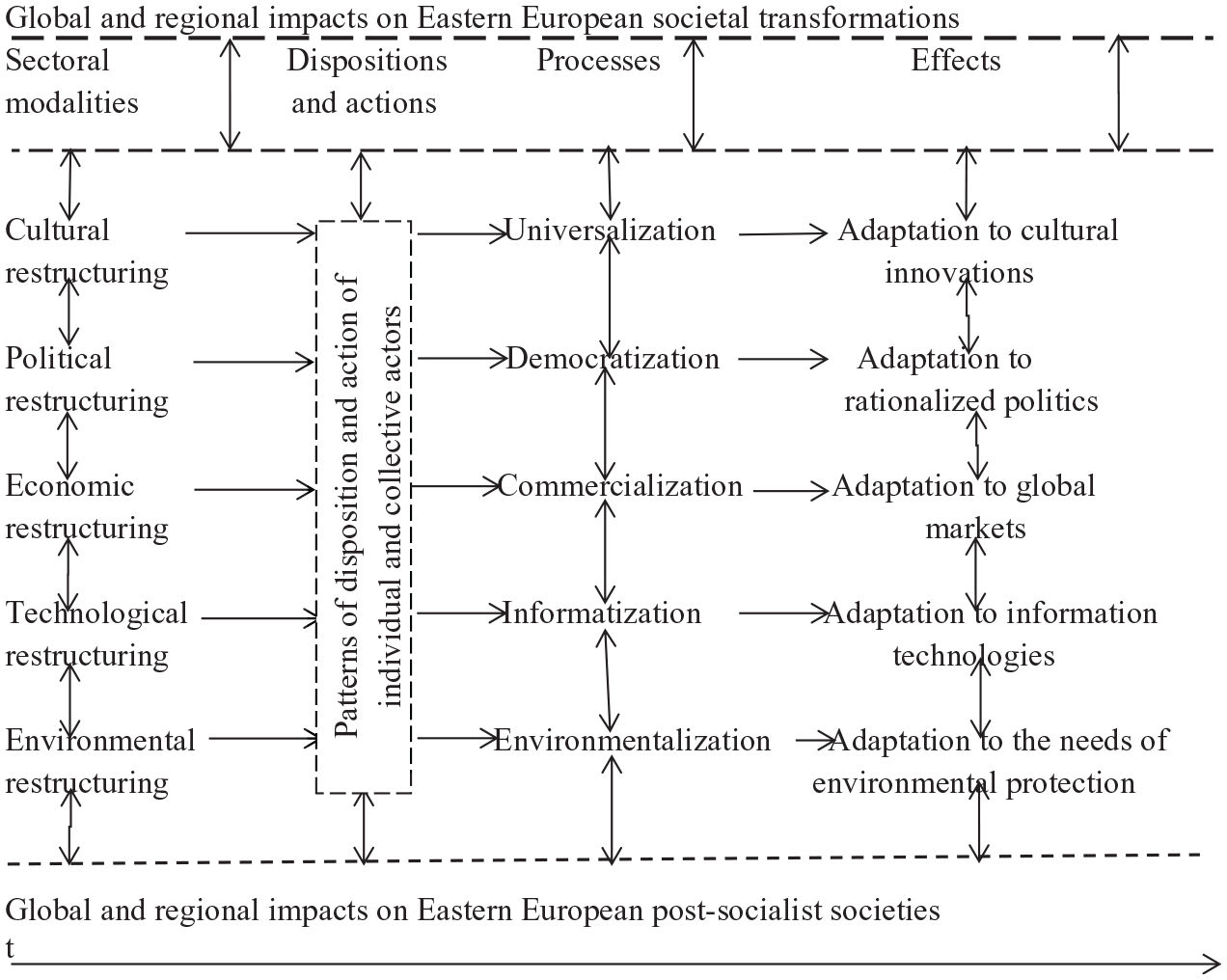
In the course of the empirical and theoretical research work, it became clear that the guiding ideas of methodological societalism have substantial limitations in the context of the rapid globalization of social structures and processes (Besnik, 2018). These new conditions facilitated a theoretical and methodological approach to the changes in Eastern Europe from the point of view of methodological globalism. The conclusion of the conducted analysis reads that the promising diagnosis of the changes in the region should rely on the concept of global processes. In this perspective, the societal transformations taking place are interpreted as more or less effective adaptations of individual Eastern European societies to global social trends. Detailed studies (Gaub, 2019; Kowalski, 2013; Kühnhardt, 2019) provide researchers and practitioners with reliable information about the close interdependence between global social trends and societal transformations. This discovery aids in understanding the substantial differences between the transformations of individual societies. The heuristic potential of studies on societal transformations in Eastern Europe is strong, as the region offers opportunities for both synchronic comparisons of post-socialist societal transformations and a unique opportunity for diachronic comparisons of post-socialist transformations after 1989. In spite of the fluctuations in changing historical preferences, the diverse scientific and practical interest in this region’s unique historical experience will remain stable in the long run.
The systematic study of post-socialist societal transformations in Eastern Europe discovers that they have been full of contradictions. The achievements of the societal transformations in the region notwithstanding, large segments of the population have suffered due to the establishment of a market economy. It’s normal that they regard the new economic and political order as problematic because of its high social costs. There are still substantial difficulties in consolidating democracy across all Eastern European societies. There are serious problems with the international competitiveness of the national economies of nearly all Eastern European societies. Sociology is able to offer explanations of the causes of the intensive social criticism as well as the spread of the perceptions of continuing social crises. Both are caused by pathological processes in the economy, politics and culture of Eastern European societies, at the structural level of the European Union, and at the global structural level. Explanations are desperately needed to support the optimization of governance in the region. This will require subsequent studies on the mechanisms developing organizational and cultural pathologies. Such studies may apply the ‘telescope’ of macrosocial analysis or the ‘microscope’ of micro-social research. The improvement of the conceptual framework for the study of social and economic development requires inter-disciplinary approaches, the combined use of different theoretical models together with mixed methods of empirical research, and the mutual enrichment of theoretical and empirical studies.
