



Abstract
This study investigated temporal changes in service returns in elite table tennis by analyzing men's and women's singles matches from the 2012, 2016, and 2021 Olympic Games. Quarterfinals and subsequent matches were analyzed, focusing on service placement and service return stroke types. Chi-square tests and effect sizes were employed to assess longitudinal and sex-related differences. The results revealed significant temporal changes in women's matches, characterized by a consistent increase in backhand-based service returns, particularly backhand topspin, accompanied by a shift in service placement toward the short-forehand area. Consequently, sex differences in service return stroke types for services directed toward the backhand and middle areas diminished over time. In contrast, men's matches exhibited no consistent temporal changes in the frequency of service return stroke types. However, observed shifts in service placement suggest changes in tactical patterns that were not fully captured by usage frequency alone. Despite an overall convergence in certain aspects, marked sex differences persisted in service return stroke types for services directed to the forehand side. These findings indicate that service returns in elite table tennis evolved differently for men and women during the examined period and have practical implications for coaching and training, particularly for female players.
Introduction
In table tennis, the service return serves a distinct function compared to other strokes. This is primarily because the service itself is governed by unique constraints; specifically, the requirement that the ball must bounce once on the server's side limits the execution of high-speed strokes. Consequently, the service has limited potential for direct scoring (Tamaki et al., 2017; Tamaki and Yoshida, 2020). Accordingly, players employ tactical services designed to induce return errors, thereby creating scoring opportunities on subsequent shots. Applying a variety of ball spin to the served ball is one technique used to provoke service return errors (Tamaki and Yoshida, 2025). In addition, players may disguise the spin direction through deceptive service motions so that opponents cannot accurately identify the spin (Iino et al., 2021). These techniques are effective to the extent that servers generally maintain a higher scoring rate than receivers (Tamaki et al., 2017). Moreover, it has been demonstrated that service skill significantly influences match outcomes in table tennis (Djokic et al., 2019; Nikolakakis et al., 2021; Nikolakakis et al., 2023). Given these characteristics of table tennis, the primary objective of the service return is to neutralize the opponent's tactical advantage. During the service return, players must rapidly identify the placement and ball spin of the opponent's service and return the ball in a manner that does not allow the opponent to gain a scoring advantage. Because these demands differ inherently from those of other strokes, the service return necessitates specialized technical skills and warrants independent analysis.
In recent years, substantial changes have occurred in service return techniques in table tennis. Around the 2008 Beijing Olympics, several players began to use a backhand flick that brushes the side of the ball to impart spin (Ozaki et al., 2013). This technique gained widespread attention after Zhang Jike, who adopted it as a trademark skill, achieved success in major international competitions, including winning world-level tournaments (Townsend, 2017). Subsequently, the backhand flick became widely adopted by players and has evolved into a standard shot against short services (Hodges, 2013; Xiao, 2015). Traditionally, short services to the forehand side were typically returned with forehand strokes. However, experts have observed a growing prevalence of the backhand flick even in these scenarios (Hodges, 2024, 2025). It is therefore essential for players and coaches to accurately understand these evolving trends in service return techniques to integrate them effectively into contemporary training regimens.
However, the specific stroke techniques employed in service returns by world-class players, as well as their temporal changes, remain insufficiently elucidated in the academic literature. Malagoli Lanzoni et al. (2014) recorded stroke types for all strokes excluding the service and identified that forehand topspin was the most frequent, followed by backhand block and backhand topspin. Wang et al. (2022) analyzed all strokes excluding the service, recorded stroke characteristics such as stroke position, stroke type, and stroke efficacy, and documented changes in stroke characteristics at the Olympic Games from 2004 to 2021. In these studies, service return was treated as part of all strokes, making it impossible to identify stroke techniques specific to service return. In contrast, several studies have focused exclusively on the service itself to clarify its characteristics (Djokic et al., 2019; Djokic et al., 2020; Iino et al., 2021; Ngo et al., 2017; Nikolakakis et al., 2021; Nikolakakis et al., 2023; Wang, 2019). However, studies adopting a similar approach for service return remain relatively limited. Wang (2019) compared the characteristics of the service and its service return in men's singles matches at the London 2012 and Rio 2016 Olympic Games. That study quantified changes in service placement distribution and service return stroke techniques, which had rarely been measured quantitatively before, and demonstrated through a comparison of the two tournaments that service return techniques in table tennis can change over a relatively short period. However, that study did not analyze the proportional distribution of service return stroke types relative to specific service placements. Although it is reasonable to assume that the stroke type used for service return differs depending on service placement, this issue has not been sufficiently examined. Furthermore, the analysis was limited to men's singles matches, and the characteristics of service return among female players remain unclear. Pradas et al. (2023) investigated service placement and return stroke distributions in both men's and women's singles matches from a domestic competition in Spain and an international tournament held in Spain. Their work aggregated the distribution of service placements for each service return stroke type and provided a more detailed analysis of the relationship between service placement and service return technique than Wang (2019). Furthermore, sex differences were statistically examined, and the study suggested the possible presence of sex differences in service return. Nevertheless, the study did not clearly specify the competitive level or the exact timing of the analyzed tournaments. Consequently, its contribution as evidence accounting for competitive standards and temporal trends remains limited.
The purpose of this study was to clarify how the stroke types in service return vary according to service placement and how these patterns have changed across the three consecutive Olympic Games from 2012 to 2021 among world-class male and female table tennis players. Focusing on matches from the quarterfinals onward, this study first analyzed the distribution of service placement in each Games to identify the presence of temporal trends. Second, the proportional distribution of return stroke types for each placement was calculated, with comparisons between Games conducted to assess technical shifts over time. Finally, by examining whether these relationships differ between male and female players, this study aimed to identify sex-specific characteristics of service return tactics.
Materials and methods
Match sample
Matches from the men's and women's singles events at the Olympic Games held in 2012, 2016, and 2021 were analyzed, limited to the quarterfinals and later rounds. All eligible matches were screened. Across the three Games, only four defensive players advanced to the quarterfinals or later in women's singles (one in 2012, two in 2016, and one in 2021), whereas all other players adopted an offensive playing style. Because the techniques used for service return differ substantially between defensive and offensive players, and because most elite players adopt an offensive playing style, defensive players were excluded from the analysis to maintain analytical consistency in this study. As a result of this exclusion, the number of analyzed players in 2016 was reduced by two compared with the other years, which may slightly limit the generalizability of the findings. The final dataset comprised 24 matches in men's singles and 18 matches in women's singles, with 2349 services for men and 1508 services for women, excluding service faults.
Data collection
For each point during the match, the server, receiver, service placement, racket side used for the service return, and stroke type were recorded by observing match footage obtained from official Olympic broadcasts. The server, receiver, racket side, and stroke type were identified by observing match footage broadcast on television or streamed via the internet. The racket side was classified as either forehand or backhand. Stroke type was classified into three categories: topspin, backspin, and others. Topspin was defined as a stroke in which topspin was imparted to the ball, backspin as a stroke in which backspin was imparted, and others as strokes that did not fall into any of these categories. In practical settings, topspin strokes are often subdivided into a topspin attacking stroke and a flick depending on whether the ball bounces close to the net (Grycan et al., 2023; Malagoli Lanzoni et al., 2014). In the present study, because service placement was recorded independently from stroke type, conditions related to service placement were removed from the stroke definitions, and topspin attacking strokes and flicks were combined into a single category. This approach ensured that stroke type classification was based solely on the spin characteristics of the stroke rather than on service length, thereby maintaining analytical consistency between placement and stroke type variables. In practical terms, topspin returns against short services in the present dataset correspond to what is commonly referred to as a backhand flick. Backspin strokes are sometimes subdivided into chop, in which underspin is applied against topspin, and push, which is executed under other conditions (Grycan et al., 2023). Because none of the offensive players analyzed in this study frequently used chop strokes, and the occurrence of chop during service return was extremely low, chop and push were combined into a single backspin category. Others included drives, lobs, blocks, smashes, and flicks executed without imparting ball spin. In the dataset collected in this study, topspin and backspin together accounted for approximately 94 percent of all service returns, indicating that these two stroke types were dominant in service return. Although strokes classified as others may be used tactically to introduce variation in ball spin or as emergency responses to unexpected services, their very low frequency in the present dataset limited their analytical priority, and they were therefore excluded from further statistical analysis. Data collection was conducted by four experienced table tennis players who had prior experience in data entry and match coding. Each match was primarily coded by one observer, and ambiguous cases were reviewed jointly with another observer to reach consensus. Match footage obtained from official Olympic broadcasts was replayed multiple times as needed. When necessary, slow-motion playback was used to improve accuracy. To assess reliability, multiple observers independently recorded the racket side and the stroke type for six randomly selected games comprising 97 rallies. The percentage agreement and kappa coefficients were 99% and 0.98 for racket side, and 95% and 0.94 for stroke type, respectively. These results indicate high reliability for all recorded variables. Service landing position was recorded as two-dimensional coordinates on the table using a two-dimensional direct linear transformation method with the four corners of the table tennis table as control points. The table was then divided into three equal sections in the lateral direction and two sections in the longitudinal direction, resulting in six service landing areas. The boundary for the longitudinal division was set at 0.85 m from the net, following the criterion adopted by Tamaki and Yoshida (2025). In the lateral direction, the receiver's racket-hand side was defined as the forehand side, the opposite side as the backhand side, and the area between them as the middle. In the longitudinal direction, the area closer to the net was defined as short, and the area farther from the net as long. Each of the six areas was denoted by combining the initials of the lateral and longitudinal directions (Figure 1): backhand short (BS), middle short (MS), forehand short (FS), backhand long (BL), middle long (ML), and forehand long (FL).
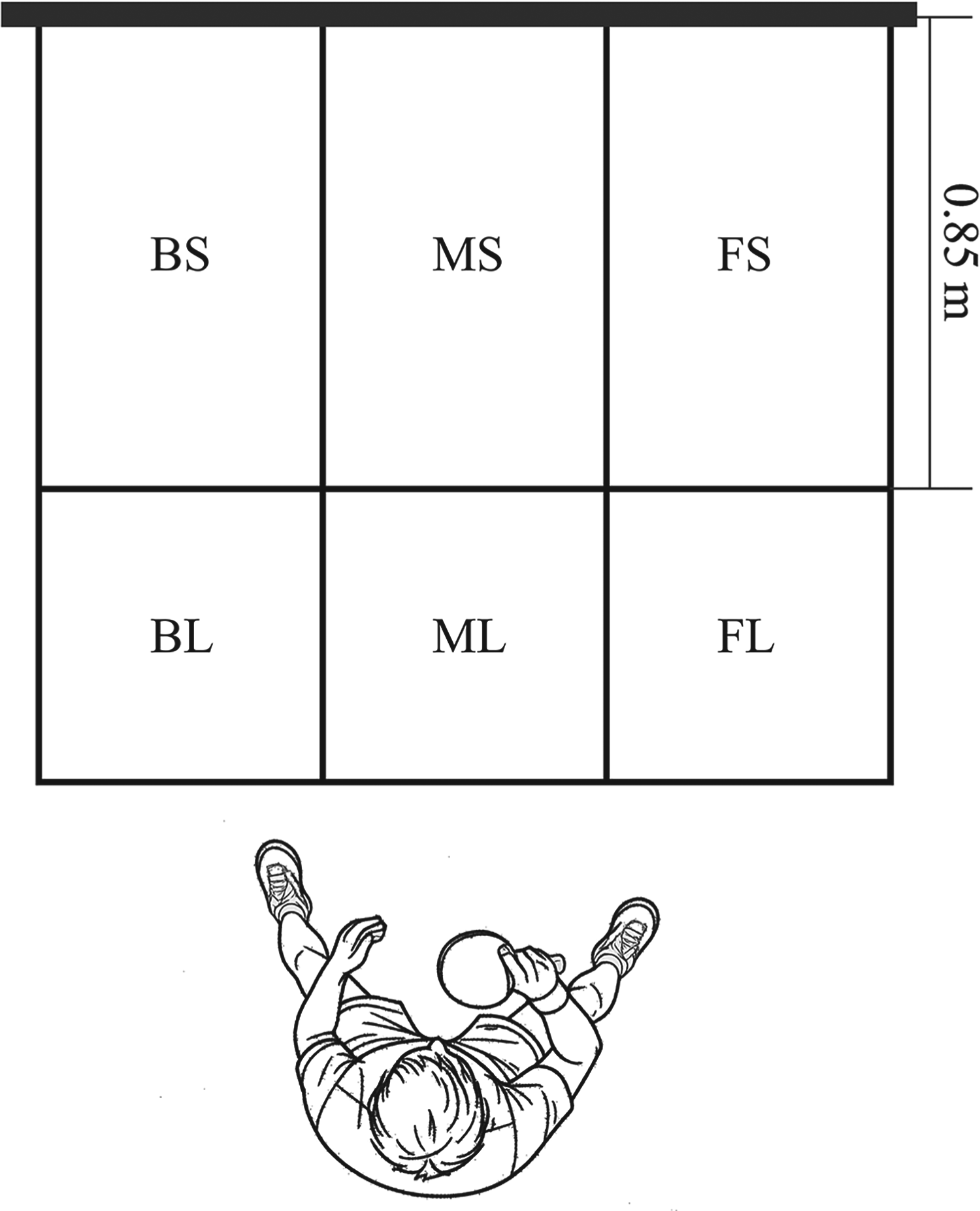
Definitions of the six service placement areas.
Statistical analysis
All statistical analyses were conducted using Python 3.11.6 with SciPy (1.16.3) and OpenCV (4.12.0). The significance level for statistical tests was set at α=0.05.
For service placement, chi-square tests were performed separately by sex to examine differences across the Games. The magnitude of these differences was evaluated using Cramér's V, with effect sizes categorized as small (0.1), medium (0.3), and large (0.5). Following significant results, adjusted residuals were calculated, and absolute values exceeding 1.98 were identified as indicating significant deviations. Similarly, chi-square tests were applied to service return stroke types for each placement area, stratified by sex. The same criteria for Cramér's V and adjusted residuals were applied. Sex-based differences in service placement and service return stroke type were also analyzed using chi-square tests and evaluated using Cramér's V.
Results
Placement of services
Figure 2 presents the proportional distribution of service placement across three Games, stratified by sex. In women's matches, the distribution of service placement areas also significantly differed across the Games, with a small effect size (Cramér's V = 0.283; χ2(10) = 242.1, p < 0.01). Adjusted residuals showed that in 2012, MS and FL occurred at higher frequencies, while FS and ML were lower. In 2016, BS occurred at a higher frequency, whereas MS and FS were lower. In 2021, FS and ML showed higher frequencies, while BS and MS were less frequent. In men's matches, the distribution of service placement differed significantly across the Games, although the effect size was small (Cramér's V = 0.126; χ2(10) = 74.8, p < 0.01). Adjusted residuals analysis indicated that in 2012, FS and FL occurred with significantly higher frequency, whereas BS and MS were less frequent. Conversely, in 2016, MS showed a higher frequency, while ML and FL were lower. In 2021, ML occurred at a higher frequency, while FS and FL were less frequent.

Proportional distribution of service placement, shown across the three Olympic games, categorized by sex. Color shading represents the relative magnitude of the proportions. The symbols ▴ and ▾ denote frequencies significantly higher or lower than expected, respectively, based on adjusted residual analysis (|z| > 1.98).
Stroke type of service return
Figure 3 shows the proportional distribution of service return stroke types in women's matches across the Games, categorized by six service placement areas. Chi-square tests and effect sizes using Cramér's V were applied to compare the proportional distribution of stroke types across the Games for each service placement area. For BS, a statistically significant difference across the Games was observed, although the effect size was small (Cramér's V = 0.260; χ2(6) = 29.0, p < 0.01). Analysis of adjusted residuals indicated that in 2012, forehand backspin occurred at a higher frequency, while in 2016, forehand topspin occurred at a higher frequency. In 2021, backhand topspin occurred at a higher frequency, while forehand topspin and forehand backspin occurred at lower frequencies. For MS, a statistically significant difference across the Games was also found, with a small effect size (Cramér's V = 0.185; χ2(6) = 41.7, p < 0.01). Adjusted residual analysis showed that in 2012, forehand backspin occurred at a higher frequency, while backhand topspin and backhand backspin occurred at lower frequencies. In 2021, backhand topspin and backhand backspin occurred at higher frequencies, whereas forehand topspin and forehand backspin occurred at lower frequencies. For FS, a statistically significant difference across the Games was detected, although the effect size was small (Cramér's V = 0.164; χ2(6) = 16.1, p = 0.013). Adjusted residual analysis indicated that in 2012, forehand topspin occurred at a higher frequency and forehand backspin at a lower frequency. In 2021, forehand backspin occurred at a higher frequency. For BL, a statistically significant difference across the Games was observed, with a small effect size (Cramér's V = 0.252; χ2(6) = 19.6, p < 0.01). Adjusted residual analysis showed that in 2012, forehand topspin and forehand backspin occurred at higher frequencies, while backhand topspin occurred at a lower frequency. For ML, a statistically significant difference across the Games was found, with a small effect size (Cramér's V = 0.294; χ2(6) = 13.5, p = 0.036). Analysis of adjusted residuals indicated that in 2012, forehand topspin occurred at a higher frequency and backhand topspin at a lower frequency. In 2016, forehand backspin occurred at a higher frequency. In 2021, backhand topspin occurred at a higher frequency. For FL, a statistically significant difference across the Games was detected, with a large effect size (Cramér's V = 0.505; χ2(6) = 8.2, p = 0.017). Adjusted residual analysis showed that in 2012, forehand topspin occurred at a higher frequency and forehand backspin at a lower frequency. In 2021, forehand backspin occurred at a higher frequency, while forehand topspin occurred at a lower frequency.

Proportional distribution of service return stroke types in women's matches across the three Olympic games, categorized by the six service placement areas.
Figure 4 shows the proportional distribution of service return stroke types in men's matches across the Games, categorized by six service placement areas. Chi square tests and effect sizes using Cramér's V were applied to compare the proportional distribution of stroke types across the Games for each service placement area. For BS, the effect size was small and no statistically significant difference across the Games was detected (Cramér's V = 0.135; χ2(6) = 11.8, p = 0.066). For MS, a statistically significant difference across the Games was observed, with a small effect size (Cramér's V = 0.234; χ2(6) = 86.4, p < 0.01). Adjusted residual analysis indicated that in 2012, backhand topspin occurred at a higher frequency. In 2016, forehand topspin and forehand backspin occurred at higher frequencies, whereas backhand topspin and backhand backspin occurred at lower frequencies. In 2021, backhand topspin and backhand backspin occurred at higher frequencies, whereas forehand backspin occurred at a lower frequency. For FS, a statistically significant difference across the Games was detected, although the effect size was small (Cramér's V = 0.178; χ2(6) = 51.6, p < 0.01). Adjusted residual analysis showed that in 2012, backhand topspin occurred at a higher frequency and forehand backspin at a lower frequency. In 2016, forehand backspin occurred at a higher frequency, while backhand topspin and backhand backspin occurred at lower frequencies. In 2021, backhand topspin and backhand backspin occurred at higher frequencies, whereas forehand backspin occurred at a lower frequency. For BL, the effect size was small and the difference across the Games was not statistically significant (Cramér's V = 0.186; χ2(6) = 10.0, p = 0.124). For ML, the effect size was moderate, and a statistically significant difference across the Games was found (Cramér's V = 0.394; χ2(6) = 34.1, p < 0.01). Adjusted residual analysis indicated that forehand backspin occurred at a higher frequency in 2016 and at a lower frequency in 2021. For FL, the effect size was small and no statistically significant difference across the Games was detected (Cramér's V = 0.234; χ2(6) = 4.6, p = 0.595).

Proportional distribution of service return stroke types in men's matches across the three Olympic games, categorized by the six service placement areas.
Sex differences
Figure 5 presents Cramér's V effect sizes for sex differences in the proportional distribution of service placement across the Games. Chi square tests revealed statistically significant sex differences in all Games (2012: χ2(5) = 195.1, p < 0.01; 2016: χ2(5) = 72.0, p < 0.01; 2021: χ2(5) = 18.6, p < 0.01). Based on effect size interpretation, the magnitude of the sex difference was medium in 2012 (0.382), small in both 2016 (0.259) and 2021 (0.113).
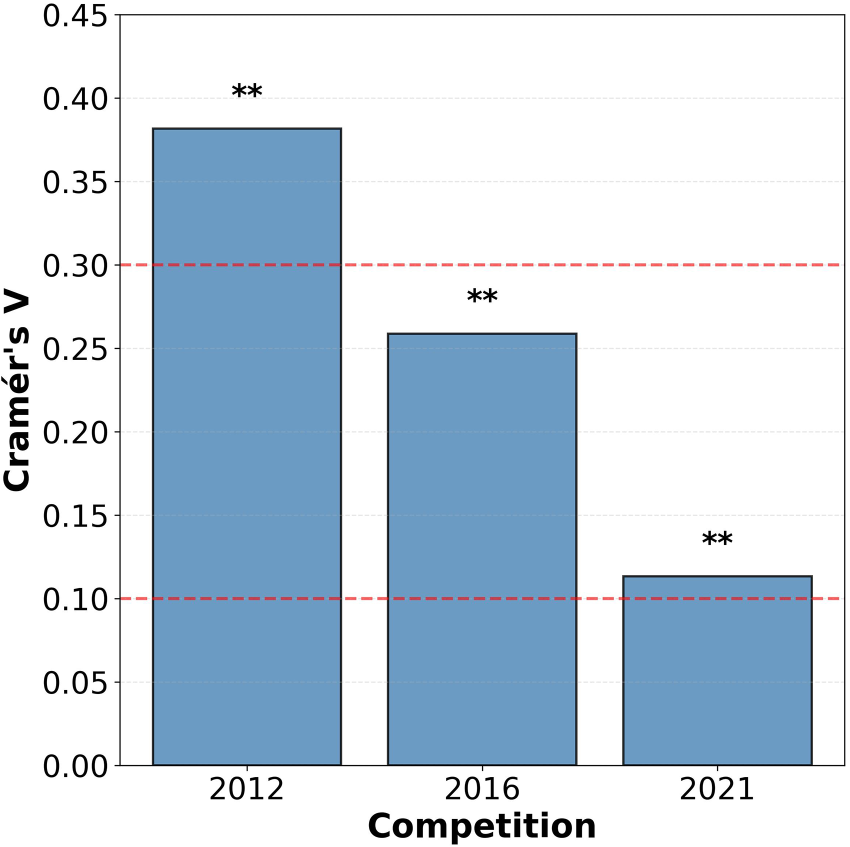
Effect sizes of sex differences in the proportional distribution of service placement across the three Olympic games. The red dashed lines represent the thresholds for interpreting effect size magnitude. Symbols above the bars denote the results of chi-square tests for sex differences: ** p < 0.01, * p < 0.05, and n.s. (not significant).
Figure 6 shows the effect sizes of sex differences in the proportional distribution of service return stroke types for each service placement area across three Olympic Games. For BS, chi-square tests revealed significant sex differences in 2012 (χ2(3) = 20.3, p < 0.01), while no significant difference was observed in 2016 (χ2(3) = 3.5, p = 0.322) and 2021 (χ2(3) = 2.0, p = 0.575). Based on Cramér's V, effect sizes were medium in 2012 (0.347), and small in 2016 (0.135) and 2021 (0.105). For MS, significant sex differences were found in 2012 (χ2(3) = 47.3, p < 0.01) and 2016 (χ2(3) = 11.8, p < 0.01), whereas the 2021 results were non-significant (χ2(3) = 6.0, p = 0.11). The effect sizes were small across all Games, with values of 0.292 in 2012, 0.174 in 2016, and 0.114 in 2021. For FS, significant sex differences were detected in 2012 (χ2(3) = 27.6, p < 0.01) and 2021 (χ2(3) = 114.1, p < 0.01), whereas no significant difference was found in 2016 (χ2(3) = 1.9, p = 0.591). The effect sizes were small in 2012 (0.210), negligible in 2016 (0.083), and medium in 2021 (0.483). For BL, significant sex differences were found in 2016 (χ2(3) = 9.4, p = 0.025), while no significant difference was observed in 2012 (χ2(3) = 6.3, p = 0.100) and 2021 (χ2(3) = 2.5, p = 0.473). The effect sizes were small in 2012 (0.244) and 2021 (0.148), and medium in 2016 (0.342). For ML, no significant sex differences were found in 2012 (χ2(3) = 5.5, p = 0.065), 2016 (χ2(3) = 4.0, p = 0.264), or 2021 (χ2(3) = 6.6, p = 0.087). The effect sizes were medium in 2012 (0.401) and 2016 (0.315), and small in 2021 (0.240). For FL, significant sex differences were found in 2012 (χ2(3) = 16.6, p < 0.01) and 2021 (χ2(3) = 8.7, p = 0.033), while no significant sex differences were detected in 2016 (χ2(3) = 2.4, p = 0.295). The effect sizes were large in 2012 (0.621) and 2021 (0.717), and medium in 2016 (0.418).
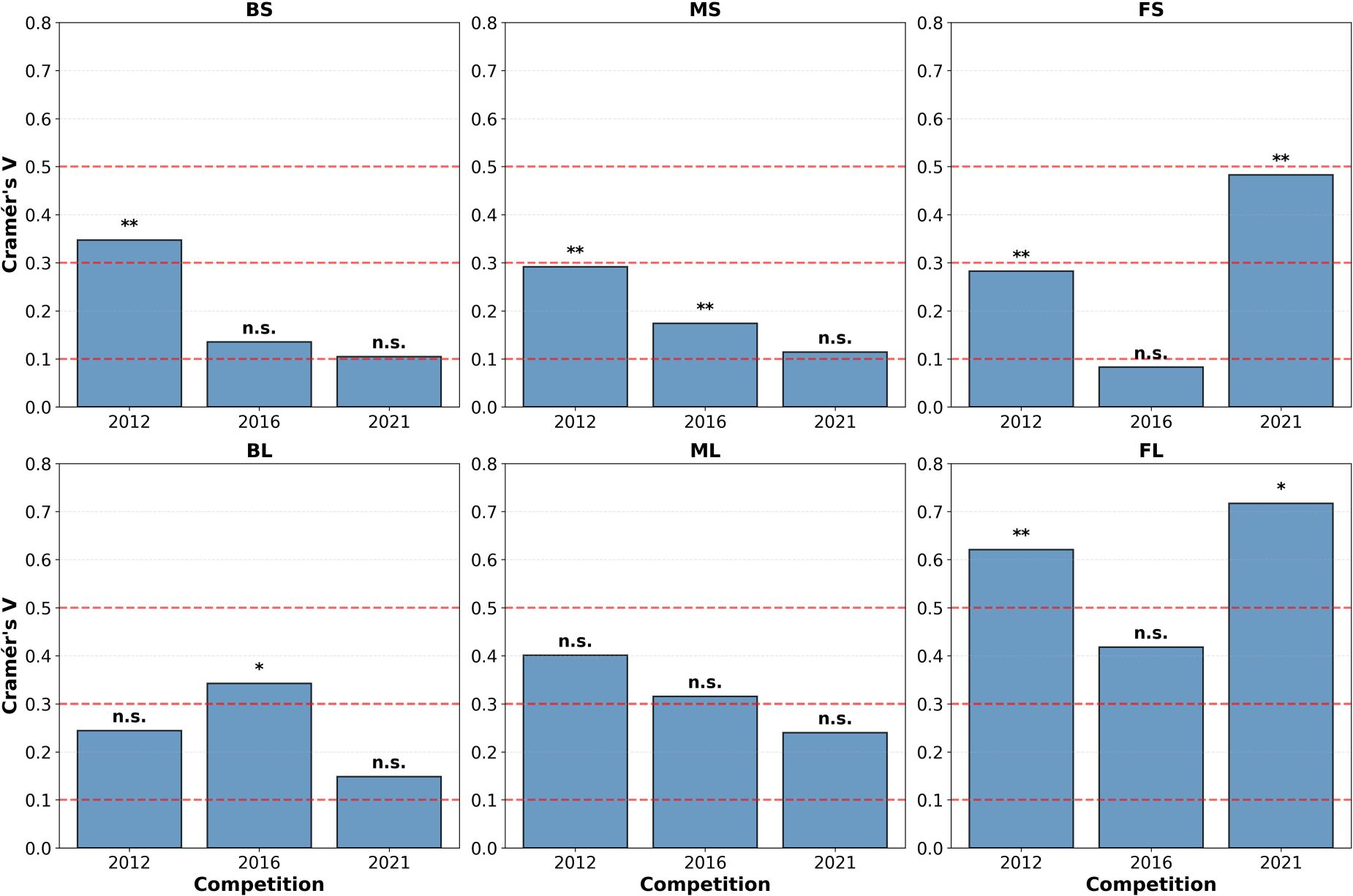
Effect sizes for sex differences in the proportional distribution of service return stroke types by service placement area across the three Olympic games. The red dashed lines represent the thresholds for interpreting effect size magnitude. Symbols above the bars denote the results of chi-square tests for sex differences: ** p < 0.01, * p < 0.05, and n.s. (not significant).
Discussion
This study investigated temporal changes in service return patterns in Olympic table tennis from 2012 to 2021, with a focus on sex differences. The following sections discuss the findings in women's matches, men's matches, and their comparison.
Changes in women's matches
In women's matches, the frequency of service returns executed with backhand stroke (backhand topspin, backhand backspin) increased consistently across the Games. For example, for services delivered to BS, forehand strokes (forehand topspin, forehand backspin) were rarely used in 2021. Together with the decreased use of forehand strokes for BL, these findings indicate a shift from stepping around to use forehand strokes on the backhand side to responding directly with backhand strokes. For services directed to the middle areas (MS, ML), the use of backhand topspin also increased consistently over time. As a recent change in service return, it has been noted that the backhand flick that brushes the ball to impart spin has been used more frequently (Hodges, 2013; Xiao, 2015). According to the definitions adopted in this study, the backhand flick is classified as backhand topspin. Previous studies have reported that this technique is used less frequently by female players than by male players (Pradas et al., 2023). However, observation of temporal changes indicates that its prevalence has steadily increased in women's matches as well. In addition, this study revealed that the use of backhand backspin increased concurrently with the rise in backhand topspin. Most returns executed with backspin are generally slow and defensive strokes, commonly referred to as pushes. When attempting an aggressive backhand topspin returns, players must use backhand backspin against services that are difficult to attack to maintain stability and avoid errors. Thus, the increased use of the backhand flick can be considered to have inevitably contributed to an increase in the use of backhand backspin. Taken together, the period from 2012 to 2021 can be characterized as one in which service returns using the backhand, particularly backhand topspin, became widely adopted in women's matches, accompanied by increased use of backhand backspin in specific service placement areas.
The use of forehand backspin in FS and FL showed a consistent increasing trend from 2012 to 2021. This increase may stem from the more frequent selection of backhand strokes in response to services directed to the middle areas. Aggressive strokes require a longer duration for racket acceleration compared to non-aggressive ones. Furthermore, the optimal ready posture for rapid service return differs between backhand and forehand strokes. Taken together, the rising frequency of backhand service returns may have prompted a shift toward a backhand-oriented ready posture, thereby limiting the temporal margin required to execute aggressive strokes. Since ready postures were not measured in this study, this interpretation remains hypothetical. Nevertheless, these findings demonstrate that the increased use of backhand strokes on the backhand and middle areas was accompanied by changes in the stroke characteristics of forehand service return on the forehand side.
In women's matches, it was revealed that services directed to FS and ML increased in association with changes in service return patterns. Analysis of service placement showed that from 2012 to 2021, the proportions of FS and ML exhibited consistent increasing trends, whereas the proportion of MS showed a consistent decreasing trend. The increase in FS may be associated with the increased use of the backhand flick. In women's matches, even in 2021, the frequency of service returns using backhand topspin against services to forehand side remained low. In contrast, services to FL were frequently returned with forehand topspin, which is an aggressive stroke, making this placement less attractive for servers. Taken together, as the backhand flick became more prevalent in women's matches, FS may have emerged as the primary service placement that allowed servers to avoid aggressive returns, thereby contributing to the increased frequency of services to this area. The increase in ML may be related to a decline in the use of forehand topspin in this area. Forehand topspin is generally a highly aggressive stroke, and servers tend to avoid returns executed with this stroke. This tendency is also supported by the consistently low frequency of services directed to FL. In 2012, services delivered to BL and ML were often returned with forehand topspin. However, this frequency declined sharply after 2016. With these changes in service return patterns, ML may have increasingly been selected as one of the available options when servers attempted to diversify service placement.
Changes in men's matches
In men's matches, no consistent changes comparable to those observed in women's matches were detected. Among men, statistically significant deviations across the three Games were identified for MS, ML, and FS. However, most of the detected deviations reflected changes that occurred from 2012 to 2016, with changes observed between 2016 and 2021 occurring in the opposite direction. As a result, no substantial differences were observed between 2012 and 2021, suggesting that the changes observed in men's matches were specific to 2016 and lacked temporal consistency. Previous studies have reported that male players use the backhand flick more frequently than female players (Pradas et al., 2023). Based on this finding, it was reasonable to expect that an increase in backhand service returns similar to that observed in women's matches would also be evident in men's matches. However, no such change was observed. This may be because changes in service return among male players had already occurred prior to 2012. The backhand flick is reported to have been adopted by some players around the time of the 2008 Beijing Olympic Games and to have become widely used after Zhang Jike began to achieve success in international tournaments (Ozaki et al., 2013; Townsend, 2017). If some players were already using the backhand flick around 2008, it is plausible that by 2012, many players advancing to at least the quarterfinals at the Olympic Games were already employing this technique. Taken together, from the perspective of usage frequency by service placement area, it can be concluded that no major changes occurred in service return patterns among male players during the period examined.
The findings suggest that changes in service return in men's matches may not be fully captured by usage frequency alone. Analysis of service placement revealed that from 2012 to 2021, the frequency of services delivered to ML showed a consistent increasing trend, whereas the frequency of services delivered to FS showed a consistent decreasing trend. This increase in ML was also observed in women's matches, where it was interpreted as being associated with a decline in the use of forehand topspin. In contrast, in men's matches, no substantial changes in stroke type usage were detected over the same period. Because service placement and service return evolve interactively, changes in service placement would normally be accompanied by changes in service return. However, no consistent changes in service return stroke types were detected in men's matches, suggesting that unmeasured factors may have changed. One possible explanation is that reducing services to FS while increasing those to ML was intended to decrease the effectiveness of the backhand flick. When service placement is biased toward FS and MS, receivers can anticipate the direction and prepare to move quickly toward the forehand side. In contrast, increasing services to BL or ML requires receivers to allocate attention to covering these areas, potentially delaying decision making or movement when a service is directed to FS. Because executing a backhand flick against FS requires rapid movement, even minor delays may influence shot stability, ball spin, or ball speed. In this sense, service placement may have shifted not only to prevent the use of the backhand flick, but also to reduce its effectiveness. Nevertheless, this interpretation remains speculative. Another possible explanation concerns the definitions of stroke type used in this study. Although stroke type was classified into six categories in this study, a more detailed classification based on ball speed or finer aspects of spin direction is also possible. Even if no changes were observed in stroke type frequency under the definitions used in this study, changes may have occurred when using a more granular classification. Taken together, these findings suggest that capturing recent changes in service return in men's matches requires extending the scope of analysis to include finer classifications of stroke type and their relationships with service return outcomes.
Sex differences
The increased frequency of the backhand flick in women's matches revealed a converging trend in sex differences in service return stroke types for services delivered to the backhand side and the middle areas. Sex differences in service return stroke type for services to BS and MS showed a consistent decreasing trend, and no statistically significant sex difference was observed for BS in 2016 or for MS in 2021. This shift can be attributed to the increased use of backhand topspin in women's matches. The reduction in sex differences in service return stroke type is also likely to have influenced the convergence of sex differences in service placement. As services to FS increased consistently in women's matches, the discrepancy between women's and men's service placement patterns was substantially reduced by 2021. Although a statistically significant difference remained, the effect size in 2021 was small compared with those in 2012 and 2016. Previous studies have suggested the existence of sex differences in the use of the backhand flick (Pradas et al., 2023). However, the present findings indicate that sex differences in contemporary table tennis have become minimal in both service return stroke type and service placement.
A pronounced sex difference remained in service return strategies for services delivered to the forehand side. In men's matches, services to the forehand side were frequently returned with backhand topspin, whereas in women's matches, forehand strokes were consistently used more often, and this pattern did not change from 2012 to 2021. Returning forehand side services with a backhand stroke requires rapid placement judgment, lateral movement, and quick recovery toward the backhand side. These technical demands inherently involve a higher risk of unforced errors. In addition to technical difficulty, physical factors such as lateral movement speed and trunk strength may influence the feasibility of executing backhand strokes on the forehand side. The frequent use of backhand strokes against forehand side services by male players suggests that they tolerate this risk because the expected scoring benefit outweighs the potential cost. In contrast, female players may consider the use of forehand topspin to be more rational from the perspective of expected point return. This pattern may also reflect differences in risk–reward assessment. Whether this difference in decision making reflects sex differences in the scoring effectiveness of specific stroke types is beyond the scope of the present study. Nevertheless, although convergence between men and women is progressing in terms of stroke type usage, pronounced sex differences persist in service return stroke type for forehand side services. This finding suggests that sex differences in underlying performance characteristics, such as point winning probability, may influence stroke selection.
Practical implications
In contemporary table tennis, it is important to provide coaching that reflects the fact that returning the ball with a backhand flick has become standard practice among female players. Although this trend has not been sufficiently demonstrated in previous studies, world class matches in 2021 show that the rate of backhand topspin use by female players has reached a level comparable to that of male players. These findings indicate that, in coaching environments for female players, training that assumes the importance of the backhand flick is essential. For example, structured drills that require players to alternate between backhand flicks and other return options under varying spin conditions may help develop tactical flexibility.
The results of this study also suggest that the importance of service return against services delivered to FS is increasing among female players. Our findings indicate that as the frequency of using the backhand flick increases, opponents tend to increase the proportion of services directed to FS. In other words, the more female players strengthen their service returns using the backhand flick, the more their ability to handle services to FS is indirectly challenged. Therefore, alongside improvements in backhand flick proficiency, there is an increasing need for training that examines which types of returns should be selected against services to FS and enhances the precision of those returns.
Furthermore, the findings suggest that training of backhand backspin is as important as strengthening the backhand flick. In particular, for service return against short services, the increased frequency of backhand topspin was accompanied by a concurrent increase in backhand backspin. These results indicate that training should not focus exclusively on acquiring the backhand flick, but should also allocate sufficient practice time to backhand backspin without underestimating its importance. Combined drills that integrate backhand flicks and controlled backhand pushes in response to unpredictable short serves may be beneficial.
Limitations and future directions
Several limitations of this study should be acknowledged, including constraints related to sample size and potential bias in the analyzed players. This study focused on matches played at the Olympic Games, which are regarded as the most prestigious competition in table tennis. As a result, the low frequency of the event imposed limitations on the achievable sample size. In addition, by restricting the analysis to matches from the quarterfinals onward, the findings are specific to top tier players during the examined period. Therefore, it should be noted that this study does not comprehensively capture technical transitions across a broad range of competitive levels. Including additional major international tournaments (e.g., World Championships, World Cup) as well as earlier rounds of competition could enhance generalizability by increasing sample size and competitive diversity. Future studies incorporating multiple tournaments would further contextualize the present findings. Another limitation is that detailed changes in stroke type could not be fully captured. Many table tennis players induce errors by varying the speed and spin direction of topspin strokes and backhand flicks. Although actual stroke execution is highly diverse, the six category classification adopted in this study represents only the minimum level of categorization required to conduct the analysis. While this study was able to identify major technical transitions, it has limitations in elucidating finer changes in stroke execution. Future research based on quantitative data such as ball speed, ball spin, and landing positions of service returns is needed to provide a more detailed examination. In addition, the relationship between stroke type and point outcomes was not analyzed in this study. Therefore, the present findings should be interpreted as reflecting changes in usage frequency rather than direct evidence of technical effectiveness. In general, as new techniques become widespread, their effectiveness tends to change over time. In men's matches, the backhand flick was already widely used by 2012, suggesting that changes in effectiveness, rather than usage frequency, may have occurred after that point. Future analyses incorporating point outcomes may allow a more comprehensive understanding of the evolution of service return among male players. Furthermore, it is necessary to acknowledge that this study does not analyze service returns against “half-long” serves. The term “half-long” refers to a length where the second bounce occurs near the end line; such shots force receivers to instantaneously decide whether to play the ball on the table or attack it after it clears the end line (Wang, 2018). In the present dataset, service length was classified based on bounce position; however, this information alone does not allow precise identification of half-long serves. Strict detection of half-long services would require three-dimensional trajectory measurement to determine the location of the second bounce on the receiver's side with sufficient accuracy. The absence of a half-long category may have reduced the spatial resolution of service placement and limited analysis of return behavior against half-long serves. Future research aiming to examine half-long services will require detailed three-dimensional ball tracking to meet this technical requirement.
Conclusion
Clear temporal changes were identified in women's matches between 2012 and 2021, characterized by a substantial increase in backhand-based returns, particularly backhand topspin, across backhand-side and middle service placements. This trend reflects the widespread adoption of the backhand flick and was accompanied by increased use of backhand backspin and corresponding shifts in service placement. In contrast, men's matches showed no consistent long-term changes in service return stroke distributions, suggesting that major technical adaptations had largely occurred prior to 2012. Sex differences in service return patterns decreased over time for backhand-side and middle placements but remained pronounced for forehand-side services, where women continued to rely more on forehand strokes.
Footnotes
Acknowledgements
The authors used generative AI tools (ChatGPT-5, Gemini 2.5 Pro, and Claude Opus 4.5) to assist in generating Python scripts based on specified computational procedures and to improve English phrasing and clarity in the manuscript based on drafts prepared by the authors. All outputs were carefully reviewed and edited by the authors to ensure correctness and consistency with the research objectives. The AI tools were used under the authors’ supervision, and the authors take full responsibility for all content. The authors would like to thank Tatsuki Simosato for assistance with data collection.

Ethical approval and informed consent statements
This study analyzed video recordings of table tennis matches. No human participants were directly recruited, and no personally identifiable information was collected. Therefore, ethical approval and informed consent were not required for this study.
Funding
The authors received no financial support for the research, authorship, and/or publication of this article.
Declaration of conflicting interests
The authors declared no potential conflicts of interest with respect to the research, authorship, and/or publication of this article.
Data availability statement
The datasets generated during the current study are not publicly available but are available from the corresponding author upon reasonable request.