




Abstract
Ball spin is a central tactical element in table tennis, yet its characteristics during elite competition remain unclear. This study aimed to quantify the spin rate and spin direction of services. In total, 1773 services from 30 professional T. League singles matches (2020–2022) were analyzed, involving 13 male and 16 female players. Ball trajectories were reconstructed from multi-camera recordings, and spin was estimated using a validated computer vision-based method. Services were classified as either short or long using a Gaussian mixture model based on the second bounce position. Statistical comparisons evaluated sex differences, spin direction distributions, and associations with service outcomes. Male players generated higher spin rates and spin parameters than female players, indicating greater brushing control of the ball. Across both sexes, side spin and side-back spin were most frequently used, whereas back spin produced significantly lower spin parameters. Spin rate and direction had only minor effects on service outcomes, with a small influence detected in men's short services. These findings provide the first systematic description of service spin characteristics in elite competition and establish a foundation for future analyses.
Introduction
Ball spin is a critical technical and tactical factor in table tennis, generating lift force on a flying ball, thereby altering its trajectory (Cross, 2011). In baseball, pitchers manipulate the ball's spin direction and spin rate, making its path difficult for batters to predict (Cross, 2011; Higuchi et al., 2013; Nagami et al., 2011; Nagami et al., 2016). In volleyball, applying top spin is essential when hitting a fast ball, as it generates downward lift force that ensures the ball lands within the court even with a near-horizontal launch angle (Kao et al., 1994). Ball spin also modifies the rebound direction after impact. For example, in tennis, a slice serve induces receiving errors not only by curving the ball's flight but also by sharply changing its rebound direction (Cross, 2003; Sakurai et al., 2013). In table tennis, all these effects of ball spin become significant. A distinctive characteristic is that ball spin strongly affects the rebound direction after contact with the racket (Kawazoe and Suzuki, 2003; Nakashima et al., 2009; Rinaldi et al., 2019), which has a profound effect on rallies. Consequently, adapting to spin is considered more demanding in table tennis than in other racket sports (Geske and Mueller, 2010). Misreading the spin often results in losing the point, as the spin causes the ball to travel in an unexpected direction upon contact. Moreover, table tennis players frequently employ service techniques designed to disguise spin (Iino et al., 2021). The difficulty of returning the ball without accurately perceiving its spin is well illustrated by the expression: “The soul of Table Tennis — the Spin is our soul” (International Table Tennis Federation, 2020). In summary, ball spin exerts multifaceted effects on the game as a vital element of both technique and tactics in table tennis.
However, many aspects of ball spin in table tennis matches remain unclear. Major League Baseball (MLB) in the United States has implemented Hawk-Eye system, a tracking technology that measures the spin of both pitched and batted balls, with the resulting statistics publicly available (MLB Advanced Media, 2025). This optical tracking system utilizes a series of high-speed cameras installed throughout the stadium. Similarly, several commercial systems are now widely used by amateur as well as professional players to measure ball spin. Trackman (Trackman, Inc.) estimates spin using Doppler radar, whereas Rapsodo (Rapsodo, Inc.) and PitchLogic (F5 Sports, Inc.) use multi-camera or optical computer-vision technologies to reconstruct the ball's spin and trajectory. These systems have been increasingly accessible to amateur players, allowing them to compare their own spin characteristics with those of elite players and incorporate relevant insights into training. In golf, ball spin measurement is also widely available to amateurs through systems such as Trackman, FlightScope (FlightScope (Pty) Ltd), and Foresight Sports (Foresight Sports, Inc.). In tennis, ball tracking using Hawk-Eye (Hawk-Eye Innovations Ltd) has long been established and, more recently, spin rate during matches has also been quantified (Cant et al., 2020). In table tennis competition, however, ball spin measurement remains extremely limited. Several studies have reported spin measurements under laboratory conditions (Delumeau et al., 2025; Lee and Xie, 2004; Wu et al., 1992); however, these findings, based on experimental settings, cannot be considered representative of the spin produced by elite players during actual matches. Yoshida et al. (2014) measured the spin rate of services at the 2009 World Table Tennis Championships, providing rare data from official competition. The spin rate of the ball was derived from footage acquired at 1000 fps using a high-speed camera. This calculation was based on the time elapsed for one complete revolution, which was measured by visually tracking the ball's printed logo as a reference marker. Although this method allowed for the calculation of spin rate, their analysis did not classify spin direction. Since table tennis players are known to employ diverse spin directions to induce receiving errors, this omission is critical. Recent developments in commercially available measurement systems also deserve mention. For example, SPINSIGHT ESN Digital has developed the Spinsight, which utilizes a compatible smartphone app, a dedicated “dot-pattern” table tennis ball and tripod stand to capture both spin rate and linear speed in real time. This system is currently available for training, although as of 2025 no results from official competition settings have been publicly released. The characteristics of ball spin in real match contexts remain largely unknown, despite the central role of ball spin in scoring.
This study aimed to quantify the spin rate and spin direction of services in table tennis matches, with particular attention to differences between male and female players. In table tennis, servers attempt to induce receiving errors through manipulating multiple factors, including spin, placement, velocity, delivery form, and variation from prior services. Through focusing on ball spin as a key determinant, this study also describes its distribution and sex-based differences. Clarifying sex-based differences can deepen our understanding of the technical and tactical nature of men's and women's table tennis at the elite level. Moreover, because service spin in table tennis is a skill that is likely less affected by muscular strength than other physical abilities in sports, analyzing sex differences in this context may offer important implications for understanding sex-related differences in sports performance. Through this analysis, this study seeks to provide new insights into the characteristics of services executed by elite table tennis players.
Materials and methods
Match sample
We examined data from Japan's professional T. League, analyzing matches played between 2020 and 2022. The dataset comprised 13 men's singles matches (790 services) and 17 women's singles matches (983 services), involving 13 male players (all Japanese) and 16 female players of diverse nationalities (13 Japanese, 1 Singaporean, 1 Chinese Taipei, and 1 Thai). At the time of play, the median ± interquartile range (IQR) of the International Table Tennis Federation world ranking for the men and women was 74.5 ± 171 and 49 ± 36, respectively. Two female players were unranked owing to inactivity in recent international competition. As the distribution of world rankings was non-normal, values are reported as median and IQR. World rankings are strongly affected by the frequency of international appearances; therefore, they should be interpreted with caution and do not necessarily reflect actual competitive strength. All players in this study were eligible to compete in the T. League, Japan's premier professional competition, which admits only athletes of elite caliber. Thus, participation in the T. League itself provides a more valid indicator of elite competitive level than world ranking alone. Players with a defensive style were excluded from the analysis because their tactical approach differs substantially from offensive players, who dominate elite competition and are more likely to exploit service spin to induce return errors. All match videos were recorded onsite with permission from the T. League.
Data collection
Two types of data were recorded: rally-level and shot-level information. Rally-level data, including the game/point score, server, receiver, and whether the point was won by an ace, which was defined as a service that the receiver failed to return, were manually recorded. Shot-level information, comprising ball speed immediately after racket-ball contact, rebound position, spin rate, and spin axis, was obtained using a computer program developed by Tamaki et al. (2024). In this method, spin rate and spin axis are calculated as the average values during the ball's flight from racket impact to the first bounce, based on both the printed logo on the ball and its three-dimensional trajectory. This approach has been shown to provide precise and accurate spin measurements, even when using cameras with relatively low frame rates. In this study, cameras operating at a resolution of 1920 × 1080 pixels and a frame rate of 150 fps were employed. In most matches, three synchronized cameras were installed to record play, while in a few matches where additional installation was permitted, a fourth camera was added to improve coverage. The reported median errors for the spin rate and axis were 0.78 rps and 12.5
Service length
To classify services into short and long, a two-component Gaussian mixture model (GMM) was fitted separately for male and female players using the second rebound position (distance from the server's end line) on the opponent's side. The classification threshold was defined as the intersection point of the two Gaussian curves. In both groups, the components intersected at 2.22 m (Figure 1). This value was therefore adopted as the threshold to categorize all services into short or long.
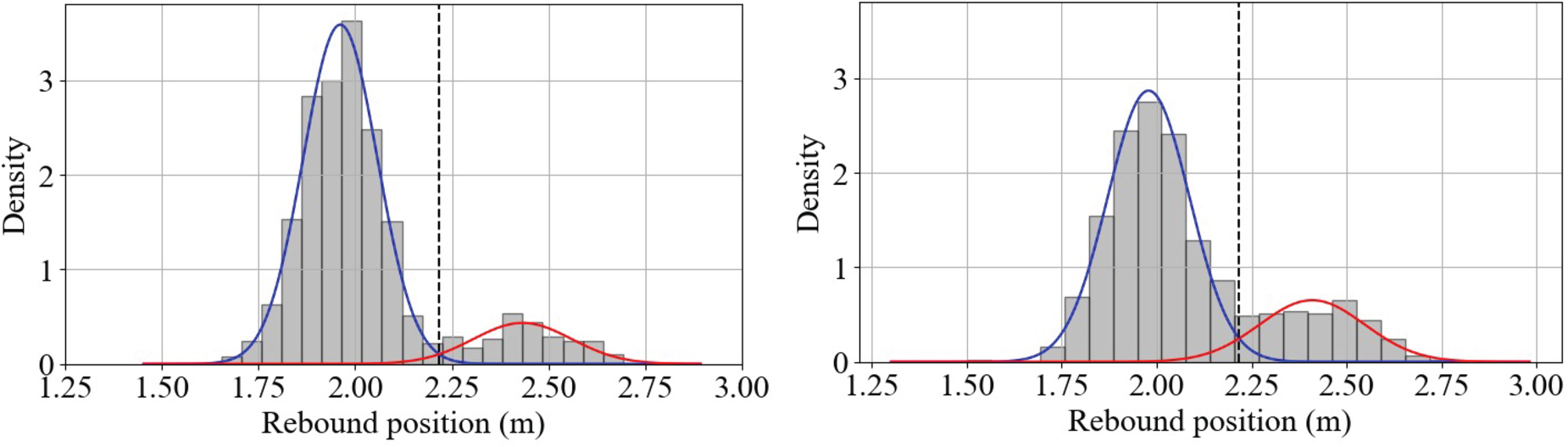
Probability density of second rebound positions for services. The histogram shows the empirical distribution, with blue and red curves representing the two Gaussian components. The vertical dashed line indicates the threshold used to classify services as short or long.
Spin parameter
In addition to the spin rate, the spin parameter, the ratio of the peripheral velocity of the ball surface to the translational velocity of its center of mass, was calculated. This parameter is a dimensionless quantity widely used in aerodynamics, primarily for calculating and modeling key factors such as the lift force and drag coefficients (Asai et al., 2007; Kidokoro et al., 2025; Mohammed et al., 2019; Nathan, 2008). It was calculated using the following Equation (1):

We utilized the spin parameter as an indicator to analyze how the table tennis players generated a high spin rate on a service. A ball spin is produced when the force applied by the racket creates a torque around the ball's center of mass. This torque arises from the distance between the force's line of action and the center of mass (i.e., the moment arm). There are two primary strategies to increase the spin rate. The first involves increasing racket speed to augment the imparted force. While straightforward, this method inevitably increases the ball's translational velocity along with the spin, which hinders the execution of short services and increases the risk of a service fault. The second strategy aims to maximize torque through increasing the length of the moment arm. This is achieved by controlling the force's line of action, effectively “brushing” the ball by moving the racket in a direction parallel to its face. This technique allows for a high spin rate with minimal increase in translational velocity. A similar concept was demonstrated by Mohammed et al. (2019), who modeled the “Ma Lin ghost serve” using a high spin parameter to reproduce a trajectory with high spin rate and minimal forward velocity. However, it is technically demanding, as a slight error in racket control can lead to missing the ball entirely. Therefore, the spin parameter, defined as the ratio of rotational speed to translational speed, serves as an effective metric for quantitatively indicating the relative contribution of these two strategies used to generate spin on a given service.
Spin direction
The spin direction was classified based on the orientation of the spin axis projected onto the X-Z plane. A right-handed coordinate system was established, where the Y-axis represents the ball's direction of travel, the Z-axis points vertically upward, and the X-axis is defined by the cross product of the Y and Z axes (pointing to the right relative to the direction of travel). The spin direction was initially categorized into eight types at 45° intervals. Subsequently, the two side spin categories—corresponding to clockwise and counterclockwise rotation when viewed from above—were consolidated into a single category. This process resulted in a final classification of five distinct spin directions: top, side-top, side, side-back, and back spin (Figure 2).
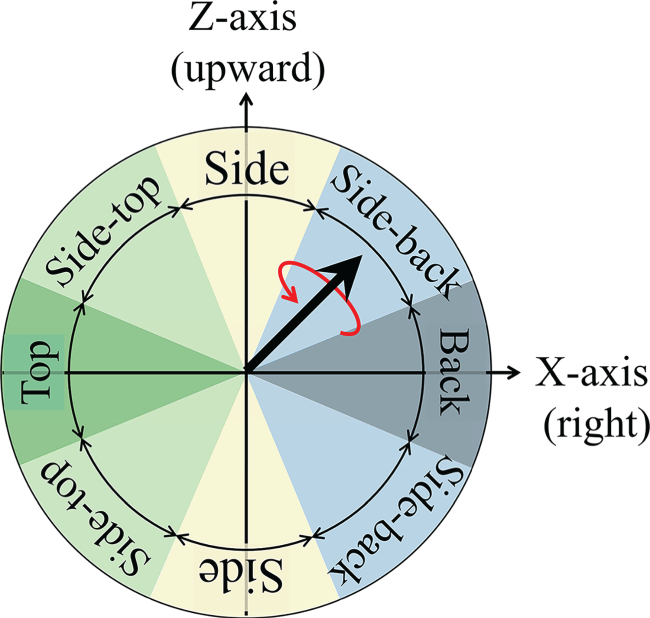
Classification of spin directions based on the spin axis projected onto the X-Z plane (server's perspective). The black arrow indicates an example spin axis, and the red arrow represents the corresponding direction of ball rotation.
Simulation of measurement error on spin direction
To quantify the potential effect of measurement error on the spin direction classification, a Monte Carlo simulation was conducted. In each of the 10,000 iterations, a set of 790 spin directions was generated by sampling angles from a uniform distribution (0–360°). Corresponding measured spin directions were then created by adding a normally distributed error (mean, 12.5°; standard deviation [SD], 10.9°) to each true angle. The discrepancy between the two distributions was quantified using the Fei effect size (Ben-Shachar et al., 2023).
The simulation yielded a median Fei effect size of 0.026 (95% CI 0.013–0.044], indicating that the effect of measurement error on classification was small. These values provides a quantitative baseline for interpreting the study's main findings.
Statistical analyses
All statistical analyses were conducted using Python 3.11.6 with the following packages: SciPy (1.11.4), scikit-learn (1.5.2), and statsmodels (0.14.2) software. The significance level for all tests was set at α = 0.05. Analyses were performed separately for short and long services. The normality of the data distribution was assessed using a Shapiro–Wilk test. Normality was rejected for spin rate in male short and long services and female short services, and for the spin parameter in male short and long services. Consequently, non-parametric tests were applied throughout the study, and descriptive statistics are presented as the median and IQR.
To compare spin rate and spin parameter, we used Cliff's delta (δ) with its 95% confidence interval (CI) to examine differences between the sexes (male vs. female) and service outcomes (ace vs. non-ace). The effect size magnitude was interpreted as small (∣δ∣ ≥ 0.147), medium (∣δ∣ ≥ 0.33), and large (∣δ∣ ≥ 0.474). To compare spin rate across the different spin direction categories, a Kruskal–Wallis test was conducted for each sex, with epsilon-squared (
The distribution and associations of spin direction were analyzed using chi-squared (χ2) tests. A goodness-of-fit test evaluated the distribution within each sex against expected frequencies based on each category's angular range (12.5% for back/top; 25% for side/side-top/side-back). Tests of independence were used to assess the association between spin direction and both sex and service outcome. Effect sizes were calculated with 95% CIs: Fei for the goodness-of-fit test and Cramer's V for independence tests. Magnitudes for both were interpreted as small (0.1), medium (0.3), and large (0.5). Standardized residuals (z) were examined to identify which categories contributed to significant results, with values exceeding ±1.96 and ±2.58 considered significant at the 5% and 1% levels, respectively.
To ensure statistical reliability, data were excluded from certain chi-squared analyses based on sample size. For the analysis of sex vs. spin direction, top spin services were excluded owing to expected cell counts falling below five. For the analysis of outcome vs. spin direction, any category with fewer than 20 observations was excluded. This led to the complete removal of male long services from this specific analysis, as all but the side spin category fell below this threshold.
Result
Spin speed and spin parameter
Figure 3(a) shows the distribution of spin rate for both short and long services. Based on the classification, 679 short and 111 long services were identified in the men's matches, and 778 short and 205 long services in the women's matches. The dataset included 94 short and 29 long winning services in the men's matches, and 108 short and 35 long winning services in the women's matches. For short services, the median ± IQR spin rate was 46.4 ± 15.8 and 38.9 ± 13.6 rps in the men's and women's matches, respectively. While the effect size was small (δ = 0.284, 95% CI 0.282–0.287), men exhibited a significantly higher spin rate. A comparison of service outcomes in the men's matches indicated that aces had a higher spin rate than non-aces (small effect size, δ = 0.229; 95% CI 0.221–0.237). In contrast, this effect was negligible in the women's matches (δ = 0.057, 95% CI 0.050–0.065). For long services, the median ± IQR spin rate was 50.9 ± 13.8 and 47.6 ± 14.7 rps for men and women, respectively, with men showing a higher spin rate (small effect size, δ = 0.235; 95% CI 0.222–0.248). The effect of spin rate on service outcome was negligible for long services in both the men's (δ = 0.133, 95% CI 0.093–0.173) and women's (δ = 0.018, 95% CI −0.007–0.044) matches.
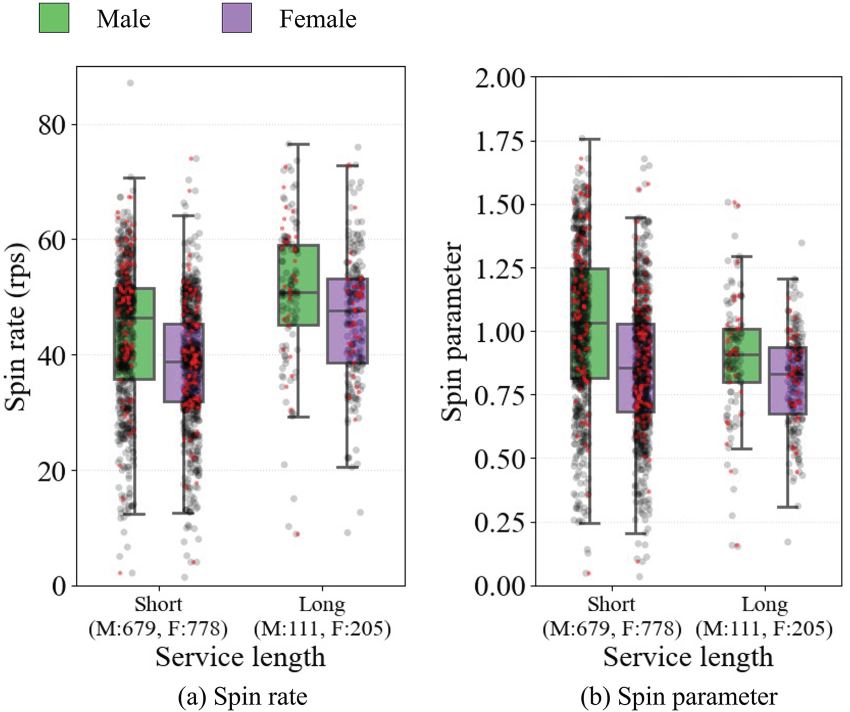
Distributions of (a) spin rate and (b) spin parameter according to sex and service length. Individual data points are shown as jittered dots, with red dots indicating service aces. Sample sizes are noted on the x-axis (M: male, F: female).
Figure 3(b) shows the distribution of spin parameter for both short and long services. For short services, the median ± IQR translational velocity and spin parameter were 5.37 ± 1.17 m/s and 1.03 ± 0.43 in the men's matches, and 5.64 ± 1.12 m/s and 0.86 ± 0.34 in women's matches, respectively. A medium effect size was observed between sexes, with men having a higher spin parameter (δ = 0.336, 95% CI 0.334–0.339). The effect on service outcome was negligible in both the men's (δ = 0.145, 95% CI 0.137–0.153) and women's (δ = 0.0.072, 95% CI 0.065–0.079) matches. For long services, the median ± IQR translational velocity and spin parameter were 7.18 ± 0.82 m/s and 0.91 ± 0.21 in men's matches, and 7.29 ± 0.90 m/s and 0.83 ± 0.26 in women's matches, respectively, with a small effect size observed between the sexes (δ = 0.258, 95% CI 0.246–0.271). The effect size of service outcome was also negligible for long services in both the men's (δ = 0.104, 95% CI 0.064–0.144) and women's (δ = 0.051, 95% CI 0.026–0.077) matches.
Figure 4 shows the spin speed and spin parameter for each spin direction, separated according to short and long services. Owing to the sample size exclusion criterion (n < 20), several groups were excluded from the analysis: top spin for both sexes in short services, all spin directions for men in long services, and both top and back spin for women in long services. A Kruskal-Wallis test finding indicated a significant difference in spin speed across spin direction categories for all analyzed groups. For short services, the overall effect size was large for both men (
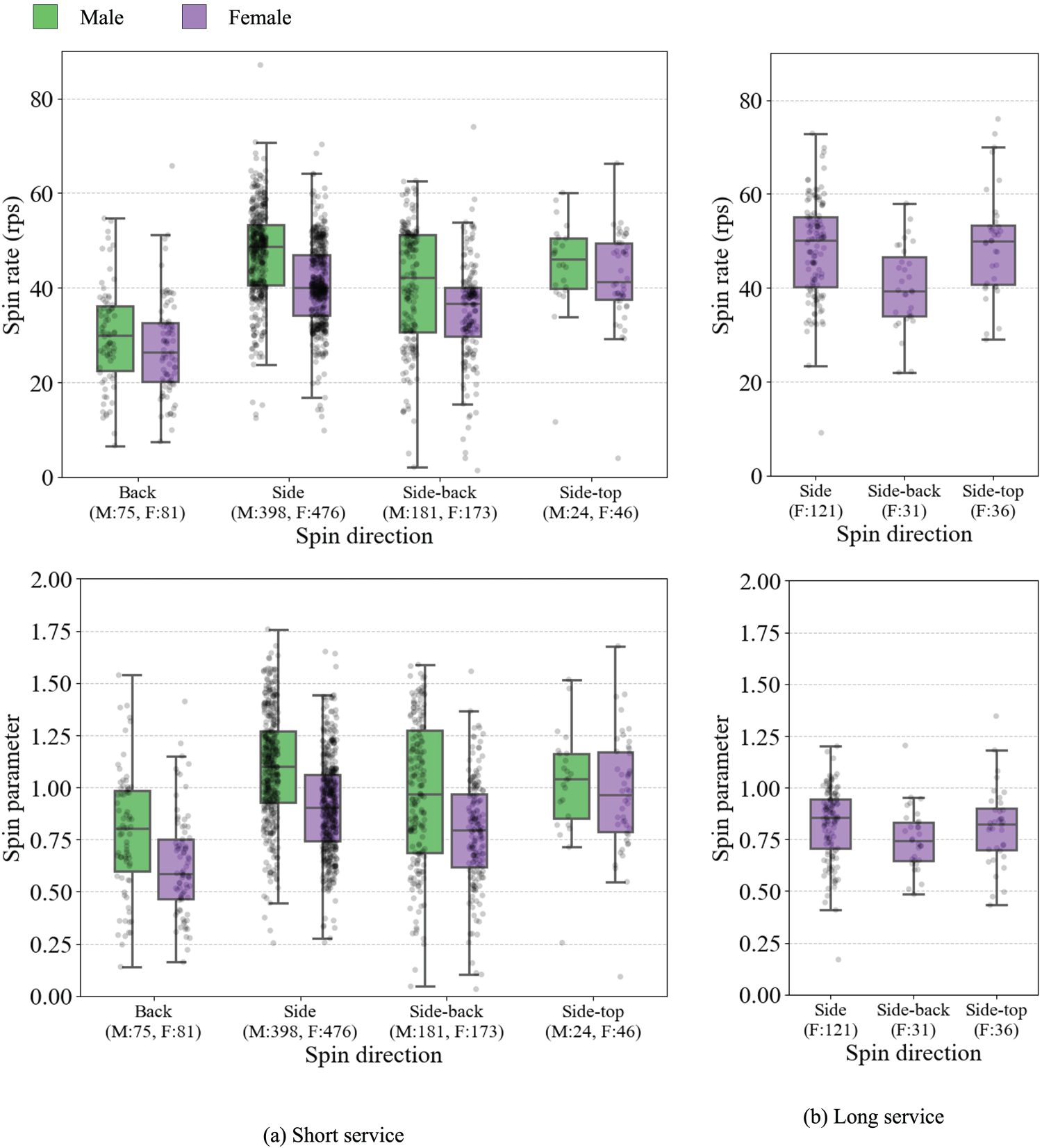
Distributions of spin rate and spin parameter according to spin direction and sex for (a) short and (b) long services. Individual data points are shown as jittered dots. Sample sizes are noted on the x-axis (M: male, F: female).
Spin direction
Table 1 summarizes the observed distribution of spin directions. A chi-squared goodness-of-fit test showed that the observed frequencies of spin directions differed significantly from the theoretically expected frequencies in all conditions (χ2 > 133, p < 0.001 for all tests), with medium effect sizes (Fei = 0.31–0.46). For short services, a similar pattern was observed in both men and women. The frequency of side spin was significantly higher than expected, while side-top and top spins were significantly less frequent (∣z∣ > 2.58 for all). In contrast, the frequencies of back and side-back spins did not significantly differ from expected values. For long services, the pattern was also consistent between sexes but different from short services. Side spin was significantly more frequent than expected (|z| > 2.58). All other spin directions were used significantly less frequently than expected (|z| > 1.96 for all).
Chi-square test of spin direction distribution according to sex and service length.
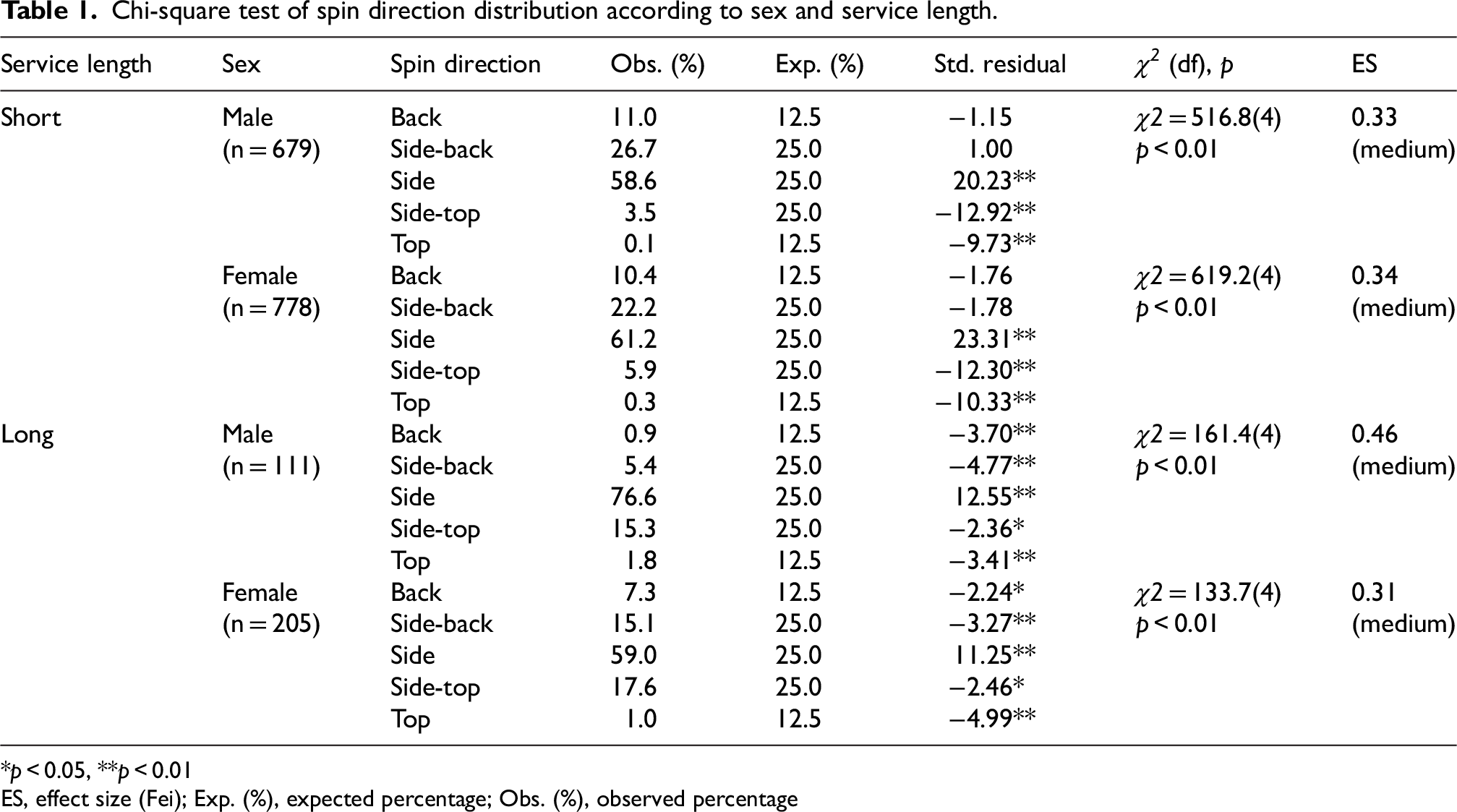
*p < 0.05, **p < 0.01
ES, effect size (Fei); Exp. (%), expected percentage; Obs. (%), observed percentage
Table 2 shows the association between sex and spin direction. The top spin category was excluded from both analyses because of low expected cell counts. For short services, a chi-squared test of independence found no significant association between sex and the selection of spin direction (χ2 (3) = 7.717, p = 0.052), and the effect size was negligible (V = 0.07). In contrast, a significant association was found for long services (χ2 (3) = 15.314, p < 0.01), with a small effect size (V = 0.22). An examination of the standardized residuals for long services indicated that men used side spin significantly more frequently than women (z = 3.27). Conversely, women used back (z = 2.47) and side-back (z = 2.54) spins more frequently than men.
Chi-square test of sex differences according to service length.
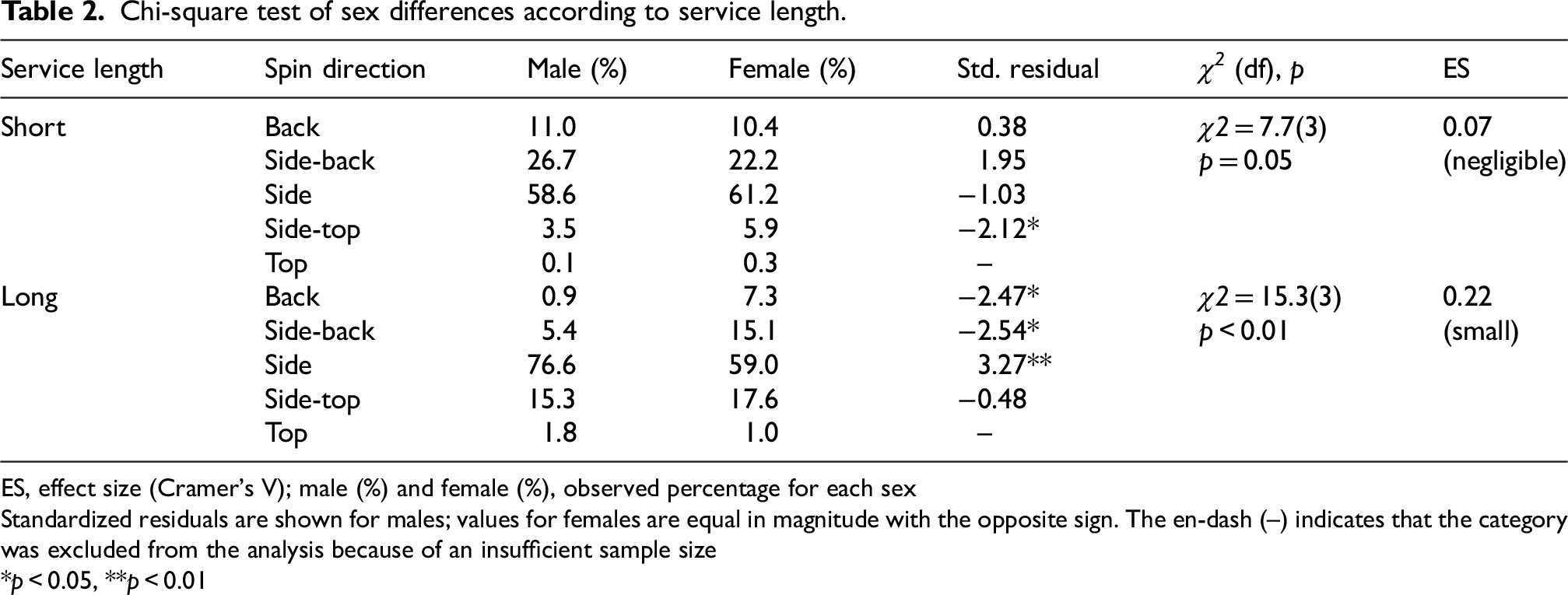
ES, effect size (Cramer's V); male (%) and female (%), observed percentage for each sex
Standardized residuals are shown for males; values for females are equal in magnitude with the opposite sign. The en-dash (–) indicates that the category was excluded from the analysis because of an insufficient sample size
*p < 0.05, **p < 0.01
Table 3 shows the association between spin direction and service outcome (ace vs. non-ace), with chi-squared tests of independence performed for each available sex and service length combination. A significant association was observed only for men's short services (χ2 (3) = 9.6, p = 0.02). An examination of the standardized residuals for this group revealed that aces occurred significantly less often than expected for back spin (z = −2.98). In contrast, no significant association between spin direction and service outcome was observed for women's short services (χ2 (3) = 6.1, p = 0.11) or long services (χ2 (2) = 3.1, p = 0.21), with negligible to small effect sizes (V = 0.09 and 0.13, respectively).
Chi-square test of spin direction vs. ace rate according to sex and service length.
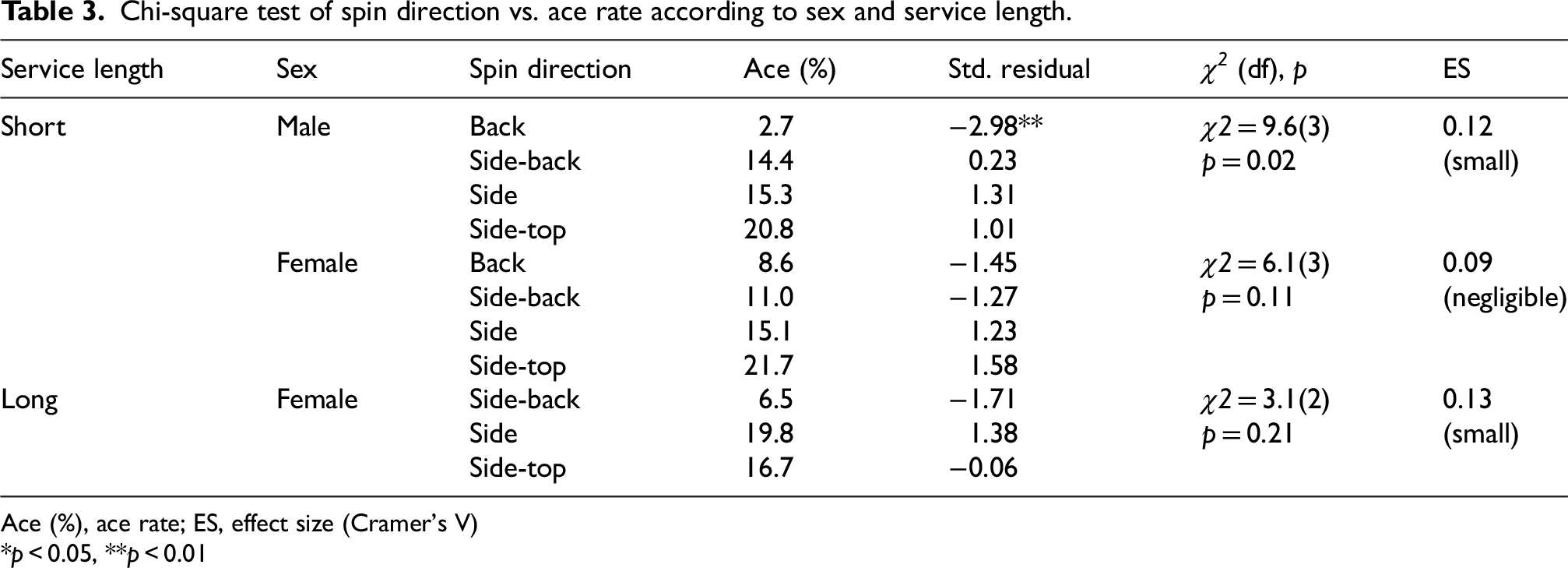
Ace (%), ace rate; ES, effect size (Cramer's V)
*p < 0.05, **p < 0.01
Discussion
Spin rate
This study quantified the spin rates of services delivered by elite players. Yoshida et al. (2014) measured spin rates during the quarterfinal matches of the 2009 World Table Tennis Championships, reporting values for men and women of 46.0 ± 9.0 and 39.2 ± 9.3 rps, respectively. Our study findings are highly consistent with these values. Comparable spin rates have also been observed in junior elite players. Iizuka et al. (2010) reported service spin rates measured under experimental conditions for three male and one female junior elite players. Approximate values obtained from bar graphs presented in Figures 1 and 2 of Iizuka et al. (2010) were 43.8 ± 2.9, 47.3 ± 4.1, 52.6 ± 3.6, and 52.8 ± 3.0 rps, respectively. These results suggest that service spin rates in elite senior players are of a similar magnitude to those in junior elite players, or at least that the spin rates do not differ substantially. Overall, the spin rates measured in this study align closely with previous reports for both elite and junior players.
The effect of spin rate on service outcomes (i.e., whether a service resulted in an ace) was minimal in this study. A small effect was observed only for short services in men's matches, whereas the effects under all other conditions were negligible. This finding is consistent with the results described above. Senior elite players generally possess greater technical proficiency and physical strength than junior players; however, their service spin rates were similar in magnitude. This suggests that elite players do not necessarily prioritize maximizing spin rate. Iino et al. (2021) reported that elite players make it more difficult for opponents to judge spin through generating similar racket angular velocities in the early phase of the swing and producing a non-linear follow-through. In table tennis, mastering such techniques is considered crucial for concealing spin (Geske and Mueller, 2010). Spin concealment and spin rate are likely to involve a trade-off: increasing racket head speed to maximize spin inevitably results in a more linear swing path, making it harder to employ the non-linear follow-through described by Iino et al. (2021), and thus easier for the opponent to judge spin. This trade-off may explain why even elite senior players do not aim to increase spin rate indiscriminately.
Spin direction
For short services, both male and female players frequently employed side spin and side-back spin. This finding suggests that elite players tend to base their service spin direction on side spin and then vary the additional spin components. Given the importance of concealing spin from opponents in table tennis, combining side spin with other spin types may facilitate this objective. Several explanations are possible. In terms of ball trajectory, pure back spin or topspin services produce relatively straight trajectories, making any slight addition of a lateral spin component more perceptible to the receiver. In contrast, when side spin is combined with side-back/side-top spin, the difference lies primarily in the presence or absence of a back spin component. The resulting deceleration and minor changes in vertical trajectory caused by the back spin component may only slightly alter the parabolic path determined by gravity, potentially making these differences difficult for the human visual system to detect. Alternatively, the racket path and contact mechanics for pure back spin and side-back spin may differ more substantially than those for side spin and side-back/side-top spin, making the former easier for opponents to distinguish. We were unable to determine the exact reasons why elite players favor side spin; however, our findings suggest that they may do so, at least in part, to make spin recognition more challenging for opponents.
Both the spin parameter and spin rate were lower for back spin services. Achieving a high spin parameter in a back spin service requires brushing the underside of the ball. However, because a toss is mandatory in table tennis, the ball is moving vertically downward at the moment of impact. When the racket is moved purely horizontally, the collision between the downward-moving ball and the racket generates an upward force on the ball. This upward force shortens the moment arm relative to the ball's center of mass, thereby reducing the torque available to produce spin. To minimize this effect, the player must reduce the relative velocity between the racket and the ball in the vertical direction while simultaneously brushing the ball forward. In contrast, for side-spin services, the ball has no substantial horizontal velocity immediately prior to impact; thus, the conditions that make maximizing the spin parameter difficult in back spin services do not occur. This physical constraint likely explains why generating a high spin parameter is inherently more challenging in back spin services than in side-spin services. The present results indicate that this limitation is evident even among elite players.
The effect of spin direction on service outcomes was minimal. A small effect was observed only for short services in men's matches, specifically that back spin services were less likely to result in aces. Short back spin services are typically a defensive choice, often employed to prevent the opponent from making a strong attacking stroke. Therefore, the lower ace rate for short back spin services is unsurprising. This finding is also consistent with the earlier discussion suggesting that elite players prefer side spin to make spin recognition more difficult for opponents.
Sex differences
Male players in this study exhibited higher service spin rates than female players. Yoshida et al. (2014) similarly reported that the most frequent spin rate range differed between sexes, with men showing higher values, and our findings are consistent with their results. In table tennis, differences in maximum ball velocity and spin rate during offensive strokes have been attributed to sex-based differences in muscle strength (Bańkosz et al., 2020). However, whether the difference in service spin rates observed here can be explained solely by muscle strength is unclear. The spin parameter results suggest that the sex difference is not simply because of differences in the magnitude of force applied to the ball. Male players exhibited significantly higher spin parameters than female players, with effect sizes greater than those observed for spin rate. This tendency was particularly pronounced for short services with low translational velocity, indicating that male players tend to brush the ball more than their female counterparts. As discussed earlier, compared with increasing both spin rate and translational velocity simultaneously, increasing spin rate while keeping translational velocity low requires more precise racket control. The reasons why male players achieve higher spin parameters may be multifactorial and could not be conclusively identified in this study. One plausible explanation draws from cognitive neuroscience, where males consistently outperform females in certain spatial cognition tasks (Aguilar Ramirez et al., 2025; Lager et al., 2024; Linn and Petersen, 1985; Silverman et al., 2007; Tsigeman et al., 2023). In motor control, men have also been reported to demonstrate greater spatial accuracy than women in rapid, single-joint movements (Casamento-Moran et al., 2017; Lissek et al., 2007). Such differences are considered to be partly attributable to biological factors (Clint et al., 2012; Lissek et al., 2007; Miller and Halpern, 2014), which may contribute to the higher spin parameters observed in male players’ services. Alternatively, environmental and tactical factors may also play a role. Recent studies have shown that male players increasingly employ the backhand flip, a backhand attack against short balls near the net, in service return (Grycan et al., 2023) and do so more frequently than female players (Pradas de la Fuente et al., 2023). In men's matches, the need to prevent opponents from executing powerful backhand flips may incentivize the development of skills to deliver services with higher spin parameters. While the exact causes remain to be determined, our findings clearly indicate that services in men's matches tend to have higher spin rates, likely generated through highly refined racket control.
A small sex-based difference was observed in the distribution of spin directions for long services. Male players relied heavily on side spin, whereas female players showed a more balanced distribution. As reported in previous research (Malagoli Lanzoni et al., 2014), short services are the most frequently used type of services in elite table tennis matches, and a similar tendency was observed in our study, with short services accounting for approximately 86% of services in men's matches and 79% in women's matches. Therefore, receivers in elite table tennis primarily need to prepare for short services. However, in women's matches, where long services are used approximately 1.5 times more frequently than in men's matches, receivers are also likely to pay greater attention to anticipating long services. As a result, female players may introduce additional variation in spin direction to further disrupt their opponents’ expectations. Taken together, these findings suggest that sex differences in the frequency of long service usage likely contribute to the observed differences in spin direction distribution. Nevertheless, the present study cannot directly determine the underlying reasons for this sex-based difference, and the explanation provided here should be regarded as a potential interpretation rather than a definitive conclusion.
Practical implications
The findings of this study have practical relevance for coaching and training in table tennis. First, the quantified values of spin rate and spin parameter provide evidence-based benchmarks for players aiming to improve their ability to generate spin. These benchmarks enable coaches and athletes to set realistic training goals. Because the results are presented separately by sex and spin direction, they can serve as tailored reference values for different player groups. Secondly, the observed tendencies of elite players in choosing spin directions offer valuable insights for developing service strategies. Understanding which spin directions are most frequently used can help players and coaches decide which types of spin should be prioritized during technical training. Collectively, these insights translate the quantitative analysis of spin into actionable knowledge for table tennis practitioners and performance analysts.
Limitations and future directions
This study has some limitations. Most participants were Japanese players, which restricts the generalizability of the findings to broader populations. The analysis focused primarily on spin characteristics, whereas other key factors such as placement, velocity, and combinations of service variations were not examined in detail. In addition, racket properties were not considered, although these factors play a crucial role in spin generation and transfer. Furthermore, distinguishing between left and right side spin while considering the handedness of both servers and receivers would provide a more comprehensive understanding of how side spin direction influence service effectiveness and. Future research should incorporate these additional elements to clarify how spin interacts with broader tactical components to influence scoring.
Several important questions remain for future investigation. The data in this study could not be used to determine whether side spin is predominantly employed to conceal spin direction from opponents; addressing this issue requires perceptual and cognitive experiments. Furthermore, it remains to be examined whether variations based on side spin are perceptually less distinguishable for humans than those based on backspin or topspin, and whether these differences lead to distinct outcomes in the subsequent shot. Similarly, while male players exhibited higher spin rates than female players, it remains unclear whether this difference arises from biological sex-based factors or tactical considerations. Addressing this question will require examining whether physiological differences in spatiotemporal cognition or motor control translate into superior spin control. The influence of playing style also warrants attention. Defensive players were excluded from the present analysis, and service strategies among offensive players were averaged despite potential variations related to racket rubbers and tactical preferences. Future studies should therefore include defensive players and further subdivide offensive players to clarify how playing style and equipment contribute to service spin characteristics. Finally, the greater variability in spin directions observed in women's long services cannot be fully explained within the scope of the current dataset. To elucidate this phenomenon, future studies should integrate spin characteristics with a wider range of performance and tactical measures.
Conclusion
Male players exhibited higher spin rates and spin parameters than female players, reflecting greater brushing control of the ball. Across both sexes, side spin and side-back spin dominated short services, highlighting their role as the central tactical elements. The physical constraints of racket-ball interaction likely explain why back spin services exhibited lower spin parameters, even among elite players. The influence of spin characteristics on service outcomes was generally small, with only limited effects observed for short services in men's matches. The study findings clarify the effects of spin rate and spin direction of services in table tennis with particular attention to sex-based differences, and provide new insights into the characteristics of elite players’ services. These results provide the first systematic description of service spin characteristics in elite competition and a foundation for future analyses.
Footnotes
Acknowledgements
We would like to express our sincere gratitude to the staff of Next Base Inc. for their generous support during data collection at the T. League. The authors used Generative AI tools (ChatGPT 5, Gemini 2.5 Pro) for the following purpose: to assist in generating Python scripts based on specified computational procedures. All scripts were thoroughly reviewed and edited by the authors to ensure correctness and alignment with research objectives and to improve English phrasing and clarity in the manuscript, based on draft content prepared by the authors. Final revisions were reviewed and proofread by a native English speaker, as a brainstorming partner during the analytical process to explore alternative interpretations and enhance analytical depth. The AI tools were used under the authors’ oversight, and all content responsibility remains with the authors.

Ethical approval and informed consent statements
This study analyzed video recordings of professional table tennis matches from the T. League. No human participants were directly recruited, and no personally identifiable information was collected. Therefore, ethical approval and informed consent were not required for this study.
Funding
The authors disclosed receipt of the following financial support for the research, authorship, and/or publication of this article: This work was supported by JSPS KAKENHI Grant Number JP19K20044.
Declaration of conflicting interest
The authors declared no potential conflicts of interest with respect to the research, authorship, and/or publication of this article.
Data availability statement
The datasets generated during the current study are not publicly available but are available from the corresponding author upon reasonable request.